|
IDEAS, NEWS AND RESOURCES | September 2017
We hope you enjoy receiving our newsletter which includes constructionist ideas and practices as well as news and resources from the Taos Institute.
|
|
Brief Encounters with The Taos Institute
September 2017
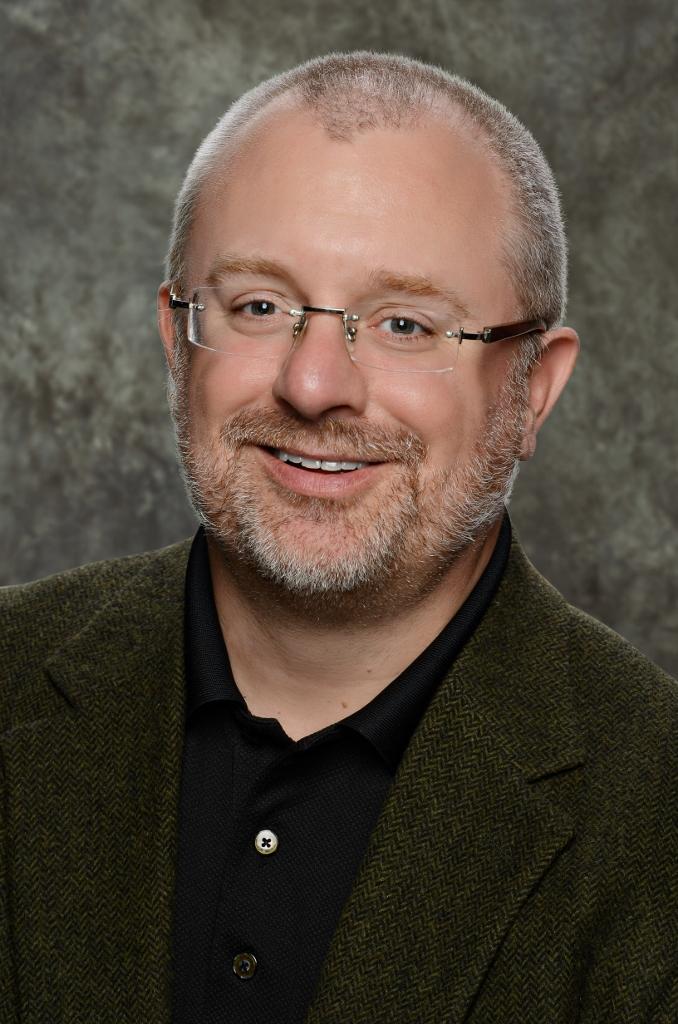
This month we welcome Duane Bidwell, a member of the Taos Institute Board of Directors, as he reflects on ...
Bodies, Floods, and Alternative Stories
As I write, words and images from Houston saturate my social-media feed. They join similar reports (and pleas) from Chennai, Freetown, Mumbai and other cities devastated by floods. And now, we see how hurricane Irma has just barreled through the Caribbean islands and Florida. Everywhere water reshapes the world.
To our knowledge, Taos colleagues and friends in the affected areas remain safe. They are beginning to see the effects of the floods ripple through their social and professional networks, families, psyches, and bodies.
In the midst of these unfolding disasters-rising water, flooded streets, never-ending rain-how can social construction be useful?
It's not a question I can or should answer as an outsider to these events. But I begin to glimpse possibilities when I describe what I see.
I see people in Houston, Florida and elsewhere using social media to challenge totalizing stories of death and disaster, material loss and emerging risks. They are using words and photographs (and strong wifi) to tell their own stories, and in the process of constructing an alternative account of the floods and their primary effect on people: Neighbor helping neighbor. Strangers using their boats to bring people to safety. Friends housing evacuated friends in a kind of perpetual summer-camp ethos.
Many of these accounts emphasize the irrelevance of race, class, political party, sexual orientation, and national origin in the shared experience of the deadly power of water.
One of the most eloquent contributors to this emerging story is Lacey M. Johnson, an English professor at Rice University in Houston who evacuated when her neighborhood was threatened by the controlled release of flood waters to benefit other parts of the city. In a recent Facebook post, Lacey writes:
Water destroys what it touches: carves canyons out of deserts, swallows people, ice, whole cities and continents. It also destroys the trivial things we spend our lives worshipping: our houses, our streets, our pride, our temples to bigotry and greed. I have heard now a story of a man who had escaped his flooding neighborhood, only to row back in his kayak to save one more person or one more thing, and capsized in the current. He was missing all night and in the morning they found him holding on to a tree. A teenager was swept away in the current of the bayou and caught the grate of a bridge and held on there for dear life until rescuers found her in the morning. An infant was taken from her mother by the current and the current offered that brand new life back to the churning sea.
But water also washes, gives life, makes new. The water has destroyed this city - there's no two ways about it - but the outpouring of love I have witnessed here among neighbors and strangers and coming to us from all over the world, is the most beautiful thing I have ever seen.
These emerging stories emphasize the coordination of bodies, resources, and values to preserve life, witness pain, share humor, and work diligently to ensure no one faces the floods-or the recovery-in isolation. There is a concentrated effort-unplanned, spontaneous, and perhaps unintentional-to embody interrelationship. Many photographs I see capture a moment of connection-one hand reaching another, one body shielding and comforting someone.
I'm struck by how these stories emphasize physicality, focusing on "what bodies do" and "what bodies experience" in the midst of tragedy. They describe behaviors; privilege the language of touch, taste, smell, hearing, and vision; and attend to the effects of interaction.
Too often, social constructionist thought and practice privileges language. This makes sense; language is a primary social tool. But it's only one way of connecting to each other and creating shared meaning.
Reflecting on these alternative, embodied stories from Houston and elsewhere, I start to wonder: Do we attend adequately to the embodied ways that meaning is constructed prior to being voiced through words? Experience-of our bodies, through our bodies, of other bodies-remains central to social construction. It precedes and shapes language, and it's shaped by language as well.
The flood waters remind me of that, reshaping the landscape of construction from where I stand.
|
|

Taos Institute Events and Gatherings
The Many Ways to Get Involved.....
***************************************************************************************
at University College Zaeland, Roskilde, Denmark
Nov. 16-17, 2017
Sharing, exploring and creating new ideas and practices... Call for Proposals being accepted until October 1st!
And there is still time to register - If you are in education in any capacity, this is the conference for you.
For more information visit:
***************************************************************************************
Workshops and Courses
- Social Construction, Relational Theory and Transformative Practices
| October 5-7, 2017, with Harlene Anderson and Sheila McNamee, in Durham, NH - There is still time to register!
www.taosinstitute.net/social-construction-relational-theory-oct-5-7-2017
Taos Online Courses
- Relational Theory and Practice - with Ken and Mary Gergen. Nov. 6 - Dec. 13.
Friends of the Taos Institute Workshops and Events
*********************
******************************************************************
Other Learning Opportunities
-
Join the group from
Taos Institute Europe
- A Gathering to Explore Possibilities
Please plan to attend our Lowlands Gathering event planned on:
- Friday, September 15. 2017. Start: 13.30hr-18.00hr.
- Location: Hoge School De Kempel Helmond
- Deurneseweg 11, Helmond, NL
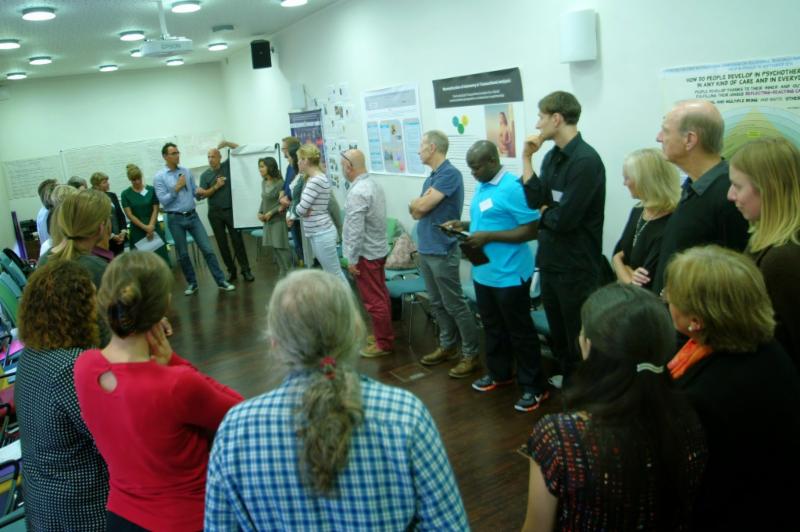
We are very excited about this first gathering. We see this as a kick-off event for getting to know each other better, making spaces for exchange of knowledge and experiences within all kinds of working fields. We are looking forward to co-create, share ideas and to make this first event successful.
**************************************************************************
|
The Taos Institute and Kanankil Institute in Merida, Mexico, invite you to explore with us as we introduce our new masters program in English. This program has been successfully offered in Spanish for many years and is now available in Enlish.
In this two-year online learning program participants will learn about and explore different applications of Collaborative and Dialogic Practices related to professional life as educators, social workers, managers, coaches, mediators, lawyers, psychotherapists, doctors, nurses, and communications working with individuals or organizations.
The collaborative approach is based on an ideological shift in the way we think about language and knowledge. It is relating and conversing in a manner that includes a way of thinking with, talking with, acting with, and responding to the people with whom we meet in our professional activities. The Master of Arts degree in Collaborative and Dialogic Practices (CDP) will introduce social construction and CDP for those new to it and help those familiar with it to deepen their understandings and practices. Drawing on the works of thinkers and practitioners such as Mikhail Bakhtin, Hans-Georg Gadamer,Kenneth Gergen, Jean Francois Lyotard, Maurice Merleau-Ponty, John Shotter, Ludwig Wittgenstein, as well as Harlene Anderson, Harry Goolishian, Lynn Hoffman, SheilaMcNamee, Tom Andersen, and Jaakko Seikkula, it specifically focuses on relational constructionist understandings of language and meaning-making, polyvocality, transformative dialogue, and appreciative and future-oriented perspectives.
Apply today! And help spread the word about this innovative program.
|
|
Dialogue with the Author Series -
Fall 2017
Free and open to anyone interested in these books - Join in conversation with the authors!
*******************************************************
Week in Dialogue with the Author - Gita Baack
October 2 - 6th, Monday through Friday, with the culminating webinar on Friday, Oct. 6th at 10:00 AM New York time/ US Eastern time.
Join Gita Baack as we explore her new book.
"The Inheritors"
is generative and personal. It is written from Gita's lens as a child of Holocaust survivors, as well as from the
personal stories by people I spoke with from different parts of the world, from someone who escaped Syria in the nick of time, to Vietnamese inheritors, to children of military parents.
Through intimate stories, engaging dialogues, and a backpack of resources, readers will
be able to
process
their inherited sadness and find solace in discovering common experiences with others
. G
uiding questions at the end of each chapter helps readers to uncover their own inherited stories and even their inherited memories to find their resilience and claim the whole life that we all deserve.
We will meet Monday - Thursday online, asynchronously, using our Taos Online Learning Community website. Then on Friday we meet live on a webinar platform.
In this Week in Dialogue with the Author, we will explore these stories, your stories, and look at:
- What are the possible ways that we can acknowledge and validate our traumatic legacies?
- How do we access hidden memories and deeply seated trauma?
- How can we create dialogues with communities and individuals both homogenous and across races and ethnicities and overcome reluctance to do so?
*****************************************************************
Dialogue with the Authors - A Webinar
With Thalia Dragonas, Sheila McNamee and Eleftheria Tseliou (Editors)
October 10th, 1:00 to 3:00 PM New York time/US Eastern time.
(Please check your own local time using the online World Clock calculator.)
Drawing from the rich array of ideas and practices surrounding social constructionist theory, this Dialogue with the Authors: A Webinar, will showcase work from a variety of different cultural settings in education. The editors will discuss how constructionist initiatives in education can be successfully shared across national boundaries. More important, we come to see how ideas and practices can be re-formed as they shift from one cultural context to another. Social constructionist logics do not demand regimentation and restriction; rather, they invite continuous emergence. Constructionism does not, for example, make a clean separation between theory and practice. Theory is itself a practice, and all practice carries with it often unspoken conceptual assumptions. Further, changes in micro-practices (for example, classroom pedagogy) are not fundamentally distinct from system change. The book includes 20 contributions from 12 countries across four continents, with each contribution carrying its own special qualities and creativity. We hope that the process of sharing these contributions through this online dialogue will invite the participant in to read the book, and continue to shape education in the years to come.
The book is available as free download. We invite you to download the book now and read it before the webinar. Download the book at:
www.taosinstitute.net/education-as-social-construction-contributions-to-theory-research-and-practice
|
International Relational Research Network Meeting and Global Dialogue
The Summer Article Reading
and
Discussion Series
Continues...
The Article Series continues as we offer an opportunity, for anyone interested, to read a scholarly article or chapter on research, and then join in a conversation about that article. This summer reading series is open to everyone. No need to pre-register. Free and open to the public.
Details: For all the information including host, article, date and time of the conversation and link to join the conversation please visit the Taos Institute website at:
The Relational Research Network Summer Article Series Talks - Join the last call for the series:
September 12, Tuesday - Spanish - at 10:00 am - 11:30 am New York Time/ US Eastern time
The Digital Wayfarer - Evocative Ethnography as Performance (In Spanish)
- Facilitator: Josep Seguí Dolz
- Article: The Digital Wayfarer. Evocative Ethnography as Performance, By Kenneth J. Gergen
- Article citation - Gergen, Kenneth J. (in press). "The Digital Wayfarer. Evocative Ethnography as Permformance".
- Guest: Kenneth J. Gergen
- Watch Video performance before the call: "Digital Wayfarer" by Kenneth J. Gergen (15 min.)
- Video with Spanish sub-titles - Click Here.
- Link to article: Spanish: Click Here.
How to join in the summer article series conversations:
- Download the articles at www.taosinstitute.net/relational-research-network
- Read the article
- Come prepared with questions, examples, comments
- Mark your calendar and arrive on time for the conversation
- No need to pre-register for these
- Use the link provided on that web page to join the call
|
|
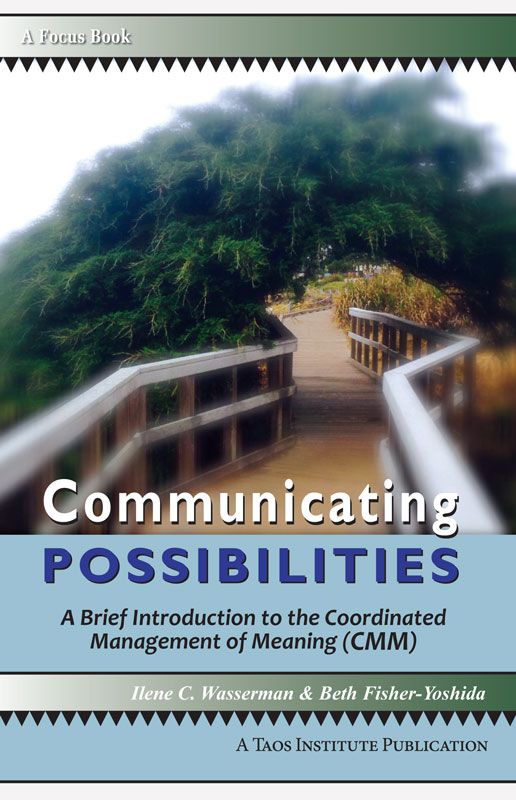
See our most recent Focus Book!
Communicating Possibilities: A Brief Introduction to the Coordinated Management of Meaning (CMM)
by Ilene Wasserman and Beth Fisher-Yoshido
Communicating Possibilities is an introduction to the Coordinated Management of Meaning (CMM), a practical theory which at its roots, is an approach to looking at our social interactions. In the process of stepping back to look at our interactions and how we construct our social worlds, we open possibilities of alternative paths and outcomes. CMM offers tools and frameworks to use so when we pause and notice what we are making together and how, we open up spaces to make better choices with more desirable relationships each turn of the way. This book offers ways we can better notice how we shape our lives through the stories we create in our ongoing conversations, and, hopefully strengthen the quality of our communities at all levels. Order the book today at:
|
|
|
Check out our Newest Books:
|
|
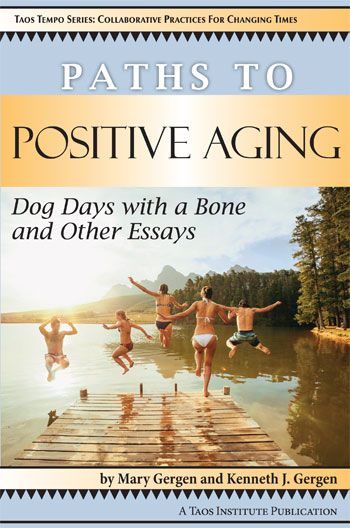
Paths to Positive Aging: Dog Days with a Bone and Other Essays
|
by Mary and Ken Gergen
Mary and Ken Gergen are devoted to the cause of reinventing aging. To focus on the gains of aging is to realize that the later years are among the richest and most rewarding of one's life. In their dedication to this reconstruction, the Gergens publish the Positive Aging Newsletter, an electronic newsletter, available in seven languages (
www.positiveaging.net).
In this book, the Gergens share ideas and experiences designed to inspire others as they age.
|
|
|
Communicating Possibilities:
A Brief Introduction to the Coordinated Management of Meaning (CMM)
by Ilene Wasserman and Beth Fisher-Yoshida
Communicating Possibilities is an introduction to the Coordinated Management of Meaning (CMM), a practical theory which at its roots, is an approach to looking at our social interactions. In the process of stepping back to look at our interactions and how we construct our social worlds, we open possibilities of alternative paths and outcomes. CMM offers tools and frameworks to use so when we pause and notice what we are making together and how, we open up spaces to make better choices with more desirable relationships each turn of the way.
|
|
|
|
|
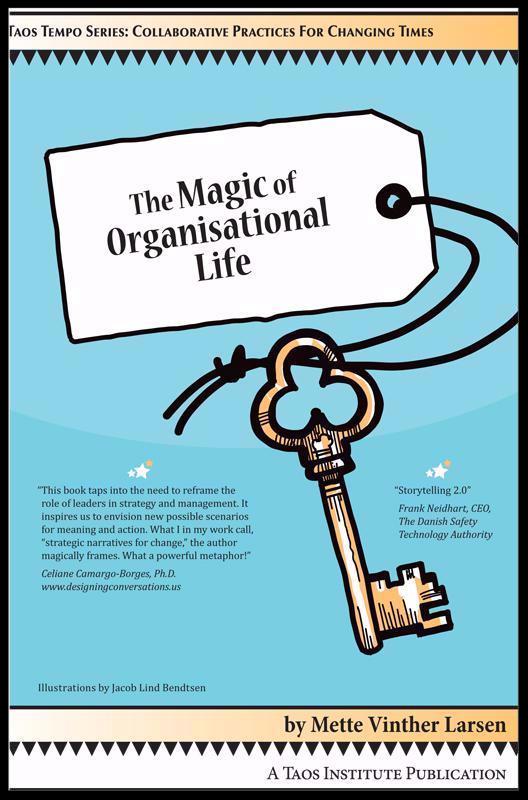
The Magic of Organizational Life
|
|
by Mette Vinther Larsen
The Magic of Organisational Life
is a story that invites you to look at your everyday work life through new eyes. It allows you to reflect upon well-known organisational, strategic and managerial challenges from a magical perspective. This perspective emphasizes what our imagination can do, if only we set it free. The Magic of Organisational Life
gently reminds us of our capacity to create flourishing ways of being at work.
For more information
→
|
|
|
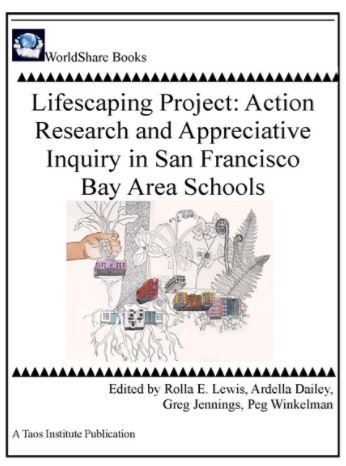
We are thrilled to bring you all the WorldShare Books and we hope you will take a few minutes to download your free copies today.
Enjoy our newest WorldShare Books:
Construccionismo Social en Acción: Prácticas Inspiradoras en Diferentes Contextos
Donate to the Peggy Penn WorldShare Books Fund
This fund helps to cover the expenses of offering these online books free of charge to anyone in the world.
|
|
Sign up for this free newsletter in the following languages:
- English
- Spanish
- Danish
- German
- French
- Chinese
- Portuguese
- Greek
- Italian
By focusing on the positive aspects of aging, and the availability of resources, skills, and resiliencies, research not only brings useful insights into the realm of practice but creates hope and empowers action among older people. By moving beyond practices of repair and prevention, to emphasize growth-enhancing activities, practitioners also contribute more effectively to the societal reconstruction of aging.
|
|
Join the Taos Institute NING Online Community website
Participate in online conversations, share resources, ask questions, connect with others doing similar work. Also, we feature special events on this community website.
Join in many different forums, groups and conversations:
1. Taos Institute Europe
2. Collaborative Governance
3. Relational Learning
4. Relational Research
5. Taos Latin America
6. Intergenerativity and Innovation
and many more at:
http://taoslearning.ning.com/
|
|
|
|
Welcome (Bienvenidos) to the International Journal of Collaborative Practices. The Journal brings together members of a growing international community of practitioners, scholars, educators, researchers, and consultants interested in postmodern collaborative practices.
Sponsored by Taos Institute and Houston Galveston Institute
I
ssue 7- Available Now in English and Spanish -
|
|
|
You can help to make a difference...
These are challenging times, and you can make a difference by supporting the Taos Institute's efforts to bring about more promising futures.
Help us to continue our work in:
- Creating and Expanding Collaborative Practices Globally
- Promoting Dialogic Means for Reducing Conflict
- Providing Degree Opportunities for Practitioners
- Offering Cutting Edge Publications in Multiple Languages: Free or at Low Cost
- Generating Resources for Positive Aging
- Creating Global Forms and Conferences for Constructing New Futures
Given the perilous global context into which we are moving, we feel the work in which we are engaged is more important than ever. We hope you can join with us as we continue to develop resources to aid the global community in co-creating more viable futures.
The Taos Institute is a 501(c)(3) non-profit organization, and all donations are tax deductible in the US.
|
|
|
The Taos Institute's mission is to bring together scholars and practitioners concerned with the social processes essential for the construction of reason, knowledge, and human value.
We are committed to exploring, developing and disseminating ideas and practices that promote creative, appreciative and collaborative processes in families, communities and organizations around the world through a social constructionist lens.
We look forward to your participation in the dialogue.
Keep up with our updates!
Dawn Dole, Executive Director
The Taos Institute
|
|
|
|
|
|