THE NATIONAL MUSEUM OF WORLD WAR II AVIATION
* * *
COLORADO SPRINGS, COLORADO
| |
|
Klaers, Praising Volunteers and Docents,
Calls 2024 a Success!
| |
|
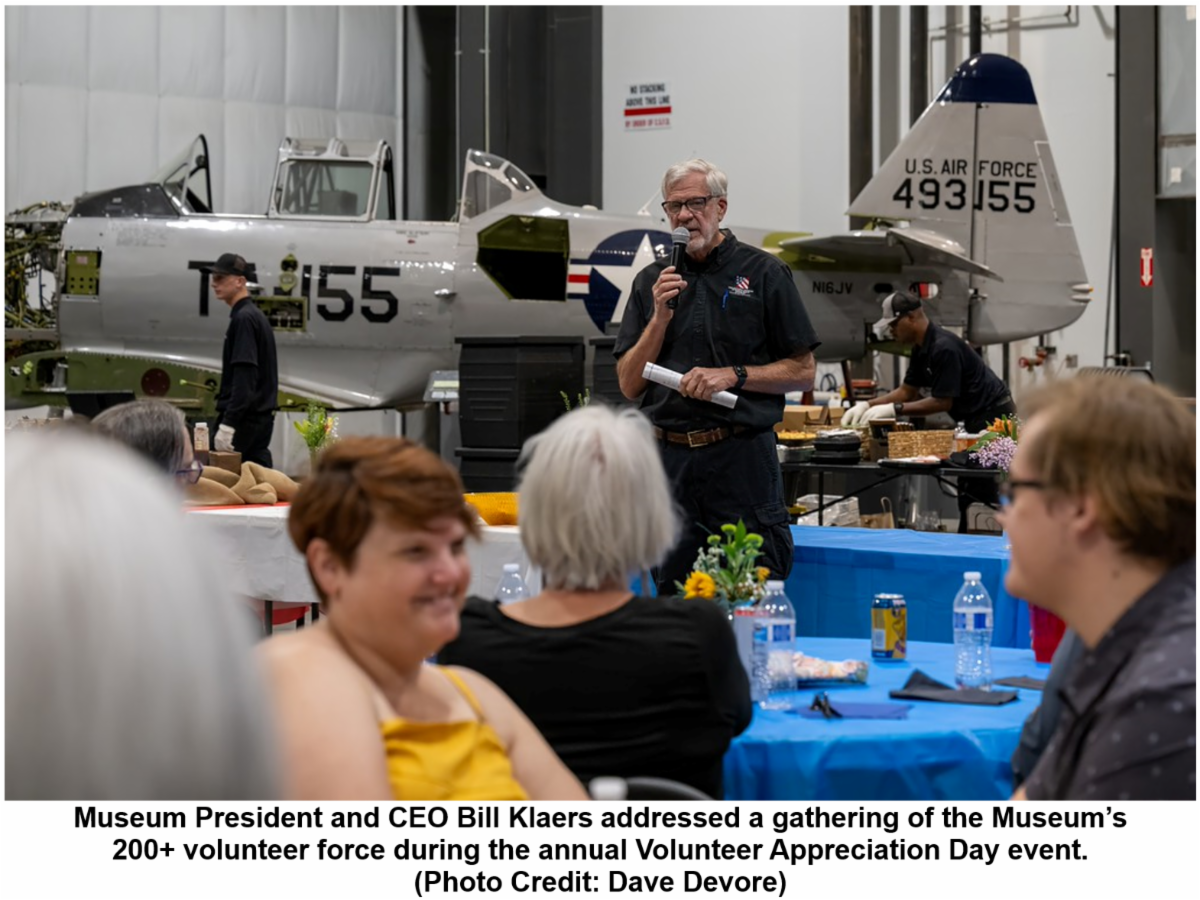
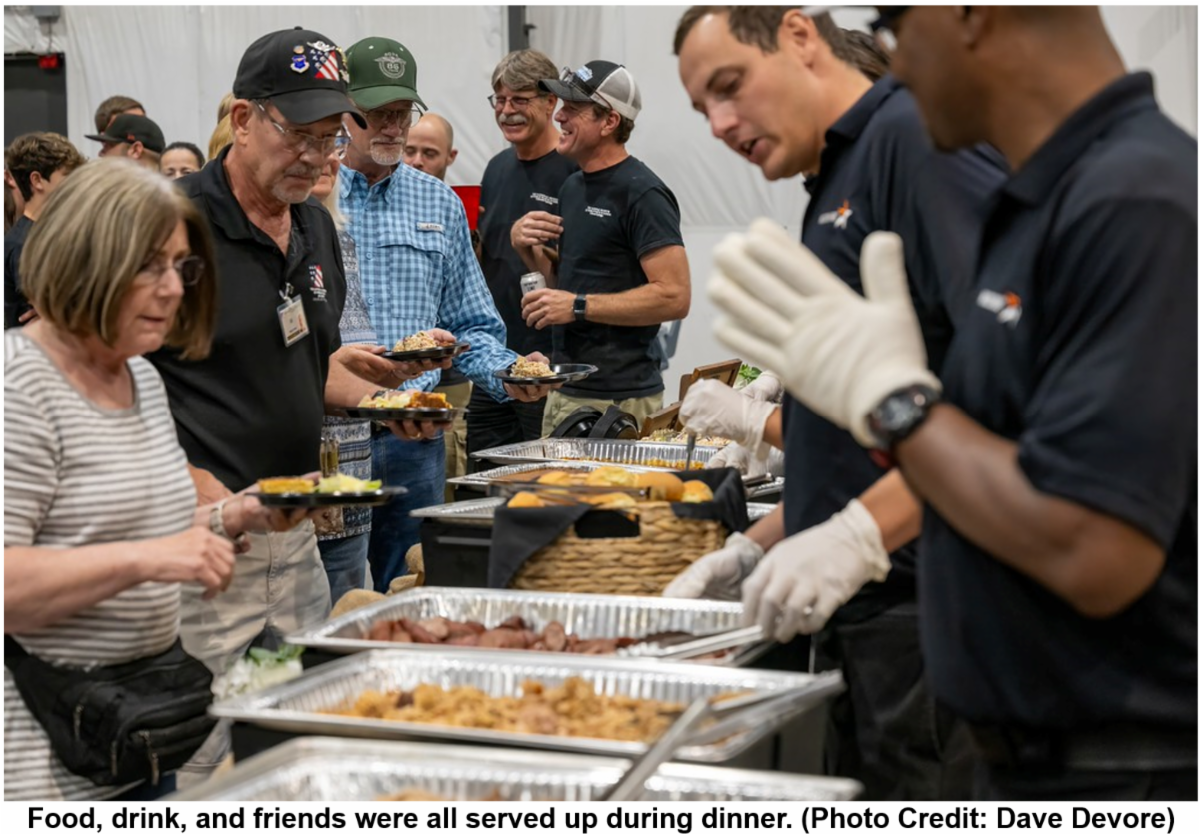
Bill Klaers, president and CEO of the Museum, said 2024 has been a success. "We've had a successful year," he said September 28 at the Museum’s annual Volunteer Appreciation Day dinner, held in the Westpac facility He praised the volunteers for their contributions. "You guys should be totally proud of what you've done," he said, "this is a bigger success every day."
On TripAdvisor, Klaers said, the Museum is "in the top 25 destinations in the United States" for the third year in a row, growing from 17th the first year to 15th two years ago, and to 11th this year.
"It's about the docents, it's about the front desk, it's about the people that run the N3N [flight simulator]...the gift shop, and everything else," he said. He noted the contributions of each group.
"We're going to start with John Henry's people, PR and communications." Klaers recognized the efforts of Jesse Carillo and his team beginning this year with videos, especially on the monthly history presentations. "It's taken the Museum to another whole level...they're ripping it." And, with photos being posted every day on social media, the Museum's presence there "has probably gone ten times from what it was before." Newsletter subscriptions, meanwhile, have grown to 5,000.
| |
|
On the retail side, Klaers praised Larry McManus and his team, and the items they make for the gift shop. "You've got some really cool stuff [and visitors] love it, and it's just very unique." He said sales of gift shop items at the Pikes Peak Regional Airshow in August were probably the largest the Museum has ever had at an airshow. "It's a huge deal for the Museum....We appreciate that, Larry, and your whole team."
Board member Mark Earle helped guide the Museum through the COVID period, and his efforts in education continue to pay off, Klaers said. He said COVID interrupted the education program, but it's back up and running and nearly booked solid for the coming months of the school year. "The kids are really the reason that we're doing what we're doing," he said. "None of the planes are roped off," allowing [kids] to get up close, and "little things like that" help inspire kids to want to learn more about the whole subject. And that's a potential boost for the aerospace and powerplant school planned for the Museum's Hangar 2A and 3, after opening of the next half of the Kaija Raven Shook Aeronautical Pavilion.
Harry Johnson's team, focused on restoration, maintenance and design and construction of exhibits, is "really crucial to this Museum," Klaers said. "Right now," he said, "we're at about 65-70% for all the exhibits that will go into" that next half. "That's all done in-house...it's all of our own people, they do everything." For instance, a Hangar 3 classroom for interns in the Museum's program involving University of Colorado, Colorado Springs (UCCS) students was built by Harry's team, Klaers said.
|  | |
Gene Pfeffer's history and collections team, working with Harry Johnson's team, make an "incredible" combination, Klaers said. Gene's team stays focused on the idea of fitting with various aspects of World War II -- items that are offered to the Museum which don't fit that theme aren't accepted -- and that's reflected in positive reviews. The result, Klaers said, is that people often say they could have spent more time absorbing displays and exhibits. "It's an educational experience for everybody," Klaers said. "Gene, you and your team are really good and I hope we can get some bigger space and then maybe you can get a few more artifacts in here," he said. And, he said, "You can have a museum and you can have airplanes," but with 29 operational aircraft also on the campus, "it's huge," particularly for the education programs.
Steve Clark as Volunteer Coordinator "has done a really good job, putting everybody together and keeping things going." Bryan McMeekin has assumed responsibility for new volunteers, "and he's done an exceptional job." Bryan has also taken over Link Trainer and N3N simulator duties from Vern Patterson.
Vern Patterson, who runs the UCCS senior engineering student program, was instrumental in getting a $150,000 grant from the Kane Foundation, Klaers said. It provides a merit-based scholarship program for Southern Colorado students through seven Southern Colorado schools, one of which is UCCS. A $50,000 grant from the Gerard B. Lambert Foundation will support the student program as well as other Museum educational programs. "So, we're moving forward," Klaers said. "That's a big deal."
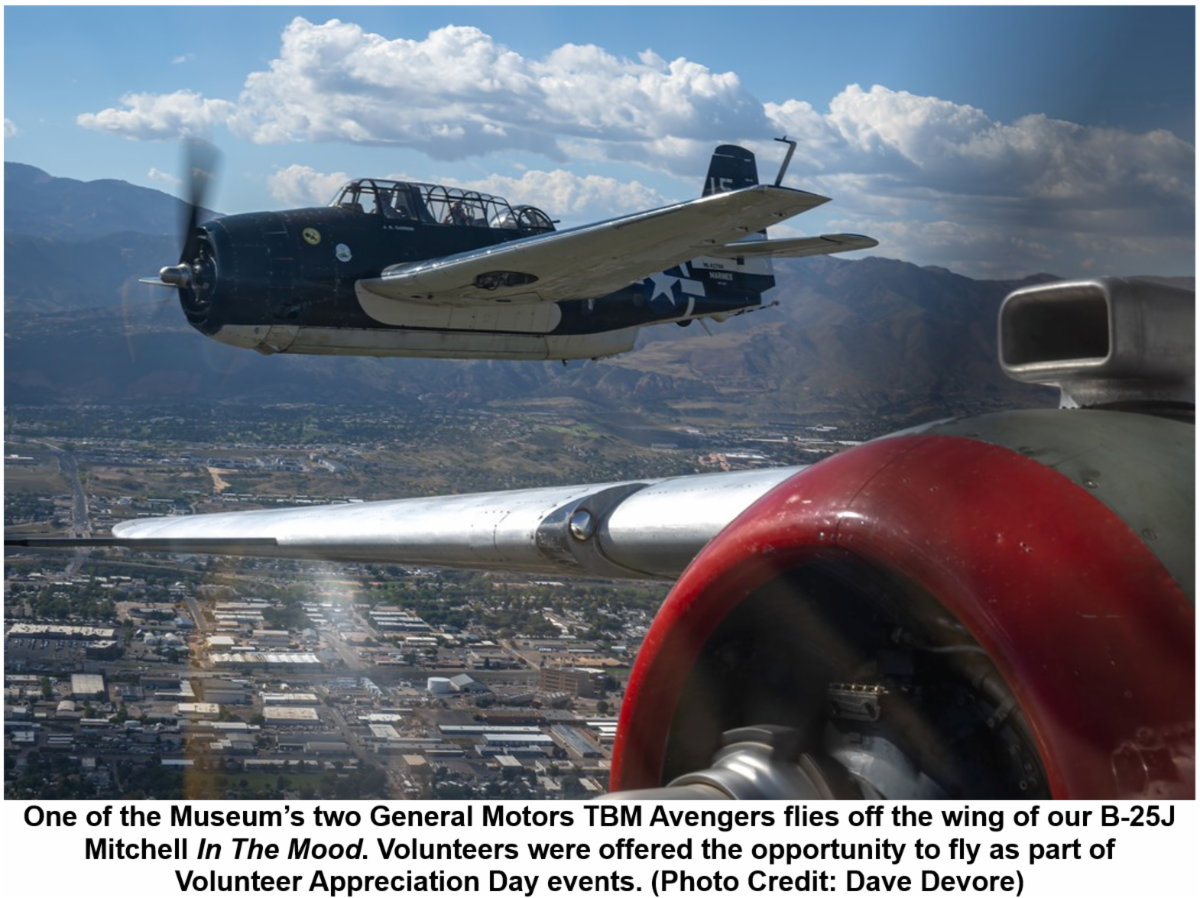
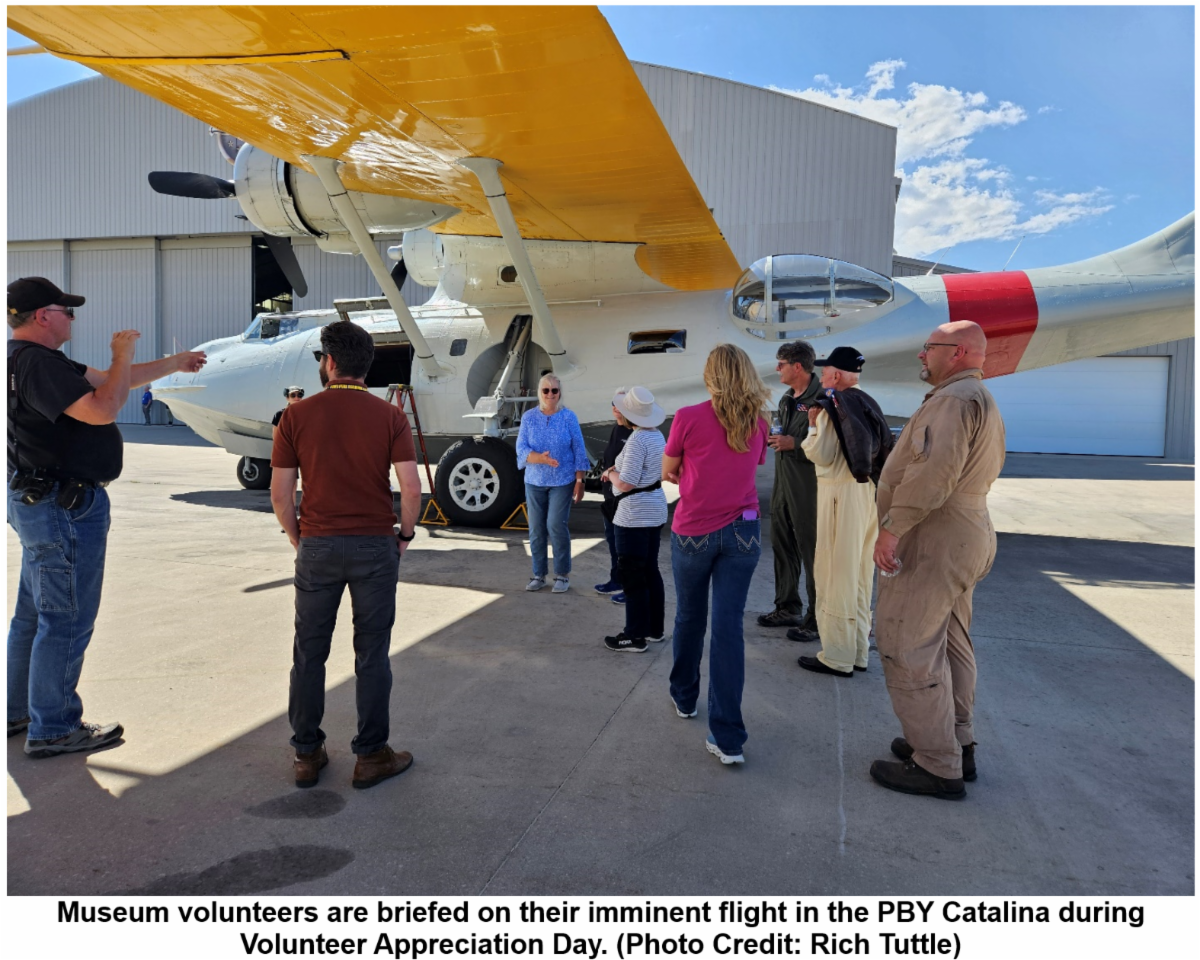
Jack Humphrey and his team manage facilities and do "a really great job," Klaers said. They kept track of which volunteers were flying in which airplanes during the September 28 Volunteer Appreciation Day. "Thank you for all that," Klaers said.
| |
|
Debi Klaers and others at the Front Desk "are the first thing anybody sees when they come into the Museum," Klaers said. "The Front Desk is so bright and cheery." Debi said, "Without all of them, the doors don't open. These guys rock every day, seven days a week in the summer, five days a week during the winter... They are awesome."
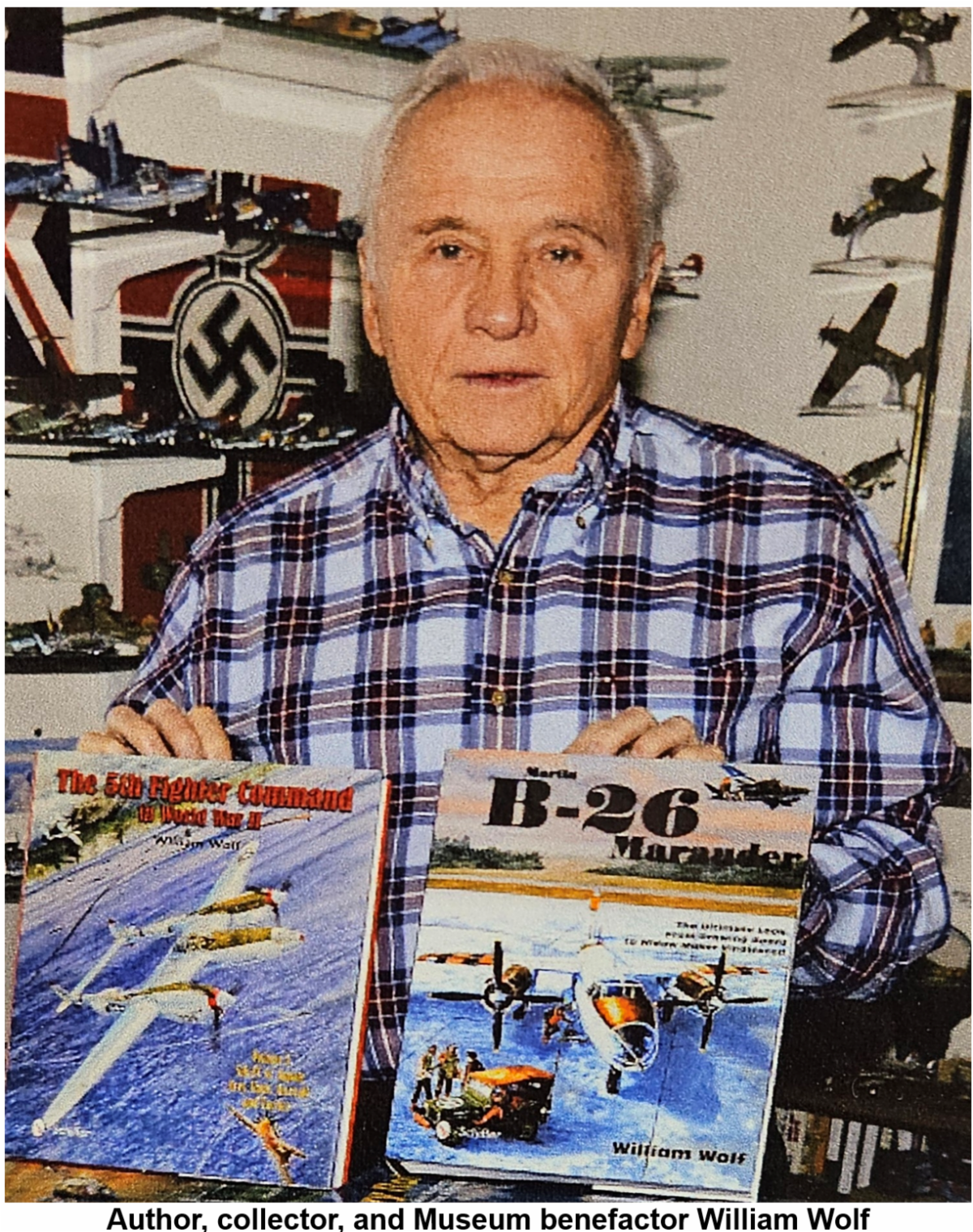
Dan Neff handles the Library. He's going through the donation to the Museum by William Wolf of Fountain Hills, Arizona, of 27,000 books and related World War II material. "This is the team right now that is going through that whole collection," Klaers said. It's probably the largest private collection of its kind.
Brian Corrado is in charge of security. He was "pretty much my right-hand man" for the airshow, Klaers said. He also set up training so the museum staff would be able to handle things like a visitor with symptoms of atrial fibrillation. "The guy does an incredible job," Klaers said.
Sandra McLaughlin helps out on the Front Desk and also takes care of duties related to Volunteer of the Quarter and Volunteer of the Year, which "means a lot to us, so thank you for that," Klaers said.
Klaers said his own Air Operations, Aircraft Maintenance and Restoration team completed the task on time of doing annual inspections of all the planes before they flew in the airshow. "It's a monumental task," he said. And lessons were learned. For one thing, "We're going to fly these airplanes a little bit more during the winter...to keep them going."
Story Credit: Rich Tuttle
| |
|
Presentation Spotlights Major ‘Pappy’ Boyington
and the ‘Black Sheep’
| |
|
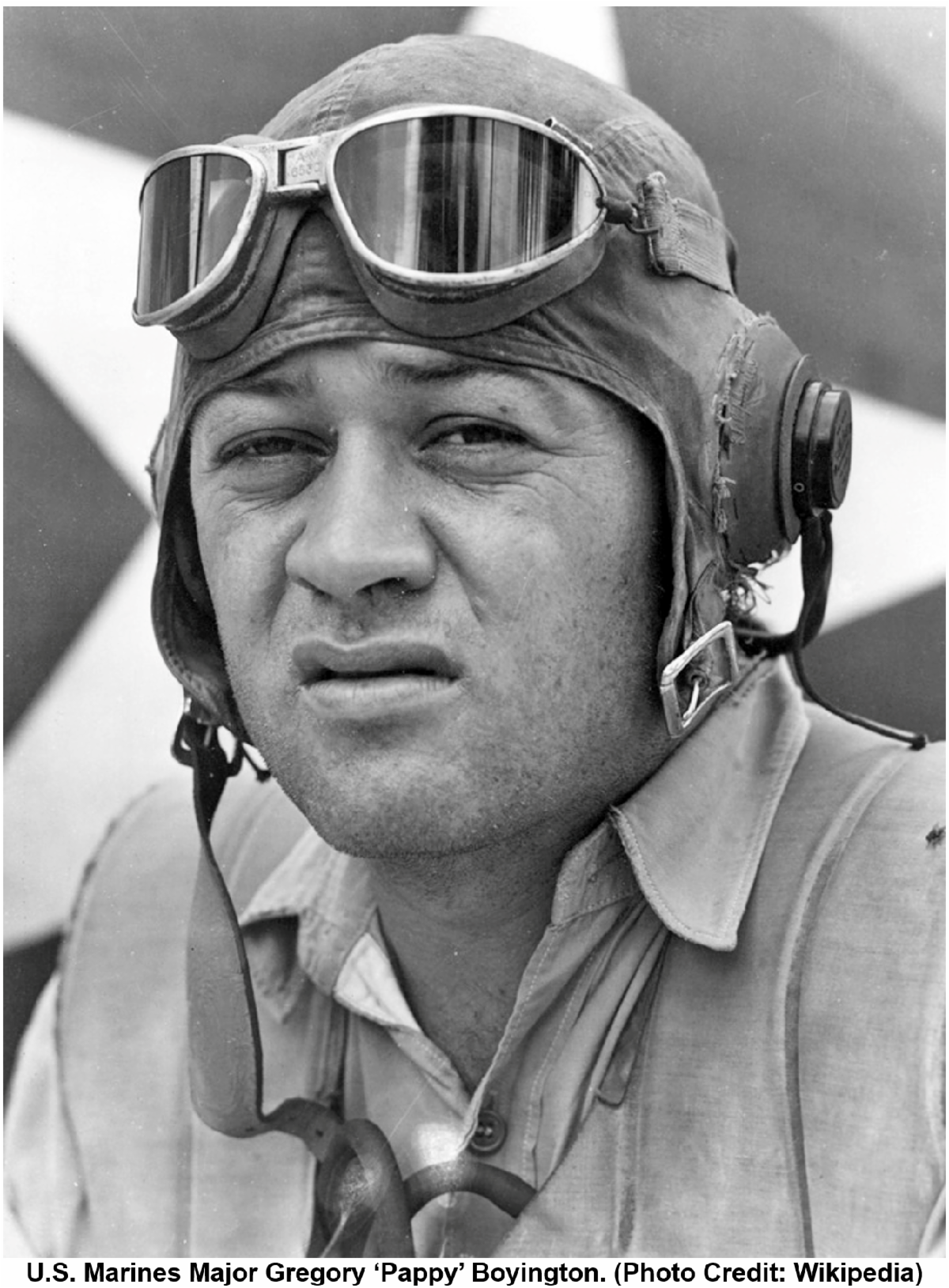
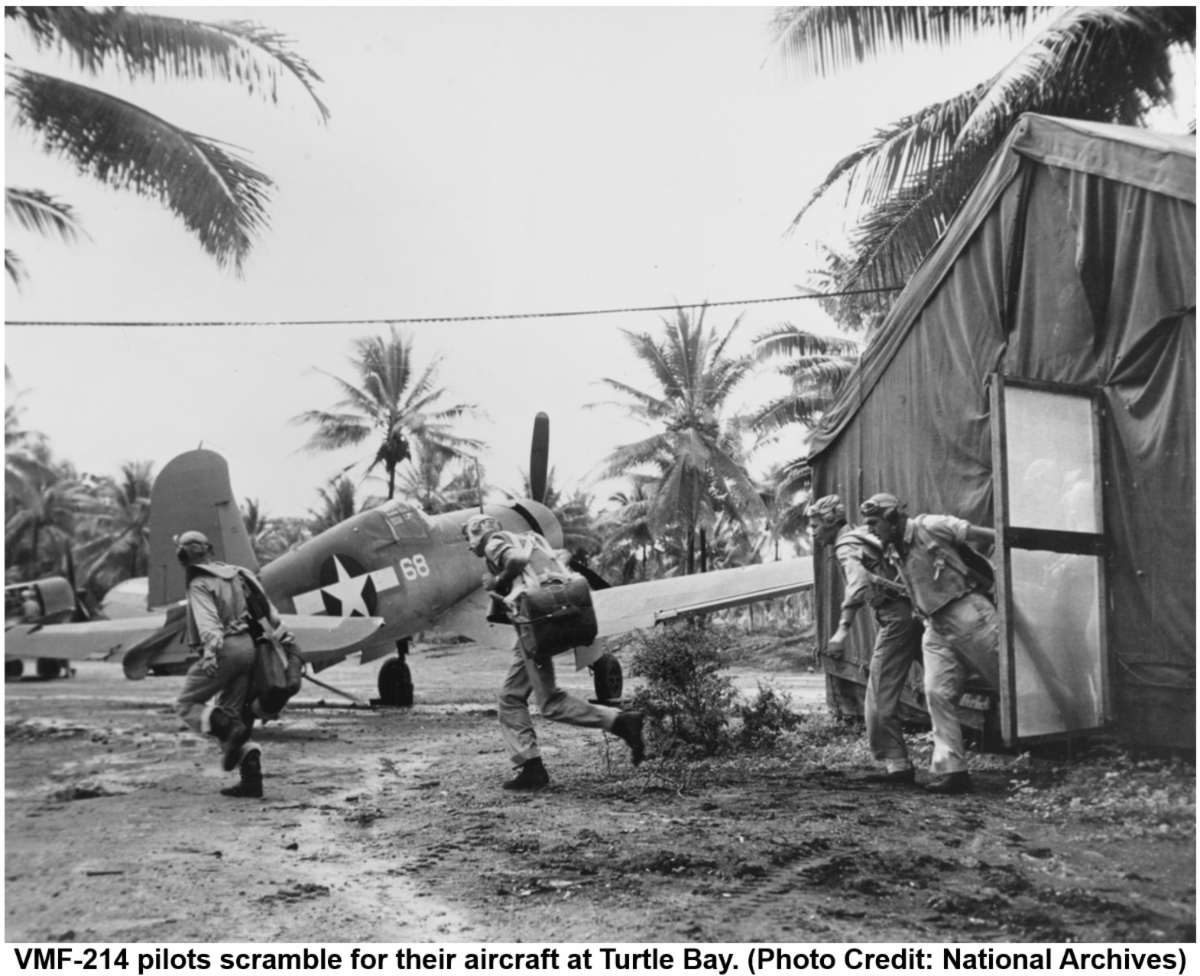
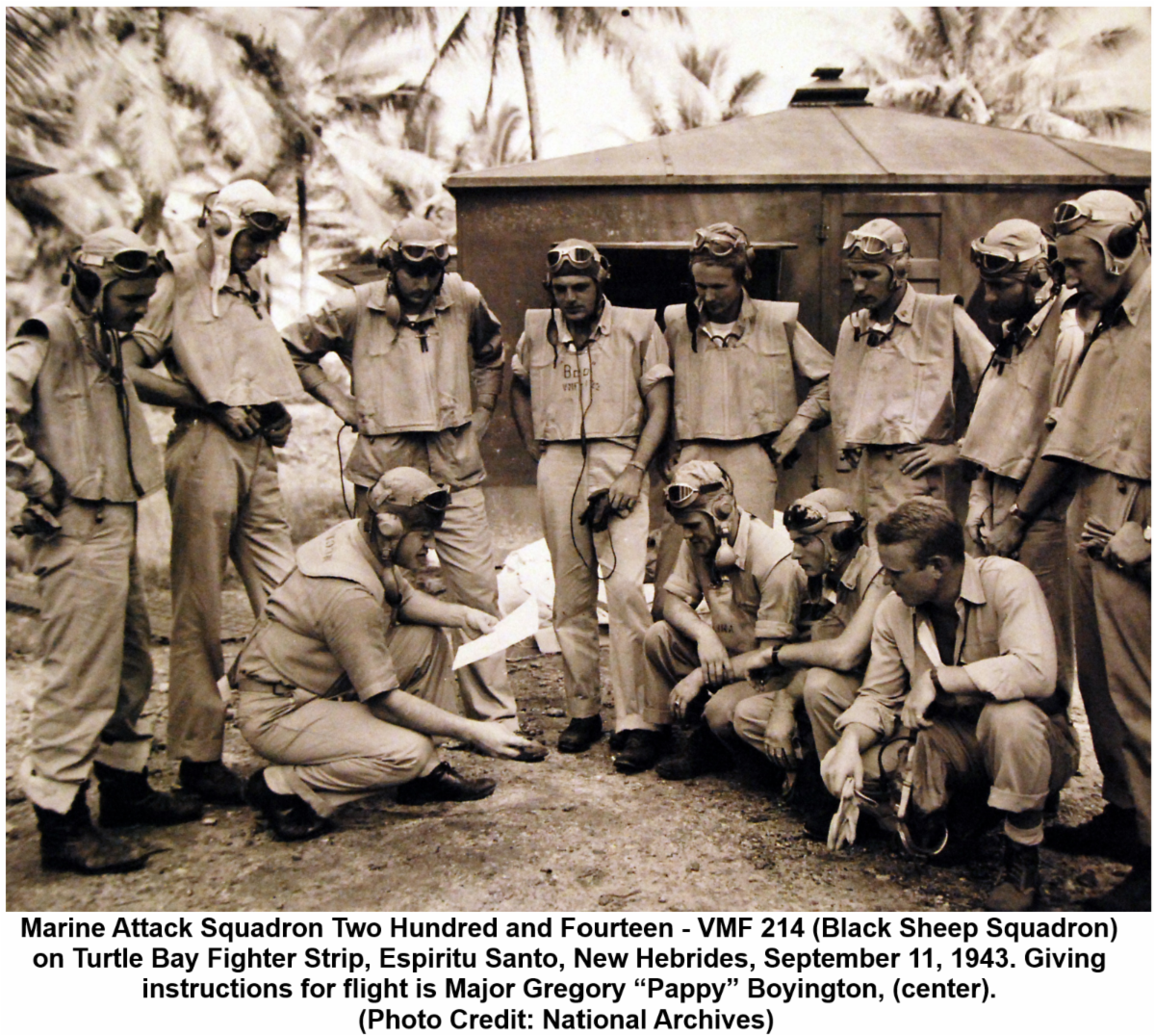
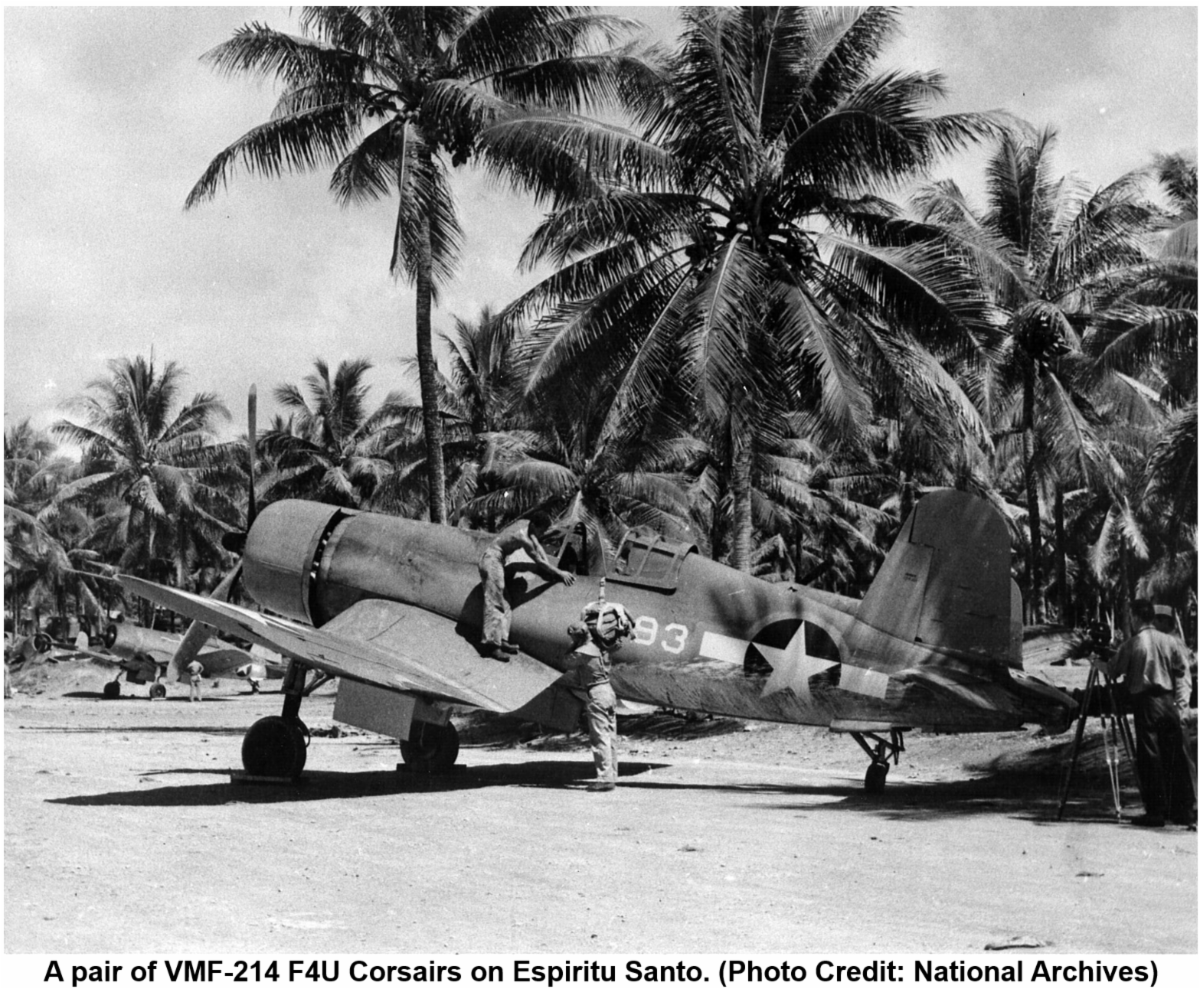
The colorful Gregory "Pappy" Boyington and his iconic "Black Sheep" U.S. Marine Fighting Squadron 214 of World War II were the subjects of an October 12 Museum special historical presentation by Docent Steve Hein.
VMF-214 is "one of the most effective and exciting American fighter squadrons of the Second World War," Hein said to an audience of several hundred in the WestPac facility on the campus of the Museum.
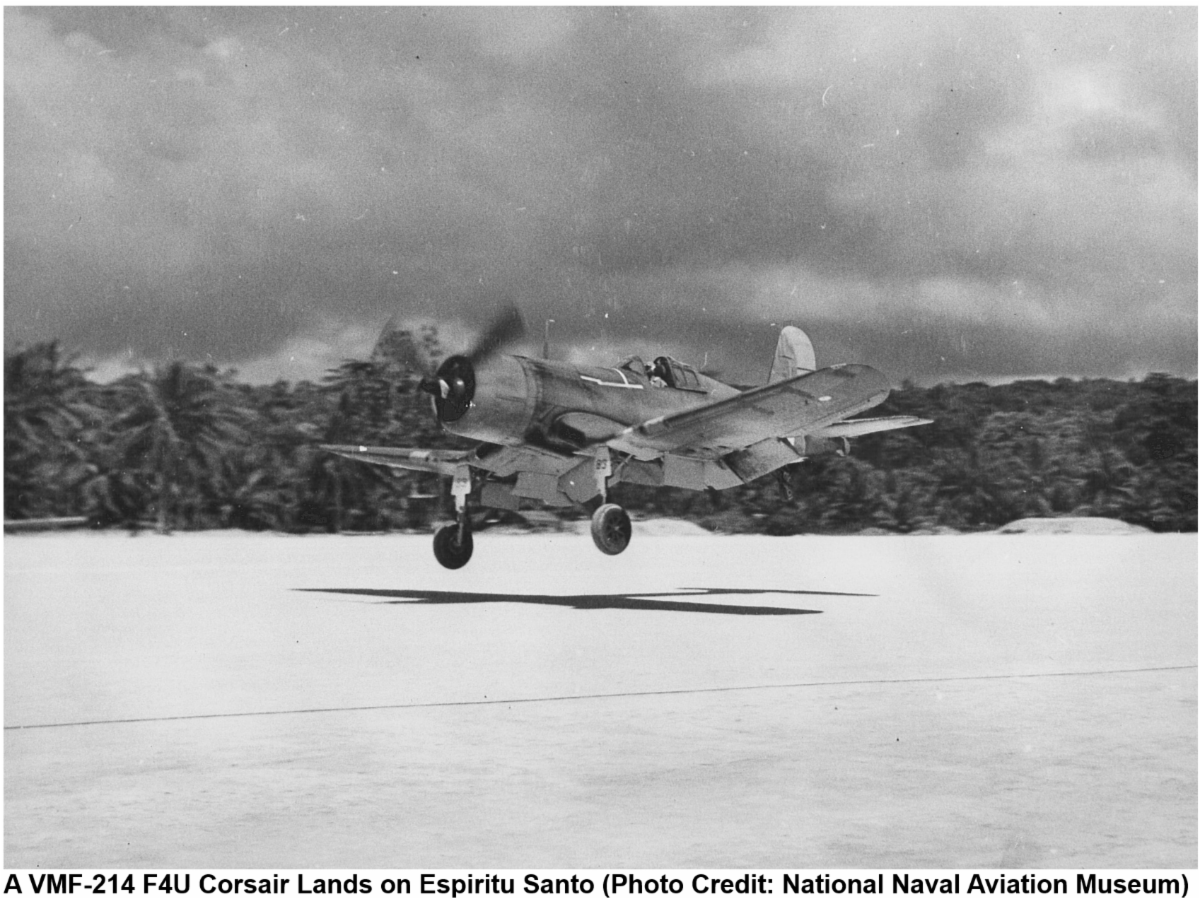
And under the command of "the brash but always exciting and skillful command of Medal of Honor recipient Major Gregory Pappy Boyington," pilots "demonstrated not only their own superiority" but also that of the Chance Vought F4U Corsair during 84 days of combat over the Solomon Islands in late 1943."
The 1970s television series about Boyington and the squadron, first titled “Baa Baa Black Sheep” and then “Black Sheep Squadron”, was entertaining but "bore little resemblance" to reality, Hein said.
He first described the Corsair. The F4U-1A hit 405 mph in level flight on October 1, 1940, a record for a single-engine fighter. The promise was great, but some shortcomings had to be overcome. The pilot's view over the long nose on takeoff and landing was restricted; hydraulic fluid tended to spew onto the pilot's windshield and stall characteristics were poor, giving the pilot little warning.
| |
|
Improvements to the -1A he said, included “an adjustable seat for better visibility and permanent closure of upper cowling gills to eliminate the hydraulic fluid problem. A six-inch stall strip was added to the outer starboard wings to improve stall warning, as were better struts to reduce bounces on landing. Later versions of the -1A included a water injection system, which gave the Pratt & Whitney R-2800 Double Wasp engine a 250-hp boost for up to five minutes in emergencies.”
The Japanese called the Corsair "Whistling Death" because of the noise it made in high-speed dives, which happened because “the engine air intakes were placed in the wing roots; the skin around the engine was so tight that no air-intake could be accommodated there.”
The requirement to land the Corsair nose-high on a carrier to catch an arresting wire was contradicted by the pilot's need to keep the nose low so he could see the deck. After 14 Corsair pilots were lost in practice carrier landings, the Navy initially deployed it with land-based Marine squadrons, first on Guadalcanal in early 1943.
| |
|
But in the air, the Corsair was outstanding. The chief engineer of Mitsubishi, which produced the A6M Type Zero fighter, said it “was the first single-engine fighter that clearly surpassed the Zero in performance." The Corsair was better than the Zero in everything except low altitude, slow-speed maneuvering, Hein said.
By the end of the Pacific campaign in 1945, he said, Corsairs had destroyed 2,140 Japanese planes at a loss of only 189 -- an 11-to-1 air-to-air kill ratio. "And most of those kills were by Marine pilots in the Solomons campaign of Operation CARTWHEEL."
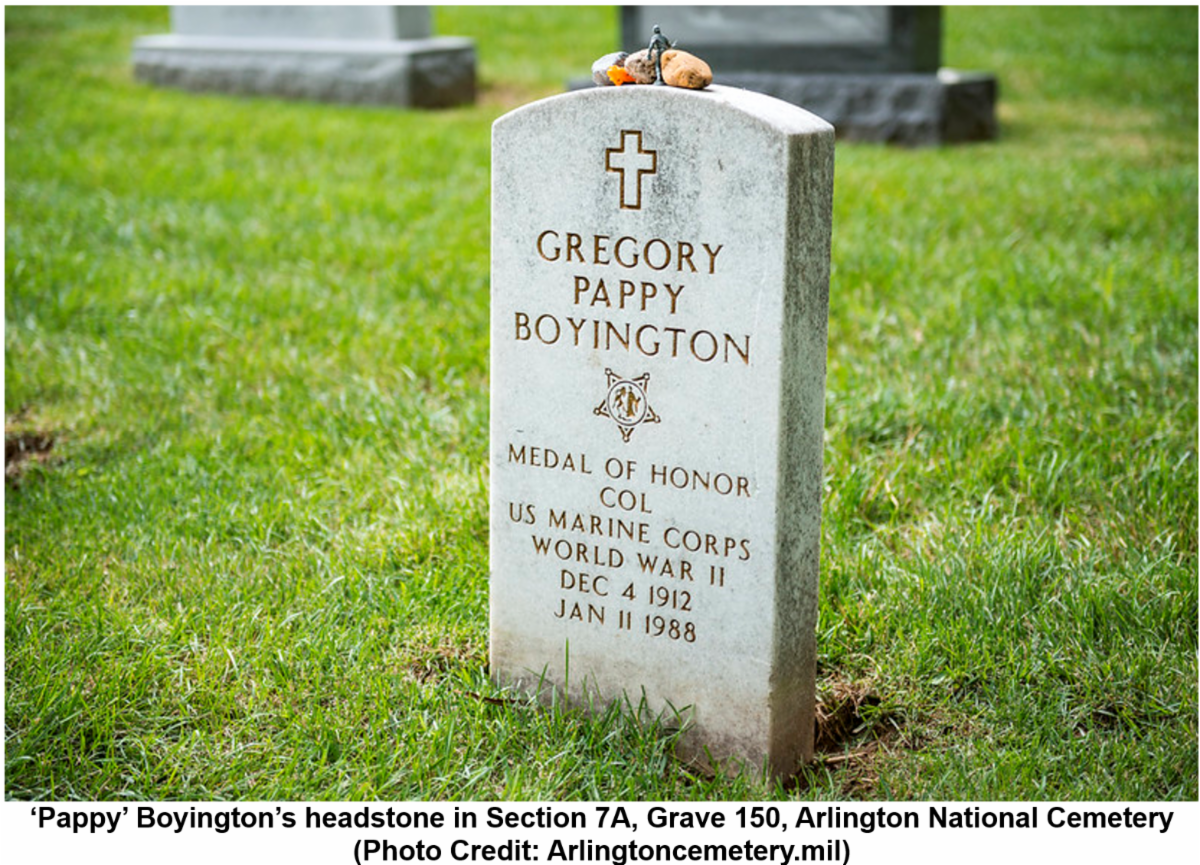
Pappy Boyington was born on December 4, 1912, in Coeur d'Alene, Idaho. He earned his wings in March 1937 but "with absolutely mediocre training performance," Hein said. "He had to fast-talk not to get washed out but he always managed to just pass on re-dos." He was assigned to VMF-1 for combat training, flying the Grumman F3F-2. The Museum has an F3F-2 which was aboard the same carrier as Boyington. It's unknown, but possible, that he flew this airplane.
Boyington's personal life was "an absolute mess," Hein said. "He suffered from alcohol abuse," was in constant brawls and was short of money "trying to support two households."
| |
|
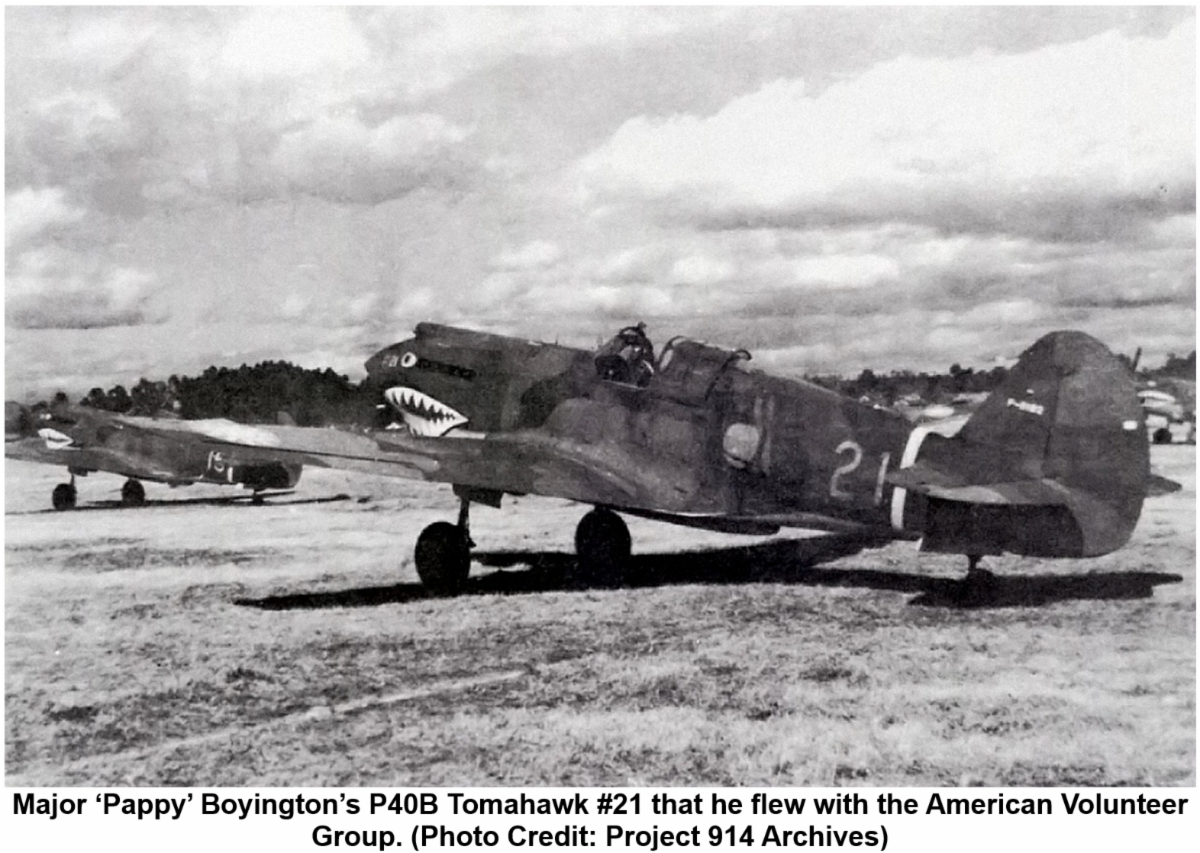
In the fall of 1941, former Army Air Corps Major Claire Chennault, then a consultant for China, was recruiting pilots for the American Volunteer Group (AVG), or Flying Tigers, to help defend China against the Japanese, Hein said. "He was offering $675 a month for a flight leader and $500 for each Japanese airplane destroyed." Boyington resigned his Marine Corps commission and joined the AVG in September 1941, becoming a flight leader, flying Curtiss P-40 Warhawks.
But he had hard luck, always seeming to miss the action. But on February 6, 1942, he shot down two Japanese Nakajima Ki-27 “Nate” fighters. On another raid he claimed seven Japanese planes destroyed on the ground.
The claims board acknowledged that his group destroyed 15 aircraft but decided to equally credit all ten pilots, giving each, including Boyington, credit for 1.5 aircraft for $750, not the $3,500 that Boyington expected, Hein said. He appealed to the review board and to Chennault, but lost both times and left the AVG before his contract was up. Chennault was happy to see him go.
As the Marines were desperate for experienced pilots, Boyington's commission was restored, and he was promoted to Major in September of 1942. He was assigned to Espiritu Santo in the New Hebrides and in January 1943 joined VMF-122 as executive officer and later for a short period its commander. He became commanding officer of VMF-112 for a few weeks while in the rear area. He saw no combat in either squadron. A press report about his Flying Tiger days said he claimed six, not just two, enemy planes shot down.
| |
|
VMF-214 was commissioned in July 1942, taking the name "Swashbucklers." Pilots flew two tours of duty from Guadalcanal in the Solomons campaign at that time. The squadron was disbanded in December of 1942 and the pilots were sent home.
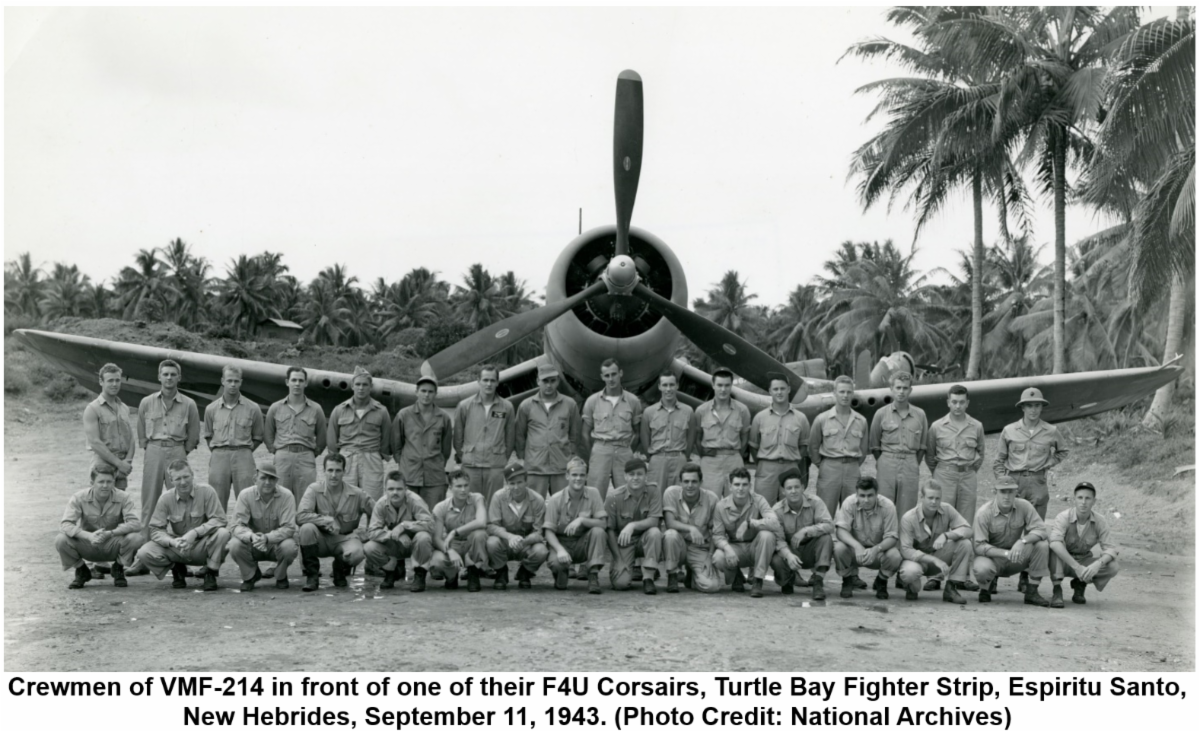
But Corsairs were needed for the Bougainville and Rabaul battles. Boyington was named commander of the reconstituted VMF-214, made up of unassigned pilots already in the South Pacific. The pilots considered themselves strays, and initially used the name "Boyington's Bastards," Hein said. That was changed to "Black Sheep."
Boyington, at age 30, was about ten years older than most of his pilots, so they called him "Gramps."
The name "Pappy" was used in one of their made-up songs, but it didn't become popular until after the name was used in media reports of his being shot down. He was captured and survived the war, but "Pappy" stuck.
Boyington became “a brilliant combat leader with exceptional air combat skills,” Hein said. He was an example for his pilots, including Lieutenant Ed Olander, who became an ace. Some of his memorabilia is on display in the Museum’s Pavilion.
| |
|
The squadron encountered no enemy planes during its first two days of combat, but it did on the third, September 16, 1943, Hein said. Escorting TBF Avenger and SBD Dauntless bombers over Bougainville, the Black Sheep “logged 11 confirmed Zeros shot down and nine probables. By September 29, the squadron had logged 23 confirmed Zeros, 13 probables, and 26 were logged by October 4. “
The Black Sheep and Boyington were written up in the Chicago Daily News and accounts of their exploits became known around the country. By the end of their first tour, they had shot down 57 enemy planes.
From the start, Hein said, Boyington wanted to become the all-time Marine ace. Eddie Rickenbacker had shot down 26 enemy planes in World War I, and Marine Joe Foss had 26 as well. On that first Black Sheep mission of September 16, Boyington downed five Japanese planes, a record he shared with two other Marines. But Boyington's action was the first such in a Corsair, and it was picked up by the newspapers. His claim of six with the Flying Tigers was picked up again, Hein said. On October 4, 1943, he said, Boyington shot down three Zeros within one continuous 360-degree turn. By the end of his first tour on October 28, 1943, he had logged 14 enemy planes shot down with the Black Sheep.
The squadron's second tour began on November 28, 1943. By the end of December, Boyington had shot down 21 Zeros. With the four undocumented aerial victories he claimed from his AVG days, that was 25, which meant just one more to equal Foss's 26.
|  | |
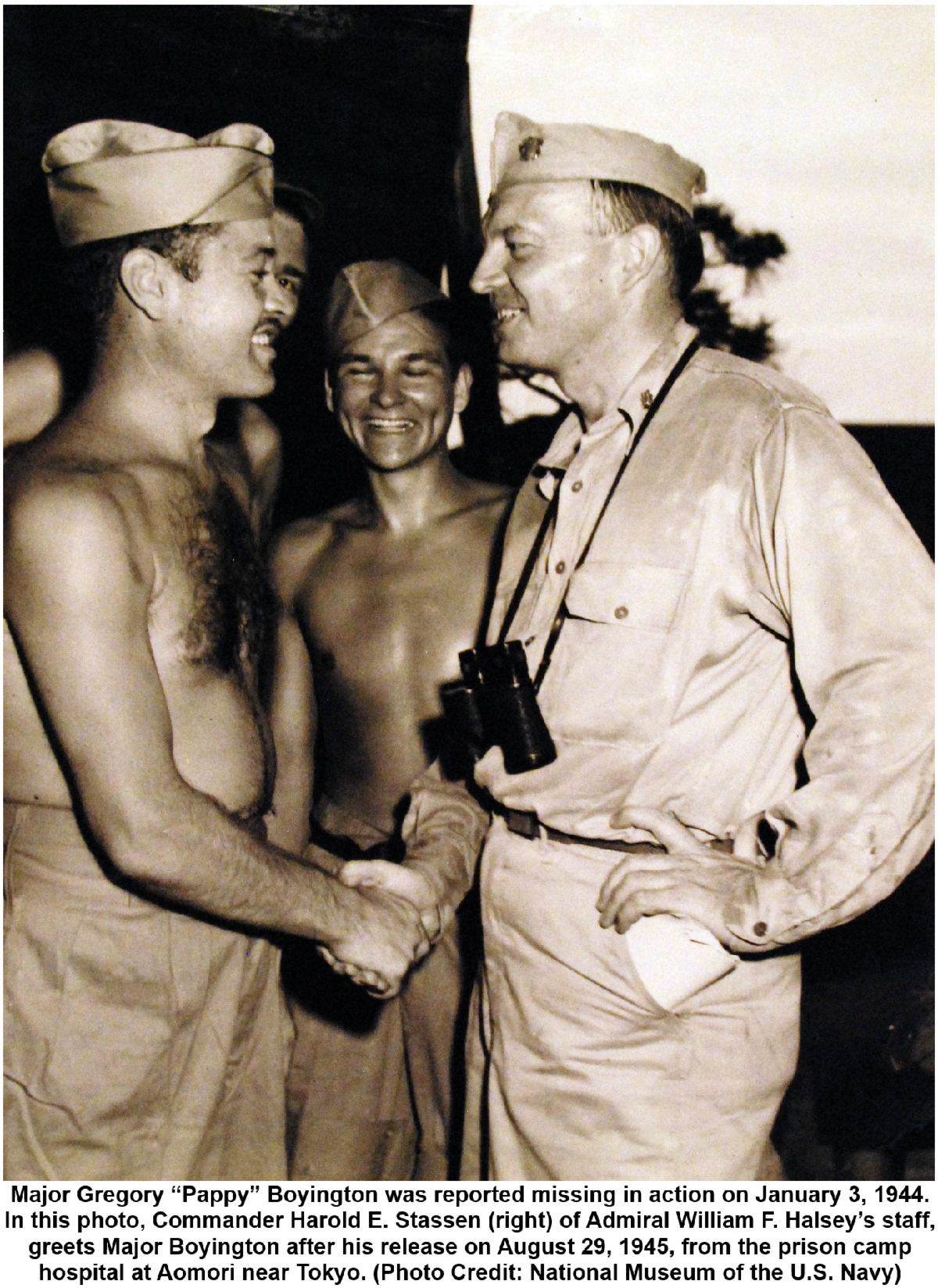
On January 3, 1944, Black Sheep pilots returned after a mission to jubilantly report that Boyington had reached the magic number. Pappy, however, didn't return and was presumed lost in action.
After Japan surrendered, Boyington emerged alive after having been held in a Japanese prison camp for 20 months. He was welcomed home to the United States by over 5,000 people in Seattle, Hein said. He said Boyington admitted to having committed the cardinal sin of flying low and slow with five or six Japanese fighters on him, and he paid the price.
Boyington claimed, and was credited with, shooting down two Zeros on the day he was shot down, which made 22 Black Sheep kills, Hein said. If six were logged with the Flying Tigers, that would total 28 and make Boyington the top Marine ace.
But his four additional kills with Flying Tigers couldn’t be substantiated with official records. Boyington's official Flying Tiger service therefore is two kills, for a total of 24 … not 28, Hein said. This, he said, means Joe Foss holds the record as the Marine pilot with the most kills at 26, and it puts Marine pilot Robert Hanson in the second place with 25, having shot down an incredible 20 enemy planes in a single six-day stretch. Boyington sits at third place with an official 24 victories.
|  | |
Boyington’s Medal of Honor citation reads as follows: "For extraordinary heroism and valiant devotion to duty as commanding officer of Marine Fighting Squadron 214 in action against enemy Japanese forces in the Central Solomons area from 12 September 1943 to 3 January 1944. Consistently outnumbered throughout successive hazardous flights over heavily defended hostile territory, Maj. Boyington struck at the enemy with daring and courageous persistence, leading his squadron into combat with devastating results to Japanese shipping, shore installations, and aerial forces. Resolute in his efforts to inflict crippling damage on the enemy, Maj. Boyington led a formation of 24 fighters over Kahili on 17 October and, persistently circling the airdrome where 60 hostile aircraft were grounded, boldly challenged the Japanese to send up planes. Under his brilliant command, our fighters shot down 20 enemy craft in the ensuing action without the loss of a single ship. A superb airman and determined fighter against overwhelming odds, Maj. Boyington personally destroyed 26 of the many Japanese planes shot down by his squadron and, by his forceful leadership, developed the combat readiness in his command which was a distinctive factor in the Allied aerial achievements in this vitally strategic area."
VMF-214, over two tours covering 84 days of combat in the Solomons, from September 14, 1943, to January 6, 1944, shot down 97 enemy planes with 35 probables, 50 damaged, and about 30 ships sunk, Hein said. Nine VMF-214 pilots became aces.
“After the war, while vowing to stay sober and clean up his chaotic life, it simply did not happen,” Hein said. “He returned to alcohol addiction. He shifted from job to job. He went through several broken marriages.” In his last years, he got “some relief through Alcoholics Anonymous.”
“After a long battle with cancer, Colonel Gregory Boyington died at age 75 on January 11, 1988,” Hein said. “He is buried at Arlington National Cemetery…right next to boxing great Joe Louis.”
Story Credit: Rich Tuttle
| |
|
William Wolf Collection is Result of Lifetime of
Fascination with WWII Combat Aviation
| |
|
The huge collection of World War II aerial combat materials recently donated to the Museum by William Wolf of Fountain Hills, Arizona, is perhaps the largest privately held collection of its kind. It includes 27,000 books and magazines, more than 10,000 photographs, over 800 videos and DVDs, and 2,000 reels of microfilm from original WWII sources. The collection is being sorted and catalogued for installation in the projected 40,000-square-foot second half of our Kaija Raven Shook Aeronautical Pavilion. It's the result of Wolf's life-long fascination with the subject.
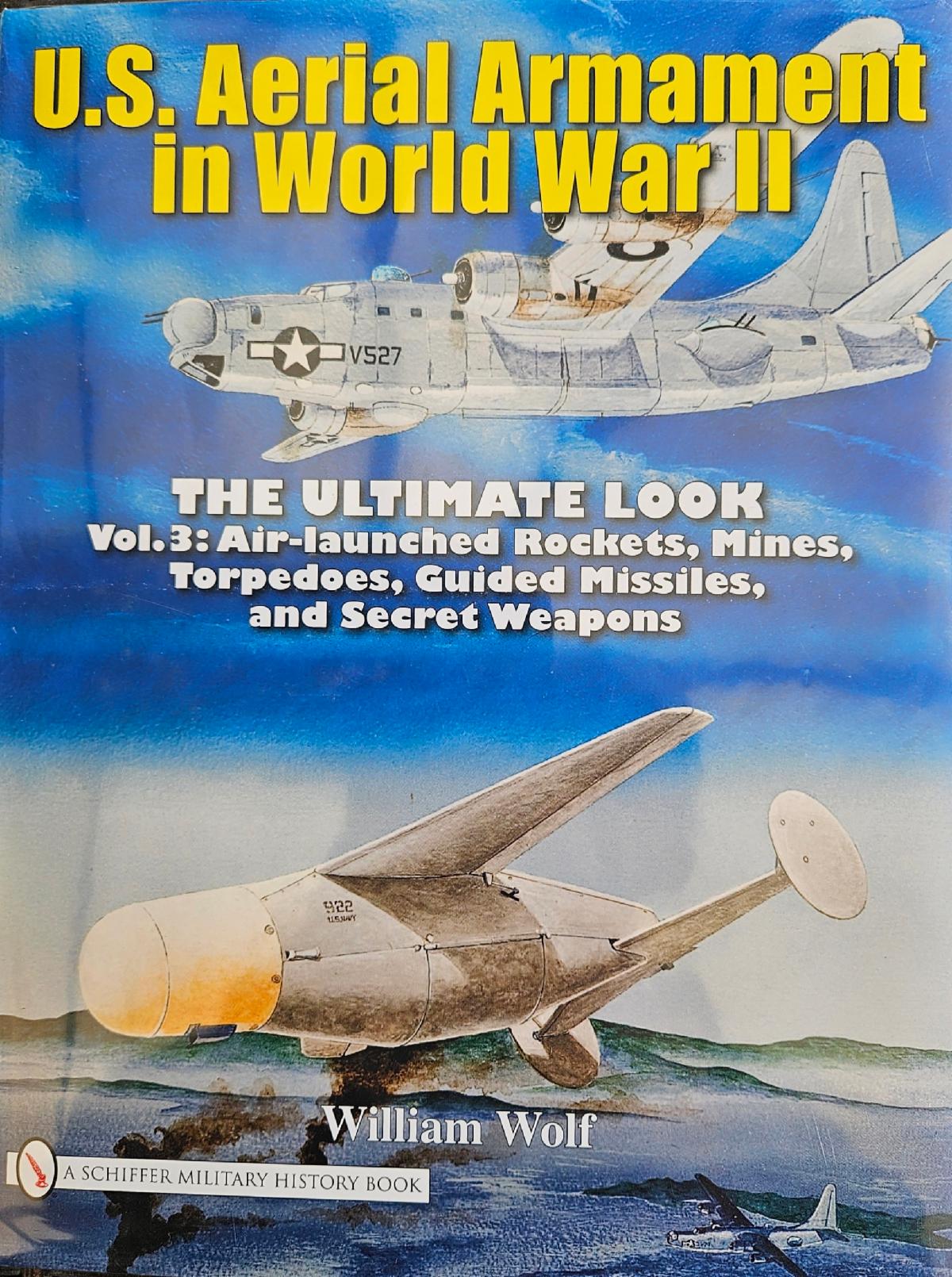
Wolf, who himself has written nearly 30 books about WWII aviation, gives us an insight into the effort he has put into amassing his unique collection, and his passion for it, in one of his books already in the Museum library. "I probably have nearly every book written on WWII aviation and complete collections of nearly every combat aviation magazine published since 1939," he writes in the acknowledgements section of the 345-page third volume of his "U.S. Aerial Armament in World War II", published in 2010.
The collection, he writes, includes "hundreds of aviation unit histories: intelligence reports; pilot, crew, flight, and training manuals; and technical, structural and maintenance manuals for aircraft ordnance, armament, engines, and equipment."
The microfilm portion "includes vintage intelligence reports; hundreds of USAF, USN, and USMC group and squadron histories and After Combat Reports; complete US Strategic Bombing Surveys, as well as complete USAF Historical Studies."
"Over the years," Wolf writes, "I have been fortunate to meet many fighter aces, other pilots, and fellow aviation buffs who have shared stories, material, and photographs with me (I have over 5,000 photos of fighter aces alone). I have made numerous multi-day expeditions to various military libraries, museums and photo depositories with my copy machine and camera, accumulating literally reams of information and thousands of photographs."
Wolf completed 11 of his books in the decade preceding the 2010 publishing date of the three-volume aerial armament work. He wrote in volume three that those books "included many hundreds of photos and drawings, many in color. Most of the photos gathered for" the third volume "and the others were from the WWII era and before, and over the years were not well cared for and showed their age." He said "almost all were copies or copies of copies made before the Digital/Photoshop Age by a standard film 35mm camera on a copy stand; many hundreds at a time over several days while visiting various facilities."
At one point, he wrote, "I had a photo darkroom where I developed thousands of rare photos from microfilm negatives which were not of best quality. Many photos were copied from printed dot-type photos from contemporary World War II publications. The reproductions of the many technical drawings were made by my non-digital drum copy machine 20 years ago or more from yellowed manuals that originally were poorly printed on poor quality wartime paper."
| |
|
He therefore apologized "in advance for the quality of some papers and drawings" in volume three of "U.S. Aerial Armament in World War II -- The Ultimate Look" even though they were photoshopped. But he wrote "I feel rare photos of marginal quality are better than no photos in describing topics in this book.”
"Many of the photos in this [third volume] are stills reproduced from training and operational films, microfilms, and manuals and are of poor quality but are the only sources available on secret weapons of the era."
He wished "every person who contributed photos and materials for [the] collection over the past 35 years could be specifically mentioned. Over the years the origin of some of the thousands of photos I have been lent to copy or have copied and collected have become obscured. Most are from military and government sources, but many are from private individuals, so I apologize if some of the photos are wrongly credited.”
"And last but not least, for the eleventh time," he wrote in the 2010 book, "thanks go to my preserving wife, Nancy, who allows me to spend many hours researching and writing, and patiently (mostly) waits while I browse bookstores and visit air museums in search of new material and photos. Also, I thank her because her car sits out in the hot Arizona sun as my WWII library luxuriates in the remodeled, air-conditioned three-car garage."
Everyone at the Museum looks forward to the Wolf collection being on display and available for reference!
Story Credit: Rich Tuttle
| |
Hellcat Pilot Flies Again | |
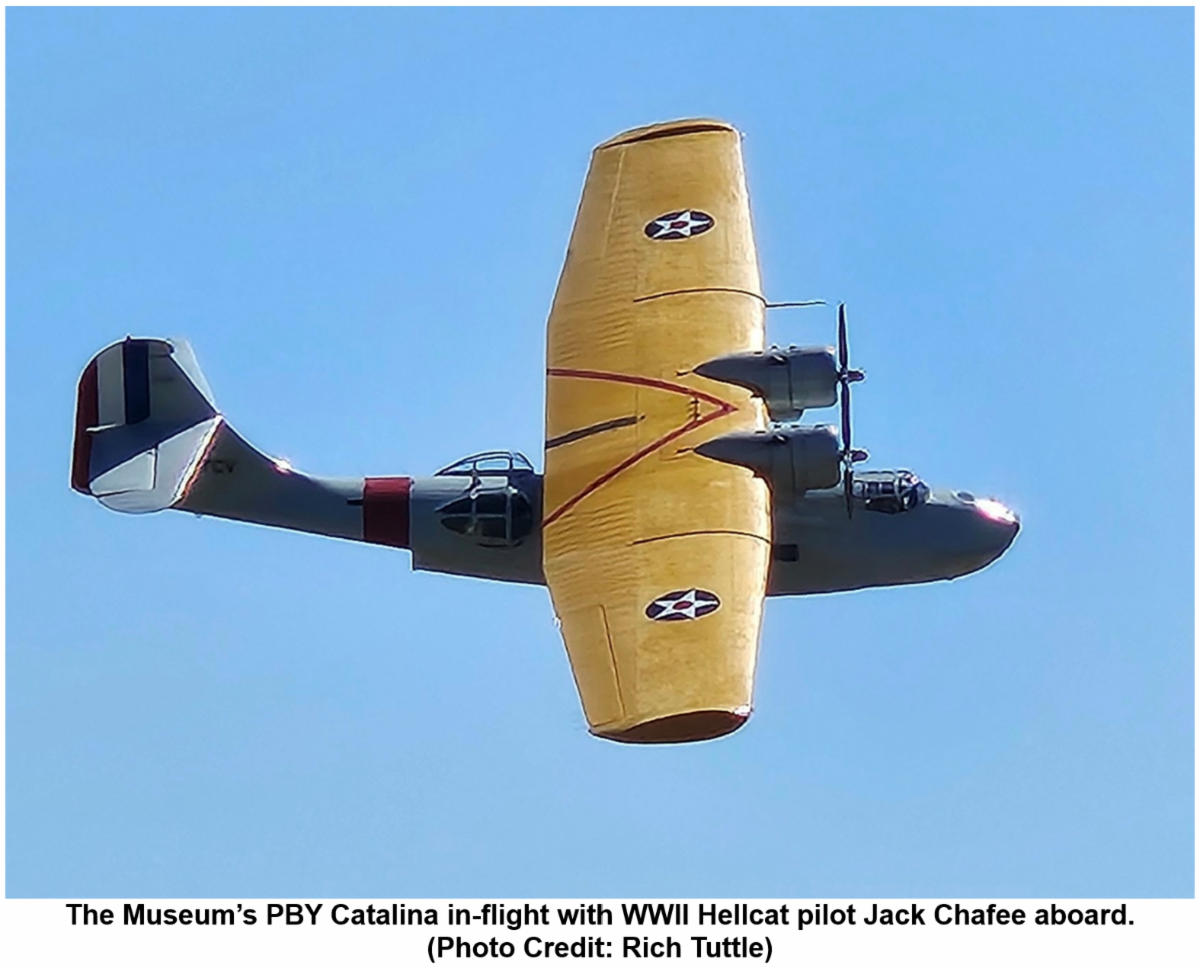
The Museum was honored recently when 100-year-old U.S. Navy veteran and former Grumman Hellcat fighter pilot Jack Chafee flew with us on our PBY Catalina. The flight followed a presentation about the daring Operation FLIGHT GRIDIRON, in which PBYs rescued 50 people from Corregidor in the Philippines in 1942 as the fall of U.S. forces there was imminent. | 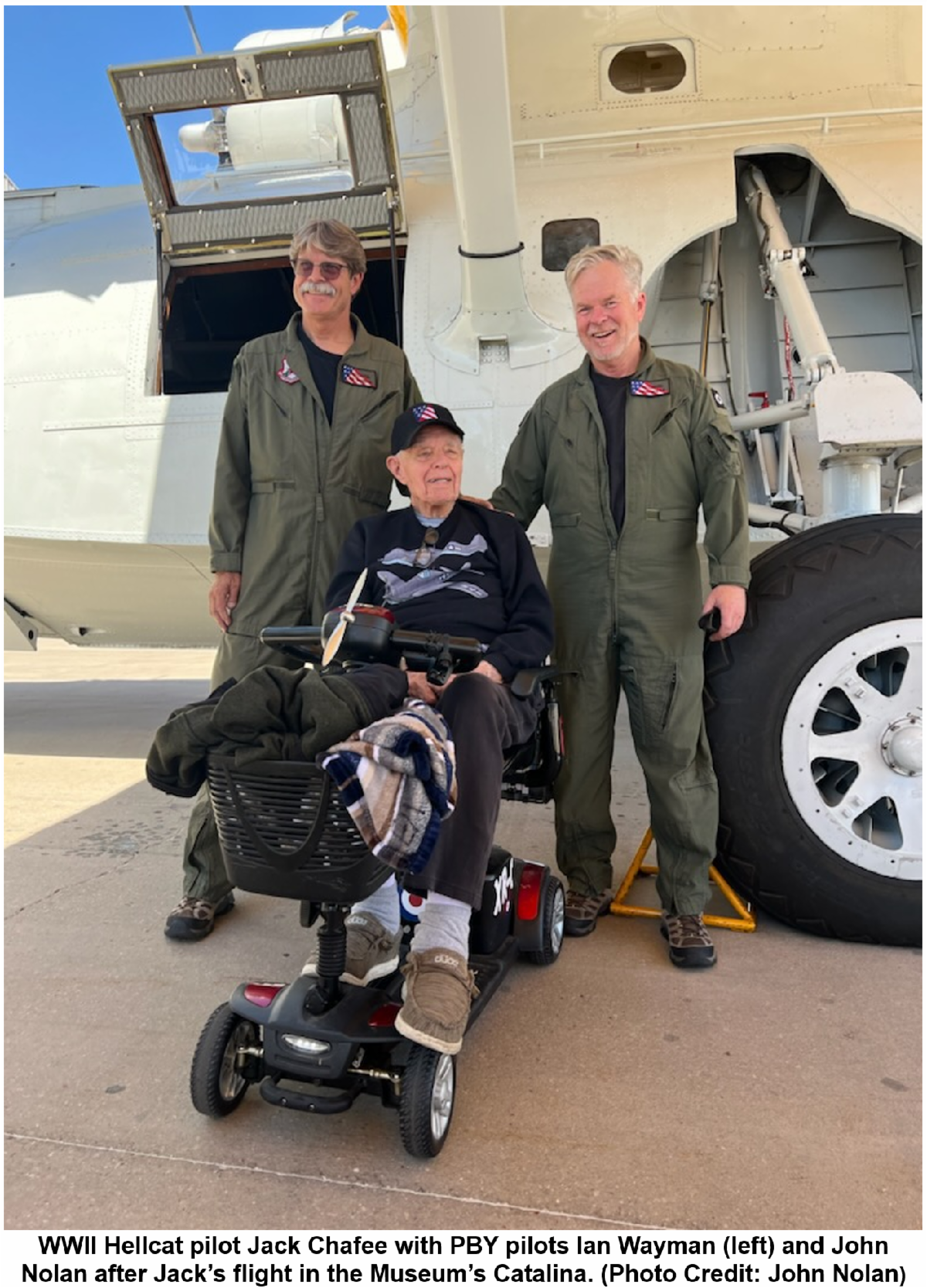 | |
In 1944, Chafee flew Grumman F6F Hellcats with VF-14, the "Iron Angels", from the USS Wasp (CV-18). The unit struck targets in the Pacific, including in the Philippines, Palau, and Okinawa.
On one mission Chafee was unable to return his Hellcat to the carrier and ended up ditching into the ocean, where he was later rescued by a PBY Catalina. 80 years later, the Museum was thrilled to reunite him with the same type of aircraft that saved him from perishing at sea.
Among Jack's awards are the World War II Victory Ribbon, American Theater Ribbon, Philippine Liberation Medal with one Service Star, and the Asiatic Pacific Medal with one Service Star.
Following his PBY flight, Chafee enthusiastically said it was, "Absolutely great! I would do it again! Wonderful!"
Story Credit: Rich Tuttle
| |
Volunteer of the Third Quarter - Jim Klages | |
|
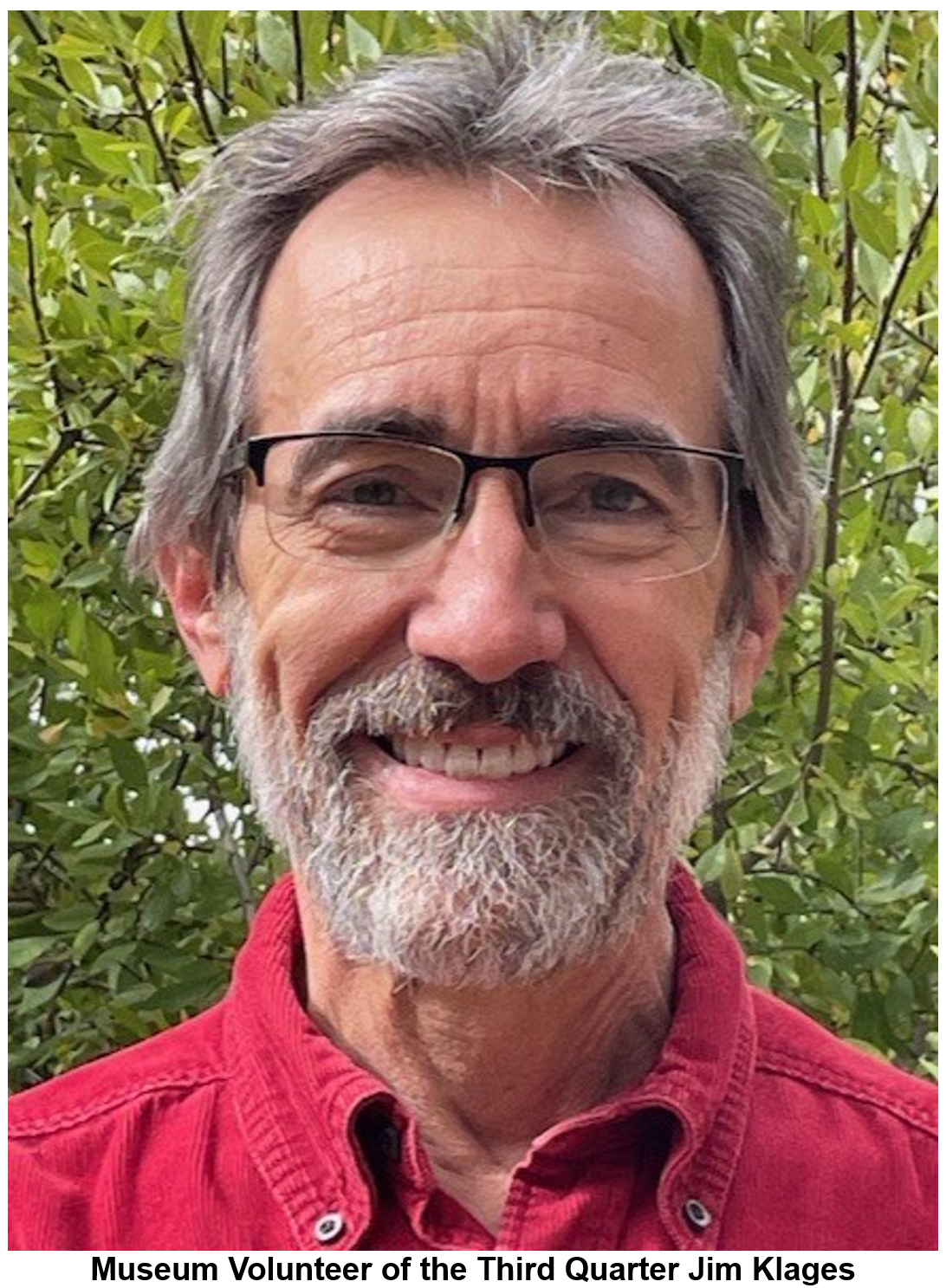
Jim Klages was named Museum Volunteer of the Third Quarter of 2024. He was recognized on Saturday, October 26, in a ceremony and lunch in Hangar 1A. He was also Volunteer of the Third Quarter of 2019.
Jim "is a rock of stability and excellence in the Museum's core functions of accepting, cataloging, storing and displaying WWII aviation artifacts," said Department Lead Gene Pfeffer in making the nomination. "His work is at the heart of the Museum's mission. He has and continues to do excellent work with little need for me to provide oversight."
Pfeffer said "Jim is solely responsible for the Museum's artifact database of nearly 7,000 items. He has redesigned some of the entries describing each artifact to provide better descriptions He also oversees the work of the history team members, writing the comments that go into each artifact's entries. He has gone back and corrected hundreds, if not thousands, of entries that were developed in haste in the early days of the Museum."
In addition, Pfeffer said, "Jim is a premier 'builder' of Museum displays and exhibits. Together we select the items that will tell the story we want to tell. He artfully arranges the items in ways to meld the into the story. He has a unique gift in this regard."
And, he said, "Jim is an expert modeler who has contributed aircraft models that help tell our stories. His recent contribution of a B-18 Bolo is superb. That model will be part of a new Pavilion display about the lack of preparedness in the Army Air Corps at the outbreak of WWII.
"Jim is always looking for ways to improve our operations and Museum displays that accord with our position as one of only 13 national museums chartered by Congress."
Pfeffer said he "could go on about the splendid work [Jim] has done for us but let me summarize by saying Jim is a low-key, often unheralded, but essential contributor to the Museum's mission. He is justly deserving of the recognition of his contributions by his selection as Volunteer of the Quarter and hopefully Volunteer of the Year."
Congratulations Jim!
Story Credit: Rich Tuttle
| |
Uncle Mac's Mission to Saarbrucken | |
|
By Rich Tuttle, Museum Volunteer
Eighth Air Force bomber crewmen flew 10-12 missions per month during 1944 against German targets. Because of the constant dangers posed by enemy fighters, antiaircraft fire, or mechanical failure, they knew that each mission could be their last, What allowed these men to climb into the cramped space of a bomber and fight in the skies over Europe? It was both the desire to get the job done and the fear of failing the other nine crew members who shared their cabin in the sky. It was also the leadership of their commanders.
The story of how the Americans bombed during the day and the British bombed at night in the years-long campaign is well known. Some 27,000 American airmen died over roughly three years while about 56,000 British airmen were killed over almost six years of air combat.
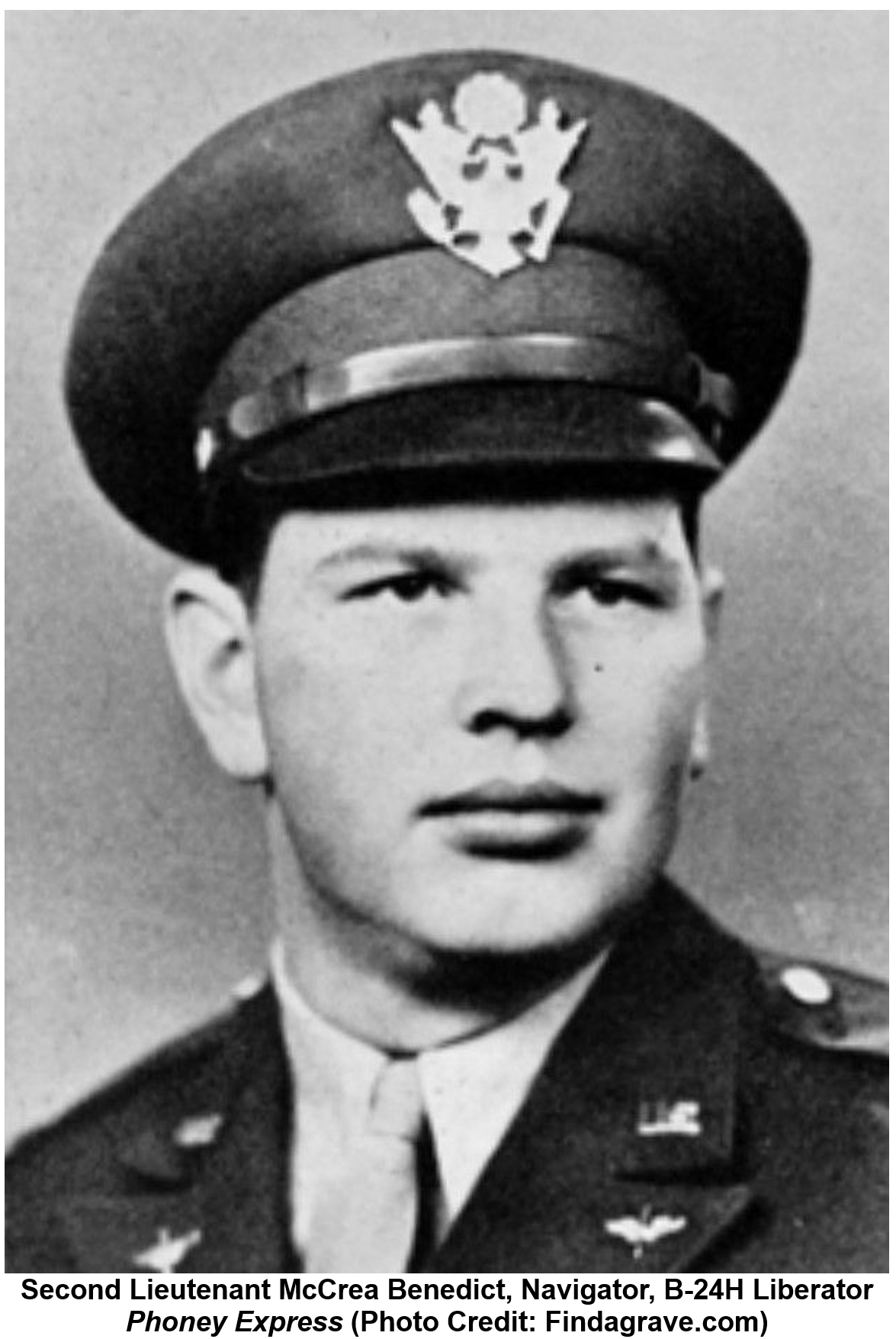
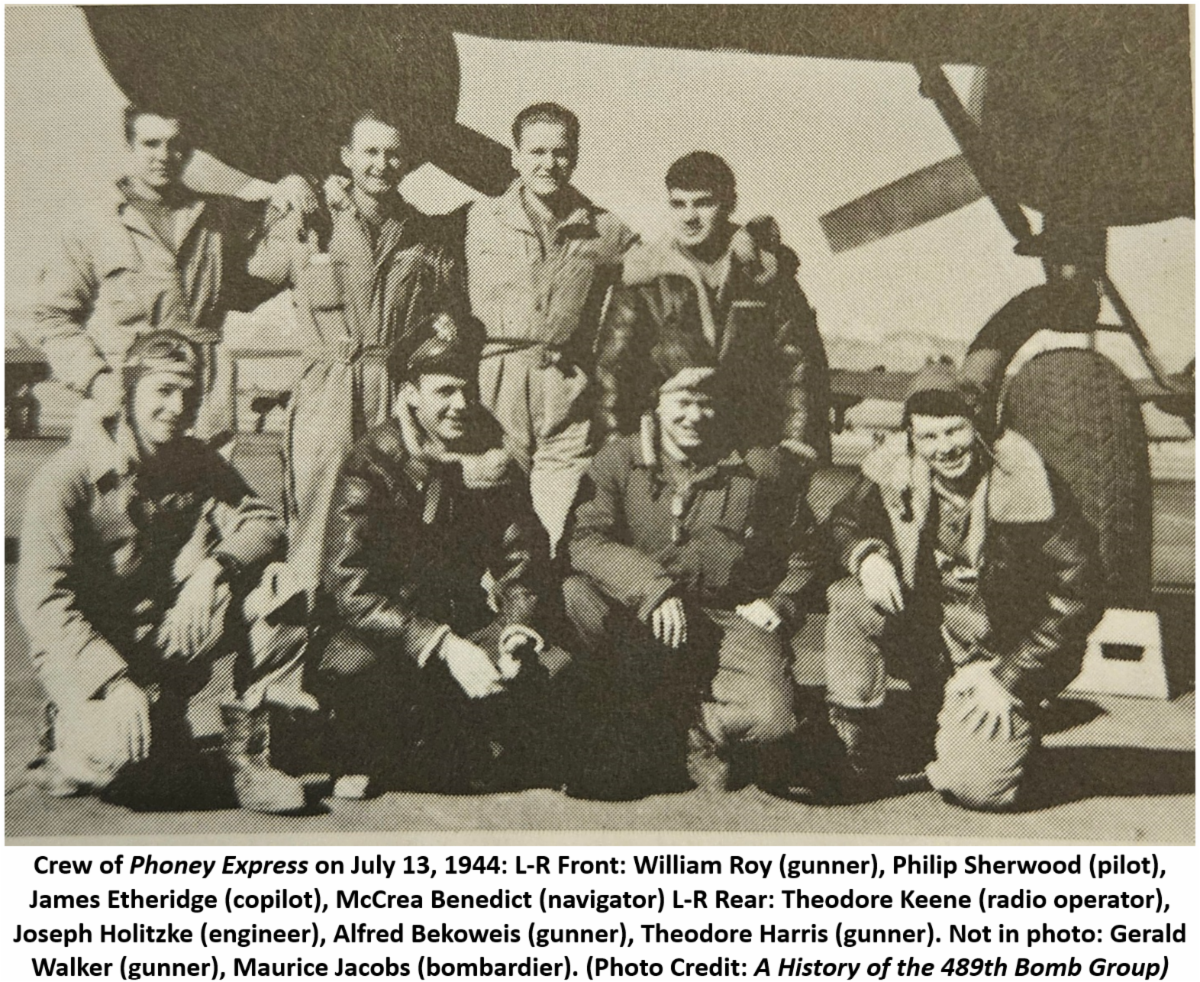
This story is about the fate of a ten-man American crew, one of whom was my uncle, Second Lieutenant McCrea Benedict, a B-24H Liberator navigator on his 21st mission.
“Uncle Mac”, my mother's youngest brother, was born on Christmas Day, 1919, in Cincinnati, and had been recently married. His father, Dr. Harris Miller Benedict, formed and led the Botany Department at the University of Cincinnati in 1914. He married Florence McCrea in 1906.
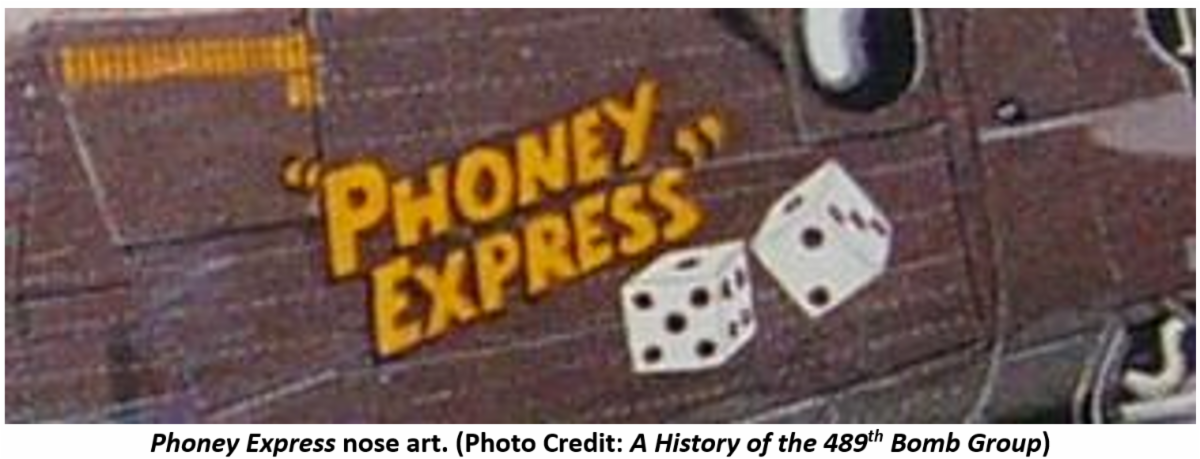
Uncle Mac was one of nine killed when their B-24H Liberator Phoney Express missed its second approach to the runway at Halesworth, Suffolk, England, and crashed at about 9:00 a.m. on July 13, 1944, after aborting a mission to Saarbrucken, Germany, because of engine problems.
The tail gunner, Sergeant Theodore Harris, survived the crash. His account is included in "A History of the 489th Bomb Group," a 300-page book by Charles H. Freudenthal of Vienna, Virginia, privately published in 1989. Phoney Express, Serial Number 42-94833, was assigned to the 844th Bombardment Squadron of the 489th.
| |
|
Pilot First Lieutenant Philip Sherwood, writes Freudenthal, had trouble with the Number 4 engine which "forced him to abort the mission early and return to Halesworth with their full load of four 2,000 lb. bombs." Quoting official records, he says Sergeant Harris "was thrown clear of the wreckage...and into a nearby wheat field." As the first of the four bombs exploded, "windows of the nearby houses were smashed, roofs caved in, and debris from the crashed aircraft was scattered over a radius of about a thousand yards."
"...As we climbed to our assigned altitude," Harris told investigators, according to Freudenthal, "we noticed one of the engines (I can't be sure which one) losing power. As we approached our assigned altitude, 22-23,000 feet, the engine had to be turned off and the propeller feathered. We managed to stay with the formation for a while, though staggering a little, and then the second engine started to lose power too, so Lt. Sherwood was forced to abort the formation and return to base. As we left the rest of the group and began losing altitude, the second engine returned to a more normal operation. We were over the North Sea, approaching the base, when Lt. Sherwood called the crew to discuss whether or not we should dump the bombs in the sea before landing. He said the plane was responding well even with one engine out. Under the circumstances he suggested that we keep the bombs, and all crew members agreed.
"Although my regular position was in the ball turret, I was flying in the tail turret on this mission. Sergeant [William] Roy, the usual tail gunner, was qualifying for Gunnery officer's school, and one of the requirements was to fly one combat mission in each of the gunnery positions. On this one, he was in the ball turret. The landing position for the tail gunner on our crew was standing on the catwalk just forward of the front bomb bay bulkhead. The ball turret gunner would sit on the floor next to his turret, facing the rear of the plane with his back against the rear bomb bay bulkhead. After Lt. Sherwood gave orders to prepare for landing, I stowed the tail turret and started forward to my landing position. As I passed the ball turret, I could see that Roy was having some difficulty stowing the turret. Since we were in our approach for landing and time was limited, I asked him to take his usual landing position and I would stow it. When I had done that, I took my usual position against the rear bulkhead. At this time, most crew members didn't have their ear phones on and therefore we did not hear any of the conversation between the pilot and co-pilot. The two waist gunners, Al Beckowies and Gerald Walker, were the only other ones with me in the rear. They each assumed the prone position on the floor beside their combat stations, with their heads propped up on their removable chest parachutes.
| |
|
"Shortly after we had taken our landing positions, and about the time we expected touchdown, I thought I saw a red light, such as a flare, out of the waist window. Then I realized that Lt. Sherwood was not going to land on this approach, but was going to circle the field and come in again. Very shortly thereafter, the main door in the rear bulkhead, which was immediately to my right, flew open, and green vegetation started flying in, just like cut grass leaving a rotary lawn mower. Then I left my position, with no sensation of a collision or other problems and started to float the air toward the tail of the plane. The last thing I remember was being suspended in air directly over Gerald Walker, who was still lying on the floor in his landing position...."
Harris suffered serious injuries and began the trip back to the United States on August 13, 1944, a month after the crash, according to Freudenthal’s book. He was discharged from the service on November 12, 1945.
Uncle Mac’s remains were sent to the family plot at Spring Grove Cemetery in Cincinnati from the Cambridge American Cemetery in England, which honors the service and sacrifice of more than 8,500 Americans who died in military operations based in the United Kingdom in World War II.
Col. Gene Pfeffer (USAF-ret.), Museum historian and curator, contributed to this article.
| |
|
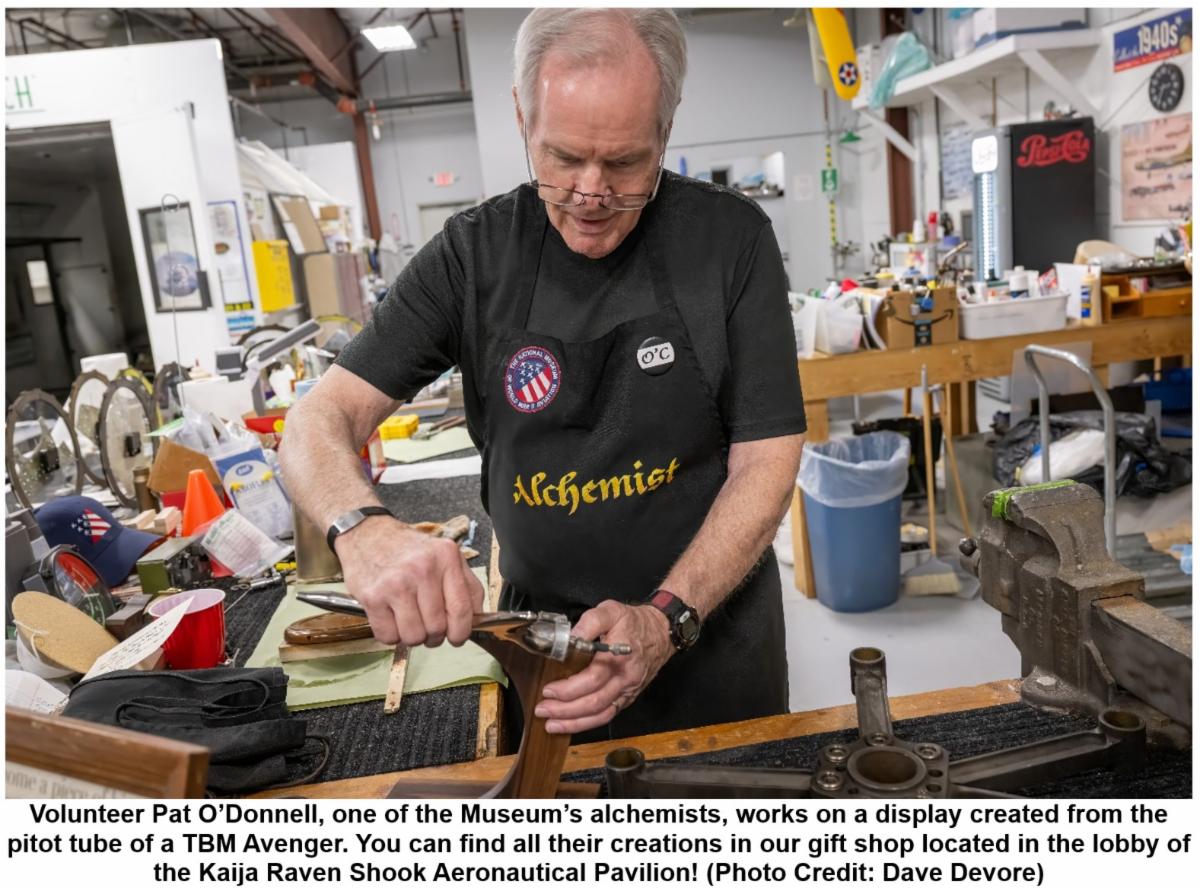
An alchemist is defined by Oxford Languages as, “a person who transforms or creates something through a seemingly magical process.” The Museum is proud to have its very own talented team of alchemists who create amazing works of art from original aircraft parts, and to most of us the process truly does seem magical! A piston turned into a lamp? We’ve got that! Bookends made from .50 caliber ammunition feeders? We’ve got that! A table made from the wing of an aircraft? We’ve got that!
To visit the Gift Shop Creations area and see our alchemists at work, exit the Kaija Raven Shook Aeronautical Pavilion through the north door (at the end of the hallway next to the Home Front exhibit), then walk across the tarmac and enter the Guest Entrance door between Hangars One and Two.
Looking for that one-of-a-kind gift for your favorite WWII aircraft enthusiast? Visit the Museum Gift Shop at the Main Entrance to see what alchemist’s creations are for sale this week during your visit. If you see something you like, snap it up while you have the chance; items are often unique and constantly being sold, so there’s no guarantee you’ll find anything like it again!
Story Credit: George White and Rich Tuttle
Photo Credit: Dave Devore
| |
|
The Airfield
Grumman F3F "Flying Barrel"
| |
|
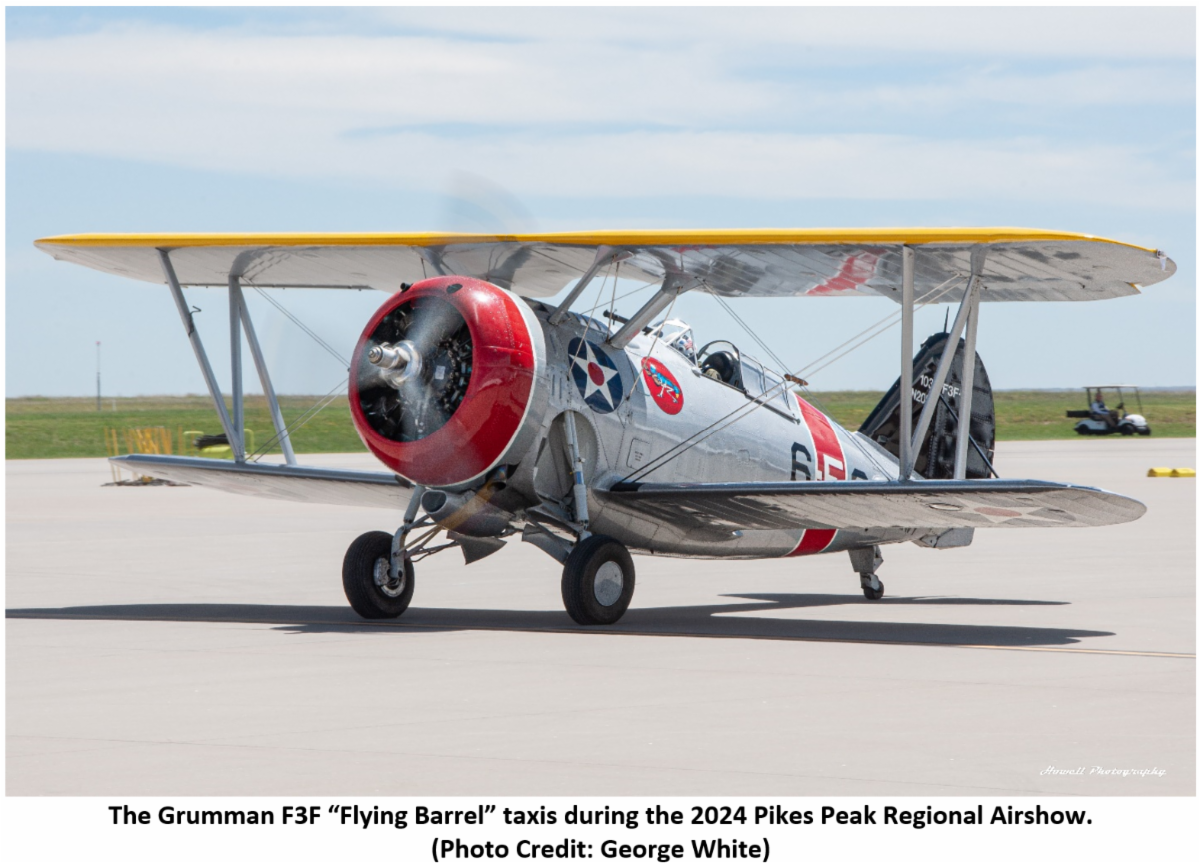
The Grumman F3F on display in the museum is one of less than a handful of flyable F3F examples that remain. Affectionately known as the "Flying Barrel", The F3F was the last biplane fighter aircraft delivered to the United States Navy, and the last biplane fighter delivered to any American military air arm, serving Navy and Marine aviation from 1936 through 1941. It was succeeded as the fleet’s frontline fighter initially by the Brewster F2A Buffalo and then quickly by the Grumman F4F Wildcat. Designed as an improvement on the Grumman F2F, the F3F inherited the Leroy Grumman-designed retractable main landing gear configuration used on an earlier Grumman aircraft design. This landing gear configuration was carried over to the much-improved F4F monoplane.
The first F3F prototype was flown by Grumman test pilot Jimmy Collins on 20 March 1935. During a dive-recovery test flight the aircraft's pullout at 8,000 feet the aircraft broke up in midair, crashing in a cemetery and killing Collins. A second, strengthened prototype was built, but it crashed on 9 May 1935 following the pilot's bailout during an unsuccessful spin recovery test. The second prototype was then rebuilt in three weeks and testing continued.
An order for 54 F3F-1 fighters was placed on August 24, 1935, following the conclusion of the flight test program. Delivery of the first production F3F-1s began in March 1936 with squadrons VF-5B of the U.S.S. Ranger and VF-6B of the U.S.S. Saratoga. At that time the “B” in the squadron designator denoted the squadron sailed aboard a carrier of the battle fleet. Marine squadron VF-4M (M for Marine) received the last six F3F-1s in January 1937.
| |
|
Grumman, wanting to take advantage of the powerful new 950 hp Wright R-1820 Cyclone supercharged radial engine, then began work on the F3F-2; an order for 81 aircraft was subsequently placed in July 1936. The engine's larger diameter changed the cowling's appearance, making the aircraft look even more like a barrel, though top speed increased only slightly. The entire F3F-2 production series was delivered between 1937 and 1938. When deliveries ended, all seven Navy and Marine Corps pursuit (what later became fighter) squadrons were equipped with Grumman single-seat fighters. In June 1938, the Navy ordered 27 improved F3F-3s, as new monoplane fighters like the Brewster F2A and Grumman's own F4F Wildcat were taking longer to develop than had been planned.
With the introduction of the Brewster F2A-1, the Navy's biplane fighter days were numbered. All F3Fs were withdrawn from squadron service by the end of 1941, though 117 were assigned to naval bases and used for training and utility duties until December 1943. A few F3Fs were used by the U.S. Army Air Forces as ferry-pilot trainers, under the designation UC-103.
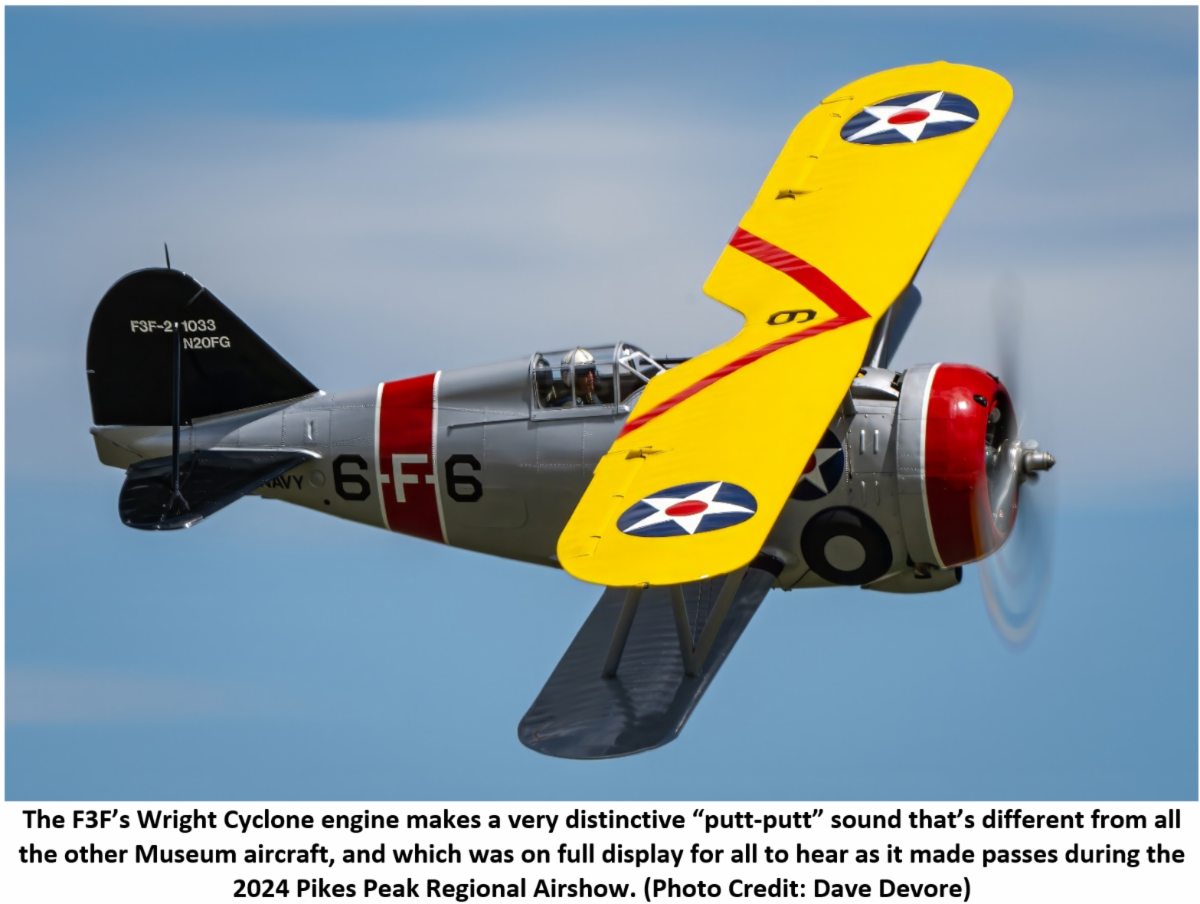
The F3F-2 was powered by the 950 horsepower Wright R-1820-22 Cyclone radial engine and had a maximum speed of 264 miles per hour, although it cruised at 150 mph. It also had a range of 980 miles, and a service ceiling of 32,300 feet. This aircraft had both a 0.30 caliber and a 0.50 caliber machine gun above the engine in the nose ring firing through the propeller. A major limitation was in the amount of ammunition—only 500 rounds for the 0.30 caliber and 200 for the 0.50 caliber. It could also carry one 116 lb. bomb under each wing.
The F3F-2 was featured in the 1940 film “Flight Command”, starring Robert Taylor as a pilot whose work developing instrument landing systems helps his lost squadron return to Naval Air Station (NAS) North Island. Perhaps the most prominent and popular record of F3Fs is in the 1941 Technicolor film “Dive Bomber”, also set at NAS North Island. This film extensively used parked F3Fs as background and one single aircraft in flight in the last action scene.
| |
|
On-line data developed from Department of the Navy records indicates that the F3F-2 currently resident at the museum, serial number 1033, was originally assigned to Marine Fighting Squadron VMF-2 in 1937. Several future Medal of Honor recipients served with the squadron during this period, including Henry Elrod, Robert Galer, and Gregory “Pappy” Boyington. So, it may be possible that one of these Medal of Honor winners flew number 1033 at some point.
In January 1941, the squadron moved to Marine Corps Air Station Ewa, Hawaii, and was re-designated VMF-211, a famous Marine squadron with significant combat experience in WWII. By late 1941, VMF-211 had traded its F3F-2s initially for Brewster F2A3s, and then very quickly it upgraded to Grumman F4F Wildcats. In November 1941, VMF-211 embarked 12 of its 24 F4F-3 Wildcats and 13 of its 29 pilots aboard the USS Enterprise for movement to Wake Island, the scene of the squadron's heroic efforts in late December 1941 to fend off the Japanese invasion of the island. During the fight all 13 pilots were killed or captured. The squadron’s other 12 aircraft which had remained in Hawaii were destroyed in the December 7, 1941, Japanese attack. Later, after re-equipping with aircraft and taking on new pilots, the squadron participated in the Bougainville, Bismarck Sea, Northern Solomon, Leyte Gulf, and Southern Philippine campaigns. The squadron survives today as VMFA-211, equipped with the short take off-vertical landing version of the F-35 Lightning II.
Records also show that, for a period of time, 1033 was assigned to the staff of the Commander, Aircraft Battle Force, U.S. Fleet. The data indicates it crashed into a mountain at Wailuki, Maui, Hawaii on June 24, 1941. It was subsequently recovered in the 1980s and restored to the magnificent, flyable aircraft it is today.
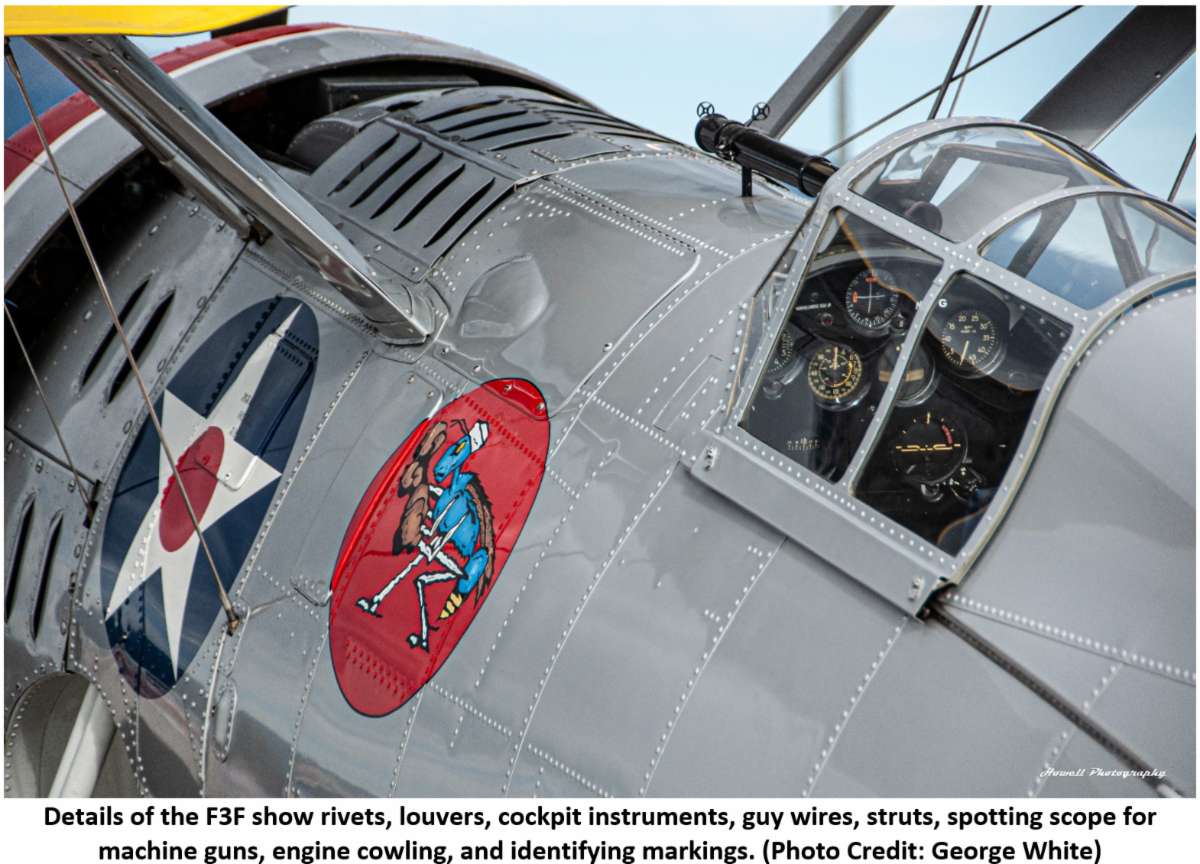
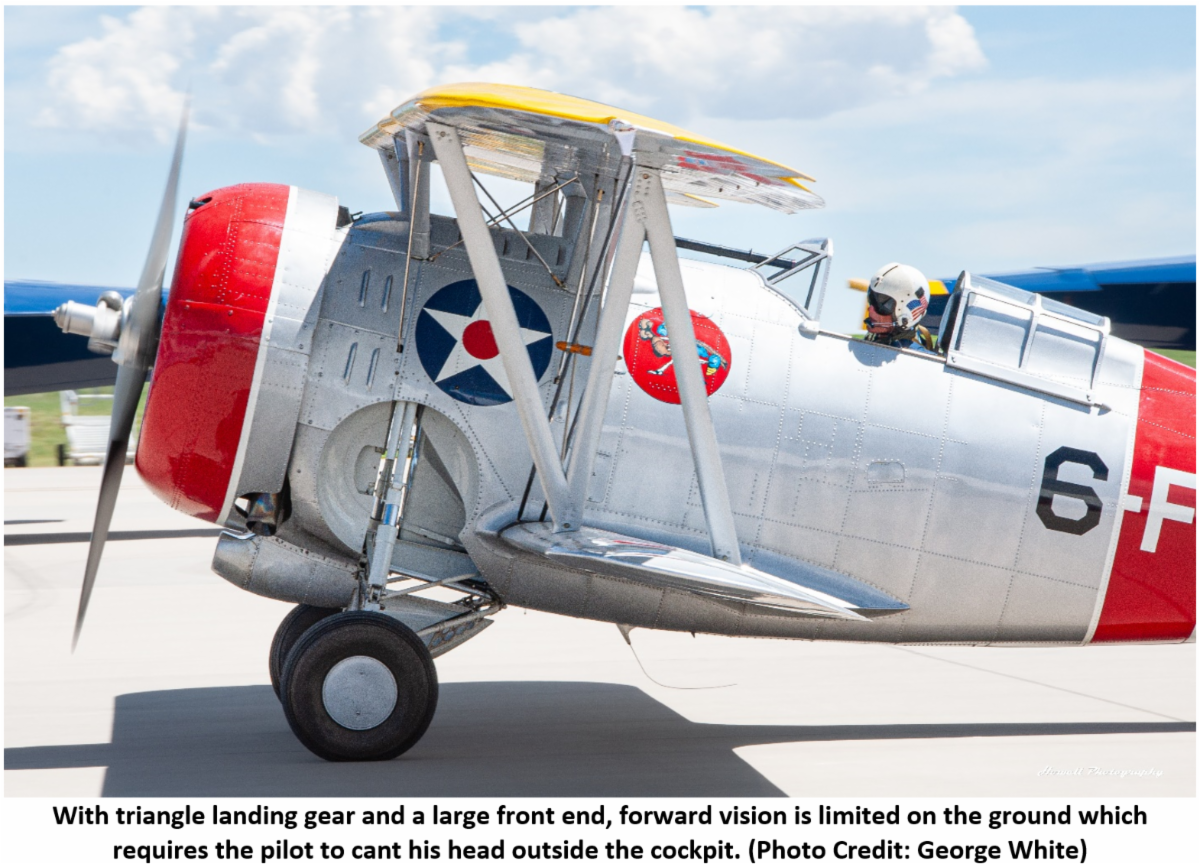
The paint scheme and markings of the aircraft on display in the museum reflect markings of squadrons that flew the F3F-2. Its squadron identification number, 6-F-6, is the number of an aircraft that was assigned to the Fighting Squadron 6 that deployed on the U.S.S. Saratoga for a time. The squadron insignia on the side of the aircraft, the blue wasp with boxing gloves, is the insignia of squadron VMF-7 assigned to the U.S.S. Wasp. The black tail is also characteristic of the Wasp squadron. Its red fuselage stripe is the identification of the first section of the squadron while the full red cowling indicates the aircraft of the section leader. The star on the front is the nationality marking carried by all U.S. aircraft from 1919 through early 1942. The red circle was removed in 1942 because of concern the marking could be confused with the Japanese larger red circle.
Story Credit: Colonel Gene Pfeffer (USAF-retired), Museum Curator and Historian
| |
|
Specifications
Length: 23 ft 2 In
Wingspan: 32 ft
Height: 9 ft 4 in
Power Plant: Wright R-1820-22 “Cyclone” 9-cylinder radial engine, 950 hp
Maximum Speed: 264 mph
Cruise Speed: 150 mph
Range: 980 miles
Service Ceiling: 32,300 feet
Crew: 1
Guns:
• 1 x 0.30 caliber M1919 machine gun, 500 rounds (left)
• 1 x 0.50 caliber M2 machine gun, 200 rounds (right)
Bombs:
• 2 x 116 lb. Mk IV bombs
| |
|
Special Presentation:
Operation DRAGOON – A Second D-Day in France
Saturday, November 16, 2024
Museum opens at 9:00 a.m.
Presentation at 10:00 a.m.
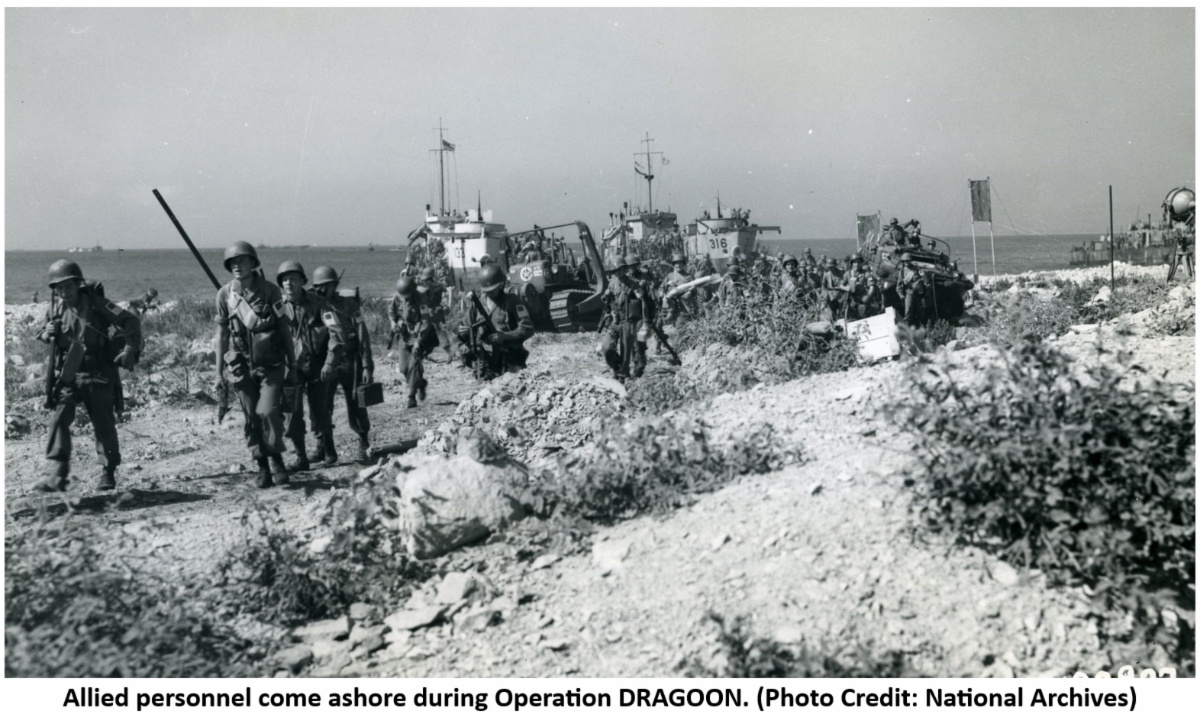
Operation DRAGOON, the highly successful August 1944 invasion of southern France, was one of the largest amphibious landings of WWII with about 500,000 American and French troops participating. Yet it was overshadowed by Operation OVERLORD, the Normandy invasion of France in June 1944. Together, OVERLORD and DRAGOON functioned as a pincer that destroyed German forces in France. DRAGOON was originally planned for June in conjunction with OVERLORD, but lack of sufficient resources for simultaneous landings delayed DRAGOON until August.
Preceded by a massive air and naval bombardment and commando raids on coastal defenses, on August 15, 1944, three American infantry divisions landed on the French Riviera, today some of the priciest real estate in Europe. Airborne drops behind the beaches delayed German counterattacks. On August 16, the first of an eventual 260,000 soldiers from the Free French Army were ferried ashore. The liberation of the French Mediterranean ports of Marseille and Toulon by August 28, and the speed with which the ports were put back in working order, meant that the Allied forces streaming into Normandy could more quickly be supplied for their final push into Germany.
Operation DRAGOON met far less resistance than OVERLORD two months earlier. Allied losses on the beach landing sites on the first day of DRAGOON were just 95 killed and 185 wounded, compared with almost 4500 Allied soldiers killed on D-Day.
| |
|
On Saturday, November 16, 2024, at 10:00 a.m., museum Docent and retired Army Colonel Nick Cressy will tell the story of Operation DRAGOON, how it came to be, how it was executed, and the important results of the second invasion of France.
Standard admission prices are in effect. The purchase of advance on-line tickets is encouraged.
Advance ticket prices are:
Adult - $17
Child (4-12) - $13
Senior and Military - $15
WWII Veterans – Always FREE!
Children 3 and Under – Always FREE!
Museum Members - Included in membership; please call 719-637-7559 or stop by the front desk to make your reservations.
And of course, parking is always FREE!
Story Credit: Colonel Gene Pfeffer (USAF-retired), Museum Curator and Historian
| |
Give Us Your Newsletter Feedback! | |
|
Do you really love an article? Did a photograph really wow you? Have a question about a story? Want to see more of a certain topic? Did something spark a memory that you'd like to share with us?
We'd love to hear your what you have to say about the newsletter; let us know by dropping the editor a message at newsletter@worldwariiaviation.org!
| |
Newsletter Staff / Contributors | |
Gene Pfeffer
Historian & Curator
| |
Rich Tuttle
Newsletter Writer, Social Media Writer, Photographer
| |
John Henry
Lead Volunteer for Communications
| |
George White
Newsletter Editor, Social Media Writer, Photographer
| | | | |