|
Now to the business at hand. I’ve noticed that ordinary circumstances often teach us extraordinary things; this story is no exception:
What We Learn from Sheep
With much anticipation, my lawn mowing crew finally arrived—far more than I ever expected! You see, William delivered almost a hundred sheep (ninety-three to be precise) in seven loads over the course of several hours. This was a first-ever experiment, after I had painstakingly attempted for years to mow our three-acre back yard with powered equipment. I never could do a good job, however, because of the dense trees and uneven terrain. So, what the heck, let’s try this, I told myself, responding to an ad on a local app.
It was exciting to watch the sheep come in, load after load—big ones, little ones, old ones, young ones, white ones, black ones, brown ones, and even some mixed-color ones. Some were unkempt with lots of wool hanging off them, and some were totally smooth. Some were very cute, and some—well, not so much.
William set them up inside a movable electric fence, not just to keep them in, but also to keep predators out. He placed two large troughs inside the fence near the gate, filling one with water for the sheep to drink. He then left for the day, and what I learned by simply watching the sheep was truly amazing. In fact, I made seven observations, from which seven distinctly different, and important, lessons emerged:
Observation 1. Whenever the sheep became frightened, e.g., when my two dogs came out and barked at them, they immediately ran away from the threat and huddled together.
Lesson 1. Scripture admonishes us to flee from temptation (danger), as we observe in Joseph’s running from Potiphar’s wife’s advances:
She caught him by his cloak and said, “Come to bed with me!” But he left his cloak in her hand and ran out of the house (Genesis 39:12), and in Proverbs 22:3:
The prudent see danger and take refuge, but the simple keep going and pay the penalty.
We’re also advised to seek strength in numbers:
And if somebody overpowers one person, two can resist him. A cord of three strands is not easily broken (Ecclesiastes 4:12).
And let us consider how we may spur one another on toward love and good deeds, not giving up meeting together, as some are in the habit of doing, but encouraging one another—and all the more as you see the Day approaching (Hebrews 10:24-25).
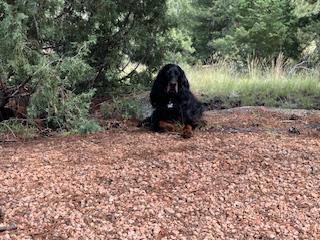
Observation 2. The electric fence was observably useful—first, in effectively keeping the sheep in, second, in keeping my two dogs out. The sheep had obviously experienced their boundaries enough to simply accept them. The dogs, on the other hand, tried to get at the sheep through the fence; it took my favorite dog Obee just two painful zaps to get the message, while it took my other dog Aries four (he’s obviously a bit slower on the uptake).
Lesson 2. The Bible is like our own personal electric fence, establishing boundaries. We, like sheep, will wander without them. And we are also indefensible without them.
All Scripture is God-breathed and is useful for teaching, rebuking, correcting and training in righteousness, so that the servant of God may be thoroughly equipped for every good work (2 Timothy 3:16-17).
Put on the full armor of God, so that you can take your stand against the devil’s schemes (Ephesians 6:11).
Observation 3. Whenever William arrived to check on the sheep, they immediately approached him; some were running at the sound of his voice, others followed, behind the runners.
Lesson 3. Sheep know their shepherd’s voice and are faithful to follow him.
“My sheep listen to my voice; I know them, and they follow me” (John 10:27).
Someone once wisely said that, “one who follows the wrong Christ is lost, and one who follows a person who follows the right Christ is equally lost.” The sheep slowly following the runners may, in fact, find themselves in the latter category. Makes me wonder if they were following the shepherd’s voice or, rather, following the herd.
Observation 4. Most of the sheep were quick to drink water from the filled trough, although a few tried the empty one before giving up and moving over to the filled one.
Lesson 4. The Lord knows what we need, and provides for all we need. We see a graphic example of this in Exodus 16:1-36, where God provides manna for the Israelites to eat. When they collected more than they needed, it spoiled by the next day. But, interestingly, God provided a double portion on the sixth day so they might observe the Sabbath without having to work by gathering food on that special day.
Another example of God’s supernatural provision is observed as Jesus encounters the Samaritan woman at the well in John 4. She is looking for regular drinking water; He promises her living water instead, with the caveat she won’t have to drink again.
“If you believe, you will receive whatever you ask for in prayer” (Matthew 21:22).
And my God will meet all your needs according to the riches of his glory in Christ Jesus (Philippians 4:19).
Observation 5. All the sheep got along well, regardless of the differences in coloration. At times the non-totally white ones congregated together briefly, but then intermixed peaceably again.
Lesson 5. Why can’t we do that in our culture today? Why do we so easily divide, and even become hateful, over something that is only skin deep?
There is neither Jew nor Gentile, neither slave nor free, nor is there male and female, for you are all one in Christ Jesus (Galatians 3:28).
Observation 6. Often, when they were full from eating, the sheep would lie down to rest in the shade, confident in their shepherd’s oversight.
Lesson 6. The sheep trusted their shepherd, not only to lead and protect them, but to provide comfortable rest as well. Jesus, our shepherd, invites us to do the same:
The Lord is my shepherd, I lack nothing.
He makes me lie down in green pastures,
he leads me beside quiet waters,
he refreshes my soul.
He guides me along the right paths
for his name’s sake.
Even though I walk
through the darkest valley,
I will fear no evil,
for you are with me;
your rod and your staff,
they comfort me. (Psalm 23:1-4).
Observation 7. The sheep were content with their calling—to be sheep and do what sheep do.
Lesson 7. The closer we are to Jesus, the less anxious we necessarily become; circumstances cannot, and should not, determine our emotions.
It’s why Job confidently proclaimed, “Though he slay me, yet will I hope in him” (Job 13:15a).
It’s why Paul commanded us to not be anxious about anything, but in every situation, by prayer and petition, with thanksgiving, present your requests to God. And the peace of God, which transcends all understanding, will guard your hearts and your minds in Christ Jesus (Philippians 4:6-7).
And it’s why Paul explained that “I am not saying this because I am in need, for I have learned to be content whatever the circumstances. I know what it is to be in need, and I know what it is to have plenty. I have learned the secret of being content in any and every situation, whether well fed or hungry, whether living in plenty or in want” (Philippians 4:11-12).
Could it be that we become anxious as humans because (when) we’re not living up to, or content with, our calling?
My Prayer: Lord, thank You for sheep, and what they teach us! May I learn to flee temptation, and establish healthy boundaries by staying in the Word. Help me to better recognize Your voice. Thank You for providing for all my needs. May I better see what unites us as Your children, rather than what might divide us. Teach me to lie down and rest in silence and solitude, and to become more content with the calling You’ve placed on my life.
Teach me to become more like sheep.
Teach me to become more like You, who are, after all, the Lamb of God!
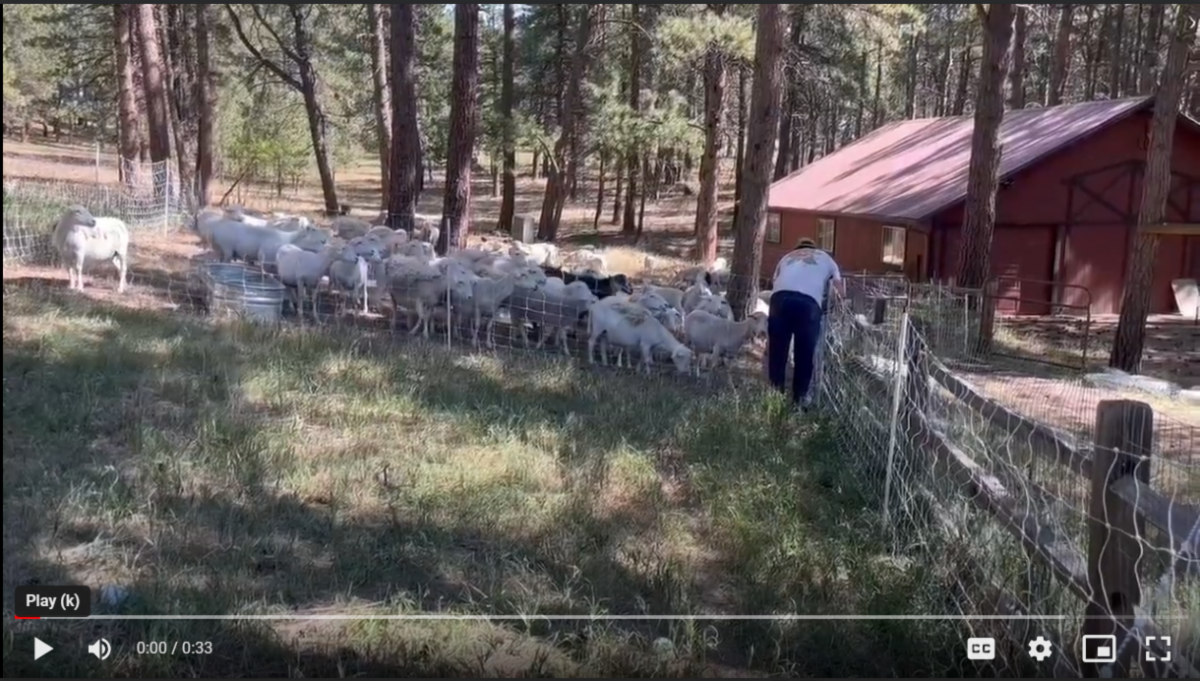
I took a 30-second video of Will moving the sheep from a cleared pasture to an uncleared one. Don’t they seem most excited to get to the fresh salad bar?
It’s embedded here for you to check out:
|