Hi, just a reminder that you're receiving this email because you have expressed an interest in Western Regional Advocacy Project. Don't forget to add wrap@wraphome.org to your address book so we'll be sure to land in your inbox!
 
You may unsubscribe if you no longer wish to receive our emails.

Hey People,


Patrolling and controlling our public spaces- sidewalks, streets and parks- Business Improvement Districts (BIDs) are privatizing our downtowns; criminalizing, and displacing the houseless, buskers, street vendors and poor people.


FOR IMMEDIATE RELEASE
September 18, 2018

What: UC Berkeley Report Release

Where: 10:30am @ San Francisco City Hall. 1 Carlton B Goodlett Pl, San Francisco, CA
Where: 12:00pm @ 5th and Spring St. Downtown Los Angeles, CA
Where:
12:00pm @ Skyline Park. 16th St & Arapahoe St. Denver, CO.
Where: 4:30pm @ Sacramento City Hall, 915 | St. Sacramento, CA
Where: 4:00pm @ Pioneer Courthouse Square, 701 SW 6th Ave. Portland, OR


THE POLICY ADVOCACY CLINIC AT UC BERKELEY SCHOOL OF LAW RELEASES CALIFORNIA BUSINESS IMPROVEMENT DISTRICTS REPORT..HOMELESS EXCLUSION DISTRICTS  


The Policy Advocacy Clinic at UC Berkeley School of Law conducted a study for the Western Regional Advocacy Project (WRAP) to understand the effects Business Improvement Districts (BIDs) have on houseless communities in California.

Patrolling and controlling our public spaces, sidewalks, streets, and parks, Business Improvement Districts (BIDs) are privatizing our downtowns and main thoroughfares. Our public spaces are becoming corridors and shopping centers that are welcoming consumers with open arms and excluding everyone else. Most particularly impacted by this emerging trend are the houseless communities that see areas to rest and sleep, free from harassment and criminalization, shrinking.

A BID is a special, legal subdivision of the city, with the legal authority to create their own districts, effectively claiming ownership over neighborhoods. The city collects assessments (taxes) from property owners, including city property and public spaces within the district, and then distributes that money to the BID. The BIDs can use those funds however they see fit to serve businesses within the district with little to no public oversight.

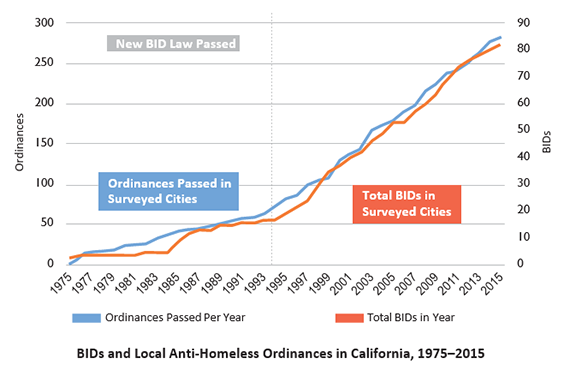
This study "Homeless Exclusion Districts: How California Business Improvement Districts Use Policy Advocacy and Policing Practices to Exclude Homeless People from Public Space," is the first of its kind and contains groundbreaking research on how BIDs impacts our local communities and reflect the impacts of BIDs across the country. The report analyses the several ways in which current BID policy and policing practices violate California law and infringe on the legal rights of homeless people. The UC BerkeleyLaw Policy Advocacy Clinic surveyed approximately 189 BIDS in 69 of California's largest cities to study the relationship between BIDs and houseless people. Clinic student Shelby Nacino states "Our research shows that BIDs have been successful in pressing state and local lawmakers to criminalize homelessness.The growing number of BIDs since the legislature gave them greater authority and autonomy in 1994 correlates strongly with a striking increase in anti-homeless laws."  

The study found that "BIDs violate California law when they spend property assessment revenue on policy advocacy... BIDs may violate additional state laws when they spend assessment revenue collected from public properties within their districts on policy advocacy... BIDs and their agents may violate state, federal, and international law through their policing practices, including the infringing on the legal rights of homeless people."

BIDs have been at the forefront of the criminalization of homelessness, gentrification, and displacement of poor people across the country. In the Bay Area, we see and experience the backlash of BIDs' influence on public policy, privatization of public spaces and policing every day. Unfortunately, the repercussions of BIDs are visible not just in the Bay Area. Benjamin Dunning from Denver Homeless Out Loud stated that business districts in Denver started to take sections of sidewalk away. "This was public space, and they were offering it up to private business... The business improvement district made environmental changes to make it more difficult for homeless people to exist in that area." BIDs are privatizing public space across the country and with privatization comes policing, criminalization and displacement of the houseless, buskers, street vendors and the local poor.

"BIDs will go Block by Block to ensure that every sidewalk, street, and park serve to benefit the businesses that are in the district. Public Space has become nothing more than the hallways of a shopping mall and if you are in that hallways you better be there to shop, or someone might chase you out." says Paul Boden of WRAP.

With the release of this study "Homeless Exclusion Districts: How California Business Improvement Districts Use Policy Advocacy and Policing Practices to Exclude Homeless People from Public Space," we hope to bring greater awareness to how our shiny new shopping spaces are created, and what goes into their creation--mainly our tax dollars and our freedom.


I'M BIG......I'M BAD......I'M A BID!!

Patrolling and controlling our public spaces- sidewalks, streets and parks- Business Improvement Districts (BIDs) are privatizing our downtowns and main thoroughfares. Our public spaces are becoming corridors and shopping centers that are welcoming consumers with open arms and excluding everyone else. Most particularly impacted by this emerging trend are the houseless communities, who are seeing these areas to rest and sleep, free from harassment and criminalization, shrink.

BIDs have been growing significantly across the United States. In California, BIDs have grown exponentially since the passage of the Business Improvement District Law of 1994, which expanded their budget, autonomy and authority. One hundred eighty-nine BIDs have been identified in 69 California cities surveyed. What began as a way to supplement public services within geographically defined boundaries has turned into massive beasts with large budgets, controlling public space and being significantly funded with tax dollars with little to no oversight.


Even though BIDs control large swaths of private and public land, many people do not know what a BID is. However, most people could probably point out the BID Ambassador and street cleaning teams, whose brightly colored uniforms are a common sight as they give tourists and shoppers directions, pick up garbage, and pressure wash sidewalks. A positive sight for many, but behind the scenes, BIDs have become powerful lobbies, crafting or supporting ballot initiatives and legislation to push anti-homeless loitering, sit-lie, sidewalk obstruction and other laws, ensuring the further criminalization of homeless people and compounding the day to day harassment of the houseless community. As shown below, the increase in BIDs directly correlates to an increase in local anti-homeless laws.


BIDs are formed when business owners and/or property owners come together, petition for their establishment and get approval from the local government. Once the BID is established, the local government collects an assessment (tax) from all the property owners within the district, including the local government on publicly owned parcels. Funds from this tax are then turned over "to a nonprofit or to a quasi­-governmental agency run by the BID organization’s board of directors." Some BIDs are run by business owners, who are primarily focused on bringing in more shoppers, while others are run by property owners, who are interested in attracting tenants who can pay higher rents for storefronts and/or housing. In effect, our local governments are turning taxpayer dollars over to private businesses, which use that money to create a more "safe and attractive" consumer environment. There are well over 1,000 of these special districts throughout the United States, whose main function is to drive poor and homeless people away from the neighborhood by hassling them, enforcing the sit-lie law and other discriminatory tactics, including contracting with the cops to step up enforcement of "quality of life" offenses, thus criminalizing homeless and poor people's existence.

"It is my understanding that the people who ride around on bikes waking up the homeless are not supposed to put their hands on anyone... If I'm breaking the law a San Diego Police Officer is to do something about it- not some flunkie on a bike who has no badge, [and] won't tell me his name," stated a complaint filed by a homeless woman in San Diego, who was awakened by a BID security guard when he rode his bike into her.

To be clear, we are not just talking about houseless people when we talk about BIDs criminalizing non-consumers. BIDs do not want anyone in their districts from whom they cannot profit. This includes street vendors (Permit Betty), buskers and anyone who is hanging out in the neighborhood but not looking to purchase anything. Laws against sitting on the sidewalk and other such laws are always discriminately enforced, specifically with the goal of removing people, who are not wanted, from public spaces.

From a study by UC Berkeley Law School Policy Advocacy Clinic conducted for the Western Regional Advocacy Project (WRAP) to understand the effects Business Improvement Districts have on houseless communities in California, "BIDs violate California law when they spend property assessment revenue on policy advocacy... BIDs may violate additional state laws when they spend assessment revenue collected from public properties within their districts on policy advocacy... BIDs and their agents may violate state, federal and international law through their policing practices, including the infringing on the legal rights of homeless people." This study, "Homeless Exclusion Districts: How California Business Improvement Districts Use Policy Advocacy and Policing Practices to Exclude Homeless People from Public Space," is the first of its kind containing groundbreaking research on how BIDs impact our local communities.

"Their entire job is to push homeless people out by harassment, pressure washing the streets, and calling the cops on folks. They are also hiring formerly homeless people to harass other homeless people and removing them from their economic corridors," remarked Benjamin Donlon of Right To Survive in Portland, Oregon, on Clean and Safe, a 213 block BID that touts itself as the "oldest, largest and most successful BID in the nation" created by several adjacent BIDs, Clean and Safe controls all of downtown and Old Town Portland.

As General Dogon, an organizer from L.A. Skid Row can attest, "Cops will pull up and go right up to the BID guard and pull him to the side and have a conversation with them, and then walk over to the homeless person and tell them what they did wrong. The BID guards then began to think that they are the police and that they have the power. The community ambassador is really the community oppressor."

A classic example of BID control of public space is the Urban Camping Ban in Denver, Colorado. Terese Howard of Denver Homeless Out Loud said, "When the unauthorized camping ban was passed in Denver, The Downtown Business Partnership (a prominent BID in Denver) listed in their annual report that they were successful in the lobbying of the unauthorized camping ban. Further, the Downtown Business Partnership supports enforcement of sit-lie laws, enforcement of unconstitutional panhandling bans, and further architecturally pushes homeless people out of their districts by removing benches, water fountains, bathrooms and trash cans."

"BIDs will go Block by Block to ensure that every sidewalk, street and park serve to benefit the businesses that are in the district. Public Space has become nothing more than the hallways of a shopping mall, and if you are in that hallway you better be there to shop, or someone will chase you out." Said Paul Boden of WRAP.

With the release of the study, "Homeless Exclusion Districts: How California Business Improvement Districts Use Policy Advocacy and Policing Practices to Exclude Homeless People from Public Space," we hope to bring greater awareness to how our shiny new shopping spaces are created, and what goes into their creation-- mainly our tax dollars and our freedom.


Business Improvement Districts
Fact Sheet Download pdf

In the past couple of decades Business Improvement Districts (BIDs) have been greatly expanding and criminalizing the presence and activities of poor people all over the country.

What is a BID?

A business improvement district (BID) is a special, legal subdivision of the city. BIDs have the legal authority to create their own districts which effectively positions BIDs as the owners of these neighborhoods. BIDs are funded from disbursed city collected assessments (taxes) from property owners, including city property and public space, within a district. The BIDS can use those funds with very little public oversight in any way that they see fits within the framework of business improvement.

To create a BID, a petition is circulated to property owners in a district. This is usually initiated by business owners who plan to run the BID. The percentage needed for approval varies but generally it is 51% of petitions that are turned in although larger property owner's votes carry greater weight. After a proposed district collects enough votes of support, the city holds a public hearing and votes on whether to establish the BID.

What do BIDs do?

BIDs spend money on the following types of activities:

Security with ambassadors or private officers, patrol public spaces (sometimes armed and with the use of electronic security systems).

Drafting and promoting legislation that privatizes community space for business interests and criminalizes poor and homeless people, and anyone who is not a consumer. They lobby local and state legislators to push legislation that supports the targeting, harassment and exclusion of homeless people, poor people, street vendors, and buskers from their districts.

Opposing legislation that seeks to protect street based people from criminalization including those that attempt to overturn sit-lie ordinances.

Controlling the architecture and aesthetics of the district including creating parklets, holding festivals, and cleaning public spaces.

Many BIDs hire private companies to implement ambassador programs that provide districts with "safety, cleaning, hospitality, outreach, and landscaping services." In addition, Ambassadors work on behalf of the BID and wear special uniforms to distinguish themselves from the general public and from local cops (even though sometimes they can be confused for cops). BIDs are also known to hire private security or in some situations retired cops, working hand in hand with local law enforcement. Some BIDs claim to offer services, outreach, referral and resources to poor and homeless people. However, in most cities, the needs of the poor far outnumber viable services so often that the outreach that BID employees provide is superficial to non-existent.

TAKE ACTION - What You Can Do:

With BIDs playing an increasingly greater role in controlling our public spaces in our cities and states, and in creating laws that criminalize poor and homeless people, it's important to take action and say NO to BIDs!

Tell your local government:
Stop all public funding of BIDs
Ask for the immediate disbanding of BIDs
Cancel all special agreements with BIDs
Demand more public oversight


Document (video, photos, take notes) incidents of BID harassment of vendors, poor people, buskers, homeless people, and send your documentation to wrap@wraphome.org and your local groups fighting BIDs.

Ask your local business if they support BIDs. If they do not, ask them if they would be willing to put signage in their windows. If they support BIDs, don't patronize their business!

Download the facts, click here >>>>>