|
 |
Greetings from PCAP!
The Prairie Conservation Action Plan would like to welcome Dave Marit to his new role as Minister of Agriculture, stated PCAP Chair Orin Balas. With close to half of the remaining native prairie in Saskatchewan administered by the Ministry of Agriculture the policies regarding native land are important to all PCAP partners. Mr. Marit's involvement in agriculture over his lifetime as well as his association with many farm and ranch organizations in the past is a great asset. PCAP has worked with past Ministers and Ministry staff from the beginning of our organization and we look forward to working with Minister Merit as well as Ministry staff going forward, the PCAP Chair added.
In another vein, we are pleased to announce two upcoming webinars, as part of our PCAP Native
Prairie Speaker Series
. On September 25th, Nature Conservancy of Canada will present about Grassland Songbirds and NCC's new Valleyview Property. You can register to this webinar for free here. On October 9th, Kirsten Palmier, MSc candidate at the U of Regina, will be presenting about Bees and Pathogens. You can also register now for this second presentation here. As always, you can watch our previous webinars on the PCAP YouTube channel!
Other upcoming events that may interest you include "The Wildlife Society Conservation Expo" this week in Regina, the "Canadian Western Agribition" in November, the "Transboundary Grasslands Workshop" in December in Lethbridge, and the "Prairie Conservation and Endangered Species Conference" (PCESC) in February 2019, in Winnipeg. About the 2019 PCESC, it is open now the Call for Posters and Presentations (information here). It's also open a call for nominations for the Prairie Conservation Award, in recognition of significant long-term contributions to native habitat or species at risk conservation. For details on the nomination guidelines please click here.
Many other important upcoming events are attached in this newsletter. In addition, please take a look at the many interesting volunteer opportunities offered by Nature Conservancy Canada, the SK Minister of Environment, and Grassland National Park.
I would like to finish by reminding you on the PCAP Steering Committee Meeting for the 2019-2023 Framework Renewal, which will be held on October 15 and 16, 2018, in Riverhurst. This five-year planning process will provide an opportunity for reviewing the ongoing PCAP plans and actions, as well as outlining the intended areas of focus for the mid-term future. We look forward to seeing all the PCAP Partners represented in Riverhurst!
Please feel free to contact me at any time; I'm pleased to receive your questions, comments or ideas.
Diego Steinaker
SK PCAP Manager
306 352 0472
pcap@sasktel.net
|
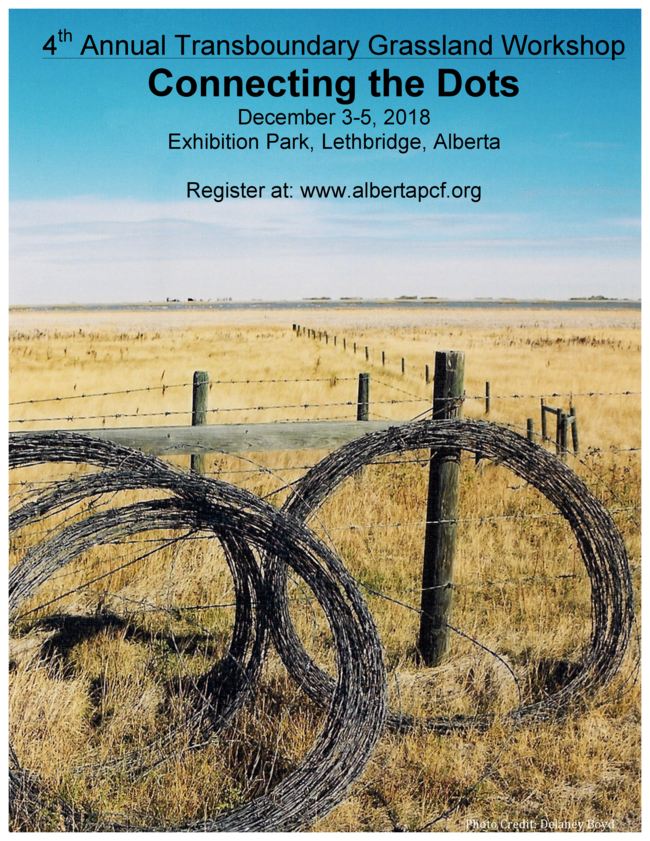
Transboudary Grassland Workshop
December 3-5, 2018
Lethbridge, AB
|
P
rairie Conservation and Endangered Species Conference - PCESC 2019
February 19-21, 2019. Winnipeg, MB
Early bird, until January 15, 2019
For details on the Conference Program please click here
|
|
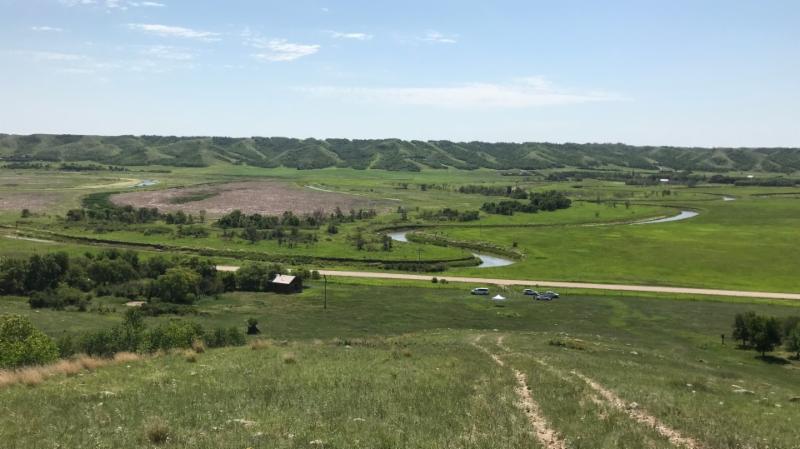
The Nature Conservancy of Canada protects one of the most significant habitat corridors near Craven, SK
The Nature Conservancy of Canada (NCC) and its partners
announced the purchase of 135.7 hectares (335 acres) of native grasslands and seasonal wetlands in the Upper Qu'Appelle Natural Area, approximately 40 minutes from Regina.
The Upper Qu'Appelle Natural Area provides important habitat for a number of species listed under the federal Species at Risk Act. Birds such as Sprague's pipit and chestnut-collared longspur, both threatened, and Baird's sparrow, special concern, are likely to be found at Valley View.
The Valley View conservation project enhances one of the most significant wildlife habitat corridors across southern Saskatchewan due to its location within the Qu'Appelle Valley, which stretches west to east across the province. The closeness to the towns of Craven and Lumsden and the city of Regina puts the acquired property at a high threat level for rural subdivision and acreage development. The area's native habitat is also at risk of conversion for annual cropping. The Valley View project is near several protected areas and other natural lands. For more information on this project please click here.
|
Released on August 29, 2018
The Government of Saskatchewan continues to implement key commitments made in the province's climate change plan to help reduce greenhouse gas (GHG) emissions and maintain a competitive economy.
As part of the made-in-Saskatchewan Prairie Resilience strategy, government has developed new output-based performance standards that will apply to more than 40 Saskatchewan industrial facilities. These facilities generate 11 per cent (or approximately 8.5 million tonnes) of total provincial emissions and are expected to reduce that portion by a total of 10 per cent by 2030. These measures are in addition to previously announced reductions in electricity generation (40 per cent) and methane from upstream oil and gas (40 per cent).
"Reductions in these three key areas will reduce emissions by 12 megatonnes of greenhouse gases each year by 2030," Environment Minister Dustin Duncan said. "Our bold and innovative system-wide strategy is designed to responsibly and tangibly reduce emissions without the imposition of an economy-wide carbon tax."
Saskatchewan's performance standards will increase over an established schedule from 2019 to 2030, cumulatively reducing GHG emissions by 5.3 million tonnes. The sector-specific performance standards are expected to achieve the following emissions intensity reductions:
- Potash, coal and uranium mining (5 per cent)
- Iron and steel mills (5 per cent)
- Fertilizer manufacturing (5 per cent)
- Pulp mills (5 per cent)
- Ethanol production (5 per cent)
- Refining and upgrading (10 per cent)
- Upstream oil and gas - combustion only (15 per cent)
Saskatchewan facilities will be able to choose from a suite of flexible compliance options including offset credits, best performance credits and a technology fund.
The SK Prairie Resilience Strategy is available
here.
Darby Semeniuk,
Environment,
Regina.
|
|
|
|
|
PCAP Native Prairie Speaker Series
Grassland Songbirds and NCC's new Valleyview Property
by Nature Conservancy of Canada
September 25, 2018, 12 pm
-----------------
Bees and Pathogens
by Kirsten Palmier
University of Regina
October 9, 2018, 12 pm
|
|
Upcoming Events!
November 19-24, 2018
Regina, SK
Transboundary Grasslands Workshop
December 3-5, 2018
Lethbridge, AB
February 19-21, 2019
Winnipeg, MB
|
|
Conservation Volunteer
Opportunities!
The Nature Conservancy of Canada has some great volunteer and citizen science opportunities!
------------------------------------------
The Saskatchewan Ministry of Environment is looking for volunteers to locate Ferruginous Hawks!
Read the details...
----------------------------------------
Parks Canada has many volunteer opportunities at the Grasslands National Park!
|
|
The Stewards of Saskatchewan (SOS) programs at Nature Saskatchewan are looking for article submissions for their SOS newsletter, and photos for their 2019 Calendar, by October 9th, 2018.
The annual newsletter and the calendar is sent out to the program participants (over 850 ranchers and farmers) as well as Nature Saskatchewan funders and partners.
The article must be between 250 and 500 words (1/2 to 1 page) and should focus on a topic relevant to landowners and producers, particularly those who have Species At Risk on their land. There is also a list of species applicable for the 2019 calendar.
|
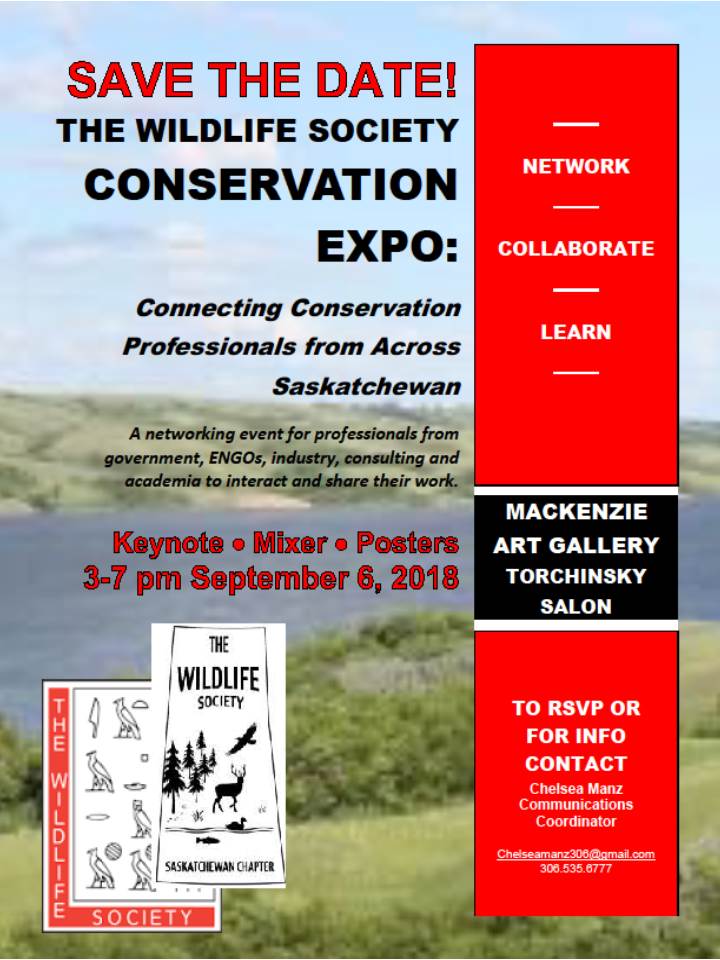
The Wildlife Society
Conservation Expo
6 September, 2018,
Regina, SK
|
|
The Saskatchewan Co-operative Wildlife Management Survey
The Saskatchewan Co-operative Wildlife Management Survey, formerly the Co-operative Deer Management Survey, is a long-standing, volunteer-based survey that provides the ministry with valuable productivity and herd structure information. Participants have the opportunity to conveniently record observations using the new mobile SK CWMS application, that is compatible with both Apple and Android smart phones.
Although the SK CWMS application will allow participants to record observations at any time of year, there are key periods where it is particularly important to record your observations for each species:
- White-tailed deer and mule deer: Sept 1 to Nov 30
- Moose: Sept 1 to Dec31
- Elk: Sept 1 to Feb 28
- Sharp-tailed Grouse: March 1-July 15
- Wild Turkey: Dec 1 to March 1
|
|
Saskatchewan Stock Growers Association (SSGA) and Parks Canada's Grasslands National Park (GNP) are teaming up to collaborate on a unique grass bank pilot project to conserve habitat for species at risk, particularly the Greater Sage-grouse, Sprague's Pipit, and Chestnut-collared Longspur.
The project area covers 40,000 acres of public and private land, much of which is considered critical habitat for Greater Sage-grouse, Sprague's Pipits, and Chestnut-collared Longspurs. Local ranchers will manage grazing on portions of the East Block of GNP and their adjacent private land with a goal of achieving habitat targets for the three species. Habitat targets are set and measured by the South of the Divide Conservation Action Program. Ranchers benefit from the program when they meet the habitat targets through a reduced grazing fee on GNP land, and through a financial incentive from SSGA through the Species at Risk Partnerships on Agriculture Land (SARPAL) program. The project is being undertaken with financial support of Environment and Climate Change Canada through the SARPAL fund.
More
information
on this project
here.
|
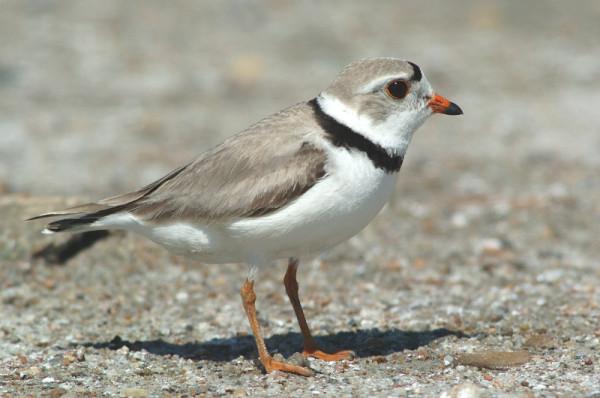
In Canada the prairie subspecies of the Piping Plover (
Charadrius melodus circumcinctus
) breeds in central Alberta, southern Saskatchewan, southern Manitoba and the Lake of the Woods region of western Ontario, using shorelines around saline/alkaline lakes, river islands and adjacent sand pits. The number of Piping Plovers has been decreasing everywhere.
This
guide determines local and landscape-scale habitat features that are optimal for Piping Plover at different life stages, as well as important non-habitat related beneficial management practices.
Piping Plover
(
Charadrius melodus circumcinctus)
This guide was developed by Sue Michalsky and Heather Peat Hamm with technical and editorial input from Corie White, Julie Mackenzie, Ashley Vass and Ryan Dudragne and GIS support from Michelle Lanoie.
|
|
Diego Steinaker, Editor, Saskatchewan Prairie Conservation Action Plan Newsletter
306-352-0472 |
|
|
SK PCAP gratefully acknowledges financial support in 2018-2019 from:
Ducks Unlimited Canada, Canada North Environmental Services, EcoFriendlySask.ca, Information Services Canada, Parks Canada - Grasslands National Park of Canada, Rancher's Stewardship Alliance Inc., Saskatchewan Cattlemen's Association,
Saskatchewan Ministry of Agriculture, Saskatchewan Ministry of Environment - Fish and Wildlife Development Fund,
SaskEnergy,
SaskPower, SaskTel, University of Saskatchewan - College of Agriculture and Bioresources, Water Security Agency.
SK PCAP gratefully acknowledges in-kind support for 2018-19 from:
Agriculture and Agri-Food Canada - Science and Technology Branch, Canadian Parks and Wilderness Association, Canadian Western Agribition, Environment Canada - Canadian Wildlife Service, Friends of Wascana Marsh, Meewasin Valley Authority, Native Plant Society of Saskatchewan, Nature Conservancy Canada, Nature Saskatchewan, Parks Canada - Grasslands National Park, Prairie Wind & Silver Sage, Ranchers Stewardship Alliance Inc., Redberry Lake Biosphere Reserve, Saskatchewan Association of Rural Municipalities, Saskatchewan Association of Watersheds, Saskatchewan Cattlemen's Association, Saskatchewan Environmental Society, Saskatchewan Forage Council, Saskatchewan Forage Industry Network, Saskatchewan Ministry of Agriculture, Saskatchewan Ministry of Environment, Saskatchewan Ministry of Economy, Saskatchewan Ministry of Education, Saskatchewan Ministry of Tourism, Parks, Culture and Sport - Royal Saskatchewan Museum and Friends of the Royal Saskatchewan Museum, Saskatchewan Research Council, Saskatchewan Stock Growers Association, Saskatchewan Wildlife Federation, Saskatoon Nature Society, SaskEnergy, SaskOutdoors, SaskPower, Society for Range Management - Prairie Parkland Chapter, South of the Divide Conservation Action Program Inc., University of Regina - Prairie Adaptation Research Collaborative, University of Saskatchewan - College of Agriculture and Bioresources, Wild About Saskatoon-Nature City Festival.
|
|
|
|