September 2021 | Volume 13 Issue 9 |
|
Happy September! I hope everyone had a great summer and is ready for what this Fall will bring!
We have a date for the 9th Native Prairie Restoration/ Reclamation Workshop, February 8-10, 2022! We should have more details available in next month's newsletter!
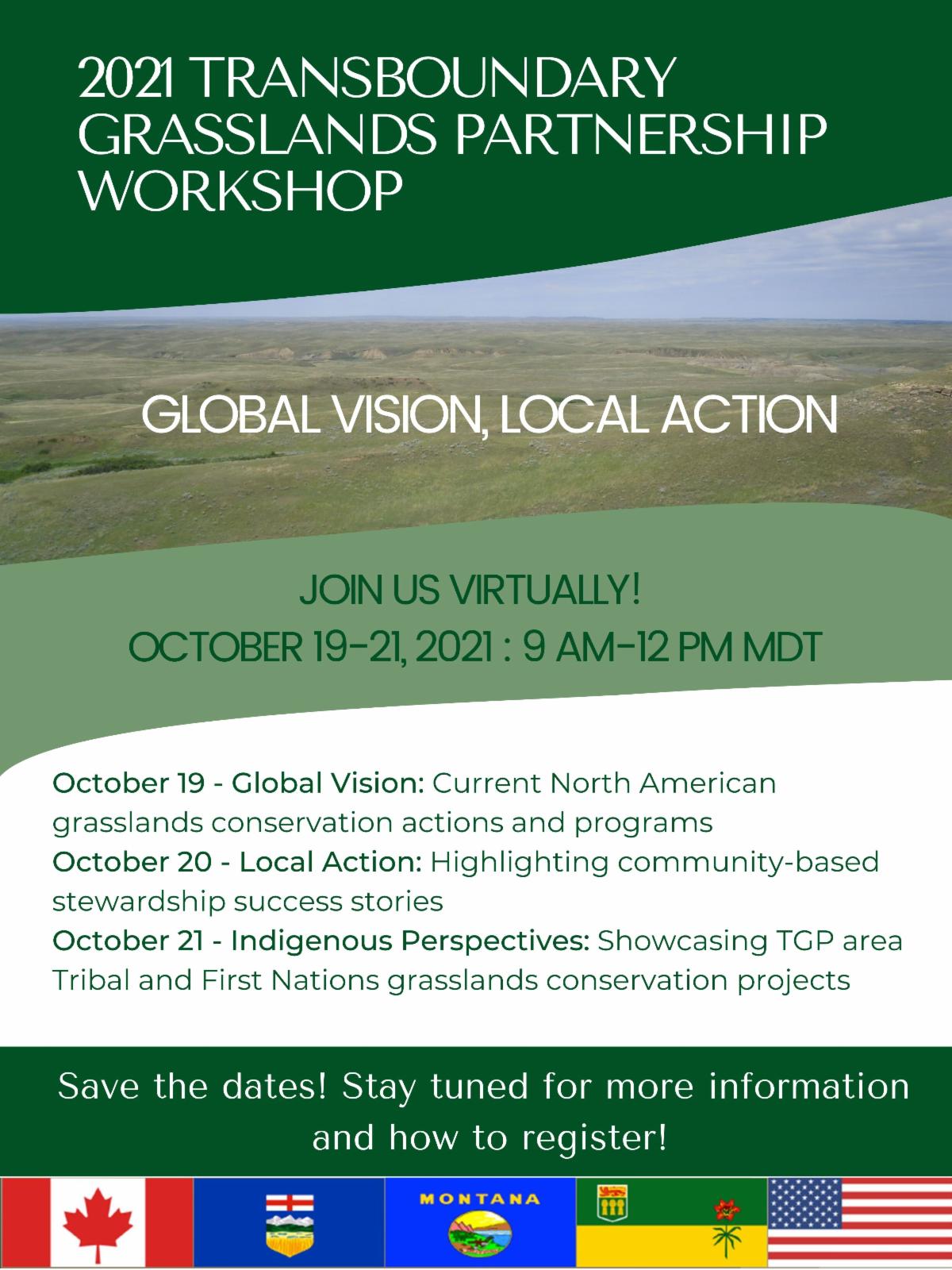
Make sure to save the date for the 2021 Transboundary Grasslands Partnership Workshop, October 19-21, 2021. We have 3 great mornings of presentations planned! You can register here! More information, including a program, will soon be available on the Alberta PCF webpage, here.
If you missed our August webinar presentation, Brandon Burda told us all about finding bat habitat in SK. The webinar recording is on our YouTube Channel!
We don't have a Native Prairie Speaker Series lined up for September, therefore we will double up during another month this fall. However if you're looking for something to watch this month, we uploaded most of the virtual NPRRW 2021 recordings onto our YouTube Channel! There are presentations on climate change, resilience, invasive species, industry, soil, planning and urban landscaping. You can find the 2021 NPRRW playlist here.
And finally, we would like to thank our sponsors for their generous support: Camp Wolf Willow, EcoFriendly Sask, K+S Potash, Pembina Pipelines, Saskatchewan Cattlemen's Association, SaskEnergy, SaskPower, SaskTel, Wildlife Habitat Canada and Environment and Climate Change Canada, as well as the continuous support of all the PCAP Partners.
Carolyn Gaudet, SK PCAP Manager
|
Save the Date!
The 9th Native Prairie Restoration/Reclamation Workshop will occur virtually February 8-10, 2022!
Theme: "Restoration, Reclamation, Resilience - Improving Soil, Water and Habitat"
Stay tuned for more details!
|
PCAP Partner Spotlight...
Native Plant Society of Saskatchewan
Submitted by Chet Neufeld, Executive Director, NPSS
We had another busy field season this year. Our Rare Plants and Ranchers program continues to forge ahead with Hilary Pinchbeck, our Program Coordinator, leading the charge. Now in its eleventh year and with over 133,000 acres currently enrolled in the program and continued funding from both the federal and provincial governments, we have the opportunity to make a tremendous positive impact for plant Species at Risk and their habitats. By directly working with landowners to give them the expertise and funding to manage for plant Species at Risk, we find win-win solutions for both the plants and the ranches to ensure that both continue to thrive long into the future.
Another one of our major projects is the South of the Divide Invasive Alien Species Strategy. Now in its second year, this project aims to tackle the incredibly complex issue of the threat posed by invasive species on Species at Risk. This alone would be enough, but to do it in a region the size of a small island nation (over 15,000 km2) is even more difficult. Components of the project include ground surveys, risk assessments, modeling, mapping, and eradication initiatives with the goal of developing an invasive species strategy with measurable results. A large portion of the project focuses on local stakeholder input and have significant citizen science, education, and outreach components.
Our commitment to addressing the threat posed to our aquatic habitats by Flowering Rush (Butomus umbellatus) remains undiminished. In fact, our efforts this year may be our most ambitious yet. Driven by the momentum of our successful eradication of a Flowering Rush population from a wetland near Watrous, SK, we planned to survey nearly 150 km of the South Saskatchewan River from the Alberta border to Cabri Regional Park. We have previously surveyed a large portion but re-surveyed the area and add a new section, as spring floods transport plants downstream and our aim is to create a Flowering Rush free buffer to protect the rest of the river. We mapped and eradicated what we found. This is a large endeavour, and we partnered with the South Saskatchewan River Watershed Stewards, Meewasin Valley Authority, Ministry of Agriculture and Ministry of Environment, and secured funding from the Ministry of Environment and SaskEnergy. We also monitored the wetland formerly containing Flowering Rush near Watrous, SK to ensure that our eradication efforts were successful.
These are just the major projects – we have many other smaller (but just as important) projects! NPSS also continues to provide free educational resources and native seeds to schools, attend various committee meetings, respond to an increasing number of native plant gardening requests, and occasionally find time to get out and smell the flowers.
|
The Saskatchewan Association of Watersheds and member stewardship groups need your help! We are looking for individuals to fill in our short survey about Climate Change. Results from the survey will be used to understand public opinion of climate change and help guide educational material! By filling in the survey, people will be entered to win a $500 gift card! Have your say – fill in our Climate Change Survey today! |
|
We do not have a September NPSS webinar planned due to various circumstances. Please visit our Native Prairie Speaker Series webpage regularly for upcoming topics, dates, and registration details.
|
PHJV Policy Webinar:
Does Drainage Pay?
September 10 @ 10 AM MT
September 11, 2021
September 18, 2021
October 19-21, 2021
Brandon, MB and virtual
Nov 15-17, 2021
Native Prairie Restoration/
Reclamation Workshop
Feb 8-10, 2022
July 12-15, 2022
|
Native Prairie in the News
|
2021/22 Speaker Series Supporting Sponsors
Camp Wolf Willow
|
2021/22 Education Programs:
Presenting Sponsors:
|
2021/22 Education Programs
Supporting Sponsors:
|
|
Carolyn Gaudet, Editor, Saskatchewan Prairie Conservation Action Plan Newsletter |
|
SK PCAP gratefully acknowledges financial support in 2021-2022 from:
Camp Wolf Willow, Ducks Unlimited Canada, EcoFriendlySask.ca, Parks Canada - Grasslands National Park of Canada, Pembina Pipelines, Saskatchewan Cattlemen's Association, Saskatchewan Ministry of Agriculture, Saskatchewan Ministry of Environment - Fish and Wildlife Development Fund, SaskEnergy, SaskPower, SaskTel, University of Regina, University of Saskatchewan - College of Agriculture and Bioresources, Water Security Agency and Wildlife Habitat Canada.
SK PCAP gratefully acknowledges in-kind support for 2021-22 from:
Agriculture and Agri-Food Canada - Science and Technology Branch, Canadian Parks and Wilderness Association, Environment Canada - Canadian Wildlife Service, Friends of the Royal Saskatchewan Museum, Friends of Wascana Marsh, Meewasin Valley Authority, Native Plant Society of Saskatchewan, Nature Conservancy Canada, Nature Saskatchewan, Parks Canada - Grasslands National Park, Prairie Wind & Silver Sage, Ranchers Stewardship Alliance Inc., Redberry Lake Biosphere Region, Saskatchewan Association of Rural Municipalities, Saskatchewan Association of Watersheds, Saskatchewan Bison Association, Saskatchewan Burrowing Owl Interpretive Centre, Saskatchewan Cattlemen's Association, Saskatchewan Environmental Society, Saskatchewan Forage Council, Saskatchewan Ministry of Agriculture, Saskatchewan Ministry of Environment, Saskatchewan Ministry of Energy and Resources, Saskatchewan Ministry of Parks, Culture and Sport, Saskatchewan Stock Growers Association, Saskatchewan Wildlife Federation, SaskEnergy, SaskOutdoors, SaskPower, Society for Range Management - Prairie Parkland Chapter, South of the Divide Conservation Action Program Inc., University of Regina, University of Saskatchewan - College of Agriculture and Bioresources.
|
|
|
|
|
|
|