Your Monthly News & Updates | |
|
|
Our mission is to preserve, promote, and share the rich history of the town of Medfield. Lately, we have been very focused on the first pillar – preservation. At a high level, this goal is to ensure that the collection lasts as far into the future as possible so that future generations can experience and learn from those that came before. To this end, some of you will remember that we recently added a fire alarm to our building after 101 years without one. Additionally, we have been working to reshuffle which items are in the safe. Since we have limited space, we have been discussing rules to help us decide which items need this extra layer of protection.
In general, we weigh a number of factors – (1) Is the item uniquely Medfield, (2) Is the item unique, is there only one in the world, (3) How well would the item survive water damage, (4) How much educational value does the item have? It is no wonder then that we have been prioritizing the various handwritten journals that we have in our collection. One of the best examples of this is a handwritten journal filled with numerous handwritten stories – many of which were authored by Medfield historian and first Medfield Historical Society president, William Tilden.
| 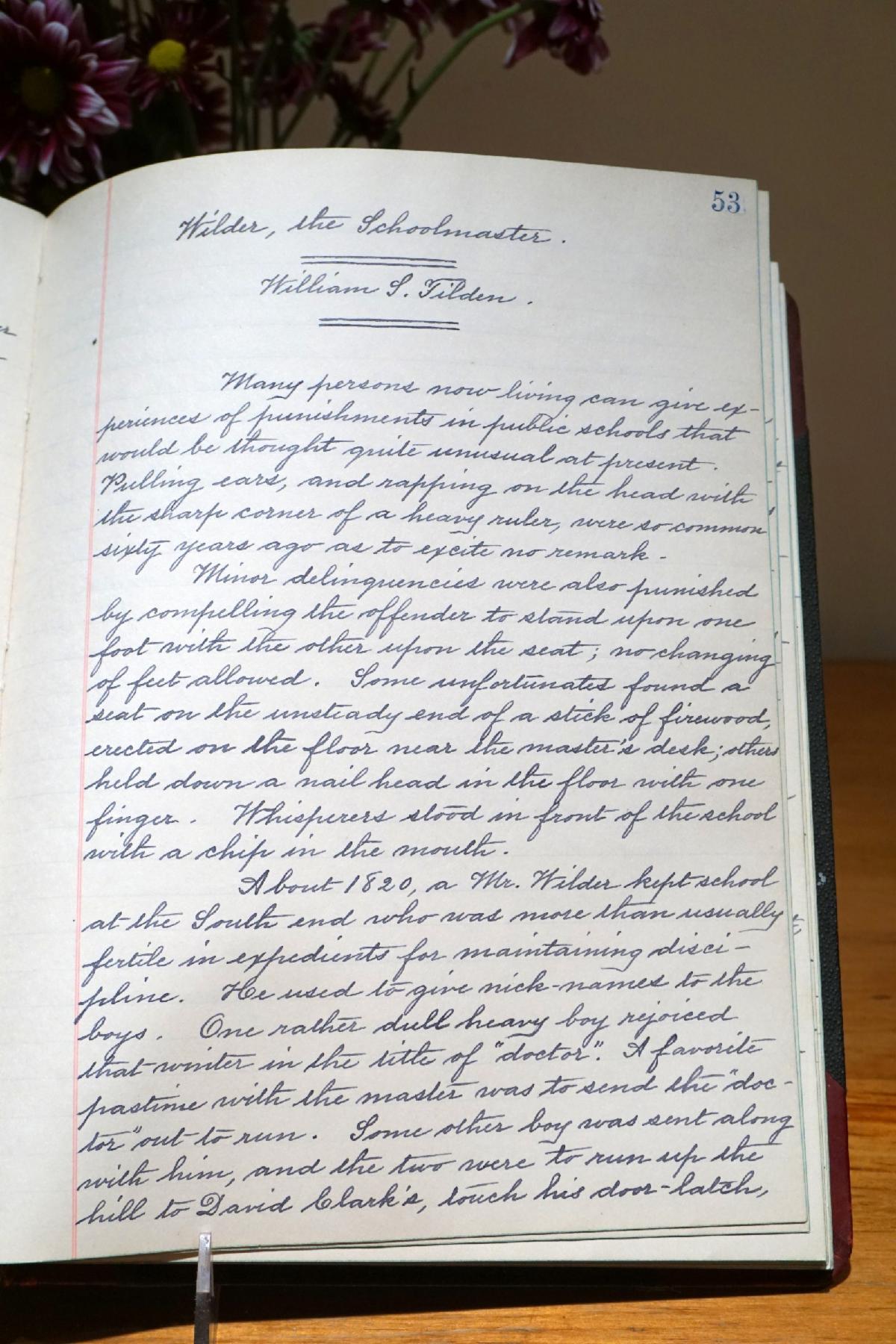 | |
The journal checks all the boxes – it is uniquely Medfield and it is "unique." It would most certainly be damaged in a fire or the water that comes with such an event. And, it is full of stories that help us understand life in Medfield in the past.
What is interesting about this particular journal is that I am fairly certain that it is not written in William Tilden's own hand. Instead, I believe a volunteer long ago wrote out these stories together in a single book to ensure that they would survive through time. Then again – maybe 50 years ago – another volunteer transcribed these into typed text. And, once more, another person typed these into a computer so that we could have the digital file. Today, we are considering what it would take to scan the collection so that we could not only search the text digitally but also expand access to the beautifully handwritten copy. Eventually, this scanned version will be stored in the archives at the Boston Public Library and the Digital Commonwealth project.
I know that this is the right thing to do and that it will drastically increase access to this beautiful asset but there is something magic about holding the old journal in your hands and feeling as if you are transported back in time. So... while I spend my days working at a computer... when I retire, you will find me in the safe blissfully reading the original handwritten text.
| |
|
PeggySue Werthessen
President
| |
Society Resumes Normal Hours | |
The Medfield Historical Society Museum will resume its usual first and third Saturday openings (10 am to 12 pm) after Labor Day, plus Monday afternoon/evening volunteer opportunities. We encourage you to stop by and see what's happening. | |
After 373 Years, the Clark Family is Still Here. What's Your Story? | |
|
by David Temple
Upwards of 1 million Americans have the surname “Clark,” making it the 20-somethingth most common name in this country, and it’s almost as common in England. Clark or Clarke is an occupational name, like Baker, Cook, Cooper, or Smith, and it’s derived from the Middle Ages, when a cleric was someone with the then-rare skill of being able to read and write.
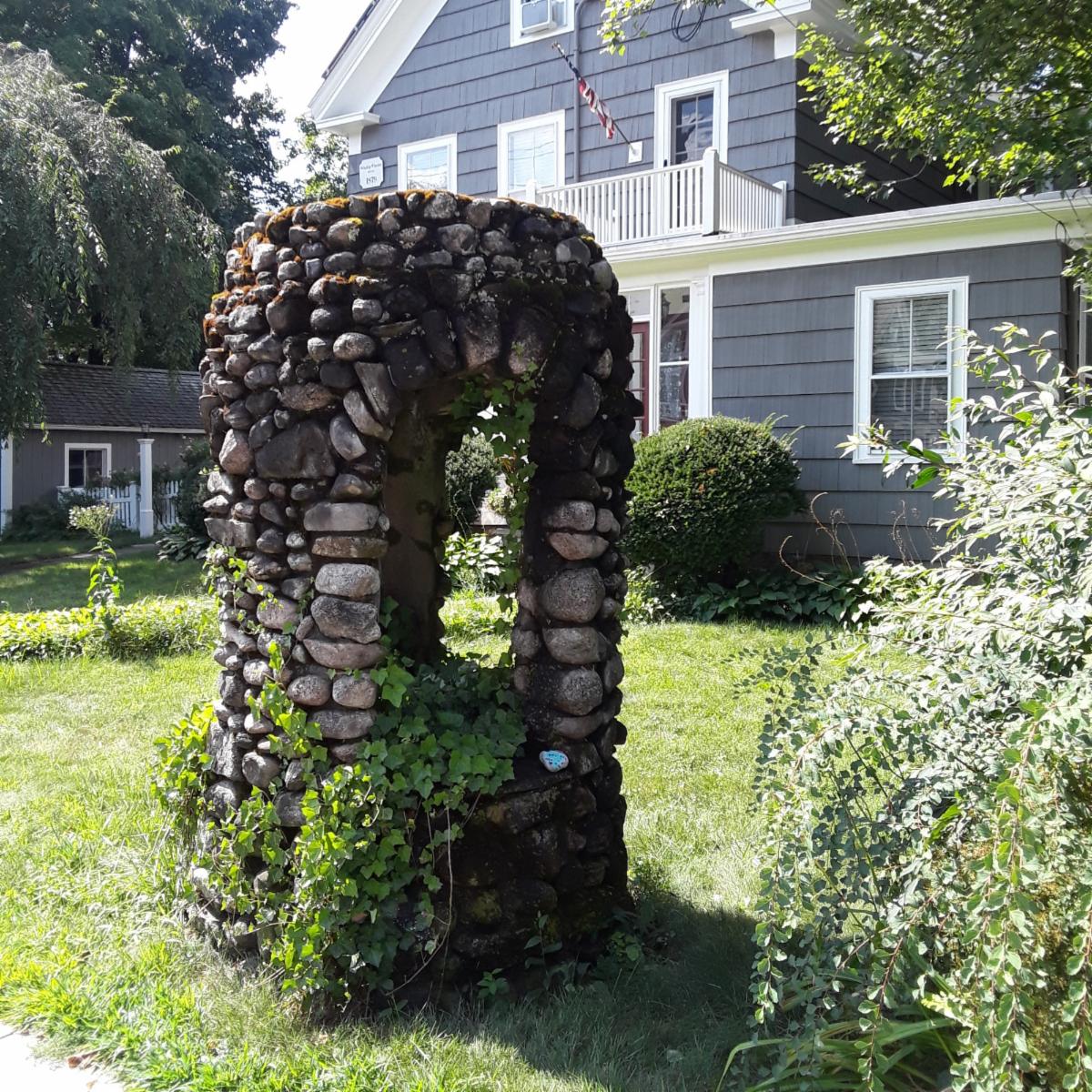
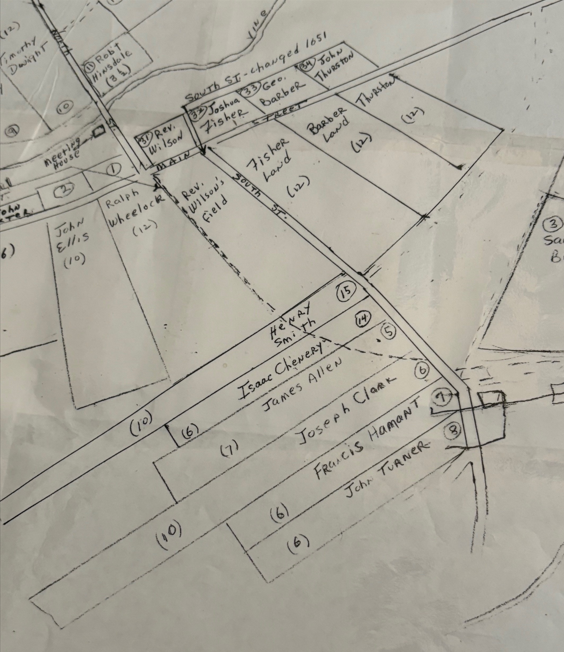
Joseph Clark was one of Medfield’s original 13 settlers; his house was near the corner of South and Oak Streets. The house is long gone, but at the side of the street, still marking the site, is a stone well casing, shown in the photo below. The well itself was filled in about 1937 after a child fell in and drowned.
| |
Clark was granted 10 acres, and the town valuations in 1652 show his estate consisted of the house and land, his wife Alice, six children, and 12 farm animals. He died in 1684; she in 1710. | |
|
Altogether, Joseph and Alice had nine children who lived to adulthood, and many of them had large families. Their son Benjamin (1644-1724), father of 10, who built the original Peak House, was a respected man in town; he served as a selectman for 17 years and two years as a representative.
Benjamin’s was the way of the Clark clan through the generations – no Nobel prizes, no governors or presidents, no titans of industry – but hardworking, respected citizens who did their part to make Medfield a good, livable community. An oddity in the family history: when Benjamin’s son Seth (1687-1756) died, he listed among his personal property, “two-thirds of a negro man,” valued at ₤20.”
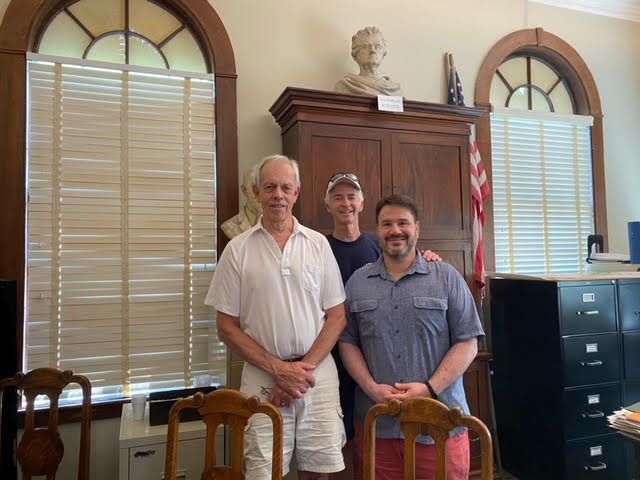
| One of Jonathan’s descendants, Armen Clark of Midlothian, Virginia, visited Medfield in early August with his wife Kathleen to do some family research at the historical society. Shown here with David Temple (left) and Richard DeSorgher (middle). | |
There are other non-related Clarks living in Medfield, but Brad Clark, with two daughters but no sons, is the last local survivor in the line of established by Joseph in 1651. He has become expert in the family’s history. (Growing up in Medfield at 29 Pleasant Street, I remember Brad’s grandfather, a long-time Medfield firefighter known as Scratch, and Brad’s father, Clint, who lived two doors away at 41 Pleasant Street. – DFT)
Read More>>
| |
Roots Research Tools at Your Fingertips | |
|
by Chris McCue Potts
Interest in tracing ones roots through genealogy research is growing exponentially, with some reports stating it is the second most popular hobby after gardening.
At the Medfield Historical Society (MHS) Museum, volunteers have seen firsthand the interest in roots research growing as descendants of Medfield’s first settlers and early residents have stopped in to learn more about their heritage and connection to the town. Over the years, Society volunteers have enjoyed meeting visitors with such names as Allen, Clark, Mitchell, Chenery and Holbrook appearing on their family trees, as well as other visitors trying to piece together less-obvious clues to their ancestral Medfield ties.
A stop at the MHS museum at 6 Pleasant Street gives visitors the chance to talk to knowledgeable volunteers, and gain access to Society documents, maps, photographs, diaries, artifacts and other reference materials that can help to fill genealogical gaps or provide color to existing research. And now that summer is coming to a close, the museum will be back to its regular first and third Saturday openings from 10 a.m. to 12 p.m., as well as by appointment.
| 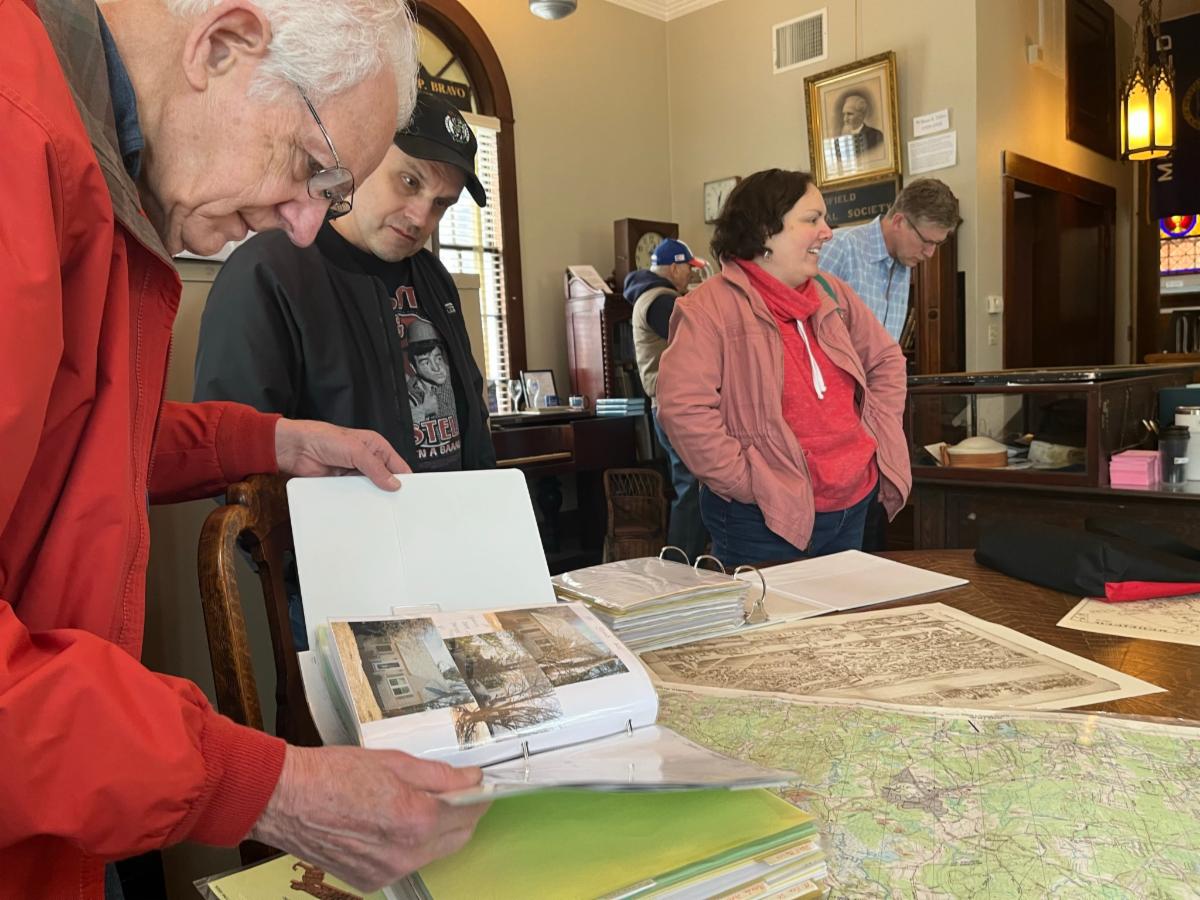 | |
Visitors to the Museum looking through our files. | |
|
As an added bonus, after a stop in Medfield, family historians can now supplement their efforts with a visit to Norfolk County Registry of Deeds in Dedham just nine miles away to access free services provided through its newly launched Genealogy Research and Resource Center. As recently announced, visitors to the registry center can tap into a dedicated bank of computers and gain no-cost access to popular databases Ancestry.com, American Ancestors, and the digital records from Massachusetts Archives.
“In the future, we hope to add other research databases,” noted Norfolk County Register of Deeds William O’Donnell. “Besides this wealth of information, the registry has more than 13 million land-related documents to explore dating back to 1793 when Norfolk County was created through an act of the legislature and signed into law by Governor John Hancock. These records include deeds, liens, foreclosures, mortgages, conveyances, trusts, and mortgage discharges.”
O’Donnell also shared that the registry launched a special initiative through which thousands of documents written in hard-to-read cursive penmanship from 1793 to 1900 have been transcribed into clearly readable print. Future initiatives include public genealogy seminars and more database resources.
| |
Similarities of Medfield Education Over Time | |
|
by Chris McCue Potts
Another Medfield school year is now underway marking nearly 370 years since the first schoolhouse was built on North Street in 1655 – evidenced by a historical marker where the new 21 North restaurant is now located. And while much has changed with education over time, some aspects of it have stayed the same. After all, lessons on reading and arithmetic have yet to go out of style.
In Massachusetts, laws were passed early on and over time mandating the education of children, although schools were not always available to certain segments of the population.
Some key Massachusetts dates to set the stage for Medfield education history:
- Boston Latin School was the first public school, established in 1635.
- Harvard College was founded about seven years later in 1642.
- Colonial law of 1647 mandated that every town of at least 50 households was ordered to have a school for teaching basic reading and writing, and towns of 100 or more households were required to have a “grammar school” providing more advanced preparation.
- Horace Mann (1796-1859), while serving on newly created Massachusetts Board of Education in 1837, created the first school system that ensured every child could receive a basic education funded by local taxes. A year later, he established the first state-sponsored “normal school” for teacher training.
- Massachusetts was not only the first state to enact a compulsory education law in 1852, it was (and still is) consistently ahead of other states with its ratings for educational excellence.
| 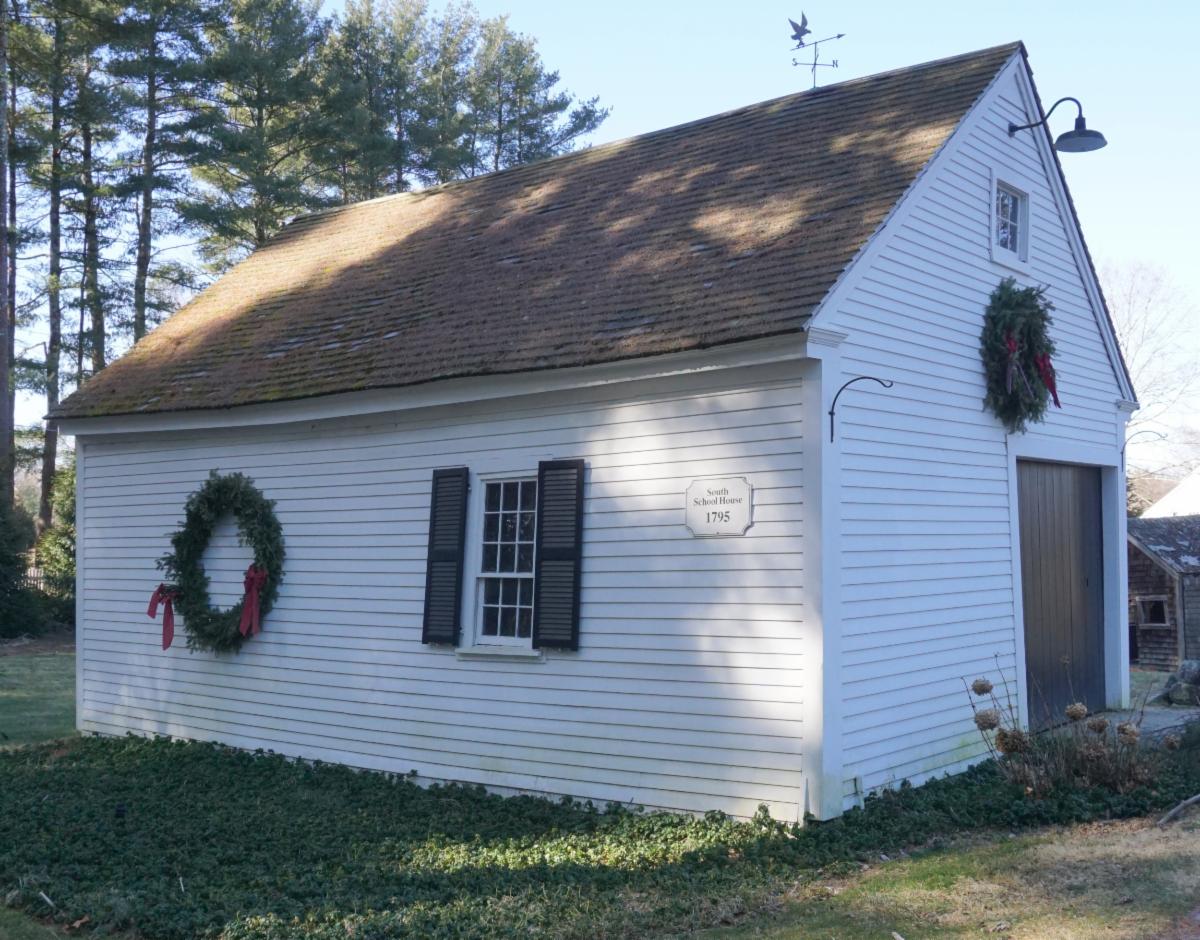 | South School House 1795 211 South Street, now repurposed as a garage. | |
Helping to illustrate the saying, “The more things change, the more they stay the same,” Tilden marks earlier moments in time in his book, History of the Town of Medfield, Massachusetts, 1650-1886. Here are examples documented by Tilden and other sources that help to illustrate past and current comparisons:
Adapting to Changing Enrollment and Needs – Medfield used a variety of structures and locations for educating children throughout its history as the town grew and prospered, starting with homeschooling, followed by the first school built in 1666, plus use of local churches and other buildings. Traditional schools, both small and large, were also established in different sections of town to ensure proximity to young students. At times, whenever additional educational space was needed, school buildings were either expanded or built new. For example, Tilden notes that in 1760, new schoolhouses were needed in the north and south districts, “that perhaps the schools had outgrown the sixteen by eighteen (foot) buildings erected in 1732. Decades later, even an additional six feet of space for two Medfield schools was considered a welcome addition. Today, with shifting school enrollment across the grades, Medfield Public Schools looks at ways to chart the best path forward. (Town Historian Richard DeSorgher published this Hometown Weekly article in 2019 with more details about Medfield’s educational roots into recent times.
Read more>>
| |
|
by David Temple
William S. Tilden was one of Medfield’s two most important and prolific historians.
(The other is, of course, Richard DeSorgher, who grew up here, taught history and social studies here for over thirty years, published four books on Medfield history, and is still Medfield’s official town historian, though he has lived in Mashpee for almost ten years.)
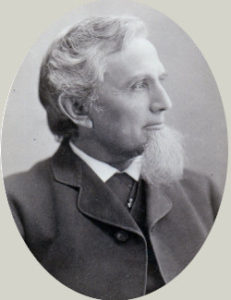
Tilden (1830-1912) was a lifelong resident, music teacher, music director and organist at the Baptist church, and, in 1891, co-founder and first president of the Medfield Historical Society. He researched and wrote the 556-page "History of Medfield 1651-1886," the society’s bible.
Tilden was a first-hand witness to many goings on in Medfield in the 19th century, and he wrote many short pieces as well as his magnum opus. Fortunately, Tilden had very neat and legible handwriting, and many of these pieces have been collected and transcribed and are in a loose-leaf binder at the society. It gives an often light-hearted picture of characters and events of the 19th century of our little farming village, in which the population grew from 745 in 1800…to 966 in 1850…to 1583 in 1900, not counting the 1,343 at the state hospital.
Here's a sample, written about 1880.
Working Out the Highway Tax
Wm. S. Tilden
Until recent years it was the custom at Town meeting to appropriate a certain sum for the repairs of the highways, and each man's proportion of this was made out separately and called his “highway tax.” The town was divided into five highway districts, called the East, West, Southeast, Southwest, Northeast and Northwest. A "highway surveyor" was chosen in town meeting for each of these districts, and a list of the tax payers with the amount of their taxes was committed to the several surveyors. A few persons paid this tax in money; but the farmers generally came on with their teams and help, and worked it out under direction of the surveyor. Men were allowed ten cents an hour, a yoke of oxen the same, and boys of fourteen or sixteen, half that sum.
It was the business of the surveyor to decide where the work was needed, notify the taxpayers when to appear for work, (usually in the month of June), keep account of their time, and oversee the labor. Our boyish recollections of "working on the road" are in the Southwest district.
Read More>>
| |
People and Places of the Past | |
|
Doctor Jabez Fuller was the son of Isaac Fuller of Middleboro, Massachusetts. Born in 1723, he came to Medfield at the age of 24 in 1747. That same year he married Elizabeth Hilliard. In 1756 the couple bought the homestead of Timothy Metcalf, located in Dingle Dell. Dingle Dell, also known in different times as Dingle Hole, Littlefield’s Hole and Littlefield’s Bottom, lies along West Street around the intersection of West Mill Street (today, the area around the American Legion to Wills Hardware). Dr. Fuller was one of two doctors servicing Medfield at the time, the other being Dr. James Gerauld. Dr. Fuller was one of Medfield’s doctors for 34 years, until his death in 1781.
Two of Dr. and Mrs. Fuller’s nine children, John and Jabez, served in the American Revolutionary War. Jabez, also a doctor, was with Captain Sabin Mann’s Medfield Militia. In 1776 they were sent to New York to reinforce the Continental Army. He was also with Captain Mann’s Medfield Militia in 1777, marching to Rhode Island and being stationed around the Rhode Island town of Bristol.
Jabez’s brother, John, responded to the Lexington Alarm during the attack on Lexington and Concord on April 19, 1775. Under the command of Captain Ephraim Chenery, the Medfield Militia responded, arriving in Lexington just hours after the British had retreated back into the confines of Boston. Fuller stayed on duty for the siege of Boston, some eight months, taking part in the victory over the British at Dorchester Heights and the British evacuation of Boston on March 17, 1776.
Read more>>
| | | | |