September 2026 || Newsletter Edition 192 | | |
In this issue:
CSU Food Systems Spotlight
Mark Your Calendar
Funding Opportunities
News, Resources, and Reading
From Our Communities
About Us
Stay Connected
| | CSU Food Systems Spotlight | | |
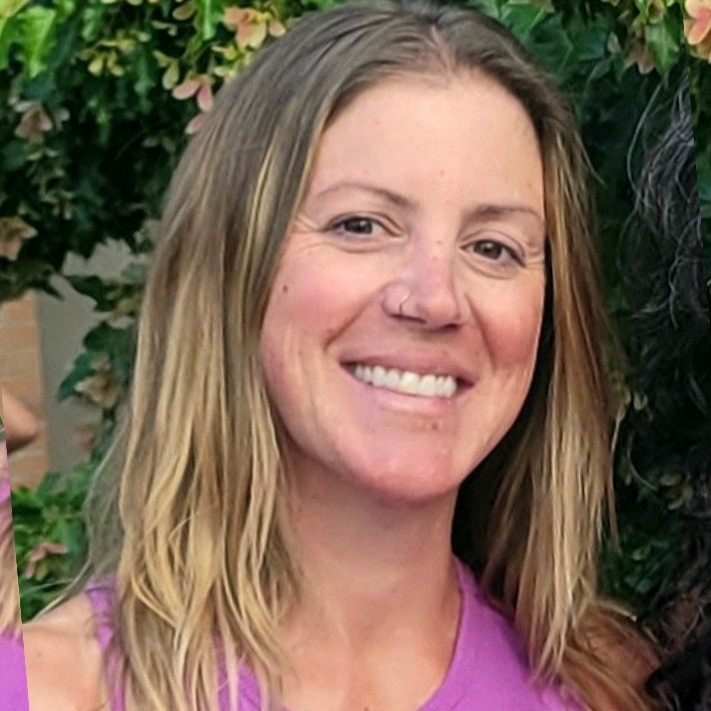
Sarah McCracken
Extension Specialist, Eagle County
Sarah is a dedicated and experienced horticulturist with a passion for cultivating sustainable practices and fostering community engagement. She has over 18 years of experience in plant cultivation, designing aesthetically pleasing green spaces, working with the public, and implementing environmentally friendly methodologies.
Sarah holds a BA in Integrated Sustainability Studies and a certificate in horticultural therapy through the American Horticultural Therapy Association. She started with CSU Extension in the Fall of 2025 as Horticulture and Natural Resource Specialist and Colorado Master Gardener Coordinator for Eagle County. Currently, she is enrolled in CSU’s MS in Horticulture and Human Health program.
Sarah's biggest project has been working with Eagle County School District in developing their Farm-to-School program. Over the past 8 months, she has worked closely with district staff, community stakeholders, agricultural producers, educators, and industry experts to assess opportunities to strengthen local food procurement, agricultural education, and community partnerships while ensuring long-term financial and operational sustainability. This project motivated her continued interest in food systems, community engagement, and human health.
Sarah's combined personal and professional experiences, together with her current role at CSU Extension, has provided an in-depth understanding of the biophilic connection between people and plants, fueling her passion for using educating and inspiring diverse audiences about the benefits of sustainable horticulture.
| | |
Yo Soy de Rancho Programa
Yo soy del rancho es un programa diseñado para empoderar a trabajadores agrícolas con experiencia para que den el siguiente paso en sus carreras creando sus propios negocios agrícolas.
Reconociendo la amplia experiencia y dedicación de quienes llevan años en el campo, este programa ofrece apoyo específico mediante clases de desarrollo de pequeñas empresas impartidas en español. Los participantes reciben orientación práctica para crear un plan de negocios, mentoría personalizada y herramientas prácticas para convertir su experiencia en éxito empresarial.
Podemos ayudarle en cualquier etapa, ya sea que sea nuevo o ya tenga una pequeña operación agrícola.
- ¿Ha trabajado usted en el sector agrícola durante varios años?
- ¿Quieres iniciar tu negocio agrícola?
- ¿Tiene actualmente un negocio agrícola paralelo y busca expandirse?
- ¿Sabía que usted puede pedir prestamos para empezar su propio negocio agrícola?
El cupo es limitado. Haga clic aquí para completar el formulario de evaluación de elegibilidad: https://docs.google.com/forms/d/e/1FAIpQLSdeGDLZULjdHHAYDFWZk0Ab248_EPpMnYjF5H3YSMVJeUAE1A/viewform
Por favor, refiera a los trabajadores a:
Ruben Pacheco al 720-830-2338 o ruben.pacheco@state.co.us, o
Ricardo Garcia al 720-908-7673 o ricardo.j.garcia@state.co.us.
| | |
Annie's Project Facilitator Trainings
Annie's Project is hosting facilitator training sessions. Registration is limited to the first 20 participants. All sessions are virtual, and there is no charge for the training.
Virtual National Annie’s Project Facilitator Training (8 hours)
All 8 hours must be completed to be certified as an Annie’s Project facilitator. If you are interested in hosting Annie's Project in your county, the first step is to become a trained facilitator by taking this course.
-
September 15-16 (9am – 11am and 1pm – 3pm MST). Times repeated on both days.
-
November 9-10 (9am – 11am and 1pm – 3pm MST). Times repeated on both days.
Contact Jenny Beiermann (jenny.beiermann@colostate.edu) or Karisha Devlin (karisha@anniesproject.org) with questions or for more information.
| |
Organic Dry Beans: Field Walk and Buyer Tour
Join Tuxedo Farms and Rodale Institute for a Field Walk & Buyer Tour to see the organic no-till systems on Colorado’s Western Slope project in action. The day will include a tour of tilled and organic no-till dry bean field trials, a look at the progress toward the new processing facility, and opportunities to connect with buyers, farmers, and project partners. Lunch will be provided.
Date: Friday, September 18, 2026, 9:00 am – 12:00 pm MDT
Location: Meet at Tuxedo Farms Cooler at 59751 David Rd., Olathe, CO 81425
Register here: https://rodaleinstitute.org/events/organic-dry-beans-roller-crimper-research-market-opportunities-field-walk-buyer-tour/
| | |
Summer Tours at the Old Fort in Hesperus
Join us for a tour of the Old Fort this summer to learn about high-elevation growing practices with the Farmer Training Program staff and participants. Participants will walk about a half mile over dirt roads and farm paths, so bring comfortable shoes and dress for the weather. The next tour will take place on September 17th, 9:00 a.m. to 10:30 a.m.
Sign up for a free tour here: https://www.fortlewis.edu/the-old-fort/visit/tours
| | |
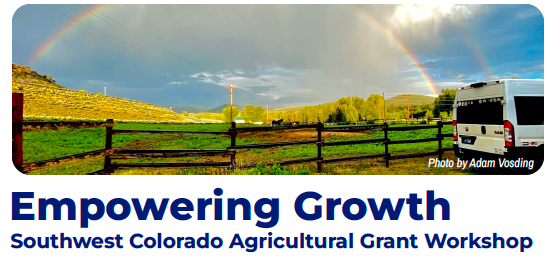
Join the La Plata-Archuleta Cattlemen's Association, Colorado Department of Agriculture, and Colorado State University Extension Office for a special event for agricultural producers to learn more about CDA grant opportunities and receive real-time grant writing support from CSU Extension Staff.
Location: Fort Lewis College, Skyhawk Station 118 Durango, CO
Date: October 1st, 2026
Time: 4 PM - 7 PM. Dinner will be provided.
We encourage participants to bring their laptops or other devices to the event, as they will have the opportunity to receive live support from CSU Extension Staff on grant applications during the event.
Grant opportunities to be covered:
- Climate Resilience Grants
- Soil Health Grants
- Ag Stewardship Tax Credit
- Climate Smart Market Grants
- and more!
| | |
Summit to Shelf - West Slope Start Up Week
Summit to Shelf is a two-part program designed to support agriculture, food, and beverage entrepreneurs across the West Slope, from early-stage ideas to growth-ready value-added agricultural and consumer packaged goods (CPG) brands. This program combines a hands-on business workshop and a live founder showcase.
Monday, October 5th. Early registration is $50 and includes lunch. Register and find out more here.
- Part 1: Half-Day Workshop from 11:00 AM to 4:00 PM at the Animas Room at the La Plata County Fairgrounds.
- Part 2: Colorado Collision – Durango from 6:30 PM to 8:00 PM at the Subterrain which is located at 900 Main Avenue (entrance on 9th Street). All are welcome to attend. Collision Participants must register for the Workshop and apply for the Collision BY AUGUST 31ST. Apply here.
| | |
Shared Kitchen Summit
The Shared Kitchen Summit is the industry's premier gathering for shared kitchen operators, incubators, and the businesses that support them. Now in its 6th year, the Summit brings operators together from across the country for three days of hands-on sessions, peer-to-peer problem solving, and real conversations about what it actually takes to run a shared kitchen — from managing member relationships to navigating growth and compliance.
This year's Summit takes place October 12–14th, 2026 at CIC Providence, in Providence, RI.
Whether you're running a shared kitchen, launching one, or supporting operators in the space, this is where the community shows up.
Ticket prices increase soon, so reserve your spot today.
Buy tickets here.
| | |
Livestock on Landscapes: Harnessing Livestock Behavior for Healthier Land and Animals
The Colorado Section of the Society for Range Management (CSSRM) will be hosting a series of events on Wednesday, Oct. 14 and Thursday, Oct. 15 in Southwestern Colorado.
October 14th, 2026
Join CSSRM for an evening of films and a panel discussion at the Sunflower Theater in Cortez, CO to celebrate the International Year of Rangelands and Pastoralist as well as the Year of the Woman Farmer. You’ll hear from local historian Andy Gulliford who will give us a brief overview of grazing in the American Southwest, enjoy films highlighting international perspectives of herding and grazing management, then learn from a panel discussion reflecting on the current state of grazing in the west, looking towards a dynamic future of rangeland management.
October 15th, 2026
CSSRM will host their Annual Meeting at the Dolores Community Center in Dolores, CO. Topics include livestock health on biodiversity-rich landscapes, lessons learned from managing landscapes before and after large fires, and how we can use our knowledge of basic livestock behavior to improve livestock and landscape health via old and new tools like range riding and virtual fence.
Learn from scientific, producer and practical expertise, join in engaging discussions, and leave with knowledge of how communities can come together to collectively manage rangelands and find a little joy along the way.
Registration is posted here: https://www.cssrm.org/2026-annual-meeting.html
| | |
Pearls of Production
Pearls of Production, hosted at the University of Missouri, offers virtual virtual and in-person sessions to connect agricultural professionals, researchers, and producers. To celebrate the International Year of the Woman Farmer, Pearls of Production is offering free monthly zoom sessions featuring international speakers.
Upcoming speakers include:
- August 26th: Cecilia Rabell
- October 28th: Lilia Arend
- November 18th: Tanika O'Connor
- December 11th: Dr. Temple Grandin
At the end of the year, you can join Pearls of Production for their annual in-person conference, designed to provide practical knowledge, hands-on learning, and networking opportunities for livestock producers.
Register for the speaker series and conference here: https://extension.missouri.edu/programs/pearls-of-production/pearls-events
| | |
Farm to School Healthy School Meals Rooted Together
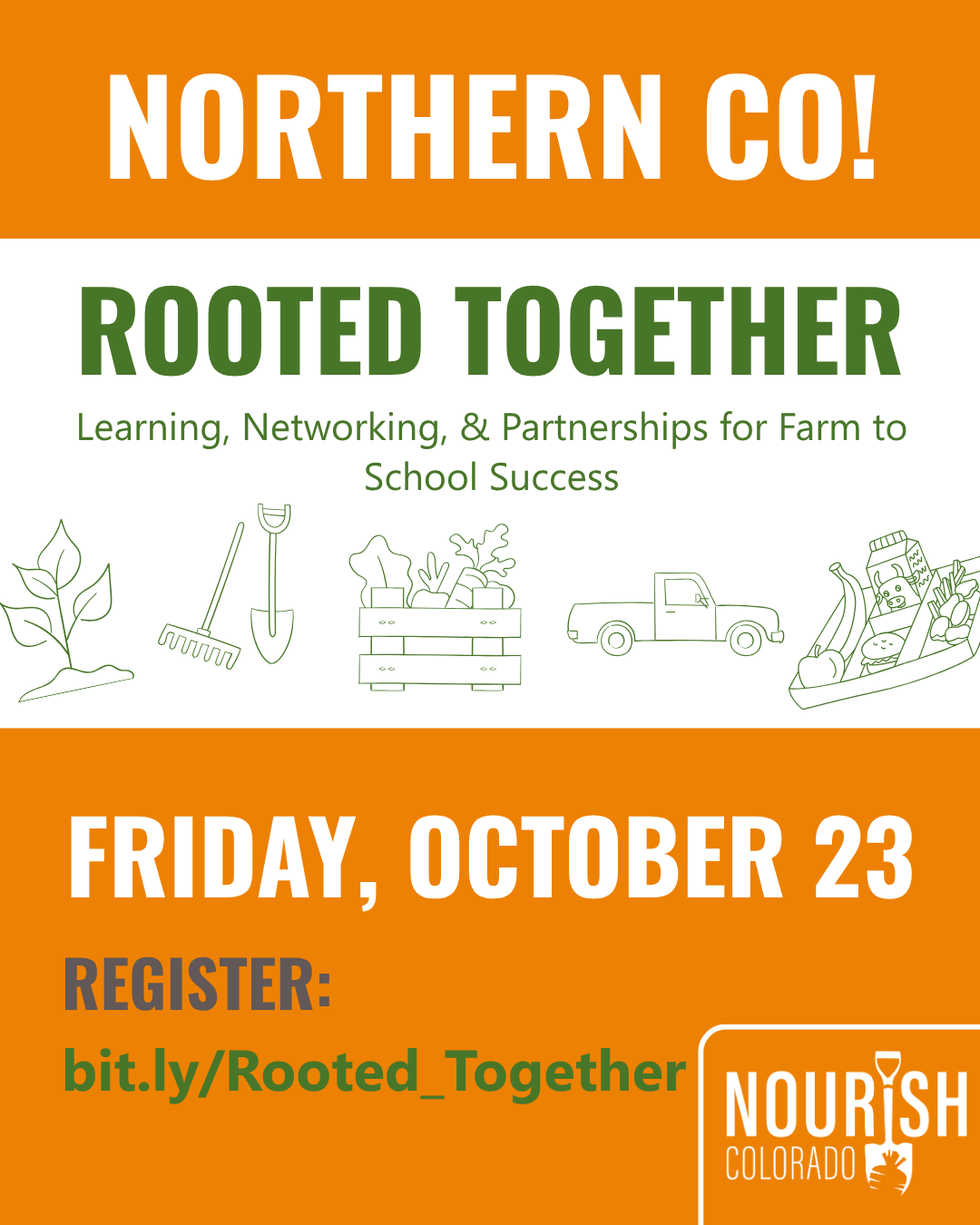
We’re excited to announce Rooted Together, a day of learning, networking, & partnerships for Farm to School success! This FREE event, presented by Nourish Colorado and the Colorado Local Food Program, is an event for K12 operators, Colorado’s agricultural producers, & strategic partners to gather, learn, and connect around Farm to School in Colorado. This year, there are six opportunities to join the event in six different regions across the state:
Oct 23rd - Northern CO (held in Greeley)
Oct 30th - Southwest CO (held in Ignacio)
Nov 6th - Western Slope (held in Glenwood Springs)
Nov 13th - San Luis Valley (TBD)
Dec 4th - Southeast CO (held in Pueblo)
Dec 11th - Denver Metro (TBD)
Choose which day (or days!) work best for you! You can join our morning pre-conference and afternoon networking OR choose to join us just for lunch and networking.
Interested? Register now!
| | |
Free Market Channel Assessments
Growers, are you thinking about which market channels are the best use of your labor? The Colorado Fruit & Vegetable Growers Association and CSU Extension have 4 farm stipends available to carry out farm-specific market channel assessments this season!
CSU Extension will help you by looking at sales volume, labor costs, and an array of market-based factors during one peak week of the market season. They provide a stipend for your time to collect that information, and you receive a report and discuss recommendations for enhancing profitability.
If you are interested, please complete this form https://col.st/GgmSF or email Nicole.Didero@colostate.edu.
| | |
Food Finance Institute Training Programs
Sources of Capital for Food Businesses
This training will help entrepreneurs explore debt, equity, grants, and alternative financing strategies while learning how to match the right type of capital to their business goals. Participants will leave with a clearer understanding of what funders are looking for and how to position their business for successful fundraising and long-term growth. This program begins on September 16th.
Learn more and sign up here.
Consultant Training
The Food Finance Institute is offering a Consultant Training beginning October 1st which will enable you to learn market trends and business models; master financials, performance, and funding strategies.
Learn more and sign up here.
Financial Foundations for Food Brands
This 3-part virtual workshop will help participants define their customers and their unique value, understand costs, and master key financial documents for growth. The program begins on October 12th.
Learn more and sign up here.
| | |
Online Course for Aspiring Farmers, Ranchers, and Food System Workers: Exploring Your Farm Dream
Exploring Your Farm Dream is an online course offered by CSU and the Colorado Building Farmers and Ranchers Program for people looking to equip themselves with the knowledge, skills, and business strategies for a future in agricultural production. This self-paced course is designed for learners who have limited experience in agriculture. Visit the course website here for more information.
The course consists of 10 modules, which learners will have access to for a full year. Registration costs $150. Register for the course here.
| | |
Open Western SARE Grants
Western SARE has released the Calls for Proposals for the following grant programs:
Grantwriting webinars will be held for each grant program.
Mini Grants
Mini grants are available for current and recent Farmer/Rancher Principal Investigators interested in attending conferences to present on the outcomes of their Western SARE-funded project and promote the Farmer/Rancher grant program. Applications must be submitted at least 60 days prior to conference attendance OR 30 days prior to virtual conference attendance.
Learn more and apply here: https://western.sare.org/grants/
| | |
Western Extension Risk Management Education Grants
The Western Extension Risk Management Education Center is announcing its 2027 Notice of Funding Opportunity on September 15, 2026.
There will be three funded program areas:
-
Education projects to help agricultural producers improve their economic viability through targeted risk management strategies;
-
Underutilization of crop insurance projects to deliver risk management education to agricultural producers who underutilize crop insurance products or programs; and
-
Exploratory projects for new ideas that address farmer/rancher risk management education needs.
Applications will open on September 15 and will be due on November 12, 2026. Awards will be announced on February 12, 2027.
For more information, including proposal resources click here.
| |
Next Generation Farmer Fund
The Next Generation Farmer Fund is a new grant program that will provide $10K-$50K grants and technical assistance to young, regenerative farmers and ranchers across the country.
Applications will open in October 2026, with recipients announced in early 2027. Eligible practices will include carbon sequestration and soil health efforts, water quality improvements, biodiversity, supply chain resilience initiatives, and other regenerative efforts.
Whole Foods Market has committed up to $500,000 in matching funds to launch the Next Generation Farmer Fund, with a goal of raising more than one million dollars. Learn more about the fund and its supporting partners here.
| | |
Restore Grants Opening Soon
Zero Foodprint’s Restore Grants provide up to $25,000 to farmers and ranchers implementing conservation practices that increase soil carbon and support climate-smart agriculture. The next application period opens October 1st and closes November 4th. Learn more here.
| | |
Growing GRASS Program
The Growing GRASS program, led by the American Sustainable Business Institute / Network and Other Half Processing, provides funding opportunities to beef and bison producers looking to build their byproduct supply chains. Whether you are a producer looking to expand existing direct-to-consumer markets or are just starting your journey selling directly to consumers, this is something to put on your radar!
Visit ggrass.org to learn more about the program, or scan the code to access the enrollment guide and see if you're eligible.
Eligible producers receive $3,000 JUST for completing the survey - if you decide it's not for you at the end, you keep it, no strings attached!
| | |
Colorado Parks & Wildlife Habitat Partnership Program (HPP)
The Habitat Partnership Program aims to work with private land managers, public land management agencies, sports persons, and other interested parties to reduce wildlife conflicts, particularly those associated with forage and fence issues related to big game ungulate species (deer, elk, moose, and pronghorn). Matching contributions from project applicants are required for every project.
Deadline: Rolling (local committee deadlines vary).
Learn more here: https://cpw.state.co.us/habitat-partnership-program#4257225834-1729028048
| | |
USDA Protection and Recovery Resources
USDA provides a suite of disaster assistance programs to help offset losses as well as crop insurance and other coverage options to help manage risk and provide a safety net. USDA’s Farm Service Agency, Natural Resources Conservation Service, and Risk Management Agency offers a number of options.
Learn more about USDA's disaster assistance programs here, and the Noninsured Crop Disaster Assistance Program here. The Risk Management Agency of USDA has crop insurance resources here.
| | |
FACT Fund-a-Farmer Grants
Funding from Food Animal Concerns Trust can support fencing, watering systems, pasture improvements, handling facilities, animal welfare certification, and other projects that improve pasture-based livestock operations. Grants typically range from a few thousand dollars up to $10,000
.
Applications Open: November 2026
Expected Deadline: Early January 2027
Learn more here: https://www.foodanimalconcernstrust.org/grants
| | |
National Fish and Wildlife Foundation's Southern Plains Grassland Program
The NFWF Southern Plains Grassland Program supports grazing management, grassland restoration, and drought resilience projects on working ranches in eastern Colorado, northeastern New Mexico, Oklahoma, the Texas Panhandle, Kansas, and southern Nebraska.
Next application cycle expected Fall 2026 (deadline to be announced).
Check out the program here: https://www.nfwf.org/programs/southern-plains-grassland-program
| | |
Quivira Coalition's Soil to Supper Program
The Soil to Supper project helps Southwest livestock producers adopt practices that improve soil and water health while strengthening their bottom line. The project is funded through an NRCS Advancing Markets for Producers grant, which helps pay livestock producers in the Southwest to do activities that improve access to markets and put conservation practices in place.
The Quivira Coalition is preparing to start signing up producers soon. Learn more here: https://soiltosupper.org/
| | News, Resources & Reading | | |
Revision to the Cottage Foods Act in Colorado, HB 26-1033
HB 26-1033 expands Colorado’s Cottage Foods Act (CCFA) allowing for the sale of homemade foods that require time and temperature control, including meat and meat products. This will go into effect on January 1, 2027. All cottage food producers must take a food safety course that includes food handling training on time and temperature control, and they must acquire and maintain proof of course completion.
As of January 1, 2027, all cottage foods producers will need to register their businesses with the Colorado Department of Public Health and the Environment (CDPHE). Producers will be assigned a registration number that must be included on their label, and CDPHE will maintain an electronic registry of all producers. Further, a producer may earn up to $150,000 in gross revenue under the CCFA each calendar year. This amount will be adjusted annually for inflation by CDPHE.
HB 26-1033 will allow cottage food producers to make a far wider range of products, with a limitation on the number of time and temperature controlled foods that can be produced. To help producers understand and comply with the new act, Colorado State University’s Cottage Foods team has revised their food safety training course to include the time & temperature control for safety information (TCS).
CSU Extension’s Cottage Food Safety Training:
Starting September 2026, the CSU cottage food safety course has been revised to include the required TCS information for 2027. Those with a current food safety certificate from CSU will need to take the shorter update class. Update classes for current certificate holders will begin September 2026.
Note that:
- Pricing for regular class will remain the same at $50.
- Pricing for the update class is $10.
- 2026 class participants will be receiving an email about their update class.
- Certificate holders who take the update class & pass the test with 80% correct will receive a sticker to be placed on their certificate showing they have taken the update course. Their certificate expiration date will not change.
- Producers who need to renew their certificate will need to register for the regular revised Cottage food safety training which will include the needed TCS information for January 1, 2027 changes.
More information on eligible foods, transportation limitations and other requirements under the act will be provided in future newsletters, including specific dates for taking the updated course.
| | |
Announcing the Good Egg Partner Program
Colorado Egg Producers is pleased to announce the launch of our new Good Egg Partner Program!
This program is designed for individuals and families who produce eggs on a smaller scale, including backyard flock owners, family farms, hobby farmers, and other small egg producers.
The Good Egg Partner Program focuses on education, responsible production practices, food safety and handling, flock health, and the care and welfare of laying hens. Members receive valuable information and resources to help them successfully manage their flocks and produce safe, high-quality eggs.
Membership benefits include:
• Educational programs and webinars
• Access to our “Ask the Vet” resource
• Important animal-health and disease alerts
• Updates from the Colorado Department of Agriculture
• Information about laws and regulations affecting egg producers
• Practical resources on flock management, biosecurity, and egg production
• Recognition as a Good Egg Partner
• A listing on the Colorado Egg Producers website
• Opportunities to connect with Colorado’s egg-producing community
Membership is only $25, and those who join now will receive membership through December 31, 2027.
Whether you operate a small family farm, maintain a backyard flock, or raise laying hens as a hobby, we invite you to become part of Colorado’s egg-producing community.
Join online today.
| | |
Globeville, Elyria, Swansea (GES) Community Food Systems Report
Researchers at Colorado State University are pleased to share the recently completed “The GES Community Food System: An Assessment and Recommendations” report. This report examines the community food system in three Denver neighborhoods (Globeville, Elyria, and Swansea) by bringing together perspectives from residents, community organizations, Denver food system leaders, and CSU staff. We hope this report can serve as a practical resource for organizations, residents, policymakers, funders, and others working to improve community food system programming and community engagement.
Visit the website to access the report (English and Spanish) and learn more about the project: https://aes.colostate.edu/marc/research/ges-community-food-system/
| | |
Colorado Tourism Office (CTO) Learning Labs
CTO Learning Labs is a free educational platform created to help tourism and hospitality professionals grow their expertise and deliver welcoming, memorable experiences for every visitor. This tool can help tourism operators
stay current with industry trends and expand their knowledge of Colorado's tourism ecosystem. Also, it can provide the tools and information needed to deliver high-quality experiences that benefit both visitors and residents.
Visit the CTO Learning Labs: https://ctolearninglabs.com/
| | |
Check Out Choices Magazine's Federal Policy Initiative Theme
Theme Overview: New Federal Policy Initiatives Are Driving Changes in the Food System
Mary K. Muth and Michele Ver Ploeg
Extensive food policy changes under the second Trump administration are affecting food insecurity, food access, food prices, and food attributes and, thus, directly impacting US consumers. This theme explores changes in SNAP, tariffs, food regulation, and dietary guidelines and their effects on program participants, food producers, and food consumers. Click here to read.
What Do Americans Believe About Food Tariffs?
K. Aleks Schaefer and Kelly A. Davidson
Public attitudes toward tariffs are shaped less by price expectations and more by symbolic narratives about fairness, strength, and national identity. Political affiliation is the dominant predictor of these beliefs, which at least partially explains why tariffs remain politically resilient despite higher consumer prices.
Click here to read.
New Federal Food Policies Will Affect Food Labeling, Reformulation, and Healthfulness
Mary K. Muth
Recent dramatic changes in food policy and federal agency priorities will affect food production and marketing in the United States. This article assesses how these changes could affect product reformulation, costs of production and thus food prices, and the healthfulness of food offerings across the supply chain. Click here to read.
Recent SNAP Policy Changes Could Have Significant Effects on Food Security, Poverty, and Rural America
Michele Ver Ploeg
The One Big Beautiful Bill of 2025 shifted a greater share of costs for the Supplemental Nutrition Assistance Program to states and tightened work requirements for some participants, among other changes. These changes could have substantial effects on participation in the program, on food security, and for agriculture and rural America. Click here to read.
| | |
Characteristics of Regional Food Policy Councils
Interest in regional approaches to food system planning, development, and governance has grown dramatically in the last decade, including that of food policy councils (FPCs). Due to limited information on regional FPCs, AMS and researchers and practitioners from Ohio State University, Colorado State University, and Johns Hopkins Center for a Livable Future partnered with 11 regional FPCs through an 18-month community of practice. They explored the unique opportunities, challenges, and needs of regional FPCs and developed resources to inform and support regional work.
These resources offer insight from the community of practice to support FPCs and other groups taking a regional approach. Visit the project website to view the resources and to learn more about the project background and takeaways.
| | |
Cultivation Station: A Colorado Proud Podcast
Cultivation Station is a business development podcast from the CO Department of Agriculture's Colorado Proud program. The podcast dives into the rich and diverse world of food and agricultural businesses. Whether you are just beginning to think about starting a food or ag business in Colorado, or your operation is up and running, there are many expert insights and insider tips to help you be successful.
Find the full list of podcast episodes here.
| |
List Your Business in USDA AMS Local Foods Directories
The USDA Local Foods Directories allow you to market your local food business to a wider nationwide audience. AMS directories include:
To create a new listing, answer quick and easy questions about the status of your business so consumers can learn more about you.
Click here to sign up for the directory.
| | |
Durango Agriculture Therapeutics Beta Test
The Durango Agriculture Therapeutics Beta Test aims to create a community where individuals with disabilities have equitable access to agricultural experiences that promote health, purpose, self-discovery, and connection. While Durango and La Plata County offer many opportunities to engage in agriculture, gardening, and outdoor recreation, few of these opportunities are intentionally designed for people living with invisible disabilities.
An invisible disability is a physical, neurological, cognitive, or mental health condition that may not be immediately apparent to others but can significantly affect a person's daily life. For many individuals, barriers such as transportation, confidence, social isolation, physical limitations, or lack of government and community support can prevent participation. At the same time, a growing body of research suggests that time spent outdoors, working with plants, and engaging in purposeful physical activity can contribute to reduced stress, improved mood, increased social connection, cognitive strengthening and greater overall well-being.
The Durango Agriculture Therapeutics Beta Test is built around a simple question: What happens when individuals with invisible disabilities are given the opportunity to explore agriculture in a supportive environment and at their own pace?
Pilot Program Overview
The Durango Agriculture Therapeutics Beta Test will engage ten participants living with invisible disabilities in an 8-month long agricultural exploration program, from March - October.
Participants will have the opportunity to:
- Cultivate raised-bed gardens
- Grow vegetables, fruits, herbs, flowers, and medicinal plants
- Learn from volunteer gardeners, farmers, and educators
- Experiment with growing methods and plant varieties
- Participate at their own pace and according to their abilities
- Track personal observations related to wellness, stress, physical activity, and community engagement
Resources Required
- Ten City of Durango Participants
- Land (Raised Beds) in the City of Durango
- Transportation
- Volunteer Agriculture Help/Educators
- Agriculture Implements and Tools
- Seeds, plants, soil etc
Please fill out the following form if you are interested in participating in this program: https://forms.gle/ERenKTnbHys7QmxZ8
| |
ABOUT FOOD SYSTEMS
at Colorado State University
| | Food systems are the connections between natural resources, the agricultural and food industries, and the buyers, consumers, and communities to which they contribute. Research, extension and education identify and inform opportunities to bridge how production, supply chains, and eaters respond to changing markets, policy, and the environment. At CSU, we focus on these key areas to train, influence, and communicate ways to connect food-related roles and foster healthy communities, economies, and individuals. | | | Find us on social media, get farm or food systems related questions answered via email, forward to a friend, or submit your contributions to our newsletter! | | | | |