The Landscape Conservation Bulletin | | A bi-monthly service of the
Network for Landscape Conservation | | | |
Dear Network Friends,
Brilliant autumnal colors are returning to the Massachusetts landscape, and fall is very much afoot here. I always find it a magical time of year—I am more attuned to subtle and daily changes in the landscape and feel drawn, with a renewed urgency, to seek out moments of visceral connection to the landscape around me while the weather is still warmish and while the season of dormancy is still just beyond the horizon.
I am finding myself especially drawn to reflections on our connection and relationship to place and the more-than-human world around us this fall, as we honor the lives and work of Annie Dillard and Wendell Berry. Both Dillard and Berry, in their own eloquence, brought a spiritual dimension to deep explorations of how we as humans connect to and make sense of the world around us—Dillard’s focus, as this tribute in The Atlantic underscores, was the holy work of hearing the natural world’s word, while Berry, as Barbara Kingsolver reflects upon in this New York Times tribute, plumbed the sense of belonging that is essential to humanity and that is rooted in our connection to the people and places that made us.
As we continue forward and deeper into fall, I trust that you all are finding moments to pause and cherish the relationship that you hold with the places you love, and—amidst so much turmoil in today’s world as we head towards the mid-terms here in America—are finding solace in those quiet moments on the landscape. I long have and will always cherish the gift of Berry’s words and voice, in reflecting on the peace of wild things as we continue to move forward in what feels like especially bleak and chaotic times.
Enjoy this month's Bulletin, and please stay in touch!
| | Making the Invisible Visible article series | Deeper reflections on conservation & stewardship | Additional Landscape Conservation News | Landscape Conservation Job Board | Webinars & Additional Resources | | |
Jonathan S. Peterson
Director, Network for Landscape Conservation
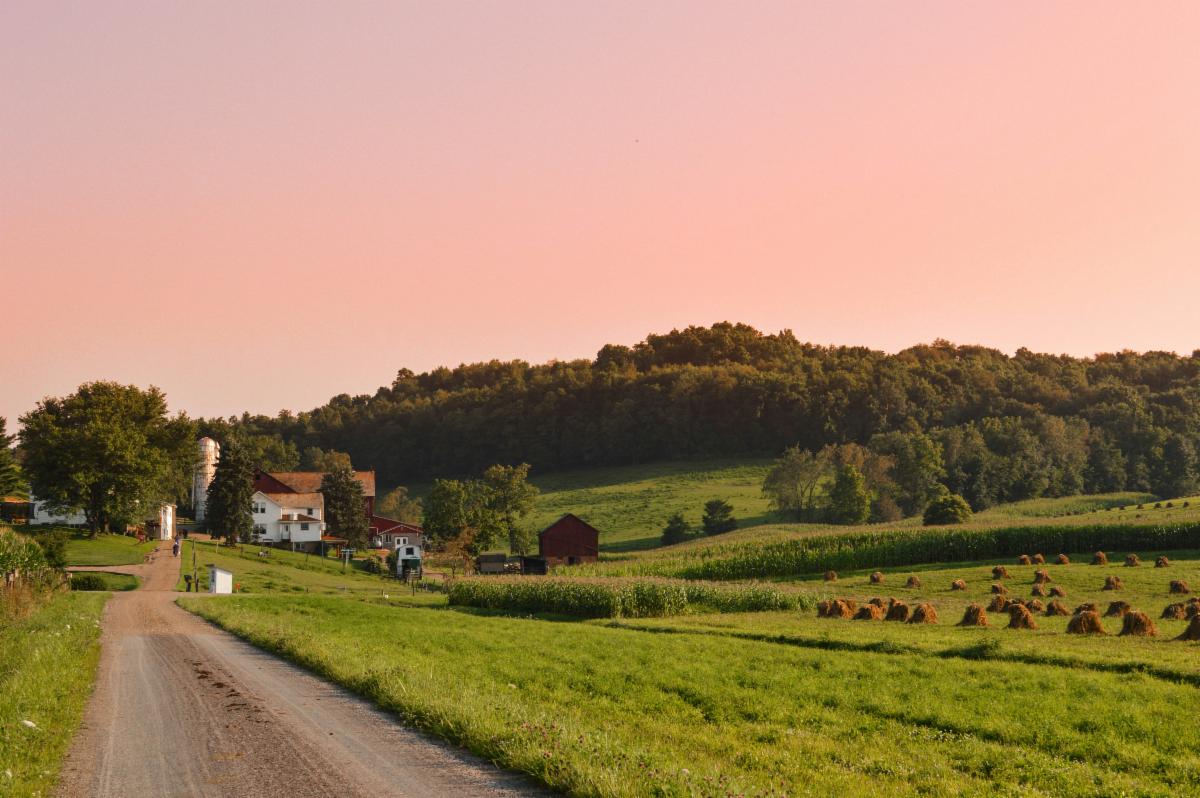
| | Cover photo: Harvest season, Holmes County, Ohio. Photo by Martin Yoder on Unsplash. | | |
Featured News
Making the invisible visible: New article series launched on collaborative coordination
| | |
At NLC, we have had the privilege of working alongside and learning from so many of you and the hundreds of landscape collaboratives that you are working to build, steward, and sustain. What we have come to understand clearly is that collaborative conservation and stewardship does not succeed through shared vision alone. Behind every effective collaborative is the often-unseen work of building relationships, facilitating dialogue, maintaining alignment, navigating conflict, sustaining momentum, and creating the conditions for collective action. Yet despite its central importance, collaborative coordination remains one of the least understood and most undervalued capacities in the landscape conservation and stewardship field.
With the launch of the Making the Invisible Visible article series, we aim to spark a conversation to change that, and are thrilled to be working alongside close colleagues and friends who collective carry decades of experience and insight around supporting collaborative processes. In writing this series, our team of authors have sought to show how collaborative coordination is its own sophisticated form of collaborative leadership—one that combines strategic, relational, administrative, and adaptive skills to help diverse partners achieve outcomes no single organization can accomplish alone. The series is written for practitioners, funders, researchers, and collaborative leaders who want to strengthen the people, roles, and systems that make lasting conservation and stewardship partnerships possible.
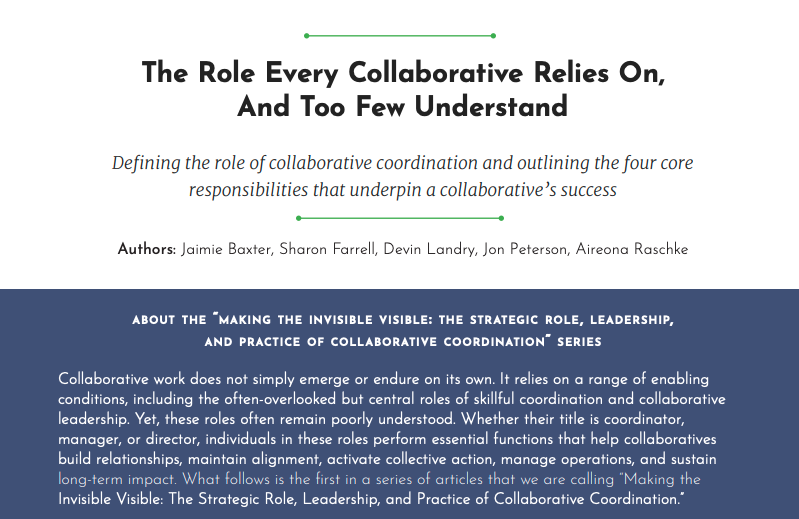
The series’ first article, The Role Every Collaborative Relies On, And Too Few Understand, lays the foundation by defining the collaborative coordination role and introducing four core responsibilities that underpin collaborative success: weaving a network, hold the big picture, activate collective action, and oversee operations and administration. The article argues that coordination is far more than meeting logistics or administrative support; it is a dynamic leadership function that helps collaboratives build trust, maintain coherence, mobilize partners, and sustain long-term impact. It also makes the case for greater clarity about coordination responsibilities so collaboratives can better design, fund, support, and share ownership of this critical work.
Stay tuned for the second article, which will be out in the coming weeks, and for others to follow. Our hope is that this article series represents a helpful contribution to the field, and that, perhaps most of all, it sparks a conversation: We know that our knowledge and understanding will continue to grow over time, and that so many of you have experience and insight that could contribute deeper nuance or perspective to what we are bringing forward in these articles. In that spirit, we look forward to hearing thoughts and reaction, and encourage folks to reach out to share those thoughts and reactions so that we can keep learning.
| | |
Featured News
Reflections from across the field: Deepening our understanding of conservation & stewardship to meet the moment
| | |
More and more, we are seeing evidence that conservation and stewardship efforts are struggling to shift the trajectories on the intersecting crises facing our socio-ecological systems—for instance, an article from The Guardian reports on new research released ahead of last week’s Climate Week that attempts to track where we are in terms of “planetary boundaries”—the conditions of Earth’s life-supporting systems that are necessary for us to stay within a “safe operating space for humanity.” The research suggests that seven of the nine boundaries have now been crossed, and the trajectories are moving in the wrong direction. What does this mean for conservation and stewardship moving forward? A number of items caught our attention this month that drive at this question for differing vantage points.
First, in a reflection shared earlier this month, Leslie Harroun of the Salazar Center for North American Conservation ponders how we’ve made conservation the specialized work of protecting nature from pressures generated throughout the rest of society, and challenges us to consider how we can build society’s capacity to steward living systems over generations. In a somewhat similar vein and writing in The Revelator, two practitioners working and living in India reflect on the role of language as conservation infrastructure, arguing that conservation cannot simply be about protecting more land. It must also protect the many ways in which we as individuals and communities understand that land, and relate to it—and that preserving language is actually a vital conservation strategy. Elsewhere, in a blogpost from the International Land Conservation Network, a colleague in Australia considers how visible young people are in other social impact sectors of civil society, but are less visible in the conservation sector—and suggests that engaging young people isn’t just about building the next generation of conservationists, but about expanding what conservation can be. Finally, this piece from Time, is framed in the context of climate change, but its core insights are widely relevant: that storytelling isn’t a subservient “messaging” tool that allows us to convey complex scientific understanding for public audiences, but is actually a tool for shifting our understanding of what is possible in the future. The implicit argument is this: that imagination and shifting the mythologies that we use to understand ourselves and our communities are essential and untapped conservation strategies.
These pieces each invite deeply reflection on the essence of our work, and suggest that landscape approaches offer more than simply a mechanism for accelerating conservation projects: in the face of complex and systemic challenges, collaborative landscape conservation and stewardship is a means of moving beyond reductive and siloed responses, and for bringing sharper focus to the deeper work of reimagining our relationship—as individuals and as a society—with the natural world in which we live.
| | Additional Landscape Conservation & Stewardship News | | |
A national Tribal needs assessment recently completed by the Arbor Day Foundation highlights how Tribal communities are leading integrated, community-driven approaches to land stewardship—and that the greatest opportunity for partners is not to create new programs, but to strengthen existing Tribal leadership through flexible funding, technical assistance, workforce development, and long-term partnerships that honor and uphold Tribal sovereignty.
Explore the report
American Forests launches the Forest Innovation Platform, an open-source tool that aims to provide landowners and land managers with comprehensive forestry data and climate projections for any forest at any scale in the continental U.S.
Learn more and explore the Platform
Briefing note explores the infrastructure—the recurring operational capacity and institutional arrangements required to convene partners, build shared understanding, agree to priorities, coordinate implementation, align resources and adapt over time—needed for advancing integrated landscape approaches, and calls attention to the need to resource this governance infrastructure.
Read the briefing note
Looking to states for leadership on America’s public lands—New report from Trust for Public Lands profiles 11 states that are incubating good ideas at the intersection of public lands, communities, and conservation across four key dimensions: access, economic vitality, community resilience in health and climate, and Tribal and Indigenous partnership.
Explore the report
With federal protections of waterways being rolled back, states are stepping forward to advance new policies and programs to conserve critical freshwater resources, with Pew Charitable Trusts spotlighting the state-level leadership in this space from Colorado, New Mexico, and Washington.
Learn more
Mongabay article reports on new practice-oriented research out of Japan that calls attention to the potential for a “gentle power” approach to conservation that does not rely on top-down control or purely voluntary participation, but that rather fosters mutual trust and collaboration “to find a middle ground where institutional support and local autonomy reinforce each other.”
Read the article
Article in Texas Monthly spotlights how Camp Bullis, located outside of San Antonio and a nationally-significant military location for nighttime field training, is leveraging the Sentinel Landscape program and bringing together an unlikely coalition of military and conservation partners to successfully protect dark skies and open space against encroaching development.
Read the article
Rights of Nature: Mongabay reports on how a group of adolescent girls spearheaded a campaign that culminated in the Eastern Band of Cherokee Indians Tribal Council passing a resolution recognizing the inherent legal rights of the Longperson, the interconnected waterway system whose headwaters rise in the Great Smoky Mountains and travel through multiple states and across nearly 800 miles to reach the Gulf of Mexico.
Read the article
New report spotlights the 68 First Nations Guardians programs across Canada and uses a comprehensive return-on-investment model to demonstrate the significant benefits that such programs deliver for community wellbeing, environmental stewardship, and personal transformation.
Learn more and explore the study here
Ground Shift essay posits that America needs a national conservation mission for its public lands and waters, arguing that multiple uses are only possible when public lands are healthy enough to support them.
Read the essay
A separate Ground Shift essay recognizes that stewardship of public lands is at its core a human endeavor, arguing that agency capacity isn’t a ‘nice to have’ but is essential infrastructure, and that we need to invest in building and sustaining the civil servants within our land management agencies that are tasked with navigating the complexity of today’s world.
Read the essay
Walton Family Foundation launches a $25 million impact investment fund, the Water and Nature Fund, that aims to support innovative nature-based solutions that protect rivers and oceans—and the communities that depend on them.
Learn more
New primer from the Nicholas Institute at Duke University offers natural resource professionals an introductory overview on using nature finance to support conservation, restoration, and other nature-based solutions.
Explore the primer
Mountain Journal reports on the U.S. Department of Agriculture’s proposal to rescind the Roadless Rule, a 25-year-old policy that bars development like road construction and logging on nearly 45 million acres of national forest land.
Read the article and learn more about the Roadless Rule here
The Yellowstone to Yukon Conservation Initiative has been named a finalist for the 2026 Earthshot Prizes, identified as one of three finalists in the Protect and Restore Nature category.
Learn more and explore the finalists here
Last month, the Mono Lake Kootzaduka'a Tribe of California and Nevada and California State Parks signed a co-stewardship agreement to facilitate a collaborative approach in the management and preservation of cultural, tribal, and natural resources on State Park units located within the traditional homelands of the Kootzaduka’a people.
Learn more
Yale e360 digest highlights new research out of the Olympic Peninsula in Washington that shows that mountain lions—by changing where and how ungulates move through the landscape and pushing them away from open areas like roadways—may be cutting down on wildlife-caused traffic accidents.
Read the digest
| | |
Upcoming Conferences & Events
* * * *
October 5-8, 2026 — 2026 Natural Areas Conference: Where Science Meets Stewardship
Asheville, NC
October 20-22, 2026 — Resilient California Summit
Sacramento, CA
October 20-22, 2026 — California Landscape Stewardship Network @10: Celebrating Progress, Inspiring Action, Shaping What's Next
Tahoe City, CA
October 22-23, 2026 — Towards a New Era for Public Lands: Restoration and Renewal
Boulder, CO
November 4-6, 2026 — Chihuahuan Desert Conference
El Paso, TX
November 5, 2026 — Regional Conservation Partnership Network Gathering: Cultivating a Shared Food Future Through Conservation, Community, and Collaboration
Amherst, MA
November 10-13, 2026 — GreenLatinos National Summit
Tucson, Arizona
February 9-11, 2027 — Salazar Center's 2027 International Symposium on Conservation Impact
Mérida, Mexico
October 26-29, 2027 — Global Congress of the International Land Conservation Network
Melbourne, Australia
A call for proposals is currently open, through October 19th.
| | |
Landscape Conservation Job Board
* * * *
Northeast Regional Connectivity Coordinator, Northeast Association of Fish and Wildlife Agencies
Learn more
Advocacy Program Manager, Together Bay Area
Learn more
Executive Director, Beaver Hills Biosphere
Learn more
Policy Associate, Alliance for Wildfire Resilience
Learn more
Director, The Nature Record
Learn more
Tribal Engagement Fellow, Natural Resources Defense Council
Learn more
Science and Evaluation Director, Puget Bay Partnership
Learn more
Executive Director, Vermont Center for Ecostudies
Learn more
Fire Networks Learning & Capacity Building Specialist, The Watershed Research and Training Center
Learn more
Program Officer, Volgenau Foundation
Learn more
President, Pisces Foundation
Learn more
Environment Program Director, Charles Stewart Mott Foundation
Learn more
This section of the Landscape Conservation Bulletin is intended to be a space to share job postings that will be specifically relevant to landscape conservation practitioners. We welcome submissions: if your organization would like to widely distribute a posting please be in touch.
| | |
Webinars & Additional Resources
* * * *
Freshwater Landscape Analysis: What We Heard from You
A webinar from the Clean Water for All and America the Beautiful for All Coalitions
October 5, 2026
Wicked Problems: Building Capacity for Lasting Impact
A webinar from the Center for Creative Leadership
October 7, 2026
Facilitating Engaging Meetings
A three-part virtual training from the Institute for Conservation Leadership
October 20, 22, and 27, 2026
Find the Common Threads: Facilitation and Collaborative Problem Solving
A three-part virtual training from the Partnership and Community Collaboration Academy
October 27-29, 2026
Building Lasting Impact: Lessons from Nature Everywhere Communities
A webinar from the Children & Nature Network
October 29, 2026
Asking Better Questions
A workshop from the Institute for Conservation Leadership
November 17, 2026
Energize Your Partnerships and Networks
A three-part online training from the Institute for Conservation Leadership
December 1, 3, and 8, 2026
Managing by Network
A six-month virtual training course from teh Partnership and Community Collaboration Academy
December 2026-June 2027
Calm the Waters: Conflict Management and Principled Negotiation
A three-part virtual training from the Partnership and Community Collaboration Academy
March 2-4, 2027
Steps to Resilience
A self-guided workshop from the Climate Smart Communities Initiative
Building Blocks of Trust Training Series
A self-directed training series from the River Network and Water Now Alliance
NatureConnect
NatureConnect is a diverse suite of services, tools, and workshops offered by the Center for Large Landscape Conservation to help partners achieve connectivity and landscape conservation goals.
Connectivity 101
A free, online course developed by the Center for Large Landscape Conservation and partners in the Wildlife Connect Initiative with technical support from UNDP Learning for Nature. Conservation professionals and other interested parties can now register for the course to learn about conserving and restoring ecological connectivity to support a healthy planet.
Conservation Finance Boot Camp Short Course
Following cancellation of the 2020 Conservation Finance Boot Camp, the Conservation Finance Network compiled a 4-part video short course, which is available via the above link.
America Adapts: The Climate Change Podcast
A weekly podcast that explores the challenges presented by adapting to climate change and the approaches the field's best minds believe are already working.
Recordings of past webinars of the Connected Conservation webinar series are available on the National Park Service Connected Conservation website.
Recordings of past NLC Landscape Conservation in Action webinars are available on the Network's Landscape Conservation in Action Webinar Series page.
| | |
The Network for Landscape Conservation is the community of practice for practitioners advancing collaborative, cross-boundary conservation as an essential approach to protect nature, culture, and community in the 21st Century.
www.landscapeconservation.org
Contact Jonathan Peterson, Network Director, for more information.
Contributions of news, upcoming events, resources, and job postings for future Bulletins are welcomed. We also welcome inquires for potential future "Perspectives: Landscapes Conservation in Action" stories; please be in touch if you are interested in sharing stories and insights from your work.
| |
The Network for Landscape Conservation is a fiscally sponsored project of the Center for Large Landscape Conservation, P.O. Box 1587, Bozeman, MT 59771
| | | | |