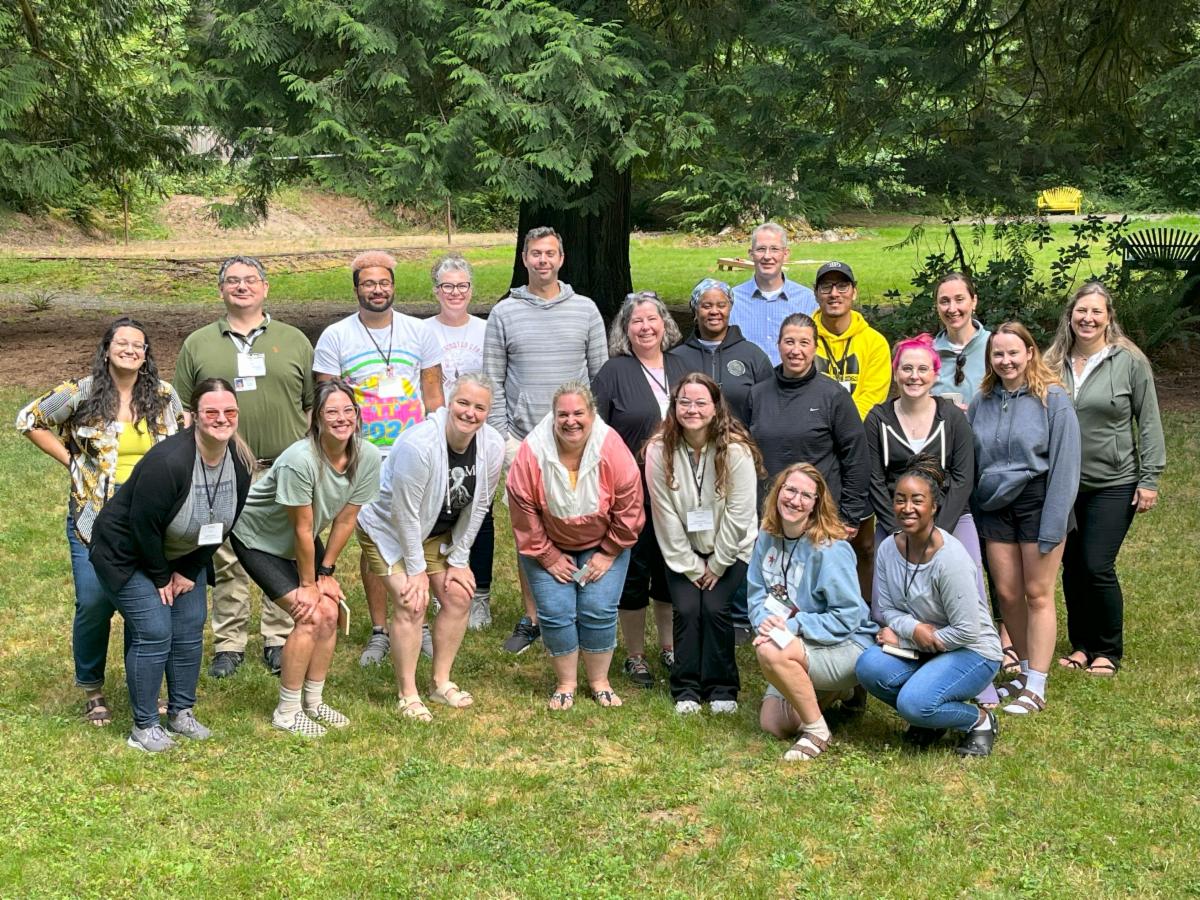
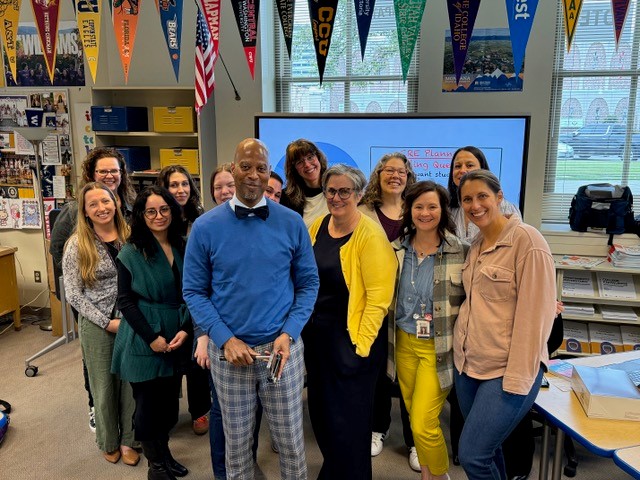
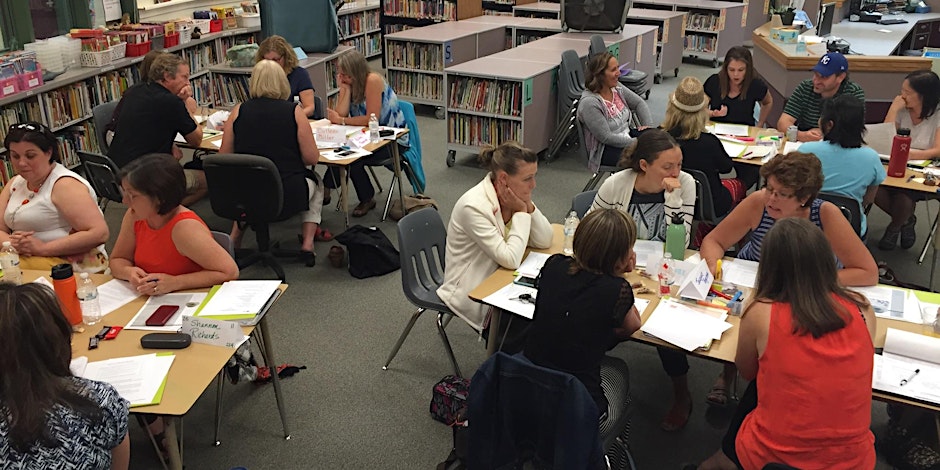
Educators from across the state take a photo break during their Camp CSTP session on equity-focused PLCs, August 2024. Camp CSTP is hosted every summer at the beautiful Rainbow Lodge in North Bend, WA. | |
WERD Book Studies: Registration is Now Open! | |
|
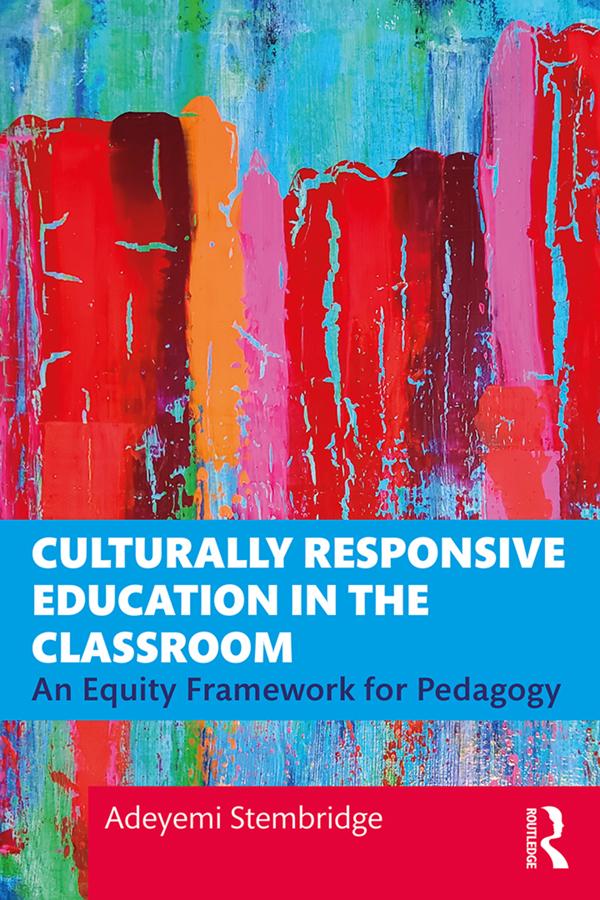
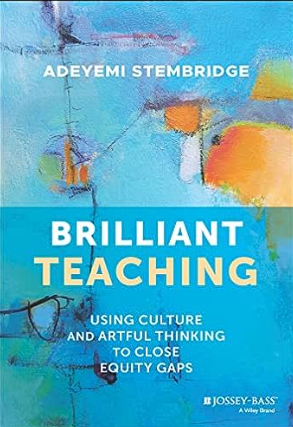
We're excited for you to join us as Dr. Adeyemi Stembridge facilitates studies of his books Culturally Responsive Education in the Classroom and Brilliant Teaching.
We will be joined by the author at each weekly meeting, who will help facilitate learning and large-group discussions on this equity-based education book. In addition, participants will connect, discuss and reflect upon the book in small groups.These free book studies are open to all Washington paraeducators, teachers, principals, administrators, and ESAs. Registration is free, and each book study offers clock hours. See our website for more information.
Culturally Responsive Education in the Classroom
-October 1st: Preface, Chapter 1 and Chapter 2
-October 8th: Chapter 3
-October 15th: Chapter 4
-October 22nd: Chapter 5 and Chapter 6
-October 29th: Application & Implication
Register and learn more here.
Brilliant Teaching
-January 9th: Preface & Chapter 1
-January 16th: Chapter 2
-January 23rd: Chapter 3 & 4
-January 30th: Chapter 5, 6, 7 & 8
-February 6th: Chapter 9 & Afterword
Register and learn more here.
Plus: Facilitators Wanted
We are seeking Facililitators for our upcoming book studies. We have a few spots left and would love people interested in facilitating small group discussions and deepening their leadership skills and equity lens, as well as earning a stipend, to consider joining our work with the WERD book studies with Dr. Stembridge!
Apply to be a WERD facilitator here.
| |
CRE Residency Experiences - A Unique And Intensive Professional Development Experience: Applications OPEN! | |
|
Click here to apply to bring a CRE residency to your district.
Culturally Responsive Teacher Experiences (formerly known as CRE Teacher Residencies) are a unique and intensive professional development experience in which your team receives coaching, facilitation and technical assistance from Dr. Adeyemi Stembridge, author of “Culturally Responsive Education in the Classroom” and “Brilliant Teaching: Using Culture and Artful Thinking to Close Equity Gaps”.
Residencies are designed based on the needs of your educators and their students, and include 18 hours of in-person learning, coaching and technical assistance around the mental model that serves as the foundation for a culturally responsive classroom. The 18 hours are covered in three consecutive days using a sub release model. The dates and schedule will be mutually agreed upon once your team is selected and approved. We anticipate selecting up to 25 schools or districts for this one-of-a-kind professional development training.
If you have any questions regarding this opportunity, please contact anzara@cstp-wa.org.
See our website for more information and FAQs.
| |
CSTP's National Board Component Support is Open for Registration | |
|
Registration is open for two CSTP-sponsored National Board Component Support cohorts, with potentially more on the way.
For the 2024-25 school year, we are partnering with the following facilitators:
-
Online cohort: Faciliated by Ranice Innocent. This will be Ranice's 6th year facilitating and supporting National Board Candidates/Cohorts. Foundations and all four components will be offered, with 12 clock hours available for each section. Read more and register here.
-
In-person cohort for music teachers: Stacy Brown will be hosting an in-person cohort for music teachers in the Olympia area. Components 2 and 3 will be offered in 24-25, with components 1 and 4 offered the year after, with 12 clock hours available for each section. Read more and register here.
| |
Partner with CSTP to Offer Clock Hours at Your Next Training | |
|
Are you running a course, professional development or book study and want to offer Washington State clock hours? CSTP is an approved Washington State clock hour provider and can approve your courses for clock hours. It is free for the instructor to apply for the course with participants paying a nominal fee.
Learn More and Apply for Clock Hours
| |
Career Connected Learning with CSTP | |
CCW is a statewide network of business, labor, education, and community leaders creating work-based and academic programs for young people in Washington to explore, prepare, and launch themselves into college and careers. CSTP is the designated Sector Lead for Education supporting this work at the state level. Here are our monthly updates.
RFP Application Window is Open
On behalf of Career Connect Washington (CCW), the Washington State Employment Security Department (ESD) is conducting a Round 13 Request for Proposals (RFP) for CCW Program Builder Funding.
We seek proposals from highly qualified entities capable of building or expanding Career Launch, Career Prep, and Career Explore programs. To develop industry-aligned programs for Career Connected Learning (CCL) opportunities in targeted counties and industry sectors.
Our vision is that every young adult in Washington will have multiple pathways toward economic self-sufficiency and fulfillment, strengthened by a comprehensive state-wide system for career connected learning. In order for every young adult to succeed, we must intentionally focus on populations kept furthest from opportunity, especially students of color, Indigenous students, low-income students, rural students, and students with disabilities. Women- and BIPOC-led organizations and organizations specifically serving young people of color and people with lived experience in historically marginalized communities are strongly encouraged to apply.
To catalyze the development and expansion of programs statewide, $4,000,000 of the Federal Workforce Innovation and Opportunity Act (WIOA) Statewide Activities funds will be made available. ESD targets award amount for each grant is $100,000 – $175,000, No single award will exceed $250,000. ESD expects performance periods will begin in February 2025 and end in September 2026.
Bids are due October 16, 2024, at 5:00 PM Pacific Time. The RFP can be accessed via the Washington Electronic Business Solutions (WEBS) system (RFP #2024-11). Bidders are responsible for downloading the solicitation document and all appendices and incorporated documents. Questions can be directed to Procurement Coordinator Aaron Pittelkau (esdgpbids@esd.wa.gov).
This grant opportunity is for those in the Educator workforce who want to build a program or expand an existing program that supports more opportunities and access to a career in Education. This could be for paraprofessionals, fully certificated teachers, mentors, coaches working to support pre-service teachers, programs that specifically support BIPOC educators, etc. If you think you might have a program that would be a good fit, please contact the Sector Lead Saara Kamal at saara@cstp-wa.org!
Regional Gathering at ESD 123
Our first regional gathering will be taking place in ESD 123 at the ESD building with a featured presentation from our Puget Sound CCW Program Builder Lead Darin Knapp. We are so excited that Darin will be sharing about their teams' experience in building a program that supports BIPOC paraeducators to attain their full teaching certification. Please contact Saara Kamal with questions at saara@cstp-wa.org!
| |
OSPI Information Session on the National Board Process | |
|
Who: Any National Board candidate working toward National Board Certification in 2024-2025
What: These one-hour webinars are designed to support writing for the National Board portfolio. Candidates should expect to examine their own writing and work with peers on the selected topic. These sessions DO NOT replace cohorts nor conditional loan requirements.
When: Twice monthly, always Tuesdays, 4:30 PM-5:30 PM (choose Series A, B, or both!)
See here for 2024-25 dates and registration.
| |
|
Join WA ESD for three days at the AI Innovation Summit, where district and building teams will explore the power of artificial intelligence in K-12 education. Whether you’re new to AI or already implementing it, this statewide conference offers valuable insights, strategies, and collaborative opportunities. Ideal for board members, administrators, educators, and IT professionals.
The event will be held in two locations: Seatac (October 16-18); and Spokane (October 17-19).
Register here.
| |
Get Schooled: Student Resources | |
|
Our friends at Get Schooled shared several great resources for students in their latest digest, including FAQs about AP courses and exams; a video on how to decide where to apply to college; and a blog on how to go from your first job to your dream job.
| |
Ready WA: The "Now What" After College Acceptance | |
|
Need advice on finding a roommate, understanding your financial aid package, or learning more about your college campus? Ready WA Storyteller Hannah's latest blog post is here to help! She shares her personal experiences and top tips for making your first year of college a success. Don't miss out! Read it here.
| |
September 15-October 15 is Hispanic Heritage Month | |
|
Hispanic Heritage Month is a month-long celebration of Hispanic and Latino history and culture. While we celebrate Hispanic and Latino communites beyond this month, from September 15 to October 15 we give extra recognition to the many contributions made to the history and culture of the United States, including important advocacy work, vibrant art, popular and traditional foods, and much more.
Hispanic Heritage Month provides an additional opportunity to explore the incredible impact Latinas and Latinos have had on the United States for generations. The Latino presence in America spans centuries, predating Spain’s colonization of what is now part of the United States, and they have been an integral part of shaping our nation since the Revolutionary War. Through the Treaty of Guadalupe Hidalgo and the Treaty of Paris that followed the Mexican-American and Spanish-American wars, the United States gained territories in the Southwest and Puerto Rico. This incorporated the people of this area into the United States and further expanded the presence of Hispanic Americans.
Read more here.
| |
|
Join us for fun facts, obscure knowledge, and exploration of physics, genetics, etymology, art, and more!
| |
|
All animals, including us humans, use teeth to bite, grind, chew, and vocalize. Teeth vary in shape between pointy, flat, or narrow. These shapes have different strengths where biting and eating are concerned, and different animals have different arrangements of teeth.
There are four classifications of teeth. From front of the mouth to the back we find incisors, canines, premolars, and molars.
Incisors: These are our frontmost teeth. They have a thin, flat edge. They are good for biting and getting purchase on foodstuffs. These are also the most relevant teeth to our speech patterns; we use interactions between our incisors and tongue to produce certain sounds.
Canines: These are the pointiest teeth in the set, good for tearing through even tougher food.. The way our top and bottom canines lock together also helps align our jaws to increase our biting accuracy and strength as well as help us form facial expressions
Premolars: These teeth have both a large surface area and some points. These help the canines by tearing food and pre-grinding the food as it is funneled back to the larger molars.
Molars: These are your backmost teeth, wide and flat. They finish breaking down food before it can be safely swallowed. Wisdom teeth are a third row of molars that many, though not all, people develop as they age. Wisdom teeth often crowd out other teeth in the jaw or grow sideways and have to be surgically removed. Some people have only two or three wisdom teeth, and some have none at all, making molars our most numerically variant tooth type.
Some animals, like lizards and sharks, are “homodont,” meaning they have only one variety of tooth. In these cases, their teeth are all equivalent to canines: Sharp and pointy for rending their all-meat diets.
All mammals are “heterodont,” having multiple types of teeth. Meat-eating mammals tend to have more incisors and much larger canine teeth than omnivores like us. They also have more premolars and fewer molars. The prominence of dogs’ fangs are why we call these teeth “canines” at all.
Meanwhile, herbivore mammals like cows have more molars for grinding up plant matter but lack canines altogether as they need less puncturing power. In addition, by lacking the canines’ locking together aspect, grazing animals can move their jaws side to side to break down plant matter more efficiently. See cows chewing their cud.
In short, teeth may be funny little outside bones that take a lot of care and upkeep, but they are also extremely useful in ways that we find practically invisible. Thanks, little teeth! Keep up the chewing.
| |
Your gift ensures that CSTP continues to support student achievement through a focus on teaching excellence. With you as a partner in CSTP’s mission, you directly make a difference in the lives of youth across Washington State schools. Donations are tax deductible and essential as CSTP works to support educators navigate unique models of student engagement and teacher leadership. | |
Liking and sharing our posts on social media is another way you can support CSTP during these times. Thank you for sharing our message. | | | | |