Green Heat News
September 2018
|
|
|
4th Wood Stove Design Challenge
Meet the Teams!
These are the last three blogs in a series of 12 about each team competing in the November stove challenge.
|
This German downdraft stove strives to “produce 100 watts of electricity as a mean value a day.” The stove heats water to distribute heat to other rooms and also comes with a large battery that is designed as a backup electricity for the home, or to augment a solar PV system.
China has tens of millions of old stoves that need changing out with newer cleaner ones. This Chinese entrepreneur will demonstrate how a $300 dollar stove can help clean up rural Chinese air sheds and provide some electricity to rural homes that often experience brownouts.
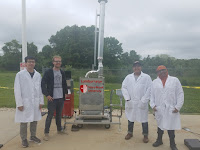
The SUNY Stony Brook team’s main focus is to show that clean, efficient, wood combustion is possible without sacrificing commercial viability. They use an innovative drying chamber, sensors and a Venturi draft inducer.
EDGE Energy is donating solar panels for the Challenge and will show how homes can combine and integrate pellet stoves, electricity-making wood stoves, solar panels and batteries! Many thanks to EDGE Energy!
Biolite is another proud sponsor of the 2018 Wood Stove Design Challenge. They bring light and charging capability to tens of thousands of homes in Africa by capturing some of the heat off wood stoves. And, they are donating products like these to be given away in November at the Challenge. Thank you!
Many thanks to the DOE’s Bioenergy Technology Office, Osprey Foundation, NYSERDA, the US Forest Service, the Masonry Heater Association, HPBA, Lignetics, Chimney Safety Institute of America, Myren Labs, Schott Robax Glass, the Catalytic Hearth Coalition, the National Fireplace Institute and Testo. We could not host this event without their generous support.
|
|
|
Focus on the NSPS and Congress
|
The EPA sent two proposals to the OMB in August, one of which proposes to allow retailers a period of time after the May 2020 compliance date to sell Step 1 units. The
second proposal
, on Aug. 7 appears to have a broader focus, bluntly stating that
they “are soliciting comments on issues raised by industry.” Other non-industry stakeholders will also be able to raise issues.
S. 1857 was introduced in 2017 and would give an additional 3 years for manufacturers to make and sell Step 1 stoves, which are typically twice as polluting as Step 2 stoves. This could result in about an additional half million Step 1 stoves to be installed in airsheds and communities. Introduced in 2017, it only has one new co-sponsor in 2018. It may go to committee mark-up this month, but getting passed into law this year is very unlikely.
Analysis:
Many stove manufacturers are getting their stoves compliant for the stricter 2020 emission standards. But there are some laggards. Are they taking the deadline seriously or just assuming the Trump Administration will delay or water down the standards?
Paul Williams VP for Business Intelligence at US Stove, based in Alabama, argues that without Senate action to delay the 2020 NSPS deadlines,
it will “leave many Alabamians without affordable options to stay warm in winters ahead.” He says the EPA gave manufacturers 5 years to complete a process than normally takes 8.
John Ackerly of the Alliance for Green Heat argues that an amendment to Senate bill S. 1857, that offers a one year sell through for retailers and nearly half a billion for a stove change out fund is a good compromise between industry, air agencies and other stakeholders. This would provide a massive economic boost to the stove industry, give retailers the next three winters to sell their existing stock and get Step 2 stoves into circulation faster.
More than 30 organizations, including BTEC, Alliance for Green Heat and Pellet Fuels Institute, urge the Senate Agriculture Committee to expand the Community Wood Energy and Innovations Program in the Farm Bill. The program provides grants to start buildings on modern pellet heating systems.
|
|
|
AGH Programs & Activities
|
In August, AGH participated in drafting new test questions for the National Fireplace Institute’s pellet stove technician exam and updating the 6
th
edition NFI Reference Manuals.
NFI is reorganizing its exams, requiring gas, wood and pellet technicians to all take and pass a common core knowledge exam as well as a exam focusing on gas, wood and pellet stove installs.
We are thrilled to have Jennifer Lessick join our staff as a Research Fellow. Jennifer recently graduated from George Washington University where she focused on environmental studies and sustainability. She is the team coordinator for the Wood Stove Design Challenge and is doing outreach on Capitol Hill.
|
|
|
A new report on thermal programs in Renewable Portfolio Standards finds that the 21 biomass heating projects in NH using the RPS program generated 43,094 thermal RECs, generating an estimated $991,162 in revenue for system owners. The projects displaced 1,500,851 gallons of #2 heating oil in 2017. INRS provided the performance analysis for the report.
|
|
|
Focus on Firewood & Pellets
|
About 7.5% of homes in Britain burn wood for ambience or warmth. By now the share is probably higher, since about 175,000 new stoves are sold each year. But home wood-burning now accounts for 38% of the particles emitted in Britain, more than twice the amount spewed by vehicles.
As biomass to electricity plants close in NH, experts say more widespread use of pellet heat could help find new uses for low-grade wood products. AGH argues that New England states need to promote pellet stoves, not just pellet boilers, to succeed in any real strategy to ramp up pellet heating.
|
|
|
State & International News
|
Alaska:
A very passionate, well-written letter arguing against what many consider to be vital regulations to improve air quality in Fairbanks.
California:
This website lists the woodsmoke reduction programs currently in place in California.
Colorado:
Confluence faced headwinds around 2010, as lower oil prices reduced the demand for pellets. Then the price of oil plummeted again in 2014.
Idaho:
Air quality monitors can be purchased now by anyone for around $200 and those of us in the wood heating community should be investing in them to learn about PM in our neighborhoods. .
New Hampshire:
UNH officials calculate that the heat and hot water plant will consume 750 tons of semi-dry wood chips, equivalent to over 70,000 gallons of No. 2 fuel oil.
Oregon:
The Department of Environmental Quality is giving Prineville $10,000 to clean its air.
|
|
|
A particulate matter (PM) chart from the United Kingdom shows electric heat has zero emissions, even if the source is 100% coal.
Hard not to enjoy an article about an 86-year old guy who loves cutting and splitting lots of cords of wood.
|
|
|
Davis, CA, September 10, 2018
ASIC brings together stakeholders from academia, government, and communities to promote and advance air pollution sensors.
Philadelphia, PA, September 12-14, 2018
The Mid-Atlantic Bioenergy Council (MABEC) is looking forward to welcoming over 300 attendees from the Mid-Atlantic and beyond
.
Amherst, MA, September 28, 2018
John Siegenthaler's Pellet Boiler Boot Camp is a single-day “deep dive” into the operating characteristics of modern pellet-fueled boilers.
Berlin, Germany, October 10-11, 2018
The International Biomass Congress & Expo brings together leading producers, suppliers, regulators and others over a two day period to address issues relating to the biomass sector.
October 24, 2018
On October 24, 2018, participating organizations will open their doors to their communities to demonstrate the many benefits that bioenergy provides on the local level.
University Park, PA, October 24-25, 2018
This two-day short course covers the fundamentals, applications, and business opportunities related to the transformation of biomass into value-added thermally processed materials.
Burlington, VT, October 18-19, 2018
REV2017 brought together leaders and experts from throughout the region to address the challenges and opportunities ahead.
Washington DC, November 9-13, 2018
The 2018 event is free and open to the public and features a competition on the best automated and thermoelectric wood stoves. It includes rigorous testing and assessment.
Aurora, CO, December 17-18, 2018
A two-day Workshop on Household Energy Impact Evaluation aims to accelerate transitions toward cleaner household energy systems and policy-oriented impact evaluation research designs. Spaces available for 50 experts.
Wels, Austria, February 27 - March 1, 2019
Energy efficiency and renewable energy are at the core of Europe’s commitment to a clean energy transition. This conference connect people and empower them to embrace the necessary change.
|
|
|
Spotlight on Misleading Advertisements
|
|
We often receive tips and suggestions from stove manufacturers about grossly exaggerated advertising by some other manufacturer. Often, these tips have already been shared with the EPA. This month we highlight the
Vogelzang TR007
for its claim that it provides “up to 152,000 BTUs” and “Efficiency rating: 82%.” Many manufacturers exaggerate their BTUs but we could not find any higher than this one. Based on third party testing, the EPA lists the TR007 puts out up to 34,000 BTUs. Vogelzang is owned by US Stove. If you find a stove advertising more than 4 times the BTUs on the EPA list, or other egregious adverting practices, please send it to us at info@forgreenheat.org. Next up: fireplaces that advertise like wood stoves.
|
|
|
Can you spot the cat in this photo? Thanks to the Firewood Association of Australia for sharing.
|
|
|
The Alliance for Green Heat is an independent non-profit organization working to promote cleaner and more efficient biomass heating. Please consider making a generous contribution. The Alliance is a tax exempt 501 (c)(3) organization.
|
|
|
|
|
|
|