|
PHOTO CONTRIBUTED
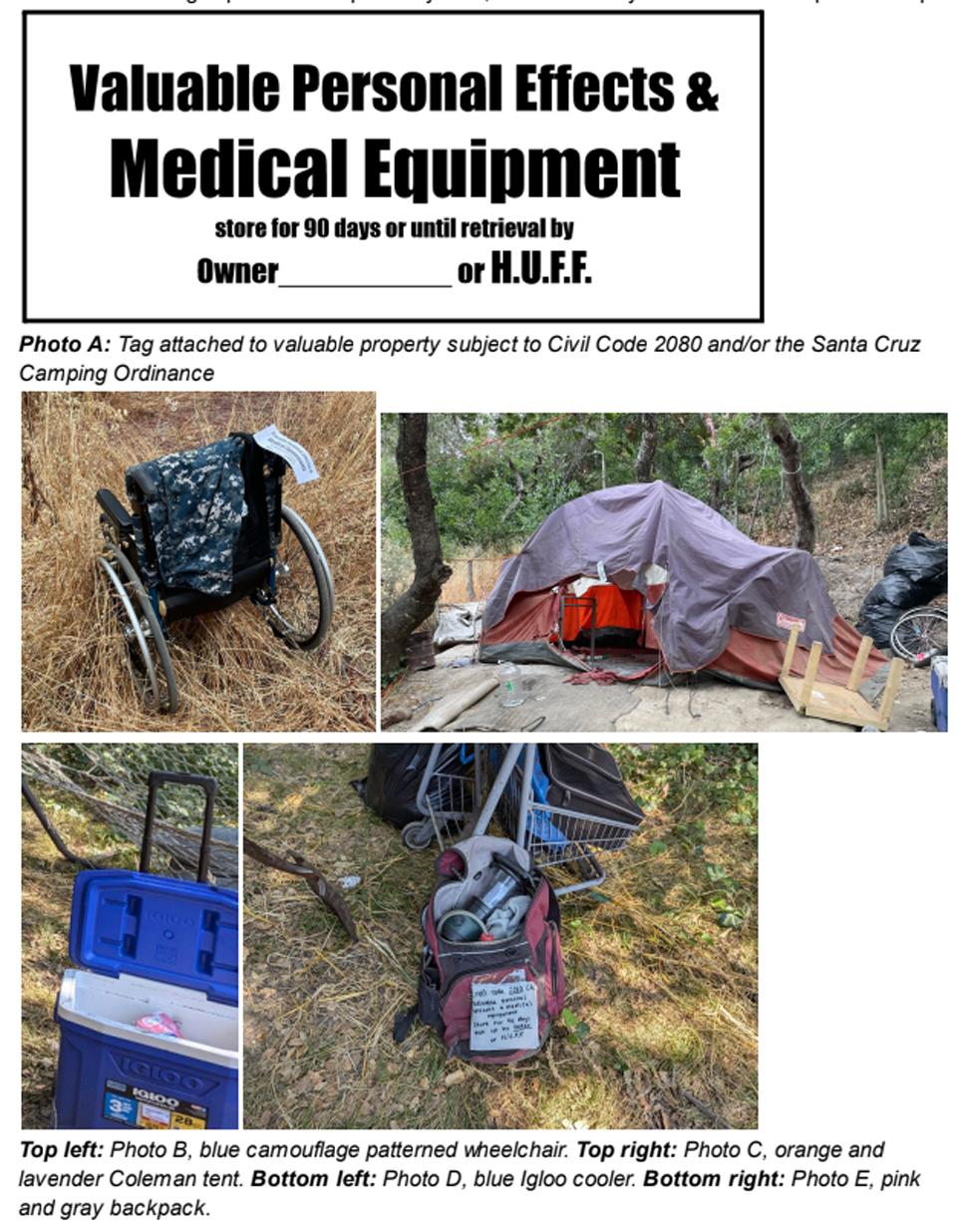
Some personal property that was tagged by their owners during the sweeps of Pogonip Nature Loop area July 29. These items seemed to have disappeared.
City Fails for Follow Legal Requirements to Store Personal Property Gathered in Sweeps
BY ATHENA FLANNERY
There is a lack of accountability for Santa Cruz Public Works and the Santa Cruz Police Department who are destroying property during encampment sweeps. We are a couple of community members involved in aiding homeless
folks in Santa Cruz, and we have observed that the most acute harm done to the unhoused residents of our town is the cycle of trauma and financial burden that people are surviving through despite having everything they own be destroyed over and over again.
Undeniably, encampment clean up is extremely expensive, and another $140,000 contract has been approved at the Santa Cruz City Council meeting for more destruction to the Pogonip. It wastes taxpayer money as well
as wasting the supplies that our citizens and government donate and fund for these people who are extremely impoverished. The way the city has been handling encampments is cruel, ineffective, and expensive, and that approach needs to be redesigned.
Several different authorities share our concern about the treatment of homeless encampments. The Santa Cruz Mental Health Advisory Board has sent a letter (attached) to the County Board of Supervisors warning that Santa Cruz's procedures for addressing homeless encampments are harmful and ineffective, particularly warning that the City and County employees are not following California Civil Code 2080 that mandates valuable property storage, and that the multiunit police “sweeps” through encampments are traumatizing. It is clear that current procedures are worsening the conditions of the people who are surviving on the streets and parks, therefore increasing the burden on the health systems and nonprofits.
In April 2023, the Journal of the American Medical Association (JAMA), researchers say practices such as encampment, sweeps, bans, move-along-orders and cleanups that forcibly relocate individuals away from essential services will lead to substantial increases in overdose deaths, life threatening infections and hospitalizations. The study states that “Continual involuntary displacement may contribute to between 15.6% and 24.4% of additional deaths among unsheltered people experiencing homelessness who inject drugs over a 10-year period.” As many unhoused residents in Santa Cruz will tell you, our current practices for homeless encampments are surely costing lives.
This month, the Pajaronian published an article covering recent sweeps on the Pajaro River bank and the Pogonip Open Space. The author, Todd Guild, describes how the sweeps are harming citizens across the county. He quotes Santa Cruz city citizen, Troy Mason, who has “been homeless for about five years, and had been kicked out of about 10 different places. He has lost his belongings several times.” Our friend Troy has witnessed many close loved one’s lose their lives to extreme poverty on the streets of Santa Cruz, he argues that the sweeps are “killing us,” as the JAMA study argues, and that “No American should have to be homeless,”a statement I know we all agree with.
On Aug.12, Cal Matters published this article focusing on Santa Cruz as a case study for the ways that unhoused people are being cruelly treated across California. Investigative journalist Marisa Kendall explores how the sweeps create a cycle of terror and destruction for our residents, and tells many people’s stories including a man named Spraq who she met while he
was “packing his belongings onto a bike trailer, preparing for the sweep he thought might come later that day on Coral Street.”
“Spraq, who ended up on the streets after the truck he was living in got repossessed about 10 years ago, was camping in the park until police kicked everyone out. He and his ex-girlfriend moved to a nearby street, and two days later, police found them, threw away his ex’s clothes and other possessions, and forced them to move on, Spraq said. So they moved into a parking spot on the street outside Costco – a place where they’d camped without issue many times before, he said.
Again, police found them, said they couldn’t be there, and threw away their belongings, Spraq said. ‘They kept doing that until we had nothing.’”
This cycle is endless and makes it far more difficult to address health issues, build support networks, and do any of the other things that allow someone to find housing and stability.
During the Aug. 13 Santa Cruz City Council meeting, a councilmember said that every single person found during outreach before or during a sweep was offered a place in either the Armory or Housing Matters shelter. In contrast to that, the Santa Cruz Sentinel drew from the Cal Matters article in their editorial, explaining that “Demarr Clark, 42, told CalMatters that he was not offered a bed when police recently kicked him out of his camp on Coral Street.” In our experience this testimony from Demarr Clark is not uncommon. Sometimes City Outreach workers do not find everyone, and specifically Jeremy Leonard and Jennifer Rosch are known in the community for holding strong prejudices and will not offer certain people shelter even when they approach asking for opportunities.
Occasionally, city workers will promise a space at the Armory Shelter and
schedule a van for transport there but then the van never arrives.Then, sadly, the person who was promised shelter has no way to move all of their belongings to the Armory so their property is destroyed in the following days when police and public works arrive. It is clear that, due to a number of issues, the current process of moving folks from encampments and into safe shelters
is not working. People are rightfully distrustful of Jeremy’s empty promises and the endless waiting lists that seem to never call back with good news, but even those who accept the offer for shelter often do not even actually end up at the shelter.
Additionally, If so many people who are living in unsafe conditions, without access to water or a bathroom, are refusing shelter, the question should be: what is wrong with the shelter, not what is wrong with the person. Strict curfews, which limit employment opportunities, and strict rules are only the beginning of how people lose their dignity and freedom when they accept shelter. People are not allowed to bring their pets, which are for some are the only important pieces of their lives they have not lost, nor have loved ones visit them, disconnecting them from vital support networks.
Many are concerned about how sleeping in packed rooms can increase their exposure to contagious diseases. Most importantly, people are afraid of Housing Matters’ and the Armory Outlook Shelter’s well known patterns of retaliatory evictions for bringing up complaints, evictions without cause or notice, permanently confiscating personal property with no given reason, and
refusing to follow up on sexual assault allegations or mold compaints.
There are many completely logical and realistic reasons someone may choose not to stay in Santa Cruz’s shelters. Even if there were no issues, though, there are simply not enough shelter beds for every single unhoused resident in Santa Cruz. Encampment protocol is especially urgent since the Grant's Pass Supreme Court decision and Governor Newsom’s executive order regarding homeless encampments. Governor Newsom’s Executive order N-1-24 explicitly states the need for survival items to be stored.
The issue of destruction of unhoused folks’ property is an issue across the state, but we have seen particularly flagrant violations of the laws surrounding unhoused peoples’ property throughout Santa Cruz. We have highlighted the relevant parts of the Santa Cruz City Camping Ordinance and California Civil Code Section 2080 below.
Santa Cruz City’s Camping Ordinance 6.36 defines personal effects that qualify for storage as: “ID/Social Security cards; Medications, medical devices, eyeglasses; Photos/photo albums; Tax/medical records; Reasonably usable, not overly soiled, non verminous items that are reasonably believed to have value to persons experiencing homelessness, including tents, sleeping bags, clothes, and functional bicycles.”
Santa Cruz City’s Camping Ordinance 6.36 explains that the procedure should go as follows:
(e)If items remain at an encampment site after the relevant notice period has expired, prior to discarding items, appropriate city staff shall make a good faith attempt to identify and remove personal effects from the encampment. Any personal effects identified by city personnel shall not be discarded.
(f)At the time of removal of any personal effects from an encampment, city personnel shall conspicuously post a dated notice (either at the exact location from which the personal effects were removed or at another nearby location) with the following information:
1. A statement that personal effects were removed;
2. A telephone number for information on retrieving personal effects;
3. An address where the personal effects are temporarily stored;
4. That personal effects will be stored for ninety days.
California Civil Code Section 2080.10 details that same procedure:
(a)When a public agency obtains possession of personal property from a person for temporary safekeeping, the public agency shall do all of the following:
(1)Take responsibility for the storage, documentation, and disposition of the property.
(2)Provide the person from whom the property was taken with a receipt and instructions for the retrieval of the property. The receipt and instructions shall either be given to the person from whom the property was taken at the time the public agency obtains the property or immediately mailed, by first-class mail, to the person from whom the property was taken.
After observing several “sweeps” of homeless encampments, we were very concerned and frustrated about the enforcement of laws regarding property seizure and storage of property and that it seems as if neither city officials like the police and public works nor the city contracted workers are following California Civil Code 2080 and the Santa Cruz Camping Ordinance.
We have observed several sweeps, including the sweep at Coral Street on June 3-14 and the over 12 police officer sweeps at Harvey West Friendship Park on April 29, and we have not ever observed any property ever being stored including when unhoused people ask directly about it. At many of these sweeps, we asked any police officer, public works employee, or city contracted worker about storage of property and procedure/practice surrounding civil
code 2080. Police officers consistently told us that since they were not the ones actually cleaning up property, they could not enforce the civil code or answer our questions, so we would have to talk to public works/the contractors.
When we talked to public works/the contractors, they consistently told us they were not subject to the civil code or camping ordinance and that we needed to talk to the police. This was a very frustrating cycle where we got passed back and forth between officers and workers, all while we observed the destruction of property. After observing police, city officials, and city hired contractors destroying and disposing of any and all property they found during the sweeps at Harvey West and Coral Street we began to clearly label valuable property with the name of the property owner, the fact that the item was valuable property, and that the item must be stored for 90 days. The tag used appeared as shown in Photo A below, and was printed on an 8.5” x 4” piece of paper with large and bold text. The tags were attached on pieces of the property that could not be moved before the time of a sweep that would be very hard to miss, with safety pins and tape. Understandably few people were willing to risk trying to get their property stored because it is community knowledge that
attempts like these won't work. Sadly they were right.
Some of the property that was tagged included - see photo at top;
● A blue camouflage patterned wheelchair that was unsoiled and completely functional (Photo B). After the sweep on July 29, we were unable to find the wheelchair anywhere in the Pogonip Nature Loop area. A wheelchair is obviously a medical device, which is explicitly defined as an item that must be stored in the Santa Cruz Camping Ordinance, and usually cost hundreds of dollars. The wheelchair could not be found anywhere in the Pogonip Nature Trail after the July 29 sweep.
● An orange and lavender six person Coleman tent which was unsoiled and completely functional (Photo C). The Santa Cruz Camping Ordinance specifically defines tents as one of the items that must be stored, and large Coleman tents like the one pictured cost usually hundreds of dollars. The tent could not be found anywhere in the Pogonip Nature Trail after the July 29 sweep.
● A new blue Igloo cooler that had no dust or dirt on it and was functional (Photo D) (The photo of this item was taken before a tag was added). The cooler could not be found anywhere in the Pogonip Nature Trail after the July 29 sweep.
● An unsoiled pink and gray backpack carrying a functional lantern and other survival supplies (Photo E) (This tag is handwritten instead of printed). The backpack could not be found anywhere in the Pogonip Nature Trail after the July 29 sweep.
Tags were prominently displayed and can be seen in the corresponding photos. All items/photos were from the Pogonip Nature Loop on July 29, on the first day of a 2-week sweep in the loop.
As the sweep took place, we spoke to a number of officers, public works people, and city contracted workers inquiring about property that falls under CA civil code 2080 or the Santa Cruz camping ordinance, and how/where to retrieve said property. We informed every individual we spoke to that they must follow CA civil code 2080, explained what it was and what property fell
under it, and said property must be stored for 90 days. Upon inquiry, the public works employees all claimed that recognizing valuable property was not under their purview, and the police officers claimed that they could not speak on the subject and that we needed to talk to Sgt. Ross. He proved extremely difficult to reach, and was always far away from areas citizens were able to access without risking arrest.
After the sweeps took place, we visited the police station to collect valuable property that had been taken and stored. We took the following steps. After consulting the SCPD official website, we found that any property could be retrieved from the property division, which is only open two days a week (Tuesday and Thursday) for two hours (from 12:30 to 2:30pm). On Aug. 8, at 12:30pm, we visited the property department to collect the items described above. We first spoke to Officer Jackie (badge #320), who said that she could not find any property under the names “HUFF”, or “Victor” (among other names that we tagged on valuable property), and that we should contact the officers that were present at the sweep.
We then called Sgt. Ross (who was one of the officers present at the sweep on July 29) using a phone number provided to us by Officer Jackie, but were unable to reach him. We were subsequently directed by Officer Jackie to call another officer that was present at the sweep. We then called officer Kair, who we knew was present at the sweep on July 29 and 30. When we asked about any stored property from the sweeps on those days, Officer Kair claimed that “there was nothing of value that was not soiled or hazardous, or damaged in some way, or that was in pieces [in the Pogonip Nature Loop], so ... we did not take any property, at least for the first two days.”
When we told him that we had marked an unsoiled and usable wheelchair with a name and the fact that it was valuable property that must be stored which we
had pictures of, Officer Kair denied that there was any wheelchair found during the sweep, and could not tell us why a wheelchair would not be saved. We then asked Officer Kair about the unsoiled and completely functional tent that had been tagged. He explained to us that “we do not take any tents that have been out in the elements, that are dirty, hazardous, that sort of thing”. We explained to him that tents are an item that are specifically defined as a personal effect that must be stored in the Santa Cruz Camping Ordinance, and asked why his officers were not following that rule. He responded that “we’re following both that, and the policies and procedures that we have.” When we asked him to direct us to a copy of those other policies and procedures
the officers were following, he told us they could be found by googling “santa cruz police policy” or finding it on their transparency portal.
After doing a lot of searching, we have been able to find no such policy, and have cc’ed an email to Larry Imwalle for clarification of Homeless Response Team Operating Procedure. However, officer Kair’s explanation that the police found no items of value that were not “soiled or hazardous or damaged in some way,” and that no tents were stored because they “do not take any tents that have been out in the elements, that are dirty, hazardous,” while we have photos of a wheelchair and tent that were absolutely unsoiled and usable, clearly suggest that the city employees are following a policy/procedure in which any item that has been exposed to the elements for any amount of time is not stored.
This goes directly contrary to the camping ordinance, which states that “Reasonably usable, not overly soiled, nonverminous items that are reasonably believed to have value to persons experiencing homelessness, including tents, sleeping bags, clothes, and functional bicycles” must be saved. In our observation, we have never seen police, public works, or contractors at a sweep save a single item–instead, all items they find are destroyed, bulldozed, compacted, and/or put directly into a dumpster. This suggests that the city’s current policy or practices regarding the property of unhoused individuals is to throw all of it away, no matter the value, utility, or soiledness. It is clear that the SCPD have made a policy or regular practice of breaking the Santa Cruz Camping Ordinance. We have witnessed that no matter how valuable or
usable/clean the property is, there is nothing that is stored or receipts given.
A thousand testimonials from unhoused folk across Santa Cruz could paint the image of how routinely police,public works, and contractors destroy qualifying valuable property. A team of us interviewed folks suffering displacement throughout the sweeps on Coral St. in June, compiling an unfinished list of property destroyed such as: generators, a bike trailer, at least 20 tents, at
least 20 12-gallon bags full of usable clean clothes, shoes of ranging values including a brand new pair of Nike airs and Doc Martens, more than 40 backpacks, over 10 tarps, 5 working bikes, propane tanks, large batteries, portable batteries, chargers, large water jugs to store drinking water, hair brushes and hair ties, diabetes medication, Heart medication, antidepressants,
antipsychotics, family memorabilia, expensive art supplies, large cooler full of food and ice, gaming laptop with tons of music and games, an e-bike worth $2,000, a Samsung tablet, a Samsung phone, a Moto g phone, a Nokia phone, a Galaxy note phone, a large bluetooth speaker, a 40 pound bag of dog food, and as always many people lost their ID’s and papers.
Another time a friend of ours had city employees confiscate and destroy his wrapped unused equipment given to him by FEMA. This is undoubtedly against the intended meaning of the civil code and camping ordinance. On August 17th, the San Francisco Chronicle published this article which points out how Public Works and Police in SF are having the same issue where
important medical and survival equipment are being destroyed due to a lack of training and accountability for city employees to properly store and tag valuable property. This could lead to individual and/or class action lawsuits against the city; for example Fresno homeless residents were able to win a large settlement from the city because of property destruction and illegal
search and seizure.
We also want to call for the cessation of bulldozing the Pogonip Open Space on the grounds of environmental concerns. The environmental damage done by destroying small encampments with heavy equipment like bulldozers in natural spaces like the Pogonip is a damaging to the local ecology. Police SUVs tear up the meadow for the last several months as they do their
rounds. We have witnessed the large stretches of trampled meadow and forest, which in many cases destroy native plants and the habitat of native animals. Campers will continue to return to the Pogonip as long as Santa Cruz has a housing crisis and limited or unsuitable shelters, especially if we continue sweeping unhoused people from other locations. The continuous cycle of sweeping the Pogonip is damaging to both the ecosystem and the people being swept, as well as extremely expensive–for example, $140,000 to contract a team and the price of an additional bulldozer as approved in the last city council meeting is terribly expensive and only a short term way to clear the area of encampments.
The least the city could do is add trash receptacles and bathrooms (portable toilets, even) that are regularly serviced to the area for any visitor to use.
This would significantly decrease the trash generated by encampments, both decreasing the hazardness of the area to unhoused folks as some council members were concerned about, and decreasing the frequency and intensity with which the city has to clean the area as they currently are. If the council is concerned first and foremost about waste and safety rather than the simple presence of unhoused people, they must also implement strategies like this to reduce the impact of camping in the area that is inevitable as long as the city has a housing crisis.
We are asking Santa Cruz and Watsonville cities and Santa Cruz County governemnts to hold the police department, public works, parks and rec and any team contracted by those entities accountable to the legal requirement to find and store personal valuable usable property in the event that someone is not able to move their property in time for the posted date. We urge you to follow the advice of the mental health advisory board to supply public works teams with the information and supplies needed to store and identify property, to reduce traumatizing police presence at sweeps, and provide trauma sensitive support to those living outdoors.
An increase in preventative methods of trash removal survival services such as portapotties, serviced trash cans as well as access to clean water by restoring drinking fountains around the city would effectively reduce the need for intensive and expensive sweeps. These actions would help every resident of Santa Cruz and all natural spaces. We are happy to speak to you about our experiences, or to connect you with some homeless residents of Santa Cruz that have been impacted by the city’s practices. Attached will be pictures of the destruction at the sweeps as well as items that we marked as important personal property that were destroyed.
|