|
Photo by SARAH RINGLER
Students from Greenfield and Watsonville High Schools present their personal experiences with poisonous agricultural chemicals and their rejection of the Department of Pesticide Regulation Draft Plan at Ramsay Park in Watsonville Monday.
Young People Show Up to Stand Up Against CA's Proposed Pesticide Regulation Draft Plan
By SARAH RINGLER
The California Department of Pesticide Regulation, DPR, presented their Draft Strategic Plan 2023-2028, Monday at the Family Center at Ramsay Park in Watsonville. Visibly present among the roughly 60 attendees were students from Watsonville and Greenfield High Schools, members of Safe Ag Safe School Future Leaders of Change. Please read their response below.
Nurses, teachers, doctors, organic farmers and a few people who represented the ag industry showed up, some from as far away as Santa Maria and Ventura. The vast majority spoke vehemently against the planned draft emphasizing that there has been enough scientific evidence of children getting sick and dying from exposure to agricultural chemicals to support such a weak plan. Despite California having some of the toughest regulations in the US, it still allows at least 133 chemicals that are banned by the European Union.
The opportunity for public comment has been extended until Nov. 10. Comments are accepted online through DPR’s public comment portal in English or Spanish. Written comments can be mailed to DPR at 1001 I Street, P.O. Box 4015, Sacramento, CA 95812-4015.
Come out next Wednesday, Nov. 8, noon at the Monterey County Government Center, 168 W. Alisal in Salinas for a rally against DPR's new 1,3-D DPR's regulation, to be released by court order on Nov. 7.
| |
|
Statement from Safe Ag Safe Schools Future Leaders of Change on DPR’s Strategic Plan 2024-2028 - We Reject It!
By VICTOR TORRES and FUTURE LEADERS OF CHANGE
The Department of Pesticide Regulation’s “Strategic Plan for 2024-2028” is not a plan to build protection from harmful pesticides in farmworker communities. It’s a plan to make sure our communities continue to get poisoned and permanently damaged not just for the next five years, but far into the future.
The plan is so outrageous – so far from what we need – that it feels like DPR just wants to try to legitimize it by being able to claim DPR “listened to farmworker communities” in Watsonville and Tulare, where they are holding public hearings, without any intention of really listening.
We reject the plan.
Most of it seems to be based on DPR’s Sustainable Pest Management timeline with a due date of 2050 to eliminate (currently unspecified) “priority pesticides.” With this first 5-year preview of DPR’s approach, it’s clear DPR is acting like the student who waits until the last minute to finish an assignment. We admit, we’ve been there. But if DPR waits until the last minute – 2049 – to actually make real protections from pesticides, it will be too late. It will be way too late for another generation in communities like ours.
This is not just a slow-walk plan; it’s a walk backwards plan.
DPR already has a priority list of the most harmful pesticides to address, study and then regulate. Their new plan says a group called the “Sustainable Pest Management Priorities Advisory Committee” – which DPR hasn’t even selected yet, ten months after they announced the plan – will begin sometime, possibly within the next 5 years, to come up with yet another list of what DPR calls “priority pesticides.” That sounds to us like DPR is starting over, but worse, this time giving Big Ag and pesticide applicators in their Advisory Committee a vote on which pesticides will be chosen. Those groups do not have an interest in reducing pesticide use. They think it will cost them money. They shouldn’t be involved in a committee that is supposed to make decisions prioritizing public health rather than profits.
One of the cruelest jokes in this plan is that it calls for -- some time in the next five years -- potentially mitigating as few as two pesticides a year. It is a fact that growers in the State of California were allowed to use at least 133 pesticides in 2020 that are banned or not approved in the 27 countries of the European Union. We’re in high school, but elementary school math tells us that if DPR were to ban pesticides at a rate of 2 per year, it would take more than 66 years to make California farmworker communities as safe from harmful pesticides as European Union farmworker communities are today.
And that’s if DPR actually bans these pesticides. But, that isn’t what DPR means by “mitigate.” Mitigate, in the DPR experience, could mean simply suggesting that County Agricultural Commissioners do something like notifying residents nearby that a highly toxic pesticide will be applied … whether they like it or not. So, it’s likely that as far away as 2090, we won’t be any closer to the health protection standards of the European Union of 2023.
Evidence of that bleak likelihood is DPR’s definition of “success” regarding priority pesticide use in the future: “success … is measured by ongoing 5% annual reductions in Priority Pesticide use.” Again, back to our elementary school math, there were 2 million pounds of chloropicrin -- the lung-damaging agent banned in 36 countries – in Monterey County in 2021. Since, “success” would be a 5% decline, that would mean we should feel good about 1,900,000 pounds the following year? And then 1,805,000 the next year. At that rate, we’ll never get rid of chloropicrin in our lifetimes. And we’re teenagers.
DPR’s “Strategic Plan” is not merely an insult to our communities and to our generation … and even to our future grandchildren’s generation; it is a planned attack on us. Throw it out.
Pretty words can’t disguise the environmental racism of this plan; it’s time for real protective action.
SASS Future Leaders of Change: Alexia Rangel, Victor Torres, Santiago Torres, Abel Pena, Eduardo Aguilera, Hugo Celio and Anthony Gallardo.
| |
|
A Brief History of a Proud Jewish Anti-Zionist Community Elder
By SHEILA CARRILLO
I was born, Sheila Goldberg, in New York to Yiddish-speaking parents, children of Russian immigrants. My birth year,1942, was a desperate and painful time for American Jews. Hitler was at the height of his power and the American press had begun revealing Nazi Germany’s atrocities.
My family had settled in the “borscht-belt” area of Los Angeles, where we celebrated the 1948 founding of the state of Israel. I remember awe and curiosity about the Kibbutz movement and mythic accounts of the “greening of the desert” and other gargantuan feats of the pioneer state.
Raising a family in lingering post-war anti-semitism, my parents instilled in us great pride in the impressive intellectual and cultural contributions of the Jewish people. And as I grew politically aware, many of my heroes proved to be Jewish, as did many dear friends. My Jewish identity has always been strong.
Growing up, however, I had never ever heard about or considered the ramifications of the Nakba—the forced expulsion and flight of 700,000 Palestinians, the depopulation and destruction of over 500 Palestinian villages by Zionist militias, and the claiming of 78% of Palestinian territory.
It wasn’t until spring 2016, that I took a deep dive into the quagmire of Israel/Palestine. A respected peace institution in our community had been attacked and subsequently ostracized by the local Jewish community leaders for holding a weekend conference spotlighting the international Boycott, Divest, and Sanctions (BDS) movement being waged against the Israeli government. The event took place at another iconic social-justice institution, which was also vilified.
At the time, I knew little about the BDS movement. But I knew from South Africa that BDS can be a potent form of nonviolent action and had hopes that the strategy might curtail the violence of the right-wing Israeli regime.
Jewish leaders published a commentary denouncing the conference. It began,
"The concept of shalom, or peace, is revered in Judaism." And concluded: "….For peace to take hold on the ground, Israelis and Palestinians must both recognize each other’s right to self-determination.…"
My inner “question authority” alarm sounded wildly. How could Jewish leaders speak of peace being revered and the right of self determination, given Israel’s illegal occupation and settlement of Palestinian territories?
I attended the conference and soon found myself on a fact-finding delegation to Palestine. Returning home, I was broken-hearted from the pain of witnessing what in some sense I viewed as my people perpetuating the dehumanization they’d experienced in Hitler’s Germany. I felt called to voice opposition to Israel’s racist Zionist government and to join in the worldwide struggle for justice for Palestine.
My delegation experience to Israel/Palestine was the impetus for unrelenting actions and letters in an attempt to shed some light on life for Palestinians under Israeli occupation. I began with a 2017 letter to Jimmy Panetta, who, despite letters, phone calls, and constituent visits, continues to support our massive annual $3.8 billion for Israel toward military weaponry. Excerpts:
"I… find myself unconvinced that a nation without a constitution guaranteeing civil and human rights and whose laws are based on Jewish religious affiliation, can be called a Democracy. The fact alone that it’s against the law for a Jew to marry a non-Jew and all civil ceremonies are illegal, is for me testimony to the sham of Israeli democracy…"
…We sped past the 25’ concrete wall, learning that in its construction, Israel took 10 percent more Arab land than designated in the 1994 Oslo Accord, and in the process, separated families and cut farmers off from their farmland. With illegal settlements scattered throughout Palestinian land, there is no contiguous Palestinian community,…."
In June 2018, outraged over the Israeli government responding with military might to peaceful marches and protests in Gaza, I published a letter :
….Living conditions are so deplorable for the 1.9 million Gazans confined to 141 square miles of land that the UN believes Gaza may be uninhabitable in the near future.
Yet the recent mostly-peaceful marches and protests were met with the Israeli Defense Forces killing over 120 civilians and crippling more than 13,000…."
Given Gaza’s barbaric living conditions and Israel’s iron-fist control, it’s no surprise that horrific violence erupted on October 7. Just as it’s no surprise that the Israeli government— with unquestioning Western support—responded with collective punishment by cutting off access to essential needs while bombing daily. In the first 6 days alone, following the Hamas attack, Israel dropped 1000 bombs a day on the tiny peninsula—25 miles long and seven miles wide--killing over 7000 and wounding tens of thousands, the majority women and children. And the one-sided U.S. backed genocide continues with a ground invasion as I write.
Early on, our state department issued a memo not to mention the word de-escalate, and Biden vetoed a Security Council resolution that called for an immediate humanitarian ceasefire. With 11 million U.S. children living in poverty and around 600,000 unhoused, rather than striving for peace, we are adding to the $1.1 million in military aid a day already designated to Israel—that will kill children, destroy schools and hospitals, and leave millions of Palestinians unhoused.
Recently, numerous human rights organizations including Human Rights Watch, Amnesty International, South African minister Naledi Pandor, and Jimmy Carter have declared Israel an apartheid government. B’Tselem, a leading Israeli human rights group has stated: “The state of Israel's treatment of Palestinians is a crime against humanity and is illegal under international law.”
What is not being recognized and honored in the West is that there can be no peace in Israel and/or Palestine without justice!
| |
|
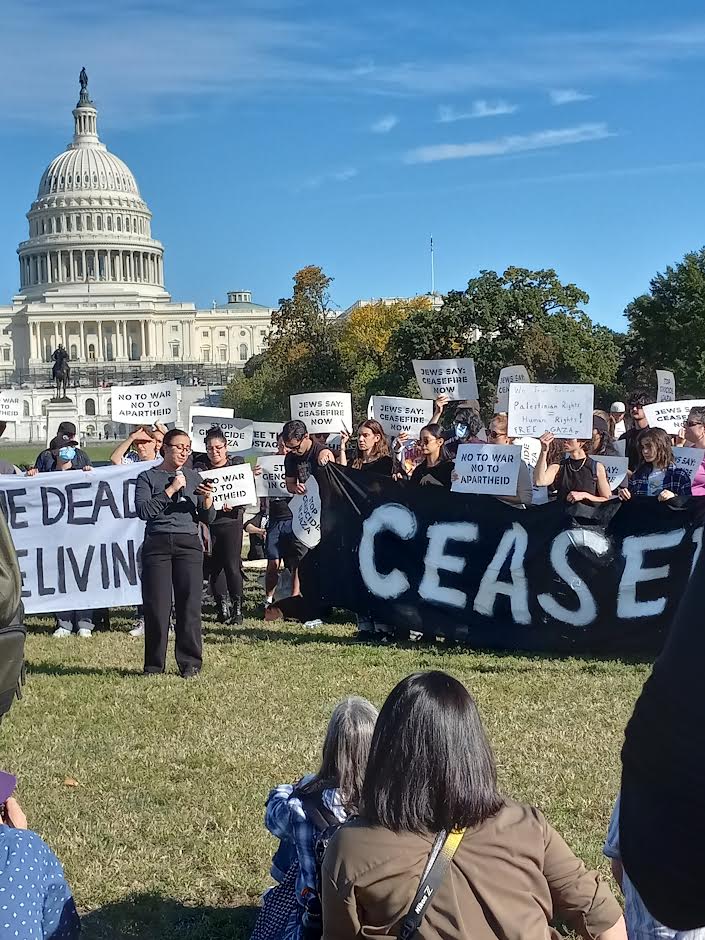
Photo and Caption by LAURA CHATHAM.
This photo is from the Jewish Voice for Peace and If Not Now peace demonstrations on the Capitol Mall, Oct. 25, in Washington DC. To symbolize grieving, we lined up and passed nice smooth stones down the line to commemorate the Palestinian and Israeli lives lost. Jewish people place stones on the graves of dead loved ones at funerals. Mostly Jews and some Muslims were there. Afterwards we went to the offices of the US Congress members who voted against sending more weapons to Isreal and thanked them. The woman speaking in the photo is a Mizrahi Jew.
| |
|
Survey on Redesigning San Lorenzo Park
By SARAH RINGLER
If you didn't get a chance earlier, the city of Santa Cruz has released Online Survey #2. Parks and Recreation are seeking public input on the redesign of San Lorenzo Park by the river in Santa Cruz. They now have Concept A and Concept B for you to examine and express your preferred option. Only one of the concepts keeps the duck pond, identified as a water feature.
My personal request was to encourage more nice public restrooms that are open 24 hours a day. A contractor installed a port-a-potty in front of our house last fall while we were having some construction done. Over the three months it was there, many people used it from letter carriers, Amazon, UPS, FedEx drivers, FEMA personnel, neighbors, as well as the various construction workers. When you gotta go, you gotta go. It should be a basic public service.
The survey closes at midnight Nov. 5. Anyone in the county can participate. Based on the input from the survey, recommendations will be made to the design team. Parks and Recreation will hold a public meeting tentatively planned for Dec. 11 that will look for additional feedback and direction for the Parks and Rec. Commission. Go HERE for information.
| |
|
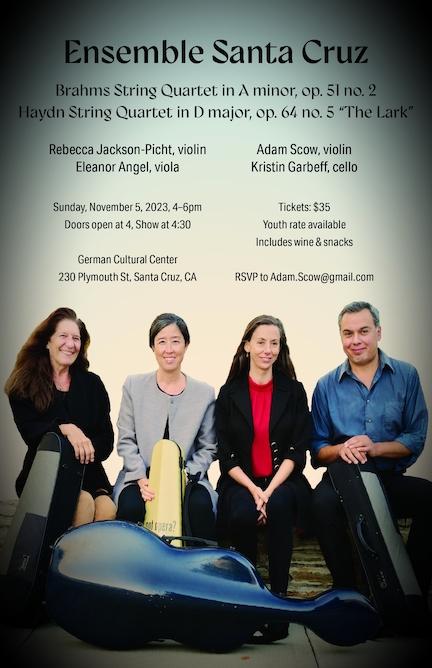
String Quartet Concert at the German Cultural Center in Santa Cruz
By ADAM SCOW
This event is a collaboration featuring Rebecca Jackson-Picht, Eleanor Angel, Kristin Garbeff, and myself, performing the epic Brahms A minor quartet and the beautiful Haydn Lark Quartet. I'm very excited to play with these top notch musicians in a venue designed for an acoustic performance.
Sunday, Nov. 5, 4pm at 230 Plymouth St, Santa Cruz. Wine and light snacks before and after performance.
Tickets are $35. RSVP at adam.scow@gmail.com
| |
|
Community Thanksgiving Needs Support
By STEVE PLEICH
For more than 30 years, veterans have hosted a Thanksgiving meal at the Veterans Memorial Building in downtown Santa Cruz for those in our community who are houseless or of very modest means. It is a tradition that has continued and endured through the good works of the veterans themselves and those who support their local mission of serving the less fortunate.
The Veterans for Peace and the Friends of Thanksgiving are thrilled to announce that the Santa Cruz Community Thanksgiving Dinner will once again this year be hosted at the Veterans Memorial Building located at 846 Front Street from 11am-3pm on Thanksgiving Day, Nov. 23.
Everyone is invited to attend and enjoy a hot, traditional meal of turkey, stuffing, mashed potatoes and all the trimmings prepared by local chefs. The hall will once again be decorated by our local Girl Scouts and music will be provided by local artists. Join us for a day of true community as we eat, share stories and experiences and celebrate the holiday spirit.
Volunteer opportunities for the dinner will be coming your way shortly in a separate message so hold that thought.
Your generous donation will help us turn a time of want and need into a celebration of joy and generosity. Here’s our donation link:https://gofund.me/af57f069
Happy Holidays to you and yours from the Veterans for Peace and the Friends of Thanksgiving.
| |
|
Motherlode
By WOODY REHANEK
"It never used to blow like this,"
my mother said one day
& then in May a devil wind
took her far away.
She vanished with the devil wind
but left us special things:
tchotchkes, knick knacks, bric-a-brac,
gold goddesses with wings.
Now Mom's long gone but lives
in song & mounds of memories...
She drifts between the devil wind
& stockpiles of her things.
A garage can be a sacred place
for classic spirit quests.
My mother visits often
as an uninvited guest
She sifts & sorts & sniffs & snorts
at what she left behind
& asks us what we did with things
she can no longer find.
We gave some stuff away, we said,
we sold the tribal masks.
"I don't mind a bit," she sighs,
"I wish you would just ask."
| |
|
Photo by TARMO HANNULA
Sanderlings (bottom) join marbled godwits in the waters of Elkhorn Slough at sunset.
| |
|
Santa Cruz County Covid-19 Report - Order Free At-Home Test Kits
By SARAH RINGLER
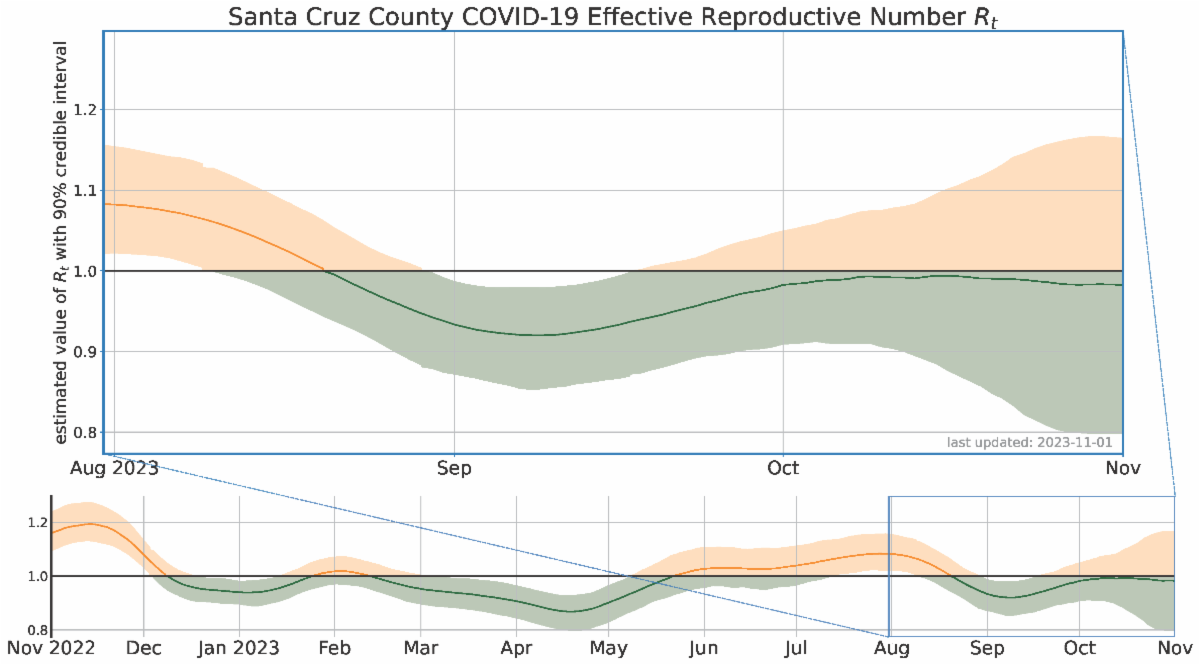
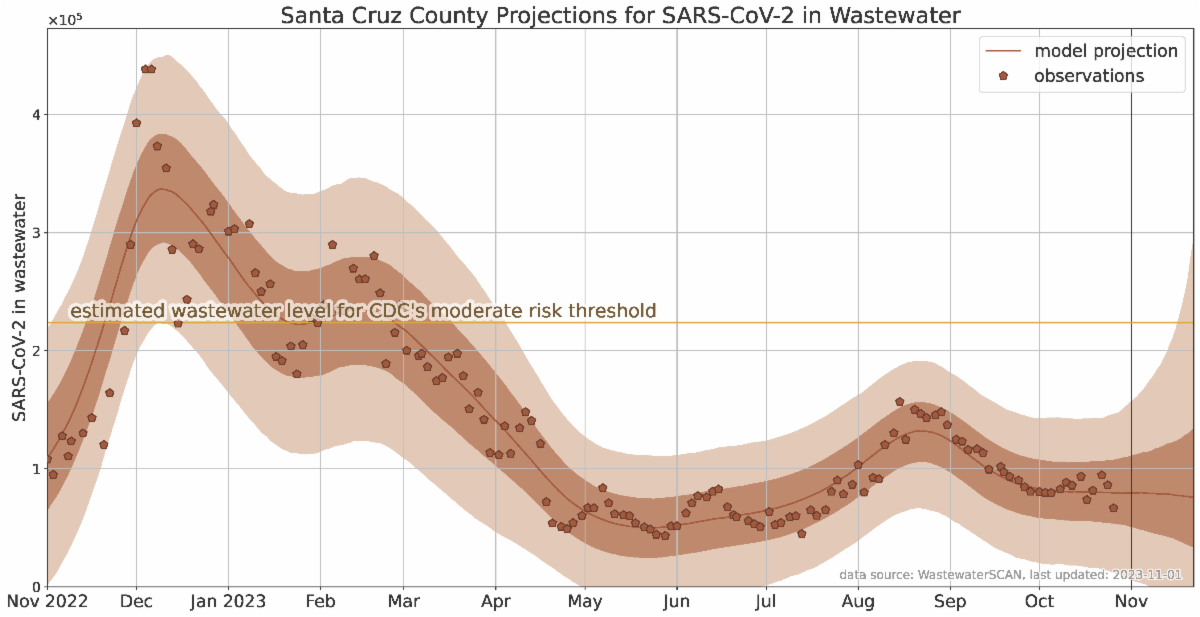
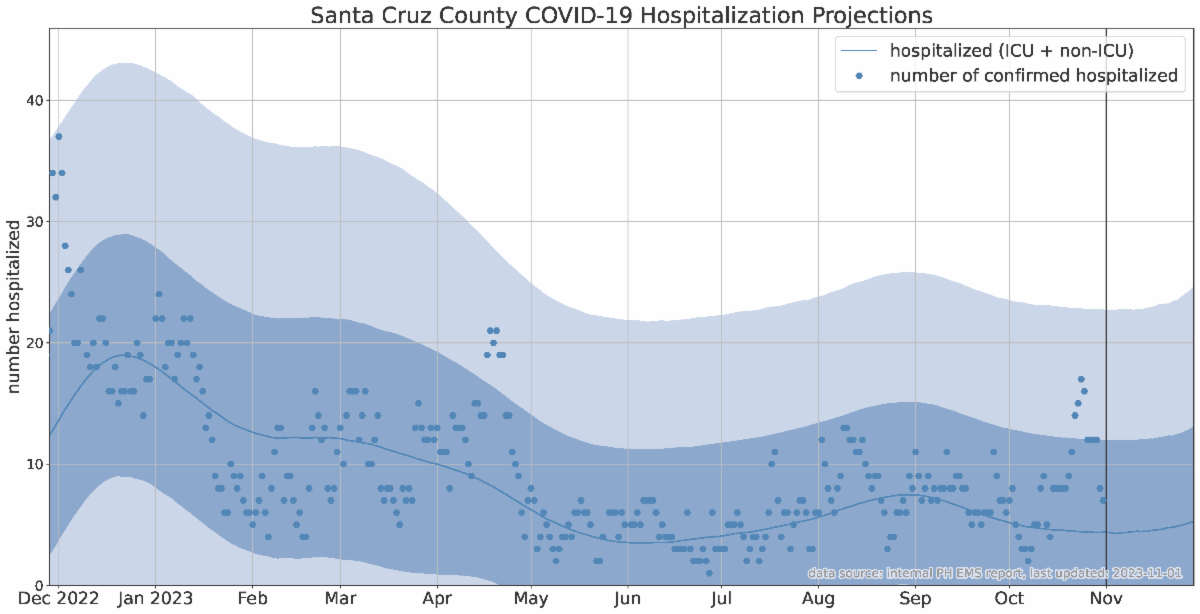
The California Department of Public Health reports on Covid-19 for The Santa Cruz County Health Department. They regularly release data on the current status of Covid-19 in the county. Since cases are still appearing, and there are still vulnerable people, I will continue reporting the graphs below.
At-home Covid-19 test kits that were sent free from the government earlier are now expiring. The program that started in Jan. 2022 has distributed 600 million test kits. If you still have those tests, before using, check the date on your box or go HERE to get more information. Over a month ago, the Biden administration announced that it will provide four free tests per household that will be delivered by the US Postal Service. Go HERE to order.
The state's website reports that the current total of confirmed Covid deaths in Santa Cruz County is at 338, up from 337 last week.
The three graphs below give a picture of what is happening as of Nov. 1. The first graph below shows the Rt Number. Numbers above one show the spread of the virus is increasing. Below one means the spread is decreasing.
The second graph below shows data that the Health Department collects for Covid from wastewater at the City Influent, for the city of Santa Cruz, and from the Lode Street pump stations for the county. This graph shows wastewater level to be below Center for Disease Control's moderate risk threshold.
The third graph below shows hospitalizations. Click to see more information on hospitalizations HERE.
The vaccination data for the county has stayed fairly constant increasing very little over time. Go HERE for new information on vaccination records, treatments, vaccines, tests, safety in the workplace and more.
| |
|
Photo by TARMO HANNULA
Fashion Street - Crocheting allows for a lot of flexibility.
| |
|
Labor History Calendar - Nov. 3-9, 2023
a.k.a Know Our History Lest We Forget
Nov. 3, 1839: Workers’ uprising in Wales.
Nov. 3, 1883: US Supreme Court decides Native Americans are aliens.
Nov. 4, 1956: Hungarian revolt crushed by Soviet troops in Budapest.
Nov. 5, 1855: Eugene Debs, Socialist leader, born.
Nov. 5, 1916: Everett, Washington massacre, at least six IWWs killed.
Nov. 5, 1984: Anti-apartheid general strike in South Africa.
Nov. 6, 1918: Revolt in shipyards in Kiel & Hamburg and creation of Workers’ Councils in Germany.
Nov. 7, 1912: First appearance of IWW in Ernest Peibe”s “Mr. Block” comic strip.
Nov. 7, 1917: Bolshevik Revolution launched in Russia.
Nov. 8, 1892: 20,000 Black and White workers stage a general strike in New Orleans.
Nov. 8, 1924: Australian dockers strike against overtime until Dec. 13th.
Nov. 9, 1935: Congress of Industrial Organizations founded.
Nov. 9, 1988: Military kills three strikers and wound dozens at the Companhia Siderurgica Nacional, Brazil.
Nov. 9, 1989: Berlin Wall falls.
Labor History Calendar has been published yearly by the Hungarian Literature Fund since 1985.
| |
 | |
Photo by TARMO HANNULA
Arancinis - Fried Rice Balls with Ground Meat
By SARAH RINGLER
Arancini comes from the word “little orange” in Italian. It describes how these little fried rice balls look. Different versions are made all over Italy but this dish is distinct to Sicily where it was invented many centuries ago. Rice is native to Asia but was brought to Sicily by the Muslims over one thousand years ago. There it was integrated into the local cuisine. However, the tomato part of this recipe, which many mistakenly associated with Italian cooking, did not get added to the recipe until after the European conquest of the Americas in 1492. Tomatoes are thought to be native to Peru, but traveled north where they were domesticated and were then widely eaten by the Mesoamerican civilizations like the Aztecs. Now they are common in most cuisines around the world.
It seems like I have been making a lot of dishes lately that require several steps, one of which involves stuffing some mixture into another. Although this can take awhile, the result is a meat and carbohydrate meal in one. These balls freeze easily and can be heated at a later date, like for lunch at work or after work for an easier dinner.
Arancinis
2 ¼ cups short grain white rice
1 teaspoon of salt
4 cups of water
¼ teaspoon saffron threads
2 eggs beaten separately (one for the outside and one for the filling)
1 cup freshly grated Parmesan cheese
plain flour for coating
1 cup dry breadcrumbs, or panko
oil for deep fat frying
Filling
1 tablespoon olive oil
1 small onion, finely chopped
1/3 pound ground pork or beef
2/3 cup white wine
1 tablespoon tomato paste
2 teaspoons fresh or dried thyme leaves
Use the recipe on your rice package or bring 4 cups of water to boil on the stove. Add the saffron and salt. When the water is boiling, add the rice and reduce the heat to a simmer. Cover and cook over low heat for 20 minutes. Move to a large bowl, add the Parmesan cheese and cool to room temperature.
Make the filling. Heat oil in a small frying pan over medium heat. Add the onions and cook a few minutes until soft. Then add the ground meat. Cook for a few more minutes breaking the ground meat up so there are no lumps. If you are cooking pork, cook until the meat is done. Stir in the wine and tomato paste and cook for a few minutes until the mixture has thickened. Add the thyme and set aside to cool.
Set up a bowl of water. Get you hands wet and divide the rice mixture into 12 balls. Take one ball and flatten it a bit. Press a small indentation with your finger into the flattened part. Then with a small spoon, add about a tablespoon of filling into the indention. Since you will be making 12 balls, divide the filling in half and then into fourths. That way you can try and end up with equal amounts of filling. Shape the rice over the filling and close it up. Keep your hands wet. Finish filling all the balls.
Next set up an assembly line. Fill a pie tin with about a cup of flour. Beat an egg in another small bowl. Put panko or bread crumbs in a third bowl.
First, roll each rice ball in the flour. Then add it to the egg. Finally coat the rice ball with the breadcrumbs. Refrigerate them for about 30 minutes.
Prepare to deep fry. Fill a heavy bottomed pan about one third full with frying oil. Also, set up an area to set the balls after they have been fried and then a final place to drain them on some paper toweling. I turn on the burner to almost high and never leave the area once I have started frying. The oil is ready when a small cube of bread turns golden in 20 seconds. Fry the rice balls for about 2 to 3 minutes each. Serve warm. They also freeze well.
| |
|
Send your story, poetry or art here: Please submit a story, poem or photo of your art that you think would be of interest to the people of Santa Cruz County. Try and keep the word count to around 400. Also, there should be suggested actions if this is a political issue. Submit to coluyaki@gmail.com
Send comments to coluyaki@gmail.com
If you are enjoying the Serf City Times, forward it on to others. We need readers, artists, photographers and writers.
Subscribe, contact or find back issues at the website https://serf-city-times.constantcontactsites.com
Thanks, Sarah Ringler
| |
|
Welcome to Serf City Times Our county has problems and many people feel left out. Housing affordability, racism and low wages are the most obvious factors. However, many groups and individuals in Santa Cruz County work tirelessly to make our county a better place for everyone. These people work on the environment, housing, economic justice, health, criminal justice, disability rights, immigrant rights, racial justice, transportation, workers’ rights, education reform, gender issues, equity issues, electoral politics and more. Often, one group doesn’t know what another is doing. The Serf City Times is dedicated to serving as a clearinghouse for those issues by letting you know what is going on, what actions you can take and how you can support these groups.This is a self-funded enterprise and all work is volunteer.
Copyright © 2023 Sarah Ringler - All rights reserved
| | | | |