We Cook for Peace - Soupstock 2024 - Free Festival to Celebrate 44 years of Food Not Bombs
BY KEITH MCHENRY
When a billion people go hungry each day, how can we spend another dollar on war?
Food Not Bombs is an all-volunteer movement that recovers food that would other wise be discarded, and shares free vegan and vegetarian meals with the hungry in over 1,000 cities and 70 countries around the world in protest to war, poverty, and the destruction of the environment. We also provide food and supplies to the survivors of natural disasters, and people participating in occupations, strikes, marches and other protests. The Santa Cruz chapter shared the only daily meal with the homeless every day for three years when the indoor meal programs were locked down during the COVID restrictions.
Food Not Bombs is not a charity but seeks to end the crisis of corporate domination and exploitation through nonviolent direct action so no one is forced to stand in line to eat at a soup kitchen or live on the streets. We have no formal leaders and strive to include everyone in our consensus decision-making process. Each group recovers food that would otherwise be discarded; prepares fresh hot vegan and vegetarian meals that are shared in visible public spaces to everyone without restriction; and distributes groceries, clothing and other supplies with the community.
The first group was formed in Cambridge, Massachusetts in 1980 by eight college-aged, anti-nuclear activists. A second group was started San Francisco in 1988 where the police started to arrest our volunteers for the “crime” of making a political statement ending only after making over 1,000 arrests. The police have also arrested our volunteers for feeding the hungry in other cities in the United States including Tampa and Orlando, Florida, Arcata and Los Angeles, California. In 1994 Amnesty International declared that any Food Not Bombs volunteer sentenced to prison would be considered a "Prisoners of Conscience" and that they would work for our unconditional release.
Volunteers have shared food at anti-globalization protests in many cities including Seattle, Cancun, Miami, Gutenberg, and Toronto. Food Not Bombs organized the food relief effort for the survivors of Hurricane Katrina and Sandy. Volunteers also fed the rescue workers in New York after 9/11; started animal rescue shelters in Slovakia; fed Camp Casey in Texas, border camps in Palestine, Poland and Mexico; helped over throw the government of Iceland; supported kitchens at hundreds of cities during Occupy Wall Street.
Food Not Bombs activists have helped start projects like Indymedia, Bikes Not Bombs, Homes Not Jails, Food Not Lawns, the free radio movement, Really Really Free Markets, Anarchists Against the Wall and many other grassroots efforts. The movement has a 184 page book "Hungry For Peace" that provides information on how to start and maintain a local Food Not Bombs chapter. You can join Food Not Bombs in taking direct action towards creating a world free from domination, coercion and violence.
Click HERE to see a video on the founding of Food Not Bombs on May 24,1980.
Food is a right, not a privilege...Solidarity not charity. Support Food Not Bombs HERE.
| |
|
Tell Driscoll's to Go Organic
BY SARAH RINGLER
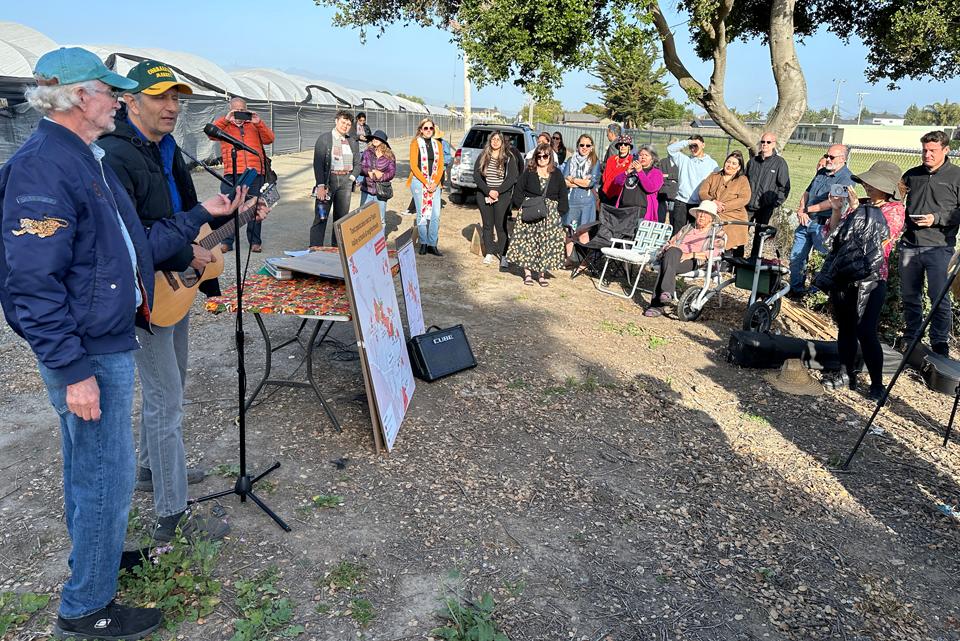
Watsonville poet laureate and musician Bob Gomez (second from left)
serenades during a rally in Watsonville.
PHOTO BY TARMO HANNULA
A rally on Tuesday held between MacQuiddy Elementary School and conventionally farmed agricultural farms in Watsonville was attended by about 70 parents, children, doctors, teachers, Watsonville mayor, the owner of Charlie Hong Kong and concerned community members who were calling for more organic farms and food. One organic farmer said that organics are not more expensive than conventionally grown produce. Organically grown produce represent the true cost of growing food; farmers of conventionally grown food often receive many subsidies.
Representatives from the Center for Farmworker Families and Campaign for Organic and Regenerative Agriculture, CORA, spoke about the high incidences of leukemia and learning disabilities in students in the Pajaro and Salinas Valleys. Over a million pounds of toxic pesticides are used in Pajaro Valley every year. Farmworkers, school children, and the communities who live near these fields and are exposed to drift, are all at risk.
Click HERE to sign a petition that asks Driscoll's to go organic.
The Environmental Working Group puts non-organic strawberries at the top of their 2024 Dirty Dozen list: "Department of Agriculture tests found that strawberries were the fresh produce item most likely to be contaminated with pesticide residues, even after they are picked, rinsed in the field and washed before eating. For these reasons, strawberries continue to be at the top of the Dirty Dozen™ list."
| |
|
UC Santa Cruz
BY SARAH RINGLER
PHOTOS BY TARMO HANNULA
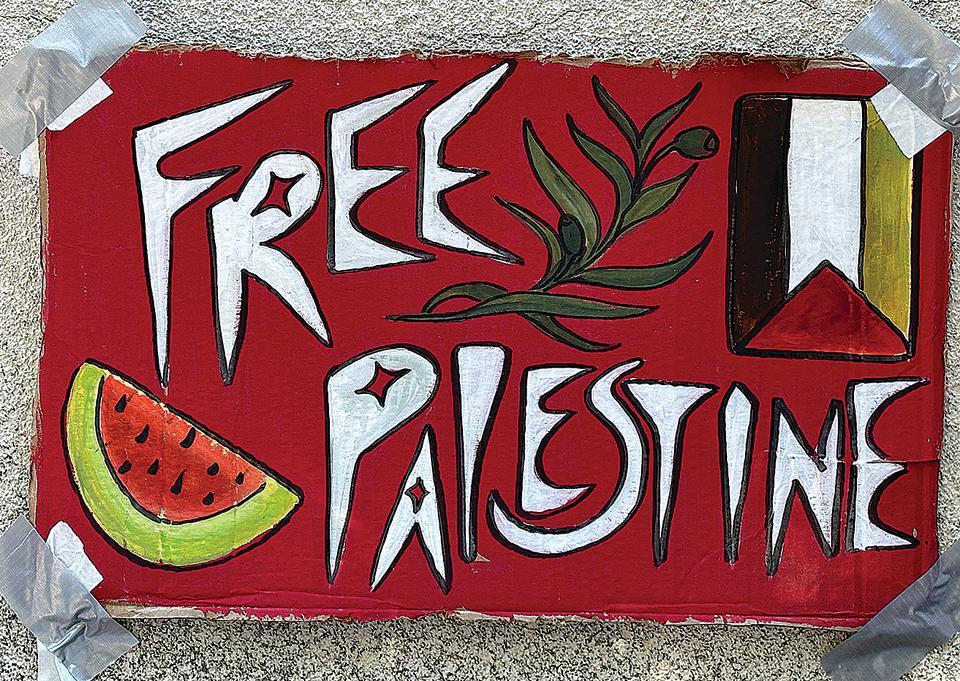
On May 1, University of California Santa Cruz Students for Justice in Palestine (SJP) joined other campuses around the world, by establishing an encampment in response to the violence in Gaza. The Gaza Solidarity Encampment started in a narrow passageway by the Bay Tree Book Store. On May 20, Day 20, the group agreed to move to a more visible location at the entrance to the campus at High St. and Coolidge Dr.
The group's demands to UCSC posted HERE include the following:
"1. Divestment from weapon-manufacturers and all research collaborations tied to weapon manufacturing industries. This includes all forms of investment in BlackRock.
2. Disclosing all UC-wide and UCSC Foundation assets including investments, donations, and grants.
3. Cutting all campus relations with zionist institutions, and complying with the Boycott, Divestment, Sanctions (BDS) — as according to the BDS National Committee — within University operations.
4. Ending the targeted repression and policing of pro-Palestinian advocacy on campus and rejecting the International Holocaust Remembrance Alliance (IHRA) definition of antisemitism, which conflates antisemitism with anti-zionism.
5. Stopping the mass surveillance and violence against students and severing all ties with the UCSC Police Department and Santa Cruz Police Department.
6. The UC acknowledging the ongoing genocide of Palestinians, and calling for an immediate and permanent ceasefire in Gaza and an end to the occupation in Palestine."
According to Hillary Ojeda of Lookout, on Monday, students blocked the entrance to campus resulting in a decision by university administrators to close the campus and hold classes remotely .
Lookout also reported, 48,000 UC graduate student workers, researchers and postdoctoral fellows from 10 campuses represented by United Auto Workers 4811 voted last week to strike over allegations that the university has not resolved unfair labor practices over its handling of the safety and free speech rights at the UC encampments.
To follow events on campus, go to City on a Hill.
| |
March to End Homelessness
BY SARAH RINGLER
PHOTO BY TARMO HANNULA
Saturday, around 300 people marched through downtown Santa Cruz for the March to End Homelessness organized by Housing Matters. The purpose of the event, the second annual, was to express the goal of "inspiring hope for actionable solutions to homelessness through the advancement of public policy." The event included speeches and booths in front of Santa Cruz City Hall.
| |
|
Larry Bensky Dies at Age 87
BY SARAH RINGLER
PHOTO FROM KPFA
A contributor to Serf City Times, but well-known and respected for a lot more illustrious feats, Larry Bensky died on May 19, in Berkeley.
As reported by Lisa M. Krieger in the May 21 Mercury News, "The signature voice of left-leaning station KPFA, Bensky was most famous for his live broadcasts of the Iran-Contra hearings of the late 1980s, which won him the prestigious George Polk Award.
"But he also covered the confirmation hearings of four US Supreme Court justices, the 9/11 Commission hearing and innumerable demonstrations and protests, earning the reverence of the San Francisco Bay Area's large leftist community. From a San Francisco phone booth, he broadcast live narrative of the historic 'White Night' riots, sparked by the lenient sentencing of Dan White for the assassination of San Francisco mayor George Moscone and Supervisor Harvey Milk."
He was born in Brooklyn on May 1, 1937. He graduated with honors from Yale University. He wrote for many publications including Ramparts magazine, the New York Times, The Nation and The Anderson Valley Advertiser. He is mostly known for his time at KPFA radio where he hosted many shows. He also taught journalism and broadcasting at several Bay Area universities and colleges.
I admired him for his responsible journalism, honesty and fearlessness while reporting the news.
| |
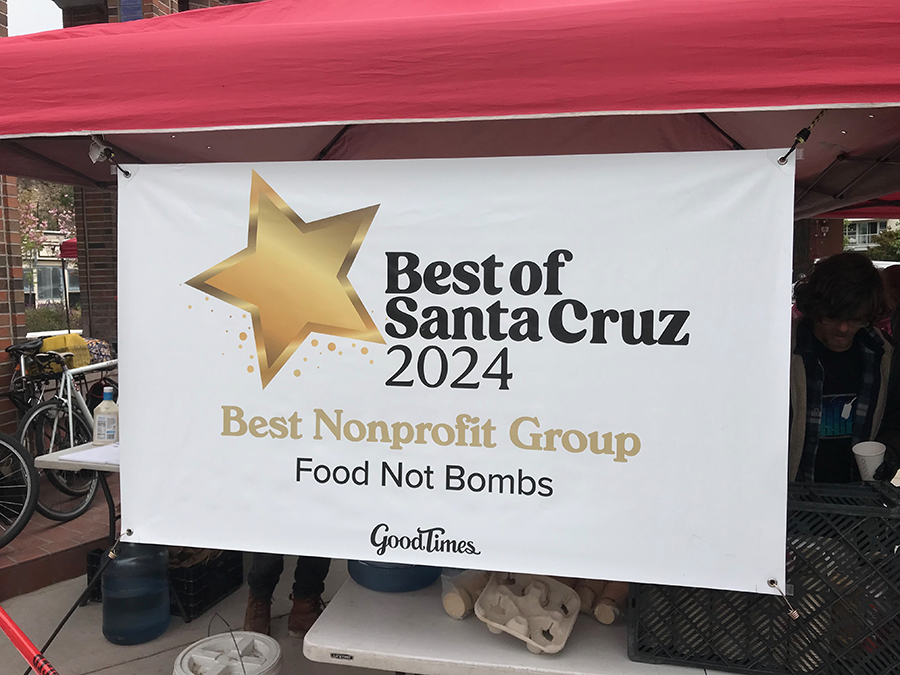
Readers of the Good Times Voted Santa Cruz Food Not Bombs as the Best Nonprofit
BY KEITH MCHENRY
- Santa Cruz Food Not Bombs shared the only daily hot meals everyday for 3 years in Santa Cruz during the Pandemic restrictions.
- Santa Cruz Food Not Bombs provided thousands of dollars worth of pup tents, tarps, sleeping bags and other survival gear during every meal.
- Santa Cruz Food Not Bombs hosted the Thanksgiving and Christmas Community Meals during those three years.
- Santa Cruz Food Not Bombs participated in protests including Black Lives Matter marches, Homeless Union demonstrations, fed the city workers and university grad student strikes, initiated protests against the wars in Ukraine and Palestine and is providing support to the Student Palestinian Divestment camp at UCSC.
Santa Cruz Food Not Bombs - 1-800-884-1136
| |
|
The Ballad of Marlon & Wally
BY WOODY REHANEK
Somewhere in Death Valley
lie the remains of Marlon & Wally
buried deep in desert sands
or scattered far across the land.
In Evanston they grew up together;
their families were neighbors.
Marlon would perform little plays
to pierce his mother's liquid haze.
He tapped resources deep within
to mesmerize his audience.
Wally had an alcoholic father,
so the boys understood each other.
In New York they were roommates
who came to fame in different ways.
Wally mastered stand-up comedy
& frequent guest spots on TV.
Marlon mined his inner core,
touching places rarely reached before.
********
These two close Chicago boys
set the world on fire
as oddball Mr. Peepers & Stanley
in "A Streetcar Named Desire."
Marlon's acting was branded
as deep, smoldering, eye-catching;
Wally fared well in Hollywood Squares,
famous for his clever repartees.
When Wally died of a heart attack,
Marlon fought to bring the magic back.
"Wally's my friend--no one else's,"
he said as he took Wally's ashes.
Marlon hoarded Wally's ashes
the rest of his days,
through women & children,
Tahiti, & the ruins of fame...
but things were really never the same.
Marlon's world was shattered.
Nothing really mattered until Marlon
& Wally's ashes were scattered
together in the Death Valley desert.
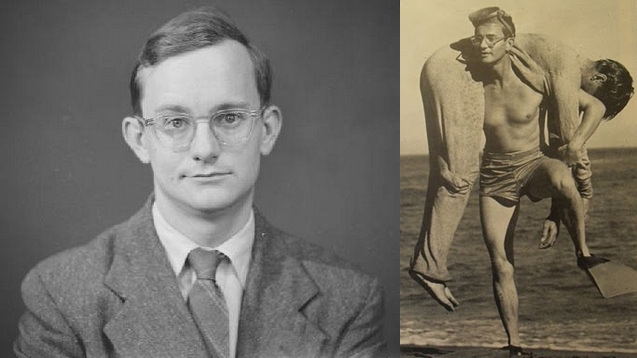
Marlon Brando struggled to mend
his broken heart & never accepted
the loss of his best friend, Wally Cox.
******Denouement******
Some say the Method
drained Brando's craft
by forcing him to inhabit
his characters 24/7.
Others say it enlivened & enflamed
his art, since Brando changed
personas with every role he played.
These things we know:
As the greatest actor of his age,
Brando loved Wally Cox
more than fortune or fame,
a love both cryptic & unorthodox.
************
"I admire his talent, but I don't
envy the pain that created it."
--Anthony Quinn
Poet's note: I still marvel at their relationship. Marlon once said, "If Wally had been a woman, I would have married him."
PHOTO BELOW COURTESY OF THE WHITE CRANE INSTITUTE
| |
|
Photo by TARMO HANNULA
A yellow-billed magpie picks through wild grass in Sacramento. These birds are known for their gregarious nature and often nest in small, loose colonies near human habitations; they typically forage in flocks and live in California's valleys.
| |
|
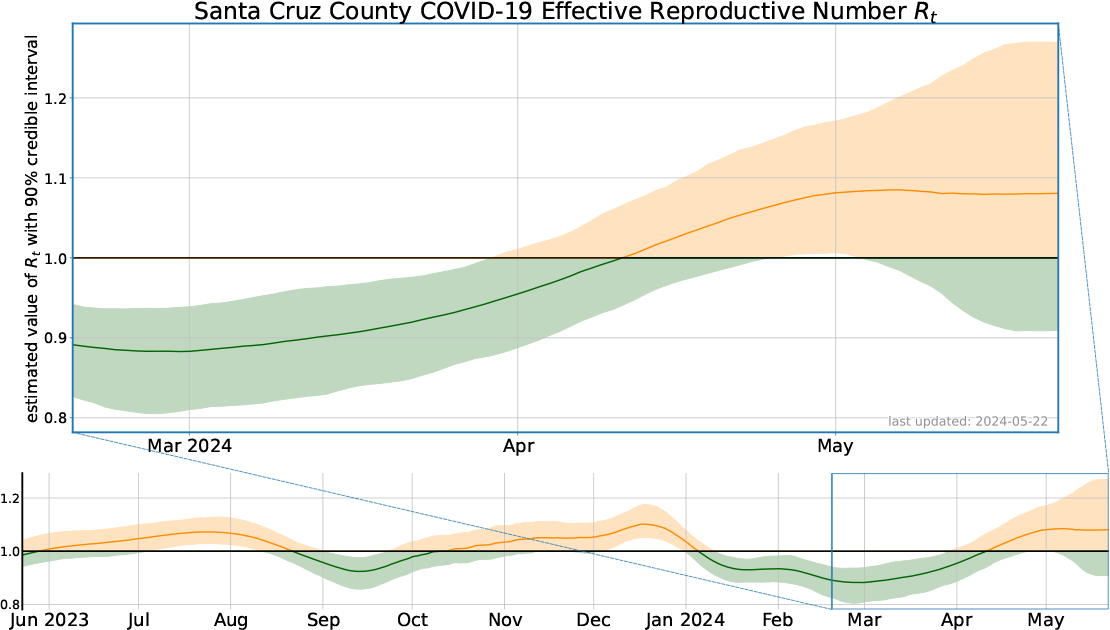
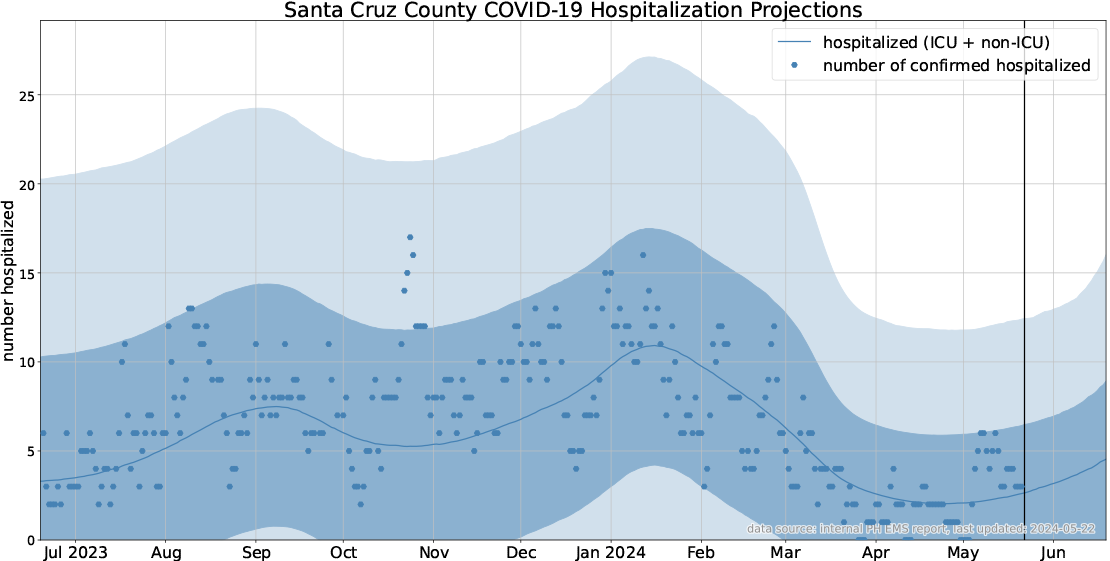
Santa Cruz County Covid-19 Report - Rt rises above 1 Second Week in a Row
By SARAH RINGLER
The California Department of Public Health and Santa Cruz County Health Department regularly release data on the current status of Covid-19 in the county as well as information on influenza, Respiratory Syncytial Virus (RSV), and Mpox. Since cases of Covid are still appearing, and there are still vulnerable people, I will continue reporting the graphs below.
At-home Covid-19 test kits are currently available at the Watsonville Public Library, Main St.
The three graphs below were updated on May 22.
The first graph is the Effective Reproductive Number. When the line rises above one, it shows that the spread of the virus is increasing. Below one means the spread is decreasing.
The second graph below shows data that the Health Department collects for Covid from wastewater at the City Influent, for the city of Santa Cruz, and from the Lode Street pump stations for the county.
The third graph below shows hospitalizations.
| |
|
Photo TARMO HANNULA
Fashion Street - Glowing lanterns punctuate Grant Street in Chinatown, San Francisco.
| |
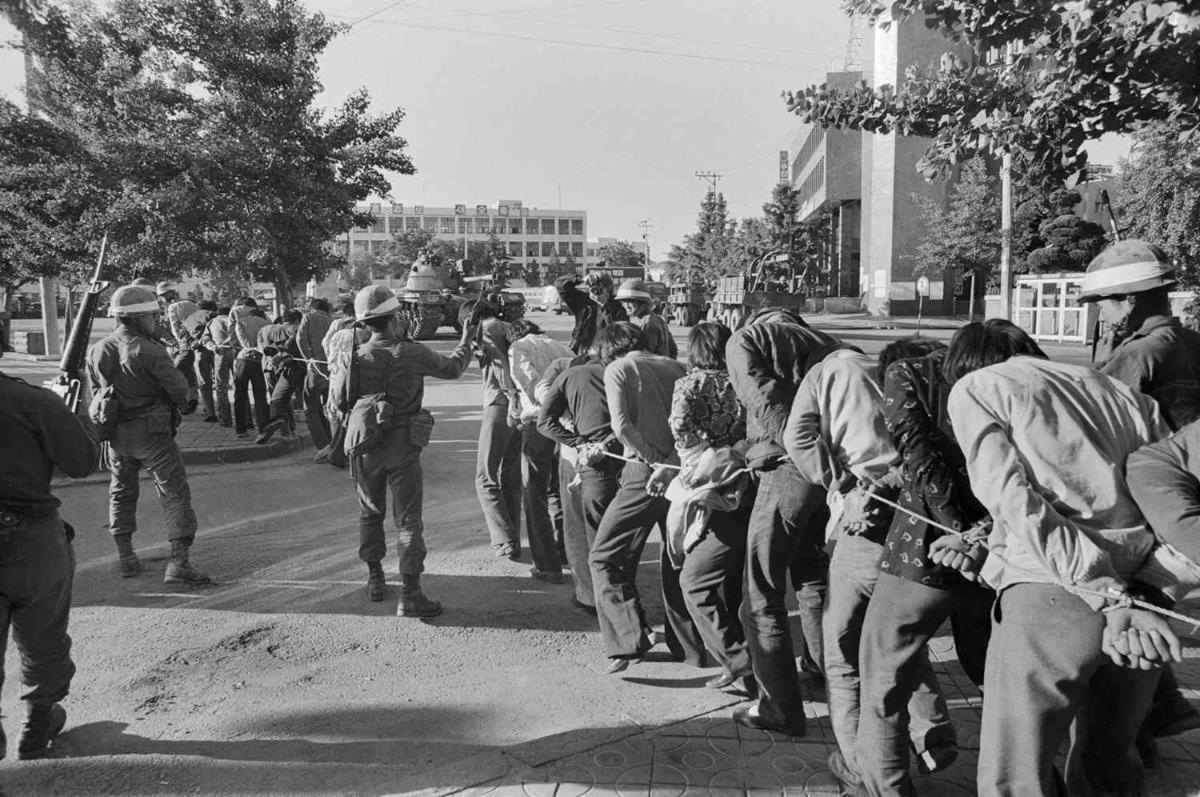
May 27, 1980 students in Gwangju, Korea, protesting martial law that had been imposed since a coup the year before, are led away by Republic of Korea soldiers. Although numbers are disputed, 2-3,000 demonstrators were killed overall in what is known as the Gwanju Massacre. | |
|
Labor History Calendar - May 24-30, 2024
a.k.a Know Our History Lest We Forget
May 24, 1990: IWW organizers Bari and Cherney bombed in Oakland, CA.
May 24, 2017: 175,000 construction workers strike across Quebec over schedules.
May 25, 1962: AFL-CIO launches campaign for 35-hour work week.
May 26, 1824: Textile factory workers block entrance, striking against pay cuts and longer hours in Pawtucket, RI.
May 26, 1920: IWW Marine Transport Workers strike in Philadelphia.
May 26, 1937: Battle of Overpass Ford thugs -- beat UAW organizers.
May 27, 1980: 2-3,000 killed in Kwangju, Korea uprising.
May 27, 2011: Hundreds of police clear Indignados from Plaza de Catalunya, Barcelona; quickly reoccupied.
May 28, 1871: Paris commune crushed: 25,000 massacred
May 28, 1946: Rochester, NY general strike.
May 29, 1969: Revolt touched off by shooting of striking auto workers shakes dictatorship in Cordoba, Argentina.
May 29, 2002: 30,000 port workers strike against union-busting in Bangladesh.
May 29, 2009: UAW auto workers accept deep concessions at GM because of US Congress demands.
May 30, 1937: Memorial Day Massacre at Chicago’s Republic Steel plant cops kill 10 and wound 30.
May 30, 1968: General strike against police brutality begins in Senegal.
May 30, 2013: Strikes at dozens of Seattle fast food outlets for living wage.
Labor History Calendar has been published yearly by the Hungarian Literature Fund since 1985.
| |
|
"We do not want the peace of slaves nor the peace of the grave."
Emiliano Zapata
| |
 | |
Photo by TARMO HANNULA
Lebanese flatbread with za’atar
By SARAH RINGLER
The French have herbes de Provence, Indians have garam masala and curry, Chinese have Five Spice Powder and hippies have Spike. All are herb and spice mixtures that define a cuisine. Za’atar is an herb mixture that is a common ingredient in Middle Eastern, North African and Arab cuisines. The core ingredients are usually thyme, oregano, marjoram, toasted sesame seeds and salt, but each family or region often has their own secret additions. Its use goes back at least 1,500 years ago. A simple, delicious and common way to eat it is to take fresh pita bread, dip it olive oil and then dust it with za’atar.
Flatbreads are usually made with only flour, water and salt. Pizza is a kind of flatbread but the crust is made with yeast and is usually associated with Italy, so this recipe is a flatbread pizza I suppose. It is inspired by David Tanis of the New York Times who ate this Lebanese treat on the streets of Paris. This crust is not thin or thick but full of airy spaces that cushion the topping providing a nice chewy base to the blanket of herbs and spices, crunchy meat, creamy feta cheese and pine nuts.
You can buy za’atar, pomegranate molasses, sumac, pine nuts and “00” flour at Staff of Life at 906 East Lake in Watsonville. The “00” flour is finer than all-purpose flour, and is often used to make pizza crusts. Staff of LIfe also carries an exceptionally smooth French feta that is creamy and not salty. It’s a good substitute for goat cheese.
Because the components of za’atar are common herbs that you may already have in your spice cabinet, you can make your own. I made six small pizzas and served them with chopped cucumbers, yogurt, salt and pepper.
Dough:
2 teaspoons active yeast
1 teaspoon sugar
1 cup lukewarm water
3 cups “00” flour or all purpose
2 tablespoon olive oil
1 teaspoon kosher salt
Topping:
Olive oil
Salt
1 large onion, diced
4 garlic cloves, minced
¾ to 1 pound ground lamb
½ teaspoon black pepper
½ teaspoon ground cloves
½ teaspoon allspice powder
¼ teaspoon cayenne
½ teaspoon cumin
½ teaspoon coriander
½ teaspoon cinnamon
1 teaspoon sumac powder
1 tablespoons pomegranate molasses
5 tablespoon za’atar mixed with 5 tablespoons of olive oil
8 ounces feta
¼ cup pine nuts, lightly toasted
Parsley, mint and cilantro leaves for garnish
Make the dough by mixing lukewarm water, sugar and yeast in a large bowl or stand mixer. Stir well to dissolve sugar and let sit until mixture is bubbly and foamy. Stir in 1 cup of flour and beat well. Let sit for around 20 minutes.
Add remaining flour, oil, and salt. Knead for about 5 minutes. Dough should be soft and a bit sticky. Add more flour if dough is too sticky. Oil a ceramic bowl with olive oil. Put dough out onto a floured board and shape into a ball. Put the ball in the oiled bowl, rub a little oil over the ball and cover with a cloth or plastic wrap. Let sit for one hour or refrigerate overnight.
Make the topping by putting 3 tablespoons of olive oil into a frying pan over medium high heat. When oil is hot, add onions, sprinkle with salt and pepper and cook until onions are soft and browned, about 5-7 minutes. Stir in garlic and cook 1 minute more.
Add the ground lamb breaking it into the onions with a spoon until it crumbles. Add salt, pepper, cloves, allspice, cayenne, cumin, coriander, cinnamon, sumac and pomegranate molasses. Lower heat and cook for about 5 minutes until meat is cooked.
Heat oven to 450 degrees and prepare a pizza stone or cookie tin. If you are using a pizza stone, put it into the oven to heat. Punch down the dough and divide into 4, 6 or 8 pieces depending on how many you want to make and how large you want them to be. Cover pieces with a damp cloth and let rest another 20-30 minutes.
In a small bowl mix za’atar and olive oil.
When oven is hot, roll or stretch dough into small of large rounds from 6-12 inches in diameter. If baking on a cookie tin, put the dough on the tin, brush with olive oil/za’atar mix. Cover with meat mixture and top with dabs of feta and pine nuts. If you are using pizza stones, you will make the pizzas on a floured board and then carefully put them on the pizza stone. I folded my pizza up and then unfolded on to the stone and reshaped it there. Try and keep the oven hot. Bake for 5-8 minutes. Serve with roughly chopped parsley, mint and/or cilantro.
| |
|
Send your story, poetry or art here: Please submit a story, poem or photo of your art that you think would be of interest to the people of Santa Cruz County. Try and keep the word count to around 400. Also, there should be suggested actions if this is a political issue. Submit to coluyaki@gmail.com
Send comments to coluyaki@gmail.com
If you are enjoying the Serf City Times, forward it on to others.
Subscribe, contact or find back issues at the website https://serf-city-times.constantcontactsites.com
Thanks, Sarah Ringler
| |
|
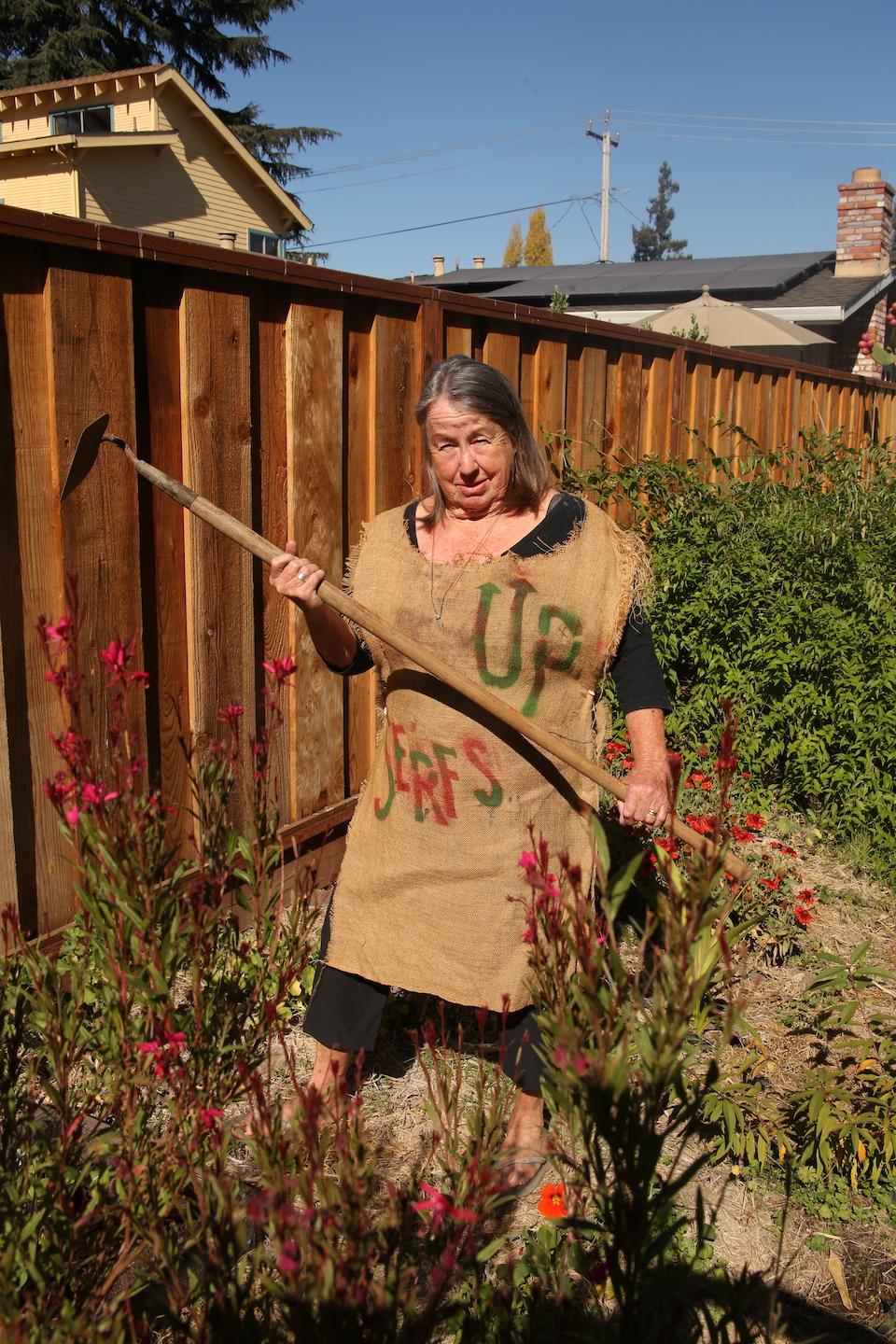
Welcome to Serf City Times Our county has problems and many people feel left out. Housing affordability, racism and low wages are the most obvious factors. However, many groups and individuals in Santa Cruz County work tirelessly to make our county a better place for everyone. These people work on the environment, housing, economic justice, health, criminal justice, disability rights, immigrant rights, racial justice, transportation, workers’ rights, education reform, gender issues, equity issues, electoral politics and more. Often, one group doesn’t know what another is doing. The Serf City Times is dedicated to serving as a clearinghouse for those issues by letting you know what is going on, what actions you can take and how you can support these groups.This is a self-funded enterprise and all work is volunteer.
Copyright © 2024 Sarah Ringler - All rights reserved
| | | | |