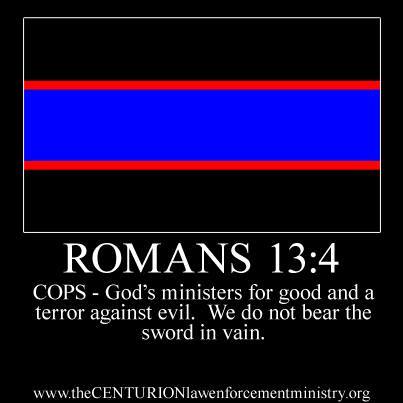
Anyone who follows my posts knows that two of the major focus points of this ministrry are our biblical servant-warrior ethos and God's call on all of us to be servant-leaders. Both because it has been some time since I've written a new Bible study message on servant-leadership and in light of an email from Pat Welsh
regarding his book on this subject (see the
resource
section above and/or the post script below), I present to you here my adaptation of a message Pat wrote under the same title and which was previously reprinted by Kevin Woodside in a post he entitled "The Modern Knight".
Servant, Warrior, Leader:
three words the public may not typically associate with law enforcement. Yet they are in fact significant to our God-ordained (Romans 13:1-4) profession and for all whom God has called according to His purpose (Romans 8:28-30). Accordingly, m
y goal here today is to challenge you to find your own Warrior, Servant, Leader vision, whether you are a LEO or not. Let's break it down:
Warrior
The English term "warrior" was first used in the 14th century, denoting "A man engaged or experienced in warfare." Webster reveals that "warrior" has its origins in the old world word "werre", meaning war. Thus, historically, a warrior always referred to a soldier-like male fighting in a war.
In more modern times, a warrior has been defined as a person who fights in battles and displays courage and skill. Most people still think of a warrior as a modern day soldier or old world Samurai or knight. But a warrior is much more than these stereotypes.
Cops are warriors inasmuch as we fight battles in the form of crime fighting and battling the evil forces around us. Fictional warriors like Batman and Superman are always hailed as "crime fighters." That said, what is the biblical (God's) view of this concept?
(1) God's word in Exodus 15:3 declares, "The
LORD is a warrior, the LORD is His name.
The NKV reads, "The LORD is a man of war..." The word "man" used here points us to the incarnation of Christ who will come forth to conquer sin, Satan and the world. Note that
He is not a common man of war but is rather the Captain ("Commander in Chief") of heavenly armies and the Leader and Commander of the people.
(2) Isaiah 42:13
The LORD will go forth like a warrior, He will arouse His zeal like a man of war.
(3) Zephaniah 3:17
says The LORD your God is with you, the Mighty Warrior who saves.
(4) Isaiah 9:6 describes
our Lord as EL-GIBHOR
: "Mighty God" -- the name describing the Messiah, Christ Jesus, a powerful and mighty warrior, who will accomplish the destruction of God's enemies and rule and judge with a rod of iron (Revelation 19:11-21).
(5)
Psalm 18!
(6) Psalm 144:1
Blessed by the Lord my rock who trains my hands for war and my fingers for battle.
Servant
The biblical and historical use of the terms "bondservant" and "servant" were definately not complimentary ones ("When I grow up I want to be a servant" or [for Halloween] "I want to dress up as a servant", said no child ever). Yet for those of us serving in law enforcement (and just about ever other endeavor, for that matter),
servanthood is central to our calling.
Sadly, the negative historical stereotype of a "servant" is alive and well today when it comes to cops. How many times have we heard, "I pay your salary!" (akin to, "I own you!"). So how should look at this biblically?
The biblical use of the word "servant" in the original Greek is diakonos from which the modern word "deacon" is derived. It carries the same meaning as "minister" in Romans 13:1-4 (a "minister" -- servant -- for good and a terror against evil"). Today we typically think of a church "deacon" in a positive light but at the time of Jesus' earthly ministry a "deacon" was one who mowed your yard, took out your trash (and your sewage), prepared your meals or a plethora of other low, menial jobs. Accordingly, I find it incredibly significant that a diakonos was also the role Jesus modeled for his disciples (and for us):
(1) In
Matthew 20:24-28
, Jesus
called them to Himself and said, "You know that the rulers of the Gentiles lord it over them, and their great men exercise authority over them. It is not this way among you, but whoever wishes to become great among you shall be your servant, and whoever wishes to be first among you shall be your slave
[bondservant]; just as the Son of Man did not come to be served [be ministered to], but to serve [minister], and to give His life as a ransom for many."
(2) In Matthew 28:7, Jesus declared that, "The greatest among you must be a servant."
(3) In John 13:1-17, Jesus took a towel, washed His disciples' feet (a job reserved for the lowest of servants given the fact that most everyone wore sandals and walked on dirt roadways covered in every kind of filth) and told them to go and do the same.
Leader
What is a leader? Is it anyone who has followers? You've heard the expression, "If you think you are leading and no one is following, you are just taking a walk."
All true leaders are servants first
. True leaders are not selfish, they are selfless. They think more about others and less about themselves. True leaders recognize that helping others first get what they desire and dream about will help them better accomplish the mission while also helping them reach their own dreams and visions along the way.
All cops are called to be leaders, regardless of rank or position.
Former cop William Stanton Westfall put the test of real leadership into the form of 4 questions:
- Are you doing the right thing?
- Are you doing it at the right time?
- Are you doing it in the right way?
- Are you doing it for the right reasons?
True servant-leaders answer these questions and influence others to do the same.
Unfortunately, much of what passes for Christian leadership is not biblical leadership at all. Accordingly, let's dig a bit deeper into John 13:1-17 to explore the example set for us by the greatest servant-warrior-leader of all time -- Jesus Christ:
Applying these considerations of Jesus as a role model for Christian servant-leaders we can see that, from a Biblical perspective, a true servant- leader is one who is:
So how do you compare to the "
servant-warrior-leader" role model of Jesus? Are you drawn to the higher purpose of serving God in accordance with His will for you? Are you focused on your people (your "people" include your own children, employees, officers, students, athletes, etc.) -- those who follow you (remember that leaders have followers) -- and helping them achieve their full potential for the Kingdom? If you're not, you most certainly should be.