|
Parshat Tzav No 1668: 12 Nissan 5777 (March 8, 2017)
|
|
|
WANT TO BECOME A MEMBER? Membership: $50.00
CLICK HERE TO JOIN OR DONATE TO THE RZA Pillar Membership:$180.00
We are in the process of collecting membership dues for 2017.
Please show your support and join as a member or renew your membership at this time.
Religious Zionists of America
305 Seventh Avenue, 12th Floor, New York, NY 10001
office@rza.org, www.rza.org
|
|
|
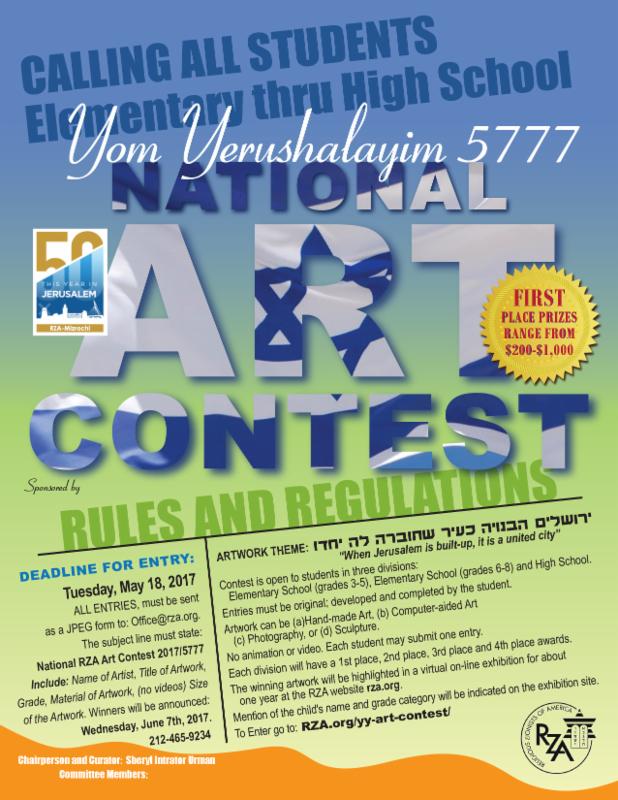
Introducing the RZA Art Contest for Yom Yerushalayim!
|
|
|
Greetings,
One of the exciting initiatives we have planned to commemorate the 50th anniversary of the reunification of Jerusalem is a National Art Contest for Children.
Please see the poster below for detailed instructions about how to participate. All artwork should connect with the theme “
Yerushalayim HaBenuya K’Ir Shechubra Lah Yachdav” - “When Jerusalem is built up, it is a united city.”
To the Students
:
When you are ready to submit your artwork please scan your entry and
email it to our office (
office@rza.org). Nothing should be
mailed to our office. All art will be judged online. Upon receipt we will send you a confirmation email.
The top winners will receive cash prizes and will have their artwork featured on the RZA-Mizrachi website. Framed certificates will also be presented to the top winners in the contest.
To the General Public:
If you know of people who are available to join our committee and assist in expanding awareness of the RZA-Mizrachi Children’s Art Contest and encouraging the participation of schools, synagogues and Jewish Community Centers in your local city, please let us know. Committee members might include art teachers in your local day school, principals, special activities coordinators, artists and those with a passion for the arts.
We have a curator/chairperson who is working closely with committee members to help coordinate and achieve maximum participation. Our goal is to have a committee member in every major city in the United States. The committee member may also initiate local award ceremonies.
Please distribute the attached flyer to your local area schools, synagogues, JCC's and any other Jewish Institutions you think would benefit from joining the RZA-Mizrachi Children’s Art Contest. We are happy to mail you copies of the poster as well.
With warm regards,
Rabbi Gideon Shloush Sheryl Intrator Urman
National Director, RZA-Mizrachi Chairperson
gshloush@rza.org
|
|
|
Artwork submitted may be used for RZA purposes in connection to the Art Contest.
Winning entries will have their name and grade featured along with their artwork on the RZA virtual Art Exhibition.
ENTRY MUST INCLUDE YOUR JPEG SUBMISSION, see flyer for complete details.
Questions? Call 212-465-9234.
|
|
|
RZA-Mizrachi Manhattan Shabbaton
June 16-17
Location:
The Jewish Center
131 West 86th Street
New York, NY 10024
|
|
|
Press Release:
RZA-Mizrachi holds first-ever National Collegiate Chidon HaTanach
|
|
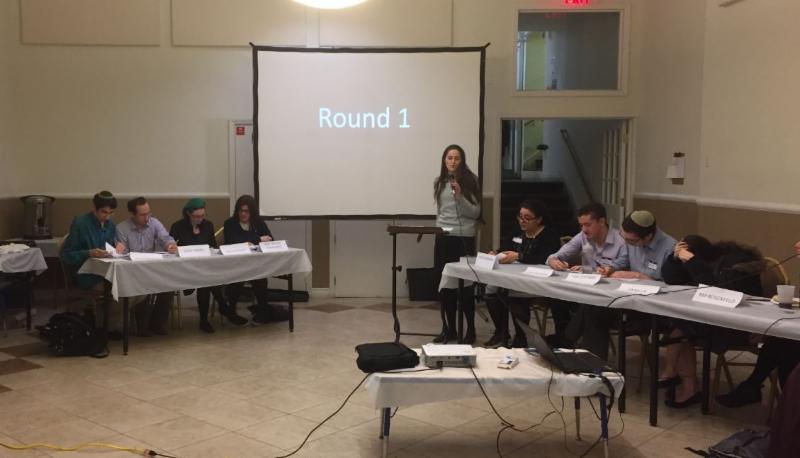
As a part of the Religious Zionists of America's (RZA) Aryeh Fellowship, six college students - Tehilla Berger, Liat Clark, Yael Eisenberg, Briana Friedman, Binyamin Kaplan, and Jennifer van Amerongen – organized the first ever collegiate Chidon HaTanach. The event took place on Sunday April 2, 2017 at Congregation Aderth El in Midown Manhattan. The Chidon HaTanach tested the knowledge of five competitors on chapters in Tanach related to themes of Eretz Yisrael and Shivat Zion (Return to Zion).
The distinguished judges of the competition were Bible Professor Smadar Rosensweig; 2013 International High School Chidon HaTanach champion Yishai Eisenberg; coordinator of the US Chidon Ha-Tanach and former Chidon champion Dovi Nadel and Yaelle Frohlich, participant in the International Adult Chidon HaTanach (and wife of the winner of the adult Chidon HaTanach competition, Yair Shahak) this past December.
Mr. Martin Oliner, Presidium member of the RZA, stressed the importance of the Chidon HaTanach, saying it is “an extremely important competition because it motivates the participants to learn more Torah. We at the Religious Zionists of America believe firmly that the State of Israel and Zionism can only succeed when increased Torah learning occurs.”
Congratulations to Avital Habshush of Brooklyn, NY, the winner of the Chidon HaTanach, who was awarded both Sefarim and a cash prize.
The Aryeh Fellowship is an RZA-Mizrachi initiative that sponsors 50 college students to initiate Religious Zionist programming throughout North America.
|
|
|
Order your Yom Yerushalayim buttons today!
|
|
|
SHOW YOUR SUPPORT FOR
YOM YERUSHALAYIM
|
As the 50th anniversary of the reunification of Jerusalem approaches, our support of Israel is more important than ever.
Please reply to this email to order your Yom Yerushalayim
"United with Jerusalem" buttons.
These buttons are perfect to hand out at your Yom Yerushalayim celebrations.
$36 per 100 buttons.
Please contact our office at
212-465-9234 or office@rza.org
to order!
|
|
|
Here's what One Shul did to Promote Yom Yerushalayim Buttons to their Community:
|
|
|
Getting Ready for Yom Yerushalayim!
|
|
|
We are pleased to introduce a new initiative. Each week we will feature new items and materials to help you prepare for Yom Yerushalayim.
|
|
|
If your synagogue is looking for an inspirational, educational and entertaining program for Yom Haatzmaut or Yom Yerushalyim, we recommend inquiring about licensing the award-winning, feature documentary
ON THE MAP
(www.onthemapfilm.com)
. More information below.
The film is screening at Film Festivals, Synagogues, Jewish Organizations, College Campuses and High Schools around the country.
|
|
|
|
ON THE MAP tells the against-all-odds story of Maccabi Tel Aviv’s 1977 win of the European Cup. Through the conduit of sports, ON THE MAP tells a much broader story of Israel and the Jewish people during the Cold War. The film recounts how the underdog Israeli team prevailed over CSKA Moscow (known in the West as “Red Army”) – a team that refused to play against Israel. Moments after this highly charged and historical win, American player
Tal Brody captured the heart of the young nation when he famously said,
“Israel is ON THE MAP, not just in sport, but in everything.”
ON THE MAP features interviews with figures such as Michael Oren, Natan Sharansky and NBA legends Bill Walton and David Stern. ON THE MAP is a documentary written and directed by Israeli Academy Award winner filmmaker, Dani Menkin (IS THAT YOU?, DOLPHIN BOY) and executive-produced by Roberta Grossman and Nancy Spielberg (ABOVE AND BEYOND).
|
|
|
NEW!!!
Introducing a new section to our website.
MEDIA RESOURCES
|
|
|
We are pleased to introduce a media resource section for our RZA-Mizrachi website! This section is meant to provide helpful resources for Israel related news, media, and advocacy, as well as Torah resources.
Please take a moment to see what’s there. Kindly let us know if there are additional sites that we should add to this list.
Many thanks to RZA Aryeh Fellow Alex Sachs for preparing this section.
You can find our new section
here
.
|
|
|
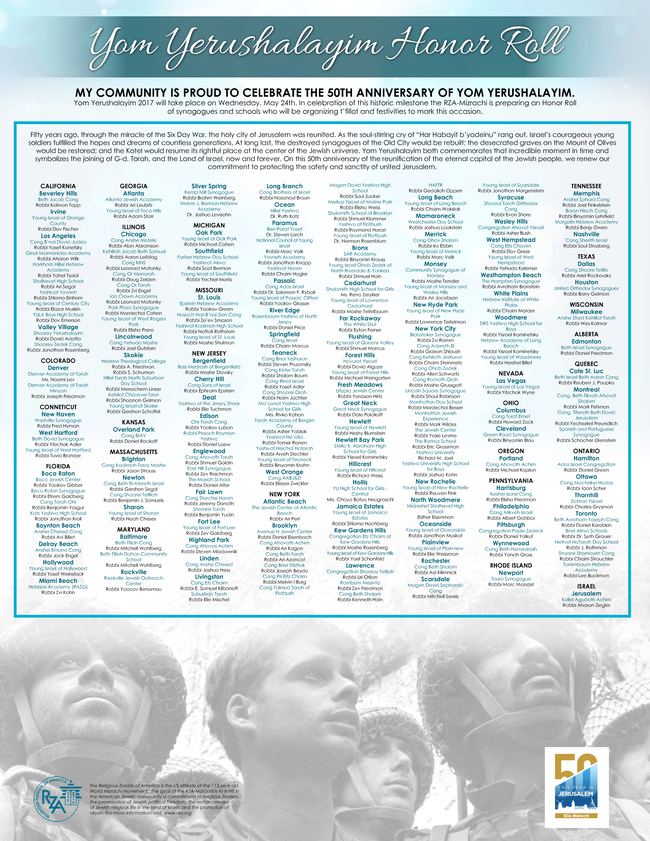
Yom Yerushalayim Honor Roll
|
|
|
Nearly 200 have signed up!!!
|
|
|
Dear Friend of Religious Zionism,
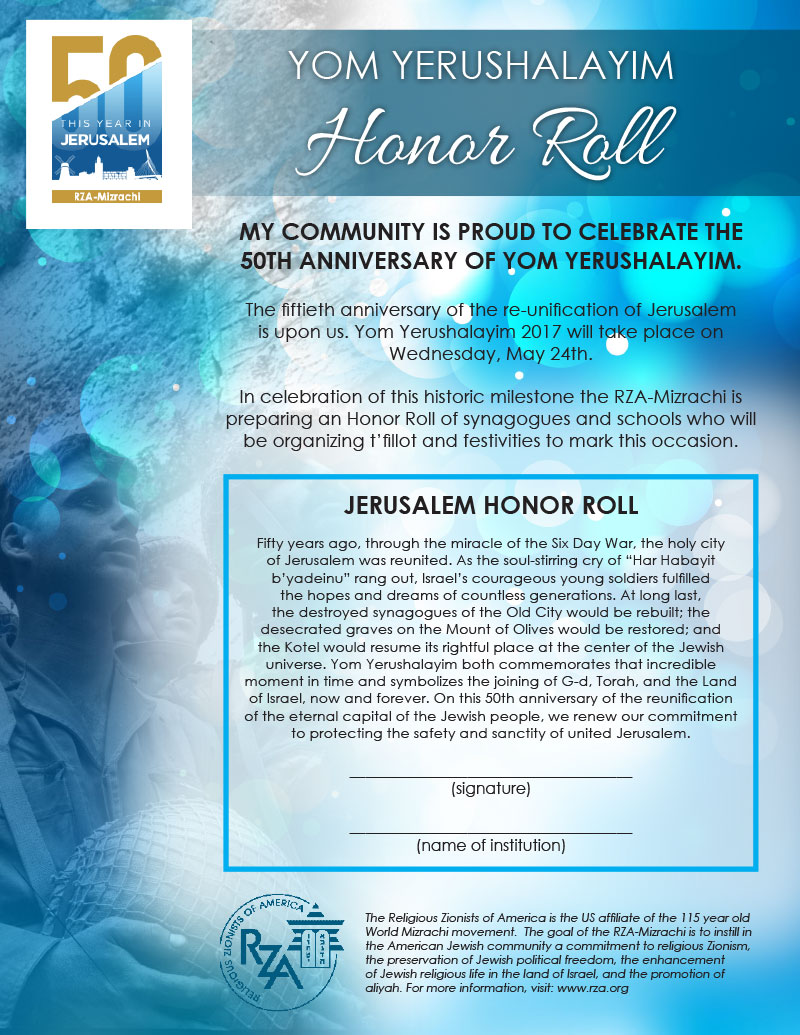
One of the initiatives we are planning, in anticipation of the 50th anniversary of the re-unification of Jerusalem, is an “Honor Roll” to be signed by the leadership of congregations and schools across the country.
1) Please have your leadership inform us if they want to be included on our Honor Roll. (We will include the names of all participating institutions in the media).
2) Please share this Honor Roll with institutions in your community and encourage participation.
3) Please arrange to display this Honor Roll in the lobbies of your Shuls and Schools. Click here to print out a copy of the poster OR kindly email us to let us know if you’d like us to mail you a hard copy flyer or poster.
Nearly 200 Shuls and Schools have signed up. If your community is not yet on our list please let us know.
Rabbi Gideon Shloush Presidium
National Director
Mr. Martin Oliner
Religious Zionists of America - Mizrachi Rabbi Leonard Matanky
gshloush@rza.org Dr. Ernest Agatstein
|
|
|
Below is a list of shuls, schools, and organziations that are participating in our Honor Roll:
|
|
|
CALIFORNIA
Beverley Hills
Beth Jacob Congregation
Rabbi Kalman Topp
Irvine
Young Israel of Orange County
Rabbi Dov Fischer
Los Angeles
Congregation B’nai David-Judea
Rabbi Yosef Kanefsky
Gindi Maimonides Academy
Rabbi Aharon Wilk
Harkham Hillel Hebrew Academy
Rabbi Yahel Tsaidi
Shalhevet High School
Rabbi Ari Segal
Yeshivat Yavneh
Rabbi Shlomo Einhorn
Young Israel of Century City
Rabbi Elazar Muskin
YULA Boys High School
Rabbi Dov Emerson
YULA Girls High School
Rabbi Abraham Lieberman
Sunnyvale
South Peninsula Hebrew Day School
Rabbi Shaye Guttenberg
Valley Village
Shaarey Yerushalayim
Rabbi David Adatto
Shaarey Zedek Congregation
Rabbi Jonathan Rosenberg
COLORADO
Denver
Denver Academy of Torah
Ms. Naomi Lev
Denver Academy of Torah Minyan
Rabbi Joseph Friedman
CONNECTICUT
New Haven
Westville Synagogue
Rabbi Fred Hyman
Stamford
Congregation Agudath Sholom
Rabbi Daniel Cohen
West Hartford
Beth David Synagogue
Rabbi Yitzchok Adler
Young Israel of West Hartford
Rabbi Tuvia Brander
FLORIDA
Boca Raton
Boca Jewish Center
Rabbi Yaakov Gibber
Boca Raton Synagogue
Rabbi Efrem Goldberg
Congregation Torah Ohr
Rabbi Benjamin Yasgur
Katz Yeshiva High School
Rabbi Jonathan Kroll
Boynton Beach
Anshei Chesed Congregation
Rabbi Avi Billet
Delray Beach
Anshei Emuna
Cong Rabbi Jack Engel
Hollywood
Young Israel of Hollywood
Rabbi Yosef Weinstock
Miami Beach
Hebrew Academy (RASG)
Rabbi Zvi Kahn
GEORGIA
Atlanta
Atlanta Jewish Academy
Rabbi Ari Leubitz
Young Israel of Toco Hills
Rabbi Adam Starr
ILLINOIS
Chicago
Congregation Anshe Motele
Rabbi Alan Abramson
Congregation Kehillah Jacob Beth Samuel
Rabbi Aaron Leibtag
Congregation KINS
Rabbi Leonard Matanky
Congregation Or Menorah
Rabbi Doug Zelden
Congregation Or Torah
Rabbi Zvi Engel
Ida Crown Academy
Rabbi Leonard Matanky
Park Plaza Synagogue
Rabbi Mordechai Cohen
Young Israel of West Rogers Park
Rabbi Elisha Prero
Lincolnwood
Congregation Yehuda Moshe
Rabbi Joel Gutstein
Skokie
Hebrew Theological College
Rabbi A. Friedman, Rabbi S. Schuman
Hillel Torah North Suburban Day School
Rabbi Menachem Linzer
Kehilat Chovevei Tzion
Rabbi Shaanan Gelman
Young Israel of Skokie
Rabbi Gershon Schaffel
KANSAS
Overland Park
Congregation BIAV
Rabbi Daniel Rockoff
MASSACHUSETTS
Brighton
Congregation Kadimah-Toras Moshe
Rabbi Jason Strauss
Newton
Congregation Beth El-Atereth Israel
Rabbi Gershon Segal
Congregation Shaarei Tefillah
Rabbi Benjamin J. Samuels
Sharon
Young Israel of Sharon
Rabbi Noah Cheses
MARYLAND
Baltimore
Beth Tfiloh Congregation
Rabbi Mitchell Wohlberg
Beth Tfiloh Dahan Community School
Rabbi Mitchell Wohlberg
Rockville
Rockville Jewish Outreach Center
Rabbi Yaacov Benamou
Silver Spring
Kemp Mill Synagogue
Rabbi Brahm Weinberg
Melvin J. Berman Hebrew Academy
Dr. Joshua Levisohn
MICHIGAN
Oak Park
Young Israel of Oak Park
Rabbi Michael Cohen
Southfield
Farber Hebrew Day School
Rabbi Scot Berman
Young Israel of Southfield
Rabbi Yechiel Morris
MISSOURI
St. Louis
Epstein Hebrew Academy
Rabbi Yaakov Green
Nusach Hari B’nai Zion Congregation
Rabbi Ze’ev Smason
Yeshivat Kadimah High School
Rabbi Naftali Rothstein
Young Israel of St. Louis
Rabbi Moshe Shulman
NEW JERSEY
Bergenfield
Bais Medrash of Bergenfield
Rabbi Moshe Stavsky
Congregation Beth Abraham
Rabbi Ya'akov Neuburger
Cherry Hill
Congregation Sons of Israel
Rabbi Ephraim Epstein
Politz Day School
Rabbi Avraham Glustein
Deal
Yeshiva at the Jersey Shore
Rabbi Elie Tuchman
Edison
Ohr Torah Congregation
Rabbi Yaakov Luban
Rabbi Pesach Raymon
Yeshiva Rabbi Daniel Loew
Englewood
Congregation Ahavath Torah
Rabbi Shmuel Goldin
East Hill Synagogue
Rabbi Zev Reichman
The Moriah School
Rabbi Daniel Alter
Fair Lawn
Congregation Darchei Noam
Rabbi Jeremy Donath
Shomrei Torah
Rabbi Benjamin Yudin
Fort Lee
Young Israel of Fort Lee
Rabbi Zev Goldberg
Highland Park
Congregation Ahavas Achim
Rabbi Steven Miodownik
Linden
Congregation Anshe Chesed
Rabbi Joshua Hess
Livingston
Congregation Etz Chaim
Rabbi E. Samuel Klibanoff
Suburban Torah
Rabbi Elie Mischel
Long Branch
Congregation Brothers of Israel
Rabbi Nasanayl Braun
Ocean
Hillel Yeshiva
Dr. Ruth Katz
Paramus
Ben Porat Yosef
Dr. Steven Lorch
National Council of Young Israel
Rabbi Marc Volk
Yavneh Academy
Rabbi Jonathan Knapp
Yeshivat Noam
Rabbi Chaim Hagler
Passaic
Congregation Adas Israel
Rabbi Dr. Solomon F. Rybak
Young Israel of Passaic Clifton
Rabbi Yaakov Glasser
River Edge
Rosenbaum Yeshiva of North Jersey
Rabbi Daniel Price
Springfield
Congregation Israel
Rabbi Chaim Marcus
Teaneck
Beth Aaron Congregation
Rabbi Larry Rothwachs
Congregation Bnai Yeshurun
Rabbi Steven Pruzansky
Congregation Keter Torah
Rabbi Shalom Baum
Congregation Rinat Israel
Rabbi Yosef Adler
Congregation Shaarei Orah
Rabbi Haim Jachter
Ma’aynot Yeshiva High School for Girls
Mrs. Rivka Kahan
Torah Academy of Bergen County
Rabbi Asher Yablok
Yeshivat He’atid
Rabbi Tomer Ronen
Yeshivat Heichal Hatorah
Rabbi Aryeh Stechler
Young Israel of Teaneck
Rabbi Binyamin Krohn
West Orange
Congregation AABJ&D
Rabbi Eliezer Zwickler
NEW YORK
Atlantic Beach
The Jewish Center of Atlantic Beach
Rabbi Ari Perl
Bronx
SAR Academy
Rabbi Binyamin Krauss
Young Israel Ohab Zedek
Rabbi Shmuel Hain
Brooklyn
Avenue N Jewish Center
Rabbi Doniel Eisenbach
|
|
|
Congregation Ahavath Achim
Rabbi Ari Kagan
Congregation Beth Torah
Rabbi Ari Azancot
Congregation Bnei Yitzhak
Rabbi Joseph Beyda
Congregation Pri Eitz Chaim
Rabbi Melvin I Burg
Congregation Talmud Torah of Flatbush
Magen David Yeshiva High School
Rabbi Saul Zucker
Merkaz Yisrael of Marine Park
Rabbi Elisha Weiss
Shulamith School of Brooklyn
Rabbi Shmuel Klammer
Yeshiva of Flatbush
Rabbi Raymond Harari
Young Israel of Flatbush
Rabbi Kenneth Auman
Cedarhurst
Shulamith High School for Girls
Ms. Rena Zerykier
Young Israel of Lawrence-Cedarhurst
Rabbi Moshe Teitelbaum
Far Rockaway
The White Shul
Rabbi Eytan Feiner
Flushing
Young Israel of Queens Valley
Rabbi Shmuel Marcus
Forest Hills
Havurat Yisrael
Rabbi David Algaze
Young Israel of Forest Hills
Rabbi Michael Weingarten
Fresh Meadows
Utopia Jewish Center
Rabbi Yonoson Hirtz
Great Neck
Great Neck Synagogue
Rabbi Dale Polakoff
Hewlett
Young Israel of Hewlett
Rabbi Heshy Blumstein
Hewlett Bay Park
Stella K. Abraham High School for Girls
Rabbi Yisroel Kaminetsky
Hillcrest
Young Israel of Hillcrest
Rabbi Dr. Richard Weiss
Hollis
YU High School for Girls - Central
Mrs. Chaya Batya Neugroschl
Jamaica Estates
Young Israel of Jamaica Estates
Rabbi Shlomo Hochberg
Kew Gardens Hills
Congregation Etz Chaim
Rabbi Moshe Rosenberg
Young Israel of Kew Gardens Hills
Rabbi Yoel Schonfeld
Lawrence
Rambam Mesivta
Rabbi Zev Friedman
Congregation Beth Sholom
Rabbi Kenneth Hain
Congregation Shaaray Tefilah
Rabbi Uri Orlian
HAFTR
Rabbi Gedaliah Oppen
Long Beach
Young Israel of Long Beach
Rabbi Chaim Wakslak
Mamaroneck
Westchester Day School
Rabbi Joshua Lookstein
Westchester Hebrew High School
Rabbi Jeffrey Beer
Merrick
Congregation Ohav Sholom
Rabbi Ira Ebbin
Young Israel of Merrick
Rabbi Marc Volk
Monsey
Community Synagogue of Monsey
Rabbi Moshe Tendler
Young Israel of Monsey and Wesley Hills
Rabbi Ari Jacobson
New Hyde Park
Young Israel of New Hyde Park
Rabbi Lawrence Teitelman
New York City
Bialystoker Synagogue
Rabbi Zvi Romm
Congregation Adereth El
Rabbi Gideon Shloush
Congregation Kehilath Jeshurun
Rabbi Chaim Steinmetz
Congregation Ohab Zedek
Rabbi Allen Schwartz
Congregation Ramath Orah
Rabbi Moshe Grussgott
Lincoln Square Synagogue
Rabbi Shaul Robinson
Manhattan Day School
Rabbi Mordechai Besser
Manhattan Jewish Experience
Rabbi Mark Wildes
The Jewish Center
Rabbi Yosie Levine
The Ramaz School
Rabbi Eric Grossman
Yeshiva University
President Richard M. Joel
Yeshiva University High School for Boys
Rabbi Joshua Kahn
New Rochelle
Young Israel of New Rochelle
Rabbi Reuven Fink
North Woodmere
Midreshet Shalhevet High School
Ms. Esther Eisenman
Oceanside
Young Israel of Oceanside
Rabbi Jonathan Muskat
Plainview
Young Israel of Plainview
Rabbi Elie Weissman
Rochester
Congregation Beth Shalom
Rabbi Avi Kilimnick
Scarsdale
Magen David Sephardic Congregation
Rabbi Mitchell Serels
Young Israel of Scarsdale
Rabbi Jonathan Morgenstern
Syracuse
Shaarai Torah Orthodox Congregation
Rabbi Evan Shore
Wesley Hills
Congregation Ahavat Yisrael
Rabbi Asher Bush
West Hempstead
Congregation Eitz Chayim
Rabbi Dov Greer
Young Israel of West Hempstead
Rabbi Yehuda Kelemer
Westhampton Beach
The Hampton Synagogue
Rabbi Avraham Bronstein
White Plains
Hebrew Institute of White Plains
Rabbi Chaim Marder
Woodmere
DRS Yeshiva High School for Boys
Rabbi Yisroel Kaminetsky
Hebrew Academy of Long Beach
Rabbi Yisroel Kaminetsky
Young Israel of Woodmere
Rabbi Hershel Billet
NEVADA
Las Vegas
Young Israel of Las Vegas
Rabbi Yitzchak Wyne
OHIO
Columbus
Congregation Torat Emet
Rabbi Howard Zack
Cleveland
Green Road Synagogue
Rabbi Binyamin Blau
OREGON
Portland
Congregation Ahavath Achim
Rabbi Michael Kaplan
PENNSYLVANIA
Harrisburg
Kesher Israel Congregation
Rabbi Elisha Friedman
Merion Station
Kohelet Yeshiva High School
Rabbi Dr. Gil Perl
Philadelphia
Congregation Mikveh Israel
Rabbi Albert Gabbai
Pittsburgh
Congregation Poale Zedeck
Rabbi Daniel Yolkut
Wynnewood
Congregation Beth Hamedrosh
Rabbi Yonah Gross
RHODE ISLAND
Newport
Touro Synagogue
Rabbi Marc Mandel
TENNESSEE
Memphis
Anshei Sphard Congregation
Rabbi Joel Finkelstein
Baron Hirsch Congregation
Rabbi Binyamin Lehrfield
Margolin Hebrew Academy
Rabbi Benjy Owen
Nashville
Congregation Sherith Israel
Rabbi Saul Strosberg
TEXAS
Dallas
Congregation Shaare Tefilla
Rabbi Ariel Rackovsky
Houston
United Orthodox Synagogues
Rabbi Barry Gelman
WASHINGTON
Seattle
Seattle Hebrew Academy
Ms. Rivy Poupko Kletenik
WISCONSIN
Milwaukee
Anshe Sfard Kehillat Torah
Rabbi Wes Kalmar
CANADA
ALBERTA
Edmonton
Beth Israel Synagogue
Rabbi Daniel Friedman
QUEBEC
Cote St. Luc
Beth Israel Beth Aaron Congregation
Rabbi Reuben J. Poupko
Montreal
Congregation Beth Tikvah Ahavat Shalom
Rabbi Mark Fishman
Cong. Tifereth Beth David Jerusalem
Rabbi Yechezkel Freundlich
Spanish and Portuguese Synagogue
Rabbi Schacher Orenstein
Hamilton
Adas Israel Congregation
Rabbi Daniel Green
Ottawa
Congregation Machzikei Hadas
Rabbi Idan Scher
Thornhill
Zichron Yisroel
Rabbi Charles Grysman
Toronto
Beth Avraham Yoseph Congregation
Rabbi Daniel Korobkin
Bnei Akiva Schools
Rabbi Dr. Seth Grauer
Netivot HaTorah Day School
Rabbi J. Rothman
Shaarei Shomayim Congregation
Rabbi Chaim Strauchler
Tanenbaum Hebrew Academy
Rabbi Lee Buckman
ISRAEL
Jerusalem
Kollel Agudath Achim
Rabbi Aharon Ziegler
|
|
|
We are pleased to announce a new initiative: Each week, we will (translate and) feature a d’var Torah from a different Rosh Yeshiva of a Dati L’umi Yeshivat Hesder in Israel. Our goal is – until we get there ourselves – to bring Torat Yisrael closer to America.
|
|
|
Chizkiyahu's Pesach
By Rav Ehud Zand
Rosh Yeshiva of Yeshivat Kiryat Shemonah
Translated by RZA Aryeh Fellow Yehudith Dashevsky
|
|
|
The Mishna in Perek Dalad of Psachim states about Chizkiyahu making Pesach in Iyar “lo hodu lo.” Why do the Sages apprehend Chizkiyahu for making a Korbon Pesach? Let us look at the details and the context of the event.
Chizkiyahu’s father was Achaz, a king who closed the doors of the Bet haMikdash, built alters for idol worship in the architectural style of the king of Assyria, etc. In contrast, Chizkiyahu was considered by Chazal to have been the greatest king of all time. The Midrash states that G-d wanted to make Chizkiyahu Mashiach. What had he done to deserve this praise? He led a massive teshuva movement. He had the Jewish people get rid of their idols, told the Cohanim and Leviim to purify themselves, had the Jewish people learn Torah, did a mass repairs on the Bet HaMikdash, etc. It so happened that the repairs on the Bet HaMikdash, together with the purification process and the re-dedication took until the 16th of Iyar. Chizkiyahu had various atonement offerings brought and then ruled that they should bring the Korbon Pesach as well. In this context, it seems that Chizkiyahu’s intentions were proper -- the Korbon Pesach would be in the context of atoning for the Jewish people’s sins and starting over.
However, there were two problems: The first was that he called to all the Jewish people to come but not everyone was willing. Divrei HaYamim describes how the tribes of Efraim and Menashe mock Chizkiyahu for ordering them to come bring the Korban Pesach. Why so? It is possible that they were not on board with the teshuva movement to begin with. However, it is also possible that they were criticizing Chizkiyahu for being a “chadshan,” for creating new laws out of nowhere. The Korbon Pesach is not normally brought on the 16th of Iyar. Yet, it is said that Chizkiyahu had created a leap month, so it technically still could have been Pesach, in Nissan. And we know that one may bring a Korbon Pesach all the days of Pesach if one had not had the chance to do so prior.
Why, then, did the Chachamim disapprove of this Pesach? The Rambam explains one reason for the Chachamim’s disapproval of Chizkiyahu’s Pesach. Normally, when one creates a leap month, one must declare it before the 30th of Adar, because that day is already considered to be Rosh Chodesh Nissan. Chizkiyahu, however, had waited until the 30th of Adar to create a leap month. Because he did not follow the procedures, his intercalation of the year did not work, and the month that he wished to bring the Korbon Pesach remained Iyar. That was problem number two.
However, there seems to be another facet to the Sages’ disapproval of Chizkiyahu’s Pesach. The Yalkut Shemoni writes that Pesach needs to be had “at the time that Matzah and Maror are placed in front of you.” That is, there is a significance to having the Korbon Pesach in its proper context, with Matzah and Maror. Why had Chizkiyahu wanted to make this Korbon Pesach in the first place, seemingly disjointed and separate from its context – the correct date and with Matzah and Maror? Chizkiyahu had looked to Moshe’s making a brit after the sin of the Golden Calf and Yehoshua’s making a brit after circumcising the Jewish people in Gilgal. He realized that after having distanced themselves so far from G-d, the Jewish people needed to renew their covenant with Him. So what was the problem? It was not at the time that Matzah and Maror were out on the table. Matzah and Maror here symbolize history – whereas we know the Korbon Pesach we bring (Pesach d’dorot) is different from the one they had in Egypt (Pesach d’Mitzrayim) – the matzah and the maror remained the same. They serve to anchor the Korbon Pesach to its history. And that was the problem with Chizkiyahu’s Pesach. His wish to renew the Jewish people’s commitment to G-d with a renewed covenant was admirable. But its disconnect from the historical context was unacceptable. Chidush and history go hand-in-hand – the Sages could not approve of Chizkiyahu’s chidush, which was bereft of its roots, its connection to Pesach Mitzrayim.
|
|
Rav Ehud Zand is Rosh Yeshiva of
Yeshivat Kiryat Shemonah, located in the northern Israeli town of Kiryat Shemona and offers a comprehensive five-year education program with a strong focus on Talmud, Tanach and Jewish philosophy. It also serves as a community center, with a variety of programs and services, ranging from providing assistance to the poor, elderly, infirm, and those with special needs, to offering educational services to the outlying communities. They also function as a food bank in times of both war and peace and serve as the point people who distribute food to families in bomb shelters. Most importantly, the Yeshiva serves as the first line of defense on the northern border with Lebanon.
|
|
|
We are pleased to feature a different Religious Zionist rabbi each week from around the country to share a Dvar Torah.
|
|
|
Parshat Tzav
Rabbi Dr. Jerold Isenberg
Rabbi of Congregation Agudath Sholom
Stamford, CT
|
|
The Midrash (Vayikra Rabba 9:1) relates the pasuk in Parashat Tzav (7:2): ואם על־תודה יקריבנו
In our days, when we have no opportunity to bring korbanot, our speech, through daily tefilot, takes their place, we need to be ever-vigilant in our obligation of giving thanks, expressing our Hakarat HaTov. It is relatively easy to recognize the need for such expression after a potential danger has been avoided. The challenge is to realize that there are many things we may take for granted, that deserve our expressed gratitude as well.
As a Mizrachi Executive Director, I have had the opportunity to discuss the goals and ideals of Religious Zionism with many people as part of the rejuvenation of Mizrachi throughout the world and especially in Chicago. I have often been asked: Before and in the early days of the State of Israel it seemed clear, but today, what is a Religious Zionist?”
My response is to pose two questions. First, does one believe that the modern State of Israel, Medinat Yisrael, with all its accomplishments and despite any failings it may have, is a gift from HaShem? Invariably, the answer is yes.
And then the second question. Does one believe that it is incumbent upon us to express Hakarat Hatov – gratitude for a gift from Hashem? Again, the answer is yes.
Done, I conclude. You are a Religious Zionist.
The type of kippa a man wears on his head does not define Religious Zionism. Expressing gratitude to HaShem for the Divine gift of Medinat Yisrael does. Yet, how does one express such gratitude?
Hallel on Yom HaAtzmaut and Yom Yerushalayim and a weekly Tefila for the welfare of Medinat Yisrael and Tzahal are to me, and many others, important manifestation of our expression of Hakarat HaTov, rooted in our haskafic and halachic traditions of Gedolim who realized that something Heavenly miraculous happened in 1948 and 1967.
But make no mistake, those whose traditions do not include such liturgical expressions have no less of an obligation to articulate their gratitude. Uncontrovertibly, for example, the State of Israel has been a factor in the growth of Torah observance and the Baal Teshuva movement. The ingathering of Jews from countries most inhospitable to Judaism is the stuff of legends. Indeed, the reasons to be thankful are myriad and multifaceted. The responsibility for Jews to do so is universal.
For nearly 2000 years no generation merited to see the creation of a Jewish Nation State. Our parents, and some of us, did. But all of us have the obligation to acknowledge it, to strengthen it, to protect it, and above all else, truly cherish it. Mizrachi provides a vehicle to do so, leading the way, always guided by Torah, in support of ארץ ישראל לעם ישראל על פי תורת ישראל.
That is Religious Zionism.
|
|
|
Introducing the New RZA-Aryeh Fellowship!
|
|
|
The RZA-Aryeh Fellowship is a new initiative of the RZA-Mizrachi to strengthen the mission of Religious Zionism. Fifty college and graduate school students from around the country have been invited to spend their winter-break in Israel where they will be studying Torah and attending intensive seminars devoted to Religious Zionism education. Upon their return the Aryeh Fellows will focus on their year-long Manhigut (leadership) projects designed to bring the message of Religious Zionism back to communities across America. We are excited to profile a different “Aryeh Fellow” each week.
|
|
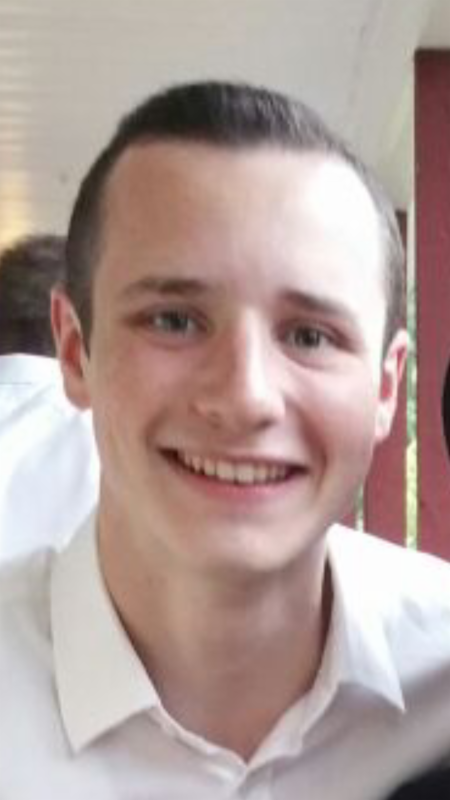
I am Yishai Pearl, a native of Brooklyn, New York and is a first year studying in Yeshiva University’s Sy Syms School of Business while studying pre-med.
Last year, I learned in Yeshivat Shaalavim last year. As a student at a Hesder Yeshiva, I was privileged to have my view of Israel broadened by my exposure to Israeli culture on a religious level, through personal interaction, and by understanding the service that Israelis contribute to the IDF.
As an RZA Aryeh fellow, I believe we have an incredible opportunity as a group to share ideas and promote positive awareness through the many facets that make Israel unique. I'm really looking forward to returning to Israel this January and look forward to working with you on the advocacy projects.
|
|
|
Welcome to Humans of Israel!
Created by RZA Aryeh-Fellows Jonathan Pedoeem, Ilan Atri, and Yishai Pearl
Our team is dedicated to increasing awareness of people that made a significant impact on Israeli society, served in the IDF, and/or made Aliyah. While we were in Israel during winter break, we sat down with our friends who made Aliya and talked with them about their journey. We listened and asked questions to understand why these people made these decisions and the difficulties they went through while executing it.
We took these interviews and are now sharing them with you to expose the true greatness of our brothers and sisters who are making this journey.
|
|
|
Zach Gottlieb has finished the army and is now applying to colleges.
|
|
What support or lack of support did you have from your family and friends?
“I thankfully had a lot of support from my family and friends. Nefesh B’nefesh was incredibly helpful as well. It was and still is difficult in the sense that many of my friends aren’t here and that is definitely a challenge."
There is a saying in the army which is “chaver l’bamba v’chaver l’amuka (there are friends to snack with and friends to carry the heavy loads with)." How do you feel this to be true in relation to your experience in Israel?
“I think it’s something that’s very real in the army that is not found as much in civilian life. When you fight side by side with someone, you develop a deep relationship with them and I think many of these relationships will last a lifetime.”
|
|
|
Save the Date - Yeshivat HaKotel Dinner
|
|
|
Yeshivat HaKotel will be hosting their 50th Anniversary dinner on
Tuesday, Yom Yerushalayim, May 23,
at the Lincoln Square Synagogue in New York City. Mr. and Mrs. Louis Drazin of Montreal will be honored for their many years of support and devotion to Yeshivat Hakotel. The program will include a Tefila Chagigit, Dvar Torah by our Dean of Students Rabbi Reuven Taragin, and music by Eitan Katz.
For those unable to join the mission to Israel, this is an incredible oppertunity to celebrate Yom Yerushalayim here in the United States.
More details to follow.
|
|
|
Yom Yerushalayim Invitation
|
|
|
Watch this video invitation from the iconic paratroopers who liberated Jerusalem in 1967. They invite you to join them for a once in a lifetime opportunity to celebrate the 50th anniversary of Yom Yerushalaym, May 22nd-May 25th. More details below.
|
|
|
Join us for Yom Yerushalyaim!
|
|
|
Please ask your Shul Rabbi and local school to include this in their weekly emails. Make sure to join us for this once in a lifetime opportunity!
|
|
|
In light of the UN Security Council vote, our support for Yerushalayim is needed now more than ever. Register now for this once in a lifetime opportunity. Join Jewish people from around the world as we gather in our holiest city to celebrate the 50th anniversary of the reunification of Jerusalem. The time is now. Show your support!
|
|
|
Dear RZA-Mizrachi Friends,
We very much look forward to having you take part in our Mizrachi World Movement's "This Year in Jerusalem" Mega-Mission over Yom Yerushalayim. Our aim is to bring thousands of people (including rabbinic and community leaders) from hundreds of communities from across the global Jewish community to learn, experience and celebrate together at this momentous time in Jewish history.
Please see below a personal invitation from Rabbi Lord Jonathan Sacks, one of the global leaders of the mission, inviting you to join him on this once-in-a-lifetime opportunity.
More details about the program can be found at the following link -
www.mizrachi.org/YY50
- including the draft schedule, highlights, pricing options and booking procedure.
Please note the following:
1. There are 10 hotel options, with a price range depending on hotel choice. Each hotel package includes breakfast, lunch and dinner (excluding Wed evening). The hotel packages also include the entire 4 day program at discounted rates.
2. There is also an option for people who are not staying in hotels - if they have their own accommodation - to join for the 4 day program, at a cost of $630 per person. It does not include hotel, breakfast and dinner, but does include transport from central meeting points to and from all the venues, lunch each day, and participation in the full program.
3. For those shuls/communities/groups who wish to bring missions and want to extend their trip either before or after our 4 day mission, that can also be arranged by contacting us at
YY50@mizrachi.org
, and we - together with our partners - will put together a tailor-made package for your group.
Looking forward to celebrating together – in Jerusalem – on this historic occasion.
With excitement and anticipation,
Rabbi Gideon Shloush Rav Doron Perez
Mizrachi – Religious Zionists of America Mizrachi World Movement
|
|
|
Please encourage your community leadership to include the paragraph below in your Shul and School Announcements:
This year marks the 50th anniversary of the reunification of Jerusalem. On May 22-25 be front and center for a mega-celebration in Israel in partnership with the Religious Zionist of merica (RZA) and World Mizrachi. Individuals and communities from around the world will participate in this once in a lifetime opportunity. Celebrating 50 years of a reunited Jerusalem on Yom Yerushalayim. See www.mizrachi.org/YY50.
|
|
|
Click below to see our video!
|
|
|
POINT OF VIEW
Charity Organizations for “Anybody who is Hungry”
By Rabbi Yisrael Rozen, Dean of the Zomet Institute
|
|
|
“Let anybody who is hungry come and eat, let anybody who is needy come and join the Pesach Sacrifice” [Pesach Haggadah].
Charity Organizations in Israel
From Wikipedia (Subject: “Charity Organizations”) we learn that “in Israel there are about 15 thousand active NGO’s. About 16% of these (2,500) are involved in welfare and health. Traditionally, in the realm of welfare there are many active religious organizations, and they concentrate on giving financial and material support, an extension of the culture of charity that was typical of Jewish society in the exile. In general, the religious organizations contribute money or food to people, while organizations that are not religious operate in the welfare regime and establish philanthropic organizations that give money to advance such goals as education and health.”
If it interests you (and if you believe Wikipedia) – and I was interested and I usually believe – here is a list of the nine largest organizations in Israel whose annual budget is more than NIS 10 million. And since it is a mitzva to publicize the names of those who perform good deeds, here are the names: Ezer Mitzion (NIS 242 million), Yad Sarah (100), Yad Eliezer (92), Kupat Ha’ir Bnei Berak (86), Latet (48), Mei’ir Panim (43), Vaad Rabanim for Charity (43), Chasdei Naomi (37), and Zichron Menachem (11). Except for Latet, which I do not consider a religious organization, all the others are initiatives run by the Chareidi sector. I want to emphasize that this label applies only to the initiators and the main staff. In all the organizations listed, there is no religious criterion for distribution of the support. This corresponds to the directive of our sages, “recipients are not checked when food is distributed” [Bava Batra 9a].
Religious Zionists in the Realm of Charity
I do not have information about the position of the religious Zionist sector as initiators in nationwide charity organizations (although I do know that we do play an active role at a local level – municipalities, settlements, in communities, on facebook, and so on). At the moment I can think only in the religious Zionist sector of “Paamonim” and similar organizations which provide financial advice at the family level, and “Mekimi.” My apologies if I have omitted any other nationwide groups. I want to emphasize that this list involves only physical support such as food and medical supplies but not other realms which are led by religious Zionists – such as support, treatment, and encouragement of soldiers injured in the IDF and their families, including victims of terrorism. Another subject that in my opinion is strongly supported by our sector is advice for married couples, in addition to guidance and support on happy occasions (such as holidays or family events), with a goal of supporting the traditions of Yisrael.
I assume that the wise men of Wikipedia are right in their suggestion that this phenomenon is “an extension of the culture of charity that was typical of Jewish society in the exile.” It seems to me that the religious Zionist sector, with its interest in statehood and the entire gamut of Yisrael, makes substantial donations from its wealth, and also volunteers personally in active charity organizations among all the sectors – including both the general population and Chareidi organizations. I am not trying to judge which system of charity is preferable from a spiritual point of view, or which one gives higher benefits to the public. I assume arguments can be made for both sides of this question. The same is true for the question of which is to be preferred - government ministries or NGO’s (I vote for the latter).
Pesach – A Holiday of Kindness
In the literature of Chassidut and Jewish philosophy in general, the three Torah festivals are linked to the Patriarchs. Pesach is paired with Avraham, the man of kindness, Yitzchak is linked to Shavuot (related to fear of G-d and justice), and “Yaacov built Succot” [Bereishit 33:17]. The RAMA writes the following in the first halacha of Pesach: “It is customary to buy wheat and distribute it to the poor before Pesach. And anybody who has lived in the city for twelve months is required to give a share.” [Shulchan Aruch, Orach Chaim 429]. (This is the custom of “Kimche D’Pischa.”) The halacha begins with “it is customary,” and ends by saying that the people are “required” to give. The Mishna Berura adds that “the amount every person is required to give depends on his wealth.” The original custom “to buy wheat and distribute it to the poor” was transformed, as is suitable for our life style, to giving monetary contributions to charity funds.
The opening passage of the Haggadah, quoted above, taking the opportunity to invite all who are hungry and needy to join the Seder table, does not seem directly applicable today. A deeper study might remind us that in the days of the Temple, when the people joined together for barbeques based on Pesach-matza-marror in the courtyards of Jerusalem, surrounded by the walls of the city, the table would only be meant for people who had been invited beforehand and not casual passersby, since “the Pesach Sacrifice can only be eaten by those who reserved in advance” [Pesachim 70a]. Well, today the charity organizations even arrange in advance for invited guests and seating at public Seder ceremonies.
This is certainly to our credit!
|
|
|
As Shabbat Approaches
“With Loaves of Leavened Bread”
By
Rabbi Mordechai Greenberg, Rosh Yeshiva, Kerem B'Yavne
|
|
|
The Todah Sacrifice has a unique element, that it includes bread which is chametz, in spite of what is written in general, “No leavening and no honey should be offered as a sacrifice to G-d” [Vayikra 2:11]. Another unique aspect of the Todah is noted by the sages: “All the sacrifices will cease to exist in the future except for the Todah Sacrifice” [Vayikra Rabba 9].
“The purpose of the Todah Sacrifice is to acknowledge the good things that take place after bad beginnings have been overturned” [Rav Kook, Ein Ayah, Berachot Chapter 1, 62]. Our sages taught us that in the future we will bless the coming of bad things just as we bless good things. But what does this mean, isn’t it true that there will be no bad in the future? The answer is that in the future our viewpoint will change, and what appeared to be evil (and for which we recited the blessing, “Dayan Ha’Emet”) will be recognized as part of a process of good. We will then retroactively recite the blessing “Hatov V’Hameitiv,” thanking G-d for the good. “In the future, G-d’s hand will show us that everything was for the good, and that all the evil was involved in setting the framework for true good.”
When life flows properly and everything goes as planned, we do not notice this principle. However, when something bad happens we fall into deep shock, and a person can begin to feel that there is no true justice in the world. But in the future, when everything will be clearly seen as leading to absolute good, the belief in Divine guidance will be strengthened. And this is the essence of the Todah Sacrifice, and therefore “the Todah will still exist, because it is only through the Todah can we recognize the fact that evil is necessary in order to arrive at perfect good. And that is why this sacrifice includes chametz, as opposed to all the other sacrifices, since chametz signifies something bad and spoiled.” And that is why the Todah will not cease to exist in the future. Just the opposite – it will remain in order to teach us this vital principle, that the reason for all the evil is to strengthen and perfect the good when its time comes.
A classic example of this principle is the exile in Egypt. While the events were taking place even Yaacov did not understand the ramifications. He therefore scolded his sons: “Why did you do bad to me, telling the man that you have another brother?” [Bereishit 43:6]. the sages teach us that this was the only erroneous statement that Yaacov ever made. “The Holy One, Blessed be He, said: I am busy arranging for his son to be a royal power in Egypt, how does he still say, ‘Why did you do bad to me?’ That is the meaning of, ‘Why should you say, Yaacov, and speak Yisrael, my path is hidden from G-d?’ [Yeshayahu 40:27].” But in the end, everybody recognized the Divine guidance. And that is what Yosef said to his brothers: “You thought evil against me, but G-d meant it for good” [Bereishit 50:20]; “You did not send me here, G-d did” [45:8].
G-d did not only send them to Egypt to rescue them from the famine, but rather for them to pass through the melting pot and to fashion them into a cherished nation. “And He took you out of the iron furnace” [Devarim 4:20]. And that is why on the night of the Seder we thank Him not only for taking us out of Egypt but even for bringing us down to there. And that is why “whoever tells more and more about the redemption from Egypt is worthy of greater praise” [Haggadah]. This is not only in order to expand the time of telling deep into the night, but also in order to broaden the limits of the event. We begin the story not only with “We were slaves in Egypt and He took us out,” but rather further back, with “At first, our fathers were idol worshippers.” This explains why we thank G-d for the exile itself, for its role in ridding us from the impurities of idol worship.
|
|
|
ZIONIST CHASSIDISM
Shabbat for “Great Minds”
By
Rabbi Rafi Ostroff, Head of the Religious Council of Gush Etzion
|
|
|
Why is this Shabbat called “Shabbat Hagadol” – the Great Shabbat? We will discuss this question, which has been answered in many ways throughout the generations, by bringing the approach of the Rebbe of Husiatyn. As usual, this will take us through a long and very special journey.
The Rebbe gives a reason for this name, quoting the words of the Maggid of Kuznitz, based on a Chassidic approach. There is a Chassidic concept of “Mochin D’Ketanot” and “Mochin D’Gedolot” – miniscule minds and great minds. This refers to ideas of miniscule thoughts or great thoughts - thoughts of fear or thoughts of courage. One can say, “I am tiny and I cannot accomplish anything,” or “I am the son of a king, and I can do anything.”
The feeling of “great minds” began to shine in the nation of Yisrael with the holiday of Pesach, and it actually started on the Shabbat before Pesach. What was special about this day? On that Shabbat the people chose the lamb which would be prepared for use as the Pesach Sacrifice. The animals which they set aside were the idols of the Egyptians, and Bnei Yisrael gathered their courage and were willing to act against their Egyptian masters, who in the end did not do them any harm because of what they did.
While in exile, the people were at the peak of “miniscule minds.” When somebody is in this state they cannot get close to the Master of the World. The beginning of the approach of Yisrael to G-d was on Shabbat Hagadol, when they took positive action to fulfill G-d’s command.
Understanding that Takes on an Approach of Royalty
And because of this we mark “Shabbat Hagadol” every year. But we not only remember the day, we use it to expand the concept of “great minds” to include us, today:
“Every year when this time arrives, it is a time of Divine favor. Yisrael can move with G-d’s help from tiny thoughts to great thoughts, for in Nissan we were redeemed and in Nissan we will be redeemed in the future. Thus, the name ‘Gadol’ refers not only to a memory from the past but also points to the present and the future.”
Our service of G-d during the holiday of Pesach is different from what we do during the holidays of Tishrei. At the time of the awakening of nature on the holiday of spring, the labor of Pesach stems from love and not from fear. The ARI writes about Pesach that the redemption from Egypt was through the trait of “binah” – understanding – which clothed itself in the trait of “malchut” – royalty. The act of setting aside the lamb for the sacrifice was an act of understanding, repentance which depends on binah. The trait of royalty is relevant because the people began to accept their independence and independent thinking, as opposed to the thought processes of a slave.
“His Banner shows His Love for Me” [Shir Hashirim 4:2]
In the name of Rebbe Shmelke of Nicholsberg, the Rebbe of Husiatyn adds the following idea: In the month of Tishrei we serve G-d out of fear, and our repentance is also based on fear. However, on Pesach, the repentance is from love. In Tishrei we go to a river and rid ourselves of sin. In Nissan, we go to draw water and let it settle through the night (“mayim shelanu”). We do not throw anything into the water, we bring it to us. This is symbolic of repentance from love, when the sins are transformed into good deeds. When we repent out of fear we throw the sins away from us. When we repent out of love, we can keep the sins and transform them into merits, and therefore we draw the water to us. We take back the sins which we threw away and make them into merits.
The extension of our service of G-d at this time is to take the “great mind” of the holiday of Pesach and continue on with it for the rest of the year. That is why we begin to count the Omer from Pesach to Shavuot, which is the time of the redemption (according to Tikunei HaZohar, Bnei Yisrael left the exile on Shavuot). That is, if we merit in our service to G-d, we will rise up to higher and higher levels from the Exodus until Shavuot, and then we will be redeemed:
“...for Yisrael will be redeemed in Nissan, and then the ‘Great Mind’ will be complete. Therefore the Haftarah that we read ends with the verse, ‘Behold, I am sending you Eliyah the Prophet... before the arrival of G-d’s great day’ [Malachi 3:23] – on this day knowledge of G-d will reach a state of perfection, and ‘the earth will be filled with knowledge as water covers the sea’ [Yeshayahu 11:9].
“Let us merit the revelation of the great light which flows out over us on this holy day; Amen!”
|
|
|
THE ROOTS OF FAITH – Basic Tenets of Jewish Philosophy
Periods of Exile
By
Rabbi Oury Cherki, Machon Meir, Rabbi of Beit Yehuda Congregation, Jerusalem
|
|
|
Exile is an integral part of the history of the nation of Yisrael. More than half of the time that the nation has existed was spent in exile. This is clearly a very important fact. This reality sometimes leads people to make a mistake and attempt to idealize the exile, or at the very least to generate a feeling of guilt when the nation leaves the exile.
The Maharal of Prague explains that exile and redemption are two sides of the same coin, based on the principle that two opposites form a single unified whole. In the same way as the creation reveals the existence of the Creator, the world itself also serves to hide Him. Based on this idea, we can conclude that true knowledge of G-d requires us to be familiar with both sides: revelation and concealment. Revelation comes when the Shechina appears and Bnei Yisrael are living on their land. Concealment takes place when G-d’s face is hidden, in exile. However, the goal of the whole process of history is to achieve a face-to-face encounter, a friendly meeting between the Creator and His creatures: “You will call me ‘My Husband’ and you will no longer call me ‘My Master’” [Hoshaya 2:18]. This means that the release from exile is needed for the Creator and does not merely fill a need of the creatures. And this makes it very clear why the Torah began its story of the history of the Hebrew nation with a description of the release from exile in Ur Kasdim.
Exile came upon the nation of Yisrael three times: in Egypt, in Babylon, and in Edom. The time span of the exiles was different – 210 years in Egypt, 70 years in Babylon, and 1880 years in Edom. In his book “Derech Emunah” (The Way of Faith), Rabbi Avraham Bibago explains that in each exile it was necessary for the nation of Yisrael to struggle against forces which competed against prophecy. In Egypt the competition was against the culture of sensory feeling of the sorcerers, and in Babylon it was against the culture of imagination of the Chaldeans. In Edom, the struggle was against philosophy, which Rabbi Bibago calls the “sense of understanding.” By this he means that even though philosophy gives the appearance of being purely intellectual, its foundation is really based on the senses. The length of each exile is proportional to the strength of the competing approach. Only with the failure of philosophy to serve as a solid basis for a spiritual life was it possible for the third exile to come to an end.
The Zohar (in the “Tikunim”) describes which Torah creation resulted from each exile: First the Torah, then the Mishna, and then Kabbalah. The mitzva of sending a mother bird away from a nest before being allowed to make use of the eggs, the chicks, and the grown offspring, corresponds to the exile of the Shechina, which in relation to Yaacov is referred to as a danger for “mother and children” [Bereishit 32:11]. The prophet makes this parallel even clearer: “For your sins, your mother was sent away” [Yeshayahu 50:1]. The eggs correspond to the masters of the Torah. When we left the exile of Egypt we were given the written Torah. The chicks represent the masters of the Mishna (and the Talmud). When we left the exile of Babylon, we had with us the Oral Torah, which was published by the “Anshei Knesset Hagedolah” and was written down in the Babylonian Talmud. When we left the exile of Europe we took with us the Kabbalistic teachings. This symbolizes the sons, the masters of the Kabbalah (“banim” means sons, and it is also related to the word “binah” – understanding).
We can conclude that there will not be another exile, heaven forbid, since the nest has been emptied of its entire contents – the eggs, the chicks, and the offspring.
|
|
|
NATURE AND THE TORAH PORTION
Merrorim: Bitter Herbs
By
Dr. Moshe Raanan, Herzog College and the Jerusalem College for Women
|
|
|
“Let them eat the meat that night roasted over a fire, with matzot, and let them eat it with bitter herbs” [Shemot 12:8].
One of the mitzvot we will perform in the Pesach Seder is eating marror – bitter herbs. In this article we will discuss very briefly the precise identity of the marror mentioned in the Torah. Is this the name of a specific plant or rather a general name for a class of vegetables with similar properties? It should be clear that even if the marror mentioned in the Torah is a specific vegetable, other species of vegetables with similar properties might also be suitable for use in the Seder, since all the commentators agree that more than one species can be used to perform the mitzva. This is clear from the Mishna which will be quoted below.
In addition to a bitter taste the Talmud lists several other properties that are common to different species of marror. They are “seed plants,” that is, they are not “trees,” they contain “resin” (a bitter milky liquid), and the top of the leaves is “silvery.” Rashi is one of the commentators who feel that the word marror is a general category, as he clearly states [Shemot 12:8]: “‘On bitter herbs’ – Every bitter grass is called marror. And He commanded them to eat marror in memory of the fact that the Egyptians made their lives bitter (Shemot 1:14).” The translation attributed to Yonatan also implies that the name marror includes more than one specific plant: “They should eat with the meat roasted by a flame on this night of the fifteenth of Nissan before midnight, and they should eat it with ‘tamcha’ and ‘olashin.’” (For the identity of these last two, see the relevant page of the Daf Yomi: https://daf-yomi.com/DYItemDetails.aspx?itemId=23077.)
Avraham Ibn Ezra is also one of the commentators who feel that marror is a general category. He has an unusual explanation for eating marror on Pesach:
“Eat it with bitter herbs – One of the wise men of Sephard explained: It is well-known that Egypt is a land with high humidity which stems from the waters of the Nile. Since there is little rain, the air is always moist. Therefore the people had a custom to eat many kinds of bitter herbs, such as grasses and mustard. And even if the Egyptian had nothing else but bread, there would always also be bitter herbs on the table in which to dip the bread, as a remedy against the humid air. However, we will base our actions on the words of the ancients, who taught us that the marror is in memory of the verse, ‘And they made their lives bitter’ [Shemot 1:14].”
Those who feel that marror is a specific species base their opinion on the Mishna which gives a list that includes a number of species, with marror as the last one: “These are the vegetables with which a person can fulfill his obligation on Pesach: Chazeret, tamcha, charchavena, oleshin, and marror. And they may be used either moist or dry.” [Pesachim 2:6]. Those who disagree feel that the word “marror” appears as a general summary of the list, and that it does not designate another specific species.
Many plants have been proposed as the identity of marror by to those who feel it refers to a single species. We will give two examples below.
Marror – Sow Thistle
One of the commonly accepted identities for marror is the sow thistle. There is a tradition of eating this vegetable during the Seder to observe the mitzva of marror. Because of its bitter taste its name in Arabic is “merer.” The description “silvery appearance” is very suitable for this plant, which often grows in human surroundings. The color of the leaves is bluish-green or silver-gray, depending on the angle of the rays of the sun. The stem of the plant is hollow, and when it is damaged it exudes a milky liquid. This identification is also based on an ancient tradition among some Yemenite communities (see Z. Amar, “Merrorim”).
Marror – Prickly Lettuce
Bar Behalul (a Catholic bishop and Syrian linguist who lived in the tenth century) identified the plant known in Syrian Arabic as “merara” as “wild lettuce.” It seems that he is referring to prickly lettuce, which evidently was the source for the domestication of garden lettuce. The two species have the same number of chromosomes, and they can be crossbred with each other. The Aruch explains (in item “mar”) as follows: “Marror – marrirta: this is wild horseradish, which is bitter...” In his insights on Pesachim, the Ritva quotes the Rit, who writes that “the Gemorra implies that marror is a specific plant – a species of horseradish that grows in the desert.” In the commentary on the Mishna the Rambam writes, “Marror – A very bitter type of desert horseradish.” (Pesachim 2:6].
Food that is Bitter as an Olive
To end this discussion, I will relate a story by Rabbi Daniel Berlin which appeared in the newspaper Makor Rishon about an experience of Chaim Ivgi from Eilat. His mother told him not to bring olives into the house on Pesach because of a custom (evidently erroneous) which was accepted in her parents’ home in Morocco (on the border between the cities of Rabat and Salei). Chaim tried to understand the source of this custom, and eventually he received a clarification from the late Rabbi Modechai Eliyahu, who linked it to the Talmud, quoting Rabbi Yochanan: “Just as olives can make a person forget seventy years of learning, so olive oil retrieves seventy years of learning” [Horayot 13b]. Since it is written, “So that you will remember the day that you left Egypt” [Devarim 16:3], one should not eat olives, which can make a person forget his studies.
Rabbi Berlin added another possibility based on the Tosafot (Pesachim 36a), which suggested that olives can also be considered marror. This is based on the Midrash on the verse, “Behold it held an olive branch in its mouth” [Bereishit 8:11]. “The dove said to the Holy One, Blessed be He – Master of the Universe, let my food be as bitter as the olive as long as it comes from Your hands.” And thus, to avoid confusion between marror and olives, the custom was not to allow olives into the house on Pesach.
|
|
|
STRAIGHT TALK
Quick Handbook for a Fantastic Seder
By
Rabbi Yoni Lavie, Manager, "Chaverim Makshivim" Website
|
|
|
It would not be too great an exaggeration to say that this is probably the most important night in the whole year. This is not simply another holiday or a wide-ranging social evening but rather the Seder Night, something greater and more important by an order of magnitude. This time the center of all the activity is not the synagogue but our own home and the family table. The central theme of this night is handing over the torch of our traditions to the next generation, and this gives us an unparalleled opportunity for a foundational experience in terms of spirituality, education, and family, which can leave its mark on the entire year.
On the other hand, if we do not prepare properly for this night, we can very easily miss the mark and fail to take advantage of the great gift that has been offered to us. Four main obstacles stand in our way: (1) Different ages of the people around the table, each with their own spiritual level and ranges of interest. (2) The text of the Haggadah is sometimes boring and hard to understand. (3) Hunger. The army marches on its stomach, and a family that has not eaten for several hours might well begin to dream about the soup and the kneidels instead of concentrating on the main themes of the night. (4) Weariness. Weeks of cleaning and scraping leave their mark, and many participants are more interested in an encounter with their pillows than in meeting the Prophet Eliyahu.
Anybody who makes an Effort on Pesach Eve...
Proper preparation is an important key to success. It is important to plan things ahead of time so that all the preparations for the holiday will be ready two days in advance and not a quarter of an hour after candle lighting time, as so often happens... Whatever time is available should be used for resting, a short hike (did you have a chance yet to recite the “blessing for flowering trees?”), and spiritual preparation for the holiday. At the end of the meeting for the traditional division of labor – who cleans which room, and so on – spend a quarter of an hour to assign a different kind of task. Every person must prepare something of his own for the Seder. It can be a performance, a riddle, a story, a game, a nice insight into the Haggadah. The guiding principle must be: This night belongs to everybody! Not as spectators standing on the sidelines but as active participants. It is not a good idea for the people to have their first encounter with the Haggadah at the Seder table, after not having seen it for a full year. Do you have guests coming? Great! Tell them in advance what to expect, and invite them as full participants in the events and not as spectators standing on the sidelines.
I suggest that you pamper yourselves and the children with new Haggadahs for the holiday, from the huge choice of new publications during the year. While the cleanup is going on and afterwards, assign study partners. Let a young child get ready for the holiday by studying with an older sibling. And don’t forget to clean out the closet full of costumes before Pesach. They will come in very handy this night.
Atmosphere and Anticipation
It is important to create a positive preparatory atmosphere in the house. This consists of the right songs on Shabbat before the holiday, bedtime stories for the younger children, background music while the cleaning is going on, and setting up a “countdown” before the holiday arrives. Children are very sensitive and will feel whether the house is filled with pressure, anger, and weariness, or if there is a feeling of excitement, anticipation, and happiness. Make sure that you have an optimal seating arrangement, where everybody sees all the others and they all feel interconnected. Take out an extra table so that everybody will feel like royalty and not like sardines. It is best for the one in charge of the Seder to sit in the middle, so that he is readily available to everybody, and not at the head of a long table, far away from the other end. He should start the night with a sack of small gifts/nuts/chocolates in order to be able to distribute them as prizes for outstanding insights or good questions. Setting the table very carefully, including decorations and signs all around, can add a lot to the atmosphere. It is important to let the children participate in all the preparations, making sure that every single one has his own place and can contribute to the family enterprise.
No Napping or Slumber
The goal is to remain wide awake for the entire proceedings. How do we do this? On the day of the Seder, in the afternoon, everybody in the family goes to sleep! Regular and cellular phones must be turned off, and all efforts should be pointed towards gathering strength and energy for the important night ahead. Whoever can manage to finish all the cooking the day before is in the best position. (Here is a small tip for the industrious housewives: It is a pity to spend time and energy in frantic cooking of five different main courses which will decorate the Seder table. By the time we reach the meal the participants are so full of matza, wine, karpas, and lettuce that not much room is left for other items.) It is also not good to arrive at the Seder in a state of starvation. In the afternoon you should eat some fruit, vegetables, chicken, and so on. We want to be hungry when we eat the matza, but we must not let our stomach pangs take over the timing of the festivities. Let everybody know that it will take some time until we finally get to the main meal, nobody should feel under pressure. The main purpose of this night is not a “sumptuous meal.”
The Great Moment Arrives
Try to start the Seder as quickly as possible. Take into account that the Maariv prayers are longer than usual, and that we are already on Daylight Time. Don’t get caught talking in the synagogue, and don’t waste time at home. Some families prefer to choose a major theme for the gathering. Examples might be: This night as the birthday of the Jewish nation; personal faith and Divine guidance; giving thanks and showing appreciation for the good; miracles. Others prefer to leave the matter open. The night should be a combination of different (and short!) formats: relevant ideas, stories, riddles, skits, songs (as many as possible). It is important that every individual child should be able to find his or her place – to hear and to be heard. The main theme of the entire night is known: Every person must see himself or herself as if he left Egypt. Anything that helps to promote this objective and to bring it closer to our hearts is acceptable.
|
|
|
The Religious Zionists of America is the US affiliate of the 115 year old World Mizrachi movement. The goal of the RZA is to instill in the American Jewish community a commitment to religious Zionism, the preservation of Jewish political freedom, the enhancement of Jewish religious life in the land of Israel, and the promotion of aliyah. For more information, visit https://rza.org.
|
|
|
A direct and compelling headline
|
|
|
|
|
|
|