|
|
Parshat Terumah No 1663: 6 Adar 5777 (March 4, 2017)
|
|
|
WANT TO BECOME A MEMBER Membership: $50.00
CLICK HERE TO JOIN OR DONATE TO THE RZA Pillar Membership:$180.00
We are in the process of collecting membership dues for 2017.
Please show your support and join as a member or renew your membership at this time.
Religious Zionists of America
305 Seventh Avenue, 12th Floor, New York, NY 10001
office@rza.org, www.rza.org
|
|
|
Rabbi Gideon Shloush, Executive Vice President, of the Religious Zionists of America (RZA-Mizrachi), spoke at two different functions in Boca Raton, FL on February 26, 2017. At Congregation Torah Ohr, with close to 200 people attending, he spoke about "The Significance of Religious Zionism in the 21st Century." The second event was held at the Boca Raton Synagogue where he spoke about “The Future of Religious Zionism in America.”
Rabbi Shloush discussed many of the new initiatives of the RZA. He highlighted the fact that the RZA’s new Yom Yerushalayim Honor Roll is bringing together
dati tziyoni communities from around the country with the shared goal of planning meaningful events to celebrate the fiftieth anniversary of the reunification of Jerusalem. More than 150 shuls and schools have signed the RZA Honor Roll.
In his talks, Rabbi Shloush encouraged listeners to travel to Israel for to participate in this historic milestone event. He also challenged the audiences, asking them to consider what they will be doing to commemorate the 50th anniversary of the reunification of Yerushalayim. He said “if you aren’t going to Israel then you ought to be thinking about what you can do to help celebrate this rare milestone in your city and community.”
If you would like to coordinate an RZA event in your community or if you would like your community to receive RZA-Mizrachi emails and mailings please send an email to
office@rza.org.
|
|
|
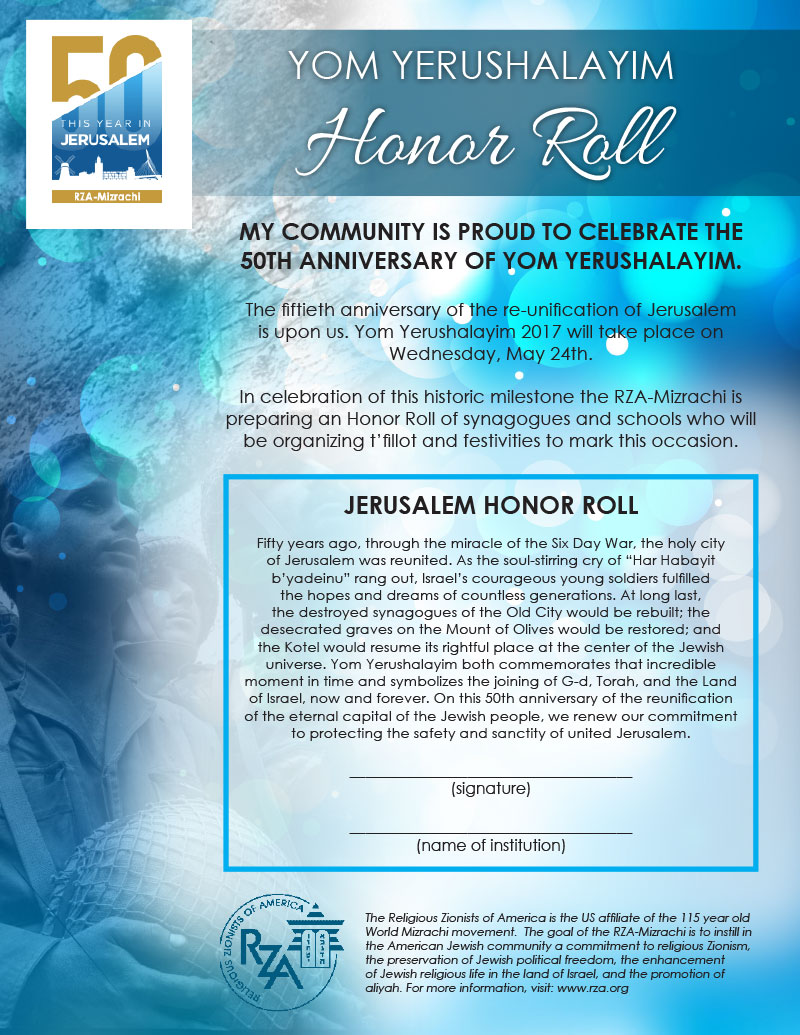
Yom Yerushalayim Honor Roll
|
|
|
Dear Friend of Religious Zionism,
One of the initiatives we are planning, in anticipation of the 50th anniversary of the re-unification of Jerusalem, is an “Honor Roll” to be signed by the leadership of congregations and schools across the country.
1) Please have your leadership inform us if they want to be included on our Honor Roll. (We will include the names of all participating institutions in the media).
2) Please share this Honor Roll with institutions in your community and encourage participation.
3) Please arrange to display this Honor Roll in the lobbies of your Shuls and Schools. Click here to print out a copy of the poster OR kindly email us to let us know if you’d like us to mail you a hard copy flyer or poster.
More than 150 Shuls and Schools have signed up. If your community is not yet on our list please let us know.
Rabbi Gideon Shloush Presidium
National Director
Mr. Martin Oliner
Religious Zionists of America - Mizrachi Rabbi Leonard Matanky
gshloush@rza.org Dr. Ernest Agatstein
|
|
|
Please encourage your community leadership to include the paragraph below in your Shul and School Announcements:
This year marks the 50th anniversary of the reunification of Jerusalem. On May 22-25 be front and center for a mega-celebration in Israel in partnership with the Religious Zionist of merica (RZA) and World Mizrachi. Individuals and communities from around the world will participate in this once in a lifetime opportunity. Celebrating 50 years of a reunited Jerusalem on Yom Yerushalayim. See www.mizrachi.org/YY50.
Below is a list of shuls, schools, and organziations that are participating in our Honor Roll:
|
|
|
Beth Jacob Congregation
Beverley Hills, CA
Rabbi Kalman Topp
Young Israel of Orange County
Irvine, CA
Rabbi Dov Fischer
Congregation B’nai David-Judea
Los Angeles, CA
Rabbi Yosef Kanefsky
Harkham Hillel Hebrew Academy
Los Angeles, CA
Rabbi Yahel Tsaidi
Yeshivat Yavneh
Los Angeles,
Rabbi Shlomo Einhorn
Young Israel of Century City
Los Angeles, CA
Rabbi Elazar Muskin
YULA Boys High School
Los Angeles, CA
Rabbi Dov Emerson
Shaarey Zedek Congregation
Valley Village, CA
Rabbi Jonathan Rosenberg
Westville Synagogue
New Haven, CT
Rabbi Fred Hyman
Beth David Synagogue
West Hartford, CT
Rabbi Yitzchok Adler
Young Israel of West Hartford
West Hartford, CT
Rabbi Tuvia Brander
Boca Jewish Center
Boca Raton, FL
Rabbi Yaakov Gibber
Boca Raton Synagogue
Boca Raton, FL
Rabbi Efrem Goldberg
Congregation Torah Ohr
Boca Raton, FL
Rabbi Benjamin Yasgur
Katz Yeshiva High School
Boca Raton, FL
Rabbi Jonathan Kroll
Anshei Chesed Congregation
Boynton Beach, FL
Rabbi Avi Billet
Anshei Emuna Congregation
Delray Beach, FL
Rabbi Jack Engel
Young Israel of Hollywood
Hollywood, FL
Rabbi Yosef Weinstock
Hebrew Academy (RASG)
Miami Beach, FL
Rabbi Zvi Kahn
Young Israel of Toco Hills
Atlanta, GA
Rabbi Adam Starr
Congregation Anshe Motele
Chicago, IL
Rabbi Alan Abramson
Cong. Kehillah Jacob Beth Samuel
Chicago, IL
Rabbi Aaron Leibtag
Congregation KINS
Chicago, IL
Rabbi Leonard Matanky
Congregation Or Menorah
Chicago, IL
Rabbi Doug Zelden
Congregation Or Torah
Chicago, IL
Rabbi Zvi Engel
Ida Crown Academy
Chicago, IL
Rabbi Leonard Matanky
Young Israel of West Rogers Park
Chicago, IL
Rabbi Elisha Prero
Congregation Yehuda Moshe
Lincolnwood, IL
Rabbi Joel Gutstein
Hebrew Theological College
Skokie, IL
Rabbi A. Friedman, Rabbi S. Schuman
Hillel Torah North Suburban Day School
Skokie, IL
Rabbi Menachem Linzer
Kehilat Chovevei Tzion
Skokie, IL
Rabbi Shaanan Gelman
Young Israel of Skokie
Skokie, IL
Rabbi Gershon Schaffel
Congregation BIAV
Overland Park, KS
Rabbi Daniel Rockoff
Congregation Kadimah-Toras
Moshe
Brighton, MA
Rabbi Jason Strauss
Congregation Beth El-Atereth Israel
Newton, MA
Rabbi Gershon Segal
Congregation Shaarei Tefillah
Newton, MA
Rabbi Benjamin J. Samuels
Young Israel of Sharon
Sharon, MA
Rabbi Noah Cheses
Beth Tfiloh Congregation
Baltimore, MD
Rabbi Mitchell Wohlberg
Beth Tfiloh Dahan Community School Baltimore, MD
Rabbi Mitchell Wohlberg
Rockville Jewish Outreach Center
Rockville, MD
Rabbi Yaacov Benamou
Kemp Mill Synagogue
Silver Spring, MD
Rabbi Brahm Weinberg
Young Israel of Oak Park
Oak Park, MI
Rabbi Michael Cohen
Young Israel of Southfield
Southfield, MI
Rabbi Yechiel Morris
Nusach Hari B'nai Zion Congregation
St. Louis, MO
Rabbi Ze'ev Smason
Young Israel of St. Louis
St. Louis, MO
Rabbi Moshe Shulman
Congregation Sons of Israel
Cherry Hill, NJ
Rabbi Ephraim Epstein
Yeshiva at the Jersey Shore
Deal, NJ
Rabbi Elie Tuchman
Ohr Torah
Congregation
Edison, NJ
Rabbi Yaakov Luban
Rabbi Pesach Raymon Yeshiva
Edison, NJ
Rabbi Daniel Loew
Congregation Ahavath Torah
Englewood, NJ
Rabbi Shmuel Goldin
East Hill Synagogue
Englewood, NJ
Rabbi Zev Reichman
Congregation Darchei Noam
Fair Lawn, NJ
Rabbi Jeremy Donath
Shomrei Torah
Fair Lawn, NJ
Rabbi Benjamin Yudin
Congregation Ahavas Achim
Highland Park, NJ
Rabbi Steven Miodownik
Congregation Anshe Chesed
Linden, NJ
Rabbi Joshua Hess
Congregation Etz Chaim
Livingston, NJ
Rabbi E. Samuel Klibanoff
Suburban Torah
Livingston, NJ
Rabbi Elie Mischel
Congregation Brothers of Israel
Long Branch, NJ
Rabbi Nasanayl Braun
Hillel Yeshiva
Ocean, NJ
Dr. Ruth Katz
Ben Porat Yosef
Paramus, NJ
Dr. Steven Lorch
National Council of Young Israel
Paramus, NJ
Rabbi Marc Volk
Congregation Adas Israel
Passaic, NJ
Rabbi Dr. Solomon F. Rybak
Young Israel of Passaic Clifton
Passaic, NJ
Rabbi Yaakov Glasser
Congregation Israel
Springfield, NJ
Rabbi Chaim Marcus
Congregation Bnai Yeshurun
Teaneck, NJ
Rabbi Steven Pruzansky
Congregation Keter Torah
Teaneck, NJ
Rabbi Shalom Baum
Congregation Rinat Israel
Teaneck, NJ
Rabbi Yosef Adler
Congregation Shaarei Orah
Teaneck, NJ
Rabbi Haim Jachter
Ma'aynot Yeshiva High School for Girls
Teaneck, NJ
Mrs. Rivka Kahan
Torah Academy of Bergen County
Teaneck, NJ
Rabbi Asher Yablok
Young Israel of Teaneck
Teaneck, NJ
Rabbi Binyamin Krohn
Congregation AABJ&D
West Orange, NJ
Rabbi Eliezer Zwickler
The Jewish Center of Atlantic Beach
Atlantic Beach, NY
Rabbi Ari Perl
Avenue N Jewish Center
Brooklyn, NY
Rabbi Doniel Eisenbach
Congregation Ahavath Achim
Brooklyn, NY
Rabbi Ari Kagan
Congregation Beth Torah
Brooklyn, NY
Rabbi Ari Azancot
Congregation Bnei Yitzhak
Brooklyn, NY
Rabbi Joseph Beyda
|
|
|
Congregation Pri Eitz Chaim
Brooklyn, NY
Rabbi Melvin I Burg
Congregation Talmud Torah
of
Flatbush
Brooklyn, NY
Magen David Yeshiva High School
Brooklyn, NY
Rabbi Saul Zucker
Merkaz Yisrael of Marine Park
Brooklyn, NY
Rabbi Elisha Weiss
Yeshiva of Flatbush
Brooklyn, NY
Rabbi Raymond Harari
Young Israel of Flatbush
Brooklyn, NY
Rabbi Kenneth Auman
Shulamith High School for Girls
Cedarhurst, NY
Ms. Rena Zerykier
Young Israel of Lawrence-Cedarhurst
Cedarhurst, NY
Rabbi Moshe Teitelbaum
The White Shul
Far Rockaway, NY
Rabbi Eytan Feiner
Havurat Yisrael
Forest Hills, NY
Rabbi David Algaze
Young Israel of Forest Hills
Forest Hills, NY
Rabbi Michael Weingarten
Utopia Jewish Center
Fresh Meadows, NY
Rabbi Yonoson Hirtz
Great Neck Synagogue
Great Neck, NY
Rabbi Dale Polakoff
Young Israel of Hewlett
Hewlett, NY
Rabbi Heshy Blumstein
Stella K. Abraham High School for Girls
Hewlett Bay Park, NY
Rabbi Yisroel Kaminetsky
Young Israel of Jamaica Estates
Jamaica Estates, NY
Rabbi Shlomo Hochberg
Young Israel of Kew Gardens Hills
Kew Gardens Hills
Rabbi Yoel Schonfeld
Rambam Mesivta
Lawrence, NY
Rabbi Zev Friedman
Congregation
Beth Sholom
Lawerence, NY
Rabbi Kenneth Hain
HAFTR
Lawrence, NY
Rabbi Gedaliah Oppen
Young Israel of Long Beach
Long Beach, NY
Rabbi Chaim Wakslak
Congregation Ohav Sholom
Merrick, NY
Rabbi Ira Ebbin
Young Israel of Merrick
Merrick, NY
Rabbi Marc Volk
Community Synagogue of Monsey
Monsey, NY
Rabbi Moshe Tendler
Young Israel of New Hyde Park
New Hyde Park, NY
Rabbi Lawrence Teitelman
Bialystoker Synagogue
New York, NY
Rabbi Zvi Romm
Congregation Adereth El
New York, NY
Rabbi Gideon Shloush
Congregation Ohab Zedek
New York, NY
Rabbi Allen Schwartz
Congregation Kehilath Jeshurun
New York, NY
Rabbi Chaim Steinmetz
Congregation Ramath Orah
New York, NY
Rabbi Moshe Grussgott
Manhattan Day School
New York, NY
Rabbi Mordechai Besser
Manhattan Jewish Experience
New York, NY
Rabbi Mark Wildes
The Jewish Center
New York, NY
Rabbi Yosie Levine
Yeshiva University
New York, NY
President Richard M. Joel
Yeshiva University High School for Boys
New York, NY
Rabbi Joshua Kahn
Young Israel of New Rochelle
New Rochelle, NY
Rabbi Reuven Fink
Midreshet Shalhevet High School
North Woodmere, NY
Esther Eisenman
Young Israel of Oceanside
Oceanside, NY
Rabbi Jonathan Muskat
Young Israel of Plainview
Plainview, NY
Rabbi Elie Weissman
Young Israel of Hillcrest
Queens, NY
Rabbi Richard Weiss
Congregation Beth Shalom
Rochester, NY
Rabbi Avi Kilimnick
Magen David Sephardic Congregation
Scarsdale, NY
Rabbi Mitchell Serels
Young Israel of Scarsdale
Scarsdale, NY
Rabbi Jonathan Morgenstern
Shaarai Torah Orthodox Congregation
Syracuse, NY
Rabbi Evan Shore
Congregation Eitz Chayim
West Hempstead, NY
Rabbi Dov Greer
Young Israel of West Hempstead
West Hempstead, NY
Rabbi Yehuda Kelemer
The Hampton Synagogue
Westhampton Beach, NY
Rabbi Avraham Bronstein
DRS Yeshiva High School for Boys
Woodmere, NY
Rabbi Yisroel Kaminetsky
Hebrew Academy of Long Beach
Woodmere, NY
Rabbi Yisroel Kaminetsky
Young Israel of Woodmere
Woodmere, NY
Rabbi Hershel Billet
Young Israel of Las Vegas
Las Vegas, NV
Rabbi Yitzchak Wyne
Congregation Torat Emet
Columbus, OH
Rabbi Howard Zack
Green Road Synagogue
Cleveland, OH
Rabbi Binyamin Blau
Congregation Ahavath Achim
Portland, OR
Rabbi Michael Kaplan
Kesher Isarel Congregation
Harrisburg, PA
Rabbi Elisha Friedman
Congregation Mikveh Israel
Philadelphia, PA
Rabbi Albert Gabbai
Congregation Beth Hamedrosh
Wynnewood, PA
Rabbi Yonah Gross
Touro Synagogue
Newport, RI
Rabbi Marc Mandel
Anshe Sphard Congregation
Memphis, TN
Rabbi Joel Finkelstein
Baron Hirsch Congregation
Memphis, TN
Rabbi Binyamin Lehrfield
Margolin Hebrew Academy
Memphis, TN
Rabbi Benjy Owen
Congregation Sherith Israel
Nashville, TN
Rabbi Saul Strosberg
Congregation Shaare Tefilla
Dallas, TX
Rabbi Ariel Rackovsky
United Orthodox Synagogues
Houston, TX
Rabbi Barry Gelman
Anshe Sfard Kehillat Torah
Milwaukee, WI
Rabbi Wes Kalmar
Beth Israel Beth Aaron Congregation
Cote St. Luc, Canada
Rabbi Reuben J. Poupko
Beth Israel Synagogue
Edmonton, Canada
Rabbi Daniel Friedman
Cong. Beth Tikvah Ahavat Shalom
Montreal, Canada
Rabbi Mark Fishman
Cong. Tifereth Beth David Jerusalem
Montreal, Canada
Rabbi Yechezkel Freundlich
Congregation Machzikei Hadas
Ottawa, Canada
Rabbi Idan Scher
Zichron Yisroel
Thornhill, Canada
Rabbi Charles Grysman
Beth Avraham Yoseph Congregation
Toronto, Canada
Rabbi Daniel Korobkin
Bnei Akiva Schools
Toronto, Canada
Rabbi Dr. Seth Grauer
Netivot HaTorah Day School
Toronto, Canada
Rabbi J. Rothman
Shaarei Shomayim Congregation
Toronto, Canada
Rabbi Chaim Strauchler
Kollel Agudath Achim
Jerusalem, Israel
Rabbi Aharon Ziegler
|
|
|
RZA Aryeh Fellows presents:
Inter-Collegiate Game Night + Chidon HaTanakh
|
|
|
We are pleased to announce a new initiative: Each week, we will (translate and) feature a d’var Torah from a different Rosh Yeshiva of a Dati L’umi Yeshivat Hesder in Israel. Our goal is – until we get there ourselves – to bring Torat Yisrael closer to America.
|
|
|
Har Sinai and Har HaMoriah
By R. Yehoshua Weitzman
Rosh Yeshiva of Yeshivat HaHesder Ma’alot
Translated by RZA-Aryeh Fellow Yaakov Ellenbogen
|
|
|
After the description of the Revelation at Sinai Sinai in Parshat Yitro and Parshat Mishpatim the matter of the establishment of the Mishkan appears, beginning in Parshat Terumah and ending with the completion of the book of Shemot. Is there a connection between these two topics, the Sinaitic revelation and the establishment of the Mishkan?
The Ramban, in the introduction to his interpretation of the establishment of the Mishkan, writes:
Now that God has told Israel face to face the Ten Commandments, and had further commanded them through Moses some of the precepts which are like general principles to the [individual] commandments of the Torah— in the same way that our Rabbis were accustomed to dealing with strangers who come to be converted to the Jewish faith— and now that the Israelites accepted upon themselves to do all that He would command them through Moses and He made a covenant with them concerning all of this, from now on they are His people and He is their God…He first commanded concerning the Mishkan, so that He would have a house dedicated to His name, from where He would speak to Moses and command the children of Israel…
The secret of the Mishkan is that the Glory which abode upon Mount Sinai [openly] should abide upon it in a concealed manner. For just as it is said there, “And the glory of the Eternal abode upon Mount Sinai” (Ex. 24:16), and it is further written, “Behold, the Eternal our God has shown us His glory and His greatness” (Deut. 5: 21), so it is written if the Mishkan “and the glory of God filled the Mishkan” (Ex. 40: 34).
The Glory of God, which appeared to the nation of Israel at Sinai, rested on the Mishkan and through this made the Revelation eternal.
It may be assumed that the Ramban’s source was the Midrash:
But Sinai, which had no idolatry done on it, is “The mountain which God has desired as His dwelling” (Ps. 68: 17), therefore, “And God descended upon Mount Sinai” (Ex. 29:20). Nevertheless, “God will dwell there forever” (Ps. 68:17), [therein means] the Eternal House [i.e. the Temple].
The verse which the sages interpret is: “The mountain God desired as His dwelling- God shall dwell there forever.” The beginning of the verse is interpreted to refer to Ma’amad Har Sinai, and the end as a reference to the Temple. The explanation of the verse is that God desired to descend on Mount Sinai [for a limited time] to give the Torah to Israel, but He would continue to dwell in the Temple eternally.
The Rambam sees the matter of the Mishkan in another light. According to the Rambam, there is no continuation of Ma’amad Har Sinai. As he writes in the Moreh Nevuchim:
...All this merely taught them this: this great gathering that you saw - I mean to say, the Gathering at Mount Sinai -
will not be a thing subsisting permanently with you, and in the future there will not be anything like it; and there will not permanently be fire and a cloud, such as those that are now always on the tabernacle.
In the Rambam’s opinion, the holiness of the Temple flows from the location of the Temple itself, as it is “the place which God will choose.”
We first encounter the Temple in the account of the Binding of Isaac, as the Rambam writes in the Mishneh Torah:
Isaac was prepared as a sacrifice in the Temple site, as it is said: "Go to the land of Moriah" (Gen. 22:2) and in Chronicles (II 3:1), it is said: "Then, Solomon began to build the House of the Lord in Jerusalem, on Mt. Moriah, where [the Lord] appeared to David...
And he also wrote this in the Moreh Nevuchim:
Therefore Abraham our Father singled out Mount Moriah, because of its being the highest mountain there…In my opinion there is also no doubt that the place singled out by Abraham in virtue of prophetic inspiration was known to Moses our Master and to many others. For Abraham had recommended to them that that place should be a house of worship…
Abraham was the one who sanctified this place after the Binding of Isaac, and afterward this place was referred to as a Temple, for it was there that God chose to establish the Temple.
If this is true, the Ramban and the Rambam argue what the source of the holiness of the Temple is. The Rambam sees God’s choice of that spot [i.e. Har HaMoriah] as the place upon which the Temple would be established as the source of the Temple’s holiness, while the Ramban understands that its holiness comes by virtue of the continued appearance of the Shechinah which began at Ma’amad Har Sinai.
As we saw, the Rambam thought that the Revelation at Sinai was not an eternal event and it had no continuation. Even the quality of the Torah which was given at Sinai was unique. So he writes in the Moreh Nevuchim:
Nothing similar to the call addressed to us by Moses our Master has been made before him by anyone of those we know who lived in the time between Adam and him; nor was a call similar to that one made by one of our prophets after him. Correspondingly it is a fundamental principle of our Law that there will never be another Law.
The prophecy of Moshe is the only one whose validity was the validity of the Torah. Because of this, in his
Sefer Hamitzvot, the Rambam does not list Rabbinic mitzvot, and does not even include mitzvot which were learned by the sages through the 13 principlesthrough which the Torah is explained. Only things which were explicitly stated at Sinai have the status of a Torah level Mitzvah.
The Ramban sees a feature in the Revelation at Sinai which continues throughout all generations in the Beit HaMikdash. Even the edicts of the Sanhedrin which ruled from the Beit HaMikdash continue the conferment of the Torah to the nation of Israel, as he writes with regards to the obligation to listen to the great court:
It is known that not all opinions concur on newly arising matters. Disagreements would thus increase and the one Torah would become many Torahs. Scripture, therefore, defined the law that we are to obey the Great Court
that stands before God in the place that He chose in whatever they tell us with respect to the interpretation of the Torah.... For it was subject to their judgement that He gave them the Torah even if it [the judgement] appears to you to exchange right for left. And surely you are obligated to think that they say “right” what is truly right, because
God’s spirit is upon the ministers of his Sanctuary, and He does not forsake His saints; they are preserved forever from error and stumbling.
“The place which God will choose” is the source of the emergence of Torah which promulgates and interprets what was given at Sinai.
These two conceptions of the source of the holiness of the Temple, whether the holiness stems from the Temple’s status as a continuation of the Revelation at Sinai, or whether the holiness is by virtue of its being in the place which God will choose, arise from how they relate to the Sinaitic experience, and from the authority of the words of the sages who came after Sinai.
|
|
Rabbi Yehoshua Weitzman is the founding Rosh Yeshiva of Yeshivat HaHesder Ma’alot. An alumnus of Yeshivat Kerem B’Yavneh, Rabbi Weitzman also studied under Rabbi Naftali Tavi Yehudah Kook. Rabbi Weitzman is the author of the book Zahav Ha’aretz, in which he lays out his method of study, termed Torat Eretz Yisrael. This method, which follows in the footsteps of Rav Kook, is meant to create a connection between Halachah and Aggadah, explaining how specific halachot are derived from larger central themes.
|
|
|
We are pleased to feature a different Religious Zionist rabbi each week from around the country to share a Dvar Torah.
|
|
|
The First Step
Rabbi Allen Schwartz
Rabbi of Ohab Zedek
New York, NY
|
|
Rabbi Yehuda Ha Nassi’s son Shimon was preparing for the standard 12 year yeshiva program away from home and as he was leaving he was told that a bride had already been chosen for him. He broke protocol by asking to meet his future wife before his departure. His father allowed it and the young couple had a short meeting. Shimon was so enamored with the young girl that he asked to interrupt his 12 years of learning by marrying after 6 years. Rebbe allowed it and after a second thought, Shimon begged his father if he could marry the girl immediately and then, while married, learn the requisite 12 years. Rebbe’s response was to compare his son’s behavior to God and that the behavior is manifest in the Torah portion of Terumah.
Moshe, in the Shirat Hayam predicted that God would firmly implant his people in the Mountain of His dwelling and that then His sanctuary would be established. Yet, God couldn’t wait that long. The time of the unification of God and His people, so that He would dwell in their midst, was taking too long. God broke protocol, as it were, by commanding us to build His sanctuary before crossing over into Israel.
There is a dispute at the end of Masechet Sanhedrin over whether God or Israel must make the first step to our salvation. The Gemara seems to conclude with Rabbi Yehoshua that God will make the first move, yet Rambam in Hilchot Teshuva decides that אין ישראל נגאלין אלא בתשובה. Our redemption will only come on the heels of our repentance.
God had already promised us that we would repent in order to deserve such salvation at Devarim 30:8 " '
וְאַתָּה תָשׁוּב וְשָׁמַעְתָּ בְּקוֹל ה."
Rav Yissachar Teichtel in his groundbreaking book, אם הבנים שמחה posits that the oaths placed upon us regarding the redemption have not been violated by any mean. The oath to refrain from establishing a political movement in Israel without God’s input is not an issue, he argues. The events of the last 100 years are clarion calls to act in the framework of Rebbe’s son Shimon. And the oath not to rebel against the will of the nations in our return to Israel, has also been undone by such acts as the 1917 Balfour Declaration, and the league of Nations Recognition of 1922 to say nothing of the UN Partition Plan of 1947.
The Talmud says that we lost an opportunity for the Messaianic arrival in the Days of King Hezikiah because he did not adequately show his appreciation for the salvation of Jerusalem and Israel. Let us not make the same mistake. Let us take advantage of the incredible good will that millions of Americans have toward Israel. Let us join the RZA in presenting Israel’s best foot forward by continuing to seek its peace and prosperity. It all starts, like Shimon, son of Rebbe with our initiative and one foot at a time.
|
|
|
Welcome to Humans of Israel!
Created by RZA Aryeh-Fellows Jonathan Pedoeem, Ilan Atri, and Yishai Pearl
Our team is dedicated to increasing awareness of people that made a significant impact on Israeli society, served in the IDF, and/or made Aliyah. While we were in Israel during winter break, we sat down with our friends who made Aliya and talked with them about their journey. We listened and asked questions to understand why these people made these decisions and the difficulties they went through while executing it.
We took these interviews and are now sharing them with you to expose the true greatness of our brothers and sisters who are making this journey.
|
|
|
Chaim is serving in Sherion in the IDF.
|
|
What attracted you to the country?
“The idea that Israel is the country of the Jews. I believe in the future Am Yisrael will all be in Israel.”
What is your advice to others who want to make aliya?
“Have a lot of patience, prepare for things not to go as planned."
|
|
|
Introducing the New RZA-Aryeh Fellowship!
|
|
|
The RZA-Aryeh Fellowship is a new initiative of the RZA-Mizrachi to strengthen the mission of Religious Zionism. Fifty college and graduate school students from around the country have been invited to spend their winter-break in Israel where they will be studying Torah and attending intensive seminars devoted to Religious Zionism education. Upon their return the Aryeh Fellows will focus on their year-long Manhigut (leadership) projects designed to bring the message of Religious Zionism back to communities across America. We are excited to profile a different “Aryeh Fellow” each week.
|
|
Hannah Kark hails all the way from the great state of Colorado where she attended Denver Academy of Torah High School. She spent the past year at Midreshet Torah V'Avodah (TVA), and chose TVA because she wanted to really take her year to experience and explore Israel. TVA gave her the opportunity to explore Israel and Judaism in multiple ways, through discovering Israel in terms of politics, culture, and torah. This past year helped her discover so much about herself and her Jewish identity, and she is so excited to continue that growth during her time as an RZA fellow.
She is currently a Government and Politics major at the University of Maryland and hopes to continue to grow in her Judaism and Zionism through Jewish learning and Israel Advocacy on campus. When she isn't talking about the (growing) Denver Jewish community, you can find her in the beit midrash, kitchen, or spin class. She is so excited to go back to Israel to learn at TVA, enjoy some great food, and continue to strengthen her Jewish and Zionist identity.
|
|
|
Nearly two weeks ago, Adina Cohen, Adi Ciner, and Brandon Lurie came together to arrange a University Aliyah Meet-Up in Bryant Park. Inspired by the notion that aliyah students should meet each other before their flight, these three students organized a meet-and-greet in Bryant Park with donuts and hot chocolate. The event was a wonderful opportunity to meet fellow students and similar aged young people in advance of their aliyah.
|
|
While the RZA Aryeh Fellows were in Israel, some wrote emails back to family and friends describing the incredible experience they've had. Read an exerpt from an email by Binyamin Kaplan below:
"Recently, during my winter break from college, I returned to Israel to study in my yeshiva, Yeshivat Har Etzion (The Gush) to continue in my life long journey of Torah knowledge. During my time there, I met up with friends, visited holy sites and, most importantly, was able to fully reconnect to my learning after my first semester of college. During my stay, I also got to witness my sister Yael make Aliyah, fulfilling her lifelong dream of returning to our ancient homeland after two thousand years of exile. All of this would not have been possible without the help of the Religious Zionists of America, an organization that is committed to fostering a strong connection between religious Jews in America, and our ancient and eternal homeland. Only because of their financial generosity was I able to afford this trip and the work that they are doing is vital to passing on the importance of Eretz Yisrael to the next generation of Orthodox American Jews."
|
|
|
Save the Date - Yeshivat HaKotel Dinner
|
|
|
Yeshivat HaKotel will be hosting their 50th Anniversary dinner on
Tuesday, Yom Yerushalayim, May 23,
at the Lincoln Square Synagogue in New York City. Mr. and Mrs. Louis Drazin of Montreal will be honored for their many years of support and devotion to Yeshivat Hakotel. The program will include a Tefila Chagigit, Dvar Torah by our Dean of Students Rabbi Reuven Taragin, and music by Eitan Katz.
For those unable to join the mission to Israel, this is an incredible oppertunity to celebrate Yom Yerushalayim here in the United States.
More details to follow.
|
|
|
Yom Yerushalayim Invitation
|
|
|
Watch this video invitation from the iconic paratroopers who liberated Jerusalem in 1967. They invite you to join them for a once in a lifetime opportunity to celebrate the 50th anniversary of Yom Yerushalaym, May 22nd-May 25th. More details below.
|
|
|
Join us for Yom Yerushalyaim!
|
|
|
Please ask your Shul Rabbi and local school to include this in their weekly emails. Make sure to join us for this once in a lifetime opportunity!
|
|
|
In light of the UN Security Council vote, our support for Yerushalayim is needed now more than ever. Register now for this once in a lifetime opportunity. Join Jewish people from around the world as we gather in our holiest city to celebrate the 50th anniversary of the reunification of Jerusalem. The time is now. Show your support!
|
|
|
Dear RZA-Mizrachi Friends,
We very much look forward to having you take part in our Mizrachi World Movement's "This Year in Jerusalem" Mega-Mission over Yom Yerushalayim. Our aim is to bring thousands of people (including rabbinic and community leaders) from hundreds of communities from across the global Jewish community to learn, experience and celebrate together at this momentous time in Jewish history.
Please see below a personal invitation from Rabbi Lord Jonathan Sacks, one of the global leaders of the mission, inviting you to join him on this once-in-a-lifetime opportunity.
More details about the program can be found at the following link -
www.mizrachi.org/YY50
- including the draft schedule, highlights, pricing options and booking procedure.
Please note the following:
1. There are 10 hotel options, with a price range depending on hotel choice. Each hotel package includes breakfast, lunch and dinner (excluding Wed evening). The hotel packages also include the entire 4 day program at discounted rates.
2. There is also an option for people who are not staying in hotels - if they have their own accommodation - to join for the 4 day program, at a cost of $630 per person. It does not include hotel, breakfast and dinner, but does include transport from central meeting points to and from all the venues, lunch each day, and participation in the full program.
3. For those shuls/communities/groups who wish to bring missions and want to extend their trip either before or after our 4 day mission, that can also be arranged by contacting us at
YY50@mizrachi.org
, and we - together with our partners - will put together a tailor-made package for your group.
Looking forward to celebrating together – in Jerusalem – on this historic occasion.
With excitement and anticipation,
Rabbi Gideon Shloush Rav Doron Perez
Mizrachi – Religious Zionists of America Mizrachi World Movement
|
|
|
Click below to see our video!
|
|
|
POINT OF VIEW
Head Coverings for the Highest Judges!
By Rabbi Yisrael Rozen, Dean of the Zomet Institute
|
|
|
“And these are the laws which you should put before them” [Shemot 21:1].
“ ‘Before them’ and not before idol worshippers... and not before laymen” [Gittin 88b].
Kippa Judgement
Shouts of joy can be heard in the national-religious community. Recently five new judges were chosen in Israel – four in the Supreme Court and one to serve as a regional judge. Three of them are religious (two men and one woman), and they can be recognized by their head covering. And according to reports, they all (?) lean more to the conservative side than to the liberal one. And in this way the Minister of Justice has fulfilled her promise to shake up the courts (and especially the Supreme Court) and make their leftist-liberal tendency more moderate. Our compliments go to the Minister for her energetic labors and her tenacity. And even if the new judges might not always provide “the goods” for the rightist nationalists, it is enough just to see how she was able to “twist the arm” of the existing President of the Supreme Court.
In our columns, we have commented regularly about the “leftist tendencies” of the Supreme Court of Israel. They have consistently turned their backs on nationalistic viewpoints, they made a religion out of the concept of equal rights, and they have maintained a close relationship with the ideas of post-Zionism. Today we will turn our gaze in a different direction: The challenge of “conquering” the Israeli justice system by judges (men and women) who are Torah observant. The ultimate vision of religious Zionism is for meaningful integration in all walks of life in the country. In Zomet Institute, we labor long and hard on the subject of fruitful halachic discussions which combine real-life situations and halacha. In thousands (!) of articles that have been published in the 36 volumes of “Techumin” (so far), we have set out a broad collection of essays encompassing such subjects as farming and economics, laws and government, medicine and science, family relationships, government and security, Shabbat and holidays, conversion, and the Temple. (See books.zomet.org.il.)
In order to move from the realm of “writing” to practical action, the vision requires “live troops” – people in the field who will be absorbed in all walks of life and who will manage their lives according to the light of the Torah. We can thank G-d that our religious youths are taking on such a role, even if they are not always aware of its significance. In the pre-state era, religious Zionism made demands and succeeded in actively participating in such realms as settlement, security, absorption, and public administration. Today you can find hordes of people with head coverings and wearing skirts in medicine, academia, economics, the military, government, politics, the justice system – and in fact all over. I feel that in the legal system, and specifically among judges, there is a “goal of conquest” similar to the target of “military command posts” which has already been partially completed. The excitement of the media around the appointment of the newest judges strengthens my feelings about this “conquest,” even though this has never been declared as a formal target.
The Court System – Is this a Legitimate Target?
And this is the right time to point out a dramatic paradox. Anybody who has even a cursory knowledge of halachic literature is fully aware that the entire court system is given a derogatory name – “archa’ot” (non-Jewish courts). See the quote at the beginning of this article. Many essays have appeared in Techumin in this context, starting with Volume 1 (Rabbi Yaacov Ariel, “Justice in the State of Israel and the Prohibition of Archa’ot”) and on through Volume 36 (Prof. Ron Kleinman, “The Attitude of Dayanim towards Civil Law and Court Rulings”). In the Chareidi and “Chardal” sectors, the civil courts are subjected to “shame by their enemies” [Shemot 32:25, referring to the sin of the Golden Calf]. Turning to the civil courts can be compared to “raising a hand against the Torah of Moshe” [Rambam, Hilchot Sanhedrin 26:7; Choshen Mishpat 26:3]. But now, wonder of wonders, the religious and Chareidi sectors are flocking to take on such roles as lawyers and are sitting on the benches in the courts, cheered on by their own colleagues.
Many years ago, Supreme Court justice Tzvi Tal (who was religious) reported that he had been given the blessing of the Rebbe of Chabad. Judge Kistner, who was close to the Chazon Ish, also reported that the rabbi encouraged him in his endeavor. Other judges who rose in the ranks also received the blessing of their rabbis and Chassidic Rebbes, from all the sectors. (Note that in the Torah anthology Emunat-Etyacha (published by Machon HaTorah V’Haaretz), an article by Rabbi Ariel Bareli was published recently - issue number 114 - which is quite stringent in this matter.)
Is this the Epitome of Hypocrisy? Absolutely Not!
I will dare to express an opinion here that has been bubbling up within me for many years, even though it may bring strong criticism. Without any doubt we can recommend that people involved in disputes should turn to the monetary courts based on halacha which have been established (Eretz Chemdah, for example, and many other similar courts). In spite of this, I cannot accept a declaration that a Jewish judge who rules according to Israeli civil law (either as accepted by the plaintiffs or if they were forced to go to court by law) can be considered as sitting “in a Gentile court.” I will give my details reasons for this at a later time... After all, this is not really “laws and behavior of the Gentiles,” but rather laws that were established by Jews living in Zion and as agreed to by the religious representatives. (See Rabbi Avraham Shapiro, “A Torah View of the Civil Laws of Israel,” Techumin volume 3.)
That is all I will say for today!
|
|
|
As Shabbat Approaches
“Let those who Volunteer in the Nation Praise G-d”
By
Esti Rosenberg, Head of the Midrasha for Women, Migdal Oz
|
|
|
“Let them take for me a donation, from everybody whose heart moves him, take My donation” [Shemot 25:2]. That is how the Torah begins its discussion of the Tabernacle. It is followed by, “Let them make a Tabernacle for me, and I will dwell among them” [25:8].
The appearance of the holy Shechina is the objective, but it is no less important than the way the goal will be achieved, “from everybody whose heart moves him.” The Tabernacle is based on the donations of Bnei Yisrael and on the full participation of their hearts and their desires. This is in contrast to the passive way that the nation experienced the Exodus from Egypt. For the Tabernacle, it was necessary for the people to act and to take on responsibility. The heart and the good will lie at the center of the link which is being formed between the Creator and His creatures.
Yisrael responded expansively to the call for contributions, as we see in the Torah portion of Vayakhel. “The nation is bringing more than enough” [36:5]. And Moshe is forced to put a limit on the outburst of enthusiasm and the many donations. “They sent a message through the camp... Do not work any more... And the work was sufficient... and even more.” [36:6-7]. The community of Yisrael responded to the knock of the Lover and opened their hearts generously and gave of its money.
A Tabernacle built from contributions allows the people to become involved, full of enthusiasm and joy, acting as partners and participants in the Divine covenant. This is indeed the goal at the start of the project. But what is missing in this great enterprise of construction which was based on volunteer contributions is continuity during routine operations. Many people are ready to donate funds to establish a new institution, but it can be much harder to gather money for day-to-day existence. After the Tabernacle has been built, who will operate it in the times of wearying routine?
The answer to this dilemma is found in the beginning of the Torah portion of Ki Tissa. “Half a shekel as a contribution to G-d... The rich man should not increase the donation, and the poor man should not give less than half a shekel, to give the donation for G-d.” [30:15]. The half-shekel donation was not based on internal desire by every person but is rather a well-organized contribution which obligates every person. Each one is required to give half a shekel. There is no longer a talk of enthusiasm and good will but rather responsibility and an obligation. The rich cannot stand out with respect to the paupers, everybody brings the same amount. The annual collection of half a shekel is the source for routine operation and defines the partnership of all the people in the general enterprise.
There are clear benefits from the burst of emotions at the peak moments of the construction of the Tabernacle, but it should also be just as clear that the people must take on a steady responsibility to maintain the Tabernacle for a long time. This is just as true for the construction of the Tabernacle as it is for all service of G-d in general. There is great value in showing enthusiasm and a volunteer spirit from the depths of everyone’s heart, but constant service for a long time must also be based on a volunteering spirit, order, and organization. This is expressed as a lower level of action – a lower flame but one that remains stable through time.
In the month of Adar, when the flame bursts out and the enthusiasm for the worship of G-d is at its peak, we look ahead to the days of Nissan, and we also remember the service of G-d that is expressed by the command, “The rich man should not increase the donation... and the poor man should not give less...” Both types of contribution are absolutely necessary.
|
|
|
A PARSHA INSIGHT
Divine Engineering
By
Rabbi Asaf Harnoy, Rabbi of “Aderet Eliyahu” Community, Gilo, Jerusalem
|
|
|
The starting point from which we must view the next few Torah portions, which involve the detailed description of the structure of the Tabernacle and its vessels, is to understand that this is not simply an architectural-engineering description. The purpose of the detailed description in the Torah is not to tell us exactly how the Tabernacle looked or to be used in the future as instructions for building the next Temple and its vessels. Rather, the great importance of the picture of the Tabernacle and the vessels lies first and foremost in our ability to understand the essence of every vessel within the combination of them all.
“And you shall make an Ark”
For example, the Ark of the Covenant is a symbol of the “crown” of the Torah where the Tablets were stored. The way the Ark was formed and designed can teach us important and essential aspects of the Torah.
The first and most surprising aspect of the Ark is the fact that it was constructed from two materials that are totally different from each other. The Ark was made of wood, but it was coated inside and outside with pure gold. The contrast between these two materials – wood and gold – is sharp and absolute.
Gold is an expensive metal as compared to wood, which is very cheap. Gold is a hard mineral, as opposed to wood, which is alive and constantly growing, and gold is beautiful and shiny as compared to the drab color of the wood. The command to build the Ark from a combination of these two opposite materials becomes even more important when we look at the way it was formed. The Ark was a wooden box which was completely covered, inside and outside, by gold. Anybody who looked at the Ark did not see the wood at all, so we might well ask why there was a need for the wood at all.
The Words of the Torah as Planted Nails
The unique combination of wood and gold can teach us two important properties of the Torah.
The first lesson to be learned is that the Torah carries within it every conceivable type of contrast. Wood and gold, which as noted above are symbolic of exact opposites, join together in order to preserve and to contain the Torah. The unique trait of the Torah is that it belongs to every person and touches on everybody’s life. The Torah includes within it even the most opposite things, and it serves as a symbol of the unity that exists within Creation.
The second lesson is that on one hand the Torah is static and will never change, while on the other hand it is a living thing which grows from one generation to the next. Gold is a metal which symbolizes stability, but gold by itself is a mineral which cannot provide life. And that is why on the inside the Ark is made of wood, as an expression of the fact that the Torah leads to innovation and flowering every single day, it is not a historical monument which was given in the past and remains in a frozen state.
The Rods
The rods, which were used to carry the vessels of the Tabernacle from place to place, can also teach us an important and vital lesson about the Torah. Here again we go beyond the simple technical fact that the purpose of the rods was to help lighten the burden of the Levites who carried the utensils and we will try to go into greater depth to understand the essence of this mitzva.
As opposed to the rods which were in the Table and the Altar, there was a special command for the rods of the Ark which prohibited ever removing them (Shemot 28:15). This is such a serious prohibition that one who removes the rods from the Ark is punished by lashes.
The significance of the prohibition of removing the rods from the Ark and the Divine insistence that the Ark related to the Torah must always be ready to be moved on short notice teaches us that our Torah is a living Torah which is not kept in a closed area, to be used only by special individuals. An important facet of the Torah is its ability to be lifted up and carried from place to place, from one man to another, and from one era to another.
Reading the coming Torah portions, which involve the construction of the Tabernacle and its utensils, can be difficult labor, bogged down as it is with many details. However, if we are wise enough to study the matter in depth and to expose the meaning of every single detail – the reading of this material can truly become a wondrous experience!
|
|
|
WHEN THE CHILDREN OPEN THEIR HEARTS
Can I Take Care of Myself?
By
Meirav Maggeni, Author of Content and Stories in Chemed, the Religious School System
|
|
|
My Savta brought me a present for my birthday. It was a large cage with a very cute and colorful parrot. It even knew how to talk. It only knew two words, “Shalom” and “todah” – thank you. But it was really cool. When Savta gave it to me, nobody in the whole world was any happier than I was. I gave my Savta as strong a hug as I could, and I imitated the voice of the parrot: “Shalom, Todah!”
Savta laughed and took out a thin pamphlet from her pocket. “This is a guide on how to take care of a parrot,” she said. “Read it very carefully.”
Then she gave me a cardboard box, and she explained that inside it was the parrot’s food. In order to know how much to feed it and what other food it could have, I would have to read the pamphlet. “No problem,” I said, and I slipped the booklet into a pocket in my pants.
For the rest of the day, I had fun with my new wonderful gift. I said, “I’ll call you Shet – the abbreviation of your two words, Shalom and todah. And tomorrow I’ll invite all my friends to meet you. Good night, Shet!” And he replied, “Shalom. Todah!” I looked at my parrot for a while, and I started to feel that I was becoming closer to it. In the morning, I ran straight to the cage, I filled a plate with seeds for him to eat, and I checked that there was enough water for him. Shet kept looking at me, happy. And he kept saying, “Shalom... Todah... Shalom... Todah...”
Shet was a very cute and funny pet. I took care of him with great care. I took a brush and smoothed his feathers. But it seems he wasn’t happy with what I had done, since he tried to run away from me, and landed right in the middle of his feeding plate. “You rascal,” I scolded him, and washed him off in order to get rid of the sticky seeds that were caught in his feathers. I tried using just water but the dirt didn’t come off, so I sprayed him with a little bit of dish soap, and I rubbed him off. Just to be sure, I refilled his plate with seeds, and I hurried off to school.
When school was over, I hurried home to see my new friend. Shet tried to fly over to me, but he seemed to be clumsy and heavy. His feathers were still wet, and his food plate was empty. I said to him, “You must be very hungry,” and I filled his food plate again. I took a hair dryer and aimed it at his wet feathers, but instead of “Shalom, todah,” Shet let out some very weird sounds. Could it be that he was sick? Was he hungry? And then I had an idea. “I’ll give him some of the lunch that Imma made for us, maybe he will enjoy it and then say ‘Shalom, Todah’ again.” I gave him some peas and a small piece of fish. I added a few grains of rice, and Shet went at it all with gusto. He quickly ate up the whole plate.
I said to Shet, “And now you can have some chocolate for desert.” I filled his plate with tiny slivers of chocolate. Shet gobbled up the chocolate, but he still didn’t say, “Shalom, Todah.” And then, after a few minutes, he dropped to the ground as if he couldn’t move at all.
“Shet,” I shouted out. “Are you okay?” But he didn’t answer me. What had happened to him? Poor Shet...
And then, suddenly, I remembered the guidebook that Savta had given me. I could only read what was written through the tears which filled my eyes:
(1) Never wash a parrot which is not fully covered by feathers.
(2) Never use soap to wash the parrot.
(3) Do not use a hairdryer or a fan to dry the parrot! Fumes that are released from heating Teflon can be poisonous for a parrot, and the heat can give it burns. You can help a parrot to get dry by wrapping it in a towel and by carefully drying it in the direction of growth of the feathers.
(4) Never give a parrot chocolate, avocado, or alcohol.
When Imma came home, she found me crying my head off, with a bunch of my friends who had come to visit Shet and saw what had happened. Nobody could have been upset as I was at that moment. If only I had read the instructions Shet would have been healthy and happy. And when Imma took Shet to the veterinarian, Savta came to our house.
I blushed from shame. But Savta patted me on the head, and she said, “What you just went through was a very powerful lesson...”
“Sure,” I said. “Today I am an expert on how to take care of a parrot...”
Savta said to me, “No! I am no talking about how to take care of a parrot! I am talking about something much more important than that...”
Savta took a deep breath, and I tried to understand what she meant. What did she want to tell me?
She went on. “Look at your own life. Are you familiar with the guidebook that teaches you how to live properly? Do you make sure to learn the rules about how to live your life? There are detailed instructions about how to care for a little creature like a parrot, about how to give it life. What about you, Ronen, do you know the instructions to follow?”
Savta’s words pierced straight into my heart. Do you understand what she was saying? For you and me, for all of us, there is a guidebook for life. It is a book that was written by the Creator of the world. It is filled with instructions that accompany us from the moment we open our eyes in the morning until we close them at night. In this book we are taught what is good for us and what will add to the quality of our lives, and what we must avoid. I really hope that Shet will come back to us, healthy and happy. When he does, I am sure that I will know how to take care of him.
But what about me? Do I know how to take care of myself?
|
|
|
STRAIGHT TALK
The Challenge of Adar: Downfall or Wonderful?
By Rabbi Yoni Lavie, Manager, "Chaverim Makshivim" Website
|
|
|
The month of Adar is around the corner, and everybody is in high tension. Many children and youths anticipate this period with great enthusiasm. But in many schools the staff goes into a state of getting ready to repel an attack. Many principals have begun a countdown to the end of Purim with a silent prayer that we will come through the next two weeks with as little damage as possible.
The sharpest comment that I heard was by a home-room teacher, who said, “the
School year is divided into two parts. In the first part we educate them, build up their character, point them in the right direction, and push them higher and higher. In the second part we gather the broken pieces and repair the damage. And what separates the two halves? It is Purim...”
Admittedly, that is a harsh description, but there can be no doubt that many people have a strong feeling of missing the mark with respect to the holiday which the ARI described as being as great as (or possibly greater than) Yom Kippur (based on the famous play on words and the similarity of their two names). From one year to the next, we are dragged through event after event which might be more reminiscent of the Ninth of Ave than Yom Kippur.
Blessed is He Who Releases the Prisoners
Why does this happen? Actually, the reason is quite simple. Many of the students see this month as a wonderful opportunity to burst out of all boundaries, with permission to do all sorts of things that are forbidden during the rest of the year. And they can even happily give halachic justification for their conclusion. After all, drinking, which is forbidden all year round, is not only permitted on Purim but becomes a mitzva for one day (see Megillah 7b). This leads them to the “logical” conclusion that of course any other prohibition becomes allowed on this day. All year round you must not offend others, especially if they are older than you and you are supposed to show respect for them. But now, you are allowed to laugh, to mimic, and to poke fun, without any limits. All year round you must keep to modest limits in how you dress and in behavior – but now everything is open and becomes possible. The bottom line is that the scent of Purim reminds you more of the party hosted by Achashverosh and Haman than it makes you think of Mordechai the Jew and Esther the Queen.
Road Markers
So, here are some small reminders related to the wonderful month that we are about to encounter.
(1) The True Test – It is not in vain that the sages taught us that “a person can be recognized through his drink,” and “when wine goes in, the secrets come out” [Eiruvin 65]. These days present us with a great test. What is really inside us, and what comes out when the normal boundaries are dropped? This month acts as a mirror which shows us how we really stand after all the effort we expended to build up our personalities during the year.
(2) Not the Contents but the Form – The main guideline must be that what changes for this month is the form but not the contents. Whoever believes in an important principle can never give it up just because according to the calendar “Adar” has arrived. If modesty is a true value, it remains valid all the time, even right now. If insulting somebody is a serious sin all year round, there is no way to make an insult and to excuse ourselves just because it is Purim. Just as the law of gravity and other natural laws are not cancelled this month, so the laws and the edicts of the Torah remain one hundred percent valid.
(3) Just the Opposite – the real challenge which we face is how to use the tool of laughter, costumes, and opposites in order to get close to reality and to the events of which it consists, and to look at them from a fresh angle. At times it is just this method – the “Purim” approach – that will allow us to bring out constructive criticism, overcoming pitfalls and obstacles that block us during the rest of the year.
(4) The One who takes the Trouble to Prepare before Shabbat... – Getting ready properly for Adar begins the month before, in Shevat – in fact, in a broader sense it should begin in Elul. How do we go about teaching ourselves and our students what is really important to us, what message we want to convey to the world, and what we are careful to avoid? The more we implant deep inside us the values in which we truly believe, and if we manage to aim higher and higher every year – this will also be revealed in the way we celebrate Purim. This month brings up important questions that are vital for us to understand: What is true joy, and how can we achieve it? Do we have a specific subject for the “coronation” of a Purim rabbi and for the entire month, together with a message that we want to pass on? How can we manage to get the entire class to participate without leaving even one student behind?
(5) Clear Guidelines – It is very important to establish in advance – in a calm manner, without any influence of alcohol – the rules which will be in effect at the moment of truth. No “human sacrifices,” what are our limits in terms of mixing of boys and girls, clothing, drinking, and so on. It is important to understand that these limits are not set in order to stifle joy and block it from bursting forth but rather to channel it in a healthy and proper direction and to protect us from things which we might regret at some later time.
(6) Spiritual Preparation – Every holiday (and especially Purim) has a spiritual content and a treasury of messages that it is willing to share with anybody who will open his heart to receive them. The more spiritual preparations we make in study and introspection, the more we will manage to produce from this holiday.
(7) The Test of the Day After – One criterion to see if we have succeeded in celebrating Purim as we should is to answer the following question: What is our appearance on the day after the holiday? Are we empty, squeezed out, and barely able to carry on until Pesach redeems us, or are we full of new energy, vitality, and freshness in anticipation of the days which are fast approaching, with love?
We wish everybody a successful and happy month!
For reactions, added material, and to join an e-mail list: milatova.org.il
|
|
|
The Religious Zionists of America is the US affiliate of the 115 year old World Mizrachi movement. The goal of the RZA is to instill in the American Jewish community a commitment to religious Zionism, the preservation of Jewish political freedom, the enhancement of Jewish religious life in the land of Israel, and the promotion of aliyah. For more information, visit https://rza.org.
|
|
|
|
|
|
|
|