|
A MESSAGE FROM THE RABBI
As I have often mentioned from the Bimah, the month of Elul is one of reflection, introspection, and repentance. As the month draws to a close, the mood of repentance becomes more urgent and prayers for forgiveness called Selichot (properly pronounced "s'lee-KHOHT") are added to the morning prayers.
Selichot prayers are recited in the morning, but start late on Saturday night, from the Saturday before Rosh Hashanah until Yom Kippur.
The JCC has a special Selichot service on Saturday evening, September 27th starting at 7:00 PM. Below I will provide information about our Selichot program and service.
Why do we say Selichot prayers? We say them because much of the High Holy Day season is about giving and receiving forgiveness. Indeed, a fundamental part of the Selichot service is the repeated recitation of God’s Thirteen Attributes of Mercy: Adonai [1], Adonai[2], God [3], merciful [4], and gracious [5], long-suffering [6], abundant in goodness [7] and truth [8], keeping mercy unto the thousandth generation [9], forgiving iniquity [10] and transgression [11] and sin [12], who cleanses [13].
The Thirteen Attributes are repeated in order to show how merciful and forgiving God is. While we are certainly asking for God’s forgiveness, the implication is that, since we are created in God’s image, we should be following God’s example and granting forgiveness as well.
This may seem cliché or trite, but before we can forgive others we need to forgive ourselves. Our first job as we approach the High Holy Days, as part of our “self” review, is to determine what we each need to forgive ourselves for and grant that forgiveness. Once we have granted “self”-atonement, we can then work on forgiving others and requesting forgiveness. Begin the process with yourself.
Saturday, September 28th, at 7:00 PM, the JCC will have a Selichot program and services. The evening will start with Maariv and Havdalah. We will then place our beautiful white Torah covers, lovingly made by Judith Pripstein, Z”L, on our 5 Torah scrolls. Next, Sheri and I will teach a short class on Cheshbon Hanefesh, the “accounting of the soul”, we customarily do in preparation for the High Holy Days. After our class, we will have a Selichot service. This is the real beginning of the holidays. Join us!!
One last thing:
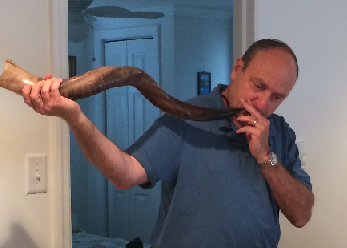
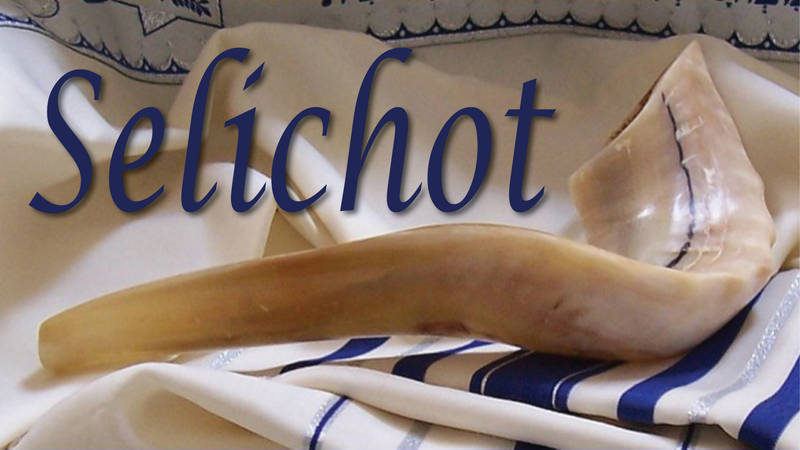
We have been blowing the shofar every morning for the last few weeks because it is Elul.
There are three basic notes that we blow on the Shofar in Elul.
We start with a Tekiah - one unbroken blast.
This is followed by Shevarim - a set of 3 small blasts.
Next is Teruah - a set of 9 very short blasts.
And then to round out the pattern, we have Tekiah - one unbroken blast again.
The 20th century mystic and religious Zionist known as Rav Kook
explained the meaning of the blasts as follows:
Tekiah - the world was created complete.
Shevarim - human beings, and natural forces, have broken and shattered the world.
Teruah - sometimes it seems broken beyond repair.
But- Tekiah - with God’s help, we can rebuild it again and make it whole.
As always, if you have questions or thoughts, please email me at mjayrab@gmail.com or call me on my cell phone, 973-865-9534.
Shabbat Shalom and Shanah Tovah U’metukah– Rabbi Michael S. Jay
|