|
How Did Sharks Get a Bad Reputation?
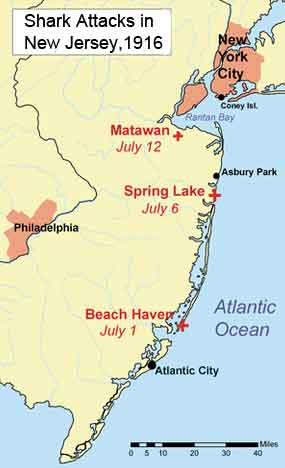
It started in 1916, decades before Jaws hit the big screen. In 1916 sharks were considered just another big fish. Until the that summer when five people were attacked by sharks in less than two weeks in New Jersey, and only one survived.
The first to die was 25-year-old old Charles Vansant who went for an evening swim with a dog on July 1. At the time it was viewed as an anomaly but the attack Charles Bruder on July 6 made national headlines. Then on July 12, 10-year-old Lester Stillwell was attacked and killed by a shark in Matawan Creek. Next day as Stanley Fisher was recovering the boy's body in the creek, he too was killed by a shark. Later the same day 12-year-old John Dunn was swimming in the creek when his leg was severely bitten by a shark. He was the only one to survive. Although the attacks in Matawan Creek strongly suggest a bull shark was responsible, on July 14, a 7.5-foot (2.3 m), 325-pound (147 kg) white shark, with 15 pounds of what appeared to be human flesh in its gut, was caught in Raritan Bay. No further incidents occurred. The 1916 shark attacks were intensively investigated by scientists of the Global Shark Attack File, and are the subject of a film and book by Richard G. Fernicola: In Search of the "Jersey Man-Eater" (1987) and Twelve Days of Terror (2001).
| |
White Sharks in Cape Cod Waters
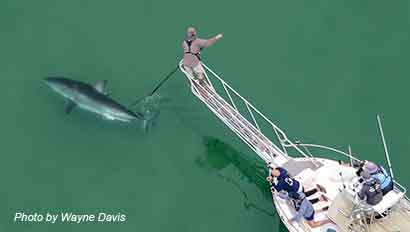
Cape Cod is the only known white shark aggregation site in the northwest Atlantic, and they tend to stick close to shore as they hunt for seals. To date the Atlantic White Shark Conservancy (AWSC) has documented more than 600 white sharks since it began monitoring the population in 2014. Many of the sharks return to the area year after year to feed on the abundant seals that call Cape Cod home.
“It’s important for people to keep in mind that white sharks are not the monsters they are portrayed to be in the media,” says staff scientist Megan Winton. "Humans are not on the menu,” she said. The AWSC scientists, in collaboration with other researchers, have been able to learn more about the sharks’ lifecycle, growth rates, the risks they face in the open ocean, and travel patterns as they swim thousands of miles up and down the eastern coast of the U.S. and Canada. “It’s important for people to keep in mind that white sharks are not the monsters they are portrayed to be in the media,” says Megan Winton. The public should use the information from the AWSC logbook to educate themselves about sharks so they can make informed choices while on the water.
| |
Monitoring Potentially Dangerous Sharks in Australia
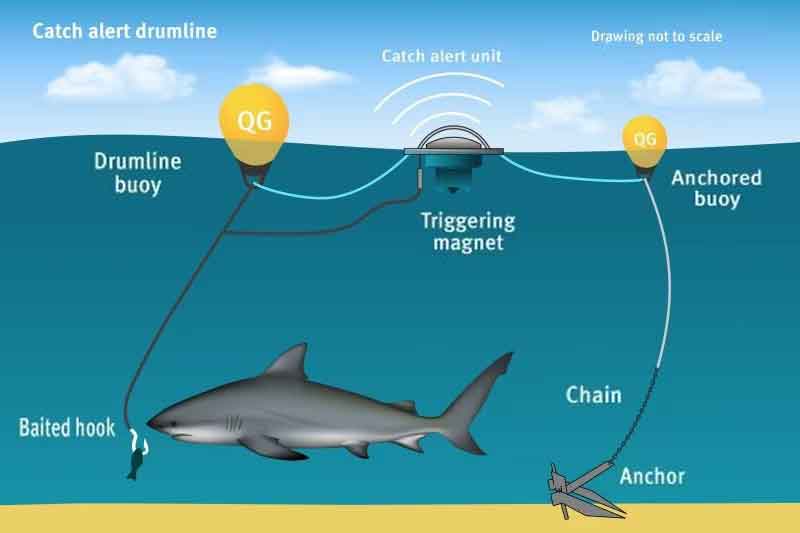
Pioneered at Reunion Island, a technology to prevent bites by sharks is in use in Australia along New South Wales and is being tested in Queensland. The system uses a network of baited fishing lines connected to buoys containing a communication device. When a shark is hooked, the buoy sends a signal confirming capture and experts go to the location, fit a sonar tracking device on the shark's fin and release the shark. The tags, then track the animals and trigger warnings to beach-goers or lifeguards if they swim near popular beaches.
| |
|
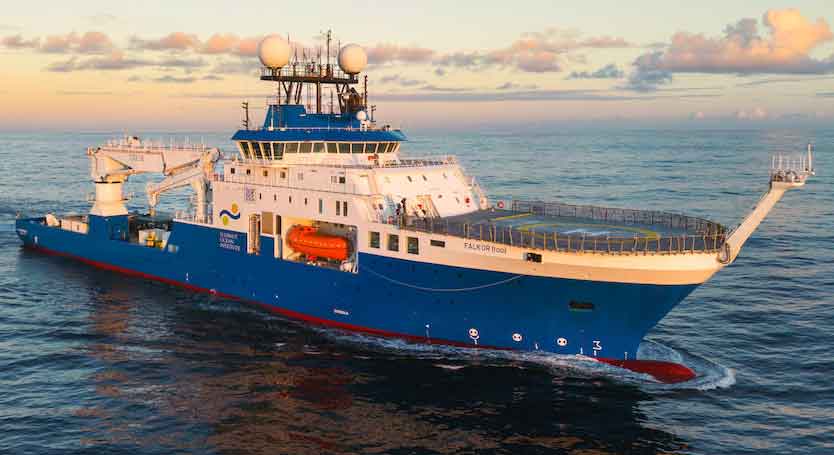
Schmidt Ocean Institute Launches New Research Vessel
Schmidt Ocean Institute has launched its newly refitted 110-meter, seven-deck, global-class research vessel Falkor II for use by scientists worldwide to advance marine science and push the frontiers of deep sea expeditions. The ship features a 150-ton crane, two moonpools, equipment for high-resolution ocean depth mapping to contribute to the global effort to map the entire ocean floor by 2030. It also has a 105-square-meter main laboratory in addition to seven other at-sea laboratories, 98 berths, and 900-square meters of aft deck space for interdisciplinary ocean research and exploration.
The Falkor II will be available to scientists and technologists globally at no cost in exchange for making their research and discoveries publicly available. The ship’s inaugural science expedition will explore–the Mid-Atlantic Ridge. The ship replaces Schmidt Ocean Institute’s previous research vessel, which was in service for a decade and hosted more than 1,100 scientists, discovered more than 50 new species and underwater formations and mapped over half a million square miles of the seafloor.
“The ocean is our planet’s last frontier, and the opportunities for exploration are immense,” said Wendy Schmidt, co-founder and president of Schmidt Ocean Institute. “Falkor II will make it possible to welcome more scientists aboard and to take them further and deeper into our unknown ocean, making possible a new and wondrous decade of discovery.”
| |
Ancient Sea Monster Was Likely a Whale
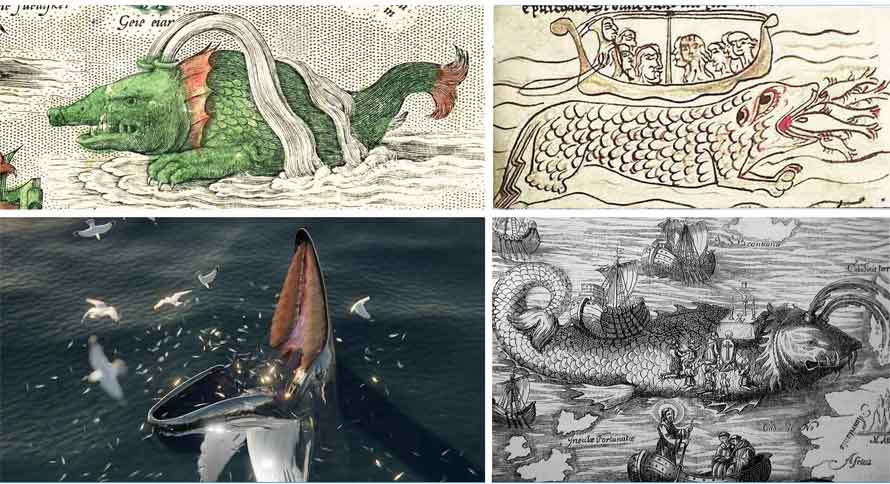
A Norse manuscript from the 13th century includes a description and behavior of a sea monster called the Hafgufa. The creature is also mentioned in a 13th century Icelandic tale revolving around two sea monsters: the Hafgufa and the Lyngbakr. Going back even further in the past, a second-century AD Alexandrian text features drawings of a whale-like creature, identified as an aspidochelone which fed on fish lured into is mouth by a perfume. Australian researchers suggest this could be a reference to whales and the odor that is often detected in the vicinity as they feed.
Trap feeding and tread-water feeding are cetacean hunting strategies first recorded in 2017 and 2018 among humpback whale and Bryde's whales. The whales sit motionless at the surface with their mouths open. Fish are attracted into the whale's mouth and are trapped when the jaw is closed. Researcher John McCarthy points out that drone technology has now made it much easier to observe whales in action in the wild.
| |
|
An Attention-Grabbing Little Crab
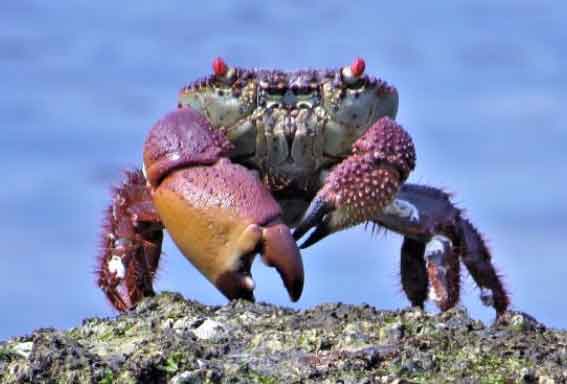
SRI member Penny Bannerman sent us this image asking "Isn't he beautiful?" This male Red-eyed Reef Crab was photographed by Peter Vos at Scottburgh, KNZ, South Africa. These small crabs are common in rocky shores and reefs in most tropical and subtropical habitats.
| |
|
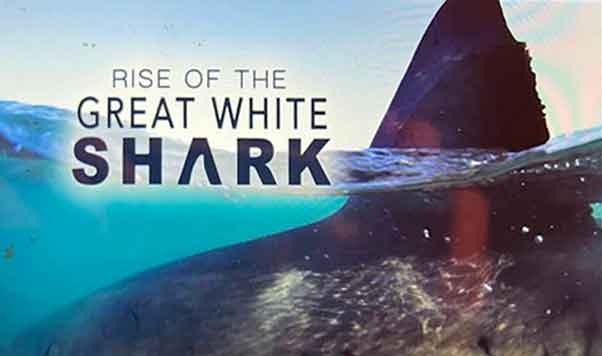
Rise of the Great White Shark
This film, available on Amazon Prime, traces the rise of the Great White Shark 11 million years ago in the wake of dramatic changes in Earth's oceans and climate. At the end of the end of an age dominated by giant ocean predators, white sharks evolved in tandem with seals and other pinnipeds in response to cooling conditions. The film is a result of a decade of filming white sharks by renowned "Shark Week" cameraman Andy Casagrande.
| |
|
Stan Waterman's 100th Birthday
On April 5, 2023, we celebrate the 100th Birthday of Stan Waterman, a beloved friend, neighbor and President of SRI for 17 years from 1993 to 2010. In addition to decades of shark conservation he was named as Legend of the Sea in 2007. Throughout the years Stan led many expeditions, and won three Emmy Awards for his underwater films. Stan also authored hundreds of magazine articles and two books: Sea Salt: Memories and Essays, with forewords by Howard Hall and Stan's best friend, Peter Benchley, followed by Sea Salt II. If you'd like to send a Birthday Card or gift to Stan, simply mail it to SRI Headquarters (70 Heather Lane, Princeton, NJ 08540) and we will hand-deliver it to Stan.
| |
|
A Special Thanks to SRI Staff During Women's History Month
March is Women’s History Month. It is a fitting time to celebrate the impacts that women have had on shark and ocean conservation. Among the women of SRI to be celebrated are Dr. Sylvia Earle, Valerie Taylor, Dr. Jennifer Hayes, Dr. Marie Levine, Dr. Jennifer Schmidt, Dr. Debra Canabal, Heather Cifuentes, Debbie Smith, Suzy Quasnichka, Caterina Gennaro, Cherilyn Chin, Elise Levin, Melissa Michaelson, Taylor Neisen, Carolyn Nickels, Lesley Rochat and the late Dr. Eugenie Clark.
| |
|
The MT Princess
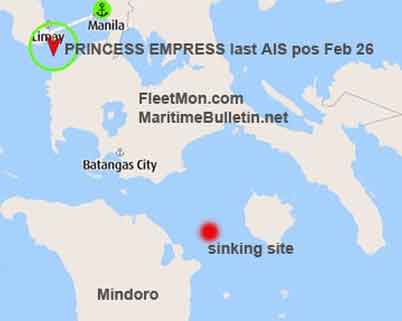
On February 28, 2023, the fuel tanker MT Princess Empress, a Philippine-flagged vessel, was carrying about 800,000 liters (211,338 gallons) of industrial fuel oil when she capsized and sank in the central Philippines. All 20 crew were rescued by the cargo ship EFES
The cargo of the MT Princess Empress has been leaking for weeks, and the oil has reached shore in three provinces. Marine scientists fear that some 36,000 hectares (88,958 acres) of coral reef, mangroves, and sea-grass could be affected by the oil slick. A ROV to determine the tanker's condition arrived on Monday from Japan and Japan has also sent a team of coast guard personnel to help in the cleanup. Five U.S. coast guard personnel have arrived to help with the spill response and NOAA will be working closely with the Philippines to conduct rapid environmental assessments of affected areas and assess needs for ecosystem restoration. Meanwhile, Philippine authorities have imposed fishing and swimming bans in affected areas, resulting in disruptions to livelihood of thousands of residents and tourism businesses.
| |
|
Legacy of the BP Disaster
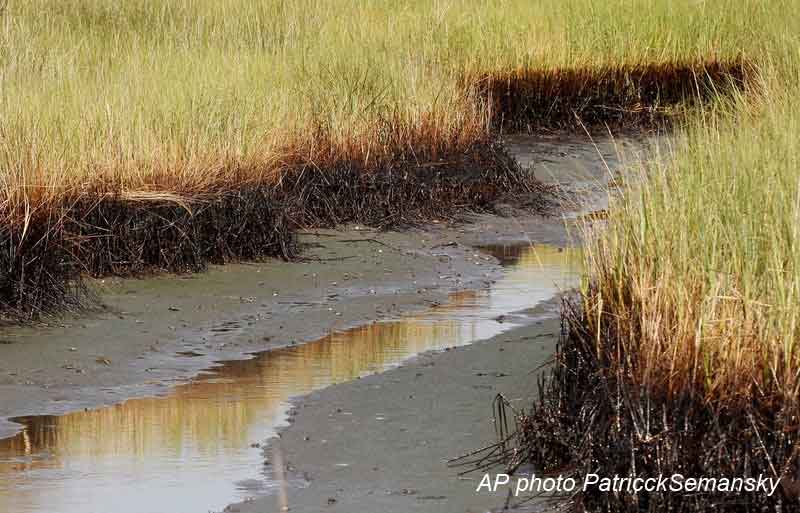
In April 2010, British Petroleum's Deepwater Horizon rig disaster dumped 205.8 million gallons of oil and 225,000 tons of methane into the Gulf of Mexico. The oil and its by-products were catastrophic for the Gulf ecosystem, both underwater and along the shore. The spill the spill likely harmed or killed about 82,000 birds, at least 6,165 sea turtles, and as many as 25,900 marine mammals, plus fish, oysters, crabs, corals and other creatures. The plant-smothering oil also caused structural damage to the shore by killing marsh plants crucial to holding soil in place. As the marsh grass roots died, the soil retained by them was loosened and washed away but the oil remained in the water and got pushed farther into the marsh, killing more plants. Shoreline erosion has accelerated with subsequent storm events, however this damage may be mitigated to some extent by the replanting of marsh grass.
| |
|
Notes
Free to Library or School: National Geographic Magazines. We have Hundreds of issues of NGM from the 1920’s to present, including many bound volumes. Must pick up at SRI Headquarters.
Amazon.com is offering an opportunity to generate donations to the Shark Research Institute at no extra cost to you. Simply start your shopping at smile.amazon.com/ch/22-3110087, confirm "Shark Research Institute, Inc." as your charity of choice, and Amazon will make a donation to our organization.
Consider a tax-deductible year-end gift to the Shark Research Institute. Just mail a check to SRI at 70 Heather Lane, Princeton, NJ 08540, USA, or go to the link on our website.
You may join or renew your membership in the Shark Research Institute, or make a donation of any size at https://www.sharks.org/donate
Note: All donations are tax-deductible from U.S. federal income taxes as
charitable donations and help fund our field research, advocacy and education programs.
| |
Please share this free weekly newsletter with your friends and family to help grow our audience. All they need to do to receive the newsletter is simply sign up on our website’s home page (https:www.sharks.org)
We all have a lot of work ahead to protect sharks and the ocean,
and combat climate change while there is still time.
| | | | |