|
Chag Shavuot Sameach!!!
A Mount Sinai Wedding
Shavuot occurs fifty days after the first day of Pesach, and is the anniversary of our acceptance of the Torah at Har Sinai. On this day, we celebrate God's special gift to us, a code of moral and ethical conduct that has held us together as a nation for thousands of years.
During the time of the Holy Temple in Jerusalem, Shavuot was one of the three holidays for which the Torah Commands us to make a pilgrimage to the that Temple, bringing with us the first fruits of the new harvest.
The Torah introduces the momentous event of the giving of the Torah to the Jewish nation with the verse (Shemot 19), “On the third month from when the children of Israel left Egypt, on this day they arrived at the Sinai desert.”
Our Sages in the Pesikta ask: Why is it that the Torah was not given to the Jewish nation until the Third month (i.e. the month of Sivan, which is the third month according to the Torah’s calculation with the year beginning with Nissan)? Rabbi Levi explained this with a parable: Once, a king’s son became ill. When he was healed, his advisors wished to send him back to school immediately. The king said, “My son’s radiance did not yet return to him, how do propose that he learn? Let him enjoy himself with food and drink for two or three months and then he will return to his studies.”
So too, when the Jewish nation left Egypt, they were worthy of receiving the Torah. However, Hashem said, “they have not yet regained their radiance after the bondage of cement and bricks and they wish to receive the Torah? Rather, I shall allow my children to enjoy themselves by eating the Manna and quail and let them then receive the Torah during the Third month.”
Hashem performed a great kindness for us by giving us a true Torah and imbuing us with eternal life; however, within this kindness, Hashem performed another kindness for us by giving us the Torah only when we were physically healthy and capable of receiving it and not when we were in a frenzy immediately following our exodus from Egypt. Although Hashem could have performed a miracle and instantly strengthen the Jewish nation, we have already written in the past that Hashem wishes, as much as possible, to direct the world in a natural manner. It is for this reason that he waited almost three months for us until we were able to receive the Torah.
The Gemara (Sotah 14a) states: “The Torah begins with kindness and ends with kindness. The Torah begins with kindness, as the verse states, ‘Hashem made for the man and his wife leather tunics and he clothed them.’ The Torah ends with kindness, as the verse states, “And He (Hashem) buried him (Moshe Rabbeinu) in the valley.’”
Our Sages mean to teach us that just as we see that the Torah begins and ends with acts of kindness, this signifies that the entire Torah is the epitome of kindness. If the entire root of Torah is kindness, it follows that all of the Mitzvot of the Torah, include the detailed monetary laws, are all contingent on Hashem’s endless kindness. Indeed, Rabbeinu Moshe Chaim Luzzato (author of Mesillat Yesharim) writes that our entire service of Hashem in this world is because we wish to earn our reward and not only to receive it as a result of Hashem’s kindness. Thus, even when the Torah commands us regarding various methods of acquisition and other intricate monetary laws, this is a result of Hashem’s kindness to us, for He wishes us to gain possession of our material belongings so that one may enjoy the fruits of his labor.
It is for this reason that our Sages instituted that Megillat Ruth be read during the Shavuot holiday, for the theme of this Megillah is inherently kindness, as the verse states, “Naomi said: ‘May Hashem perform kindness with you, just as you have done with the deceased and with me.’”
However, the Megillah seemingly does not mention any other kindness that Ruth and her sister performed for their husbands other than the fact that they were married to them. Similarly, the verse later in the Megillah states, “Boaz replied and told her: ‘I have been told about everything you have done for your mother-in-law after your husband’s demise.’” This is quite perplexing, for Ruth did not do anything for Naomi as Naomi actually pleaded with Ruth to return to her land and her people while Ruth cleaved to Naomi for her own personal benefit. If so, how can such actions be considered acts of “kindness,” so much so that the verse states, “My daughter, you are blessed to G-d; your last kindness is better than your first”? Here too, Ruth went to Boaz for her own benefit; how can the verse call this kindness?
Our Sages (Pesachim 8a) teach us: “One who says, “I shall donate money to Tzedakah on the condition that my son lives,’ is considered completely righteous.” It seems that although one donated charity for one’s own benefit and not for the sake of Heaven, one’s actions are nevertheless accepted and appreciated by Hashem. Based on this, any action that one performs, even if one intends to do so primarily for one’s self, as long as others are gaining from this action as well and the individual does intend for others to benefit, one’s actions are considered those of kindness and charity.
Thus, if a grocer, bookseller, or bus driver do their work primarily for their own livelihood, nevertheless, as long as they also intend to benefit others and others do indeed benefit from their actions, they perform endless Mitzvot by doing so.
On the other hand, we must realize how much kindness we receive from others and how much gratitude we owe to those around us. This realization causes Hashem great satisfaction when we give back to others and perform acts of kindness with them.
The great kindness which Ruth performed for Naomi was that, ultimately, Naomi did not remain alone in the world. Similarly, the fact that she went and married Boaz was likewise considered a great act of kindness, for by doing so, she was a partner in establishing the illustrious dynasty of King David’s kingdom.
We customarily read Megillat Ruth on Shavuot in order to show that the basis of the Torah and its essence is pure kindness by learning, teaching, and observing the Torah’s laws. Indeed, the greatest kindness possible is teaching Torah to others, for by doing so, one shares the spiritual wealth Hashem has given the Jewish nation with others. Similarly, the Gemara states, “Rabbi Yehoshua ben Levi said: One who teaches his grandson Torah is considered to have transmitted the Torah to him from Mount Sinai, as the verse states, ‘And you shall make them known to your sons and your grandsons.” This applies when one teaches one’s grandson Torah. However, if one teaches Torah to others, even if Hashem has decreed a harsh decree, Hashem will annul it for this individual because of the spiritual wealth and abundance that one shares with others.
| |
|
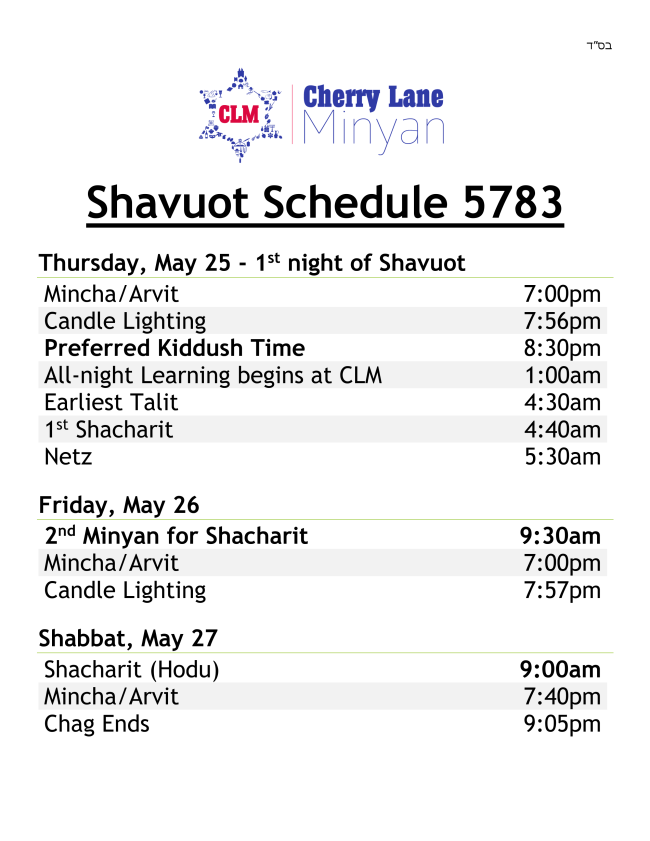
SHAVUOT ALL NIGHT LEARNING SCHEDULE
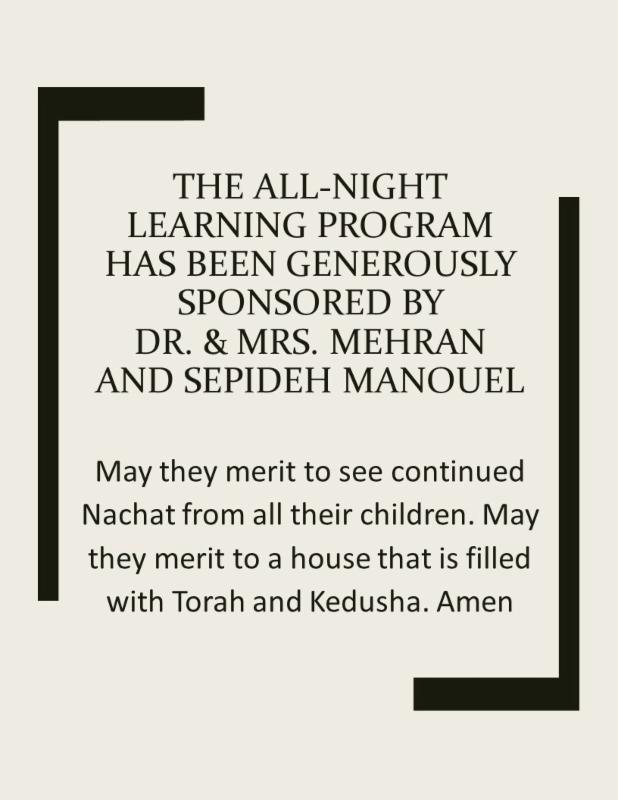
Please join us for our all night learning program led by Rabbi Levy. We will be reading the "Tikun Shavuot" and sharing words of inspiration. Open to men and women. Refreshments will be served throughout the night. Cheesecake will be served in the morning to all those who stay with us all night!!
For our dear young professionals, we will have an ALL NIGHT LEARNING PROGRAM led by Bryan Lavi as well!! Join the round table and chavruta learning!!! BE A PART OF THE MOVEMENT!!
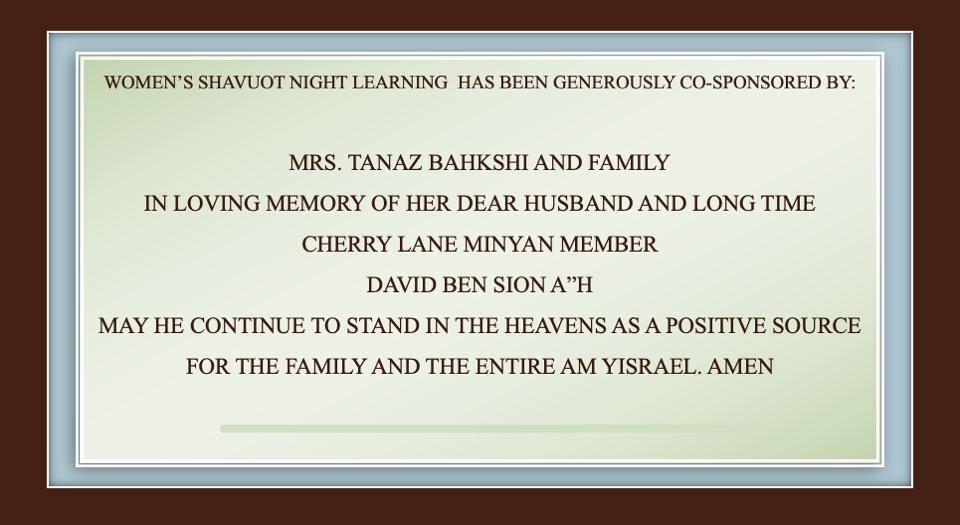
ATTENTION LADIES OF THE CHERRY LANE MINYAN!!
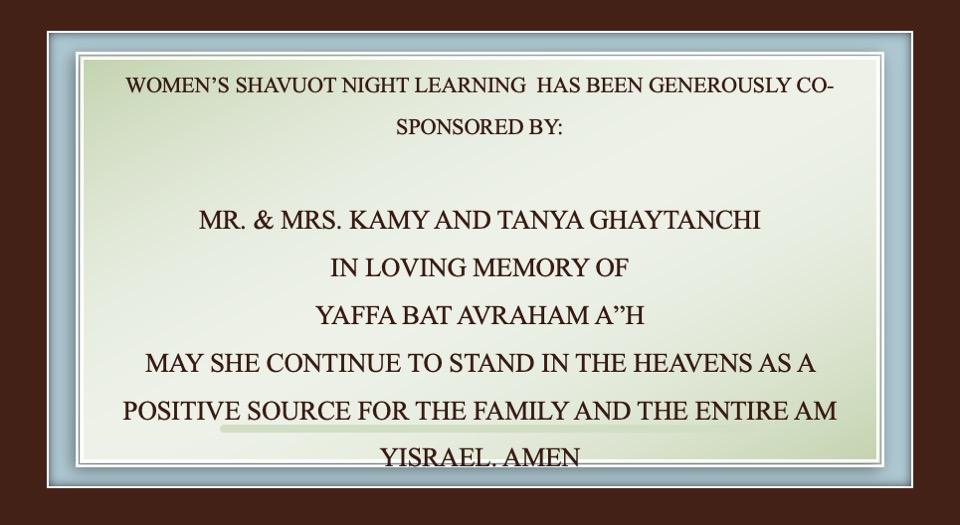
This year you will have the pleasure to hear words of inspiration from Mrs. Ferry Sedaghatpour. The ladies class will be held in the main shul at 11:30pm (Thursday night).
|
| |
|
|
On behalf of the ENTIRE CLM Family, we would like to take this opportunity to thank our dear Shul President Mr. Soli Sassouni for ALL of his hard work and devotion to our shul.
Mr. Sassouni, you are the pillar of our shul and we thank you from the depths of our hearts.
| |
 | |
Dearest Members,
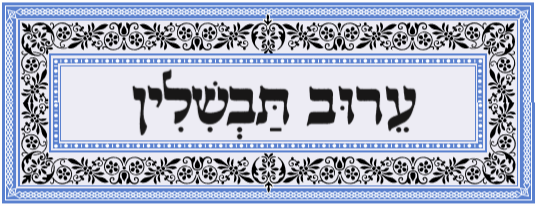
This year, being that we will go from Chag straight into Shabbat, every family should prepare Eruv Tavshilin which permits us to cook on chag for shabbat.
Please take a moment to read below to learn more about this valuable mitzvah:
What is an Eruv Tavshilin?
This year (5783), the Shavuot holiday will fall out on Friday, Erev Shabbat. We know that it is permissible to cook on Yom Tov. (It is nevertheless forbidden to create a new fire; rather, one may transfer a pre-existent flame lit before the onset of Yom Tov. It is likewise forbidden to extinguish a flame on Yom Tov.)
When Yom Tov falls out on a Friday as it does this year, many people wish to cook on Yom Tov for the upcoming Shabbat. However, our Sages prohibited cooking on Yom Tov for Shabbat without placing an “Eruv Tavshilin,” which is placing (designating) bread and a cooked food on Erev Yom Tov (Thursday) for Shabbat (i.e. to be eaten on Shabbat) in order for it to be recognizable that one is not beginning to cook or bake on Yom Tov for Shabbat; rather, one is merely concluding this preparation.
Explanation of the Above
In honor of Yom Tov, our Sages prohibited cooking on Yom Tov for Shabbat (in order for Yom Tov not to appear like a regular weekday with regards to Shabbat). However, if one begins cooking for Shabbat on Erev Yom Tov (i.e. before the onset of the holiday) and merely concludes on Yom Tov, this does not constitute a lack of respect for Yom Tov. We therefore leave bread and a cooked food on Erev Yom Tov to be eaten on Shabbat in order to show that one has already begun preparing foods for Shabbat before the onset of Yom Tov and that on Yom Tov itself, one is merely finishing off what one has already started. If one did not place an Eruv Tavshilin, one may not cook on Yom Tov for Shabbat.
The Proper Way to Prepare the Eruv
There are several laws regarding the bread and cooked food one must leave for the Eruv Tavshilin. It is customary to leave bread (amounting to a weight of approximately fifty-four grams) and a hard-boiled egg. When one takes the bread and hard-boiled egg on Erev Yom Tov (Wednesday), one recites: “Baruch Ata Hashem Elokeinu Melech Ha’Olam Asher Kideshanu Be’mitzvotav Ve’tzivanu Al Mitzvat Eruv.” One must include Hashem’s name while reciting this blessing. After reciting the blessing, one should say: “With this Eruv, we shall be permitted to bake, cook, light candles, and do anything necessary on Yom Tov for Shabbat.” One then saves the bread and cooked food and (preferably) eats them on Shabbat night or any other time on Shabbat.
A Public Eruv
In most places, the rabbis of the city customarily make an Eruv Tavshilin in a special way that will benefit those who have forgotten to make one. Thus, if one forgets to make an Eruv Tavshilin but the local rabbi has made an Eruv in this way, one may rely on the Eruv of the rabbi and one may cook on Yom Tov for Shabbat. Nevertheless, it is preferable for each individual to make an Eruv Tavshilin in his own home.
| |
Laws of Shavuot
The Order of the Night of Shavuot
The widespread custom among the entire Jewish nation is to stay awake the entire night of Shavuot and immerse one’s self in Torah study until dawn. Indeed, the holy Zohar states: “The earlier righteous individuals would not sleep on this night and would toil in Torah and say, ‘Let us inherit a holy legacy for ourselves and for our children in both worlds.’” Similarly, the holy Zohar states: “All those who perform the order of rectification on this night and are glad about it shall be inscribed in the Book of Remembrance and Hashem shall bless them with seventy blessings and crowns from the upper realms.”
The Reason why we Customarily Stay Awake All Night
The Pirkei De’Rabbi Eliezer states: “Rabbi Pinchas says: The Jewish nation stood at Mount Sinai on Erev Shabbat with the men being prepared alone and the women being prepared alone. Hashem told Moshe, ‘Go ask the women of Israel if they are willing to accept the Torah, for men usually follow the decision of women,’ as the verse states, ‘So shall you say to the house of Yaakov,’ which refers to the women, ‘And speak to the house of Israel,’ which refers to the men. All answered as one, ‘Whatever Hashem has spoken, we shall perform and heed.’ That day the Jewish nation slept until the second hour of the day (approximately 7:00 am) at which point Moshe went around the camp of Israel awakening them from their sleep. He told them, “Awaken from your slumber! The groom has already arrived and is expecting his bride and is waiting for her in order to give them the Torah!”
Since at the time of the acceptance of the Torah the Jewish nation slumbered all night and Hashem needed to awaken them, we must therefore rectify this matter by staying awake all night long and immerse ourselves in Torah.
Women and the Order of the Night of Shavuot
Rabbeinu Yosef Haim of Baghdad writes in his book based on the Kabbalah that he was asked if it is proper for women to participate in the order of learning on the nights of Shavuot and Hosha’ana Rabba or not. He answers that the custom in his household is that the women do not recite the order of learning on the night of Shavuot and instead, they go to sleep. Although they are wise and righteous women who recite Tehillim and hold other learning sessions daily, nevertheless, according to Kabbalah it is not a good thing for women to stay awake on the night of Shavuot at all. He proceeds to support this from the words of the holy Zohar. Maran Rabbeinu Ovadia Yosef zt”l rules likewise. However, this does not apply to Hosha’ana Rabba; on the contrary, it is actually a good practice for women to stay awake all night long on the night of Hosha’ana Rabba like men.
Adorning the Synagogue and One's Home with Plants
The Rama writes (in his gloss on Chapter 494, Section 3) that it is customary to scatter plants throughout the synagogue and one's home on the holiday of Shavuot in commemoration of the joy of the giving of the Torah. Many Acharonim bring another source for this custom based on the Gemara in Masechet Shabbat (88b) which states that after every commandment uttered by Hashem, the entire world was filled with a fragrant smell, as the verse states, "His lips are like roses dripping with passing myrrh." It is likewise customary to lay tree branches in the synagogue and in one's home in order to hint to the Gemara in Masechet Rosh Hashanah (16a) that on Shavuot we are judged regarding the fruits of the tree.
Nevertheless, the Sefer Chayei Adam writes that Rabbeinu Eliyahu of Vilna discontinued this custom, for nowadays, non-Jews place tree branches in their homes during their holiday season. This therefore constitutes the prohibition of following the practices of non-Jews. On the other hand, Maran Rabbeinu Ovadia Yosef zt"l writes that the Gaon of Vilna writes that this constitutes the prohibition to follow the practices of non-Jews in accordance with his own opinion that this prohibition applies to all non-Jewish practices. However, according to Rabbeinu Yosef Cologne and many other Poskim who rule likewise, this prohibition applies only to those observed practices which have no reason behind them (for only then are we concerned about "Emorite ways" and the possibility of idolatrous rituals) or to those customs which are observed for immoral purposes and the like. However, if it is a custom which is observed for a specific reason, such as if a garment is worn by non-Jewish doctors in order for them to be recognizable as doctors, a Jewish doctor may follow this custom and wear the garment as well. Therefore, this custom may indeed be observed, for the custom of the Jewish people is law, especially when the custom in question is very ancient and quoted by our Sages.
Eating Dairy Foods
The Rama (ibid.) continues and writes that several communities have the custom to eat dairy foods on the day of Shavuot. Some Acharonim add that it is customary to eat milk and honey together as well, hinting to the acceptance of our holy Torah which is compared to milk and honey. Some explain that the reason for eating dairy foods on Shavuot is because when our forefathers were given the Ten Commandments, the rest of the Torah and its commandments were revealed to them as well (as Rav Sa'adia Gaon writes that all of the Mitzvot are included in the Ten Commandments). When the Jewish people returned to their homes after receiving the Torah, they did not find anything ready to eat besides for dairy items, for eating meat now involved much preparation including slaughtering the animal with a knife free of imperfections, removing the forbidden fats and sinews, salting the meat and washing it off as well as many other laws pertaining to the kosher dietary laws. They therefore made due with dairy foods; we eat dairy items in commemoration of this. Many other reasons are given for this custom.
Since Halacha prohibits eating dairy foods for six hours after eating meat, we therefore customarily eat the dairy foods first and only after washing one's mouth out in accordance with Halacha, i.e. by eating some bread and drinking some beverages, do we eat meat. One should eat meat on Yom Tov in order to fulfill the Mitzvah of joy of Yom Tov, as the Gemara in Masechet Chagiga (8b) states that one experiences true joy only by eating meat. One should likewise drink wine in honor of the joy of Yom Tov. One should nevertheless abstain from frivolity and unruliness, for we have only been commanded to experience a joy through which one will come to serve Hashem. One should rejoice by performing permissible actions, such as singing the praises of Hashem and his holy Torah. One must likewise try his utmost to learn Torah during the day of Shavuot as well. Maran zt"l writes that one should also learn from the Rambam's Sefer Ha'Mitzvot. It is also proper to recite Tehillim on this day, for the holiday of Shavuot marks the anniversary of the passing of King David.
Maran zt"l would say that it is not so beneficial to remain awake the entire Shavuot night studying Torah and then to sleep the entire day thereafter. Rather, one should only sleep for an hour or two in order to regain one's strength and then awaken and study Torah once again. Although this is indeed a tall order for most people, nevertheless, we can understand from the words of Maran zt"l that one should not many hours sleeping on this most awesome day and should dedicate as much time as possible to Torah study.
Gladdening the Needy
The Torah (Devarim 16) states: "And you shall be glad during your holiday; you, your son, your daughter, the Levi, the convert, the orphan, and the widow in your midst." One must therefore gladden the hearts of the poor, widows, and orphans during the holiday as well and this is a truly important obligation. One may fulfill one's obligation to do so by donating Tzedakah before the holiday so that the needy will have the necessary funds so that they can enjoy the holiday as well.
• We do not say Tachanun from the 1st through the 12th of Sivan
• When lighting candles, women make the blessing before lighting unlike Shabbat where the custom is to light and then recite the blessing.
• On the first night of Shavuot, kiddush should be recited after Tzet Hakochavim. When chag falls out on motzaei shabbat, the kiddush order is "Y'KNHZ" (Yayin, Kiddush, Ner, Havdala, Zmanim)
• A bit before midnight, one recites the bedtime Sh’ma excluding the blessing of Hamapil. After midnight one who was up all night, recites the morning blessings, skipping Al Netilat Yadayim. We recite Birkat Hatorah only after Amud Hashahar.
• It is customary to recite Tehillim on Shavuot as it is authored in part by David HaMelech who passed away on Shavuot.
• On the second day of chag, one can light candles, pray Arvit and make Kiddush after sunset. one does not have to wait until after night fall.
|
|
The Holiday of Shavuot
Food Preparation
The Torah states (Shemot 12) regarding the various holidays, i.e., the first day of Sukkot, Shemini Atzeret, the first and last days of Pesach, and the holiday of Shavuot: “No work shall be performed on them; however, any (work necessary for) food preparation eaten by all, this alone may be performed by you.” This means that any work which is forbidden on Shabbat is also forbidden on Yom Tov, besides for work needed to prepare food which is permissible on Yom Tov.
Some works pertaining to the Yom Tov food preparation which the Torah allows on the holiday itself include cooking, frying, baking, and the like.
Cessation of Work on Holiday
The Sefer Ha’Chinuch explains that the reason the Torah forbade performing work on holidays is in order for the Jewish nation to remember the great miracles that Hashem performed for them and their ancestors and to pass this message on to their children. If work was permissible on these days, the honor of the festival and joy of the holiday would be forgotten because everyone would be busy at work; thus, due to the prohibition of working on the holidays, the Jewish people will be free to gather in synagogues and Batei Midrash to hear words of Torah and wisdom from luminaries of the generation who expound Halacha and stories of the Torah. This is based on the teaching of our Sages, “Moshe instituted that the Jewish nation expound the laws of Pesach on Pesach, the laws of Shavuot on Shavuot, and the laws of Sukkot on Sukkot, as the verse states, ‘And Moshe spoke out the festivals of Hashem to the Children of Israel.’” Similarly, our Sages taught, “Shabbat and holidays were only given to the Jewish nation so that they may delve in Torah study.” We were therefore commanded to have a complete cessation of work, excluding work needed for food preparation (for instance, preparing a dish for a holiday meal, according to the conditions and procedures we shall lay out in following Halachot). Similarly, our Sages have taught, “There is no distinction between Shabbat and Yom Tov besides for [the prohibition of] food preparation.”
Half for Hashem and Half for You
Nevertheless, one should divide the hours of the holiday with half being spent in the synagogue and Bet Midrash and half being spent eating, drinking, and enjoying the holiday.
Our Sages taught that one who ceases to work and eats and drinks on the holiday in honor of the holiday is tantamount to having built and altar and offering a sacrifice on it, as the verse states, “Bind the festal offering to the corners of the altar with cords.” Our Sages added (Betzah 15a) that one who adds copiously to one’s enjoyment of Yom Tov is granted abundant sustenance from Heaven, for our Sages taught, “All of one’s sustenance for the year is decided between Rosh Hashanah and Yom Kippur besides for one’s Shabbat, Yom Tov, and children’s Torah expenses, for in these areas, if one skimps, Heaven will detract from him and if one increases, Heaven grants one more.” This is especially true regarding the Shavuot holiday, the day we received the holy Torah and became a nation and is worthy of being honored and enjoyed respective of one’s means. Mrs. Malka Sasson (daughter of Maran zt”l) recounted that she remembers in her youth that in the days when Maran zt”l would still go shopping himself, he would go a few days before the holiday to purchase something special for the holiday in order to make it more enjoyable.
The Laws of Food Preparation on Yom Tov
The Torah states (Shemot 12) regarding the various holidays, i.e. the first day of Sukkot, Shemini Atzeret, the first and last days of Pesach, and the holiday of Shavuot: "No work shall be performed on them; however, any (work necessary for) food preparation eaten by all, this alone may be performed by you." This means that any work which is forbidden on Shabbat is also forbidden on Yom Tov, besides for work needed to prepare food which is permissible on Yom Tov.
Some works pertaining to the Yom Tov food preparation which the Torah allows on the holiday itself include cooking, frying, baking, and the like, as we shall soon discuss.
The Sefer Ha'Chinuch explains that the reason the Torah forbade performing work on holidays is in order for the Jewish nation to remember the great miracles that Hashem performed for them and their ancestors and to pass this message on to their children. If work was permissible on these days, the honor of the festival and joy of the holiday would be forgotten because everyone would be busy at work; thus, due to the prohibition of working on the holidays, the Jewish people will be free to gather in synagogues and Batei Midrash to hear words of Torah and wisdom from luminaries of the generation who expound Halacha and stories of the Torah. This is based on the teaching of our Sages, "Moshe instituted that the Jewish nation expound the laws of Pesach on Pesach, the laws of Shavuot on Shavuot, and the laws of Sukkot on Sukkot, as the verse states, 'And Moshe spoke out the festivals of Hashem to the Children of Israel.'" Similarly, our Sages taught, "Shabbat and holidays were only given to the Jewish nation so that they may delve in Torah study." We were therefore commanded to have a complete cessation of work, excluding work needed for food preparation (for instance, preparing a dish for a holiday meal, according to the conditions and procedures we shall lay out in following Halachot). Similarly, our Sages have taught, "There is no distinction between Shabbat and Yom Tov besides for [the prohibition of] food preparation."
Nevertheless, one should divide the hours of the holiday with half being spent in the synagogue and Bet Midrash and half being spent eating, drinking, and enjoying the holiday.
In the next Halacha we shall, G-d-willing, discuss which works may not be performed on Yom Tov although they are associated with foods preparation.
The Laws of Cooking on Yom Tov
Although Shabbat and Yom Tov are equal in their prohibition to perform work on them and it is therefore a Torah prohibition to drive a car on Yom Tov, nevertheless, certain works associated with food preparation, such as cooking and frying, are permitted.
Let us now discuss an important detail regarding the laws of cooking on Yom Tov: There are certain foods which "lose their taste," meaning that they are as not as tasty as time goes by from the time they were cooked. On the other hand, there are other foods which do not taste any different a day or two after they were cooked.
For instance, meat cooked on the grill will begin to lose its flavor as time passes since it has been cooked and it is preferable to eat it immediately after it has been cooked. Similarly, fried vegetable, such as French fries, are tastier when eaten immediately after they are prepared and the more time goes by, they begin to lose their taste. Such foods may be cooked on Yom Tov according to all opinions since if they are prepared before Yom Tov, they would not be as flavorful.
On the other hand, regarding foods which do not lose their flavor, such as jams, fruit compotes, and the like which do not taste any different several days after they have been cooked, there is a dispute among the Rishonim if they may be prepared on Yom Tov. Some say that since these foods may be prepared before Yom Tov, our Sages forbade preparing them on Yom Tov so that one does not stand in the kitchen and cook all Yom Tov long and abstain from enjoying Yom Tov. Others rule that our Sages never forbade this. The reasons behind this matter are quoted by Maran Ha'Bet Yosef and the other Poskim in the laws of Yom Tov (Chapter 495).
Halachically speaking, Maran Rabbeinu Ovadia Yosef zt"l rules (in his Chazon Ovadia-Yom Tov, page 8) that even a food which would not taste any different had it been prepared before Yom Tov, such as jams and compotes, may be prepared on Yom Tov,, it is nevertheless preferable, wherever possible, to prepare such foods before Yom Tov. One should prepare only foods that taste better fresh, such as fried vegetables, on Yom Tov itself.
Ashkenazim rule stringently on this matter as the Rama forbids preparing "foods which do not lose their taste" on Yom Tov. Nevertheless, the Mishnah Berura writes that if one did not have a chance to prepare such foods before Yom Tov due to a lack of time and the like, one may prepare them on Yom Tov. It is likewise permissible to prepare such foods on Yom Tov while cooking them in a somewhat different manner (such as by placing the pot on the flame in a different manner than usual).
Summary: Any food which tastes better when eaten immediately after its preparation, such as fried vegetables and grilled meat, may be prepared on Yom Tov. A food which does not taste any different if it is prepared before the holiday should preferably not be prepared on Yom Tov and should be prepared before Yom Tov.
|
| |
Chag Same’ach and Tizku Le’Shanim Rabbot Ne’Imot Ve’Tovot! |
| | | |