|
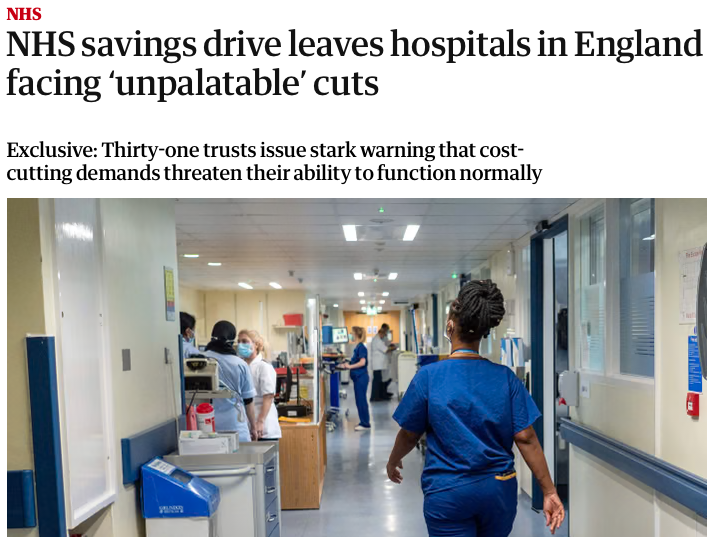
The Guardian has been reading NHS trust board papers…
… saves me the job.
Thirty-one trusts have recorded financial pressure as a threat to their ability to function normally.
Twenty-seven rate it as, their biggest risk.
This is really serious stuff… and looks particularly grim with winter on the doorstep.
What does that look like to a patient?
In East Kent, the Trust cut what it paid nurses to work extra shifts. Fewer nurses took up the shifts.
There’s a surprise.
The Trust’s own board paper linked that to longer waits for appointments before chemotherapy.
There’s a surprise.
In Bridlington, the trust said it would close a 28-bed ward where people recover after a spell in hospital, saving £1m. That’s given them a number for the board to put in its savings plan.
No surprise there, but...
... I’d like to see the number for the extra days people might spend in an acute bed while they wait for somewhere to go. That’s how the funding squeeze reaches the patient.
A decision about a pay rate becomes
a longer wait for treatment.
A decision about a ward becomes
a few more nights in hospital.
By the time it gets to the patient, it’s called a delay. In the board papers, it will be called a saving.
Of course, there’s another side to this.
The NHS can waste money. The NAO found trusts paying up to £490 for a hip replacement stem that NHS Supply Chain was selling for £258. If you can get the same product, in the quantities you need, when you need it, buy it for £258. There’s cash in that.
No surprise.
Now try the same argument with an agency nurse. If you’re paying a premium to fill the same shift every Friday... look at the rota.
You have a recurring vacancy and you’re buying your way out of it a week at a time, but… (and winter and flu is on the way)…
… if three nurses ring in sick and the ward is full, the premium buys you cover at short notice.
The invoices might look identical. You’d manage the two problems differently.
Good planning will deal with some of this. It will also tell you how much room you need for the things you can’t plan.
A bed kept available, some stock in reserve, enough people on the rota to cover an absence. All can look expensive on a quiet Tuesday.
Take that room out of the system and see what happens on Friday night. You may find yourself buying it back at the price you were congratulated for cutting.
Then there’s the question of; what a saving actually saves?
Get a patient home two days earlier with the right support and you’ve done something worthwhile. You’ve freed two bed-days. If there’s someone in A&E waiting for that bed, it’ll be occupied whilst it’s still warm.
The same ward will be heated, cleaned and staffed. The hospital can look after another patient. The finance director still has a hole in the budget.
This matters because ministers are asking hospitals to;
- improve productivity,
- balance their books and
- get more people treated within 18 weeks.
A bed freed up and used again helps with two of those ambitions. The finance director can only spend the money if it actually comes off a bill, and if you close the ward to get the cash, you’ve lost the beds you could have used to treat more people.
I’d like to see three figures in every big savings plan.
-
How much will come off the bill this year?
-
How much extra care can we provide with the resources we free up?
-
What will it cost to keep the service safe on the days the plan falls apart?
Back to Bridlington.
The Trust has a figure for closing the ward. Before it banks the million, I’d like to know where the next 28 patients are going, who will pay, and do they have the money.
Edwards Deming called it suboptimisation...
... I'd call it cost shifting.
|