|
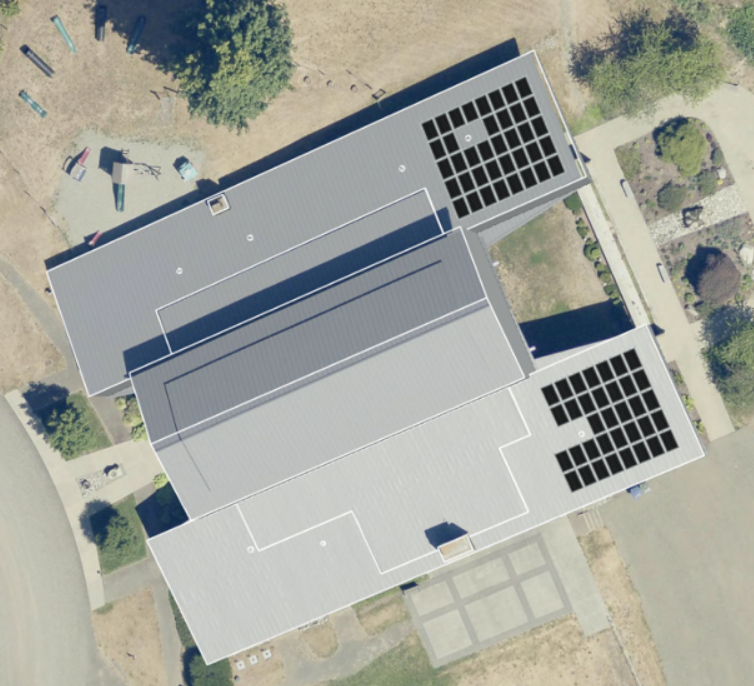
This summer, work will get underway to install a 32.12 kW solar array on the roof of Grace Episcopal Church which will generate approximately 30,000 kWh of clean electricity annually. It's the latest in a string of exciting solar projects on the island. As with the other efforts, the project at Grace took fortitude and no small amount of work. We sat down with two people key to this initiative — Marcy Lagerloef, who co-leads Grace's Earth and Spirit ministry, and Jens Boemer, a member of the church's Greening Grace Committee — to hear the story of how they got here, and what they'd tell other organizations and property owners on the island who want to follow the same path.
For Marcy, the road to solar at Grace began with a conviction. "We became a Greening Congregation under Earth Ministry back in 2008," she says. "Those were our values." Earth and Spirit has had its eye on solar since 2012. So the question was never a matter of whether they were going to try to do something meaningful; it was a matter of how — and who was going to pay for it.
Things accelerated after the passage of the Inflation Reduction Act in 2022. Marcy started tracking federal and state funding possibilities, sitting through what she cheerfully describes as "innumerable, boring, intensive workshops online" to understand how potential funding might work. Around the same time, the Greening Grace Committee formed — Jens joined at Marcy's invitation — and the group zeroed in on two potential initiatives: getting solar on the roof of the church and swapping out the building's oil boiler for the in-floor heating system. They began soliciting bids.
However, the heating piece soon proved intractable. "It was going to be exotically expensive to put in a heat pump in this particular situation, and nobody could even give us a clear design," Marcy says. After exploring every option, the group set that challenge aside and sharpened their focus on solar.
Marcy's breakthrough came when she discovered that Washington State's Department of Commerce, through its Clean Energy Community Grants program — supported by the Climate Commitment Act — would potentially cover up to 100% of a qualifying project's cost. The Grace team took what seemed to be the most natural next step: they applied in 2024 for monies to cover an initial feasibility study. They were rejected. They tried again. And were rejected yet again.
Undeterred, the Grace team took their next cue from Saint Barnabas Church which at roughly the same time succeeded on its third application by applying for a straight solar install rather than solar plus battery. Grace simplified its application, secured a $10,000 matching contribution from its congregation, and told the more complete story of the church’s reach in the broader community: a significant share of the folks who come to Grace do so from off the island. And the Grace team decided that it would turn its monthly electricity savings from solar into a contribution to FishLine, the non-profit headquartered in Poulsbo. The grant came through.
The installation will be done by Cascadia Solar — who also installed the system at Bethany Lutheran. The building permit application and PSE interconnection request have been submitted; the panels are expected to go on the roof this summer. As we have pointed out in earlier editions of this newsletter, getting panels up now is a big deal: it means that Grace will be live before the current net metering terms change, and the church will therefore be grandfathered into the favorable one-to-one credit arrangement. "That was the other reason to push through with installation now," Marcy notes. "We don't know what the new net metering arrangement is going to be."
Grace has three-phase power — the kind of electric service more typical of commercial buildings — which complicates battery storage considerably. Unlike a home installation where a FranklinWH or Tesla Powerwall mounts neatly on the wall, the church would need commercial-scale batteries on separate concrete pads — a much larger undertaking. "Smaller-scale three-phase batteries are already common in Europe and other countries," Marcy says, "and similar products are apparently under development for the U.S. market — that would eventually allow our preferred wall mounting. That's our plan." Jens adds that the longer-term vision has always been to extend the project in phases — solar first, then resilience infrastructure that will strengthen Grace's capabilities as one of the island's emergency hubs.
Both Marcy and Jens have clear advice for other Bainbridge non-profits and faith communities considering this path. "Think big, then break it down into steps," Jens says. "Focus on the step that is closest in reach. And really go through the Department of Commerce criteria carefully — tailor your proposal to their priorities in order to boost your probability of success."
Marcy adds a pointed note about the equity dimension: "I do believe it's going to get more and more difficult for applicants from the island to get these grants, simply because we are comparably in a very affluent area. That is not to discourage anyone — but really put thought into how your project benefits both island and off-island communities."
On the question of what solar means to the Grace congregation, Jens is direct. "We put our money where our mouth is. There is a value in Grace to conserve and to protect — and this is one very specific, concrete way to do that." He also points to Grace's role as an emergency shelter: "This is one step on the way to make this building more resilient and available when the power goes out."
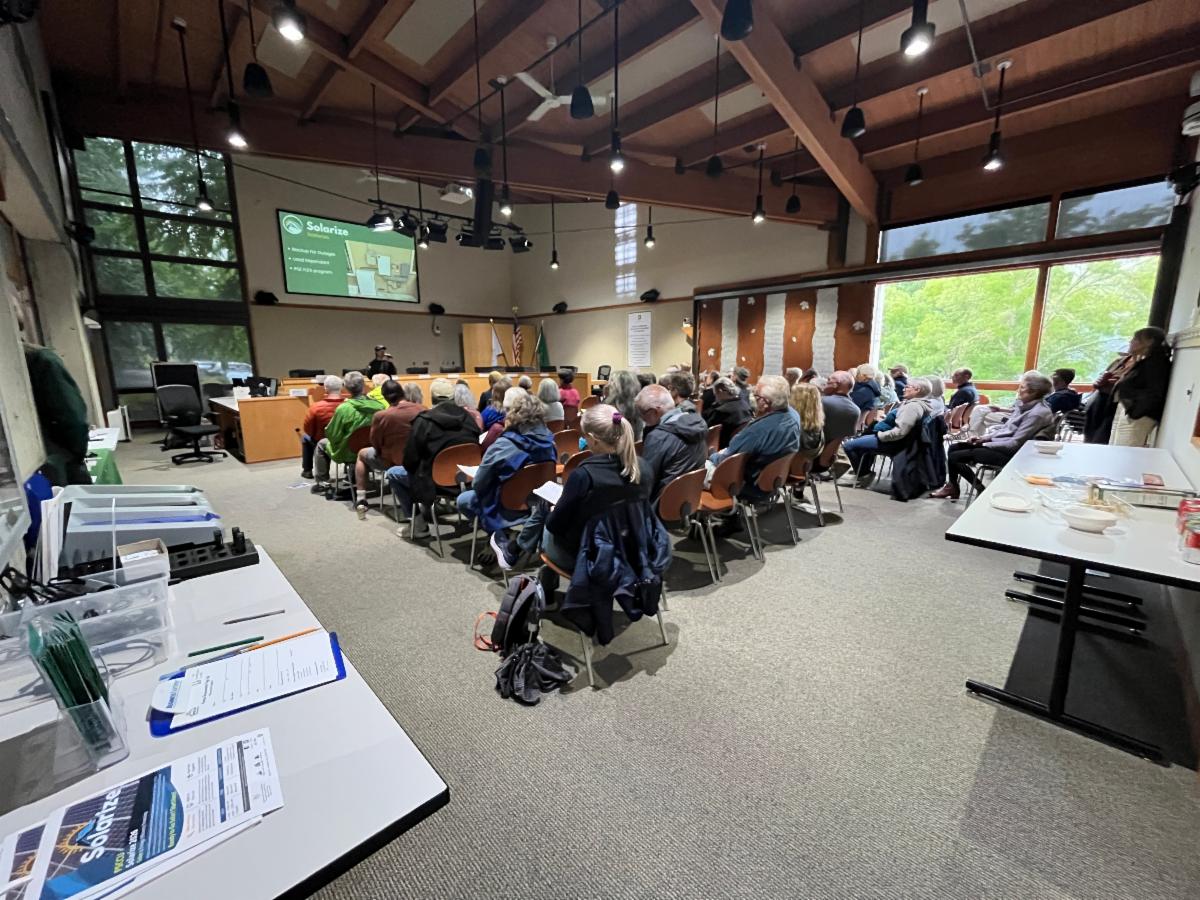
As we reported here, Grace hosted a Solarize Bainbridge workshop for homeowners last month. It is fitting that a church that has spent years navigating a difficult yet rewarding process is now turning around to help individuals and institutions do the same. As Marcy says, "This is consistent with who we are. People are excited about it."
|