Electrical and Computer Engineering Department Heads Association | | | |
Letter from the ECEDHA Executive Director
The Strength of ECEDHA is our Membership Community
| | |
Dear ECEDHA Community,
As we continue into the academic year, I want to thank our ECEDHA member institutions for their continued support and engagement. The strength of our association lies in the connections we build, the ideas we share, and our collective commitment to advancing ECE education. If your institution has not yet renewed, I encourage you to remain part of this valuable community and to take advantage of the opportunities that membership provides for your entire department.
As we prepare to welcome the ECEDHA community to the 2027 ECEDHA Annual Conference & ECExpo in San Jose, California, March 31 - April 4, we look forward to sharing program announcements and opening registration in November. With Silicon Valley as the backdrop, we are thrilled for a vibrant convening of ECE academic leaders and industry partners.
We appreciate your continued committment to ECEDHA. I personally look forward to seeing many of you in San Jose and to what we can accomplish together!
| | |
Warm regards,
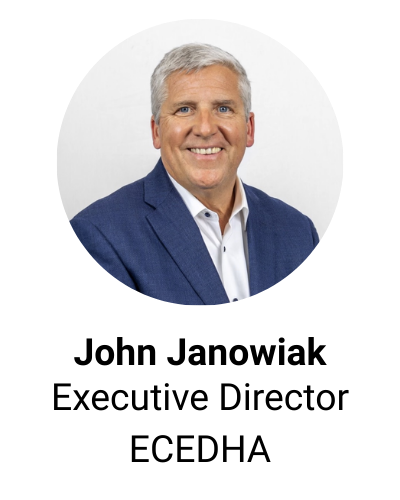
John Janowiak
Executive Director
ECEDHA
| |
RIGOL's Ultra-Portable, High Resolution DHO900 Series Oscilloscopes,
In-Stock and Ready to Ship
| | | |
RIGOL’s DHO900 Series High-Resolution Oscilloscopes are ideal for teaching, offering university engineering departments the powerful combination of feature-rich
performance, desk- and lab-friendly form factor, and budget-friendly pricing. A 7-inch touch screen display makes for easy student operation while HDMI output and web control support instruction via large screen and remote sharing respectively. DHO900
features bandwidths to 250MHz, 50Mpts memory, 1.25GSa/s sample rate and 4 channels.
Save 10% with RIGOL education discount on DHO900 Oscilloscopes!
| | | |
Growth Requires Choices. How ECE Leaders Are Setting Strategic Priorities By: Elizabeth Hibbler
As electrical and computer engineering expands into emerging fields such as artificial intelligence, quantum computing, semiconductors, and power and energy, department leaders face an increasingly complex challenge: deciding where to focus their time, talent, and resources.
With new opportunities emerging across nearly every area of ECE, growth is no longer simply a question of securing additional funding. It requires strategic choices about which programs to develop, where to invest in faculty expertise, and how to prepare students for a rapidly changing technological landscape.
| | | |
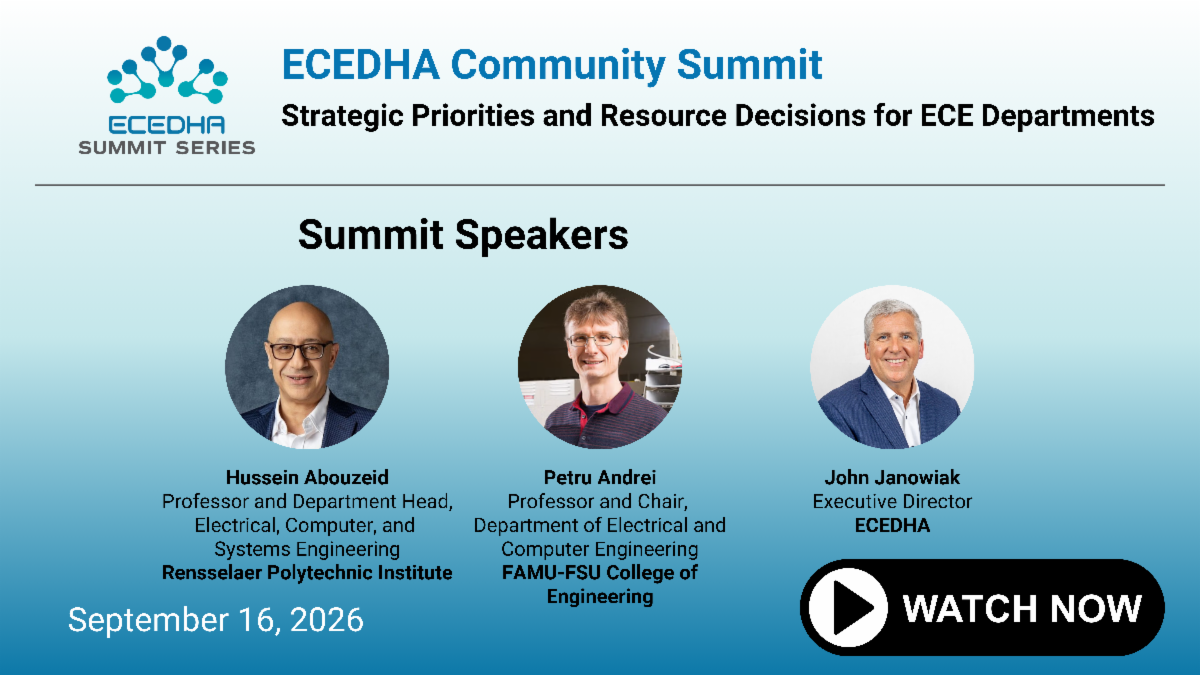
At ECEDHA's September Community Summit, Strategic Priorities and Resource Decisions for ECE Departments, two department leaders shared how their institutions are navigating these decisions and positioning their programs for future growth.
The discussion featured Hussein Abouzeid, Professor and Department Head of Electrical, Computer, and Systems Engineering at Rensselaer Polytechnic Institute (RPI), and Petru Andrei, Professor and Chair of Electrical and Computer Engineering at the FAMU-FSU College of Engineering.
Although their institutions differ in size, history, and resources, both leaders emphasized the importance of making deliberate investments that build on institutional strengths, respond to student interests, and create opportunities for long-term growth.
| | | |
Spotlight Partnerships Across the ECE Community By: Elizabeth Hibbler
Collaboration has long been central to progress in electrical and computer engineering. From research partnerships that advance new technologies to educational initiatives that expand opportunities for students, institutions across the ECE community have demonstrated what can be accomplished by bringing together different expertise, perspectives, and resources.
| | | | |
As the field continues to evolve, these partnerships remain essential. Advances in semiconductors, artificial intelligence, robotics, energy systems, and communications draw on expertise across disciplines and institutions. At the same time, ECE departments are sharing approaches to teaching, developing new educational opportunities, and strengthening connections with industry.
Across the ECEDHA community, many institutions work together to advance research and education. These efforts deserve recognition, not only for what they accomplish, but for the opportunities they create for students, faculty, and the broader ECE field.
Collaboration That Expands What's Possible
At Prairie View A&M University, Professor of Electrical and Computer Engineering Suxia Cui is leading a $1 million National Science Foundation-funded initiative to advance semiconductor education and research through a partnership with Alabama A&M University and Central State University.The initiative, Advancing Semiconductor Education through Expansion and Diversification (ASEED), brings together three historically Black universities, each contributing expertise in different aspects of semiconductor design and manufacturing.
| | | |
A Multimillion-Dollar Opportunity:
New Korea-Illinois R&D Partnership
Available to Grainger Engineers By: Em Jankauski
| | | |
The Grainger College of Engineering is pursuing a multimillion-dollar funding opportunity to develop technology in artificial intelligence, nuclear power, quantum technology and robotics.
The funding is provided by South Korea’s Ministry of SMEs and Startups and its research and development agency, the Korea Technology and Information Promotion Agency for SMEs (TIPA). In 2025, the University of Illinois Urbana-Champaign was named one of 11 partner institutions selected to help develop high-impact technologies.
Four Illinois-led projects have already received about $90,000 each in initial funding. If all four are selected to advance to the next phase, each team could receive approximately $1 million to continue research and development.
Proposals were required to focus on one of 12 Korean government-identified national strategic technologies. A total of 100 awards have been made across the partner institutions this year. The four awards led by Grainger Engineers were handpicked by Korean funding agencies interested in furthering developing the proposed technology.
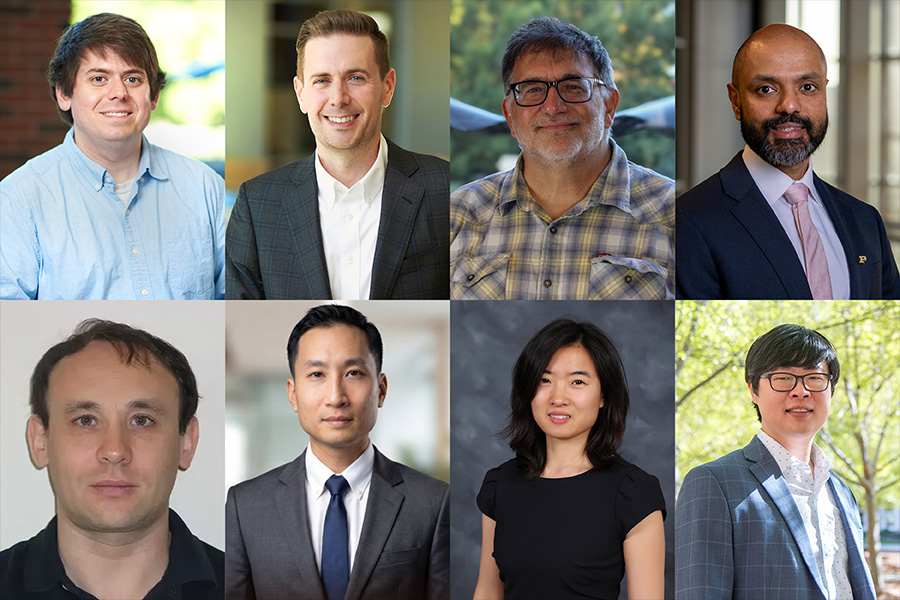
The Department of Electrical and Computer Engineering leads two of the projects. Associate professor Joohyung Kim and professor Nam Sung Kim will co-lead a robotics project, while Nam Sung Kim will lead a separate project focused on artificial intelligence.
The other Illinois-led projects focus on quantum technology and nuclear power. They are led by Department of Materials Science and Engineering assistant professor Chris Anderson and Department of Nuclear, Plasma and Radiological Engineering associate professor Angela Di Fulvio and research scientist Ming Fang, respectively.
| | | |
In a Quest for Efficiency, UF Researchers Develop a One-Way Traffic Controller for Quantum Signals By: Dave Schlenker
| | | |
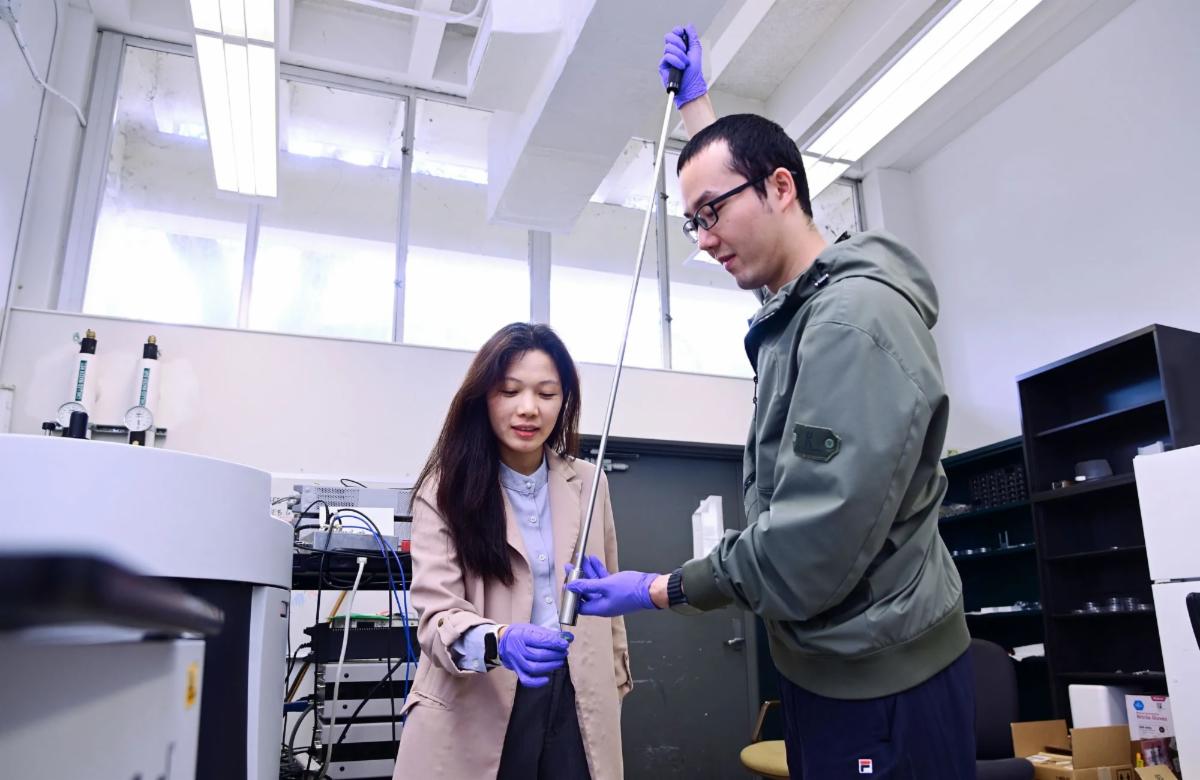
A University of Florida research team has introduced a new tuning knob for superconducting quantum circuits, a breakthrough that could mean more efficient everyday tech.
Led by Malachowsky Family Rising Star Endowed Assistant Professor Yingying Wu, Ph.D., the research examines how signals move through quantum circuits so quantum computers can be further scaled up with high fidelity. The researchers are using junction-free Josephson diodes to act as a one-way traffic controller for quantum signals, allowing better flow and preventing backscatter at the circuit level and getting more signals to their targets.
The new device is built from a two‑dimensional crystal that is twisted by a single degree; its behavior is tuned with twist angles and material thickness. This kind of superconducting diode is conventionally used as a current rectifier in classical electronics.
In this work, researchers are, for the first time, developing these diodes for quantum computing use.
“It only allows a one-way transfer, meaning no backscattering on the signal. Your qubits can only move forward; as a result, it helps reduce decoherence and thus enhance accuracy in your quantum circuit operations,” Wu said.
The twisted, nonreciprocal superconducting quantum diodes provide an intrinsic route to suppress backscattering at the circuit level and, therefore, reducing qubit fidelity degradation.
| | | |
Purdue ECE Leads $4.8M NSF Project to Bring AI-Powered Networks to Disaster Response
By: Johns Hopkins University
| | | |
Purdue University researchers have received a $4.8 million grant from the National Science Foundation to develop technology that could help first responders make faster, better-informed decisions during disasters.
The project, called HEIDRA, short for Heterogeneous Edge Intelligence for Disaster Response Analytics, is led by Christopher Brinton, Elmore Associate Professor in Purdue’s Elmore Family School of Electrical and Computer Engineering. The goal is to create a system that can collect, share and analyze critical information in real time, even when cell towers, internet connections or other infrastructure are damaged or unavailable.
During wildfires, floods, tornadoes or other emergencies, responders often need to make decisions in unfamiliar, dangerous and rapidly changing environments. HEIDRA is designed to help by connecting devices such as phones, drones, emergency vehicles and sensors into a temporary intelligent network. Instead of relying on distant cloud servers, the system will process information closer to where it is needed.
“First responders are often operating in situations where every second matters and connectivity cannot be taken for granted,” Brinton said. “Our vision for HEIDRA is to give them timely, trustworthy information from the devices already around them, while keeping people firmly in control of the decisions that matter most.”
| | | |
Leaky AI's Security Problem
By: Nathan Kahl
As AI systems become more powerful, the technology making this possible is also becoming more complex. According to George Mason University researcher Yicheng Zhang, that complexity may be creating security vulnerabilities that could put sensitive information at risk.
| | | |
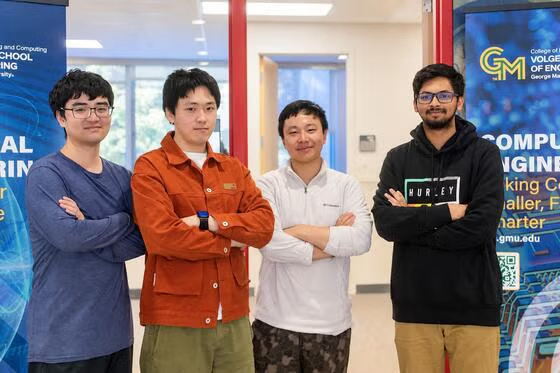
Zhang, an assistant professor in the Department of Electrical and Computer Engineering, received a two-year, $150,000 research grant from EA Funds to investigate how information can inadvertently leak through the hardware connecting the thousands of graphics processing units (GPUs) used to train and operate advanced AI systems.
The project builds on Zhang's recently published research demonstrating that the high-speed connections between GPUs can reveal information about the applications running on them, potentially allowing attackers to learn about activities they should not be able to observe.
"Our goal is to understand how this sensitive information might be leaked through these shared hardware resources," Zhang said. The next step, he said, is developing practical ways to detect and reduce those risks.
GPUs are specialized processors capable of performing many calculations simultaneously, making them essential to modern AI. Training a large language model can require thousands of GPUs working together, exchanging enormous amounts of information through high-speed connections.
One such technology is NVIDIA's NVLink, which enables GPUs to communicate rapidly. But Zhang and his collaborators discovered that the same connections that make AI computing more efficient can also expose information about what other users or applications are doing.
Their paper, "NVBleed: Covert and Side-Channel Attacks on NVIDIA Multi-GPU Interconnect," was accepted for presentation at the 2026 ACM SIGSAC Conference on Computer and Communications Security, one of the leading international conferences in cybersecurity. Zhang will present the findings in November in the Netherlands.
| | | ECE Academia–Industry Collaboration | | |
New Research Program Connects Students with World's Leading Semiconductor Manufacturer
The GT-STAR program gives students opportunities to work with faculty mentors on research while exploring future internship and career opportunities with TSMC Arizona. By: Dan Watson
| | | |
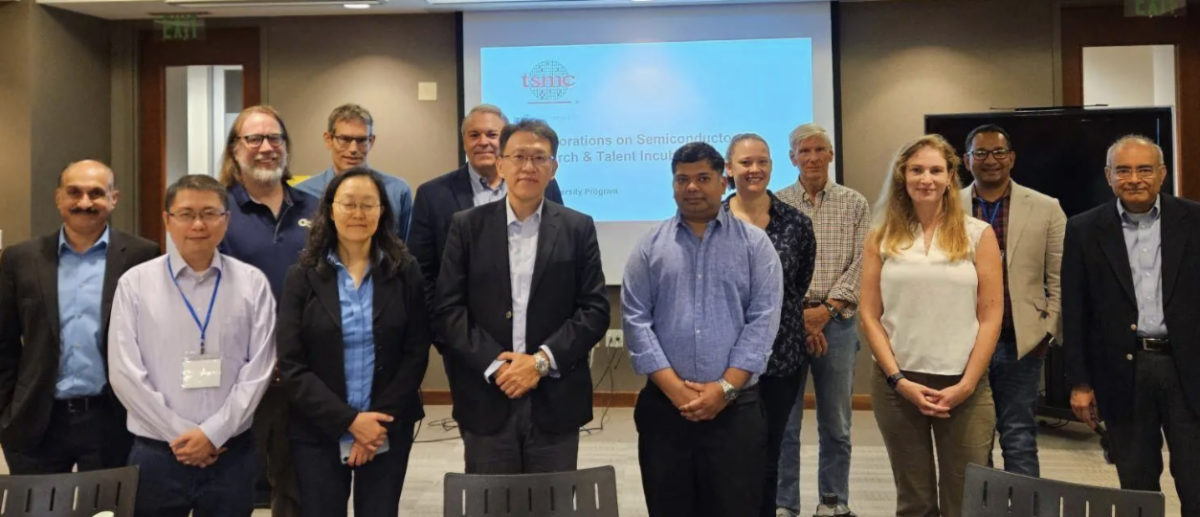
A collaboration between the Georgia Tech School of Electrical and Computer Engineering (ECE) and Taiwan Semiconductor Manufacturing Company (TSMC) is creating new opportunities for undergraduate students to participate in semiconductor research and engage with one of the industry's most influential companies.
Through the GT-STAR (Strategic Training & Advanced Research) Undergraduate Research Program, students will work closely with faculty and graduate student mentors while gaining industry exposure and exploring future internship and career opportunities with TSMC, the world's leading semiconductor foundry, as it expands its footprint in Arizona.
"As semiconductors become ever more central to powering the AI era, this collaboration with TSMC gives our students a unique opportunity to learn from and train for a crucial industry," said Matthieu Bloch, associate dean for Academic Affairs in the College of Engineering.
The collaboration addresses the continued need across the semiconductor industry for engineers with expertise in chip design, manufacturing, devices, and materials.
| | |
Connect with ECE Leaders Through ECEDHA
Reach ECE department heads and academic leaders with your organization’s news, programs, products, and opportunities through the
ECEDHA Source newsletter.
Newsletter sponsorships
are available.
Contact Kim Simpao to learn more.
ksimpao@ecedha.org
| | | Corporate Member Spotlight | | |
Q. Can you share the role your organization plays in advancing the ECE industry?
NI plays a dual role in ECE. In academia, our involvement is both providing student hardware for hands-on learning (and instruction!) of ECE concepts that ensure the ECE workforce pipeline is strong, as well as providing industry-grade prototyping and measurement hardware such as software-defined radios and modular instrumentation (like oscilloscopes, source-measure units, and RF signal generators/analyzers) for customizable research systems. In industry, a huge part of our business is providing systems out of those same modular instruments to validate and verify semiconductor products. We also leverage these ECE-centric technologies in many other industries such as aerospace, automotive and energy where testing and monitoring of physical systems such as wind turbines is done with our flexible platform. Some say that if it flies, drives or turns on, NI probably had a hand in it.
Q. From your perspective, what does a strong industry–academia partnership look like, and how is NI working to support or strengthen that relationship?
Industry-academic partnerships are a critical part of what's needed in today's asks of academic institutions. As funding bodies push for faster time to publication, greater commercialization leverage, and translation of results to workforce readiness, academic institutions must work with industry to achieve this pace.
The core of a quality partnership is a common goal, whether that be a shared research outcome or enablement of learning key skills to address industry gaps. To build those partnerships, NI is working with institutions around the world to better facilitate partnership with tools, people, and programs.
With our tools, NI is working to help researchers get better access to data and validate results more effectively, and working with educators to more effectively engage students by enabling hands-on learning that the students carry with them throughout their degree.
With our people, we have a global Academic team working to build open dialogue and communication with universities on what’s working and what doesn’t, finding those common goals to build partnerships.
Finally with our programs, we’re connecting our shared industry partners with our academic partners to facilitate the right collaboration, pulling our partner network in to help train students and professors, and work closely to understand the asks of funding organizations so we can be aligned in that common direction.
| | | New Department Chair Spotlight | | |
Q. Introduce yourself and tell us about your current role and institution
I recently joined the University of Nebraska–Lincoln as Chair of the Department of Electrical and Computer Engineering and as the Jim and Gail Anderson Professor of Engineering. Before coming to Nebraska, I spent more than two decades at Oklahoma State University, where I was a professor of electrical and computer engineering and held the Edward Joullian Endowed Chair in Engineering.
My academic background is in computer engineering, with research interests spanning computer architecture, VLSI and ASIC design, computer arithmetic, low-power digital systems, and open-source semiconductor design. Much of my work has focused on making integrated-circuit design more accessible to students and researchers. My group has contributed to open-source standard-cell libraries, memory compilers, design-automation tools, and RISC-V processor platforms.
Throughout my career, the most rewarding part of my work has been mentoring students and seeing them move from learning fundamental concepts to designing systems with real-world impact. I have also valued opportunities to connect university research with industry and national needs, particularly in semiconductor technology, aerospace, and defense.
Q. What inspired you to take on the role of department chair?
I was attracted to the opportunity to help create an environment in which faculty, staff, and students can do their best work. A chair can help bring people together, remove barriers, develop resources, and connect individual strengths to a larger departmental vision.
Nebraska was especially compelling because of the breadth of the department, its presence in both Lincoln and Omaha, and the opportunity to build stronger partnerships across the University of Nebraska system. Electrical and computer engineering touches nearly every major technological challenge—from AI, semiconductors, and quantum systems to health care, energy, communications, and national security. I saw an opportunity to help an already strong department become even more connected, collaborative, and visible.
| | | Association Announcements | |
Upcoming ECEDHA Community Summit
Industry Advisory Boards that Actually Work and Strengthening Industry-Academic Collaboration Models Tuesday, November 17, 2026, from 12:00 - 1:00 pm CT
| | | Many departments have advisory boards, but not all drive meaningful impact. Learn how to structure engagement, align expectations, and build partnerships that inform curriculum and research. | | | | |
Now Accepting Applications!
Applications are open for Impact: Redefining Electrical and Computer Engineering Faculty (iREDEFINE), an NSF-sponsored workshop that helps PhD students and postdoctoral scholars explore and prepare for academic careers in ECE.
| | | | | Join us April 1-3, 2027, in San Jose, CA, in conjunction with the 2027 ECEDHA Annual Conference & ECExpo. Fellows receive complimentary conference registration, two nights of hotel accommodations, and up to $900 in additional travel and meal expenses. | | | |
Important Dates:
- Applications Due - December 6, 2026
- Recommendations Due - December 13, 2026
- Decisions Announced - January 20, 2027
| | | | | | ECEDHA is pleased to provide a platform for members to post job announcements | | |
|
University of South Carolina (posted 10/1/26)
- Semiconductor Faculty Search
University of Washington (posted 10/9/26)
- Assistant or Associate Professor
University of North Carolina, Charlotte (posted 10/16/26)
- Assistant Professor, ECE (Tenure Track)
Liberty University (posted 10/16/26)
- Assistant Professor of CE
University of California, Berkeley (posted 10/21/26)
- Electronic, Functional, and Quantum Materials (EE & CS and Materials Science and Engineering)
Southern Illinois University, Carbondale (posted 10/23/26)
| | | |
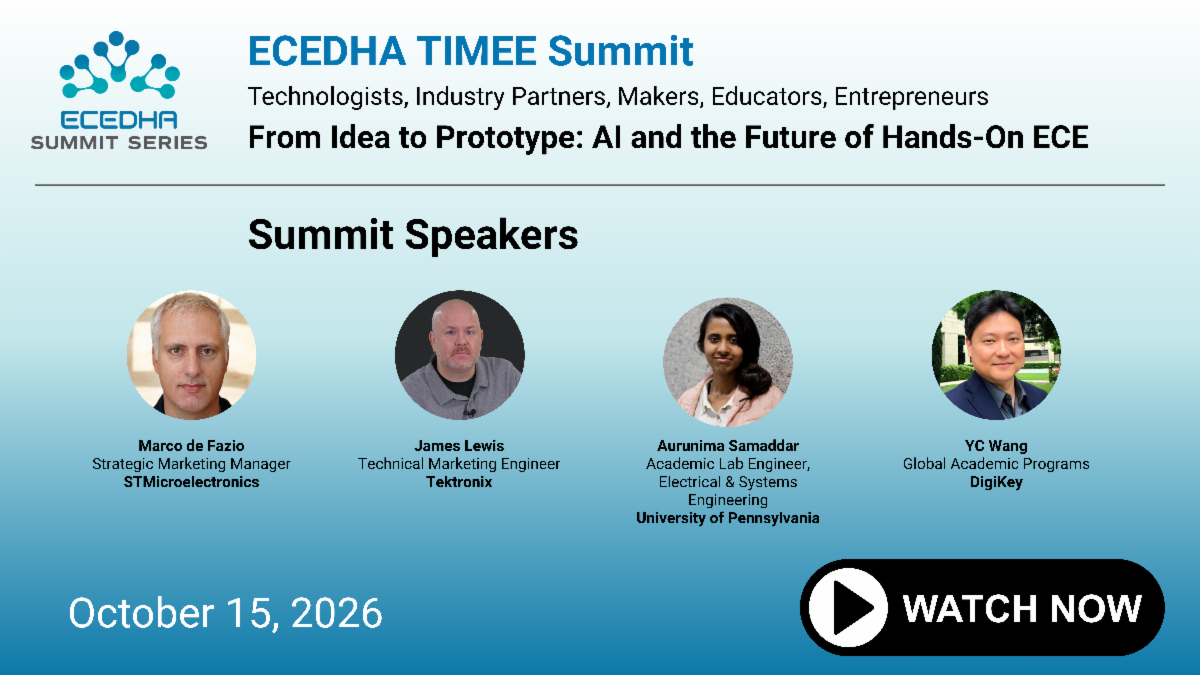
ECEDHA TIMEE Summit
From Idea to Prototype: AI and the Future of Hands-On ECE
AI is reshaping the engineering design process, from code generation and hardware design to rapid prototyping and robotics. This TIMEE Summit will explore how these capabilities can be brought into ECE labs and student projects, with examples that help students experience the full process of designing, building, testing, and refining real systems.
Sponsored by: DigiKey and Tektronix
| | | |
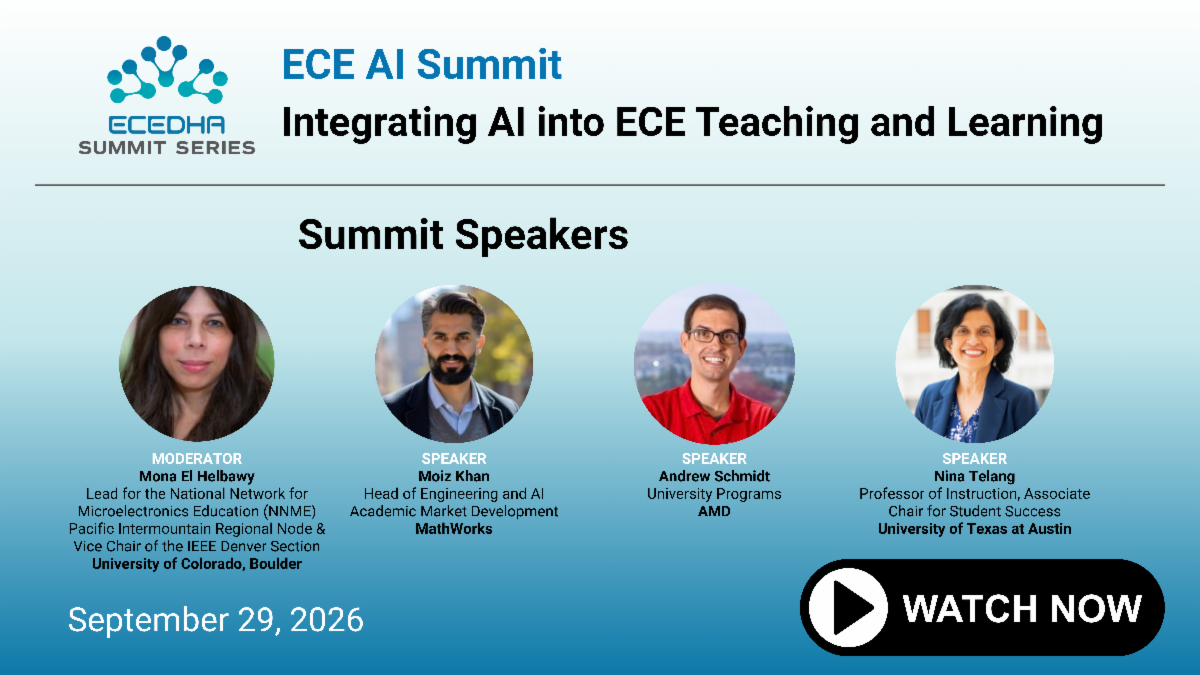
ECE AI Summit
Integrating AI into ECE
Teaching and Learning
How can faculty use AI to strengthen teaching and improve the student learning experience? This session focuses on the practical integration of AI into ECE instruction, from developing course materials and assignments to providing feedback, supporting different learning needs, and creating more engaging classroom and lab experiences. Discussion will focus on how faculty are experimenting with AI in their teaching, what is working, and where challenges remain, including perspectives on emerging tools and capabilities that could further support faculty and enhance engineering education.
Sponsored by: AMD, Engineering Unleashed, MathWorks, NI, and Tektronix
| | | |
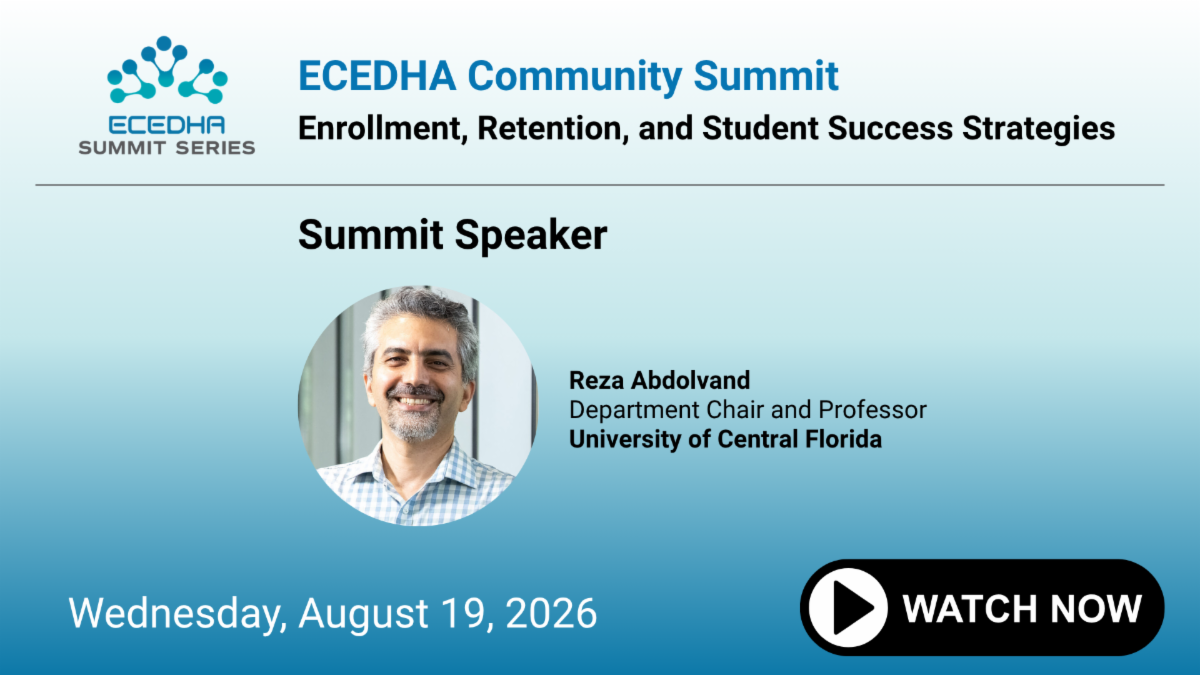
ECEDHA Community Summit
Enrollment, Retention, and Student Success Strategies
Departments are navigating shifting enrollment trends and evolving student needs. This session shares data-informed approaches to recruitment, retention, and supporting student success.
| | | A Little Engineering Humor | | |
This ECEDHA Source eNewsletter is made possible by the support of our corporate sponsors. As such, by reading selective content, your email address may be shared with our sponsors. If you do not wish for your email address to be shared, please contact privacy@ecedha.org with the subject "Do not share request."
You are receiving this ECEDHA member communication because your organization is an ECEDHA member. If you wish to unsubscribe from ECEDHA member communications, please use the unsubscribe link below.
View our communications privacy policy.
| | | | |