Electrical and Computer Engineering Department Heads Association | | | |
Letter from the ECEDHA Executive Director
The Power of Connection in a Rapidly Changing Field
| | |
Dear ECEDHA Community,
The pace of change across electrical and computer engineering has never been faster. Artificial intelligence, quantum technologies, semiconductors, and advanced communications are transforming our field, bringing new opportunities and challenges for ECE departments.
In this era of rapid transformation, the impact of a connected ECE community becomes even more profound.
ECEDHA membership brings institutions together to exchange ideas, address shared challenges, and advance engineering education. Through our Annual Conference, regional meetings, Summit Series, and year-round initiatives, we provide opportunities for meaningful engagement and collaboration across academia and industry.
Importantly, membership extends to your entire department, connecting faculty and academic leaders with valuable resources, professional relationships, and opportunities to engage with the broader ECE community.
As we look ahead to our 2027 Annual Conference and ECExpo in Silicon Valley, I encourage you to renew your institution's ECEDHA membership to take advantage of these benefits.
Your participation strengthens ECEDHA and ensures that our collective perspectives help inform the future of ECE education.
Thank you for your continued commitment to ECEDHA. I look forward to another year of collaboration and progress.
| | |
Warm regards,
John Janowiak
Executive Director
ECEDHA
| |
ECE Product Spotlight
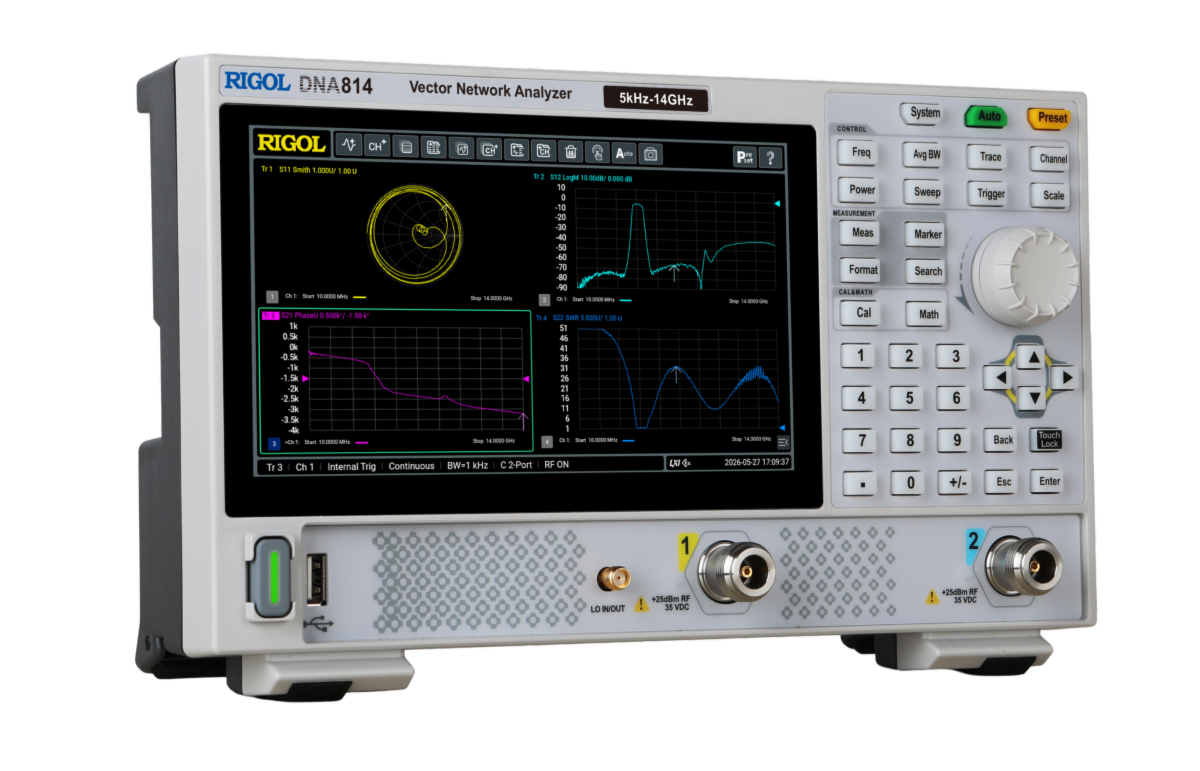
New Ultra-Portable DNA800 Series Vector Network Analyzers from RIGOL
RIGOL introduces DNA800 Series entry-level, vector network analyzers featuring two-ports and frequencies from 5 kHz to 14 GHz. DNA800 is a compact, ultra-portable VNA delivering comprehensive S-parameter and impedance measurements. With a typical 125 dB dynamic range, 1 Hz to 3 MHz IF bandwidth & 0.005 dB rms trace noise, it is ideal for testing passive
components, filters & matching networks.
| | | |
DNA800 Series Features:
- 5 kHz to 14 GHz Frequency Range
- High Dynamic Range 125 dB typ.
- 1 Hz to 3 MHz IF bandwidth
- 7-inch Multi-Touch Display
- 2 Ports
Offer: Save 10% with RIGOL Education Discount
| | | |
Partnership Announcement
ECEDHA and Engineering Unleashed Expand Engagement Across ECE
By: Elizabeth Hibbler
Some of the most important conversations in ECE education right now are not confined to a single discipline.
| | | | |
Artificial intelligence is changing how students learn and how engineers work. Employers are thinking differently about the skills they need. Departments are reconsidering curricula, hands-on experiences, industry connections, and how students are prepared to navigate a profession that will continue to change throughout their careers.
For ECE leaders, responding to those changes requires more than looking within our own departments. It also means connecting with educators and organizations that are experimenting with different approaches to engineering education.
That is one reason ECEDHA is beginning a new partnership with the Engineering Unleashed to expand engagement across the ECE academic community.
Engineering Unleashed is a community of engineering educators focused on incorporating an entrepreneurial mindset into engineering education. At its core is an idea that feels particularly relevant to the challenges departments are navigating today: engineering education should prepare students not only with strong technical capabilities, but also to recognize opportunities, understand needs, create value, and adapt as technology changes.
| | | |
The Next Technology Challenge is a People Challenge
By Elizabeth Hibbler
| |
Billions of dollars are being invested in the technologies expected to define the coming decade. New semiconductor facilities are being built. Artificial intelligence capabilities are advancing at an extraordinary speed. Investment continues in advanced communications, energy systems, quantum technologies, robotics, and new computing architectures.
But behind each of these advances is a challenge that cannot be solved by technology alone. We need people prepared to make them possible. The scale of that challenge, and the speed at which it is changing, is becoming increasingly clear. The U.S. semiconductor industry is projected to add nearly 115,000 jobs by 2030. Approximately 67,000 of those positions are at risk of going unfilled at current degree completion rates.
At the same time, AI is changing both the technologies engineers will build and the environment in which they will work. The 2026 Stanford AI Index found that organizational AI adoption reached 88% in 2025. Four out of five U.S. high school and college students are already using AI for schoolwork. The U.S. Bureau of Labor Statistics expects AI adoption to help drive strong growth in computer and mathematical occupations over the coming decade.
These developments are converging with an even larger workforce story. The U.S. STEM workforce reached 37 million people in 2024, more than one-quarter of the entire domestic workforce. It continues to grow faster than the non-STEM workforce.
For ECE departments, this is more than a workforce challenge. It is an education challenge. Rapid advances in AI, semiconductors, computing, energy, communications, and other emerging fields are changing what students need to know and how departments prepare them. ECE leaders are being asked to evolve curricula and strengthen hands-on learning. They are building new connections with industry and investing in emerging areas. At the same time, they must preserve the fundamentals that remain essential to an ECE education.
These decisions are happening now, in departments across the country. They will influence the capabilities of the engineering workforce for years to come.
| | | "As the leaders of our departments, we're responsible for the decisions that affect faculty, staff, and our students. The more we know, the better decisions we can make. Being a member of ECEDHA and participating in its programs helps me be the best department chair I can be. " | | | |
Enrollment Is Shifting. How Can ECE Departments Respond? By: Elizabeth Hibbler
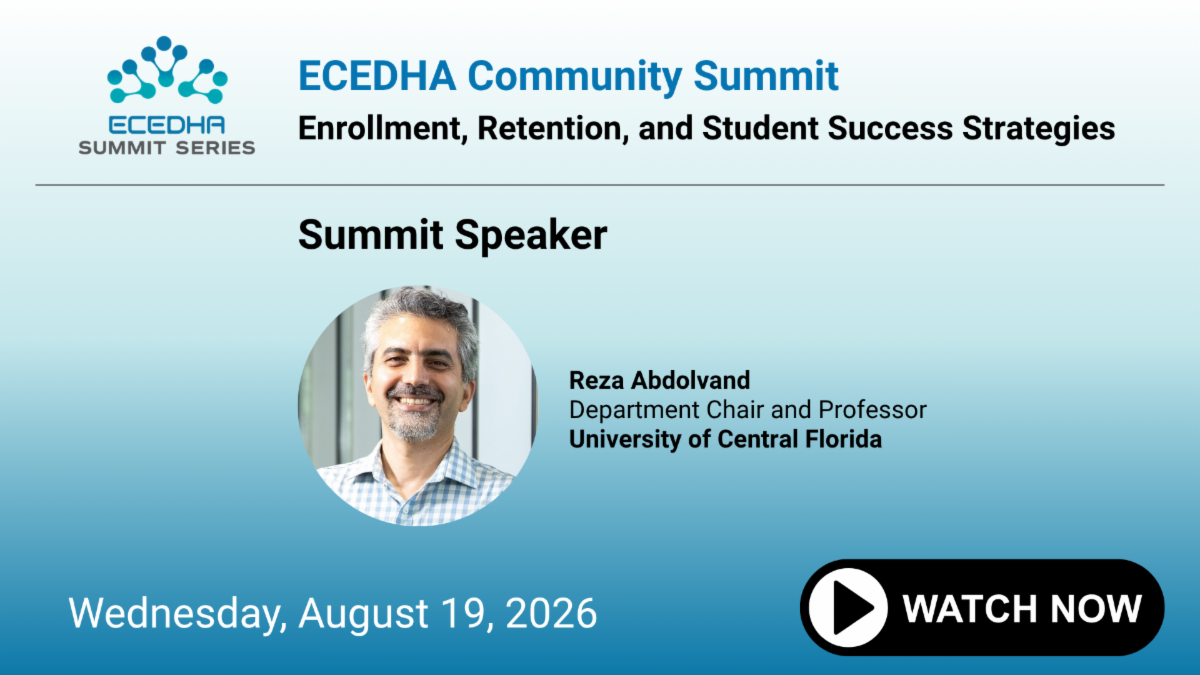
Enrollment trends across electrical and computer engineering are shifting, but not always in the same direction. At ECEDHA’s August 19 Community Summit, Enrollment, Retention, and Student Success Strategies, department leaders shared what they are seeing on their own campuses. Some reported significant growth. Others are seeing relatively flat enrollment or declines in particular programs. Several noted differences between electrical engineering and computer engineering enrollment, even within the same department.
| | | |
The discussion highlighted an important question for ECE leaders. As student interests and enrollment patterns change, how can departments respond in ways that not only attract students, but help them see a future in ECE? Featured speaker Reza Abdolvand, Distinguished Professor of Electrical Engineering at the University of Central Florida, shared how UCF is approaching that challenge through intentional student pathways, undergraduate research, and industry connections.
UCF itself offers an interesting case study in growth. The ECE department is approaching 2,300 undergraduate students, with much of its recent growth coming from electrical engineering. At the same time, the department has grown from approximately 35 faculty members when Abdolvand became chair to nearly 60.
Growth brings opportunity, but it also creates new challenges. More students require more faculty, additional course sections, laboratory capacity, and strategies for maintaining educational quality. UCF, for example, caps many ECE courses at 75 students and offers multiple sections in parallel.
But one of the most interesting lessons from UCF was not simply how the department is managing more students. It was how the department is thinking about what happens next for those students.
| | | |
Renowned Vanderbilt Institute for Software Integrated Systems Renamed 'ICONS'
By: MyVU News
| | | |
After nearly three decades of research in complex software-enabled systems, Vanderbilt University’s Institute for Software Integrated Systems is entering its next chapter with a new name: the Institute for Convergent Software Integrated Systems, or ICONS.
Founded in 1998, the institute has remained focused on understanding, engineering and operating complex systems that are safe, secure and resilient. What has changed is the nature of the systems themselves.
“Our mission has remained remarkably consistent, even as the technologies, systems and challenges around us have evolved,” said Sandeep Neema, director of ICONS and a professor of computer science and electrical and computer engineering. “The addition of ‘Convergent’ reflects how we work today—bringing together disciplines, perspectives and technologies that have historically stood apart to address increasingly complex problems in national security and society. ICONS builds on the strong foundation of our past while more clearly expressing our vision for the future.”
| | | |
ECE Faculty Create Two New Introductory Engineering Classes
The Classes Focus on Next Generation Computing Hardware and Computational Machine Learning
By: Catharine June
| | | |
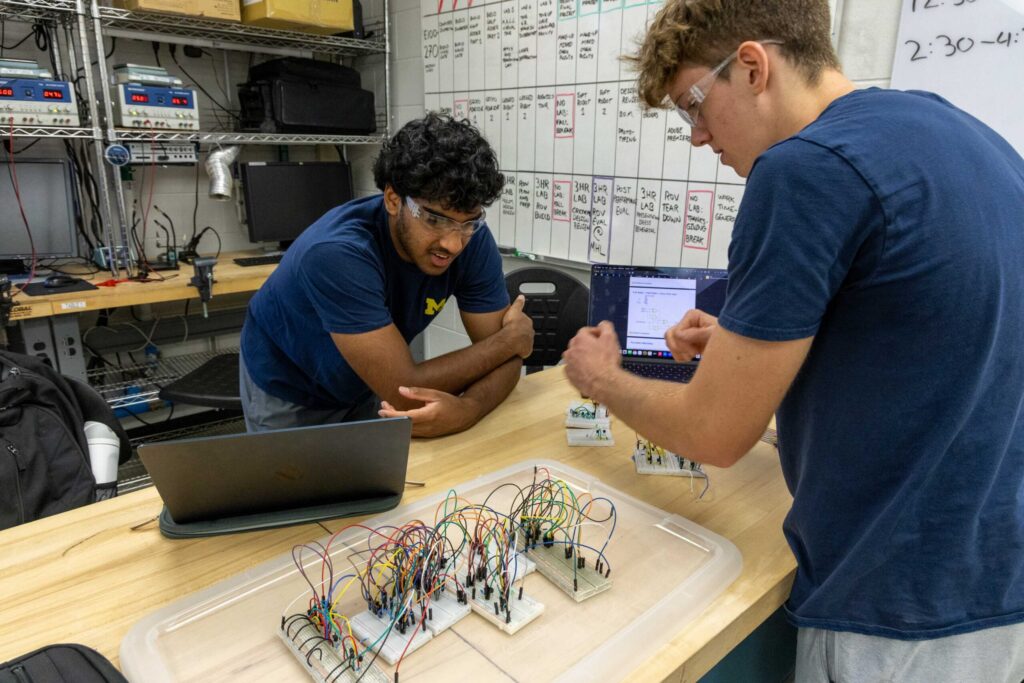
One of the first courses taken by all students entering the College of Engineering is a section of Engineering (ENGR) 100. ENGR 100 courses are designed to introduce students to what it’s like to be a practicing engineer. ECE faculty have recently developed two new courses to add to the selection. They are focused on next generation computing hardware and computational machine learning, areas that increasingly depend on one another to drive innovation.
Faculty throughout the College design these project-based courses to be general enough to provide material relevant to students of any major, while also focusing on the expertise of the individual teaching the course.
“It’s like a first year version of a major design experience course,” said Prof. P.C. Ku, who designed the course on next generation computing hardware. “It has hands-on experiences, and there is an open-ended systems design component to the class.” [read more about ECE’s pedagogical focus on open-ended systems design.]
| | | |
Hopkins Researchers Help Policymakers Assess Data Centers and Energy Planning
Two resources state leaders can use to develop evidence-based policies to manage data centers, infrastructure needs, and energy affordability.
By: Johns Hopkins University
| | | |
As electricity usage associated with data centers, advanced manufacturing, and society-wide decarbonization is projected to increase significantly over the next five years, leaders from across the political spectrum are exploring the policy levers that can help protect ratepayers from increases.
“The nation as a whole is projected to run out of electricity in the very near future,” said Abe Silverman, assistant research scholar with the Johns Hopkins Ralph O’Connor Sustainable Energy Institute (ROSEI). “In the regional grid that we sit in called the PJM Interconnection, the nation’s largest electricity market, they’re predicting that they’re going to run out of supplies in June of 2027.”
There’s often tension between this stark projection and the rapid growth of artificial intelligence. But Silverman said energy security and AI development don’t need to be at odds with each other.
“AI dominance and national security and U.S. energy dominance is entirely consistent with the strategy of making sure that the data centers are funding the new infrastructure that they require,” he said.
To help policymakers better navigate these decisions, he and other Hopkins experts have developed research-driven policy tools and strategies that leaders can deploy to balance energy affordability and reliability with infrastructure growth and tech innovation.
| | | |
At 90, UCLA's Judea Pearl Is
Still Asking the Big Questions
From transforming artificial intelligence to pursuing dialogue across divides, the UCLA pioneer has spent a lifetime turning uncertainty into understanding By: UCLA Newsroom
| | | |
Judea Pearl has spent most of his life thinking about some of the hardest questions there are.
How can machines reason when they don’t have all the information? How can scientists distinguish correlation from cause and effect?
How can people divided by religion, culture and politics better understand each other? And, after the murder of his son Daniel, how does a parent make sense of the senseless?
On Sunday, Sept. 6, more than 50 colleagues, former students, friends and admirers gathered at UCLA, Pearl’s academic home for the past 56 years, to celebrate the pioneering computer scientist as he turned 90 and to consider some of the questions that have animated his extraordinary career.
The daylong Pearl@90: Honoring Judea Pearl celebration at UCLA’s Covel Grand Horizon Ballroom — organized by several of his academic protégés — covered broad terrain, much like Pearl’s own interests and influence, with personal tributes and discussions exploring artificial intelligence and causal reasoning, Jewish identity, dialogue and coexistence, and peace.
UCLA Chancellor Julio Frenk, in his remarks at the event, lauded Pearl’s enduring willingness to wrestle with some of the most challenging issues of his time.
“Judea has spent a lifetime in conversation with life’s most difficult questions,” Frenk said. “And in doing so, he has been a living testament to what higher learning makes possible.”
| | | |
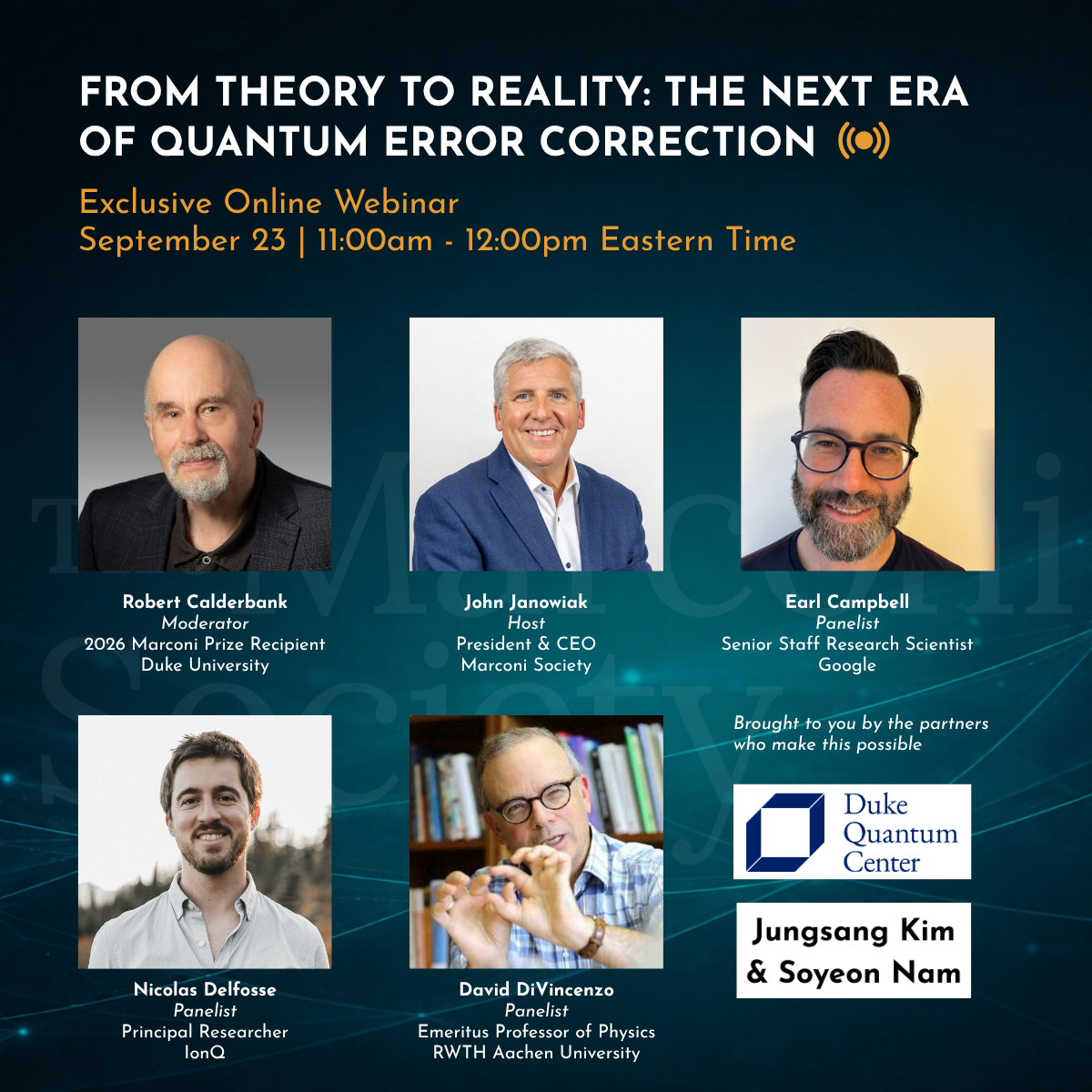
Exclusive Marconi Society Webinar: From Theory to Reality - The Next Era of Quantum Error Correction
Wednesday, September 23, 10:00 am CT
| | | |
This exclusive, 60-minute session brings together some of the most influential minds in quantum information science. This rare assembly brings together the foundational experts of quantum error correction (QEC) and the leading architects of today's cutting-edge fault-tolerant architectures
- Robert Calderbank
- David DiVincenzo
- Earl Campbell
- Nicholas Delfosse
| | | | | |  |
Connect with ECE Leaders Through ECEDHA
Reach ECE department heads and academic leaders with your organization’s news, programs, products, and opportunities through the ECEDHA Source newsletter.
Newsletter sponsorships
are available.
Contact Kim Simpao to learn more.
ksimpao@ecedha.org
| | | Corporate Member Spotlight | | |
Q. Can you share the role your organization plays in advancing the ECE industry?
RIGOL makes electronic test and measurement tools that engineers use to build, test, troubleshoot, and ultimately turn their ideas into working products. We cover the range of standard bench equipment, from basic instruments like power supplies, multi-meters, and function generators to more advanced instruments like oscilloscopes, spectrum analyzers, signal generators, and vector network analyzers.
What excites me personally is helping bring capabilities that were once limited to big-budget labs into the hands of a much broader group of engineers and students
Technologies that historically lived mostly in very expensive instruments, such as real-time spectrum analysis, high-bandwidth oscilloscopes, advanced VNAs, jitter and signal-integrity tools, are becoming available to smaller companies, universities, and individual engineers.
I think that matters. Innovation tends to accelerate when good tools stop being scarce resources.
Q. From your perspective, what does a strong industry–academia partnership look like, and how is your organization working to support or strengthen that relationship?
The strongest industry–academia partnerships are a real two-way exchange, not just equipment donations or sponsorships.
Industry can give educators better visibility into where technology is headed, the problems engineers are actually running into, and the skills that are becoming more important. Universities, in turn, are often exploring ideas years before there is a real commercial market for them.
For us, the goal isn’t just to put modern instruments in a lab. We want to help faculty give students more opportunities to build, measure, troubleshoot, and solve real engineering problems through labs, research, senior projects, and better access to test equipment.
We also want to listen. What are students working on? Where are the limitations in the lab? What new technologies are starting to show up in research? What measurements would faculty like to teach but can’t today? Those conversations should shape both how we support universities and, over time, the products we build.
To me, that’s what makes it a partnership rather than just a vendor relationship.
| | | New Department Chair Spotlight | | |
Q. Introduce yourself and tell us about your current role and institution
My name is Weiguo Yang and I go by Bill for colleagues or Dr. Yang for my students, it is just easier, isn’t it? 😊
I grow up in China and before came to US for my Ph. D., I studied laser physics and quantum optics, in particular the collective quantum optical phenomena induced by RF and/or acoustic waves. My Ph.D. work advised by Dr. Warren S. Warren then at Princeton is focused on the ultrafast pulse shaping and its applications in highspeed optical communications. After my Ph.D. I joined Bell Labs doing forward-looking R&D in integrated photonic circuits and devices and their applications in optical networks. I had patents in optical channel monitoring as well as mode-locked semiconductor lasers. I also studied polarization mode dispersion in long-haul optical fiber transmissions. After joining Western Carolina University, my research expanded to include metamaterials and plasmonic materials and more recently in quantum computing and quantum information. I’m a life-long learner and have recently completed multiple training and courses in ML/AI, LLM, and LLM harness design using LangChain/LangGraph.
I have taught at WCU for almost 20 years and have taught almost every course in the BSEE curriculum. With strong support from NC legislators, engineering programs at WCU are expanding and we also got state funding to build a new engineering building. The College of Engineering now comprises of three departments with a new ECE department. We have two ABET accredited programs, BSEE and BS-Electrical and Computer Engineering Technology (ECET) with total of 15 faculty members and more than 250 students and growing. I was appointed to be the Interim Department Head of the new ECE department.
Q. What inspired you to take on the role of department chair?
I’d like to help setting up the new ECE department to be a place where students, faculty, and staff can all successfully pursue their own professional passion, for example, through more collaborations with industry partners and other institutions.
| | | Association Announcements | |
Upcoming ECEDHA AI Summit
Integrating AI into ECE Teaching and Learning
Tuesday, September 29, 2026, 1:00 - 2:00 pm CT
How can faculty use AI to strengthen teaching and improve the student learning experience? This session focuses on the practical integration of AI into ECE instruction, from developing course materials and assignments to providing feedback, supporting different learning needs, and creating more engaging classroom and lab experiences. Discussion will focus on how faculty are experimenting with AI in their teaching, what is working, and where challenges remain, including perspectives on emerging tools and capabilities that could further support faculty and enhance engineering education.
| | | | | ECEDHA is pleased to provide a platform for members to post job announcements | | | |
Featured Job Posting
Virginia Commonwealth University (posted 9/21/26)
- Department Chair, Electrical and Computer Engineering
| | | |
|
University of Manitoba (posted 9/21/26)
- Assistant Professor, Computer Engineering
- Assistant Professor, Electrical Engineering
Liberty University (posted 9/3/26)
- Assistant Professor of Electrical and Computer Engineering
University of Wisconsin, Platteville (posted 8/13/26)
- Assistant Professor of Electrical and Computer Engineering
University of Pittsburgh (posted 7/23/26)
- Professor, Department Chair
| | | |
ECEDHA Community Summit
Enrollment, Retention, and Student Success Strategies
Departments are navigating shifting enrollment trends and evolving student needs. This session shares data-informed approaches to recruitment, retention, and supporting student success.
| | | |
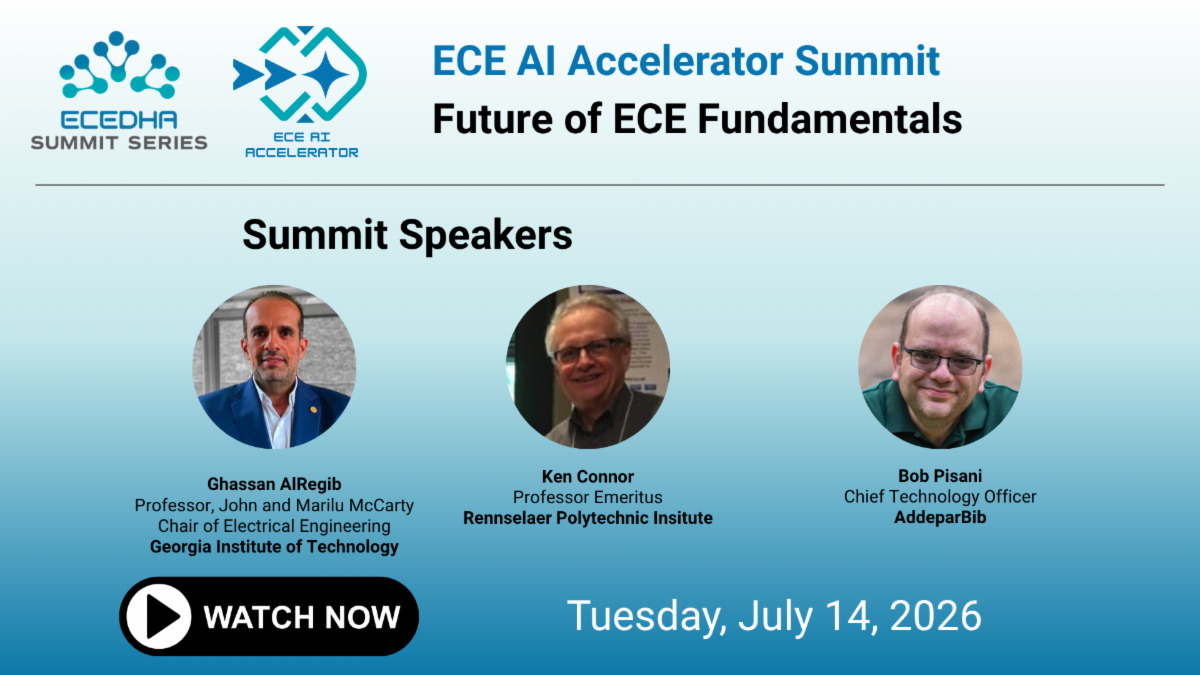
ECE AI Summit
Future of ECE Fundamentals
As AI reshapes engineering education and industry practice, ECE programs and companies alike are evaluating the balance between foundational technical knowledge and emerging AI-driven skill sets. This session brings together academic and industry leaders to discuss how core ECE competencies are evolving, what skills employers are seeking, and how universities and companies can work together to prepare students for the future workforce while maintaining academic rigor and strong engineering fundamentals.
| | | |
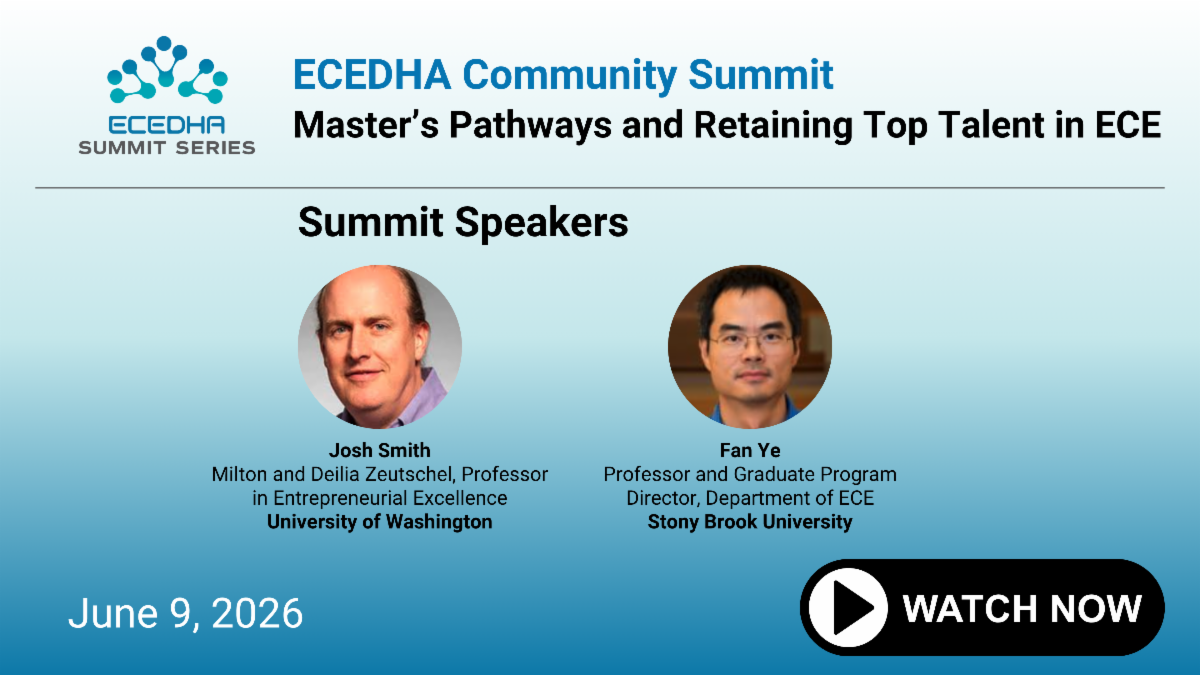
ECEDHA Community Summit
Master's Pathways and Retaining
Top Talent in ECE
In this session, we will explore Master’s pathways and other innovative models designed to retain top talent in ECE and accelerate degree completion. We will examine how institutions are aligning undergraduate and graduate curricula, strengthening advising and mentorship, and creating streamlined pathways that encourage students to continue into advanced study and leadership opportunities in the field.
| | | A Little Engineering Humor | | |
This ECEDHA Source eNewsletter is made possible by the support of our corporate sponsors. As such, by reading selective content, your email address may be shared with our sponsors. If you do not wish for your email address to be shared, please contact privacy@ecedha.org with the subject "Do not share request."
You are receiving this ECEDHA member communication because your organization is an ECEDHA member. If you wish to unsubscribe from ECEDHA member communications, please use the unsubscribe link below.
View our communications privacy policy.
| | | | |