|
The SWSP’s goal is to improve the supply of ecologically-appropriate native seeds for restoration projects in New Mexico and Arizona. The SWSP is represented by diverse public and private partners, from land managers and natural resource scientists to on-the-ground restoration practitioners and native seed farmers and nurseries.
In the midst of the growing season, we wanted to reconnect with this Newsletter to introduce new SWSP staff, share an uplifting story of farmer outreach, an example of completing the native plant materials cycle, a glimpse into an efficient irrigation approach, and next year’s seed production opportunities. Don’t forget to scroll to the end to check out upcoming events, including a seed production workshop hosted by one of our awesome SWSP growers!
| | Meet our new SWSP Team Members | | |
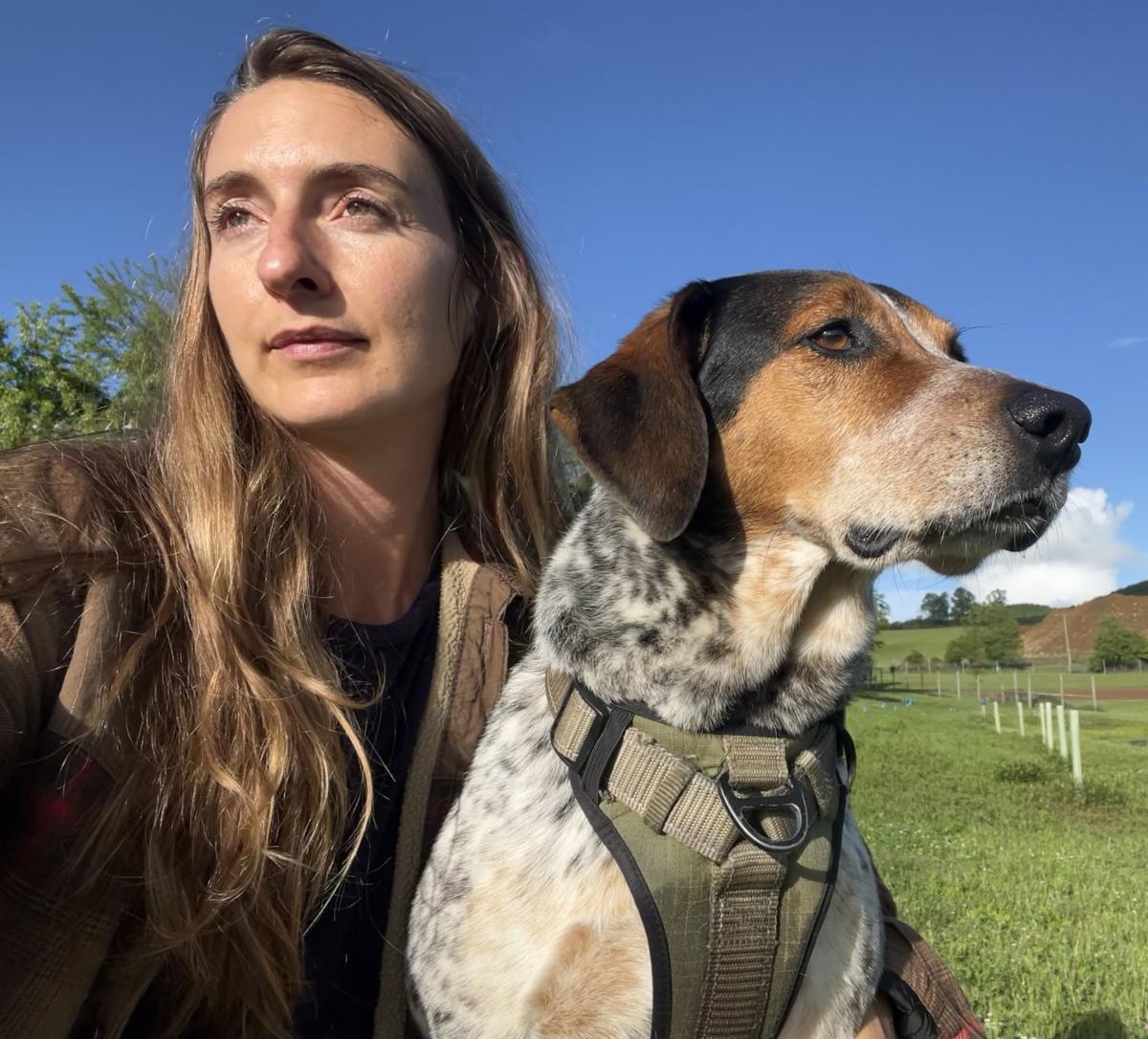
Mia Brann (SWSP Coordinator): Mia has transitioned from the role of Restoration Ecologist to Southwest Seed Partnership Coordinator this year, and she couldn’t be more excited about getting to know the SWSP growers in New Mexico and Arizona. In her previous role as a Restoration Ecologist at IAE, she supported restoration and recovery projects for pollinators including the monarch and silverspot butterflies; forecasted Forest Service restoration needs through seed projection analyses; and provided seed collection and cleaning support. She received her B.S. in Plant Science at Purdue University and her M.S. in Biology from Northern Arizona University, where her research was focused on disturbance ecology of endangered forb Pectis imberbis in southeastern Arizona.
| |
Sarah DeSimone (SWSP Technician): Sarah is the Southwest Seed Partnership Technician for IAE's office in Santa Fe, New Mexico. She offers boots-on-the-ground support for IAE's Southwest Seed Partnership and Native Crop Toolkit initiatives, assisting farmers with native plant and seed production throughout New Mexico and Arizona. Sarah holds a B.A. from Mary Baldwin University in Virginia where she studied Economics with a concentration in Food Systems and Environmental Justice and has a background in regenerative farming.
| | IAE’s Farmer 2 Farmer Hub Reaches over 1,500 Farmers! | | |
We’ve kickstarted the Farmer 2 Farmer (F2F) Native Crop Toolkit. In the last few months, the SWSP and IAE Southwest Restoration Team have connected with 29 local farming networks reaching over 1,500 farmers and have met with 20 farmers in the Rio Grande watershed of New Mexico who are interested in installing native seed production fields, native cover crops, pollinator hedgerows, or on-farm habitat restoration. This project engages a wide audience of farmers in New Mexico who are interested in regenerative farm practices that will increase pollinator and wildlife habitat, increase soil health, and decrease crop inputs and runoff into the watershed. Through our Conservation in Prisons program, we are also planning to collaborate with the Central New Mexico Correctional Facility in Los Lunas, New Mexico, to cover crop a fallow field with native species and establish a native seed production field. This collaboration will provide long-term, hands-on education opportunities for the adults in custody at the facility.
Seven farms have been chosen to participate this year, but we are still looking for farmers interested in participating next year, especially farms interested in transforming > 5 acres of fallow or degraded land into pollinator and wildlife habitat through our on-farm restoration tool. Priority will go to New Mexico farms within Santa Fe, Sandoval, Bernalillo, Valencia, and Socorro counties with available acreage adjacent to working lands. Restoration seeding and planting will occur in early fall 2027. Please complete a farm assessment form if interested in participating in this program or getting involved as a grower for the SWSP in general.
Even if you’re not located within the project area, there are still ways to participate through workshops, webinars, and technical guides and video chapters which will be developed over the next year. You can view recordings of our first two F2F webinars and stay up to date on resources and events by visiting the F2F Hub website.
| | |
Follow the Seed
The Story of a Chihuahuan Desert Species
The Southwest Seed Partnership tracks seed from wild collections, through seed increase production, and all the way back into the ground via restoration projects. Here’s the story of five wild Ratibida columnifera collections and how they ended up being seeded out to create habitat for grassland birds in the Chihuahuan Desert. This work was funded by the Bureau of Land Management (BLM).
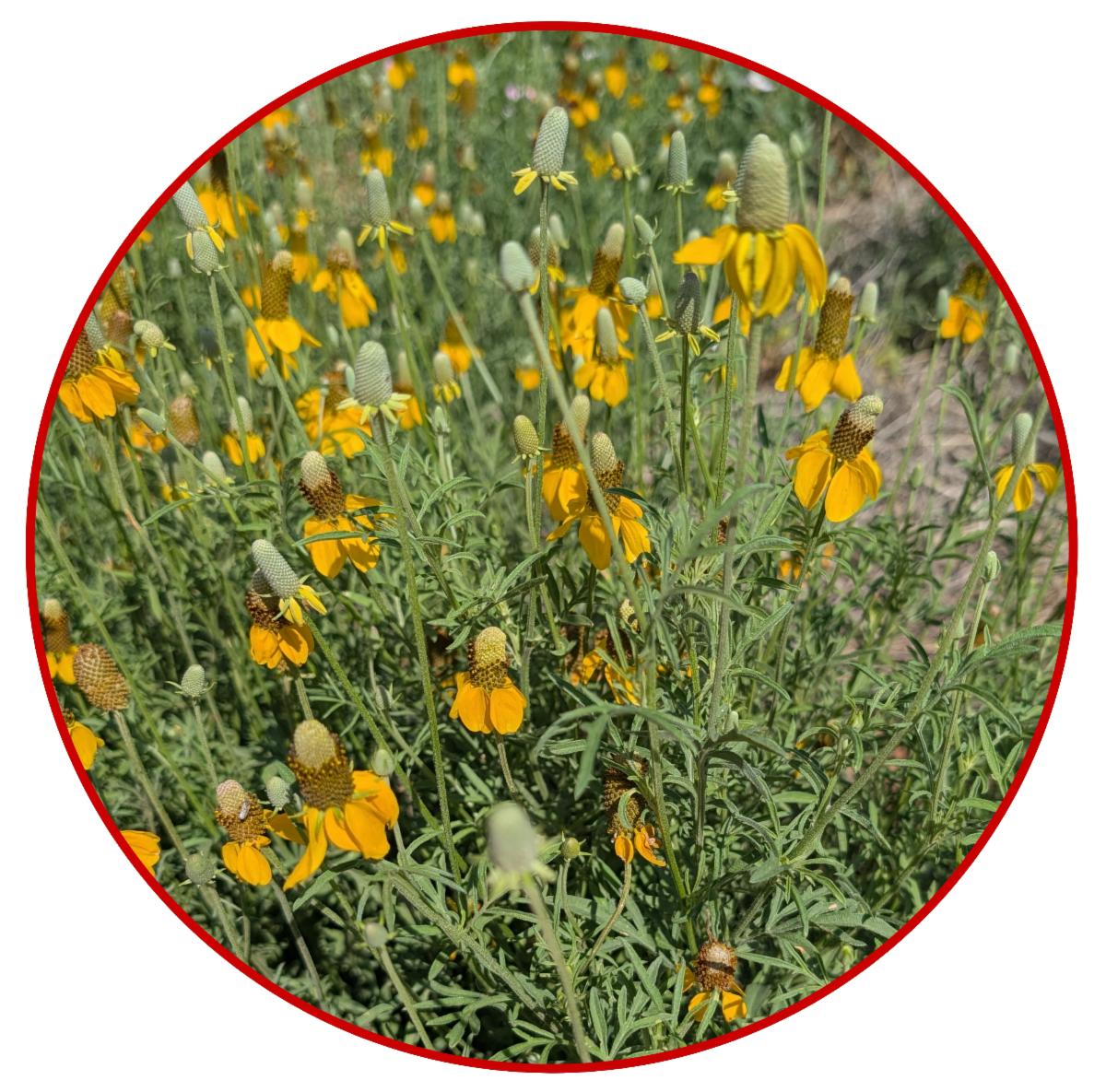
First, let’s introduce our main character: Mexican hat, upright prairie coneflower, long-headed cone flower, or thimbleflower. This is a widespread drought tolerant plant that you may see growing along trails and roadsides or in beautiful meadows. This plant is a strong competitor and a great candidate for restoration as it is typically quick to establish itself.
| | |
In 2016, 2019, and 2020, seed collection crews scouted the landscape for upright prairie coneflowers swaying in the wind. In the heat of summer in the heart of the Chihuahuan Desert, these crews filled their paper bags with seed, following sustainable collection protocols. Each year they brought their bounty of seeds back to our seed lab in Santa Fe, New Mexico, to be cleaned and stored in the seed cooler. Not all species stay viable for long periods of time, but storing seed in a temperature and humidity controlled cooler helps to preserve the longevity of seeds.
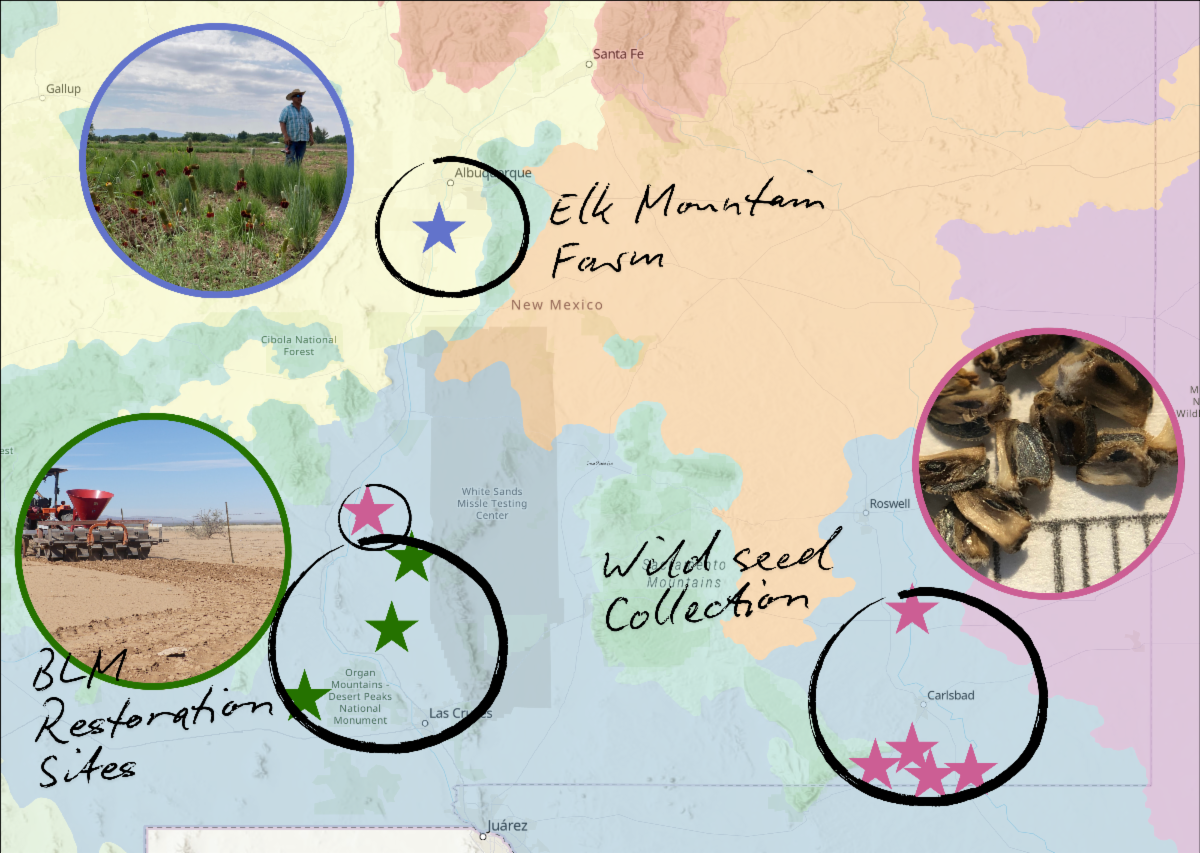
In 2021, five collections of Mexican hat were rounded up for their next adventure in seed production fields. We mixed these collections together to increase the genetic diversity and resilience of the production field and the subsequent seed harvest. Starter plugs were outplanted in a 0.125-acre field at Elk Mountain Farm on Isleta Pueblo, New Mexico, in 2021 and had two successful years of harvest. Over 37 lbs of seed was brought back to our seed lab to be cleaned and stored.
Just as these harvested seeds were getting antsy to be released from the cooler, on one lucky day in 2025, they were brought to their new home - three BLM restoration sites in the Chihuahuan Desert. The Chihuahuan Desert provides overwintering habitat for 90% of grassland birds. These areas were chosen to monitor changes in the bird community before and after seeding grasses and wildflowers with a keyline imprinter seeder (KIS). If you’d like to learn more about this project and the KIS method, check out this blog post by IAE Ecologist, Katy Silber!
| | Background colors indicate Omernik Level III Ecoregions, which are broad seed transfer zones that can be used when there are not hyper-local constraints needed to bound seed movement. Seed was collected and eventually seeded in the Chihuahuan Deserts Ecoregion, and seed was increased in the southern portion of the Arizona / New Mexico Plateau Ecoregion. | | The SWSP prioritizes making smart decisions about seed movement within each stage of the native plant materials process, keeping these Chihuahuan Desert seeds local. When we make wild collections of seeds intended for seed increase production, we’re in it for the long haul. Scouting, cultivating, and sowing are no easy feats, but the seed collectors, growers, and restoration practitioners who are part of the SWSP all support appropriate sourcing of seeds. | |
Grower Corner
Buried Driplines for Arid-Land Farming: A Conversation with Justin Brereton, Fieldhouse Farms
We’ve heard first-hand from growers in the Southwest this season that the lack of snowpack this winter is bringing unprecedented challenges, as arid-land farming is all about the water. Finding the balance between keeping these plants happy and keeping them adapted to the ever-changing precipitation patterns their progeny will face once they are seeded at a restoration site is challenging, and requires considering your farm’s water availability and infrastructure.
The SWSP has worked with growers who utilize flood irrigation via acequia, sprinklers, and drip irrigation, and there’s no one-size-fits-all irrigation strategy for native seed production. The only easy answer is to get to know what works best for the plants you are growing, your water source, and your landscape.
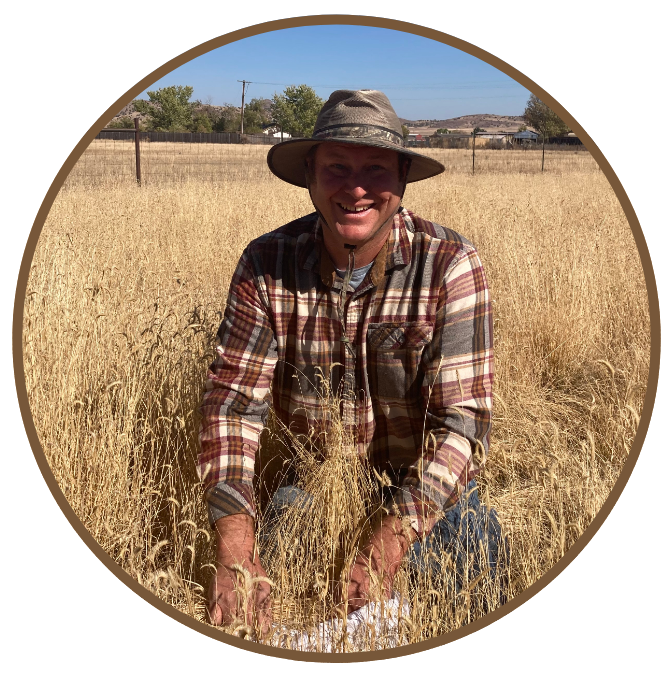
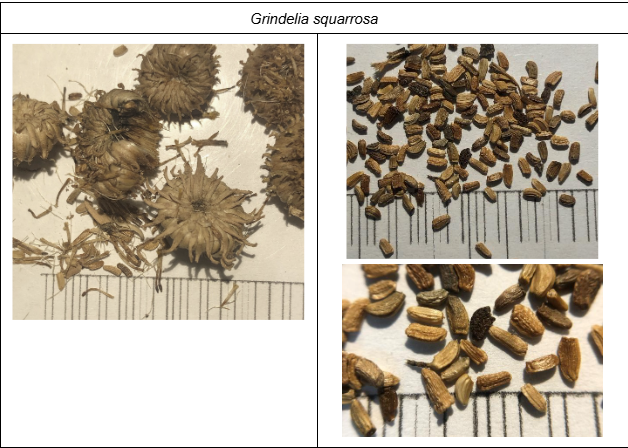
Justin Brereton, professor of Horticulture at Yavapai College, owns Fieldhouse Farms, a family-run home-based agricultural property covering 5 acres, established in 2017. He has grown 1.5 acres of small-scale seed production fields (0.1-0.25 acres/species) with the Southwest Seed Partnership since 2021. He is based in Chino Valley, AZ and has grown yarrow (Achillea millefolium), blue grama (Bouteloua gracilis), bottlebrush squirreltail (Elymus elymoides), beardlip penstemon (Penstemon barbatus), prickly poppy (Argemone pliecantha), ragleaf bahia (Hymenothrix dissecta), Wright’s deervetch (Lotus wrightii), curlycup gumweed (Grindelia squarrosa), Rocky Mountain bee plant (Cleomella serrulata), and junegrass (Koeleria macrantha). Justin started his seed production journey with drip tape and has tweaked his methods along the way.
| |
“After using drip tape in my first native seed production field, I was hooked. It is affordable, easy to install, and very water efficient,” Justin said.
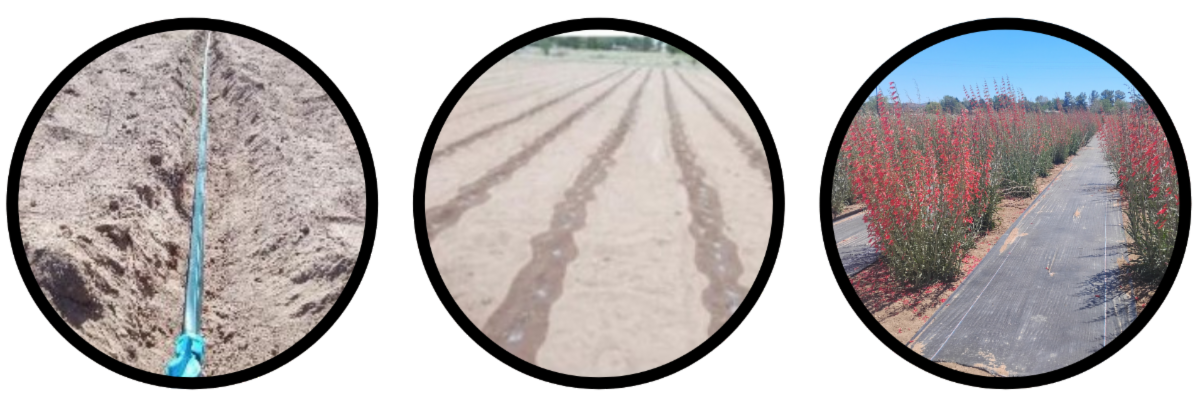
For his second seed production field, he dug deep, burying sturdy 15 millimeter drip tape 4 inches deep in the center of each planting row. This allowed him to be very precise and efficient with his watering.
“After a deep irrigation, the wetting pattern reaches the planting holes while moving moisture deeper into the soil. This reduces evaporation, delivers water directly to the root zone, and helps suppress weeds by keeping the soil surface between rows dry,” said Justin. He decided to continue this method for his next production fields.
| |
Although you can deliver pinpoint irrigation to your crops, it’s not always a set-it-and-forget-it method. Justin explains, “After three years, I have been very pleased with the results. The biggest challenge is maintenance. Gophers occasionally chew the tape, and because it is buried, leaks can be difficult to find. I also found that repairs become even more challenging when drip tape is installed beneath weed fabric, so I now use poly tubing in those situations.”
Another issue Justin ran into was that this irrigation technique was almost too efficient. He points out the importance of matching your irrigation system to your water source. “Drip tape is so efficient that wells can short-cycle if the irrigation demand is too low. Check the manufacturer's flow specifications and size your irrigation blocks accordingly.” This method has worked well at Justin’s farm and is well-suited to his soil type. It may not be as suited at sites with rocky or heavy clay soils.
“For growers looking to maximize water efficiency in native seed production, buried drip tape is a simple, affordable system that delivers water where it is needed most while reducing evaporation and weed growth. Just be prepared to monitor your fields regularly and keep repair supplies on hand.”
We are grateful to Justin for sharing his knowledge with us over the years and for providing the photos and quotes featured in this article.
|
|
Sneak Peek into 2027 Seed Increase Production Needs
We’ve begun the process of starting five new seed production fields this year with small growers in New Mexico and Arizona. In the meantime, we’re already thinking ahead to opportunities for small-scale seed increase production for next year (typically 0.1-0.5 acres per species). We welcome all inquiries from growers in the Southwest looking to explore seed production opportunities, but we are specifically looking to reach growers in the High Plains Ecoregion of Eastern New Mexico.
We are also looking to expand our relationship with nurseries interested in contract growouts of starter plugs for our production fields. Please reach out to miabrann@appliedeco.org to learn more about these opportunities.
| |
TransLATINg Plant Names: Asclepias speciosa
Written by: Katia Chavez, Youth Conservation Corps Crew Member
Upon first glance, scientific names may seem confusing or difficult to remember, but after looking a little deeper, they often reveal clues that can ultimately be quite helpful for plant identification. To highlight some of the clues that a scientific name can give us about a plant, let’s look at Ascelpias speciosa, or Showy Milkweed.
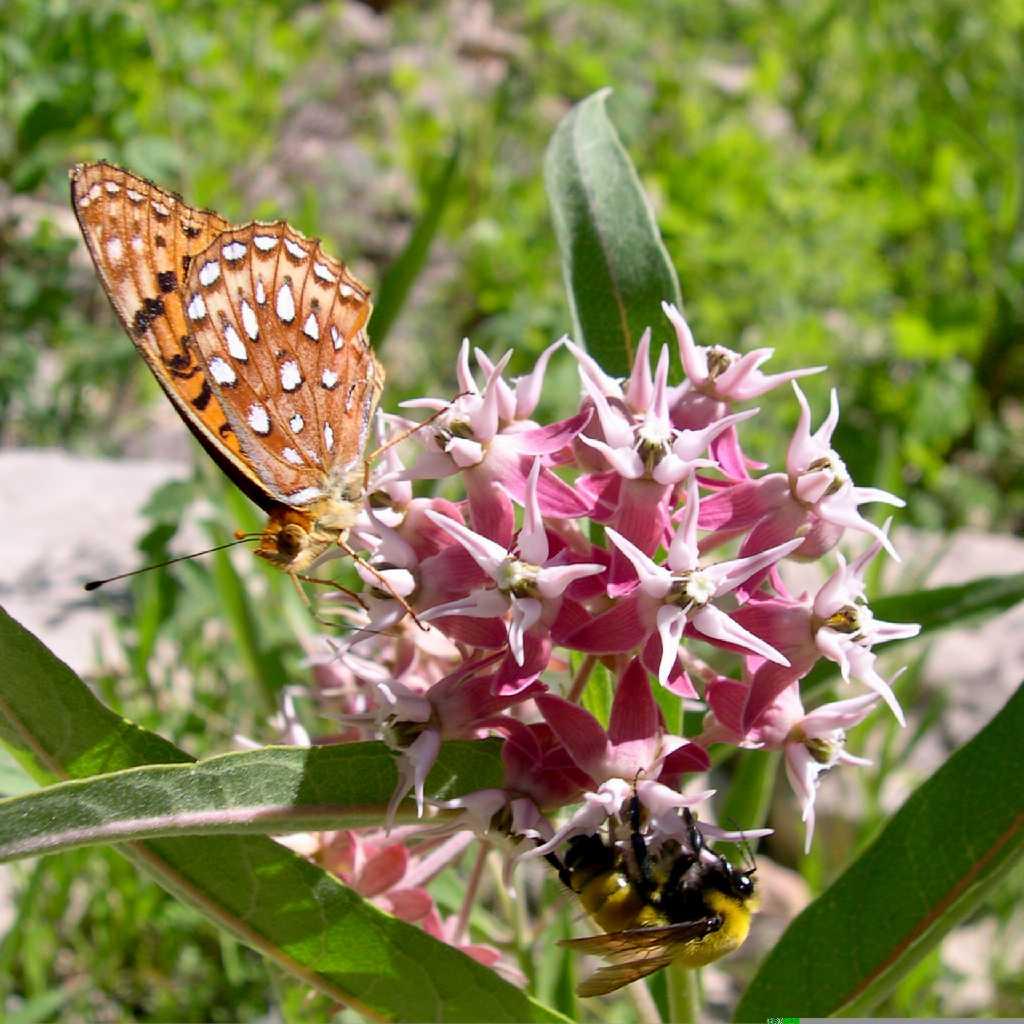
Found anywhere from meadows, along streams, or in disturbed areas, Asclepias speciosa grows across the western US and provides essential breeding sites for monarch butterflies 1. Monarchs exclusively lay their eggs on milkweed to provide food and chemical protection for their offspring, making this plant of high conservation priority 5.
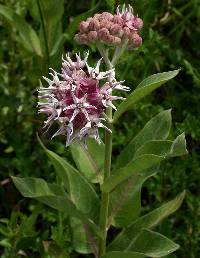
The genus Asclepias is named after Asklepios, the Greek god of healing, an appropriate name given the traditional medicinal properties of the plant in addition to the fibers it produces that are used to make cords and ropes 2,3,4. The epithet speciosa means ‘showy’ or ‘beautiful’, which describes both the large pink flowers and long, silvery green leaves 3.
This plant is culturally important to many indigenous groups, including the Téwa people of the Rio Grande who use plant fibers to make string and rope 4. The Zuni people use the seed fibers to make yarn that is then used to weave clothes for dancers 4. In addition to providing an important food source for many indigenous groups, the sap of the plant has been used to clean and treat sores and cuts, soothe coughs, reduce swelling, and even treat rattlesnake bites 4. These uses explain some of the medicinal significance behind the genus name. Clearly, this plant has very important cultural, traditional, and ecological roles. Next time you’re out in the field searching for showy milkweed, be sure to remember the clues of the scientific name while thinking about the cultural and ecological stories this species has to share with us!
| | Image credits: Max Licher and Paul Rothrock, via SEINet | |
Upcoming Events
-
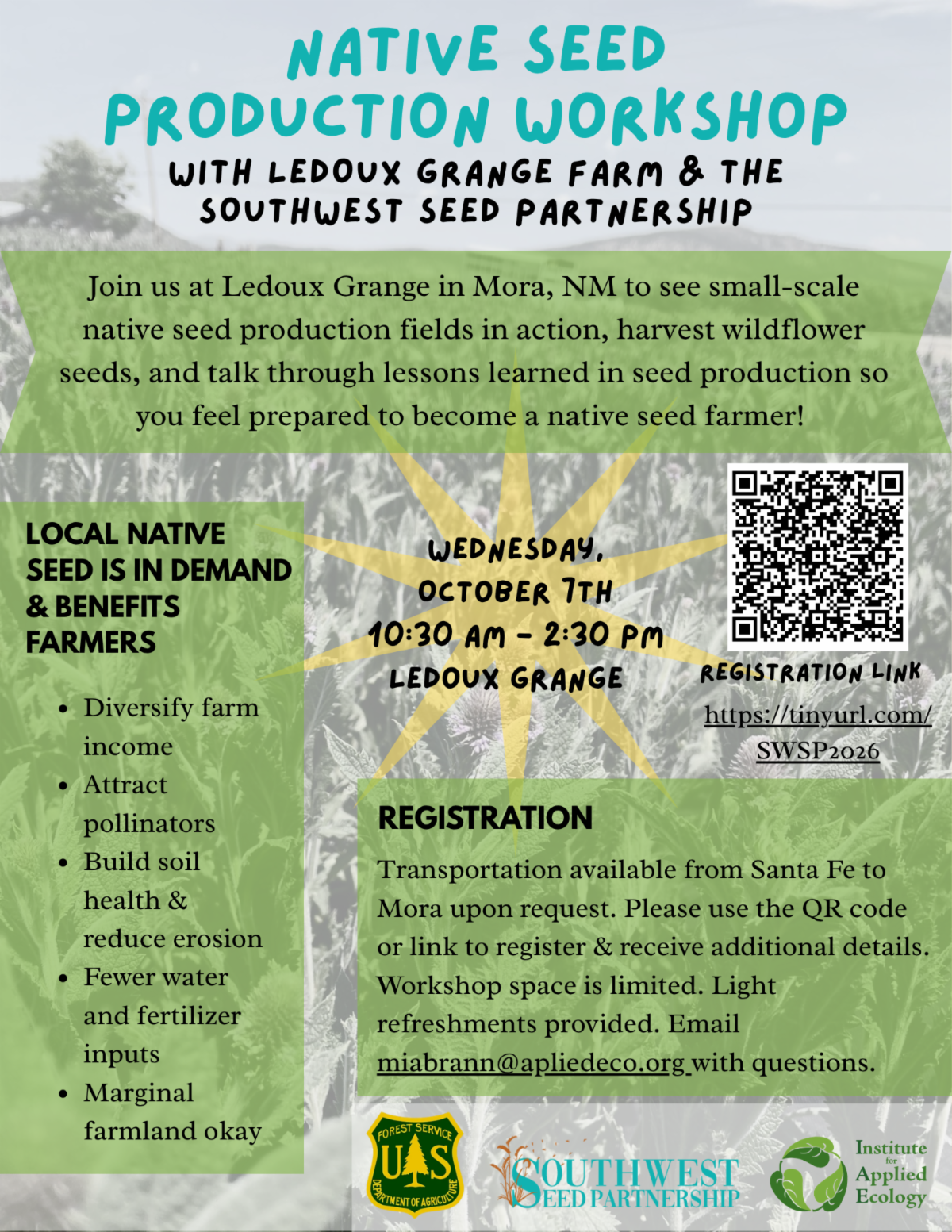
SWSP Native Seed Farming Workshop at Ledoux Grange Farm (Mora, New Mexico) on Wednesday, October 7th. Register here.
| | |
To share future events with the SWSP, fill out this form!
| | Example from the SWSP Seed Cleaning Photo Guide. | | Thank you to our partners, including the New Mexico Bureau of Land Management, US Forest Service Region 3, National Park Service, and the US Fish and Wildlife Service Partners Program, for continuing to fund our native seed production fields in 2026 and 2027. Additionally, we'd like to thank the Carroll Petrie Foundation and the Thornburg Foundation for providing funds to support SWSP growers and staff. | | |
TransLATINing Plant Names References
1. Bullard, V., Cruz, J., & Smither-kopperl, M. 2020. Milkweed Establishment in California’s Central
Valley: I. Showy Milkweed, Asclepias speciosa by Seed, Rhizome and Transplants. United States Department of Agriculture. https://www.nrcs.usda.gov/plantmaterials/capmcsr13648.pdf
2. Sundell 1993, Woodson 1854, Nabhan 2015; from SEINet Field Guide, online. Accessed 8/1/2026.
3. Kinter, Cecilia. 2019. Native Milkweeds of Idaho. Idaho Department of Fish and Game. https://idfg.idaho.gov/sites/default/files/idaho_milkweed_guide_kinter_2019-07-16.pdf
4. Stevens, Michelle. (n.d.). Plant Guide: Showy milkweed. United States Department of Agriculture Natural Resources Conservation Science. https://plants.sc.egov.usda.gov/DocumentLibrary/plantguide/pdf/cs_assp.pdf
5. The connection between milkweed and Monarch Butterflies. Coastal Georgia Botanical Gardens. (2023, October 2). https://coastalbg.uga.edu/2023/10/the-connection-between-milkweed-and-monarch-butte
| | | | |