Dear ACRO Members:
Please note that the PFS rule has been released. Click here for a link to the rule.
The proposed conversion factor for 2022 is $33.5848 and reflects the expiration of the 1-year 3.75% bump included in the Consolidated Appropriations Act of 2021 (CAA).
In addition to the cut to the conversion factor, there are significant cuts to freestanding radiation oncology. These cuts relate to CMS’ proposed clinical labor pricing data updates. While all specialties see increases (see Table 5 of the rule), CMS is implementing this in a budget neutral fashion that in general benefits hospital-based providers and primary care to the detriment of freestanding radiation oncology. Says CMS:
- The potential effects of the clinical labor pricing update on specialty payment impacts are largely driven by the share that labor costs represent of the direct PE inputs for each specialty. Specialties with a substantially lower or higher than average share of direct costs attributable to labor would experience significant declines or increases, respectively, if this proposal is finalized. For example, the Family Practice specialty has a higher share of direct costs associated with clinical labor, and payments to services comprising the specialty would be expected to increase as a result of this clinical labor pricing update. In contrast, Diagnostic Testing Facilities have a lower share of direct costs that are associated with clinical labor, and payments to services comprising the specialty would be expected to decrease.
Specifically, the total pool of direct costs went up by approximately 32% (100 * 0.5916 = 132 * 0.4468), most of which was higher clinical labor costs. But because of the budget neutral nature of the PFS, the “direct adjustment factor” (the factor CMS uses to keep the total direct PE input costs the same) went from 0.5916 in 2021 to a proposed 0.4468 in 2022. As a result, freestanding radiation oncology and other office-based interventionalists are negatively impacted.
While Table 6 of the rule shows radiation oncology receives a 4% cut due to the clinical pricing, as has historically been the case, this masks the impact to freestanding radiation oncology. For example, the key code for freestanding radiation oncology – G6015 – would be cut by 15% under the PFS proposed rule.
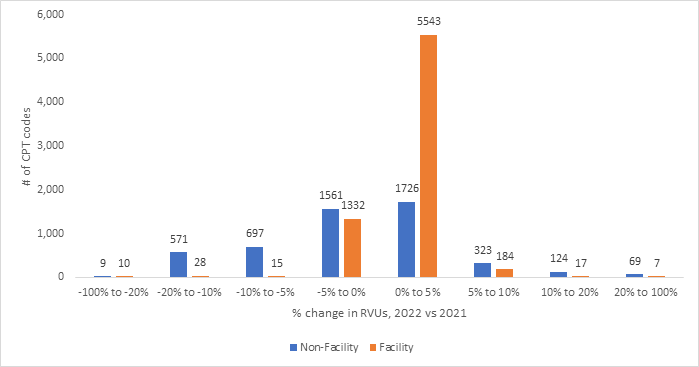
The chart below shows the count of codes going up or down split between facility and non-facility—there are 580 non-facility codes that are going down by at least 10% next year, and another 697 that are going down between 5-10%. This redistribution away from office-based interventionalists to other hospital-based and primary care providers is as significant as last year’s 2021 PFS Rule.