|
Budget Process
Over the coming months, the budget process will become an all-consuming topic in the State Capitol.
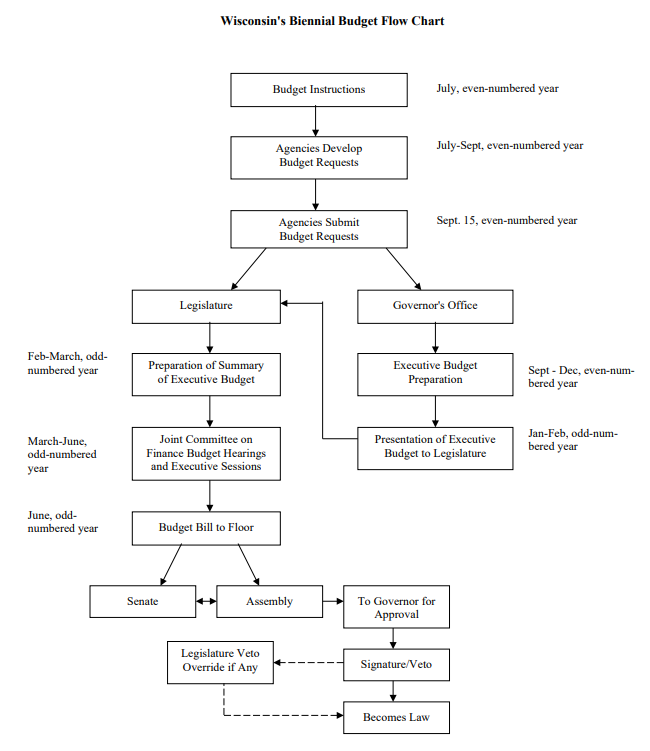
To start, the Legislative Fiscal Bureau will produce a summary of the Governor’s budget. These summary documents help to dive further into the details and provide an expansive, nonpartisan fiscal and policy analysis of the impacts of each provision outlined in the Governor’s budget. One of the items the Joint Finance Committee typically requests is an analysis of all the policy items in the Governor’s budget. Those items are usually not addressed in the Legislature’s version of the budget. Policy items that are identified and are bipartisan will often be introduced as stand alone legislation outside of the budget process.
After these analyses are completed, the Joint Committee on Finance will also hold a series of meetings, including public hearings where the committee will travel to a handful of locations throughout the state to hear from the public about their priorities for the state budget. The committee will also hold agency briefings where select agency heads are called before the committee to present on their budgets and answer questions of the committee members. Following these two steps, the committee will begin meeting in the State Capitol to vote on the provisions that will build the Legislature’s state budget.
For approximately two months and following the Joint Committee on Finance working agency by agency, item by item through the budget, they will vote on a substitute amendment containing every approved motion by the committee. The budget bill, as amended by the Joint Finance Committee, will be available for a vote in both chambers of Legislature, where it will be taken up and if passed, the budget is then sent to the Governor’s desk.
Governor Evers will have the ability to sign the budget bill, veto the budget bill, or, as he has with the last three budgets sent to him by the Legislature, partially veto provisions in the budget while signing into law the remaining provisions. As many of you may be familiar with, the Wisconsin Governor has a stronger partial veto ability than most of their counterparts in other states, so partial vetoes, while constrained in some areas, can be quite impactful.
Typically, the entire budget process concludes with Legislative passage just prior to the end of the state’s current fiscal year on June 30th, and the budget is signed in early July with the Governor’s partial vetoed items removed. Wisconsin is different than the federal government, in that if a new budget is not signed into law by June 30th, the statutes provide for the automatic continuation of the existing budget levels.
It is a long, comprehensive process to craft and finalize the state’s two-year budget. As always, the League’s Government Affairs Team is here to keep you updated on the entire budgetary progress as well as legislative proposals introduced during the session.
If you have questions please contact:
Toni Herkert, the Government Affairs Director, at therkert@lwm-info.org or
Evan Miller, the Government Affairs Specialist, at emiller@lwm-info.org.
|