|
|
What's New with EUG Planning
A special edition newsletter honoring and celebrating Black History Month in Eugene.
Sunday, February 16, 2024
| | |
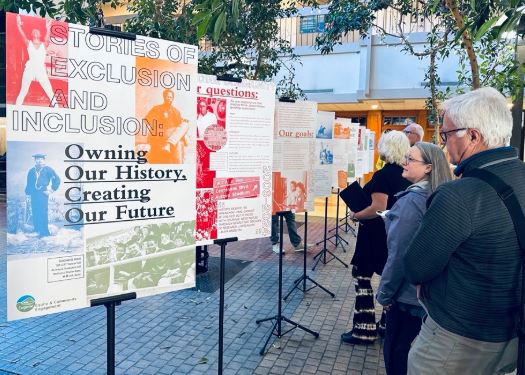
Stories of Exclusion and Inclusion: Owning Our History, Creating Our Future | |
|
To celebrate Black History Month, the exhibit "Stories of Exclusion and Inclusion: Owning Our History, Creating Our Future" is on display through the end of February in the Atrium Building, located at 99 W 10th Ave. and open to the public from noon to 4 p.m. Monday through Friday.
Through hardship and resilience, Eugene’s Black community has persisted and carved out a special place in the heart of the city. This educational display highlights the experiences, historic through present-day, of African Americans living in the Eugene-Springfield area and future visions for our community. The content of the display is based on decades of research, community outreach, and partnership building. Perspectives were gathered from elders and established leaders in the African American community, multi-cultural youth groups, and community institutions.
| |
Recognizing Black History, Exclusion, and Displacement in Eugene | |
|
February is Black History Month, a time to honor the triumphs and struggles of African Americans throughout U.S. history. It is also a time to acknowledge and reckon with past and current practices that have harmed Black community members, along with Indigenous people and other people of color. In the context of land use planning, these practices take the shape of exclusionary laws and racial covenants that limited where Black people could live within Eugene, Lane County, and Oregon, as well as the displacement of Black residents for both government sponsored and private development projects.
You may have heard about the “Over the Bridge” community (also sometimes referred to as the Ferry Street Community) where Black community members settled when it was illegal to live within City limits. In 1949, during the construction of the Ferry Street Bridge, this neighborhood was demolished, and its residents displaced. Some residents resettled in west Eugene, near what is today W. 11th and Sam Reynolds St. – an area again outside of city limits, with limited infrastructure and subject to regular flooding. The aerial photo below (circa 1945) shows the approximate location of the Ferry Street Community, which is now the present day entrance to Alton Baker Park.
|  | |
Eugene’s history echoes other urban development and transportation projects across the country that displaced Black communities, including highway building that separated communities and urban renewal projects to remove “blight” from inner cities. Racism still exists in our current land use and zoning systems – exclusionary zoning segregates cities, development can lead to displacement, and low-income communities carry the burden of more pollution and other public health risks.
This Black History Month, and every day moving forward, we can continue to work with local partners to learn from our history, uncover and disrupt the potential for harm, exclusion, or displacement in current practices. Learn more about local Black history, including Eugene’s first Black residents, through this Lane County timeline and map, the Museum of Natural and Cultural History’s Racing to Change Exhibit, or through Oregon Black Pioneers.
| |
|
Honoring Eugene's Black History
A video from LTD
| |
In Eugene, one of the pivotal people who contributed to our community was Wiley Griffon, who introduced an industry that would later become what we now know as Lane Transit District, or LTD. LTD’s current-day operations can be traced back to Griffon, who operated the first mule-driven streetcar in the 1890s. More than a century after his passing, his spirit lives on—embodied in LTD’s current-day mission of connecting the community. Today, residents and visitors to Eugene can read about Wiley Griffon and his contributions on a commemorative plaque on East 4th Avenue, near the spot where his home once stood and at his gravesite in the Eugene Masonic Cemetery. | |
|
Take time to explore ways you can engage in celebrating Black history in February and throughout the year with the following resources:
-
Black History Month - A deep dive into the background and significance of Black history. This course includes content on language use, a history of Black activism, and a celebration of Black excellence.
-
11 Ways to Honor Black History Month in 2024 - Suggestions to watch, listen, read, and explore Black history with a focus on this year's theme: African Americans and the Arts.
-
Visit the website Oregon Black Pioneers - Preserving the History of Black Oregonians and explore this resource into our local history. Consider the following:
-
Oregon Black Pioneers Oral History Collection - this collection is the combination of 2 projects. One project is a series of interviews in 1993 by the Black History Club at Jefferson Middle School. The second project was carried out from 2018-2020, sponsored by OBP and featured community leaders from Portland, Eugene, and Salem. Click the link where the interviews are made available online.
-
Meeting the Sewells - a Living history video of the Sewells, the first Black family in Central Oregon.
-
Oregon's Civil Rights Years - This exhibit explores the racism, exclusion, and displacement that targeted Black Oregonians, and the Black community's efforts to pursue justice.
| |
You can decide which email lists to be a part of by clicking update profile below. This will allow you to unsubscribe from this email list while remaining on other City of Eugene Planning and Development email lists. If you would like to unsubscribe from all City of Eugene Planning and Development emails, please click unsubscribe below. Thanks! | |
|
City of Eugene Planning & Development Department
99 W. 10th Avenue | Eugene | OR | 97401
| | | | |