|
In this Issue:
- News
- Events & Webinars
- Community Resources
- Los Recursos Familial en Español
- Family Resources in English
- Job Opportunities
| |
|
Spotlight On:
Dry January: A Trend Worth the Hype
| |
|
There’s something about a global trend that excites the public on a level extending far beyond the self. It demonstrates there is power in the collective.
This feels true even for a trend like Dry January that aims largely to promote individual health and wellness, although cultures can benefit from a sober society.
You may choose to participate in Dry January because you had over-indulgent holiday celebrations, because you want to examine and challenge your relationship with alcohol, or because you want to be part of a popular trend. No matter what your reason for participating may be, the benefits are sure to make you glad you gave Dry January a try.
| |
|
Empowerment Coalition of Milwaukee's
2025 Workshop Calendar
Next Session: Housing Services on Wednesday, January 22
| |
|
You can register now for the January session of the Empowerment Coalition of Milwaukee or sign up for the whole year of workshops.
ECOM is a monthly gathering of social services professionals, advocates, and consumers organized by Community Advocates Public Policy Institute. ECOM explores topics that are vital to Milwaukee’s human services professionals. Each session features multiple presentations from experts and opportunities to share resources.
Sessions are held in person from 9:30 a.m. to 12 p.m., typically (but not always) on the third Wednesday of the month. The $5 registration fee is non-refundable and must be submitted the Friday before each workshop.
January’s topic is Housing Services, and will be held on January 22 at Community Advocates, 728 N. James Lovell St., Milwaukee.
| |
Opioid Settlement Public Input Survey | |
|
Wisconsin Department of Health Services (DHS) is conducting a survey that aims to collect input to identify priorities for the use of approximately $75 million of Wisconsin State Opioid Settlement dollars. The survey seeks to identify potential barriers and existing needs/services gaps. Take the survey by February 28 and share your ideas to inform planning for future opioid settlement funds.
| |
2025 PSW Conference Call for Presentations | |
|
Prevent Suicide Wisconsin (PSW) is accepting presentation proposals for the 2025 PSW Conference: Building Together: Adding to Your Toolkit. This year's theme is meant to continue building on the perspective that suicide is a public health and social justice issue, and not only a concern for the field of behavioral health. Proposals that demonstrate evidence-based or promising practices, enhance practical skills, support recovery, and energize people are invited to apply.
The conference will take place as an online event Wednesday, May 14 - Friday, May 16. The deadline to submit your session proposal is Friday, February 14.
| |
Brain Structure Differences Are Associated with Early Use of Substances Among Adolescents | |
|
A recent study published by the National Institute on Drug Abuse (NIDA) reveals critical insights into the relationship between early substance use and brain development in adolescents. The research identifies specific brain structure differences associated with early substance use, highlighting the importance of early prevention and intervention strategies. These findings contribute to our understanding of how substance use during formative years may impact long-term brain health and development.
| |
The Precarious Online Lives of Young Men | |
|
In this essay, published by TIME, the author delves into the growing mental health crisis among young men and the critical need for effective intervention. Highlighting alarming statistics and societal pressures, the piece sheds light on the challenges young men face, including societal stigmas around vulnerability, the overwhelming influence of online spaces, and the barriers to seeking help. With suicide rates among young men remaining distressingly high, the article seeks to help parents and educators have open and honest conversations, provide accessible mental health resources, and dismantle toxic notions of masculinity. The essay emphasizes creating a more supportive environment that prioritizes the well-being and safety of young men.
| |
Youth Advocates of the Year Awards | |
|
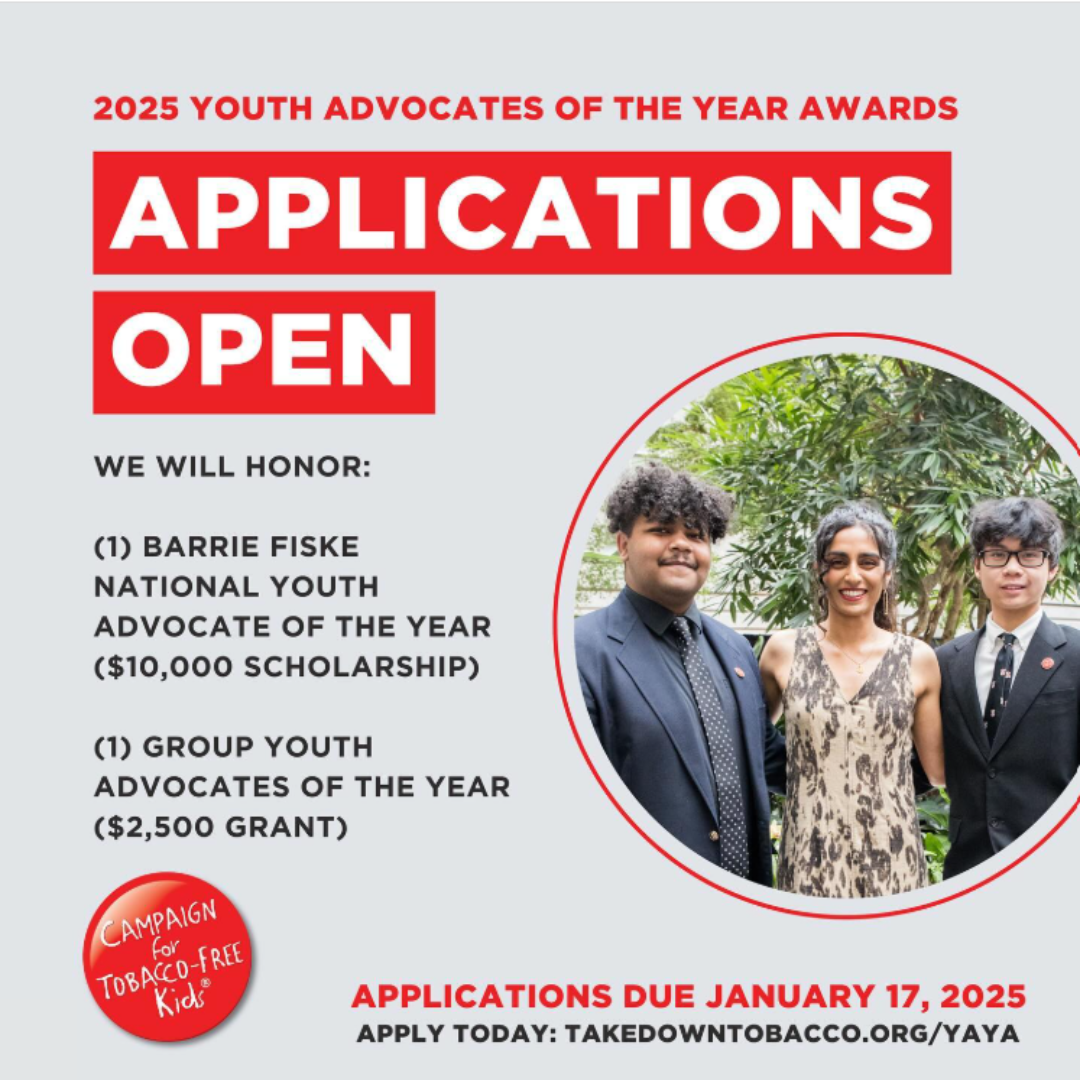
If you’ve been leading tobacco prevention efforts in your community, there is still time to submit your application for be considered for the Campaign for Tobacco-Free Kids’ 2025 Youth Advocates of the Year Awards. The awards honor outstanding youth advocates, emerging leaders, and public health champions who are leading the way to the first tobacco-free generation. Award recipients receive scholarships, training and leadership opportunities to take their advocacy to the next level. Applications are due January 17.
| |
|
Using Cultural Humility to Reshape Your Prevention Coalition
Tuesday, January 14
| |
The Great Lakes PTTC is hosting a webinar that will explore the significance of cultural humility in the mobilization of substance use prevention coalitions. The session will investigate the ways in which cultural humility can be employed by individuals to improve community responsiveness during key phases of the Strategic Prevention Framework.
The webinar is scheduled from 10 to 11:30 a.m. on January 14.
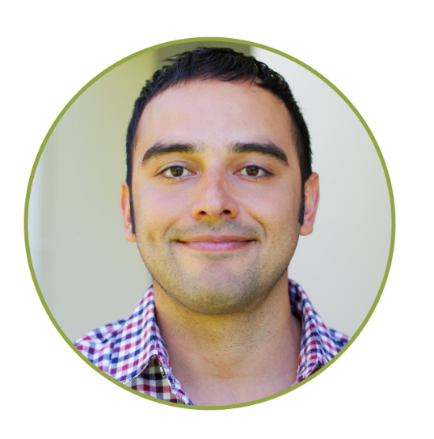
| Presenter: Albert Gay, MS | |
|
SAMHSA Grant Application Process Webinars
Tuesday, January 14, and Thursday, January 16
| |
|
SAMHSA is offering webinars on their grant application process to help organizations better understand the steps to apply for a SAMHSA grant. This webinar will focus on the process to apply, from registration to completion of the application. Organizations that have not received SAMHSA funds may find this webinar helpful.
Use the links below to RSVP for one of the following dates:
- January 14 from 9:30 to 11 a.m.
- January 16 from 12:30 to 2 p.m.
| |
|
Building Community Resiliency Through Storytelling and Media Narratives
Wednesday, January 15
| |
|
Join the Centers for Disease Control and Prevention for a discussion on how communities can enhance resilience through storytelling and media narratives. Media narratives shape the public's opinions on the root causes, impacts, and solutions to community violence. This webinar will discuss how these narratives impact communities affected by violence and how local storytelling efforts can help build community resiliency.
This webinar is scheduled from 1 to 2:30 p.m. on January 15.
| |
|
A New Era in Poverty Politics? The Social Safety Net in the Second Trump Administration
Wednesday, January 22
| |
|
With each new presidential administration comes the possibility of changes to public assistance programs. With the start of the second Trump administration and Republican control of both the House and Senate, panelists will discuss the policies and administrative moves that they are tracking. This will include food assistance (SNAP), Medicaid, child care subsidies, and benefits provided through the tax system like the Earned Income Tax Credit (EITC) and the Child Tax Credit (CTC). They will also discuss how changes in the federal bureaucracy could affect program administration.
This webinar from UW-Madison's Institute for Ressearch on Poverty is scheduled from 1 to 2:15 p.m. on January 22.
| |
|
Cultural Humility & Responsiveness in Behavioral Healthcare
Thursday, January 23
| |
|
The Prevention Technology Transfer Center Network (PTTC) is hosting an interactive virtual training that will review practical tools and strategies that can be used to identify and diffuse personal bias and address dynamics of communication. The content will further inform on cultural humility as a practice that informs clinical processes, increase patient care and wellness for racial and ethnic populations, and help effect a supportive work environment.
This webinar is scheduled from 9 to 11 a.m. on January 23.
| |
|
The PRIDE Study Wrapped: Research Year in Review
Monday, January 27 - Thursday, January 30
| |
|
This webinar series will explore the latest research on LGBTQIA+ health and provide attendees with opportunities to engage directly with leading researchers. LGBTQIA+ health topics to be covered include:
- Substance Use & Supports
- People of Color Experiences & Perspectives
- Experiences with Chronic Pain & Muscle Concerns
- Reproductive Health & Family Building
You can choose to attend or more of the webinars.
| |
|
QPR Question Persuade Refer
Suicide Prevention Training
Tuesday, January 28
| |
|
We can all save lives.
The QPR mission is to reduce suicidal behaviors and save lives by providing innovative, practical and proven suicide prevention training. The signs of crisis are all around us. We believe that quality education empowers all people, regardless of their background, to make a positive difference in the life of someone they know.
This two-hour interactive introduction to suicide awareness and prevention will also cover statistics and intervention strategies. This workshop will be held on January 28, from 9 to 10:30 a.m.
| |
|
Effective Sharing of ‘Lived Experience’ While Maintaining Boundaries
Tuesday, January 28
| |
|
The Northeast & Caribbean ATTC is hosting a webinar that will provide a space for workforce members with lived experience to reflect on the especially important contributions that they make in the lives of the people they support and guide. Participants will explore the balance of self-disclosure that can best meet the needs of people in care and review a person-centered method of sharing information or offering our “own story.”
This webinar is scheduled from 12 noon to 2 p.m. on January 28.
| |
|
Equipping Professionals to Tackle Synthetic Drug Challenges in Prevention
Tuesday, January 28
| |
|
This workshop, hosted by the Prevention Technology Transfer Center Network (PTTC), offers prevention professionals a comprehensive overview of synthetic drugs, also known as “new psychoactive substances” (NPS), and their unique risks and challenges.
The webinar is scheduled from 1:30 to 3 p.m. on January 28.
| |
Presenter: Dr. Fernando Montero | |
|
VA S.A.V.E. Suicide Prevention Training
Tuesday, January 28 and Wednesday, January 29
| |
|
This webinar is a collaboration between the VA Center for Faith-Based and Neighborhood Partnerships (CFBNP) and the Office of Mental Health and Suicide Prevention. This webinar is scheduled from 1 – 2 p.m. on January 28 and 29.
| |
|
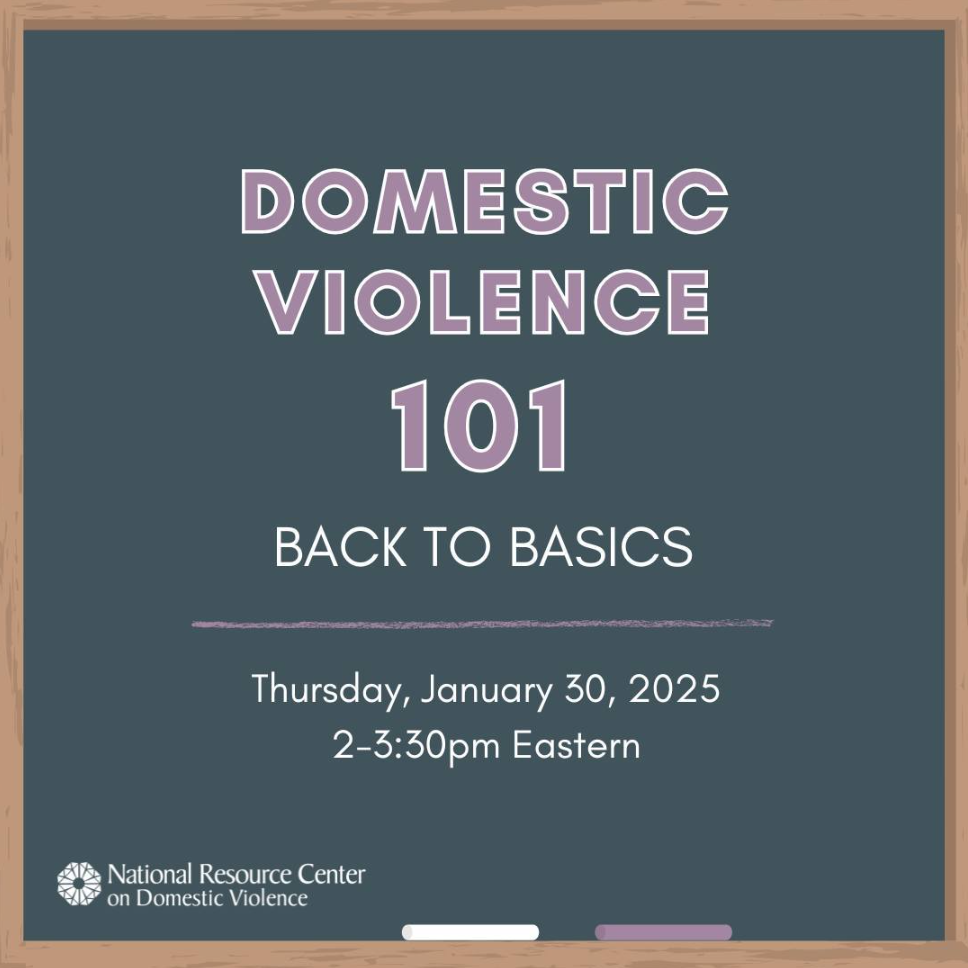
Domestic Violence 101: Back to Basics
Thursday, January 30
| |
|
The National Resource Center on Domestic Violence is hosting an introductory webinar to describe the dynamics and common tactics that characterize domestic violence. It will also provide an overview of the scope and impact on individuals and society. Because it is impossible to prevent and respond to domestic violence without addressing larger structures of oppression, this webinar will explain the connections between doing racial equity work and ending domestic violence. This session will help new advocates, allied professionals, students, and the general public achieve a basic understanding of this complex issue and how they can be part of the solution. The webinar is scheduled for January 30, from 1 to 2:30 p.m.
| |
|
Hey, there,
-- do you have:
-
Job openings?
- Upcoming events?
- News to share?
- Suggestions?
Forward the information to Prevention@CommunityAdvocates.net.
Thank you for your service to Milwaukee!
| |
|
National Maternal Mental Health Hotline
The National Maternal Mental Health Hotline offers free, confidential support 24/7 before, during, and after pregnancy. Assistance is available in English and Spanish, with interpreters supporting over 60 languages. Click here to learn more.
| |
|
National Alliance on Mental Illness – Peer Support Groups
The National Alliance on Mental Illness offers NAMI Connections and NAMI Peer Support, support groups for individuals 18+ who believe they have a mental health condition or are living with any mental health diagnosis. NAMI offers in-person and virtual options. Click here for more information.
| |
|
Hmong American Women’s Association (HAWA)
HAWA offers services to meet the ongoing needs of the Hmong community, while also engaging in organizing efforts to strengthen their political influence. They are working toward transforming the community’s conditions to align with a vision of a thriving a prosperous community. In 2024, their Community Closet supported over 300 appointments for families and DV/SA victims and survivors by providing them with the essentials. Click here to learn more about HAWA.
| |
Los Recursos Familial en Español | |
|
La Línea Directa Nacional de Salud Mental Materna
La Línea Directa Nacional de Salud Mental Materna ofrece apoyo gratuito y confidencial las 24 horas del día, los 7 días de la semana, antes, durante y después del embarazo. La asistencia está disponible en inglés y español, con intérpretes en más de 60 idiomas. Haga clic aquí para obtener más información.
| |
|
Healthy MKE
De Milwaukee Health Care Partnership y Milwaukee County Behavioral Health Services, el sitio web Healthy MKE ofrece una única fuente de información para los servicios públicos y privados en el condado de Milwaukee, donde los proveedores y los miembros de la comunidad pueden obtener la información que necesitan para ayudarse a sí mismos o a otros. Accede a ellos aquí.
| |
Family Resources in English | |
|
National Alliance on Mental Illness – Family Support Groups
NAMI Southeast Wisconsin has a number of free peer-led support groups for family members, caregivers and loved ones of individuals living with a mental health condition. They offer in-person and virtual options. Click here for more information.
| |
|
Milwaukee Muslim Women’s Coalition
The Milwaukee Muslim Women’s Coalition provides parenting education, advocacy, and community outreach. They strive to create a nurturing space where families feel supported and valued. Empowering families, they empower survivors, welcome immigrants, and help youth. Click here to learn more.
| |
|
Positive Options for Women Entering Recovery
Are you worried about your drinking or other drug use? You aren’t alone. The Positive Options for Women Entering Recovery (POWER) is here to help. The Milwaukee Women’s Center’s POWER provides FREE day treatment for women struggling with alcohol and other drug issues. Click here to learn more or call 414-270-4600 to get help.
| | | | |