Spotlight on Safety

Health and Safety News For The Princeton Community, March 2026

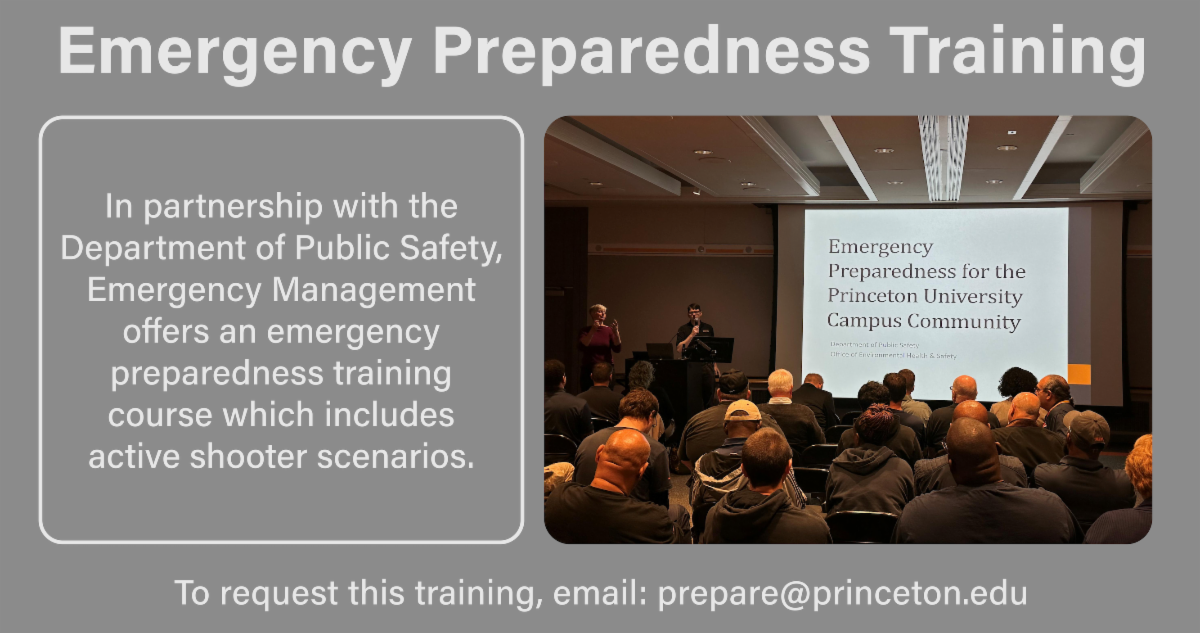
Learn more about Emergency Management's in person and online training opportunities on the Emergency Management website.

Don't Get Yourself in a Pickle: Come to Office Hours!

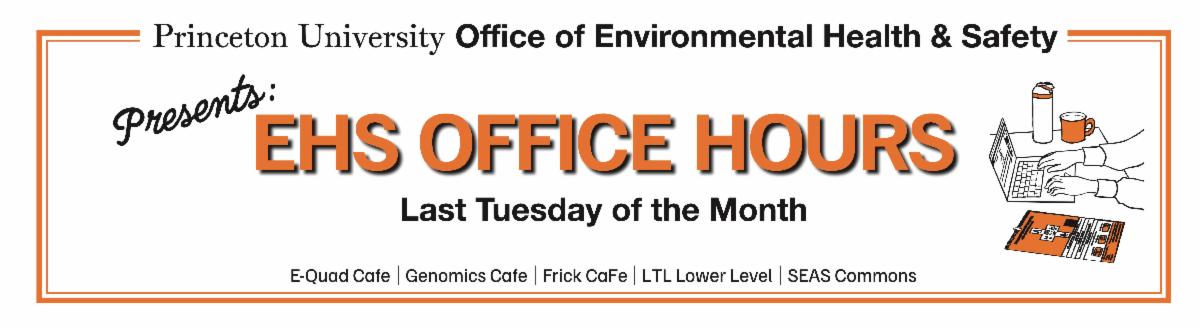
EHS office hours return to E-Quad Cafe, Genomics Cafe, Frick CaFe, LTL Lower Level and the atrium of Briger Hall on Tuesday, March 31 from 11:30am to 12:30pm. Be sure to stop by and get one of our fun new safety stickers — collect 'em all!


Bring your questions, concerns and comments to EHS staff and browse useful handouts and other materials to help you keep your research space safe and secure.


Learn More »

Research News

Mission Continuity Plan For Labs

The Princeton Emergency Management website has mission continuity plan guidance for labs to ensure essential research operations can be sustained, or safely and responsibly suspended, during periods of disruption.


This guidance is designed to help principal investigators, research supervisors and laboratory managers think through the key considerations for maintaining research continuity.  Learn More »

Hazardous Waste Collection Procedures

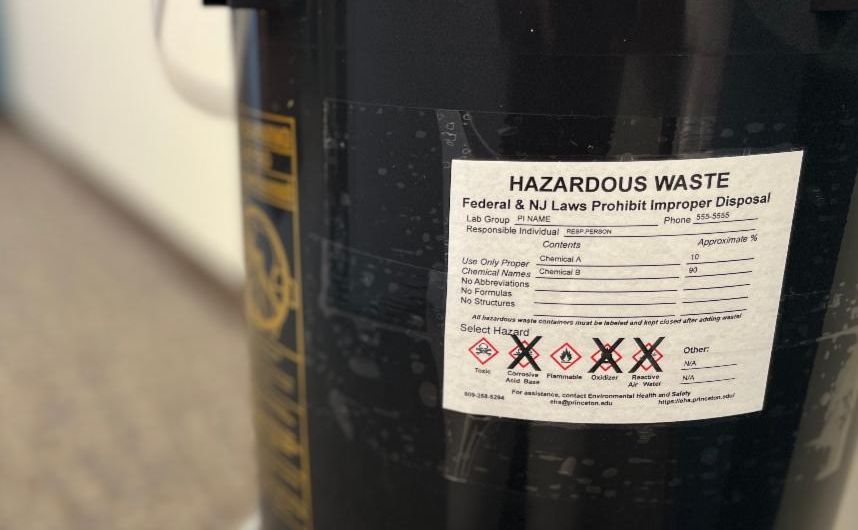
As of January, EHS will collect waste from laboratories to bring to a centralized collection point, where it is picked up by the waste vendor. Use the Waste Pickup Collection Form to request pickups. Requests must be submitted by 2pm on Wednesday in order to be picked up on Thursday of the same week.

A reminder: EHS is now using updated hazardous waste labels, replacing the previous "yellow" waste labels.


Updated waste labels may be requested from the EHS Safety Supply Store, including pre-made Waste Labels.

Battery Recycling


Nonrechargeable alkaline batteries do not contain regulated hazardous materials and can be disposed of in the regular trash. Other batteries are recycled on campus and must be disposed of through the University's recycling program:

  • Lithium button cell
  • Rechargeable Ni/MH (AA, AAA, C, D, 9V)
  • Nickel-Cadmium (Ni-Cad)
  • Lithium-Ion
  • Lead Acid

Collection containers are available in research buildings or can be picked up by emailing ehs@princeton.edu. See our battery disposal guide for collection locations and more infornation.

Policy Spotlight: Work Alone and TigerSafe

Individuals conducting hazardous operations on campus may not work alone unless they receive explicit permission from the responsible party (PI, supervisor or facility manager). The responsible party must review the activity to be undertaken to determine whether the risk of working alone can be controlled to a reasonable/acceptable level. Read more »


The TigerSafe app contains a WorkAlone feature which automatically triggers a call to your emergency contact if you fail to check in at the allotted time. Watch a video about WorkAlone and learn more about the app on the Emergency Management website.

Bat Protocol: What Should I Do If a Bat Gets Indoors?


Princeton sees seasonal upticks in incidents of bat incursions into residential spaces on campus. If you encounter a bat, follow these actions.


  • Avoid direct contact with the bat and call the Public Safety non-emergency number at 609-258-1000.
  • Do not try to capture or kill the bat.
  • Do not release a bat found in a building until it has been confirmed through Public Safety that no exposure has occurred.


Learn More on the EHS Website »

Follow EHS on social media:

X  Instagram  Youtube  

Export Control Training Open to All

Export control regulations apply to everyone on Princeton’s campus and are designed to protect U.S. national security. This class provides an overview of the U.S. export control framework and how these rules relate to everyday research activities.

When:

Wednesday, April 15th 10am-11am

Where:

Julis Romo Rabinowitz Building Room 399 (JRR399)

Who:

Anyone who works with or supports international travel, shipping, research, collaboration, visitors, or technology sharing.


Topics will include:

• Shipping materials outside the United States

• Key questions to consider before exporting

• International travel considerations

• Working with individuals or entities debarred by the U.S. government

• Understanding the Fundamental Research Exclusion

Sign up for the class through the Employee Learning Center.

Under "Training by Department", select ORPA.

Contact exports@princeton.edu with any questions. 

Upcoming Trainings

Intro to Biosafety

April 9, 1:30-2:30 p.m. TBA
May 13, 9:30-10:30 a.m. TBA


Bloodborne Pathogens For Researchers

April 9, 2:30-3:30 p.m. TBA
May 13, 10:30-11:30 a.m. TBA


Radioactive Materials Safety

April 24, 1:15-3:00 p.m. LTL Room 317


_____________________________________________________________


Laboratory Safety at Princeton University (Online)

New researchers to Princeton University should complete the following steps as part of the online Laboratory Safety Training Sequence.


  1. Complete the online components of the laboratory safety training: Fundamentals of Laboratory Safety 1-5 and Final Test, available at: https://putrain.learn.com
  2. After completing the online components, sign up for and attend an instructor-led Laboratory Safety Training session.


Upcoming dates for instructor-led Laboratory Safety Training sessions:


Laboratory Safety at Princeton University


April 7, 24


To sign up for a training session, go to:

https://putrain.learn.com

Select Environmental Health & Safety under "Training By Department"


Contact the editor with any feedback or story ideas at  js74@princeton.edu

Looking for old  Waste Paper content? Archives are  available online. 
Princeton University
Environmental Health & Safety
262 Alexander Street
Princeton, NJ 08540
(609) 258-5294
Twitter  Instagram  Youtube