Our "Little" Secret is Out |
Mission Communications has been hard at work for two years with a goal in mind: to create the highest-quality water monitoring mobile training center possible. |
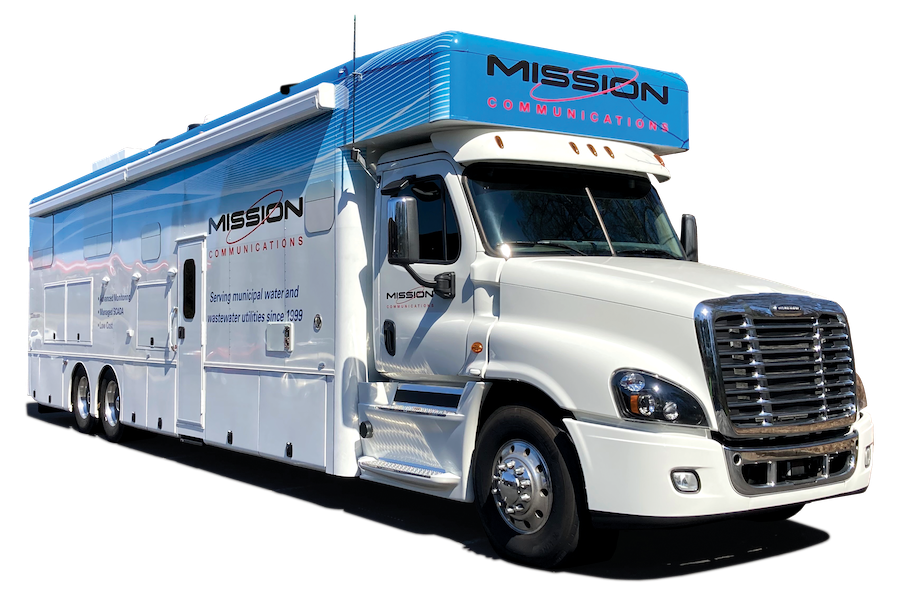
We are proud to unveil our official RV! But this is more than just a typical RV. It is a fully-customized 600-horsepower 2021 Freightliner Cascadia. And by “fully customized” we mean that every square inch of its 45-foot motorcoach has been designed with you in mind.
You may find the Mission RV at your local trade show, utility, or neighboring town. The Mission RV roadshow will be traveling coast-to-coast.
This roadshow provides the perfect environment for continued education, exhibitions, and hands-on training. Every piece of this super-hub of water management learning has been purposely and meticulously designed for its prime directive–to spread industry, product, and system training wherever it goes.
-
Learn from top industry experts in our comfortable, climate-controlled classroom with 50-inch smart TV, outdoor veranda, or outside entertainment center (with another big screen TV, two large awnings, sound bar, and stereo).
-
Practice wiring, installing, and maintaining hardware on the simulated control panels.
-
Enjoy the day's work with the outside slide-out BBQ grill, full-sized fridge (stocked with refreshments), and kitchen.
Who needs to build or travel to a training center when you can just invite us over?
|
Mobile, AL
March 20 — March 23
Springfield, IL
March 21 — March 24
GreatFalls, MT
March 23 — March 25
March 29 — March 31
Wichita, KS
Worcester, MA
April 6 — April 7
Round Rock, TX
April 6 — April 8
Sacramento, CA
April 11 — April 14
Phoenix, AZ
April 12 — April 14
Norman, OK
April 20 — April 22
Roanoke, VA
April 20 — April 22
Lake Tahoe, CA
April 25 — April 28
Tacoma, WA
April 27 — April 29
Verona, NY
May 23 — May 25
Biloxi, MS
June 1 — June 3
San Antonio, TX
June 12 — June 15
Since events are still in flux due to COVID restrictions, please make sure to confirm schedules with individual trade shows. We will update our website as new information is made available.
|
Web Portal II—Advanced Features, Reporting, Supergraph, Volumetric Flow
Special Topics
Week 1: Survey of Features
Week 2: Hardware Instrumentation
Week 3: Web Portal I—Unit Setup Options, Notification Setup Options, Alarm Groups, Website Tools
Week 4: Web Portal II—Advanced Features, Reporting, Supergraph, Volumetric Flow
Week 1: Survey of Functions
Week 2: Hardware and Instrumentation
Week 3: Web Portal I—Unit Setup Options, Notification Setup Options, Alarm Groups, Website Tools
Week 4: Web Portal II—Advanced Features, Reporting, Supergraph, Volumetric Flow
Week 1: Survey of Features
|
|
Mission System Helps Siloam Springs
Do More with Less
|
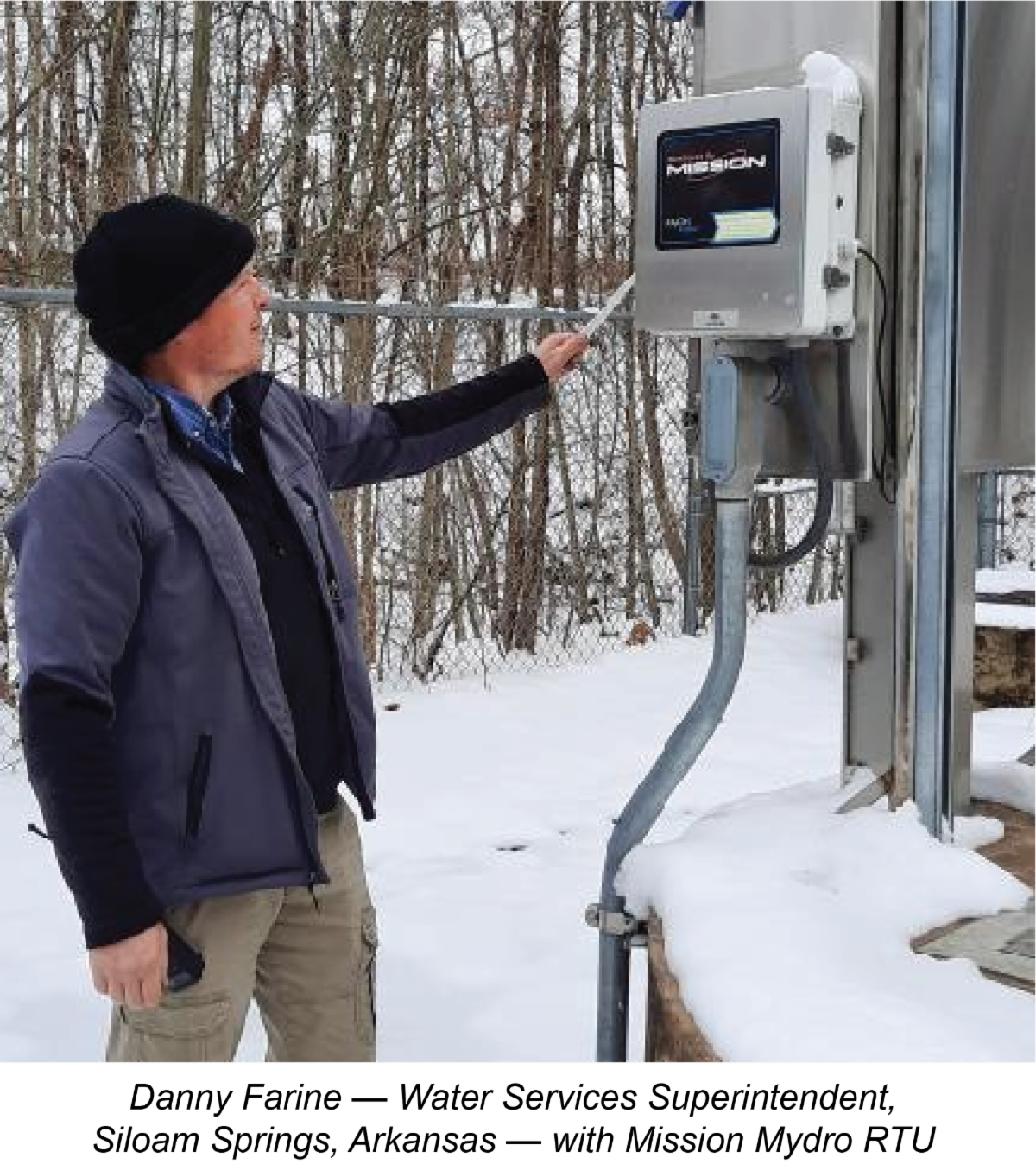
“Out in the middle of nowhere, no one hears your alarm,” Danny Farine, Water Services Superintendent in Siloam Springs, Arkansas, says. He recalls the old system of reporting and dispatching his technicians to an overflow incident. |
He explains, “There was a placard at every lift station that said ‘if the alarm sounds, please call police dispatch.’ So someone would have to call the number, then they called somebody, and then another person calls somebody else. There were huge time delays before you could get over there.” A system like this relies on a chain of reporting before any corrective action is made. Consequently, the likelihood of overflows was high and the response effort likely turned into both cleanup and repairs— more time spent and money wasted.
Siloam Springs is known for its water springs and a picturesque environment. The Smithsonian magazine called it “a town that could model for a postage stamp commemorating the American heartland.” A sewage overflow is the last thing any citizen or visitor needs, especially since more people are moving in. Farine, who has worked for the city since 1996, expects the next census to show a large population growth over the past 10 years. With that growth comes a lot of strain on the municipal services like water management. It can be a challenge for a fully staffed crew to respond to incidents, perform their preventive maintenance, and keep up with the growth.
Another significant challenge is that Farine’s team is not fully staffed. He talks about the difficulties of keeping up with the private sector. “Opportunities offered by contracting companies can pay more than the city can right now, so it’s hard.” He adds, “We have 14 spots and now we’re down to nine and of those, only five can do things like pull a pump and work on it.”
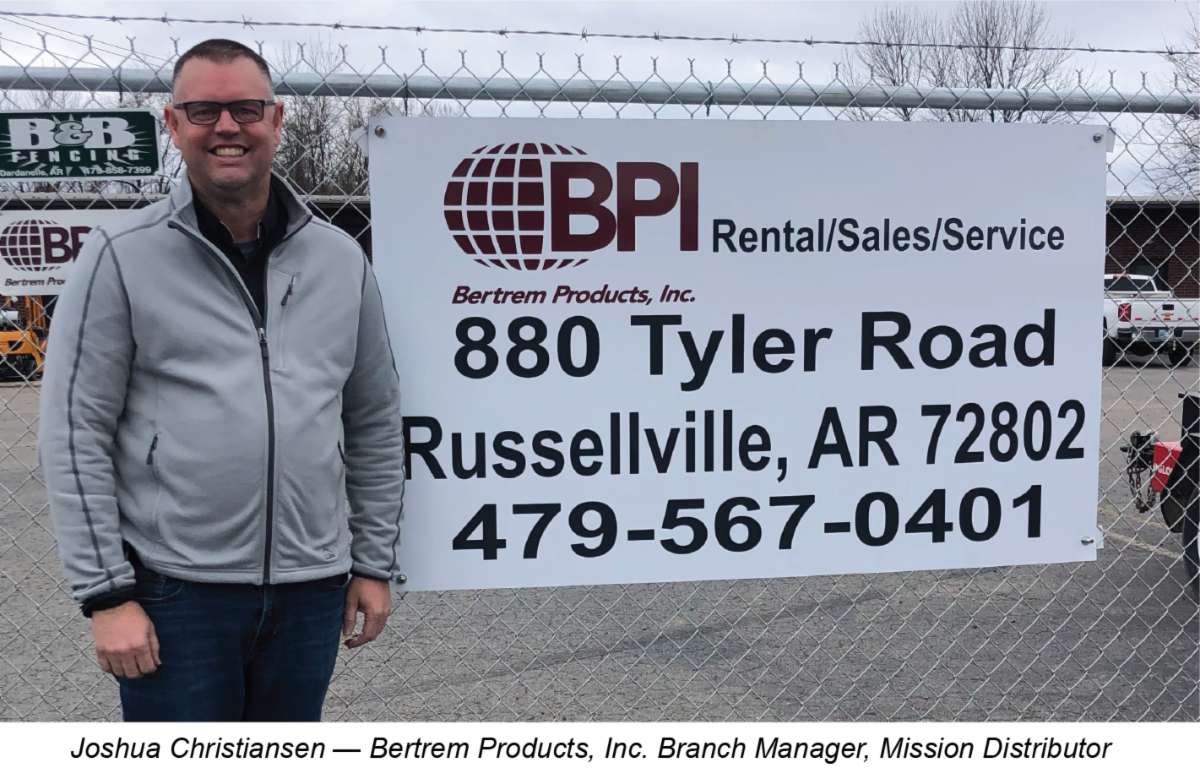
Challenges from the pandemic have caused situations like that at Siloam Springs all over the country–a big burden placed on a small department. Bertrem Products, Inc., a Mission distributor, has been working with Siloam Springs for years. Bertrem Branch Manager Joshua Christiansen suggested installing a Mission Communications system. “We already had a relationship with them with pumps and transmitters and different things. They already had a system that they weren’t happy with and we offered a ‘Try and Buy’.”
|
The trial was Eddie Stewart’s idea, Midwest Regional Sales Manager for Mission Communications. He recommended Siloam Springs install the MyDro remote terminal unit (RTU) and monitor at one of its problematic sites for 30 days, a risk-free demonstration unit. If Siloam Springs could see its value in that first month, then they would buy it and sign up for service.
Christiansen remembers seeing an immediate impact. “We started watching the reports immediately. We installed it on a Thursday, came back on a Monday, and we told them that the station’s Pump 1 was running more than Pump 2.” The team investigated the site, pulled the pump, and found a problem. “Pump 2 was clogged,” he says.
The MyDro RTU paid for itself in the first week. “Total install of the MyDro was a couple thousand bucks, but it saved them a $10,000 pump loader.” That was just in potential equipment damage, since a clogged pump can quickly cause an overflow and add cleanup and containment efforts. Avoiding incidents like that is one of the many benefits of the Mission system and its reporting. “They were really impressed,” Christiansen says.
Farine’s department quickly reconciled the monthly fee and installed more MyDro RTUs, starting with the troubled sites first. Now all of their lift stations have been fitted with monitoring systems and Farine’s crew can use their resources better. There are even plans for new stations to keep pace with the growth. “All new stations will have Mission devices on day one.”
|
There are still issues; every station, in every system, in every town has them. But Farine says that since using the Mission devices, the jobs are smaller. “It gets us out there to take care of the equipment.” The depleted staff can focus on being more proactive with their maintenance. He explains, “Our biggest benefit right now is we’re doing so much work like fixing water leaks. We’re just constantly doing something and if we don’t have to pull off those jobs to go lift a lid at a pump station to look at it, then it saves us time doing everything else. And that’s its biggest benefit right now. It lets us stay concentrated on all the other stuff we have going.”
What was once a reliance on an observant neighbor starting a series of phone calls is now an automatic alarm directly sent to the Siloam Springs Wastewater Technician’s phone. They are able to use reports like the Daily Runtime Report to identify potential site issues, so that maintenance schedules can be customized. But the key element is avoiding overflows. Farine explains, “Relying on flashy lights to avoid system failure just won’t work. You need a remote monitoring system like the Mission system. We use it. We enjoy it. It’s helped us a tremendous amount.” To learn how the MyDro system can help your utility, contact sales@123mc.com or visit our website at 123mc.com. |
3G Sunset Planning Pays Off as Mission Customers Stay Connected |
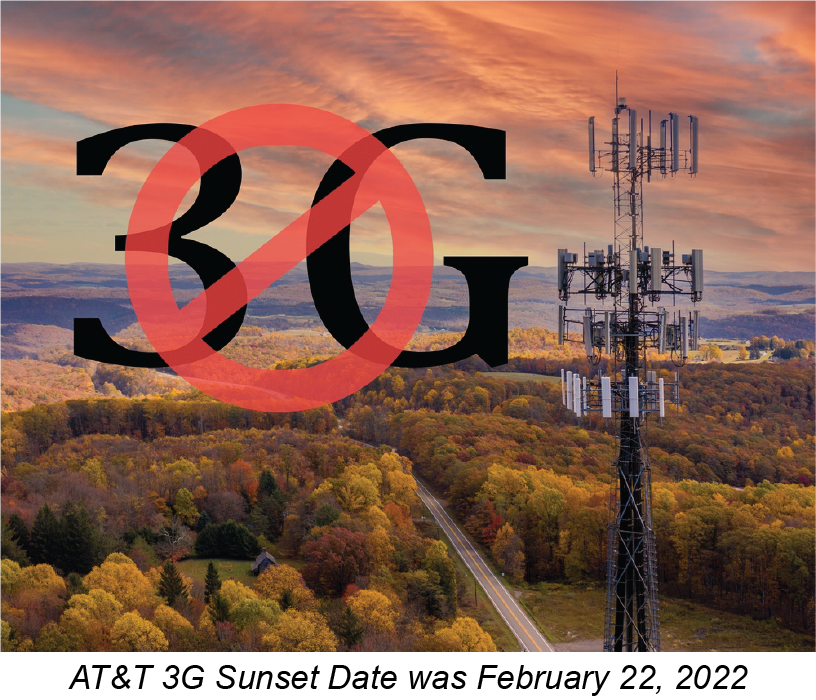
The third generation (3G) of wireless cellular over-the-air protocol debuted in May of 2001. If you had a child born then they’d already be off to college and it’d be time to re-purpose that bedroom. That’s exactly what’s happening with the cellular carriers in the United States right now. All have announced that they are retiring that base station equipment this year, so that the frequency spectrum it occupies can be used more efficiently by the newer protocols. |
Mission has incorporated cellular modules that operate on the latest protocols for several years now, but we did still have thousands of legacy radios that will be unable to communicate with their towers after the shutdown. Over two years ago we began to prepare for the sunset by purchasing sufficient stock of new radios to replace the older ones.
While the pandemic has thrown sand into the gears of everyday life for everyone, we were able to get the vast majority of radios into the hands of our customers before the scheduled sunset. At its peak our 3G warroom showed customers installing up to 500 new radios per day. The vast majority of those went without incident or a phone call to the office.
Clayton Balassi’s team at Beaufort-Jasper Water & Sewer Authority in South Carolina converted 357 radios, that is 77% of their Mission devices, before the sunset date. Balassi said, “We found out about the AT&T 3G Sunset deadline primarily from Mission Technical Support over the phone and constant reminders on the 123SCADA website. We have all of our sites organized in a checklist order to make our monthly routes efficient. We reorganized the radio upgrades in this sequence to minimize drive time.”
The Autoswapper all but eliminated the Beaufort-Jasper team’s need to involve Technical Support. Balassi added, “We called them, maybe, once every 20 sites. Without it we would have been extremely frustrated and we may still be working on this project. Bless the team that created Autoswapper.”
Some had issues though, and they can be broadly categorized into three areas:
- Logistical issues such as a radio showing up to someone who wasn’t expecting it, or an attempt to install the radio at a different site than expected.
- Installation issues were generally easily solved by technical support assistance. For example, many of our new radios feature an embedded SIM and do not require the removable one, but a spare inactive SIM was installed into the radio.
- The remaining issues are the most difficult to diagnose, likely some combination of environmental issues and changes to the underlying cellular technology.
Cellular wireless carriers operate on numerous frequency bands typically ranging from 700 MHz to 2.1 GHz, but now even higher with the newest 5GHz bands supporting 5G. Lower frequencies are more forgiving for non-line-of-sight installations. As the frequencies get higher, it’s more important to have fewer obstacles in the radio path. In urban areas cell towers may be inconspicuously located on corners of buildings, but in rural areas they tend to be mounted on 200-foot towers. As carriers rejigger the frequency spectrum they will continue making many changes to optimize their new networks.
Traditionally our radios have sent in telemetry from the radio indicating signal strength or power (“RSRP”), and the newer radios do this as well. But the new protocols also use sequential and block-error data coding techniques to measure signal quality (“RSRQ”). This number tells us the difference between a really strong signal (that the radio is having a hard time decoding because of a nearby interferer) compared to a really weak signal (that it can decode just fine because there's not much background noise). So while both the old and new parameters are generally highly correlated, interesting combinations of “bad/good” and “good/bad” can inform the user of where to troubleshoot problems.
Across the country in Oregon, Rogue Valley Sewer Service’s TJ Weber swapped out every antenna on his own. He said, “The radios were an easy swap. Even swapping the MyDros was easy. For the radios it was removing the four screws and then the little screws on the board. Then pop that radio off, pop the new radio in. Then change out the antenna.”
|
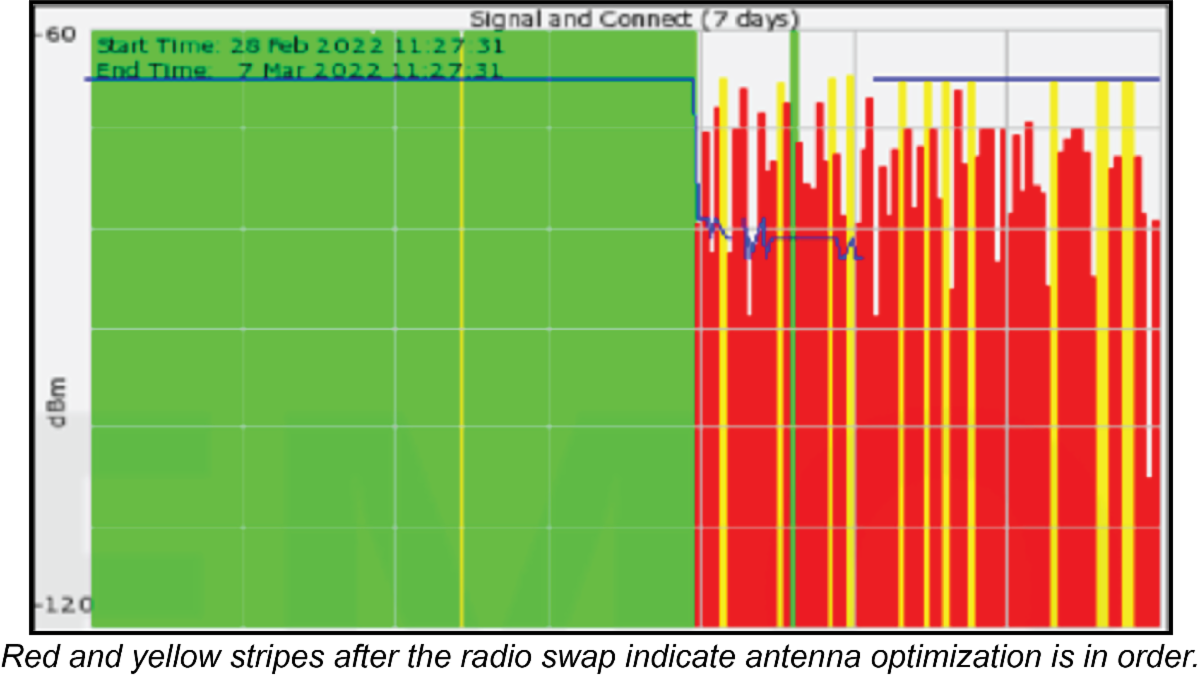
Antenna optimization will improve signal strength and will likely result in a more reliable connection. Locate the antenna high, outside, and away from metal structures (buildings, control cabinets, signs, etc.). The new radio may be relying on different frequency bands than the old one, and an antenna that performed well with the old band may not perform as well in the new environment. If your Mission RTU has been installed for many years a new antenna cable and whip may help. |
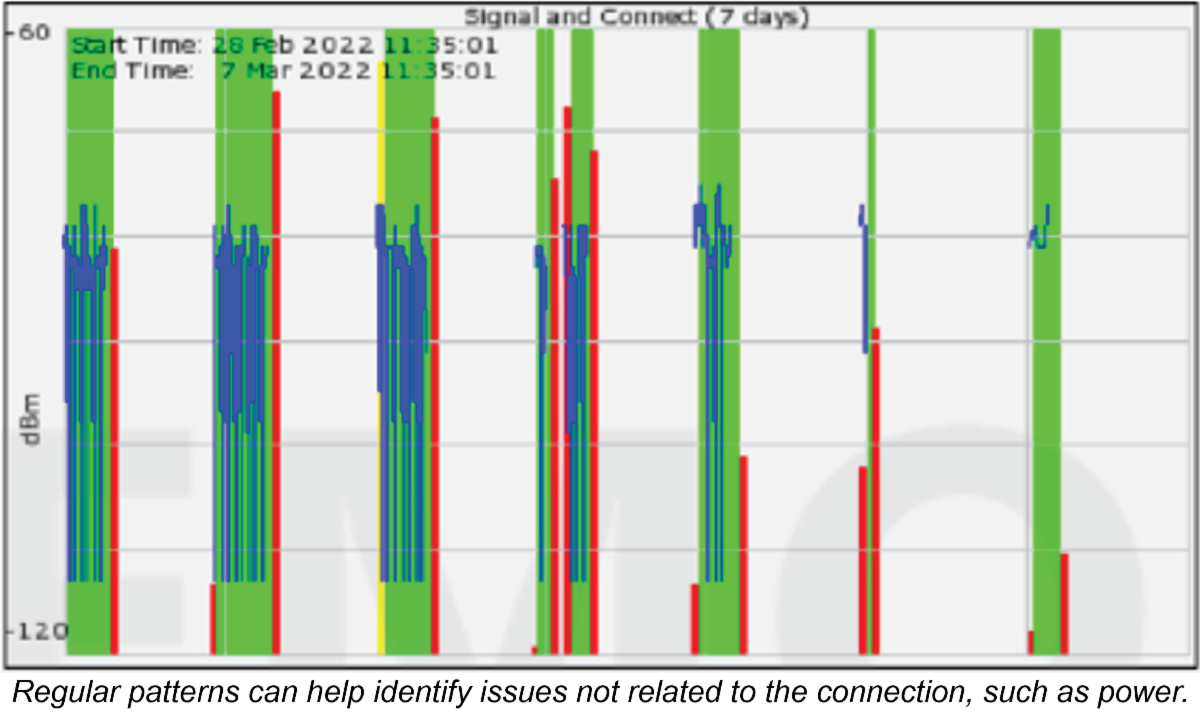
Other issues may have little to do with the new radio. A connection pattern like this can indicate a power problem. For example, the battery of a solar powered RTU no longer has the storage capacity to last the night.
For more information, contact Mission Communications Technical Support at techsupport@123mc.com or by dialing 877-993-1911, option 2. |
Discovering Water on Mars Steers New Ideas |
With private citizens funding and developing space exploration missions, it seems that humans are on the cusp of creating extraterrestrial colonies. The mission of SpaceX—Elon Musk’s private spaceflight organization—is to cultivate life on other planets, starting with Mars. There are a plethora of logistical, technological, physiological factors to consider before human life can sustain itself away from Mother Earth. One such concern is the availability of water in space.
Currently, the water humans use in space has to be transported from Earth and recycled. The majority of water on the International Space Station (up to 80%) is recycled from the astronauts’ sweat, exhalations, and other waste, but this system still requires regular filter changes and refills.
For more than 30 years, the European Space Agency and partner universities have been working to develop a self-sustained ecosystem in a box for astronauts to take with them to explore the Solar System. The system uses a chain of filters to endlessly recycle waste such as urine and sweat. Bacteria in bioreactors and chemical reactions produce clean water and food. With a completely self-sufficient system, astronauts can travel through deep space forever producing the three basic elements of life: water, oxygen, and food.
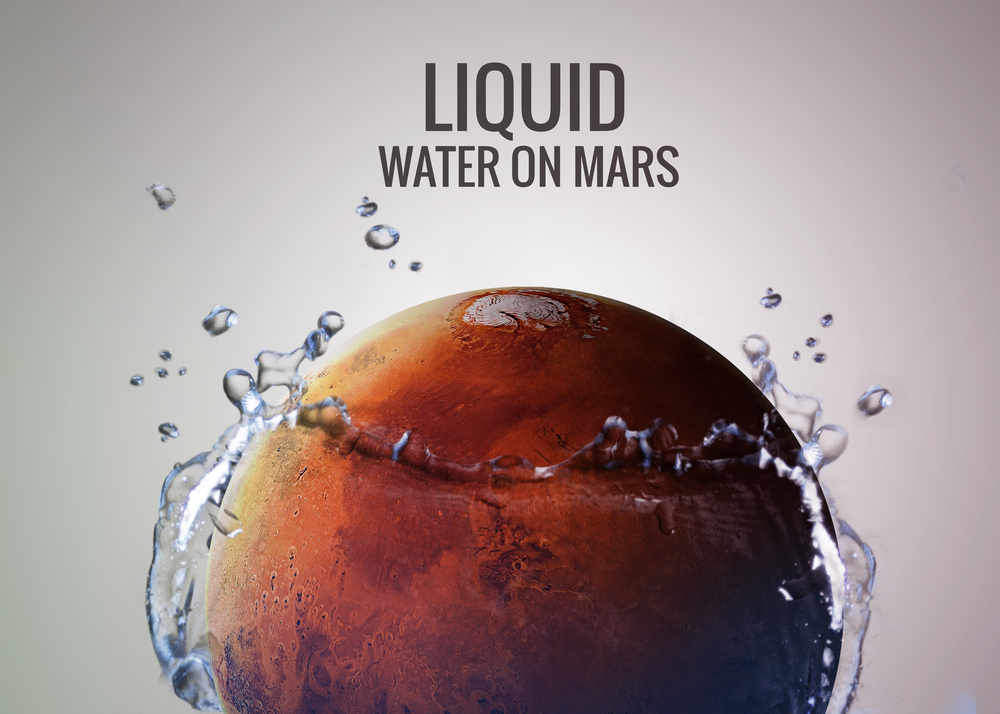
The alternative option is to identify an existing body of water in space for humans to harvest. Mars already has such sources of water and so does Earth’s moon. Water was found even on a large quasar, 12 billion light years away. And those are just a few examples. Most recently, the first real-time discovery of ice on the moon was made by China’s Chang’e 5 lunar lander in December of 2021. This excites anyone interested in the development of interstellar travel, as water is a dense, heavy substance, and there are limitations on the amount of it that can be transported in a spacecraft.
NASA expects to initiate a rover mission—Viper—in 2023 to map resources and lunar ice deposits around the moon’s South Pole. With adequate funding from Congress, the agency plans to land humans on the lunar South Pole in 2025 to explore mining discovered resources.
Humans can use lunar ice for more than just drinking and growing crops. They can potentially convert it into hydrogen or oxygen fuel. Even 3D printers can use extracted minerals to enable manufacturing in space, using native materials. Advancements made in technology for space exploration stand to benefit life on Earth—as was the case with portable vacuum cleaners, cardiac pumps, and embedded web technology that provided the basis for the Internet of Things.
|
|