|
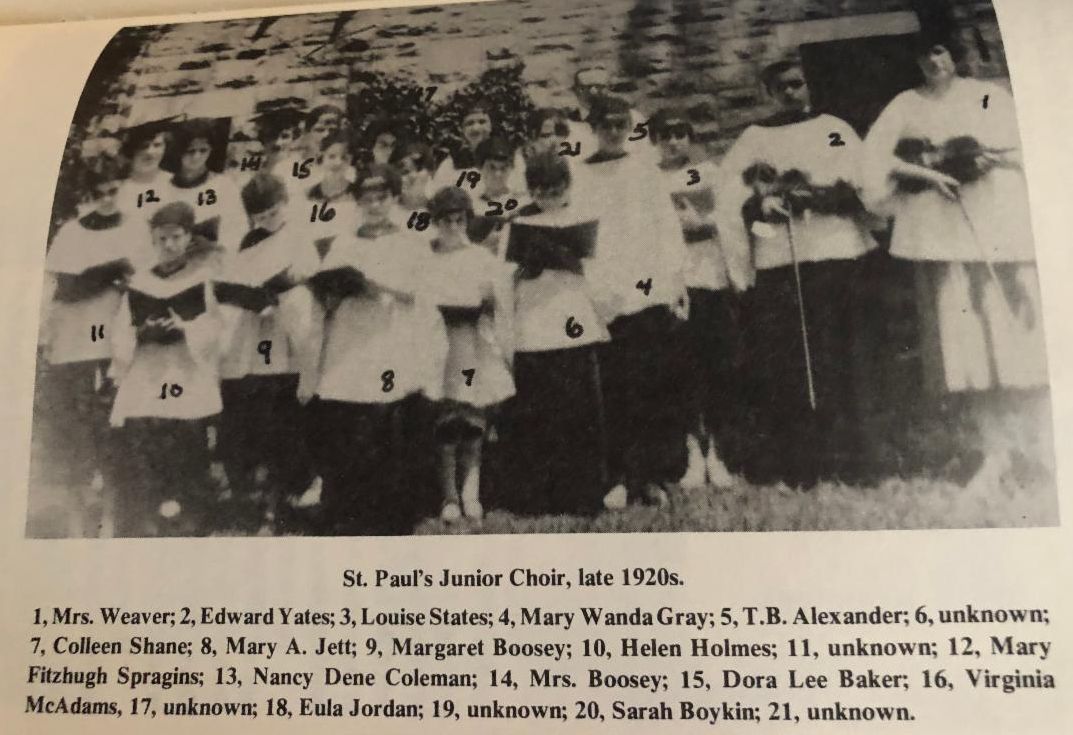
Note: Dora Le Baker Ferguson was one of the authors of ‘Worthy of Much Praise,’ the history of St. Paul’s. This is an account of her experience during the 1930’s Depression.
The Depression and Several Years Before by Dora Leale Baker Ferguson
The people who lived through the depression of the thirties are just a little bit different! Most of them say that even if they had a million dollars, they would still be looking for a bargain. It left a lasting impact on nearly everyone.
My father, Walter Louis Baker, was a survivor. We were never hungry. He raised chickens, rabbits and had a part interest in a goat farm near Cushman with the county agent. He made a wonderful garden from a rocky patch of ground. He was good friends with all county agents, especially Mr. Clem and Mr. Beard. We had red raspberries, celery, cabbage, artichokes, and many unusual things he would order from seed catalogues.
He made a fish pond with a fountain from pieces of junk. He made a graceful bird bath out of a cistern bottom and a metal top which is still in our side yard 65 years later. He made a hammock which my friends thought was wonderful.
Our front room (really a front room because it was so close to the sidewalk [the house was built long before the sidewalk was built]) was lined on all sides with books. There was no library in Batesville at that time. I read everything, including the Classics. I read straight through the “Books of Knowledge” including French lessons. My brother, Albert, was ten years older than I and he spent all his money on books. We also had many old books from grandparents. I knew Albert was a dedicated minister instead of a brother. Our minister, Dr. Verne Stover, gave Albert many books and was a great influence on his spiritual life. He became a minister.
We lived in house, now gone, between the Glenn and Wycough houses on Water Street. The Glenns, Wycoughs, and Bakers were friends and neighbors for many years.
We, some girls and I, went swimming nearly every day in the summer. My father and T. B. McAdams usually took a car full of girls to Millers Creek, The ledge, or the Rocks on the bayou. We also went to Ruddell Mill where the water was very cold. Robin Stamps often a Dr. Pepper truck and we rode on the back. We also went to Green Briar where some boys had built a float in the river. The water was warm at that time. Sometimes we went to Salado Creek.
One of the events of the week was Saturday night when nearly everyone went downtown. The stores were open until nine or ten. If you had a car, you sat in in and watched the people on the street or in the stores.
Another event was the Chautauqua which came to town once a year and had a large tent on the old Arkansas College Campus – now the Presbyterian Church. It was a good grade of entertainment. There was always one event in which the town children took part. I remember when we marched and sang about the “Health Crusades.” The quality of this was far above TV today. I have a program of June, 1928, and the season ticket was two dollars.
My father’s first car was a Model T Ford which won prizes at fairs for being the oldest car. He was very proud of this, but I wasn’t! Later, we had a small car with a rumble seat. This car was named ‘Doodle Bug.’ My cousin Walter Reeder, could sometimes get his family car. This was called ‘Essie Blue’ and was of course an Essex. Edwin Brewer had a Buick which really got used. We liked to drive in circles at the end of Main Street until we got dizzy. Not much traffic then!
We also used our feet. We hiked to Kippewa, a cave with a spring up the old bayou road. At one time a club house stood there. We walked to Waldron Lookout further up the same road across from old Jesse Bean’s house. We hiked to Millers Creek where Robbie Callis had a store and often to Moorefield. Sometimes we took our 22’s for target practice. Jack Evans and Paul Arnold had taught us all the rules of safety with rifles.
The house where I lived had been built by my grandfather and had a large front porch and one at the side of the house was a good gathering place for young people. It was a perfect place to dance. Once we disturbed a Methodist Revival held in a vacant lot across the street. We were requested to be quieter! My cousin, Walter Reeder, and friends Edwin Brewer, Jack Evans, Jimmy Cox, Louis Vacey and others were always ready to do silly but fun things! Looking back, we were very innocent and dumb.
We had a Victrola and our friend, Anela Laman, played the piano with vim and vigor. The Victrola and records got traded in during the worst of the depression for several loads of stove wood.
The Southern Grill, below the courthouse, was owned by two young men, Paul Tobey and Sid Bronson. They let the high school and young college crowd use it as a meeting place. They were fine young men and no one took advantage of them – no liquor or drugs. Aspirin was the only drug we knew about. We had barely enough money for a coke of hamburger. I met my husband, Wilbur B. Ferguson, there. He was on the Arkansas College football team.
We made our own amusements. Friday or Saturday nights we invited some college boys and other friends to eat chili, hamburgers, scrambled eggs, or something cheap to fix in our homes. We were often at Butler Hill, home of Lib and Paul Butler. A favorite game was ‘Hide in the Dark.’ One person hid and as each person found him, they would hide with him or her until the entire group was huddled in one place – silly but fun!
We often went to the Presbyterian Church for Christian Endeavor – called ‘Christian Devilers’ wittily by us. Sometimes we went to BYPU at the Baptist Church known to us as ‘B Y Phew.’ Our sense of humor worked overtime.
Many young men were in the CCC Camps. There were dances at Sylamore Lodge. The CCC boys built some beautiful bridges and other things. One WPA project was researching Courthouse records. Another was a course on family history taught by Chloe Vida Young – a descendant of early settler, George Ruddell. She taught us to make direct line charts and use courthouse records in our research. I was about seventeen years old, but this interest stayed with me all my life.
Arkansas College recruited a football team. Wilbur Ferguson, Red Smith, Russel Bentley, Bull Durham, Enid Barron, Elmer Hogg, and others. There were no jobs available, so they played ball and got an education. They worked part time at college jobs. The boy’s dormitory was a lovely brick building with should not have been torn down. Lib Butler’s Aunt Nola was matron and she had some girls spend the night several times. What a thrill for teen aged girls!
Alumni Hall, next to Morrow Hall was our entertainment center. The plays were really good and we attended all recitals, sitting on the front row. It was good entertainment and was, for the most part, free. Alumni Hall was a lovely classic style building. I got an ‘A’ on an essay I wrote on it in Dr. Samuel Evin’s English class.
My friend, Virginia Timmons’ father was Dean of College, and taught Spanish. We thought the furniture in the Timmons house, torn down now, was weird. Blasé and weird were our favorite descriptions of everything. Later, we realized their furniture had real value as early southern antiques.
We went to the Gem Theater and saw many really good movies – never paid more than a dime. Mr. Landers was very good to us – gave us lots of movie magazines and the show cards from the front of the theater.
Boyce’s Sandwich Shop had really good chili. A steak sandwich was ten cents. A line of boys were always in front of the shop. They were known as the ‘Receiving Line.’ If you didn’t merit a whistle – too bad. Chad Moore sold hot tamales from a cart on the street. Rumors that they were made from cats didn’t hurt business.
A group of girls often looked at clothes at Barnett’s and Fitzhugh’s, but there were few sales from us.
I had my Aunt Emily Bass, who was an artist, with a sewing machine. She made me a beautiful tailored coat from a man’s over coat. I wore it for many years and it would have been small looking today.
Most people did not lock doors at that time. We didn’t have a key to one door of our house on Water Street. We walked anywhere in town at night with no fear at all. ‘Gang’ at that time meant a crowd of young people who met together to drink cokes, talk, and dance.
None of us felt poor in any way. We were seldom without something to do. We had access to spend the weekend at Riverview, a large club house on a bluff up the river. Betty Blonde’s family belonged to this club. We would also go for weekends to Kamp Kiwanda, owned by the Hail – later Batesville Outing Club. Sometimes Eleanor Gray was our chaperone.
Some of our favorite songs were ‘Stardust,’ ‘Mood Indigo,’ ‘Smoke Gets in Your Eyes,’ and many others.
When Wilbur and I got married, he was one of the few young men who had a job. He made fifteen dollars a week working in a drug store. We once rented a house for fifteen dollars a month, which we shared with a school teacher, his wife, and their child. Each family paid seven dollars and fifty cents a month for rent. We spent five dollars a week for groceries. Round steak was twenty-five cents a pound and a large can of peaches cost ten cents.
It was a very different world from the one we live in today.
|