|
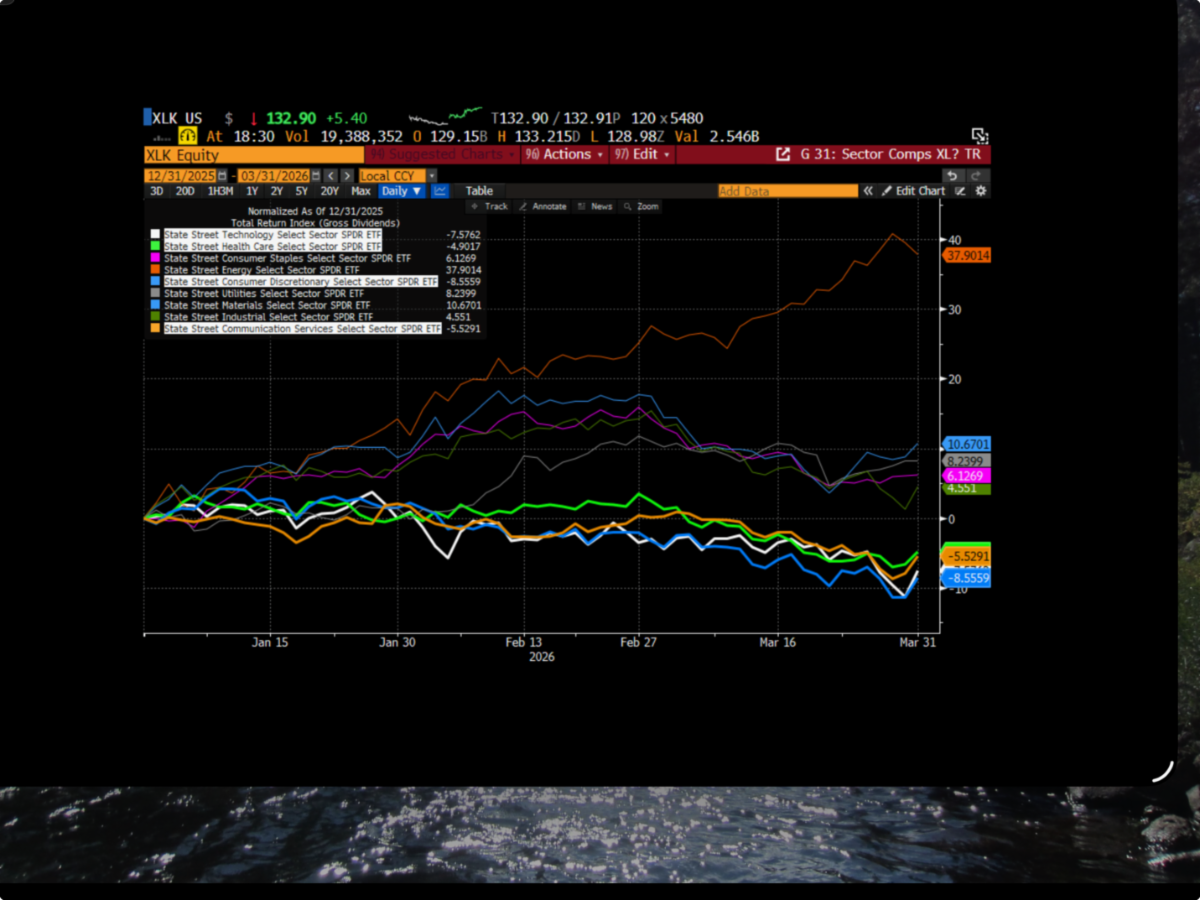
Q1 2026 Sector Performance — Wide Dispersion Across Outcomes
Dispersion, Not Direction
The most important takeaway from the quarter is not which sector performed best or worst—it is how far apart those outcomes were.
Returns did not move together. The spread between winners and losers widened meaningfully, with some areas generating strong gains while others declined over the same period.
That is not just an observation. It has direct consequences.
In a market like this, broad exposure becomes less reliable. Owning “the market” is no longer a neutral decision—it is an active bet on everything, including the parts that are not working.
And in Q1, there were plenty of areas that were not working.
Rate-sensitive segments, lower-quality balance sheets, and businesses dependent on continued favorable financing conditions came under pressure. In many cases, these were not dramatic drawdowns—but they were persistent drags. The kind that compound quietly in the wrong direction.
Avoiding those areas was not about being defensive. It was about not allocating capital to segments where the outcome depended on conditions improving rather than fundamentals already being in place.
That is where dispersion mattered in practice.
It wasn’t just that some areas did better than others. It was that the gap between good capital allocation and poor capital allocation widened enough to show up in results.
Selection mattered more. Positioning mattered more. And just as importantly—what we chose not to own mattered more.
What Was Actually Driving It
From the outside, the quarter looked relatively orderly. Underneath, it was anything but.
Leadership narrowed further. Volatility appeared quickly, then disappeared just as fast. Correlations that investors rely on shifted without warning. Liquidity felt available—until it wasn’t.
And the difference between being generally exposed and being correctly positioned widened.
That gap is where most of the real work is happening now.
AI: From Story to Business
AI remained the dominant force shaping investment. The scale of capital being committed—data centers, compute infrastructure, enterprise integration—continued to grow.
Microsoft, Alphabet, and Amazon remained central to that buildout, with NVIDIA and Apple playing critical roles across chips and devices. These are not just large companies—they are the primary builders of the current cycle.
But something important changed in how the market treated them.
AI is no longer being priced as a story. It is being priced as a business.
That shift showed up clearly. Investment alone was no longer enough. The market began asking when that investment translates into earnings.
Margins were pressured in the near term as spending accelerated, while monetization lagged. That tension drove much of the price behavior.
The opportunity remained—but it became narrower. It required more precision around where capital was going and how it would ultimately generate returns.
A More Selective Market
For much of the last cycle, the market was willing to underwrite investment ahead of results. It assumed scale and participation would eventually convert into earnings.
That assumption is now being tested.
And that changes behavior.
Even within the strongest themes, not everything worked at the same time. Leadership narrowed. Timing mattered more. Capital became less forgiving.
Outside of AI, the same pattern showed up in simpler terms:
• Businesses with real cash flow held up
• Strong balance sheets held up
• Companies that could fund their own growth held up
What struggled were the areas that had quietly depended on a more forgiving backdrop—stable correlations, lower funding costs, and a market moving broadly higher.
This was not a market breaking. It was a market becoming more selective.
And that distinction matters.
Structure, Not Prediction
In an environment like this, the question is not “what happens next?”
It is: how is capital positioned so that outcomes are not dependent on being exactly right?
That is where structure shows up—not as a concept, but as a difference in results.
A portion of capital was anchored in areas that could hold their ground—income, shorter-duration exposures, and businesses with visible cash flow and balance sheet strength. Not because they were exciting, but because they allowed us to stay invested without being forced into reaction.
Another portion was allocated to growth—but selectively—where capital was actually being deployed and where there was a credible path to return on that capital.
Stability and participation were not opposites. They were complements.
Too much stability, and you miss where growth is occurring. Too much participation, and you take on volatility that is no longer predictable or contained.
The balance is what matters.
How That Actually Showed Up
During the first quarter, that balance showed up in ways that are easy to overlook if you only look at headline returns.
The more stable portions of the portfolio did their job. They provided income, reduced volatility, and preserved flexibility. That mattered most during moments when markets moved quickly and without warning.
The growth-oriented exposures contributed—but not broadly. Returns came from specific areas where capital, earnings visibility, and execution aligned.
Just as important were the areas we avoided.
We did not extend into parts of the market where pricing depended on improvement rather than existing strength. We did not rely on broad exposure to carry results. And we did not assume that leadership would remain stable.
Those decisions do not always stand out in a rising market. But in a dispersed one, they compound meaningfully over time.
We also maintained liquidity.
Liquidity is often misunderstood as idle capital. In practice, it is optionality—the ability to act when conditions change, rather than when they feel comfortable.
In a quarter where volatility appeared without much warning, that mattered.
Looking Forward
The temptation now is to simplify the outlook.
To decide whether growth is strong or slowing. Whether rates are going up or down. Whether markets will move higher or lower.
Those questions are less useful than they used to be, because the environment is not resolving into a single path.
Growth is present—but uneven. Some areas continue to expand and attract capital, while others face pressure.
Inflation has moderated—but not resolved. Policy has adjusted—but not clearly. Liquidity is present—but not stable.
And layered on top are structural forces—technology, geopolitics, capital flows—that do not move in cycles at all.
That is what creates the wider range of outcomes.
AI remains central, but the next phase will be defined by what that investment produces—and when. That is a slower and more uneven process, one that rewards selection over participation.
Takeaway
What this quarter reinforced is straightforward:
Managing risk is not separate from generating returns—it is what allows returns to compound.
Avoiding weaker areas of the market was not about being cautious. It was about not allocating capital where outcomes depended on improvement rather than evidence.
At the same time, results were not driven by avoiding growth, but by being selective within it—focusing on businesses with real cash flow, strong balance sheets, and the ability to fund their own expansion.
That combination—protecting downside while participating selectively in durable growth—is what allows a portfolio to move forward without being dependent on any single outcome.
The first quarter did not reward being broadly right.
It rewarded being selective.
It rewarded discipline.
And it rewarded portfolios built to function across different conditions—not just one.
That is unlikely to change.
We are not positioning for a single outcome. We are positioning across a range of outcomes—while ensuring no single path determines the result.
That takes structure. It takes patience. And it takes the willingness to not chase what is working in the moment.
Andy
On behalf of Stableford Capital
|