There is no record of who is winning after the seventh inning. -Ed Doherty | | |
My expectation is that sometime this month, the second book in the 'speed of life' series will be published. Did I intend it to be a series? No.
The similarities between the books go beyond the speed of life metaphor. This book highlights Observational Leadership and includes 30 stories, ten each to illustrate Observe. Act. Stay With It. All of the stories were originally Weblogs, so if you've read all the Wednesday Weblogs, you've kinda sorta read the book.
Each chapter also has some reflections and activities to act on or implement the lesson included, so it is not only a book of stories, but can also serve as a workbook for personal development.
Once the book is available on Amazon and Barnes and Noble, I won't be shy about letting you know.
| Standing on the Corner, Smoking a Butt | |
When I was growing up in Braintree, Massachusetts, I played baseball in the East Braintree Little League.
There was a kid I'll call Kenny who was a year older than I was but looked like he was five years older. He was taller, better-looking, more athletic, and considerably more talented.
Unfortunately, he was also an arrogant jerk.
Kenny played shortstop, which seemed like the perfect position for someone who considered himself the most important person on the field. He was good, and he knew it. Worse, he wanted everyone else to know it, too. He made fun of kids who weren't as talented as he was, which included just about everyone.
When I was playing at the lowest level of Little League, Kenny was already playing at the highest. He was an All-Star in Little League, an All-Star in the Babe Ruth League, an All-Star in junior high, and eventually an All-Star in high school. Whatever the sport, whatever the level, Kenny seemed to be one of the best.
Everything came naturally to him, and just about everyone was jealous of Kenny.
Except me.
Well, that's not entirely true. I certainly wished I was as tall as he was. I wouldn't have minded being as good-looking as he was, either. And I definitely would have appreciated being able to hit a baseball the way he could. But there was something about Kenny that bothered me far more than his considerable athletic advantages impressed me.
It was his attitude.
Kenny wasn't simply confident. He was arrogant. He wasn't simply competitive. He enjoyed making other people feel inferior. He was a bit of a con man, a bully, and someone who seemed to believe that his early success entitled him to a lifetime of superiority.
And somehow, even as a preteen, I had the distinct feeling that things weren't always going to work out quite so well for Kenny.
I'm not sure where that perspective came from. I certainly wasn't a particularly sophisticated student of human behavior at the time. I was just a kid who loved playing sports and wished he could hit a baseball farther than Kenny did. But something told me that Kenny's greatest weakness wasn't anything you could measure on an athletic field.
It was his assumption that being ahead meant he would always be ahead.
And I didn't believe that.
| |
The Years Have a Way of Changing the Standings
As we got older, something interesting happened. The distance between Kenny and the rest of us began to shrink. The qualities that made him so impressive at twelve or thirteen didn't necessarily make him equally impressive at seventeen or eighteen.
Other kids grew taller. They became stronger. They developed skills. They worked harder. Some discovered talents they didn't even know they had.
And some of us simply kept going.
I eventually became an All-Star hockey player and an intercollegiate athlete. Not because Kenny inspired me to prove him wrong. He didn't. I can't honestly say that I spent much time thinking about him at all, except when our paths happened to cross.
But one day, in my forties, as I was driving past the old high school in Braintree, I saw Kenny standing on the street corner across from the school, smoking a butt.
He was noticeably out of shape. The kid who had once been bigger, stronger, and more athletic than practically everyone around him no longer looked anything like the athlete I remembered. The imposing physical presence that had made him seem so much older and more accomplished than the rest of us had disappeared.
There he was. The former superstar. The kid everyone had admired, envied, and perhaps feared.
Standing on the corner smoking a butt.
Meanwhile, I was driving by, having experienced athletic success that would have seemed pretty unlikely back when Kenny was making fun of the rest of us on the Little League field.
I couldn't help noticing the contrast.
Now, I have no idea what eventually became of Kenny. Seeing someone out of shape and smoking a cigarette on a street corner hardly qualifies as a comprehensive assessment of his life. He may well have gone on to accomplish wonderful things. I simply don't know.
But I do know that the physical advantages and athletic superiority that had once seemed so permanent were no longer apparent.
And that image stayed with me.
| |
There's No Record After the Seventh Inning
One of my favorite expressions is, "There is no record of who is winning after the seventh inning."
Kenny was certainly winning in the early innings. He had the talent, the looks, the athletic ability, and all the recognition that went with them.
But life is a much longer game than Little League, and being ahead early doesn't mean you'll stay ahead.
Some people peak early. Others develop their abilities over time. Some who appear to have every advantage discover that talent alone isn't enough to sustain success. And some who seem destined to spend their lives on the bench eventually become the stars of their own stories.
That's something I sensed about Kenny long before I fully understood why.
A head start is not the same thing as a victory.
I've thought about that experience occasionally over the years, particularly when I've encountered people who were exceptionally successful early in their careers and seemed to assume that success would continue indefinitely.
Sometimes it does. More often, success introduces an entirely new challenge: staying successful.
The person who was the smartest student in high school discovers that college is filled with smart students. The outstanding young salesperson becomes a manager and discovers that selling and leading are two very different skills. The executive who rises quickly through an organization begins to believe that every decision must be the right one because so many previous decisions worked out.
And that's when trouble can begin.
Early success can be a wonderful advantage, but it can also become a trap. When things come easily, there's a temptation to believe they always will. When people constantly tell you how good you are, it's easy to stop listening to the people who might tell you how much better you could become.
Talent can open a door. It doesn't guarantee you'll know what to do once you walk through it.
And arrogance has an interesting way of making people believe they've arrived when they're actually just getting started.
| |
Even Champions Have to Keep Winning
Of course, there are exceptions. Take Bill Russell and the Boston Celtics of the 1950s and 1960s. Those Celtics seemed to make winning championships an annual event. Russell won eleven NBA championships in thirteen seasons, including eight in a row.
That's not a dynasty. That's practically a subscription service.
But there's a reason we still talk about that team more than half a century later. Sustained excellence on that level is extraordinarily rare.
In sports, business, leadership, and life, yesterday's success doesn't guarantee tomorrow's results. Competitors improve. Circumstances change. Expectations rise. And the very qualities that helped you succeed initially may not be sufficient to sustain that success.
The question isn't simply whether you can reach the top.
It's whether you have the character, discipline, humility, and willingness to keep learning once you get there.
| |
The Lesson
Kenny taught me something without ever knowing he was teaching it.
He helped me understand that exceptional talent and early recognition don't automatically translate into lasting achievement. More importantly, he helped me realize that I didn't need to be the best at twelve years old to accomplish something meaningful at twenty, forty, sixty, or seventy.
That's a particularly important lesson for leaders, because we have a tendency to evaluate people based on where they are today rather than where they might be capable of going tomorrow.
We identify our stars, celebrate our high performers, and occasionally dismiss those who haven't yet demonstrated exceptional ability. We make judgments about potential based on performance at a particular moment in time.
But people develop at different rates. Some start quickly and level off. Others begin slowly and continue improving long after their supposedly more talented colleagues have stopped growing.
The employee who struggles today may become tomorrow's outstanding performer. The person who appears to have every advantage may eventually discover that talent alone isn't enough. And the person quietly improving while everyone else is celebrating may be the one who surprises us all.
| |
Never mistake someone's current position for their ultimate potential.
And there's a lesson here for those of us who aren't necessarily the biggest, brightest, fastest, or most naturally talented people in the room.
Don't become discouraged simply because someone else is ahead of you. Don't assume that the people receiving all the recognition today will be the ones receiving it tomorrow. And don't allow someone else's arrogance to convince you that their advantages are permanent or your limitations are.
Keep learning. Keep improving. Keep competing. And perhaps most importantly, keep your humility, particularly when things are going well.
As for Kenny, I don't know how his story ultimately turned out, and that's really the point. None of us knows the final outcome while the game is still being played.
But I do know one thing.
There is no record of who is winning after the seventh inning.
And that's worth remembering, whether you're the person who's ahead or the one who's still trying to catch up.
| |
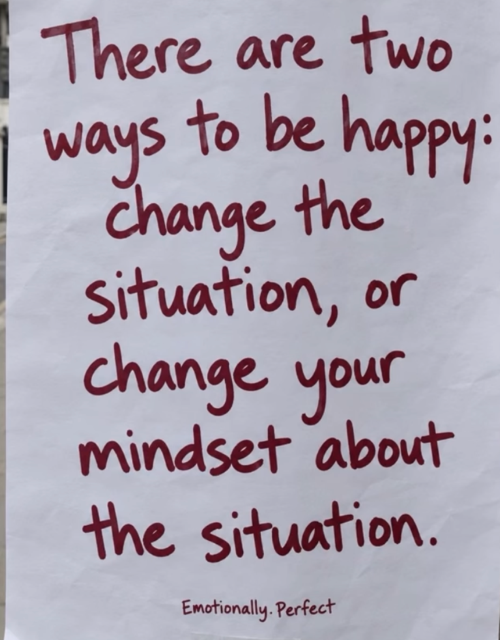
Surprise Photo at the End:
From a Restaurant in West Hartford, CT
| | If you are reading this on a social media platform, click below and you'll automatically receive a 'different' story every week on Wednesday. | | |
The Roll Call of states and countries where readers reside: Arizona, California, Colorado, Connecticut, Delaware, Florida, Georgia, Hawaii, Illinois, Indiana, Iowa, Kansas, Kentucky, Louisiana, Maine, Massachusetts, Michigan, Mississippi, Missouri, Montana, New Hampshire, New Jersey, New Mexico, New York, North Carolina, North Dakota, Ohio, Pennsylvania, Puerto Rico, Rhode Island, South Carolina, South Dakota, Tennessee, Texas, Vermont, Virginia, Washington and Washington DC, Wisconsin plus Canada, Conch Republic, Australia and the United Kingdom.
| | |
Ed Doherty
774-479-8831
www.eddoherty.com
ed-doherty@outlook.com
Forgive any typos please.
| | | | | |