Message from NYSTAR Executive Director | | |
In the Marvel movie “Ant-Man and the Wasp,” the character Scott Lang at one point asks: "Do you guys just put the word 'quantum' in front of everything?" While this is one of my favorite jokes from the movie, it may be a very real future across New York State. Quantum Computing, Quantum Networking, Quantum Sensing… the list goes on. Amazing scientific breakthroughs are happening that provide a glimpse into how potentially transformative quantum technologies are.
Quantum is nothing new to New York State, which has for many years been a hotbed for innovation in quantum technologies. As a result, we are in a very strong position to lead the future of translating this transformative potential into real world commercial applications. Under the leadership of Governor Kathy Hochul and the proposed Quantum Hubs initiative, we are poised to begin writing the next chapter of quantum innovation and commercialization across the state.
The applications for quantum are vast, from developing unhackable quantum networks, to quantum sensors that allow for things like ultra-precise positioning and navigation without GPS, to quantum computers capable of solving problems that are beyond the capabilities of classical CPU and GPU frameworks. All of this is currently happening across the state, showcasing advancements in commercialization, manufacturing, partnerships, and research. This work is opening the door to even more possibilities.
And with every success story, there’s another opportunity to appreciate the sky-high potential emerging from every corner of New York.
This is an exciting time to be a New York–based innovator. With continued support and resources from Empire State Development’s Division of Science, Technology and Innovation (NYSTAR), these breakthroughs— and breakthroughs in waiting—have the guidance they need to make an incredible impact, remaking industries like healthcare, science, technology, and so much more.
Enjoy the details of some of our recent quantum-related successes throughout this newsletter, along with an early update on this year’s New York State Innovation Summit.
Thanks as always for sharing your achievements. This network continues to be remarkable, showing us how far we’ve come—and how far we can go.
Ben Verschueren
Executive Director, NYSTAR
| | Partnership works to improve quantum computing, communication | | |
Superconducting nanostripe single-photon detectors (SNSPDs) are currently the gold standard for detecting light at the single-photon level. They are widely used in quantum computing and communication—but there’s still room for improvement.
To answer this challenge, the University of Rochester has partnered with SEEQC to create, manufacture, and distribute a next-generation smart sensor, designed for use in cutting-edge quantum applications such as optical quantum networks, quantum computing, and secure data transfer systems like quantum key distribution.
Current SNSPDs face a tradeoff between three key performance factors: speed, detection efficiency, and background “noise” (known as dark counts). Integrating digital circuitry directly on the chip could help solve this problem by improving bias control, distinguishing between real and false signals, and even measuring photon numbers and energies more accurately.
With help from a $50,000 Fuzehub Manufacturing Grant in 2022, the partnership transitioned an existing SNSPD model into a new simulation platform (WRSpice), fabricated prototype chips, and performed testing and characterization.
Since development, the project has achieved excellent results. It has allowed the team to expand their work into new areas of quantum interface development and into a new 13,000-square-foot facility in Hawthorne, N.Y., and has led SEEQC to further collaborations with major corporations like IBM and NVIDIA.
To read more about the University of Rochester’s partnership with SEEQC—and how NYSTAR support has been critical to their work—read our latest blog.
| | New computing framework helps unlock complex biological networks | | |
In modern biomedicine, scientists today collect huge amounts of biological data from across the entire genome and different layers of biology (like genes, proteins, and more). They use this data to find groups of genes that work together—some that act the same across many situations, and others that are specific to certain diseases. By studying these gene networks, researchers can better understand how diseases work, identify early warning signs (biomarkers), and develop new, more effective medicines.
Yet as datasets grow, so do the computational barriers. Even with powerful parallel computing, exhaustively searching gene–gene interactions for multiple different conditions remains inherently time-intensive—especially when you must double check results many times to ensure the output is stable and trustworthy. The scale of genome-wide analysis demands a new computational paradigm.
To address this challenge, Binghamton University and Sostos, Inc.—supported by the CNY Biotech Accelerator—developed a quantum computing–based framework for large-scale multi-omics network analysis. At its core, the framework integrates Grover’s search algorithm—a quantum algorithm that provides quadratic speedup for unstructured search problems—into gene regulatory network interrogation, helping researchers more quickly identify meaningful and overlapping gene–gene interactions across patient cohorts by reducing the number of calculations required.
To prove the concept, Binghamton and Sostos, Inc. applied the approach to copy number variation (CNV)-mediated transcriptional networks in non-small cell lung cancer. After querying overlapping edges from networks containing 28,390 edges and simulating 90 qubits using tensor network methods, the framework demonstrated scalability while maintaining analytical fidelity.
Thanks to this quantum-enabled analysis, Sostos, Inc.’s approach successfully identified overlapping gene–gene interactions across large prediction logic boolean implication networks (PLBIN)-derived networks. Results from quantum hardware closely matched classical simulations, confirming the approach works under real-world quantum conditions. Ultimately, by reducing the effective search complexity, the framework demonstrated measurable acceleration in gene regulatory network (GRN) interrogation without sacrificing accuracy.
This work establishes a foundational proof-of-concept for quantum-accelerated multi-omics analysis. It opens the door to integrating quantum approaches into future biomedical data pipelines and large-scale knowledge systems—an early but significant step toward practical impact in translational science.
| | New hardware provides connection between computing of past and present | | |
Despite enormous investment in quantum computing worldwide, one fundamental barrier has slowed adoption: today’s digital infrastructure is classical, while quantum machines communicate with light, making it difficult for the two systems to talk to each other.
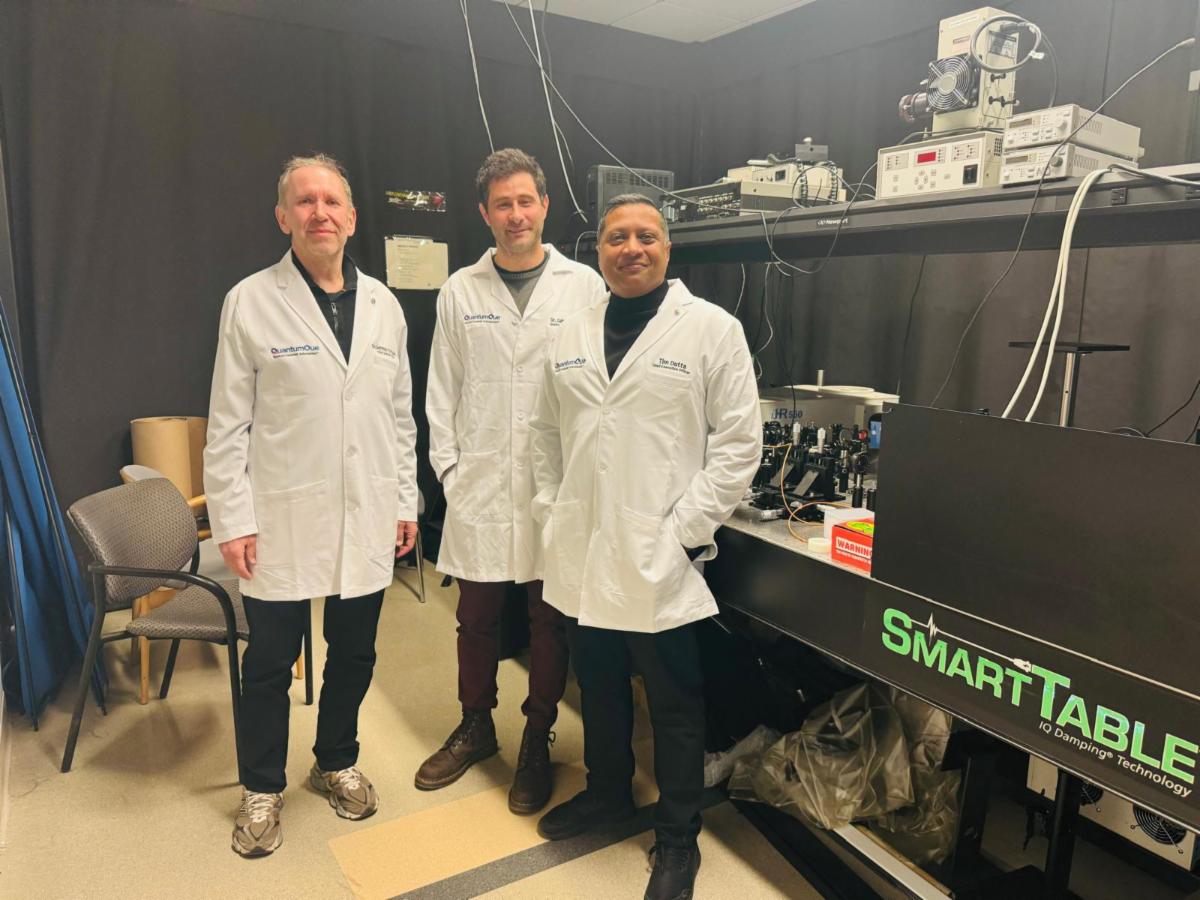
QuantumCue, Inc.—formerly Next Generation Quantum Corp. (NGQ), founded by researcher Dr. German Kolmakov and powered by partnerships with CUNY and the NYC Innovation Hot Spot—is driving the development of hardware to connect existing telecommunications infrastructure to quantum computing and quantum encryption technologies. The big idea: supply a key missing component in deploying quantum networks at scale.
Dr. Kolmakov, a Physics Professor at the New York City College of Technology (CUNY) and co-founder and CTO of QuantumCue, has spent his career working at the intersection of quantum physics and real-world communication systems. In 2025, he was awarded a full U.S. patent for a an electro-optical converter that transforms electrical signals into optical signals and moves those signals between optical channels using exciton polaritons, hybrid light-matter particles generated by electrical signals.
More simply put, the device enables classical electronic systems to communicate directly with quantum photonic systems—and provides a key missing component in deploying quantum networks at scale.
While Dr. Kolmakov’s team is actively developing this needed hardware, support from the New York innovation ecosystem has been critical in helping the team transition from research breakthrough to a viable commercialization pathway. Through CUNY and the NYC Innovation Hot Spot, the QuantumCue team has received CUNY prototyping funds, National Science Foundation (NSF) I-Corps National Teams nomination, and NYC Innovation Hot Spot prototyping support totaling more than $50,000; business development assistance from the NYC Innovation Hot Spot; and travel funding to participate in the TechConnect Discovery Bootcamp in Summer 2025.
Once complete, the planned patented exciton-polariton optical interconnect aims to enable applications such as quantum-secure communication networks, lower energy data centers, faster computing and drug discovery, and next-generation cybersecurity. Ultimately, this technology will enable the integration of quantum computers with existing internet infrastructure.
Dr. Kolmakov and QuantumCue, Inc. are now pursuing federal funding and industry partnerships to scale the device and move toward manufacturing and deployment.
Thanks to the many NYSTAR assets for continuing to submit their success stories. Click here to share your story for potential inclusion in our blog or newsletter — we want to hear from you!
| | NYS Innovation Summit: Save the date! | | |
The 2026 New York State Innovation Summit will be here before you know it. And, yes, quantum will be a big part of the mix!
Set for October 27-28, 2026, inside the Buffalo Convention Center, this year’s edition will feature an impressive list of makers and shakers eager to communicate the many advancements—and potential for more—taking place across New York State.
The NYSTAR annual meeting will be held on October 26th at the Hyatt Buffalo.
And with the prevalence of quantum innovation now gaining momentum statewide, leaders in the field will be in attendance, and on the main stage, to celebrate the work happening right in our backyard.
To learn more about the Summit or to apply as an exhibitor, visit nysinnovationsummit.com.
| |
State of Innovation news and notes | | | | |