View Our Events

Statement by the Center for the Study of Islam and Democracy (CSID) on:


The Imprisonment of Sheikh Rached Ghannouchi


Statement by the Center for the Study of Islam and Democracy (CSID) on the Imprisonment of Sheikh Rached Ghannouchi


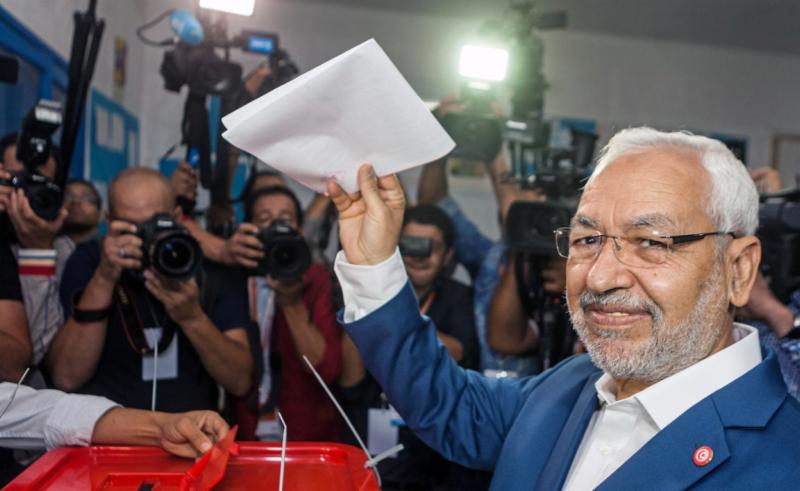
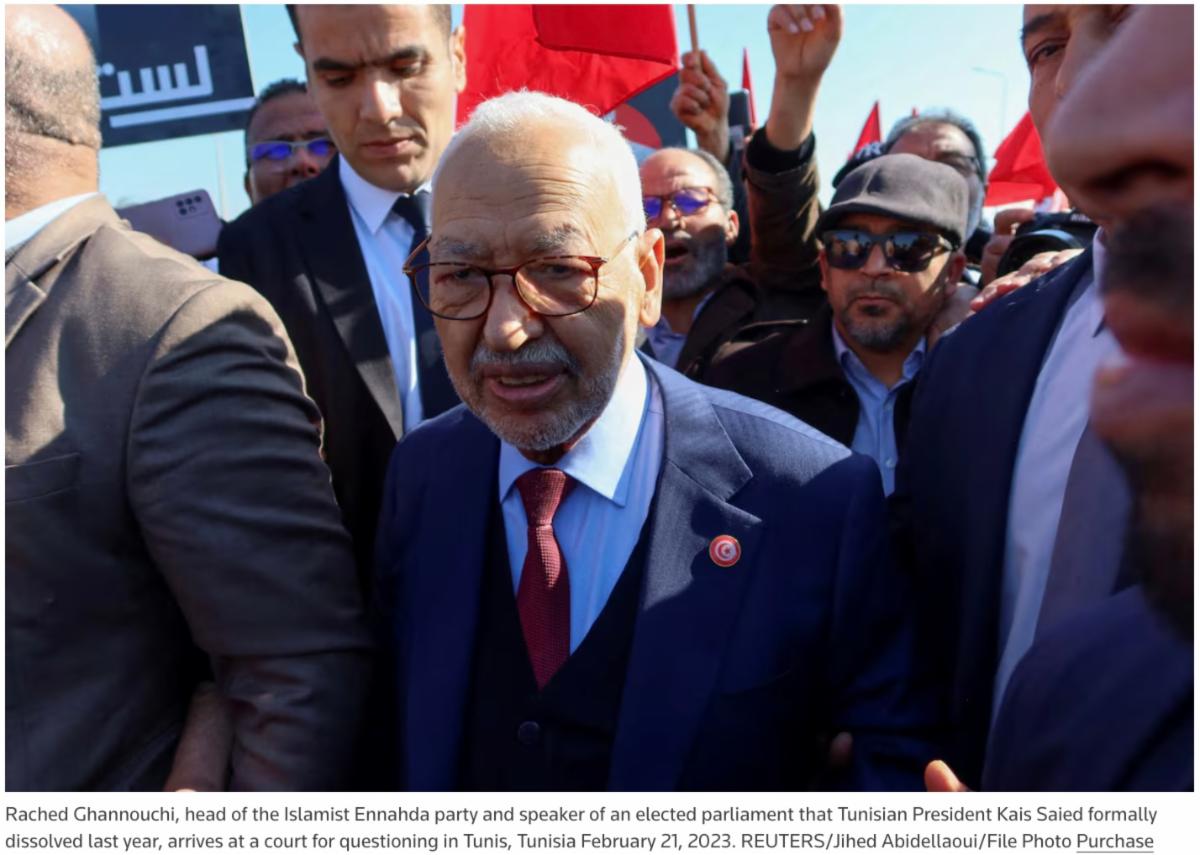
The Center for the Study of Islam and Democracy (CSID) calls for the immediate release of Sheikh Rached Ghannouchi, former Speaker of Tunisia’s Parliament and a leading advocate for democracy and human rights. His continued imprisonment represents a grave violation of political freedoms and the rule of law.


Sheikh Rached Ghannouchi has dedicated his life to advancing democratic governance, peaceful political participation, and dialogue in Tunisia. He is a prominent Tunisian politician, thinker, and co-founder of the Ennahda Movement, a party rooted in moderate Islamic and democratic principles.


Born in 1941, he spent years in exile during Ben Ali's authoritarian rule, advocating for political pluralism and human rights. After the 2011 Tunisian revolution, he returned to the country and played a key role in shaping its democratic transition, supporting a system that balanced Islamic values with democratic governance.


As Speaker of the Tunisian Parliament from 2019 to 2021, Ghannouchi championed dialogue and political consensus-building. his detention is part of a broader crackdown on political opposition, independent voices, and civil liberties. The arrest of opposition leaders undermines Tunisia’s democratic progress and threatens the fundamental rights of its citizens.


Tunisia was once a beacon of hope for democratic aspirations in the Arab world, exemplified by its 2014 democratic constitution and successful peaceful transitions of power.. The unjust imprisonment of political figures like Sheikh Ghannouchi signals a troubling regression. Silencing dissent through politically motivated charges only deepens the country’s crisis and isolates it from the international community.


CSID urges the Tunisian authorities to respect constitutional rights, uphold due process, and ensure the immediate and unconditional release of Sheikh Ghannouchi. We call on the international community, human rights organizations, civil society organizations, and democratic governments to press for his freedom and to support the restoration of democracy and political pluralism in Tunisia.


The path to stability lies in dialogue, inclusion, and the protection of fundamental freedoms—not in repression. Tunisia’s future depends on safeguarding democratic principles and ensuring that all voices, including those of political opponents, are heard and respected.


Center for the Study of Islam and Democracy (CSID)


Tunisian court hands lengthy prison terms to top politicians


By Reuters, February 5, 2025

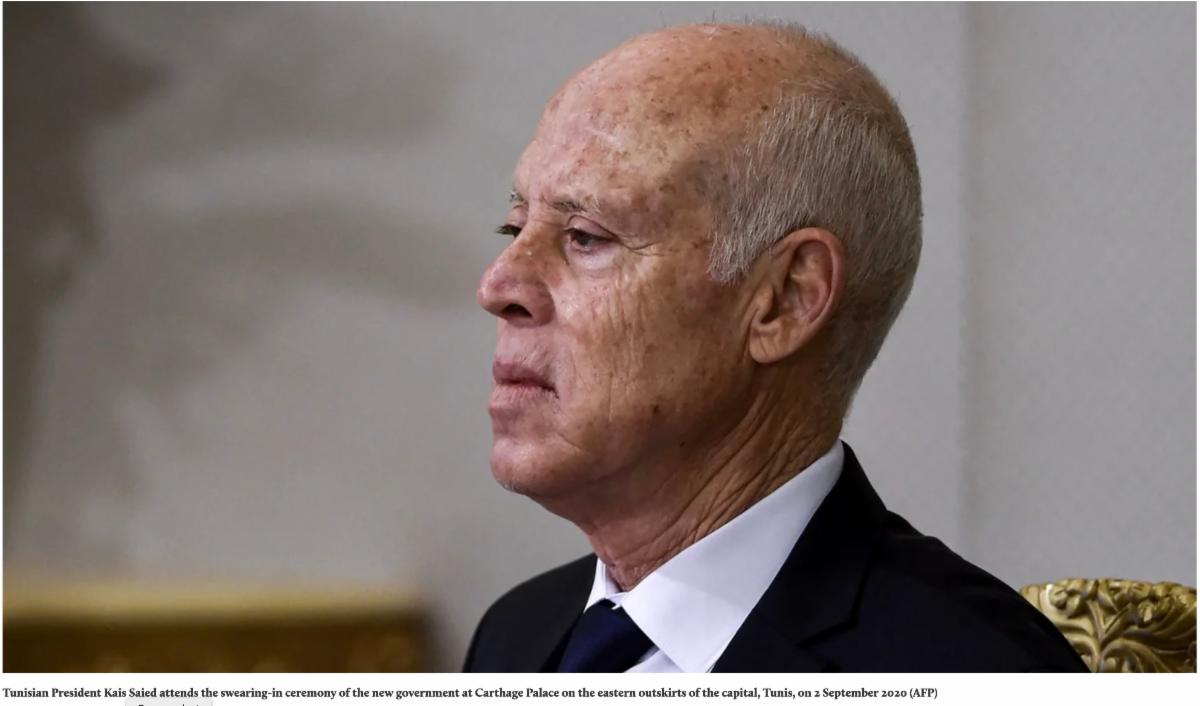
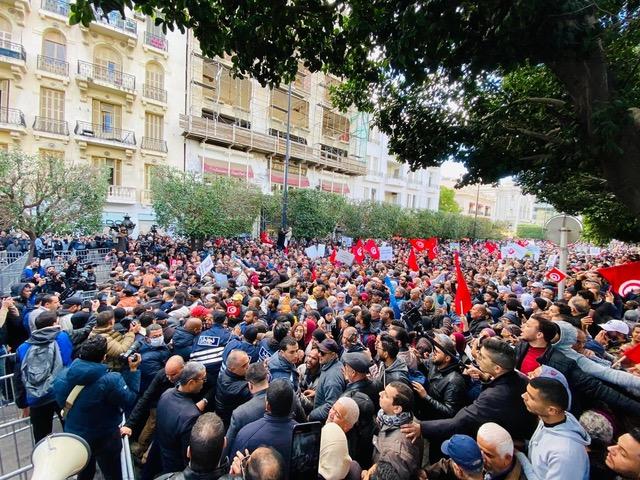
A Tunisian court sentenced a number of top politicians, former officials and journalists to long prison terms on Wednesday, defence lawyers said, the latest move in what critics say is an attempt to stamp out opposition to President Kais Saied.


Among those sentenced on charges of conspiring against state were Rached Ghannouchi, veteran head of the Islamist-leaning Ennahda party, who was handed a 22-year term, and former Prime Minister Hichem Mechichi, who received 35 years.

Advertisement · Scroll to continue


Ghannouchi, 83, has been in prison since 2023, receiving two sentences of a total of five years in separate cases.


Mechichi has been living abroad since 2021, a few months after Saied sacked him and shut the elected parliament, a step the opposition described as a coup.


"These are unjust and political rulings that aim to eliminate political opponents", said Mokthar Jmai, one of the lawyers, adding that they would appeal against the sentences.


Ennahda called the trial a blatant violation of the independence of the judiciary, saying in a statement that it came in the context of further attacks on rights and freedoms.


A total of 41 people were charged in the case. Jmai said the court handed a 27-year sentence to journalist Chahrazad Akacha, who has fled abroad, and gave a five-year sentence to another journalist, Chadha Haj Mbarak, who was already jailed.


"My sister is innocent, and this sentence is harsh for a journalist who was just doing her job", said Bassam Haj Mbarak, Chadha's brother.


The court also sentenced Lazhar Longo, a former intelligence director and Mohamed Ali Aroui, a former interior ministry spokesman, to 15 years in prison each.

Most political party leaders in Tunisia have been jailed in what they say are fabricated cases.


They accuse Saied of tearing apart the democracy built after a 2011 revolution that toppled long-ruling autocrat Zine El-Abidine Ben Ali, of seeking to impose one-man rule, and of filling prisons with politicians and journalists.


Saied denies conducting a coup and says his actions were needed to save Tunisia from years of chaos.


He has called his critics criminals, traitors and terrorists and warned that any judge who freed them would be considered to be abetting them.


Link to Article


How Kais Saied undermined Tunisia's democratic experience


In his new book, Hatem Nafti looks at the democratic regression under the Tunisian president


By Hatem Nafti 9 February 2025

The Tunisian presidential election, which took place on 6 October, was marked by a very repressive and unfair political environment.


All public authorities - the government, parliament, judiciary and electoral body - were mobilised to ensure the re-election of 66-year-old incumbent Kais Saied.

In this new book, Our Friend Kais Saied, Essay on Tunisian Democratorship (Riveneuve editions), I look at the restoration of authoritarianism under Saied, the decline of civil liberties as well as the responsibility of local and international actors in the consolidation of autocracy in the country. 


Below are some extracts from the book.


Populism without people

Tunisian political scientist Mohamed Sahbi Khalfaoui, a specialist in populism, often uses a lapidary expression to describe the Tunisian president: “Kais Saied is not a populist; Kais Saied is a textbook of populism."


Indeed, if we consider the classic definition of Dutch political scientist Cas Mudde, we see that it applies perfectly to the Saiedian vision. Mudde defines populism as “a thin-centred ideology that considers society to be ultimately separated into two homogenous and antagonistic groups: ‘the pure people’ and ‘the corrupt elite,’ and argues that politics should be an expression of the volonte generale [general will] of the people”.

'Dictatorship': Saied's landslide re-election results met with doubt by Tunisians


This vision is reflected in Saied’s 2019 campaign slogan “the people want”. 

It is important to emphasise that when Saied speaks of the people, he does not mean a majority of citizens or a mass whose critical size can represent the Tunisian population. Saied's people are those who think like him and support him unconditionally - even if they are a minority.


During the online consultation organised in 2022, Tunisians had to choose three reforms deemed priorities among five proposals. The adoption of a new constitution received only 36 percent of the votes, against 38 percent in favour of a partial revision of the fundamental law.


However, it was the minority choice that was picked by Saied and the country was given a new fundamental law.


Let us also recall that this consultation, supposed to represent the popular will, only gathered 534,915 participants - barely 5 percent of the electorate - knowing that it was open to segments not entitled to vote during national elections (the armed forces, minors aged 16 to 18).


The same applies to the constitutional referendum of 25 July 2022. If the Soviet-style score obtained by the “yes” (94.5 percent) can seem impressive, it goes down to 28.5 percent when related to the electorate.


Bringing justice into line


On 25 July 2021, by listing the “exceptional measures” he had just adopted (freezing parliamentary activities, lifting MPs’ immunity and dismissing Prime Minister Hichem Mechichi), Saied announced his intention to head the public prosecutor’s department. Although this provision was not directly implemented, a methodical undertaking to bring justice into line started.

Under the guise of cleaning up the judicial corps, the regime annihilated all guarantees of the judiciary’s independence.

By relegating the judiciary 'power' to the rank of a simple 'function', Saied controlled a machine capable of crushing his opponents and creating a climate of terror in society

By relegating the judiciary “power” to the rank of a simple “function”, Saied controlled a machine capable of crushing his opponents and creating a climate of terror in society. In this chapter, we will study the different phases of this process of subjugating the most important counter-power that can exist in a democratic society.


The bringing of justice into line is undoubtedly the most significant regression since 25 July 2021. Judges are now subject to a double submission. The most obvious is that of an executive who no longer even tries to pretend to respect the independence of justice.

But magistrates are also under the heel of the security forces, who have the ear of the authorities and are capable of breaking the career of any judge.


It should be noted that resistance to this movement is very weak. The Judges’ Union, the most representative body, welcomed the latest transfer movement. (In September 2023, Saied’s justice minister transferred magistrates whose rulings are deemed not compliant with the president’s will, although according to the constitution, they cannot be relocated against their will.)


While it is obvious that fear reigns within the ranks of magistrates, repressive policies and the abusive use of custodial sentences are in the DNA of a profession that needs a profound revolution in terms of both training and legislative texts.


The permanent conspiracy


What does the naming of Storm Daniel, artificial intelligence and the shortage of raw materials have in common?

Libya floods: Tunisia's Saied says Zionist 'penetration of minds' behind naming of Storm Daniel


They are all, in Saied’s rhetoric, the result of conspiracies. If conspiracy theories are used by many rulers around the world, under Saied, it is a real governing mode.


By multiplying conspiracy theories, the ruler offers a reassuring speech which is quite capable of legitimising the government in power.


(These theories) maintain the idea of ​​a generalized conspiracy against Tunisians. They reinforce among some citizens a siege mentality, pushing them to become one with their well-guided leader who, in doing so, is no longer accountable for the deterioration of the socio-economic situation.

By establishing a link between the worsening of the multidimensional crisis and a widespread conspiracy, Saied succeeds in maintaining social peace while continuing to deploy his authoritarian project and to reverse all the liberal advances snatched since the outbreak of the Tunisian revolution (in 2011).


The migration issue and the racist turn


The migration issue is not new in Tunisia. The problems linked to the movements of people between the two shores of the Mediterranean or the "brain drain" phenomenon have constituted challenges for successive governments.

But the Saied regime’s approach has completely changed the perception and treatment of the issue. By adopting the "great replacement theory", the president has exacerbated racial tensions and caused tragedies.

By adopting the 'great replacement theory', the president has exacerbated racial tensions and caused tragedies

Under growing pressure from the far right, European authorities have supported this racist shift.


The migration issue has become a central axis of Saied’s policy. It is part of the conspiracy narrative that helps justify the regime's failures. It makes vulnerable populations, who are victims of discrimination, prevented from leaving for Europe and stuck in Tunisia, into the popular scapegoat.


European authorities, delighted with Tunis' cooperation, support this policy and turn a blind eye to human rights violations.


Western reactions after 7 October: a gift for despots


"There is a before and an after 7 October 2023": this standard expression is valid in Tunisia, like elsewhere in the world.


Western reactions after 7 October 2023 have gone far beyond the borders of the West. Indeed, by choosing to adopt a civilisational prism as their main interpretative framework, a majority of western media and leaders have given away the values ​​to which they claimed to be attached.


The western double standard has been a real boon for supporters of the rulers in place... Those close to the regime find in this double standard a way to justify their support.


Tunisia election: Why a stolen victory may seal Kais Saied's fate


By focusing all their statements and actions on the situation in Gaza alone, they dismiss Saied's embarrassing behaviour, such as the treatment of migrants or the repression of the opposition. They thus revive the old saying: "No voice should be raised above the battle [for the liberation of Palestine]."


But western hypocrisy serves, above all, as the basis for a particularly effective sophism, which consists in saying that if the West denies to this extent the values ​​of liberal democracy and human rights that it claims to defend, it is because these values ​​are obsolete. Instead of criticizing the gap between values ​​and their application by westerners, they prefer discrediting these values ​​and justifying their violation by local despots.


An objective alliance is then established between governments that deny their values ​​and dictatorial regimes that jump at the chance to denigrate those same values.


Read Full Article


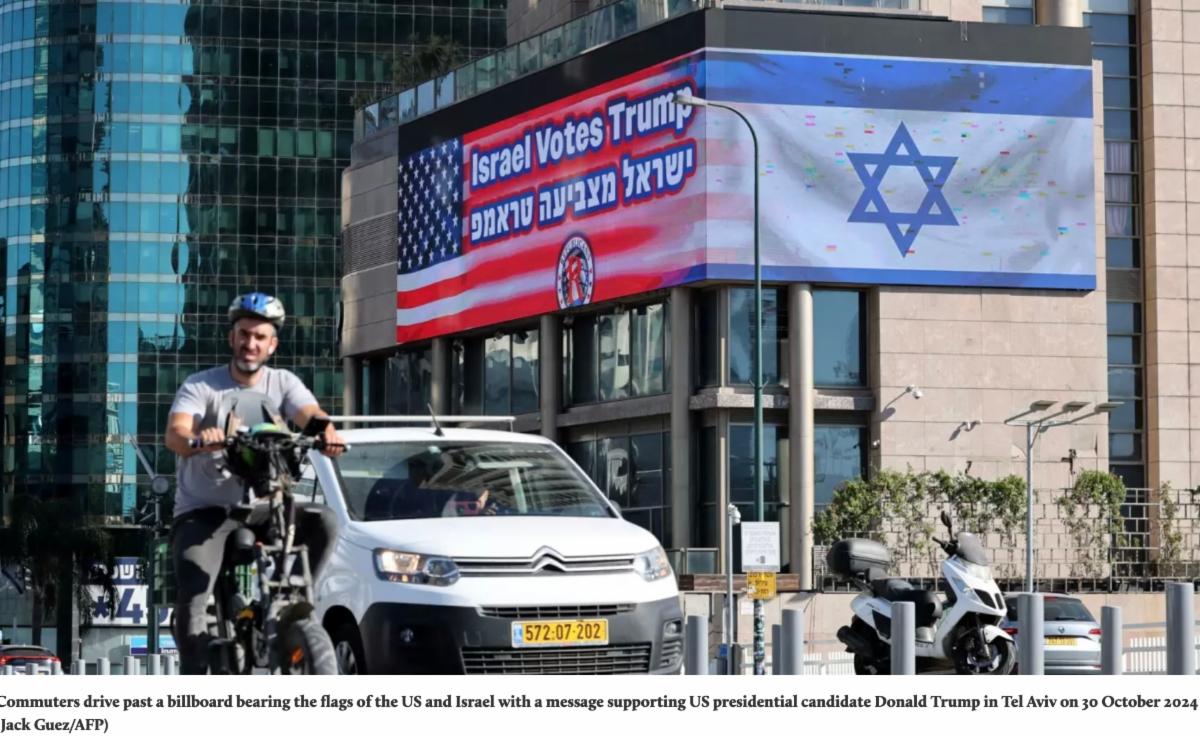
What will a second Trump presidency mean for the Middle East?


The choice to not vote for someone as deeply complicit in genocide as Kamala Harris must be respected. But we can't afford to be naive about what it means if Donald Trump returns


For anyone who has family or friends in Gaza, or any connection to Palestine, the choice between Donald Trump - a man who enacted a ban on visas to people from a list of Muslim countries, is widely perceived as a fascist, and tried to stage a coup the last time he lost an election - and Kamala Harris - the vice president presiding over the United States' full partnership in Israel's genocide in Gaza - is a cruel one.


For voters in swing states, it's even more difficult.


Still, it is important that those who either refuse to vote in the presidential race or vote third party - and certainly those relatively few choosing to vote for Trump because of Gaza - fully understand the ramifications of their vote.


Trump also helped create the conditions that led to 7 October and everything that Israel has done since.


He did this with the Abraham Accords, a naked attempt to isolate the Palestinians and strip them of the one bit of diplomatic leverage at their disposal: normalisation between Israel and the Arab states.


Prior to that, Trump had broken with years of precedent by refusing to issue the presidential waivers that kept the US embassy in Tel Aviv rather than Jerusalem and kept the PLO offices in Washington open.


This ruptured diplomacy between the Palestinians and the US, confirming for Palestinians that there was no diplomatic path towards freedom.


On Gaza, his complaint against Israel is not about genocide, but about the genocide going too slowly. "Biden is trying to hold [Israeli Prime Minister Benjamin Netanyahu] back," Trump said.


He added: "He's trying to hold him back, and he probably should be doing the opposite, actually. I'm glad that [Netanyahu] decided to do what he had to do, but it's moving along pretty good."


Earlier this year, Trump called on Israel to "finish the job" in Gaza, meaning that it should escalate the mass slaughter it was already engaged in.


Read Full Article


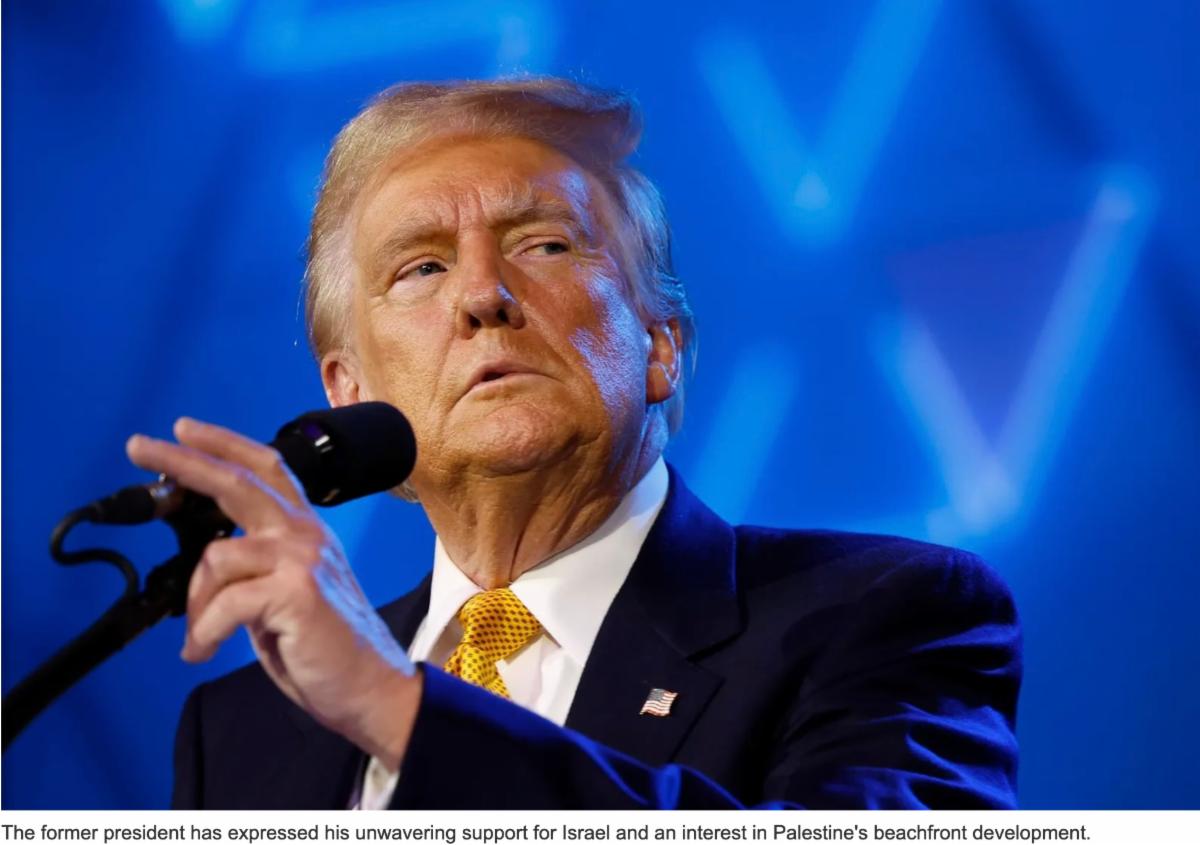
Donald Trump sees himself as 'protector' of Israel


What does that mean for the war in Gaza?

"You have a big protector in me. You don't have a protector on the other side," Trump said at the Israeli-American Council summit in October. And NPR said he repeated his longstanding assertion — called antisemitic by some — that Jewish-American voters owe him their vote for his Israel-friendly policies as president. "Anybody who's Jewish and loves being Jewish and loves Israel is a fool if they vote for a Democrat," he said.


In policy terms, that means a second Trump administration "would probably be more permissive toward the Israeli military campaign in Gaza," Uri Friedman said at The Atlantic. The Biden Administration has tried fitfully to impose some restraints on Israel's war. But Trump has signaled that he would like the conflict to end sooner than later. "I will give Israel the support that it needs to win," Trump said in August, "but I do want them to win fast."


"Trump hasn't laid out a clear vision for Gaza," Nicole Narea said at Vox. But his first-term record is pretty clear: He recognized Israel's "controversial annexation" of the Golan Heights and — after years of pledges from American politicians — also recognized Jerusalem as Israel's capital. Those acts may have hurt America's ability to push Israeli-Palestinian negotiations forward. Trump sees those acts as "proof of his pro-Israel bona fides," Narea said.


Read Full Article

 
Subscribe to CSID Email Lists
 

Center for the Study of Islam & Democracy (CSID)

1405 S. Fern Street, Suite 703

Arlington, VA  22202

1-202-304-2940

www.csidonline.org

Facebook      Twitter