|
Source: LPL Research, Fitch Ratings, Evercore ISI, Strategas, Yale Budget Lab, 08/07/25 Disclosures: Past performance is no guarantee of future results. Estimates may not materialize as predicted and are subject to change.
Significant Policy Tailwinds Coming in 2026
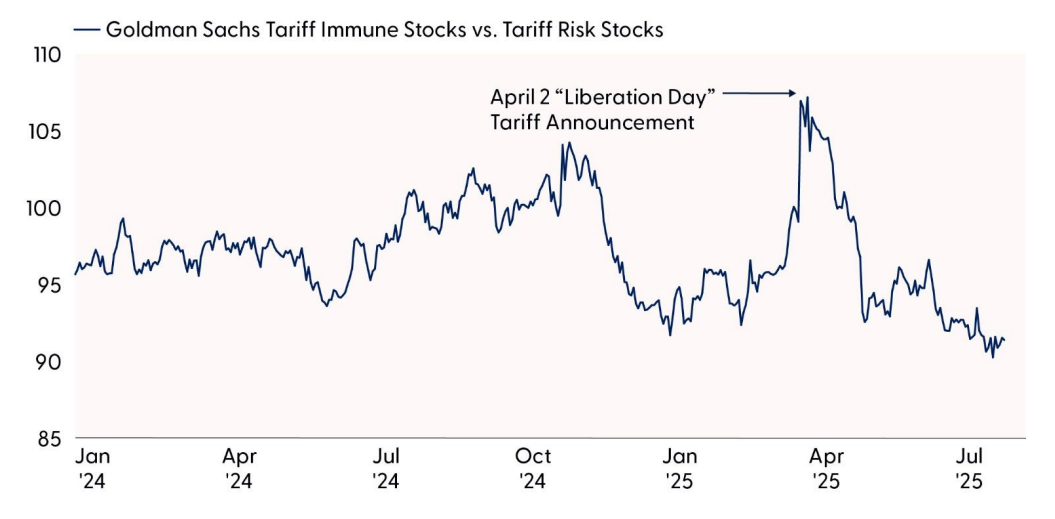
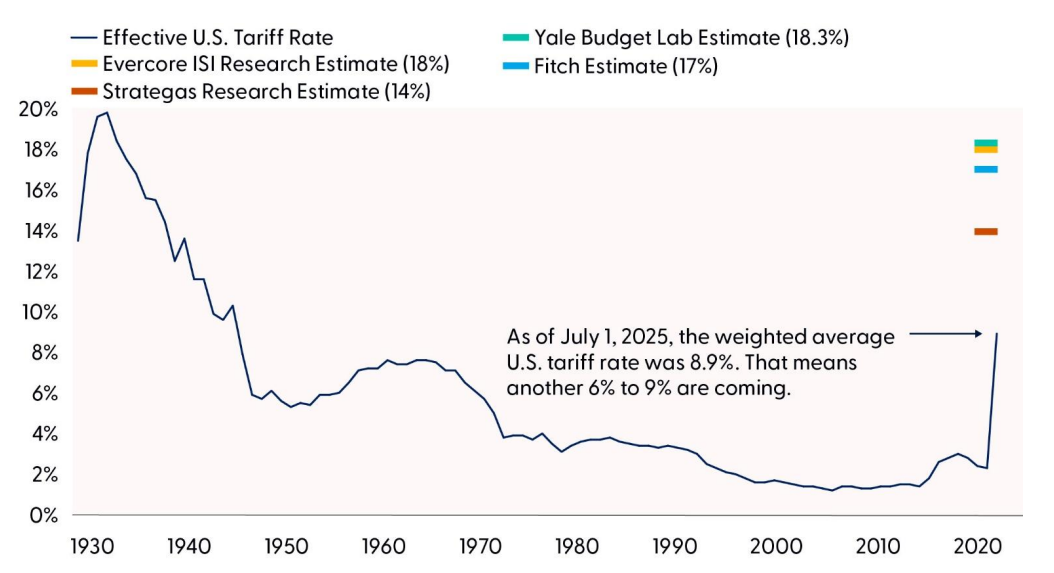
The recently passed “One Big Beautiful Bill Act” includes stimulus in the form of business tax incentives and consumer tax cuts that the policy strategy team at Strategas Research estimates will be worth 0.9% of gross domestic product, including $120 billion in fresh consumer tax cuts. Importantly, this stimulus will offset tariff revenue running at an annualized pace of over $300 billion. After the one-time tariff price adjustment is put in place, the subsequent upward pressure on inflation should be limited. As 2026 approaches, and more tariff uncertainty clears, market participants have gotten more comfortable taking on equity risk.
The risk of markets getting overly complacent makes us less comfortable predicting that stocks will continue rising at their current pace, although we would stop short of calling this market a bubble despite renewed attention on meme stocks.
It’s Not Policy-Driven, but Artificial Intelligence is a Key Driver of the Rally
Earnings season has been outstanding. We’ll get into all the numbers in next week’s commentary, but artificial intelligence (AI) investment, which has started to bear fruit, is a big reason earnings growth and guidance have been so much better than we — and most others — anticipated. We wrote in early July that double-digit growth on the bottom line was a reach, but we got there handily with S&P 500 earnings per share (EPS) growth for the second quarter tracking to 12% (source: FactSet). The increase in EPS estimates during reporting season — a rare feat — was even more impressive.
The power of the AI investment cycle, in which hundreds of billions are being invested this year by the biggest U.S. technology companies, is quite evident in the latest rally. Since the April 8 low in the S&P 500, the technology sector has gained more than 50%, nearly double the S&P 500, led by several AI names including Palantir (PLTR), Advanced Micro Devices (AMD), Arista Networks (ANET), and Oracle (ORCL), which have all doubled during that time. NVIDIA (NVDA) and Broadcom (AVGO) aren’t doing too shabby with gains of 88% and 95%, respectively.
While tariff costs have started to pressure company profit margins, the amount of investment in AI and early returns on that investment in the form of productivity gains have kept overall profit margins steady. With limited upward pressure on inflation so far, stocks have been able to achieve and maintain strong gains.
Conclusion
The stock market has shown remarkable resilience despite ongoing trade uncertainty, buoyed by corporate flexibility, fiscal policy tailwinds, and the powerful earnings momentum from AI. While we caution against complacency, especially with more tariff costs yet to flow through, the combination of fiscal stimulus and transformative technology investment continues to support rich equity valuations. Bouts of volatility will likely come over the next several months, but dips are likely to be bought quickly due to supportive company fundamentals, upcoming Fed rate cuts, and the power of AI that has only started to bear fruit.
Asset Allocation Insights
LPL’s Strategic and Tactical Asset Allocation Committee (STAAC) maintains its tactical neutral stance on equities. Investors may be well served by bracing for occasional bouts of volatility given how much optimism is currently reflected in stock prices and lingering tariff risk. LPL Research advises against increasing portfolio risk beyond benchmark targets currently and continues to monitor trade negotiations, economic data, earnings, the bond market, and various technical indicators to identify a potentially more attractive entry point to add equities on weakness. The Committee’s regional preferences across the U.S, developed international, and emerging markets (EM) are aligned with benchmarks. The Committee still favors growth over value, large caps over small caps, and the communication services and financials sectors.
Within fixed income, the STAAC holds a neutral weight in core bonds, with a slight preference for mortgage-backed securities (MBS) over investment-grade corporates. The Committee believes the risk-reward for core bond sectors (U.S. Treasury, agency MBS, investment-grade corporates) is more attractive than plus sectors. The Committee does not believe adding duration (interest rate sensitivity) at current levels is attractive and remains neutral relative to benchmarks.
|