Straightshooting with Robert Egger, Santa Fe's Food Security Advisor
by Cullen Curtiss
|
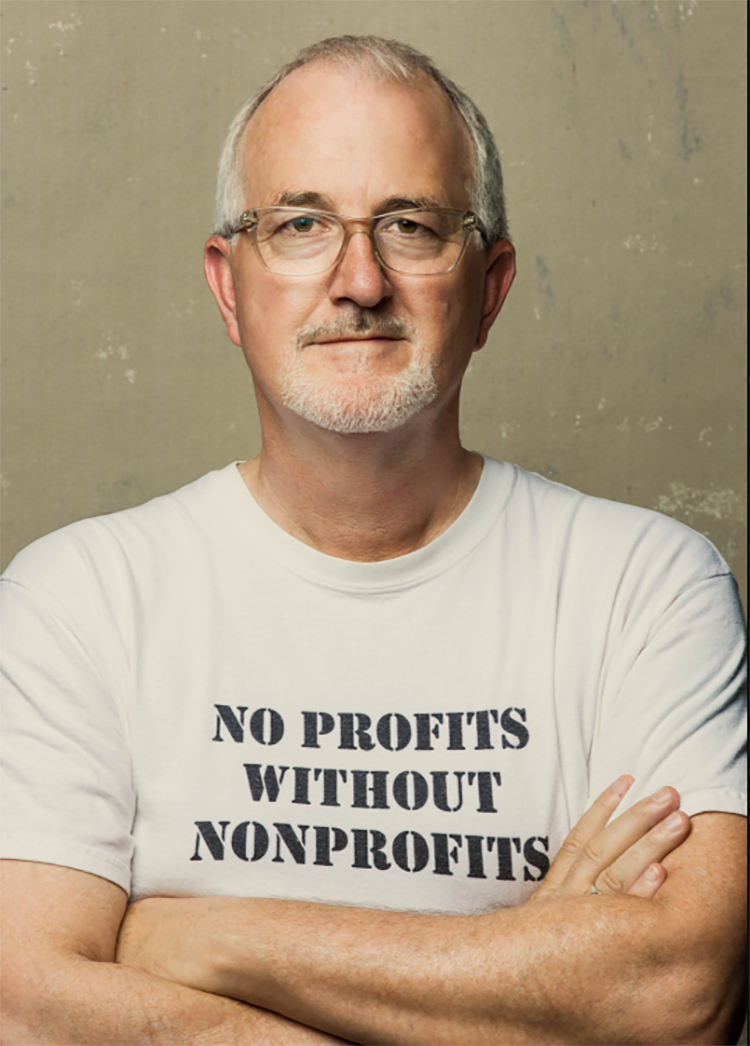
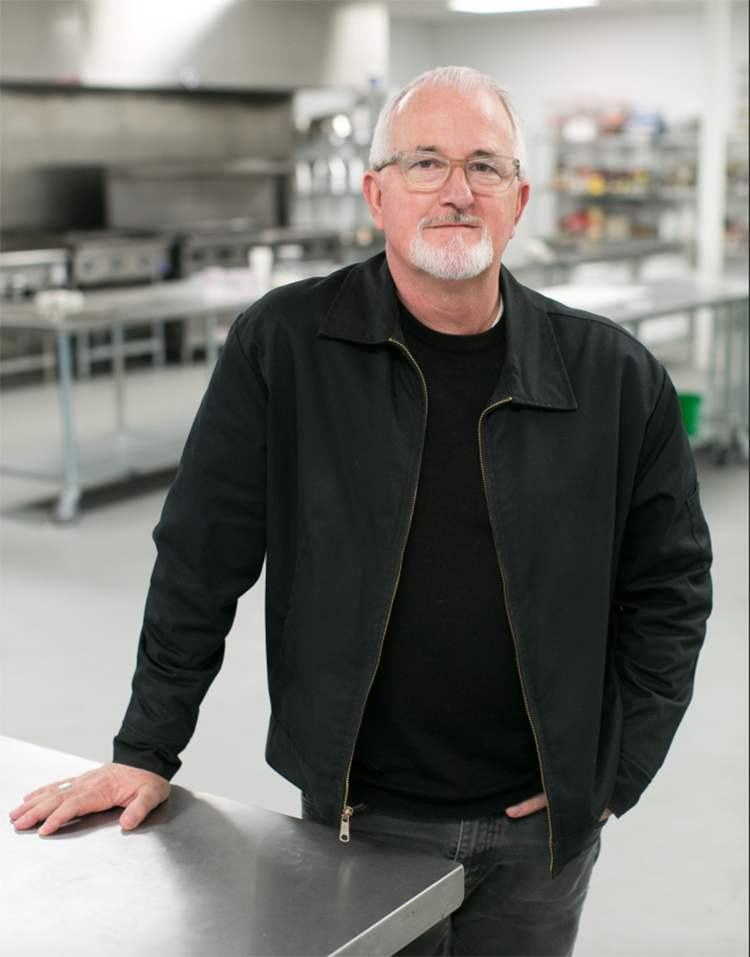
“I have been open source all of my life,” says Robert Egger, who was named Santa Fe’s Food Security Advisor by Mayor Alan Webber in April after multiple conversations with nonprofit leaders and city officials regarding the threat COVID-19 posed to food distribution in the city and county.
|
|
|
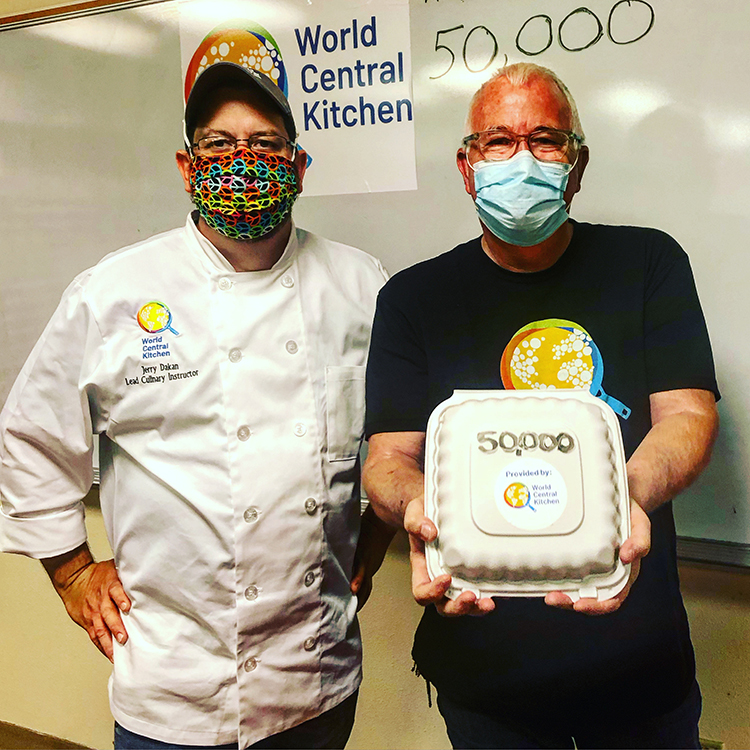
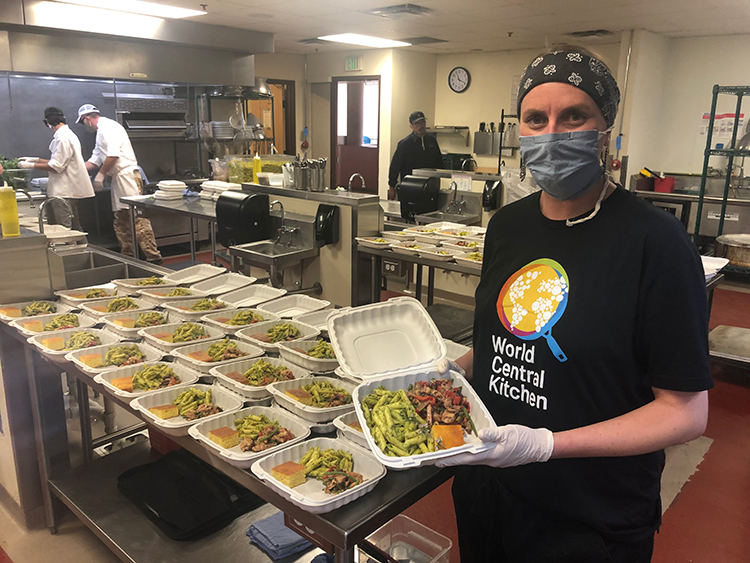
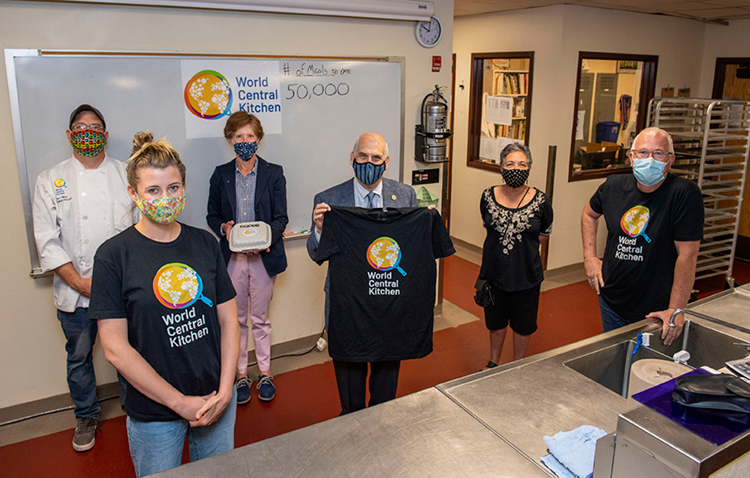
You may know of Robert Egger's hand in Santa Fe Community College’s prepared meals program. When Santa Fe struggled to find funding for it, Egger reached out to friend Jose Andrés, director of World Central Kitchen (where Egger is a board member and their “Research & Development man”) and with $60,000 produced 50,000 meals between May 1 and June 26, a gap-closing solution to the issue of thousands of city and county residents who lost access to free meals.
|
|
Santa Fe Community College Culinary Arts Lead Instructor Chef Jerry Dakan and Robert Egger
|
|
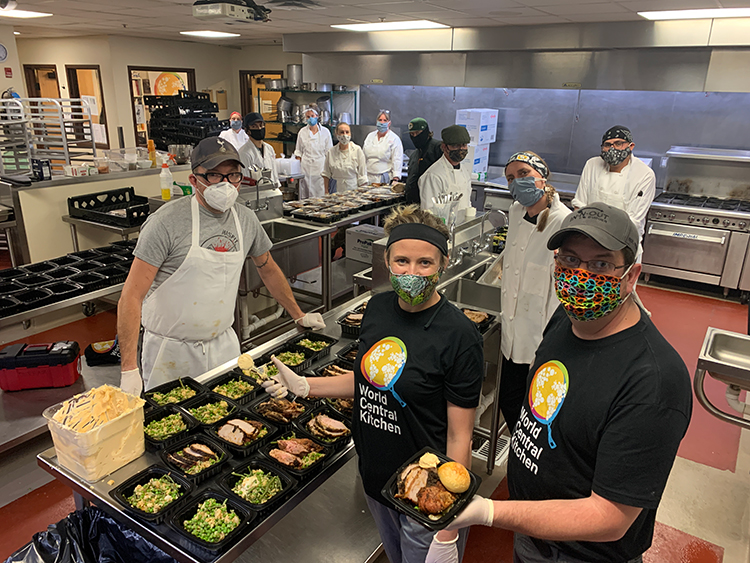
Left to right: Chef Rocky Durham, Chef-Instructor Chloe Friedman, Chef Jen Doughty,
Chef-Lead Instructor Jerry Dakan and students
|
|
For Egger, the endeavor was a typical one—a well-oiled machine churning away to provide not only nutritious, reliable meals, but to also build skills for people whose livelihoods had been decimated by the pandemic.
“I am always thinking, how can you do three things at once?” Egger says from behind a mask one day as we sat six feet apart in the mostly empty Railyard.
|
|
|
|
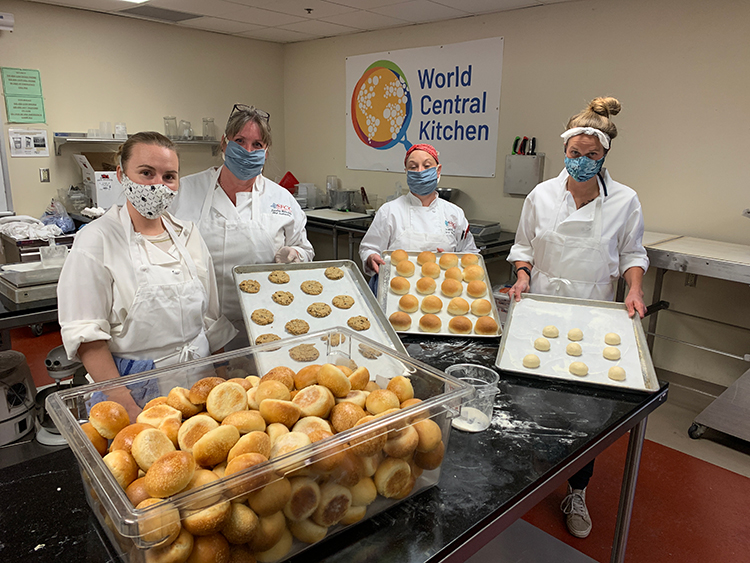
Baking Team, left to right: Jennifer Warren, Chef Sandra Nitschke, Chef Micaela Deaton, Sally Blakemore
|
|
His gift for multitasking has proven highly productive. He’s a multi-doer. Egger creates unprecedented efficiencies and provides long-lasting solutions to problems in ways no one imagined—and he lifts people up in the process. He might blow off that assessment with a comment like, “I just like things that are cool as shit,” but his legacy is enduring.
Decades ago in Washington, D.C., he slowly awakened to the devastating intersection of persistent hunger, ruinous socio-economic stigmatization and misguided food charity work. In response, he built DC Central Kitchen in 1989, now an emboldened nonprofit and social enterprise that, according to its website “uses food as a tool to strengthen bodies, empower minds, and build communities and that combats hunger and poverty through job training and job creation.” LA Kitchen followed in 2013, with a similar model, focused on feeding the elderly with food excesses from multiple sources.
|
|
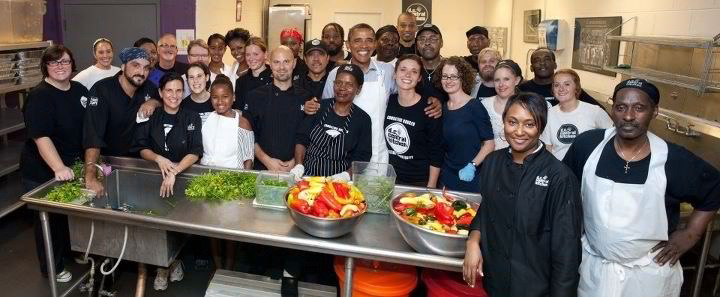
DC Central Kitchen when President Barack Obama visited
|
|
In 1989, Egger was in his late twenties and running a nightclub that generated quite a bit of waste, a concept and a thing he’s come to abhor and do everything in his power to avoid. “I have spent my entire life saying, ‘Don’t throw away that food, it’s perfectly good.’ And don’t “throw away” that person because they were homeless or an addict or in prison, don’t waste this person because they are old. Most people don’t want to talk about those larger social issues, but if I can get them to see the folly of wasting food, then maybe I can lure them further into a dialogue. All the kitchens I’ve built, they’re really Trojan Horses."
In a good way. People cannot help but talk about food when Egger is involved, and talk we did over multiple visits and emails through the months of the SFCC project and during the transition to YouthWorks scaling up their prepared meals program.
Though he is retired and living with his New Mexico born-and-bred wife and her sister in Cerrillos, he is by no means retiring. “I’m a rent-a-brain,” he says. “I will talk to anyone, for free, and happily share any knowledge I have.”
In addition to his board role at World Central Kitchen, he’s just joined the Street Food Institute in Albuquerque. He advises multiple individuals and organizations searching for the smartest, most efficient and compassionate ways to resolve food insecurity and inequity problems. Egger has a kind, infectious, uncanny way of plainly exposing egregious system failures and poignant fallacies.
Conversations with him inspire passionate ire and galvanize the soul.
|
|
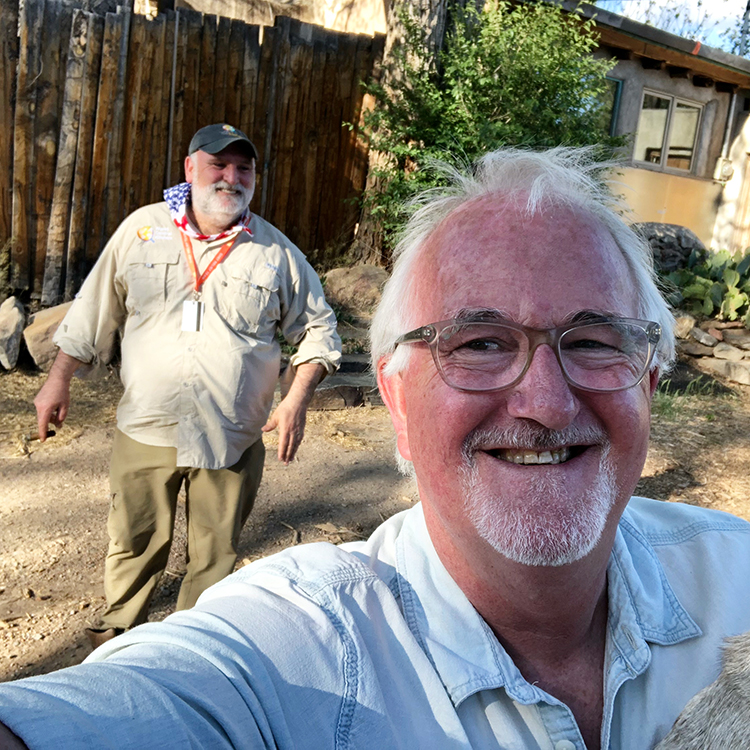
World Central Kitchen Executive Director Jose Andrés and Robert Egger at Egger's home in Cerrillos
|
|
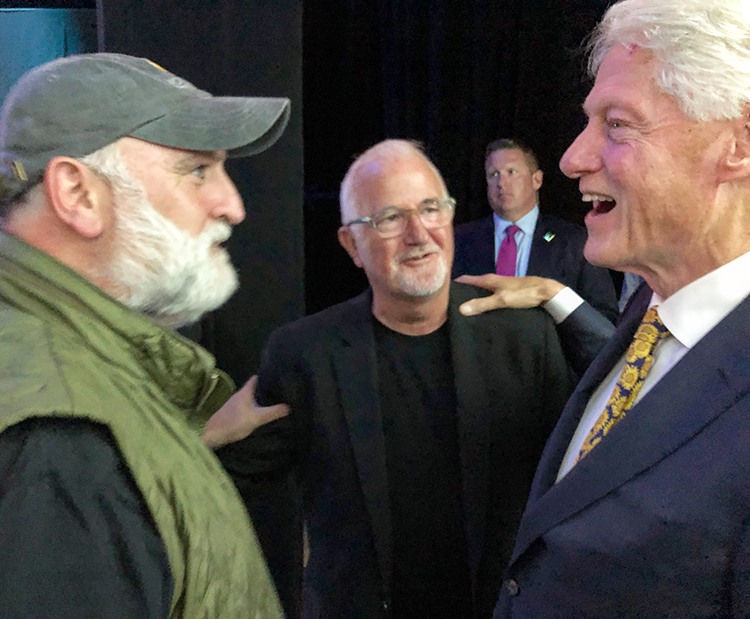
At a World Central Kitchen Gala in New York City (Sept 2019): Jose Andrés, Robert Egger, Bill Clinton
|
|
Here are some of the threads we pursued in our conversations:
|
|
Hunger:
“We have been talking about hunger in America for 40 years and most people still don’t want to think that there is an issue. They would rather think if you’re poor it’s your fault, if you are in prison, you deserve it. We need to open peoples' minds, but rarely do stats, or pity, do that. Hunger is the dumbest problem. Hunger is not a lack of food, it’s a lack of money to buy food. It’s a lack of jobs that pay a good wage. It’s also a problem that impacts so much of our collective economic future, because a hungry kid can’t learn, a hungry mom can’t work, and a hungry senior can’t stay active.”
Fighting hunger with tradition:
“I met Alan Webber while he was running for governor when he came to visit LA Kitchen, interested in social enterprise. And before I reached out to him just a few months ago, I was pitching our current governor, saying this is one of the only places in America where you can actually address hunger in an affordable way, while you genuflect to the traditional meals of the stat—posole, green chili stew, tamales, even Frito-Pie. Consider fighting hunger with tradition! What about your fiestas, your Matanzas? Why not say we are going to do mini-Matanzas at the local firehouses, which are in every corner of the state? Let’s treat hunger as an emergency, and go to towns and really explore the idea of eating together as a community. Stop separating people by the way you feed them: kids over there, seniors over there, or making people self-identify as poor and stand in line at the pantry. New Mexico has some of the oldest food cultures in America. It’s where the three sisters of corn, beans and squash met the occupying army’s domesticated livestock. It’s not expensive to do well and it can be very nutritious.”
Hunger for community:
“People are not looking for a cheeseburger, they are looking for a tribe.”
|
|
left to right: Chef-Lead Instructor Jerry Dakan, Chef-Instructor Chloe Friedman, SFCC President Becky Rowely, Mayor Alan Webber, SFCC Foundation Board President Carmen Gonzales, Robert Egger
|
|
Food service contracts:
“I wish cities and states would start to think about all of their food service contracts. Most are based on low bids. Who’s the cheapest? It might cost more, but if they're supportive of any agency or restaurant that pays a good wage, that’s fewer people that have to go to a food pantry. If they are supporting local agriculture, those farmers are only going to reinvest dollars back in their community. Or if it’s a social enterprise like YouthWorks, it’s employing and training young people. Again, [it] keeps the money local as long as possible. Thank goodness for some of the traction Pam Roy and the Food Policy Council have been able to achieve in that respect here in Santa Fe.”
Disaster relief vs. pandemic relief:
“Jose Andrés would go down to Puerto Rico after the hurricane and do big paella meals, and since it was a disaster and no one said, ‘You can't do that.’ But at any other time, if I just set up a paella pan and started feeding people, the health department would shut me down. But what makes now any less a disaster? We have extreme hunger in this state. Why do you need a dam to break or the earth to shake for you to say, let's try something new? I went to the Matanza last fall and I saw them literally butcher a pig live in the open air and then cook it in the ground, in old copper pots, over big open fires. Of course we need to be safe, but let’s be daring and gets folks fed."
Food charities:
“As we go forward into a post-COVID world, everyone wants to go back to the comfort of the past, but ask yourself this question: Did the charitable food system in America have a responsibility for the susceptibility of people of color or elderly to COVID-19 because of the food we have been serving people for 40 years, in the name of feeding the poor? We have been pushing junk food on people for decades and giving each other prizes for the amount of pounds we moved this year, when, in actuality, we are culpable. We should never go back to a system of poisoning the poor in the name of feeding the poor. I have spent my entire life in the nonprofit structure where money is finite. I have butted heads for years with traditional food programs promoting how many pounds of food you moved. We have been trained to think that is impact, that is good. More pounds equals better impact. But we are rewarding the wrong metrics. What are the new set of metrics that are just and nutritious? Of course, it’s never wrong to feed a human being, but if you create a situation where you make a relationship that that person has to come back more for more food, you have created bondage. It should be about the liberty of the receiver, not the redemption of the giver. Of course I need redemption, most people do, but not at the expense of another person. If it’s done right, we can rise together, and life is good. That’s the model I am interested in.”
|
|
Tyranny of the portioned plate and low wage:
“We need to shift away from the four compartment meals—schools, airlines, hospitals, senior centers. It’s all designed to conform to that rotten plastic plate. We need to rethink portion size and the importance of plant-forward meals, particularly post COVID. I ask restaurateurs, 'Do you want to try to sell that $26 entree right now? Look at your menu.' I think the smartest move is a $10 price-fixed menu of three things—a salad, an entree, a dessert, all with smaller portion sizes. Or tapas—small and flavorful bites. Americans are truly sick because of the groaning plate we grew up expecting. The fact is, as a restaurant owner, if I want to pay a good wage, source locally, put a meal in an environmentally friendly package, I am most likely selling only to a small number of people who can shop at Whole Foods, so the only way to do this sustainably is to explore portion size. We know the role that diet played in COVID susceptibility and we want to make stronger people. And we want to make sure we pay the people who work for us a good wage. We can either charge you a lot more for the old thing, or we can keep our prices where they were and serve you a different portion. I think America is ready for that.”
Commercial kitchens:
“For local growers and producers, there’s no middle ground for business between the farmers’ markets and Whole Foods. The most powerful opportunity, the next step for them would be in securing a city and state contract for school meals or snacks, or meals at senior centers, and even prisons. If you build a commercial maker space, a kitchen, where these budding entrepreneurs can grow, then we’d open a big door for these businesses to thrive. It’s the perfect in-between solution and everybody wins.”
Santa Fe:
“We think of Santa Fe as arts and culture and restaurants, but no one ever thinks of it as an army of nonprofits. Could we organize these major economic contributors to make it streamlined and efficient, impactful? Are there things that we are doing forever because we have been doing it forever? What would it be like to challenge the dogma around philanthropy? There is truly a feast here.”
|
|
The restaurant industry:
“With the anniversary of Anthony [Bourdain]’s passing, I am reminded of the real costs of our industry, the island of misfit toys, notorious for alcohol, drugs and libertine lifestyles and often a huge workload that you are supposed to deal with. What about the structure of wage for growers and workers? This is the next big leap for our industry. What role do immigrants play? We could have been at the forefront of talking about immigration reform and we were not. Anthony was. This is what should come out of the COVID era. Acknowledge the people who grow, pick, serve our food.”
Restaurant Success:
One of the biggest failures I’ve seen in my life is my generation’s version of success. Look at the restaurant world. The predominant theory is that, if you have a successful business, then quick, open another, and another. Look at my friends Tom Colicchio and David Chang? Look at how quickly those empires dissolved. Do you really want four or more restaurants? I look at my friend Katharine Kagel, of Cafe Pasqual’s. She’s been operating for 40 years. How many times do you think folks pushed her to open another, and then another Pasqual's? But she kept it local, supported local growers, honored her team and stayed small. I think she’s the model of success."
|
|
Egger closed one of our conversations by saying, “I am a social chef. It’s like a chef who comes to your home and you are embarrassed because you say you have no food, but he looks around and 20 minutes later, he’s cooking away. I am that way with a community. To me, a community is one giant pantry that they think is threadbare. There is a lot to work with here in Santa Fe.”
To find out more about Robert Egger, his work and views, please visit fuckingshitup.net.
|
|
|
|
|
|
|
|