Weekly update from the National Housing Conference | | News from Washington | By Brittany Webb | | |
HUD moves to gut disparate impact regulations
The U.S. Department of Housing and Urban Development (HUD) issued a proposed rule that would completely remove HUD’s disparate impact rules under the Fair Housing Act. First established in 2013, the existing interpretation of disparate impact acknowledges that programs or policies with disparate outcomes for protected classes may be considered discriminatory, even if those policies do not explicitly seek to exclude a protected group. As in 2020, the National Housing Conference (NHC) strongly opposes this latest move and will be leading a comment letter in response to the proposed rule. Interested NHC Members who would like to participate in the drafting and sign-on of comments should reach out to NHC’s Senior Policy Director, Britt Van.
The disparate impact interpretation has had a tumultuous recent history. The initial 2013 interpretation was challenged, leading to a 2015 Supreme Court ruling in Texas Department of Housing and Community Affairs v. The Inclusive Communities Project, Inc. that disparate impact claims were in fact cognizable under the Fair Housing Act. The first Trump administration significantly narrowed HUD’s disparate impact rules in 2020, at the opposition of advocates, and was also challenged in court. By 2023, the Biden administration had overturned the 2020 rules and reinstated the 2013 disparate impact regulations.
This new proposed rule goes well beyond the first Trump administration’s rule, completely removing all HUD disparate impact regulations and leaving all interpretation and enforcement up to the courts. They cite the Loper Bright Enterprises v. Raimondo Supreme Court decision, which overturned Chevron deference, as justification. Furthermore, HUD is providing a truncated 30-day public comment period as opposed to the standard 60-day period, claiming that the proposed rule does not change or affect any requirements, rights, or obligations, and citing previous extensive public comment during previous rulemaking processes. Comments are due by February 13.
“The Fair Housing Act was passed, in part, as a tribute to Dr. Martin Luther King, Jr. who fought long and hard to remove all forms of discrimination as well as the vestiges of redlining, segregation, and other harmful race-based policies from our society. As the nation prepares to commemorate his birthday, HUD is taking this step to move America further away from his vision of a fair, inclusive society where everyone can thrive,” said Lisa Rice, President and CEO of the National Fair Housing Alliance in a press release denouncing the change. “These protections are critical to addressing exclusionary zoning and increasing the supply of affordable homes.”
Meanwhile, Senator Elizabeth Warren (D-Mass.), Ranking Member of the Senate Banking, Housing, and Urban Affairs Committee, held a “shadow hearing” on fair housing, hosting HUD whistleblowers and other experts to discuss HUD’s overall mission of ensuring fair housing. The whistleblowers, two civil rights attorneys previously employed at HUD’s fair housing division, described changes and directions from the Trump administration that made enforcing fair housing rights impossible and stated that HUD is failing in its mission.
“The consequences are enormous. Already, hundreds of housing discrimination cases have been dropped or stalled,” said Senator Warren. “People who are already struggling have to ask themselves, why even file a complaint if there's no one there to enforce the law?”
| |
DOJ targets Federal Reserve, Powell responds
The U.S. Department of Justice (DOJ) officially opened a criminal investigation into the activities of Federal Reserve Chairman Jerome Powell, prompting bipartisan backlash and renewed concerns of the central bank’s independence throughout the financial world. The DOJ’s probe seeks to investigate ongoing renovations of the Federal Reserve Board’s historic building, which has cost an estimated $2.5 billion. Chair Powell released a public statement in response to the subpoena from the DOJ.
“I have deep respect for the rule of law and for accountability in our democracy. No one—certainly not the chair of the Federal Reserve—is above the law. But this unprecedented action should be seen in the broader context of the administration's threats and ongoing pressure,” he states. “The threat of criminal charges is a consequence of the Federal Reserve setting interest rates based on our best assessment of what will serve the public, rather than following the preferences of the President.”
Democrats on the House Judiciary Committee sent a letter to Chairman Jim Jordan (R-Ohio) demanding an investigation into potential abuses of power by the DOJ. The investigation is the latest in a series of other probes the DOJ has opened to prosecute perceived adversaries of the Trump administration’s agenda. Chair Powell’s term is due to expire in May; however, he can remain on the Board of Governors as a voting member until 2028.
| | | |
HUD reissues CoC NOFO
HUD has reissued the original FY24-25 Notice of Funding Opportunity (NOFO) for the Continuum of Care (CoC) program following a preliminary court order that temporarily blocks much contested proposed program changes. The administration had sought to restructure the CoC program by shifting funding away from permanent housing toward short-term assistance models tied to work or treatment requirements. Those changes are now subject to ongoing litigation, prompting the court to require HUD to proceed under prior-year rules while the case is resolved. Per the court’s order, HUD reopened the FY24–25 NOFO on January 9, with a deadline of February 9 for eligible CoCs to submit renewal applications. HUD has indicated it anticipates selecting awards no later than late March 2026, though it will only continue processing under the prior-year NOFO while the injunction remains in effect.
HUD has also stated it intends to reissue the December 19, 2025, NOFO if it receives a favorable court ruling. In the meantime, many CoC contracts are set to begin expiring, creating budget uncertainty for local homelessness response systems and raising concerns about potential service disruptions as providers await renewal decisions.
| | | |
CFPB, DOJ withdraw ECOA citizenship status statement
The Consumer Financial Protection Bureau (CFPB) and the U.S. Department of Justice (DOJ) issued a joint withdrawal of a previous advisory opinion from the agencies clarifying the implications of creditor consideration of immigration status under the Equal Credit Opportunity Act (ECOA).The previous statement, Joint Statement on Fair Lending and Credit Opportunities for Noncitizen Borrowers Under the Equal Credit Opportunity Act, was issued under the Biden administration and explicitly prohibited lenders from discriminating against immigrants and non-citizens in lending practices. It had clarified that while immigrant status could be a part of overall decisions for lenders, it could not be the only factor in such decisions nor lead to an overall bias. The withdrawal statement from the current Administration argues that “nothing in ECOA or Regulation B prohibits the consideration of an applicant's immigration or citizen status. To the contrary, Regulation B permits the consideration of ‘any information obtained, so long as the information is not used to discriminate against an applicant on a prohibited basis’,” and goes on to claim that this withdrawal helps to eliminate confusion for creditors.
“The federal government is committed to avoiding statements that could confuse the law or imply compliance standards for civil rights laws that lack any statutory or regulatory basis,” said Assistant Attorney General Harmeet Dhillon at the Justice Department’s Civil Rights Division. “This administration is restoring alignment with established federal civil rights law rather than continuing the prior administration’s ideologically-driven departures.”
| |  | |
Republican Study Committee releases affordability framework
The Republican Study Committee (RSC) released a new framework that offers a roadmap for future reconciliation bills to help address the affordability crisis. The entitled “Making the American Dream Affordable Again” framework includes a series of housing proposals aimed at creating pathways to homeownership. Proposals focus on demand-side solutions, and include downpayment assistance programs, selling of public lands, eliminating capital gains taxes on sales to first-time homebuyers, and other tax adjustments to bolster a household’s ability to afford homeownership. The framework also includes several provisions aimed at reducing access to affordable housing for noncitizens, such as a five percent remittance tax on funds sent by noncitizens through electronic transfer services, restricting HUD funding from going into sanctuary cities and any districts with rent control policies, and prohibiting undocumented and non-permanent residents from leasing units under the Low-Income Housing Tax Credit program.
“This blueprint cuts costs where families feel it most—housing, health care, and energy—slashes woke and wasteful spending, and locks in President Trump’s deregulatory agenda through the only process Democrats can’t block: reconciliation. We’re focused on results - lower prices, more freedom, and a stronger future for American families. We have 11 months of guaranteed majorities. We're not wasting a single day,” said RSC Chairman August Pfluger (R-Texas).
| | | |
Sen. Slotkin introduces housing emergency bill
Senator Elissa Slotkin (D-Mich.) introduced legislation to declare a national housing emergency, aiming to mobilize federal agencies and resources to significantly expand housing supply. The National Housing Emergency Act of 2026 would direct the federal government to use existing emergency authorities to help facilitate the construction of up to four million new homes nationwide, responding to persistent shortages that have driven up rents and home prices and constrained affordable and workforce housing options. NHC and the National Leased Housing Association endorsed the bill.
Under the legislation, federal agencies would be instructed to coordinate more closely to reduce regulatory barriers, accelerate permitting, and prioritize the use of federal land, financing tools, and infrastructure support for housing development. The bill emphasizes deploying existing federal programs and authorities rather than creating new ones, with the goal of rapidly increasing housing production. Supporters argue that formally declaring a housing emergency would elevate the issue to a national priority and enable more aggressive action to expand supply, while critics have questioned the scope of executive authority and whether an emergency declaration would meaningfully address long-term affordability challenges. The White House released a brief article highlighting its actions to try to improve housing affordability and has previously indicated it was considering a housing emergency.
“There is nothing more fundamental to the American Dream than owning your own home, and it has become increasingly difficult for middle class Americans to do this,” said Senator Slotkin. “The United States is in a housing crisis, and we need to act now. That’s why my bill declares a national housing emergency, cuts regulations that get in the way and uses the full weight of the U.S. government to increase our housing supply by 4 million homes.”
| |
Freddie Mac multifamily production tops $77 billion in 2025
Freddie Mac reported that its multifamily business delivered $77.6 billion in financing in 2025, a 17% increase since 2024. The financing supported over 577,000 affordable rental units, emphasizing the continued role of the Enterprises in providing liquidity to the rental housing market amid elevated interest rates and affordability pressures.
According to the company, 66% of its multifamily volume supported mission-driven affordable housing, with 93% of all units financed in 2025 affordable at or below 120% of area median income. Freddie Mac also made a record investment of $1.2 billion in Low-Income Housing Tax Credit (LIHTC) equity investments following the increased investment cap from the Federal Housing Finance Agency earlier in 2025.
“Our focus in 2025 was on bringing liquidity to the multifamily market to increase the supply of affordable rental housing in communities across the country,” said Kevin Palmer, head of multifamily for Freddie Mac. “We stepped up to meet the needs of the market with product enhancements and customer-focused process improvements, and as a result, working with our lenders, servicers, borrowers and investors, delivered quality, affordable housing to hundreds of thousands of families nationwide.”
| | | |
SNAP and Medicaid serve as essential support for renters facing severe cost burdens
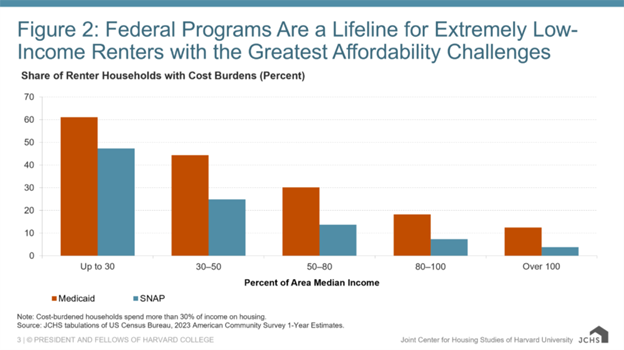
New analysis from the Harvard Joint Center for Housing Studies examines the critical role non-housing federal assistance programs play in helping cost-burdened renters make ends meet, particularly as housing assistance remains unavailable to eligible households. The research shows that while only one in four eligible households receive housing assistance, programs like SNAP and Medicaid serve as essential lifelines for those without it—73% of cost-burdened renters with children receive Medicaid and 46% receive SNAP. The findings underscore how cuts to these non-housing programs would compound the consequences of unaffordable housing, particularly for renters earning less than $30,000 whose monthly residual income after housing costs has dropped to just $250.
| | |
The Urban Institute reported on new survey findings revealing why consumers with low incomes often distrust mainstream financial services, offering insights into how financial institutions and regulators can build trust with unbanked households and promote greater financial inclusion. The research finds that only 55% of unbanked respondents agreed that they trust banks, and 46% indicated that banks do not give clear and honest information. The findings underscore the need for financial institutions to address both perception and accessibility barriers, particularly for communities of color who have historically faced discriminatory lending practices and institutional divestment that created a dual credit market with significantly disparate access to affordable financial products.
An article from Politico features discussion of California Governor Gavin Newsom’s efforts to address the state’s homelessness crisis ahead of a potential 2028 presidential run, analyzing whether preliminary data showing a 9% reduction in unsheltered homelessness represents meaningful progress. While the decrease is notable, critics add nuance that it is only considering unsheltered homelessness, which can be attributed to Newsom’s enforcement-focused approach to clearing encampments. However, the reduction marks a shift in previous trends that could indicate successful investment in other local resources to reduce unsheltered homelessness.
The Wall Street Journal reports that the Trump administration is considering targeting homebuilders over their substantial stock buybacks while housing costs remain elevated, following similar restrictions recently imposed on defense contractors. Federal Housing Finance Agency Director Bill Pulte has expressed concern that major builders including D.R. Horton, Lennar, and PulteGroup have spent billions on share repurchases rather than lowering prices or increasing construction, with the administration exploring potential penalties to encourage more homebuilding activity and affordability. The move reflects the administration’s evolving approach to housing policy, though industry analysts caution that restricting capital allocation decisions could complicate builders’ ability to respond to market conditions and finance new development.
| | The National Housing Conference is a diverse continuum of affordable housing stakeholders that convene and collaborate through dialogue, advocacy, research, and education, to develop equitable solutions that serve our common interest. | | Defending Our American Home since 1931 | | Copyright © 2024. All Rights Reserved. | | | | |