Weekly update from the National Housing Conference | | News from Washington | By Brittany Webb | | |
28 housing groups urge Senate to advance ROAD to Housing Act
A coalition of 28 affordable housing organizations and industry groups, led by the National Housing Conference (NHC), is urging Senate leadership to bring the bipartisan Renewing Opportunity in the American Dream to Housing (ROAD) Act of 2025 to the Senate floor for full consideration through a proposed amendment to the National Defense Authorization Act (NDAA) of 2026. The legislation, which received unanimous support in the Senate Banking, Housing, and Urban Affairs Committee, is viewed by advocates as a rare opportunity for bipartisan action to address the housing affordability crisis. NDAA is cited as an opportunity for expedited passage.
In the letter, the ROAD to Housing Act is described as “one of the most potentially impactful housing proposals in over a decade.” The bill aims to expand and preserve housing supply, improve affordability and access, promote accountability and fiscal responsibility, and strengthen oversight and program integrity.
The call to action has drawn support from a broad range of stakeholders, including national nonprofits, housing developers, lenders, and trade associations. Among the signatories are AARP, Habitat for Humanity International, the National Association of REALTORS®, the National Association of Home Builders, UnidosUS, New American Funding, and the Local Initiatives Support Corporation. Advocates stressed that advancing the ROAD to Housing Act would mark a significant bipartisan step forward at a time when communities across the country are struggling with rising housing costs.
| | | |
EARLY BIRD REGISTRATION NOW OPEN
On December 3, the National Housing Conference (NHC) will host its annual Solutions for Affordable Housing convening at the National Press Club in Washington, D.C. This event brings together a diverse range of affordable housing stakeholders—including policymakers, advocates, lenders, developers, and researchers—to explore strategies that are tangible, impactful, and achievable to address today’s most pressing housing challenges. During this event, attendees will build a deeper understanding of key national housing issues and the interplay between federal, state, and local policies that shape them.
Panel discussions will focus on key housing challenges, including affordability, supply, access, and policy reforms that shape the future of rental, ownership, and subsidy programs. Experts will also explore innovative solutions such as new housing models, rural and middle-income strategies, homelessness prevention, and resilience in the property insurance market.
Take advantage of special early bird member pricing through Oct. 17!
| | |
In Person Tickets
$150*
(Increases to $250 after Oct. 17)
*Use Code: Member2025
| |  | |
Virtual Tickets
$100*
(Increases to $175 after Oct. 17)
*Use Code: MemberVirtual2025
| | |
Senate Banking Committee holds nomination hearing on Hobbs, Kurtz, and Miran
The Senate Banking, Housing, and Urban Affairs Committee held a hearing to consider the nominations of Ben Hobbs for Assistant Secretary of Public and Indian Housing (PIH) and Ronnie Kurtz for Assistant Secretary of Community Planning and Development (CPD) at the Department of Housing and Urban Development (HUD), and Dr. Stephen Miran to be a Member of the Board of Governors of the Federal Reserve System (Fed). The hearing also included the nominations of Christopher Pilkerton to be Assistant Secretary for Investment Security and Jonathan Burke to be Assistant Secretary for Terrorist Financing at the Department of Treasury. The next step is for the Committee to hold a vote on these nominees, but no date has been scheduled.
Hobbs has been serving as the Principal Deputy Assistant Secretary for PIH since February. Kurtz was previously the Director of Planning and Community Development for the city of Grovetown, GA, before resigning that post in June 2024 to join President Trump’s reelection campaign. Miran currently serves as the Chair of President Trump’s Council of Economic Advisors (CEA).
The vast majority of the questions at the hearing were aimed at Miran, whose nomination comes at a time of heightened concern about the Fed’s independence. Committee Democrats had previously asked that the hearing be delayed in light of the administration’s recent attempts to restructure the Fed. Miran has been nominated to complete the remainder of former Governor Adriana Kugler’s term, which expires in January, though he could be renominated for a full fourteen-year term thereafter. He told the Committee that he intends to take unpaid leave from his White House role while serving out the remainder of the term—a decision that drew strong concern from Democrats and surprise from Republicans, as no administration official has held a seat on the Fed concurrently in nearly 90 years.
According to the Washington Post, “Dual roles would be an unusual twist for Miran, who has criticized the revolving door between the central bank and the executive branch. In a paper last year, Miran said Fed board members should be insulated from the day-to-day political process. He added they should be prohibited from serving in the executive branch for four years following the end of their Fed term.”
|
| | |
Bipartisan bill introduced to reform CDBG
Reps. Sam Liccardo (D-Calif.) and Mike Flood (R-Neb.) introduced the Unleashing Needed Local Options to Construct and Keep Housing Act, or UNLOCK Act, a bipartisan bill that would reform how federal funds are used to build affordable housing. The proposal would allow greater flexibility in the use of Community Development Block Grant (CDBG) funds so local governments can better respond to housing shortages. It came from a solicitation of ideas by House members to local governments on how to better address the housing crisis.
“When Mountain View shared their idea, I jumped at the chance to bring this idea to fruition in Congress,” said Rep. Liccardo. “As Mayor of San Jose, I saw firsthand how cities are forced to face the brunt of the housing crisis without the federal money to match the magnitude. Easing restrictions on municipalities’ use of CDBG funds will help us meet our communities’ growing needs faster.”
Supporters of the legislation include the U.S. Conference of Mayors, the Council of State Community Development Agencies, the National Association of Counties, the National League of Cities, the National Community Development Association, and the National Association of Housing and Redevelopment Officials.
| | | |
VA awards $818 million in grants to combat veteran homelessness
The Department of Veterans Affairs (VA) announced $818 million in grants to 235 community organizations across the country to prevent and end veteran homelessness. The funds, distributed through the Supportive Services for Veteran Families (SSVF) program, will provide rapid rehousing for veterans experiencing homelessness and prevention assistance for those at risk of losing their housing.
“Supportive services like childcare, housing counseling and financial planning can be important catalysts for preventing or resolving homelessness,” said VA Secretary Doug Collins. “These grants will help bring crucial support to thousands of Veterans in need across the nation.”
The grants will help fund local organizations that connect veterans with housing and housing counseling, healthcare, financial planning services, childcare, legal assistance, and transportation.
| | | |
BPC hosts housing roundtable with Reps. Beyer and Kelly
The Bipartisan Policy Center (BPC) hosted a housing roundtable with Reps. Don Beyer (D-Va.) and Mike Kelly (R-Penn.) as part of its American Congressional Exchange program at the Amazon HQ2 in Rep. Beyer’s district. National Housing Conference (NHC) President and CEO David Dworkin, and NHC Senior Policy Director Britt Van, joined the policymakers and other housing leaders and experts for a discussion on housing supply, local solutions, regulatory reform, and the broader economy and fiscal outlook.
Participants stressed the importance of reducing costs and barriers to single family and multifamily development, supporting renters, streamlining federal programs, and the role of manufactured housing. Both members sit on the Ways and Means Committee, prompting discussion of the Low-Income Housing Tax Credit, Opportunity Zones, employer assisted housing, and the Neighborhood Homes Investment Act—a key solution to addressing affordable housing supply for middle-income homebuyers led by Rep. Kelly in the House.
| | | |
Working households priced out of homeownership
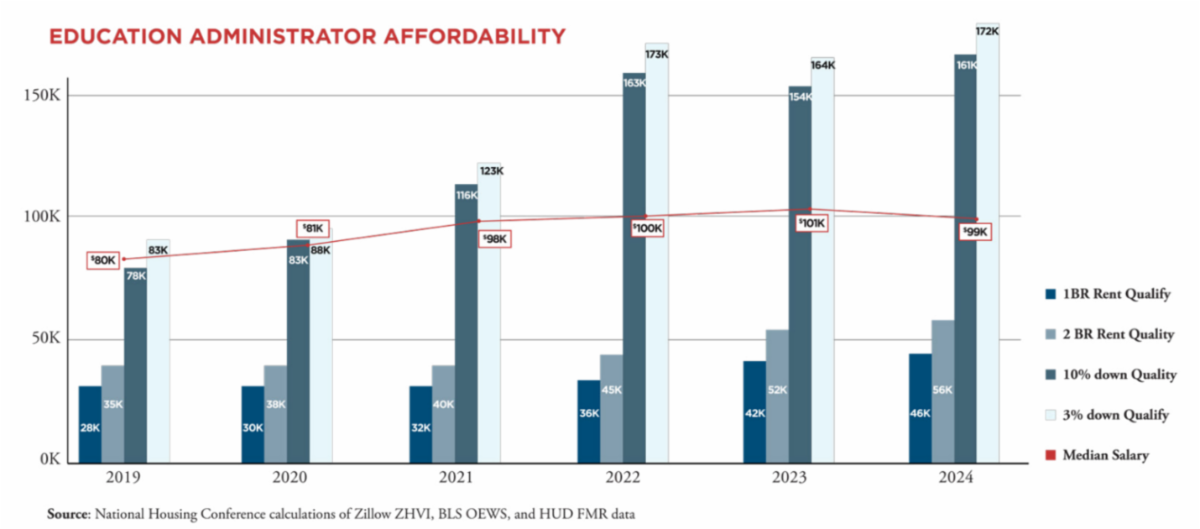
NHC’s recently released report, Priced Out: When a Good Job Isn’t Enough, reveals how the growing housing affordability crisis is impacting working households at all income levels and ultimately pricing the middle class out of homeownership. Rising home and rent costs have outpaced wages, leaving many workers unable to afford homeownership or renting. One example shows how education administrators in Boise, Idaho, have lost the ability to purchase a home with 3% or 10% down – once a possibility in 2019 – despite earning a median salary of nearly $100,000.
| | |
The AEI Housing Center and the U.S. Chamber of Commerce released over 6,600 “Strong Foundations” playbooks identifying local opportunities to add as many as 1.6 million homes per year. Their analysis finds the biggest driver of affordability is “smaller lots,” supported by data on 12 million single-family home sales, 70 million existing detached properties, 1 million multifamily units in mixed-use areas, and 170 million acres of federal land, offering geography-specific strategies to expand supply through regulatory flexibilities.
A news piece from Realtor.com reported that President Donald Trump is contemplating declaring a national housing emergency to tackle the ongoing affordability crisis and lack of housing supply. While the emergency declaration could accelerate federal housing programs and ease some regulatory burdens, experts caution that without tackling entrenched local zoning laws and supply shortages, the impact may be limited. Nonetheless, this potential declaration represents a step towards coordinated federal leadership.
ProPublica published an article exploring the intricacies of the recent controversies regarding multiple primary residencies listed on mortgage loans of government officials, most notably Federal Reserve Governor Lisa Cook. The authors claim that three other members of the Trump administration made similar claims on mortgage applications and explores how the forthcoming battle will handle the complexities inherent in mortgage regulation and legal standards, as well as the uniformity of standards.
| | Cotality accelerates data, insights, and workflows across the property ecosystem to enable industry professionals to surpass their ambitions and impact society. With billions of data signals across the life cycle of a property, we unearth hidden risks and transformative opportunities for agents, lenders, insurers, governments, and innovators. We turn our clients’ biggest questions into a future they can see. | | |
Monday, September 8
No events scheduled.
Tuesday, September 9
After the Farm Bill: A Discussion About the Future of Farm and Rural Policy, 12 PM – 1 PM ET
Breaking Down the New Census Data on Poverty in America, 11:45 AM – 1:30 PM ET
The Projects: A Book Event, 5 PM – 6:30 PM ET
Human Resources Symposium 2025, 8 AM – 5 PM ET
Becoming a HUD- Approved Housing Counseling Agency, 8 AM – 5 PM
REIA NOW Zoom Call, 3 PM – 4 PM
Wednesday, September 10
Multifamily Lending for Shared Equity Homeownership: How Companies Can Expand Their Community Impact, 2 – 3 PM ET
Becoming a HUD- Approved Housing Counseling Agency, 8 AM – 5 PM ET
Novogradac 2025 Fall Affordable Housing Conference
NMHC Emerging Leaders Networking Series (LA): NMHC Mixer at Four Wood Golf Club, 6 – 8 PM PT
Thursday, September 11
Commercial Real Estate Basics: Property Inspection and Environmental Concerns: September 2025, 1 – 2 PM ET
Right-Sizing Financial Regulation Conference, 9:30 AM – 4:30 PM ET
Novogradac 2025 Fall Affordable Housing Conference
Friday, September 12
Essentials for Executives and Board Members: Module XI: Artificial Intelligence in Mortgage Finance: September 2025, 1 – 2:30 PM
| | The National Housing Conference is a diverse continuum of affordable housing stakeholders that convene and collaborate through dialogue, advocacy, research, and education, to develop equitable solutions that serve our common interest. | | Defending Our American Home since 1931 | | Copyright © 2024. All Rights Reserved. | | | | |