image002.png

10 August 2023

Summary of Monthly Situation Update for July 2023

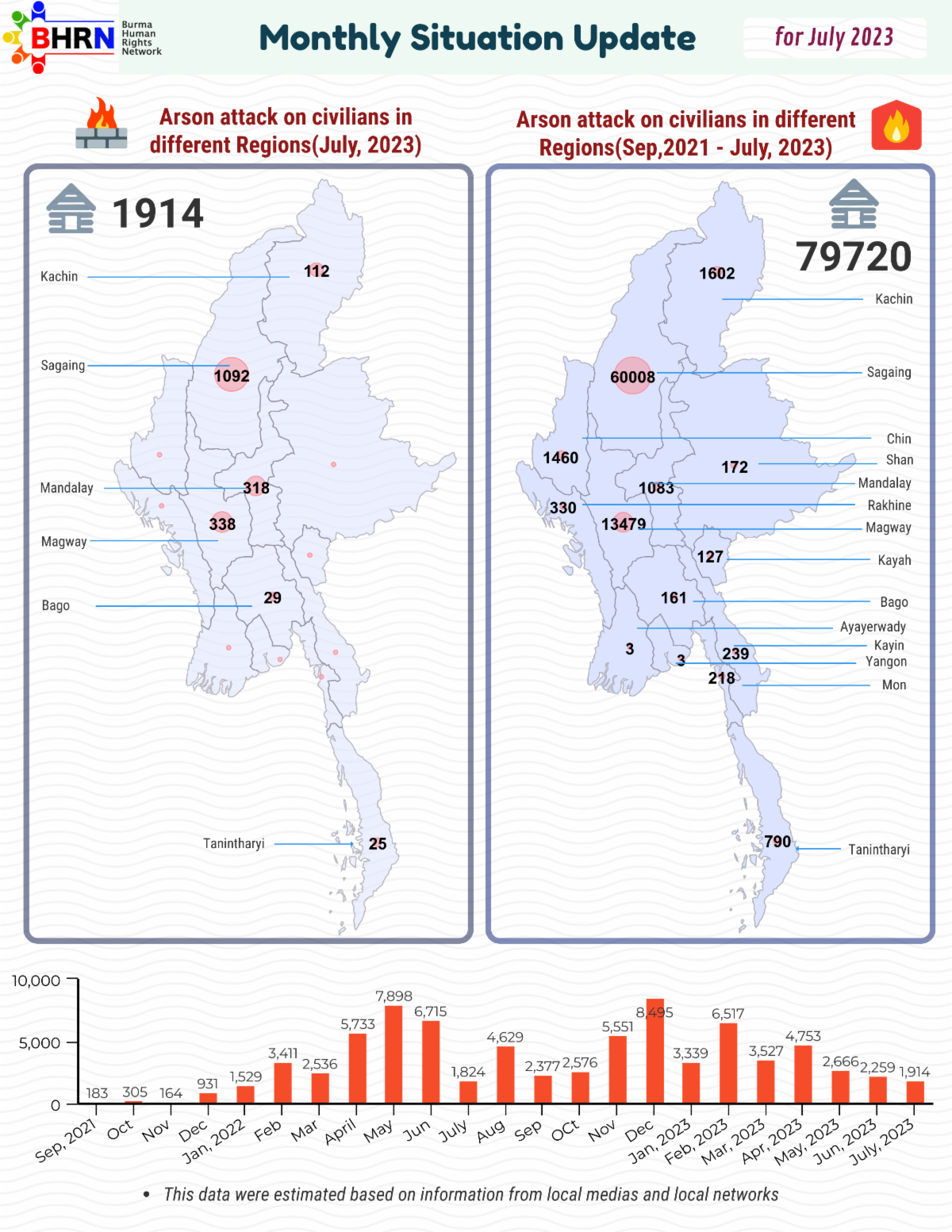
1. Info-graphs of BHRN's Report

2. Editor's Note

3. Rohingya Issue

3.1 Rohingya in Rakhine Updates

3.2 Rohingya Refugees in Bangladesh and India

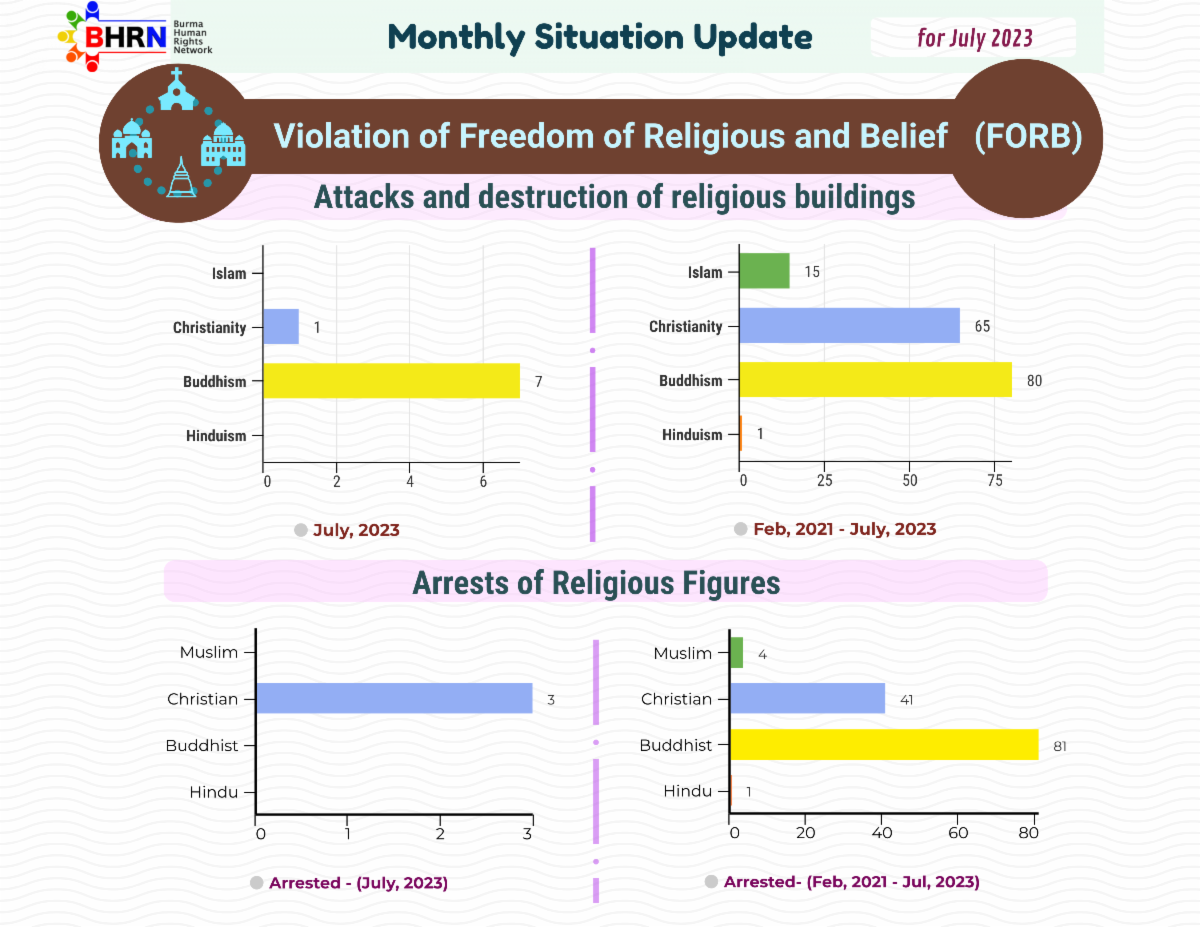
4. Violations of Freedom of Religion and Belief

5. Human Rights Violations

5.1 Rape as War Crime (Committed by Junta Troops)

5.2 Oppression of the political prisoners

5.3 Violation of Freedom of expression

5.3.1 Arrest of CDMs

5.4 Extra-Judicial Punishment

5.4.1 Arbitrary Arrests

5.5 Extra-Judicial-Killing and Enforced Disappearance

5.6 Violence Attacks by Pro-junta Thugs

Every month BHRN provides a summary of situation update for the previous month’s important event in Burma. More detailed information for each paragraph contained in the update is available in more details upon request.


Methodology


Information in this document has been gathered by the BHRN team by primary and secondary research method. We employed local researchers and local informers across Burma including in Rakhine State, Thai-Burma border and the Bangladesh border monitoring, investigating and documenting incidents of human rights violations. Any information we receive is carefully checked for credibility and authenticity by experienced senior research officers in the organisation. Once the information is approved the editorial team prepares the final document.

HungerStrike.jpg
Short Video of Monthly Situation Update (BHRN) - July 2023

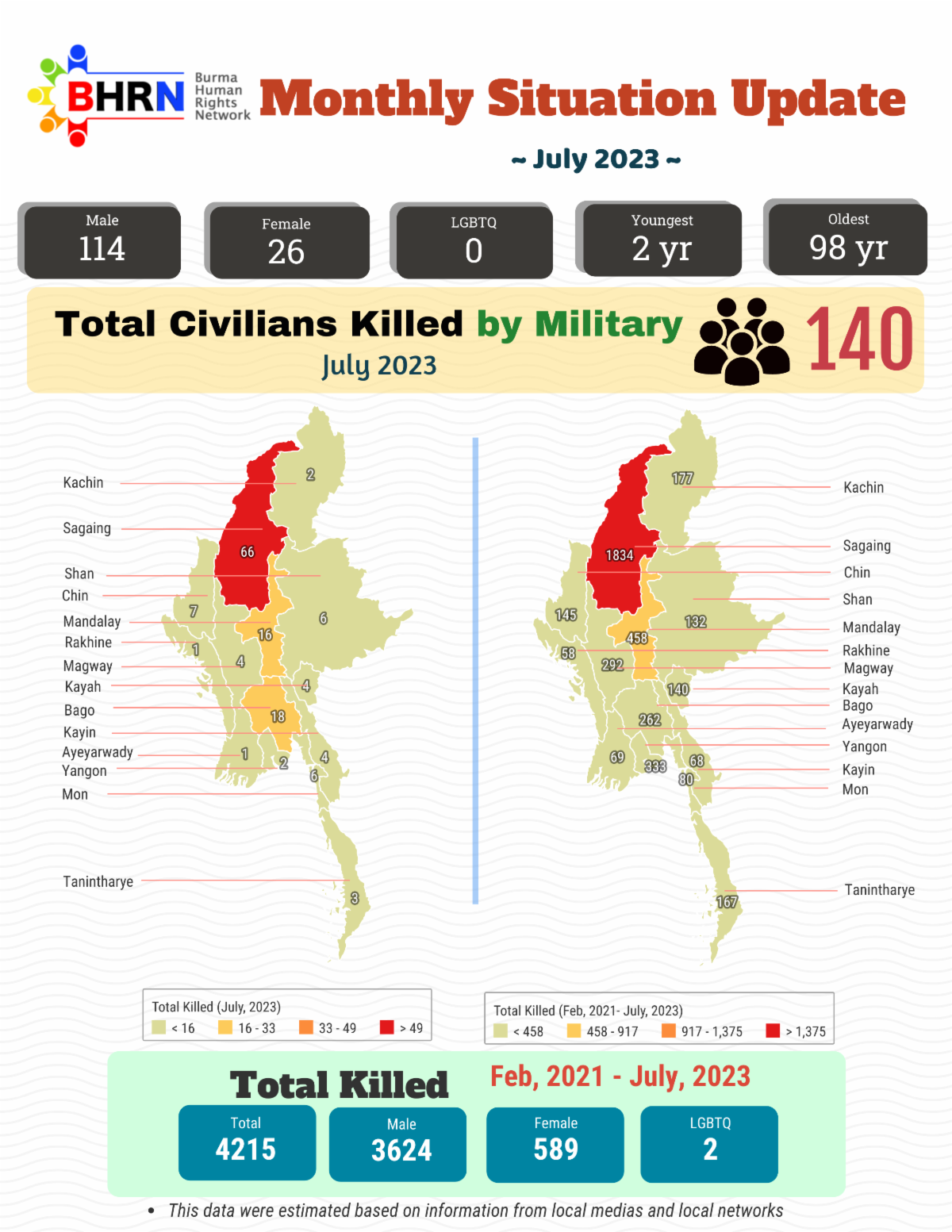
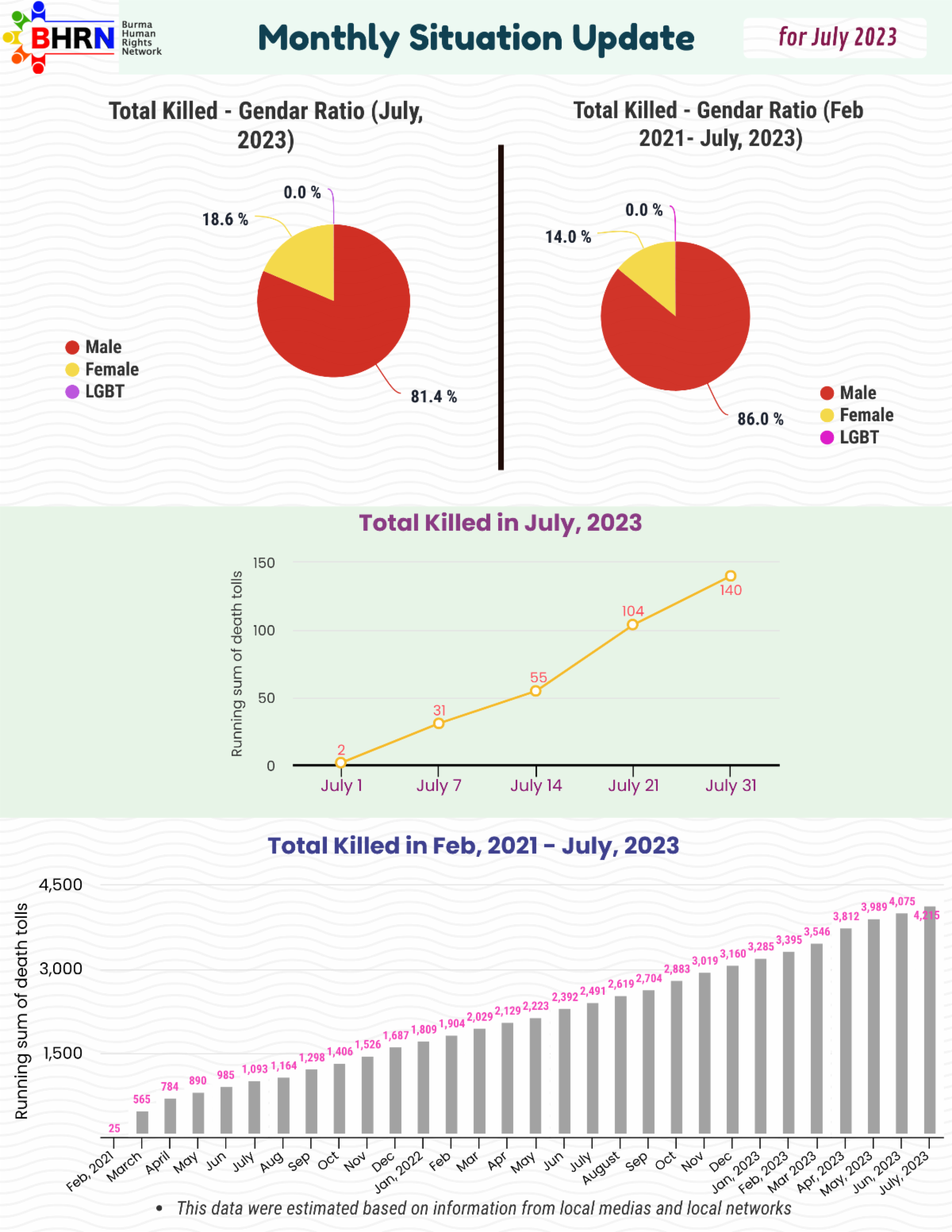
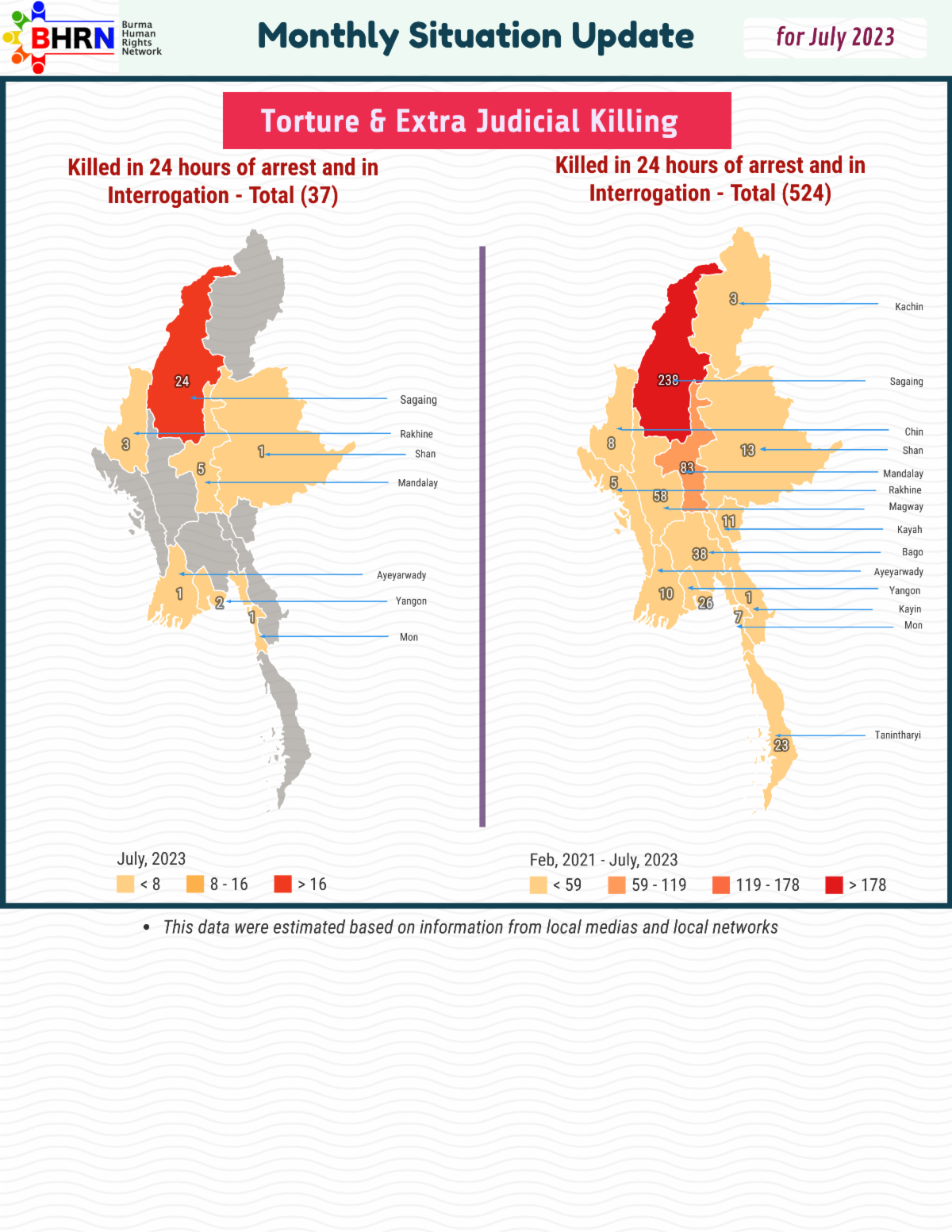
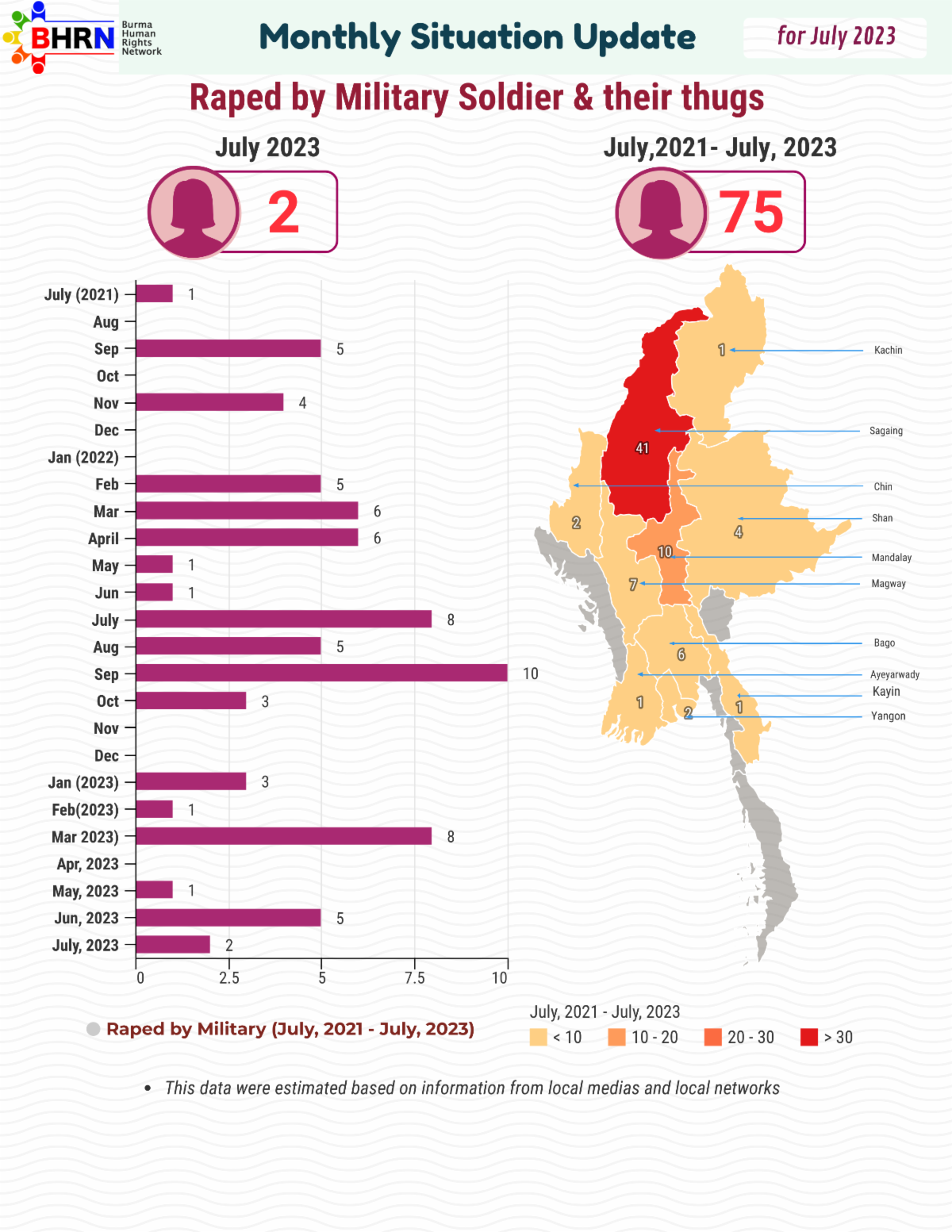
1.Info-graphs of BHRN’s Report

2.Editor's Note

Background  

·        The military junta extended its unconstitutional rule for another six months on 31 July, as the country plunged further into a political stalemate and intensified conflict. 


·        Pro-democracy leader, Daw Aung San Suu Kyi, was reportedly moved from prison to house arrest a few days before the junta announced that it is extending the state of emergency until the end of January 2024. The key rationale used by the junta is the current conflict situation in Myanmar is not conducive to holding free and all-inclusive elections and thus handover of power is not feasible.[1] 


·        The latest move by the junta to prolong its rule heralded the beginning of a power transition in Myanmar and it is most likely to occur violently. Min Aung Hlaing’s popularity within the military has dented significantly due to his inability to keep the entire country under the control of the military due to resistance by the people's defence forces (PDF) across the country. 


·        With the junta due to convene its quarterly meeting of the military in August, a major reshuffle of military commanders is expected. The meeting comes as a sign of disunity emerges within the junta. Two junta-appointed senior ministers, both known to have close ties with the junta head Min Aung Hlaing were demoted in a reshuffle announced in early August. Home Affairs Minister Soe Htut and Defence Minister Mya Tun Oo were replaced.  


·        Also, the commander of the Northern Command based in Kachin State, a former close aide of Min Aung Hlaing was arrested in Jule along with several military commanders based in the region. Commander Ko Ko Maung is reportedly under investigation for his alleged business link with the Kachin Independence Army (KIA). The investigation against Ko Ko Maung is led by Min Aung Hlaing’s deputy Soe Win. 


·        Also, the deputy commander of Triangle Command based in the Tanintharyi Region on the Thai-Myanmar border and a junta-appointed security minister of the region were arrested. Although it is reported in the media that the crackdown is linked to corruption and illegal business dealings, such incidents in the past are indicative of a tussle of power among the top military leaders in Nay Pyi Taw.  


·       Meanwhile, the junta released political prisoners on 1 August to mark an important day in the Buddhist calendar that also coincides with the inauguration of a US30 million worth statue of Buddha in Nay Pyi Taw. 


·       In terms of engagement with the regional actors the junta organized meetings with two regional envoys with Daw Aung San Suu Kyi in July. The meetings by the outgoing Thai Foreign Minister Don Pramudwinai and the Chinese special envoy Mr Dang which is expected to persuade the pro-democracy leader to engage with the military leaders to find a peaceful solution for Myanmar’s political crisis. The junta organized the meetings between Daw Aung San Suu Kyi and the Chinese special envoy on Myanmar Mr Deng Xijun. The two countries both shares long borders with Myanmar have a particular interest to reduce the level of conflict in Myanmar, to prevent the flow of conflict-affected people moving into their countries. In a major foreign policy coup for the junta, China is reportedly considering inviting Min Aung Hlaing to China as Beijing continue to come closer to the military junta since early this year. 


·      However, both China and Thailand could be considering the meeting with Daw Aung San Suu Kyi as too little too late to find a solution to Myanmar’s political crisis, due to two reasons i) because the centre of power of political opposition in Myanmar is no longer rests with Daw Aung San Suu Kyi alone and; ii) the people defence forces, who currently define the political and military opposition to the regime may not be ready to give recognition to the current junta, they are calling is to put the current military leaders on trial for the atrocities they committed against the people of Myanmar.


·        Amid all these dynamics, the junta so far failed to initiate a process of repatriation of Rohingya refugees from Bangladesh. As the sixth anniversary of the flight of Rohingya refugees from Rakhine State to Bangladesh approaches, there are some visible diplomatic efforts by China to help Myanmar and Bangladesh to start the process of repatriation of Rohingya refugees. 


  • [1] In fact, the country has never been able to conduct elections in the entire country since it held the first democratic elections in 1952. More than one million Rohingya Muslims were denied the right to vote in the elections in 2015, which was won by Daw Aung San Suu Kyi’s National League for Democracy (NLD)  

Context 

In yet another sign that Myanmar’s 2008 Constitution ceased to exist, the junta head Min Aung Hlaing secured the fourth six months of his rule, even though the constitution only allows a maximum of two six months terms for the Commander-in-Chief to enforce the emergency rule.


The extension was announced after a meeting of the National Defence and Security Council, one significant development of the latest meeting of the council is the participation of former Vice President Henry Van Thio, a member of NLD. His participation is seen as a thaw in relations between the junta and the NLD. However, a statement from the NLD issued after the meeting after the meeting condemned the participation of Henry Van Thio. 


There is speculation that the participation of Henery Van Thio, who did not join such a meeting in the past could be a sign of a positive result coming out of the junta’s decision to move Daw Aung San Suu Kyi to house arrest. Even though it was widely reported that Daw Aung San Suu Kyi was moved to a government residence in Nay Pyi Taw in late July. However, there is no announcement from the junta confirming the move. 


Myanmar’s government in exile the National Unity Government (NUG) which is led by several top NLD leaders and the entity that is managing the People's defence forces (PDF) announced in late July that it is against entering into negotiations with the junta, instead it look for the persecution of Min Aung Hlaing and his associates.    


Increasingly it is likely that the PDF will be the key bargaining chip to make the junta more conciliatory toward the opposition. It is because the junta itself has admitted that it has lost control of several areas in the country including Bago, Magwe and Sagaing regions, which are used to the most peaceful parts of the country. The junta lost control of these regions as PDF gained more support from the general public and it inflict heavy casualties on the junta troops, despite having lesser numbers of troops and weapons. 


A local media group Khit Thit compiled the numbers of casualties in the conflict between the junta and PDF forces daily. Even though these figures could not be independently verified, there is a consistent trend that indicates that the junta is losing at least 15 soldiers a day with much lesser numbers of PDF troops. These figures were taken from the areas where there is the most intense fighting between the two sides including Sagaing and Magwe regions as well as Kyyah State, where the junta used fighter jets and heavy weapons to attack the PDF forces. And some reports indicate that PDF groups are operating very close to the capital city Nay Pyi Taw. 


In some estimates, the junta has stable control over only one-fifth of the townships in the country. Also, the junta nearly lost the entire Rakhine State to Arakan Army.


Such a situation is a serious cause of concern not only for the sustainability of the junta and the credibility of its leaders but also for Myanmar's neighbouring countries.

Despite these setbacks, Min Aung Hlaing's regime is likely to cling to power with the support of powerful monks in the country.  


Unlike in other countries where the political might is played out in the elections or battlefields, however in Myanmar, other powerful forces can keep the governments in power and keep them strong, that force is Buddhist monks or Sangha. They are being used by successive military regimes to keep them in power. Min Aung Hlaing has been using the same old tactics before and after his ruthless military takeover.


The latest display of alliance between the junta and some of the most powerful monks in the country was seen during a daylong event of unveiling of a huge Buddhist statue in Nay Pyi Taw built at the cost of USD 30 million. The Maravijaya status claimed to be the world's largest and it perhaps cost more than the country’s annual health care and education budget combined. 


Most of the monks seen together with Min Aung Hlaing at the statue inauguration ceremony on 1 August were instrumental in stroking anti-Muslim hate speech and persecution of Rohingya Muslims, these incidents took place from 2012 (when the NLD won all the contested seats in the by-elections) up until 2021 military coup. These incidents were orchestrated to push Myanmar into yet another dark period of military dictatorship. 


The successive military junta in Myanmar also used its political opponents particularly pro-democracy leader Daw Aung San Suu Kyi as a pawn in formulating closer ties with the regional and Western powers. In recent weeks the junta reportedly moved Daw Aung San Suu Kyi to house arrest and reduced part of the sentences she is facing and allowed her to meet with the regional allies and officials of the former government including the speaker T Khun Myat. These moves were the attempts by the junta to show the international community that it is interesting to engage in a dialogue to find a solution to the political crisis. 


However, with NUG rejected the junta’s move to release political prisoners and commute the prison sentences of Daw Aung San Suu Kyi and former president U Win Myint. Acting President Duwah Lashi La said the latest moves were another attempt by the junta to create confusion among the people of Myanmar and the international community. 


Even though there has been increasing rights abuse committed by the military junta there is no unified international stance about dealing with the political crisis in Myanmar.


The Association of Southeast Asian Nations (ASEAN) continued its approach of encouraging all stakeholders in Myanmar including the junta to engage in dialogue, as China increasingly shows concerns over increasing tension in Rakhine State and other parts of the country. But Beijing still sees the military as a key force to keep Myanmar intact as one country.


A recent meeting of the Foreign Ministers of the Association of Southeast Asians in late July called for a dialogue among all stakeholders while asking the junta to allow humanitarian assistance to the IDPs displaced due to conflict. 


China adopt a more proactive approach and tried to establish closer ties with the military regime earlier this year. The Chinese special envoy Deng Xijun was allowed to meet with Daw Aung San Suu Kyi during his trip to Nay Pyi Taw.

Observations and Analysis

The latest moves by the junta to extend its mandate could further polarize between the junta and pro-democracy forces, especially with the people defence forces (PDF) which is emerging as the key force that poses the biggest threat to the junta. The National Unity Government that oversees the operation of PDF forces said the number of PDF troops on the ground has now reached 65 000 and it has a presence in more than 250 townships out of 330 in Myanmar. 


There were no high expectations for PDF when it was first established in 2021, however, PDFs have been able to inflict heavy losses to the junta force than the Ethnic Armed Organisations (EAOs) who have been fighting the pro-Bamar military since the late 1940s. 


However, it is unlikely that either Tatmadaw or PDF to maintain complete control of the entire country in the coming months or years so the political stalemate in Myanmar is most likely to continue for a few more years. And as PDF gained its strength the response from the regime is likely to become more intense, which would push the country to a more complicated civil war.  


The complexion of the conflict could be changed if there is a leadership change in Tatmadaw, which is increasingly likely with Min Aung Hlaing losing the support of top military generals, as he overseeing the most chaotic phase of the Tatmadaw since its establishment in 1941.


It is expected a far-reaching military reshuffles of the top military leaders in the quarterly meeting of the Tatmadaw which is due in late August. It is expected more of Min Aung Hlaing’s loyalists are likely to be moved to civilian positions. With the latest reshuffle, it is expected a new generation of military leaders to emerge.


In terms of international engagement, China is likely to play a more active role not only in brokering political settlement in Myanmar through the promotion of dialogues between the junta and NLD as well as with the EAOs. China also is trying to help Myanmar and Bangladesh with the repatriation of Rohingya refugees. The Chinese envoy Dang had a series of talks with Myanmar and Bangladeshi officials in July on starting the long-delayed repatriation process. 


In terms of concession for Rohingya, Beijing is reportedly pushing the military junta in Myanmar to grant citizenship to Rohingya and allow them to stay in their places of origin i.e. the places the refugees lived before they were forced out by the Myanmar military in 2016 and 2017.


With the Arakan Army making strong advances in Rakhine State the ethnic harmony in the areas under its control has increased significantly. Also, the relief work for Cyclone Mocha, which struck Rakhine State, has brought Rakhine Buddhists and Rohingya communities closer.  

3.Rohingya Issue

3.1 Rohingya in Rakhine Updates


1 July- Aid remains limited for Rohingya as INGOs face restrictions by the Junta. Access to food, medicine, and building supplies are in high demand, and many IDPs are still living without replacement shelters for homes destroyed by cyclone Mocha. Ref: BHRN


7 July- The Immigration and police authorities in the Sittwe Airport in Rakhine State have been harassing Rohingya and Muslim travellers by posing unnecessary questions related to their travels even after travel documents and national registration cards are provided. A local CSO network AEN quoting five Muslim travellers who had such experiences recently said in some cases Muslim travellers were asked to pay bribes to immigration authorities and police at the Sittwe Airport. A Rohingya traveller who shared his experience said he had to pay up to Kyat 10 000 to immigration although he presented Form No 4 which is a special requirement for Muslim travellers to carry when they travel outside of Rakhine State. In addition, he had to pay Kyat 15 000 to the police. Such experiences are being faced by only Rohingya and Muslim travellers in a gesture by the authorities to continue a long-standing practice of harassing Muslims. Ref: Arakan Express


17 July- Flu cases are being reported in high numbers around the Sittwe IDP camps, while INGO access remains extremely limited. This is especially dangerous for small children and elderly people living in the camps. Source: BHRN


18 July - Fighting broke out between the Arakan Rohingya Salvation Army and the Arakan Army when AA attacked ARSA for a perceived territorial encouragement in the Mayu Mountains. Both sides have been reluctant to discuss the incident, but indications are that members of both groups were killed in the fighting. Recent movement by ARSA in Rakhine State seems at least partially connected to events in Bangladesh that have pressured members out of the refugee camps and border region. Source: BHRN


24 July - The junta sent hundreds of soldiers to secure areas near where the fighting between ARSA and AA broke out. The junta troops were redeployed by boat from Sittwe to Buthidaung on 21 July.

Source: BHRN and Narinjara


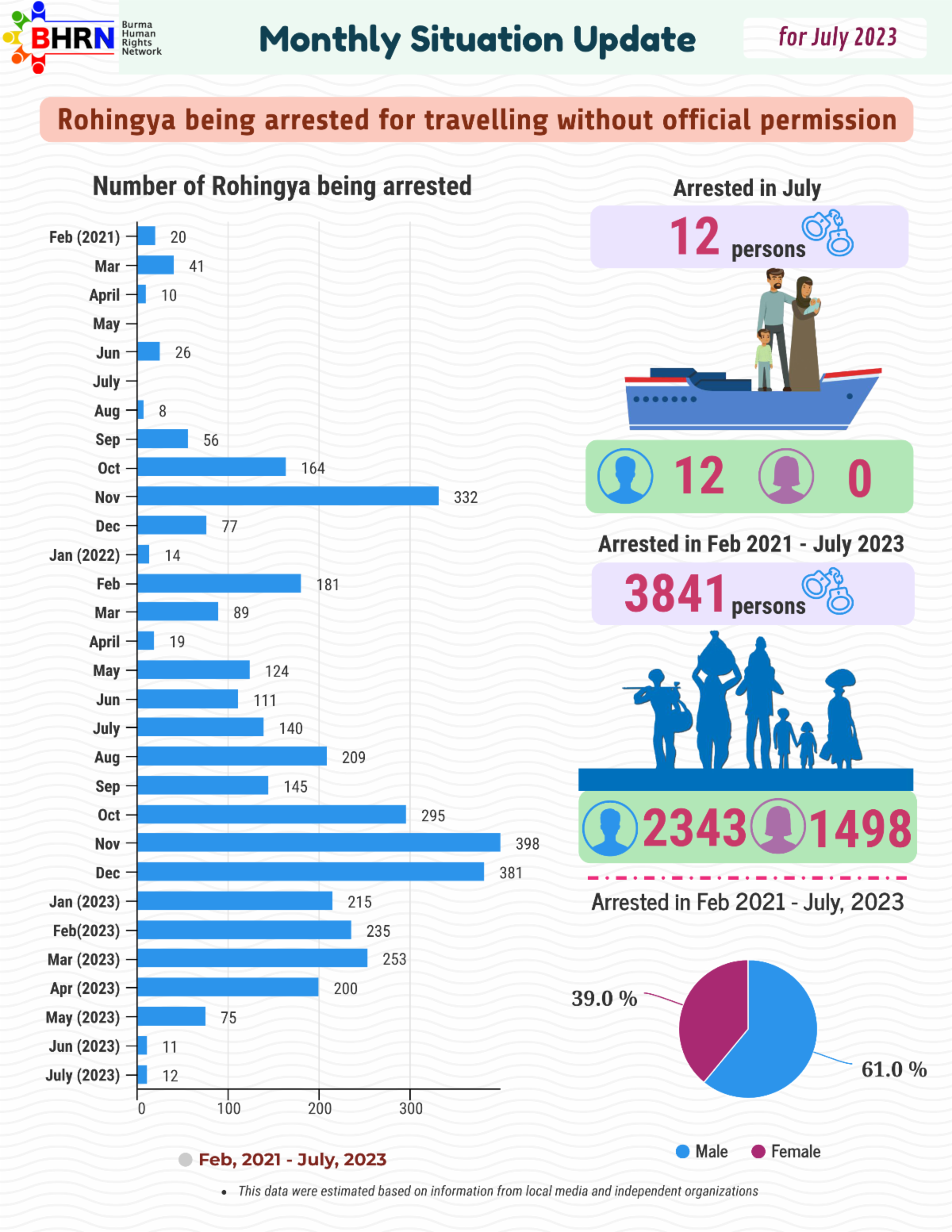
31 July- The military junta arrested at least 12 Rohingya men in Rakhine State during July, statistics compiled by the Burma Human Rights Network said. They were arrested from different places in Rakhine State as well as from Nga Phe Township in Ayeyarwaddy Region. BHRN  

3.2 Rohingya in Bangladesh Camp & India

8 July- Seven Rohingya refugees were killed prior to a visit by a prosecutor from the International Criminal Court. Five of the victims were members of the Arakan Rohingya Salvation Army, one was from the Rohingya Solidarity Organization, and one was a junior warden gathering refugees to testify about the violence of 2017. The murders are all believed to be connected to fighting between militant groups, with the junior warden’s murder likely being a militant group's disapproval of his work.

Source: BHRN and VOA

19 July- Assam Police arrested a man for trafficking Rohingya and Bangladeshis into India. He had been arrested for the same crime on July 12th but was released on bail. Partha Sen is accused of smuggling 14 people from Bangladesh to India, including four Rohingya. Source: BHRN and India Express


22 July- Hafez Nur Mohammad, a high-ranking ARSA officer, was arrested by Bangladesh authorities.

Source: BHRN

24 July - A five-month-old Rohingya girl died after tear gas was deployed by Indian authorities at protesters inside Hiranagar jail in Kashmir and Jammu. The incident allegedly occurred while refugees were trying to escape. The facility is being used as a detention center for immigrants and refugees, and many of the Rohingya there have staged a hunger strike. Approximately 270 Rohingya are being detained at Hiranagar. Source: BHRN


25 July- 74 Rohingya refugees were arrested by Indian authorities in Uttar Pradesh. Among those arrested were 14 women and five children. One of the women detained is said to be pregnant.

BHRN and Al Jazeera


31 July- Special task force police in Assam arrested eight people they claim helped facilitate the transportation of Rohingya in India. Partha Sarathi Mahanta, a senior officer in the Assam police, told India Today, “Illegal immigrants are a threat to our country and its security,” while explaining the operation. The rhetoric and actions by authorities against the Rohingya have become far more worrying over the past month while new operations are conducted to stop refugees from seeking shelter in the country. Source: BHRN and India Today

4. Violations of Freedom of Religion and Belief

3 July- A pagoda and a monastery were destroyed in a shelling by the junta troops in a village in Kyaikhto Township in Mon State on 3 July, a local group the Kyaikhto Information Team told the Yangon Khit Thit Media. It said one monk was injured in the attack on Saungnaing Gyi village. Ref: Khit Thit Media


10 July- A pagoda and statues of Buddha were destroyed in an airstrike by the junta troops on a village in Ye U Township in Sagaing Region, a local source the People Defence Command said. It said two fighter jets were involved in the attack on Ye Myat village. It said the junta has an air force base near a civilian airport in Mandalay and they attack the village without any ongoing fighting in the area. BHRN 


14 July- A monastery and statue of Buddha were destroyed in an airstrike by the junta troops in Pha Saung Township in Kayah State, a local group the Karenni Generation Youth, told the Burma Human Rights Network. The group called on the international community to take action against the military junta for attacking civilians. BHRN 


14 July- A Buddhist nun was injured in an attack by the junta troops in Kyaikhto Township in Mon State, a local source told Yangon Khit Thit Media. The report said the junta troops attacked with two 66 mm rocket launchers on Aye Pagoda in Moatpalin Model village in Kyaikhto. Ref: Khit Thit Media


20 July- A former soldier who served in Tatmadaw said he and his family faced discrimination after his marriage to a Muslim woman. Ko Aung Aung, served as a private in Tatmadaw for 15 years until March last year, when he fled to the border area after joining the Civil Disobedience Movement (CDM) against the junta. Ko Aung Aung said his Muslim wife was forced to convert to Buddhism several times when they were living in a military barrack. And he was given several forms of punishment when he failed to worship in the Buddhist tradition. Ko Aung Aung said he was once asked to clear grass on 300 square feet plot of land alone. His children were asked to eat pork which is prohibited to eat for Muslims. Ko Aung Kaung said such practice of discrimination against the members of the minority religion in Tatmadaw was one of the reasons that forced him to join the CDM after the military junta took over power in February 2021. Ref: Khit Thit Media


26 July- A Christian missionary school in Loikaw Township in Kayah State was destroyed after it was hit by shells fired by the junta troops based in the region. The attack on the school using heavy weapon shells took place as the junta troops raided several villages in Loikaw including Nwa La Woe village where the school is situated. The raid comes as the junta forces continue attacking the civilian defense forces in Lei Htwe, Kone Thar, and Nwa La Woe villages. Ref: BHRN  

5. Human Rights Violations

5.1 Rape as War Crime (committed by junta troops)

4 July- At least 59 women have faced sexual assault over the past two years since the junta came to power in a coup, a civil society organisation Burma Women Union (BWU) said in a recently published report. The report “Sexual violence faced by women during the time of political crisis” published in June said among the cases, 9 involved junta troops rapping civilian women. Also, four cases were reported of sexual violence committed by the members of anti-junta defence forces and 23 were committed by civilians and it said the same number of reports of domestic abuse against women. It said the victims in all cases so far have not got justice. Ref: The Irrawaddy


 24 July- Two women were rapped and murdered by the junta troops in a village in Kyauktaga Township in Bago Region on 24 July. The Kayin National Liberation Army, the armed wing of a rebel group the Kayin National Union confirmed the incident that took place in Nan Za village, it said the junta troop looted public properties during the raid. KNLA said these atrocities were committed while the junta troops were stationed in the village for five hours. Ref: Narinjara


26 July- There is a widespread report of committing sexual harassment and exploitation of women in Tatmadaw, several sources confirmed. They said women troops are deserting in large numbers as there is no protection for them. The Tatmadaw has increasingly used women troops in frontline areas in recent months to replenish the declining number of troops. The source said sexual harassment and exploitation of women troops were committed by the commanding officers in charge of training and they commit in groups. Ref: Khit Thit Media

5.2 Oppression of the political prisoners

3 July- A political prisoner died due to torture committed by the prison guards in the prison in Myinchan Township in Mandalay Region on 2 July. The prison authorities said the unnamed prisoner has died due to internal bleeding of the stomach, however, a source close to the family of the deceased prisoner said the injuries were found on the body of the prisoner and his hands were tied to his back. Other sources also suggest that other political prisoners are also facing torture inside the prison. Ref: VOA


27 July- At least 13 political prisoners were killed in Deik U Prison in Bago Region during June this year. The sources close to the prisoners and the groups monitoring the political prisoners said they were either killed inside the jail or shot dead after the authorities took them out of the prison. They said another 37 political prisoners are missing after they were taken out from Daik U Prison. A member of a student union in Mandalay Region said the authorities are intentionally killing political prisoners with an aim to terrorise the junta’s political opponents. Ref: RFA

5.3 Violation of Freedom of expression

5.3.1 Arrest of CDMs

18 July- Three former government employees who joined the Civil Disobedience Movement (CDM) against the junta were arrested in Lashio in Shan State on 15 July. The junta said the three, one a former staff of the Education department and two railway staff were arrested in connection with their roles in a bomb blast gold shop in Lashio. The junta has also arrested other four people in connection with the blast in the Zwe Htet gold shop in June. Ref: Myanmar Now


29 July- A former employee of the Railway department U Kaung Htet (a.k.a) Phoe Si and his wife were each sentenced to 7 years imprisonment for joining the Civil Disobedience Movement (CDM) against the military regime. They were arrested in last October and were badly tortured at the hands of the junta troops. Ref: DVB


5.4 Extra Judicial Punishment

5.4.1 Arbitrary arrests and imprisonment

5 July- A group of 60 civilians were abducted by the junta troops in Kanbalu Township in Sagaing Region on 4 and 5 July, a local activist group said. The group said the reason for their abduction was still unclear. The group said among those arrested include three children. BHRN 


5 July-The junta troops arrested 18 youths in Yangon in a series of raids from 1 to 4 July. He said they were arrested with the accusation of joining a civilian urban defence force. According to the sources close to the Burma Human Rights Network (BHRN) said the arrested youths are aged between 17 and 20 and include three women. It said they were arrested from Lanmadaw, Mingladon, Tarmwe, Kamayut, North Okkalapa, Shwe PyiThar, Kyeemyin Dine and South Dagon townships. Among those arrested were not involved in any junta movement, some of them were pickup from the street, the source told BHRN. 


12 July- A group of 19 civilians were arrested in Kyauktaga Township in Bago Region and they are held in the local police station. A source said they visited the area to purchase food. The junta later released one detainee and the rest are to face charges. Ref: Arakan Express


18 July-The junta’s troops arrested more than 20 civilians in Kyainseikkyi Township in Kayin State on 14 July. The area is under the control of the Kayin National Liberation Army (KNLA), the armed wing of the Kayin National Union (KNU) rebel group. The KNLA said the arrested civilians were used as human shields. The civilians were abducted as they travelled in the area where the junta and KNLA troops were engaged in fighting. KNLA said two of the abducted civilians were later killed by the junta troops. BHRN  


19 July- A special court in Mandalay’s Oh Bo prison sentenced a teacher who worked for the National Unity Government to 20 years imprisonment on 17 July. Daw Shwe Zin Myint established an online study network with the name Federal School of Aung Myay Thar Zan which was established in February last year. She was arrested along with other 15 teachers of the school who are aged between 20 and 40. Ref: Myanmar Now


 27 July- The junta troops abducted more than 30 civilians in Ye Phyu Township in Tanintharyi Region, a local source said. He said they were asked to wear the military uniform and asked to walk in front of the junta troops as human shields in the areas where there is active conflict. He said the incident has led to several civilians in the region to relocate to safer places. BHRN 


28 July- The junta troops abducted at least 80 civilians including children in Thabeikkyin Township in Mandalay Region on 27 July, a local resistance group Thabeikkyin Revolution- TR said. He said they were held in a monastery in Sei Zin Kone village in Thabeikkyin Townsihp, adding that all abductees including children were tried up by ropes. BHRN


5.5 Extra Judicial Killings and Enforced Disappearances

6 July- The junta troops burned two civilians alive in a village in Myinchan Township in Mandalay Region on 4 July, a local activist group said. It said the two killed brutally included an elderly woman. The incident took place in Shwe Paw Kyun village in Myinchan and the killing was committed by the junta troops based in the Watlu area. A local source said it was a reprisal killing for the death of a local member of the junta baked the Union Solidarity and Development Party (USDP), Than Tun Aung and his son. BHRN 


8 July- 8 members of the anti-junta resistance force were killed in an interrogation camp in Kyeikkazaw prison in Bago Region’s Deik U Township on 27 June. The junta, however, said Ko Khant Lin Naing, the vice chair of Bago Region All Burma Student League and seven other members of the groups were killed when they tried to flee while they were being moved from Kyeikkazaw to prisons in Tharyarwaddy and Insein townships. The junta informed the news of the incident to the family members of the 8 activists. The Burma Human Rights Network received the news of the incident from a former chair of the Bago Region All Burma Student League. He said the family of other detainees are worried about the well-being of other student activists under detention. BHRN 


9 July- Two civilians accused of killing an ultra-nationalist vocalist Li Li Naing Kyaw were killed in an interrogation camp. The junta said Kaung Zarni Hein (a.k.a) La Pyae, 23 and Na Kyaw Thuya (a.k.a) EiTi, 30, were shot dead as they tried to flee. The junta said they attempted to flee as they were taken to the site of the killing to confirm the evidence against them. The pro-junta supporters earlier attacked the home of the mother of La Pyae, Daw The Malar Win and his elder sister Ma Saung Thazin Oo on 6 June. The attack was reportedly carried out by the members of the pro-junta Pyu Saw Htee militant group and now-defunct Association for Protection of Race and Religion (Ma Ba Tha in Burmese acronym). BHRN


9 July- At least 17 civilians were reportedly killed in Mandalay in a little over one month since 1 June. Most of them were killed by a pro-junta Thay Tauk Group. A local source said the bodies of the victims were thrown on the street and some of them were seen with the tag of Tway Tauk. He said among those killed included a monk from Thabeik Kyin Township in Mandalay Region. The source said the junta has not conducted any investigation into the killing of innocent civilians.  Ref: The Irrawaddy


19 July-The junta troops killed 4 people in Madaya Township in Mandalay Region on 14 July. A local group Wetlet Informational Network said the civilians were killed at Nyaung Oak village in Madaya Township by the junta troops who were stationed in a monastery in the nearby Nat Kyi Sin village. It said the bodies of the victims were thrown into the pound to erase evidence of the killings.  Ref: Khit Thit Media


22 July- The junta troops killed 14 civilians during a raid on a village in Yin Mar Pin Township in Sagaing Region on 21 July, a local source told Burma Human Rights Network (BHRN). He said three guards on sentry duty were beheaded and other 11 civilians were shot dead by the junta troops during their raid on Sone Chaung village. Ref: BHRN


22 July- At least 5 civilians were killed in an attack by junta troops and its affiliate Pyu Saw Htee militant group in their raids on several places in Monywa Township in Sagaing Region on 21 July, a local source said. He said 5 men were arrested by junta troops and later killed in Kulaw village in Monywa. He said the photos of the bodies of the victims were taken by placing guns nearby their bodies to accuse them of being members of the people's defence force fighting the junta in the region. The source said the identities of the 5 people were still unknown. Ref: Khit Thit Media


28 July- The junta troops raided the offices of the All Burma Student League activist group in Buthlin Township in Sagaing Region on 28 July. A news release by the group said the chair and vice chair of the group were killed by the junta troops during the raid. BHRN

5.6 Violence Attacks by Pro-junta Thugs

10 July- A pro-junta group Pyu Saw Htee killed a youth in a village in Yesagyo Township in Magwe Region on 9 July. A cow herder Ko Thet Paing Kyaw, 15, was killed after he was arrested by the Pyu Saw Htee group on the same day, a local source told the Yangon Khit Thit media. The report said the killing of the youth was the latest in a series of killing committed by the pro-junta group. A local source told the Yangon Khit Thit Media that a local Pyu Saw Htee leader Nga Lin in the past has arrested innocent civilians for extortion and they were also killed if they do not pay extortion money to him. Ref: Khit Thit Media


25 July- An affiliate of the junta Pyu Saw Htee militant group is forcing civilians in Thegone, Western parts of the Bago region to join the military. A local source told Mizzima News agency that the group is forcing civilians in the area, where the junta’s 66 Batallion is based, to join the military training during weekends. However, 20 civilians who joined the training were abducted and they were used as human shields in the junta’s military assaults in Bago Mountain range.  Ref: Mizzima

Background on the Burma Human Rights Network (BHRN)


Burma Human Rights Network (BHRN) is based in London, operates across Burma/Myanmar and works for human rights, minority rights and religious freedom in Burma. BHRN has played a crucial role in advocating for human rights and religious freedom with politicians and world leaders.


Media Enquiries


Please contact:

Kyaw Win, Executive Director

Burma Human Rights Network (BHRN)

E: kyawwin@bhrn.org.uk

T: +44(0) 740 345 2378


Learn More

[Burma Human Rights Network] | [Phone] | [E-mail] | [Website]

Facebook  Twitter  Instagram