image002.png

December 9, 2023

Summary of Monthly Situation Update for November 2023

1. Info-graphs of BHRN's Report

2. Editor's Note

3. Rohingya Issue

3.1 Rohingya in Rakhine Updates

3.2 Rohingya Refugees in Bangladesh

4. Violations of Freedom of Religion and Belief

5. Human Rights Violations

5.1 Extra-Judicial Punishment and imprisonment

5.1.1 Arbitrary Arrests

5.2 Extra-Judicial-Killing and Enforced Disappearance

5.3 Violence attacks by pro-junta thugs

Every month BHRN provides a summary of situation update for the previous month’s important event in Burma. More detailed information for each paragraph contained in the update is available in more details upon request.


Methodology


Information in this document has been gathered by the BHRN team by primary and secondary research methods. We employed local researchers and local informers across Burma including in Rakhine State, Thai-Burma border and the Bangladesh border monitoring, investigating and documenting incidents of human rights violations. Any information we receive is carefully checked for credibility and authenticity by experienced senior research officers in the organisation. Once the information is approved the editorial team prepares the final document.

HungerStrike.jpg

Short Video for Summary of Situation Update - November 2023

Short Video for Summary of Situation Update - November 2023

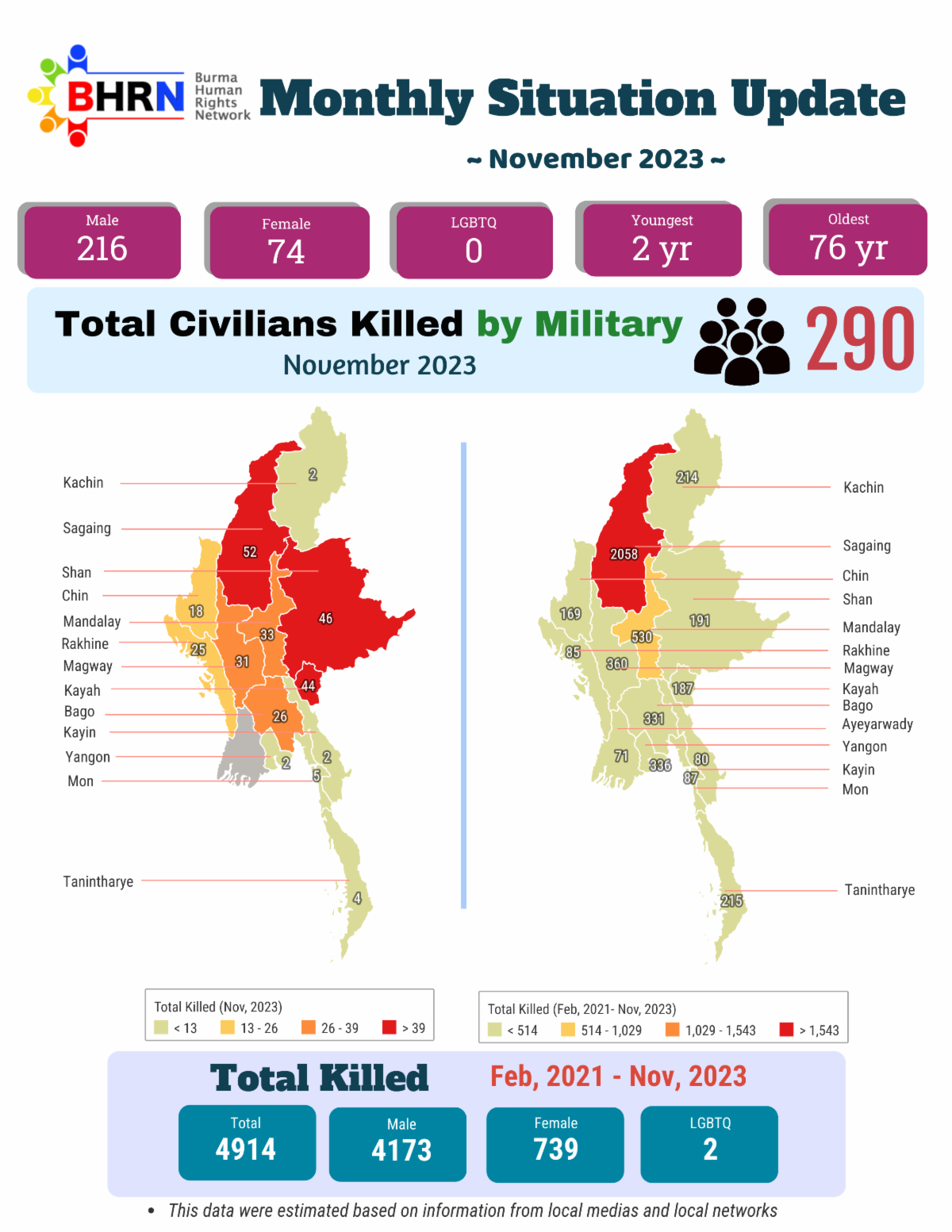
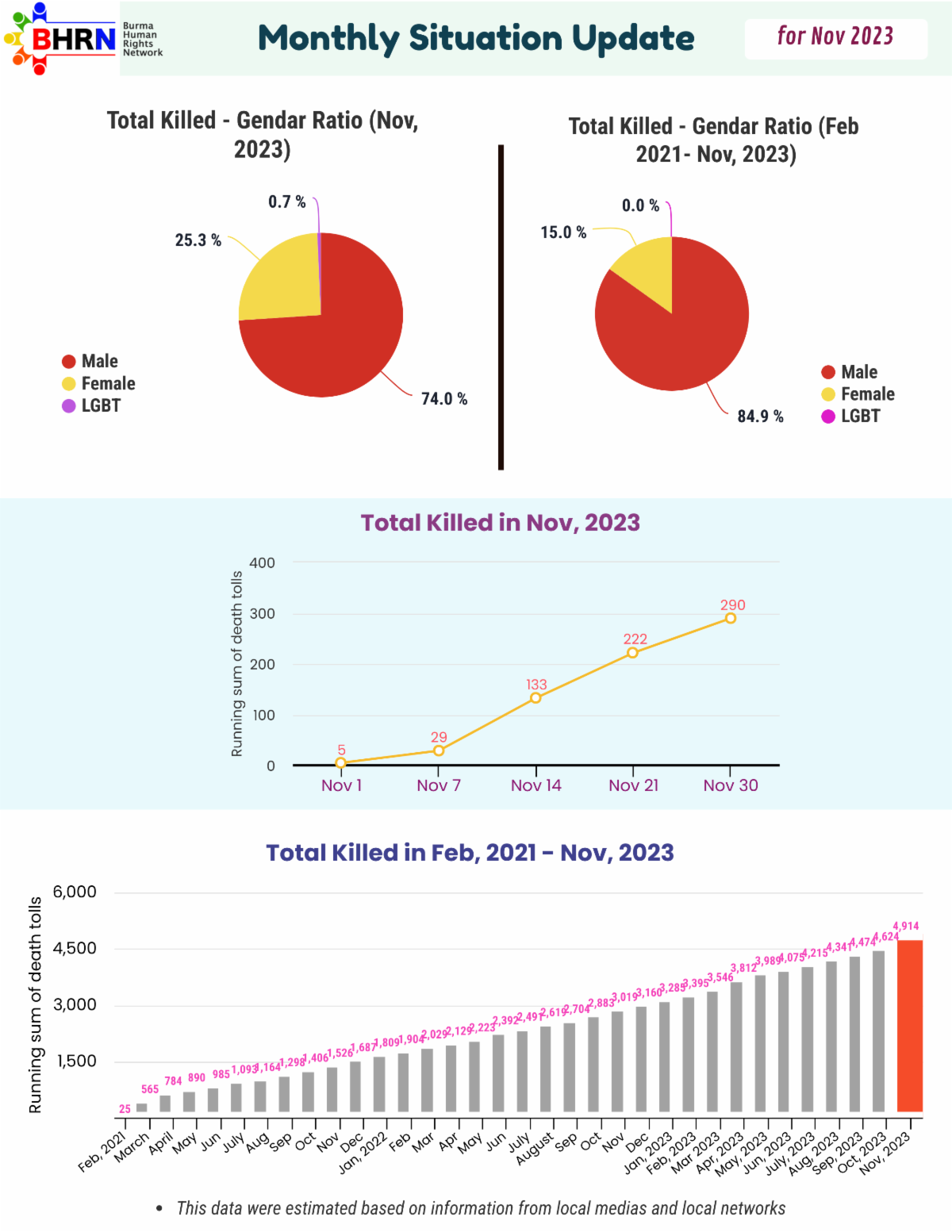
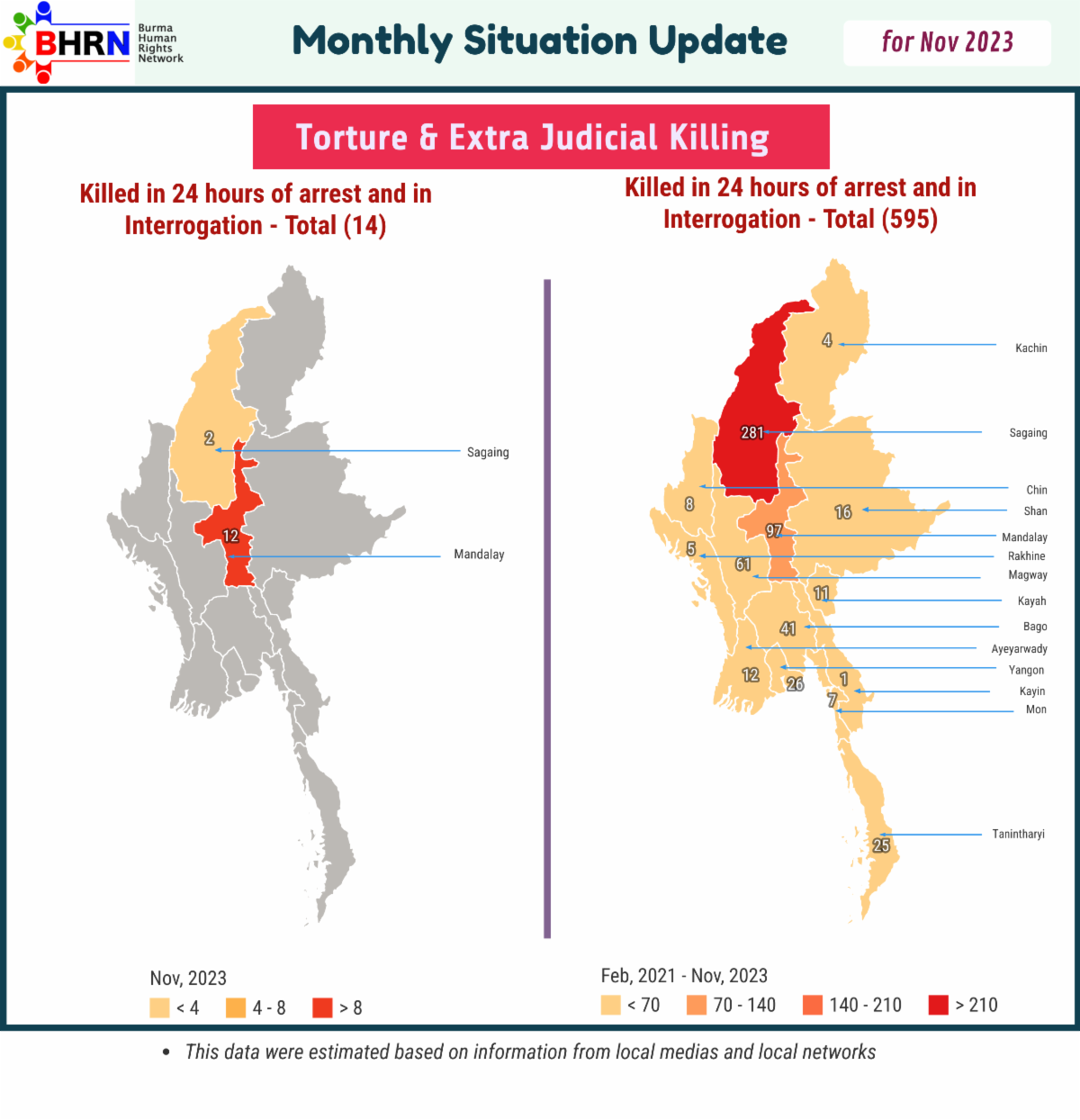
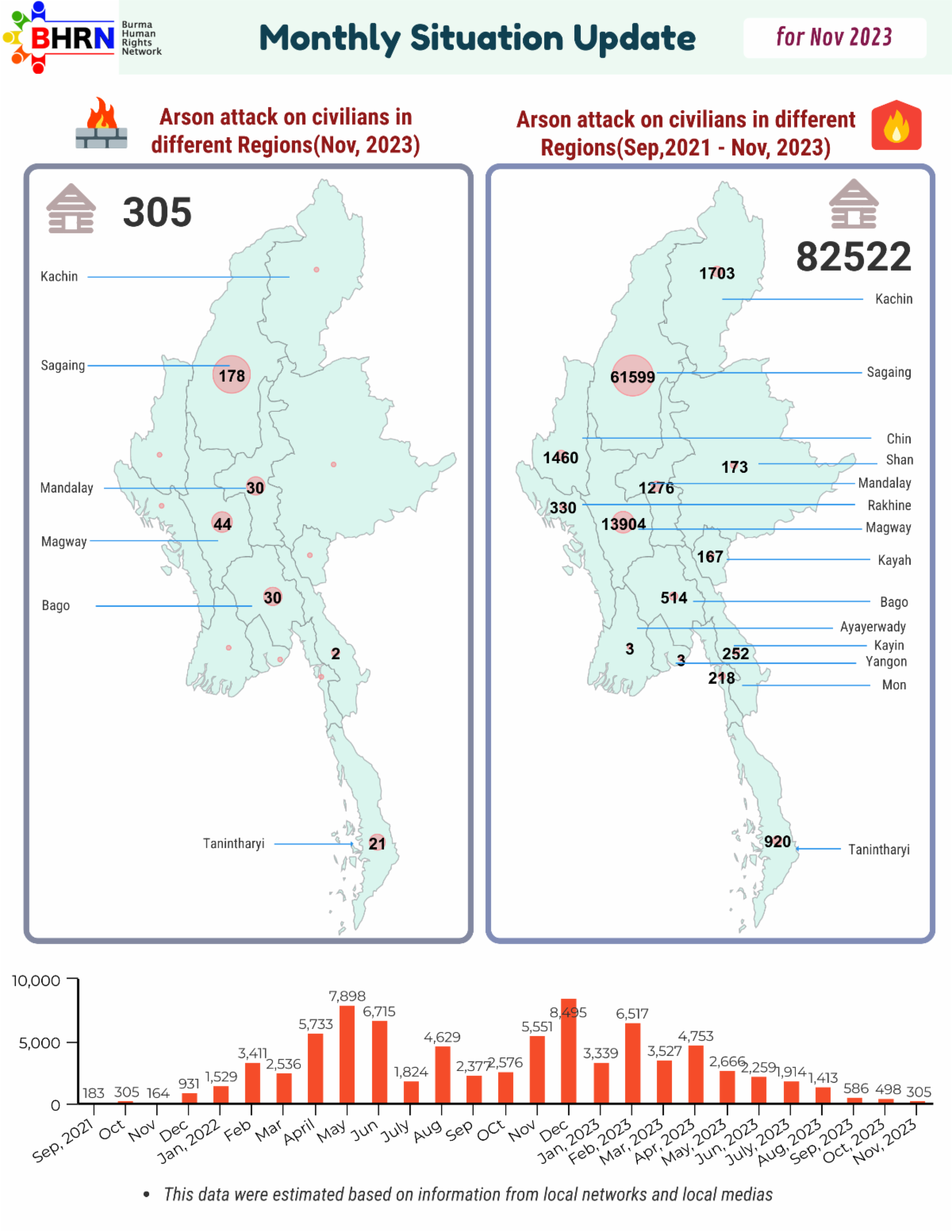
1.Info-graphs of BHRN’s Report

2.Editor's Note

Key Highlights 

·       All the major developments in Myanmar this month (November) were dominated by the successes militarily by the Ethnic Armed Organizations and the civilian defence forces against the military junta. It was an unprecedented military operation that has made Myanmar's military most vulnerable both militarily and politically since the late 1940s. 


·       The Brotherhood Alliance which is led by China baked the Myanmar National Democratic Alliance (MNDAA) is making gains on several fronts in Northern Shan State since the military campaign dubbed as “Operation 1027” for its start date, has been launched. Other members of the alliance are the T’ang Palaung National Liberation Army (TNLA) and the Arakan Army (AA). Many areas have fallen under the control of the alliance including the Kokang Region on the border with China. Many analysts now say that the operation got tacit support from China. 


·       A spokesperson of MNDAA recently said in a media interview that his group aims to take Nay Pyi Taw and root out the junta from there.  


·       This led many to believe that China has finally taken a side in the long-standing civil conflict in Myanmar. For China, the Northern Shan State is strategically important not only due to geographical proximity and shared ethnic identities, it is also crucial for Beijing economically. The Chinese-owned natural gas pipeline that starts from Kyaukphyu deep seaport passes through the Northern Shan State and runs up to China’s Yunan Province. 


·       Also, China sees the importance of maintaining law and order along its border with Myanmar, especially in the Kokang Region, which has been under the absolute control of the Myanmar military in recent years. Much to the dislike of China the Kokang has become a haven for the Chinese and international crime syndicates. The junta has so far failed to reign in on these groups despite repeated requests from China to do so. Now, with the MNDAA closing in to take control of the capital of the Kokang Region Lokkai, these groups were flushed out within a few days and the members of these crime syndicates were under detention of the Chinese law enforcement agencies.  


·       That would make Beijing rethink who is a more reliable partner in Myanmar in its geopolitical game. The junta has been going closer to Russia in recent months at a time when Moscow is under international pressure for its war in Ukraine. Many thinks such a move to go closer to Russia by Min Aung Hlaing is a sleazy move, that is not going to benefit Myanmar politically and economically.


·       Now, with China showing its muscle of influence in Myanmar’s affairs, it could lead the United States to think about how to counter such influence by China in Myanmar. The US experts on Myanmar are asking the Biden Administration to engage more closely with the anti-regime political forces to make sure that democracy is restored in Myanmar. 


·       While these military and political maneuvers take place the people of Myanmar continue to suffer due to the atrocities committed by the junta and the economic impact of political instability in the country. 


Context 

·      Operation 1027

The offensive launched by three pro-Chinese ethnic militia groups alliances in Myanmar dubbed “Operation 1027” for its start date is only a month old, but it forced the military junta in Nay Pyi Taw to think about how it would defend its bases in the administrative capital and other major cities in the country including Yangon and Mandalay. 


Although the operation launched by the Three Brotherhood Alliance looked ad hoc in the beginning, it now emerged that the planning for this coordinated attack has been underway for the past two years. 


Only within two weeks after the operation started the junta’s access to China through land border is almost lost. The offensive inspired other ethnic groups to launch a similar attack against the junta. In Chin State, the Chin National Front (CNF) conducted a renewed military operation in early November and that operation has led the junta to lose control of the areas near the country’s western border with India.


And one of the oldest ethnic armed organisations the Karean National Union launched a similar offence against the junta later in the month, and if that operation is also successful the junta will lose a part of access to the Thai border from Kayin State. 


There is renewed fighting in Rakhine State after the rebel group the Arakan Army (AA), which has already bases in the State, joined “Operation 1027”, the junta is fighting back against AA using its naval force. However, with the fighting likely to spread to the Northern Rakhine State, near the country’s border with Bangladesh, access to the Bangladesh border will also be severely restricted for the junta. 


In another setback for the junta, the Kayah State which is situated close to Nay Pyi Taw is fast falling into the hands of the ethnic groups fighting the regime there. The rebel group fighting the regime in Kayah State, The Karenni Nationalities Defence Force (KNDFF), recently claimed that it has already controlled 80 per cent of the state including the state capital Loikaw. 


Also, the junta is facing a similar fate in the Sagaing Region, where anti-junta civilian militia groups are very active. The junta faced military defeats at the hands of the recently established People Defense Forces (PDF). Lossing several towns in the Sagaing Region.


Also, there are reports of fighting between the junta troops and PDF in smaller towns in the eastern parts of Bago Region, which is close to Nay Pyi Taw.


The junta also faces threats of attacks by underground guerrilla fighters in major cities like Yangon and Mandalay, which frequently target soft targets of the junta and its officials.


These recent military setbacks forced the junta to think about how it would defend Nay Pyi Taw and these major cities if indeed, they eventually came under attack. 


However, even the most optimistic views point out that the junta’s hold on the control of these major cities will not come to an end for at least for a year. They suggest the junta may regroup and reestablish its control in the lost areas in the meantime. And military experts think it is still possible, especially with its air supremacy. 


  •  Political and diplomatic impact 

There are some likely political ramifications from these military losses that could be more dreadful for the junta, particularly its leader Min Aung Hlaing. 


The attacks and control of border towns by the Three Brotherhood Alliance come at a time when China is growing frustrated with the junta’s slow response to its request to clamp down on several illegal businesses, including human trafficking, being conducted by the Chinese and other nationals in Myanmar Chin border, particularly in Kokang Region. Most of the Kokang Region is currently under the control of the MNDAA also known as the Kokang militia. 


The military success of MNDAA has paved the way for the arrest of these illegal business operators, much to the delight of Beijing. China might want to avoid such unlawful activities resume in the area, and due to its close alliance both ethnically and politically, China would prefer MNDAA to continue its control of the region. 


With the elected civilian government under the leadership of Daw Aung San Suu Kyi maintaining cordial ties with China during its five-year reign in Myanmar since 2016, China may no longer think that only the military junta could guarantee for continuation of its influence in the country and the economic benefits. 


  • Power struggle 


With the latest setbacks politically and militarily the Myanmar military is on a very low morales, the way the junta soldiers surrendered in large numbers to the ethnic armies, in some cases without engaging in fighting, indicates that they no longer have faith in the current leadership, especially in Min Aung Hlaing.  


With more military setbacks for Min Aung Hlaing looming, his position as the head of the military and junta may soon become untenable. And the history indicates that the transition in Myanmar military leadership is rarely a smooth affair.  


With the recent incidents of Min Aung Hlaing and his deputy delivering punches at each other, the latest military debacles under Min Aung Hlaing’s watch could likely exacerbate the power struggle between the regime's two top leaders.  


In the latest evidence of political struggle, one of Min Aung Hlaing’s trusted aides and former Home Minister Soe Htut and his family were jailed in November after an investigation led by Soe Win on their business dealings found widespread corruption and misuse of power. 


Min Aung Haling from his end retaliated by jailing Soe Win’s close friend and former Information Minister Ye Htut to 10 years imprisonment on sedition charges. Ye Htut, who served as the information minister under the nominal government civilian government led by U Thein Sein from 2013 to 2016, has been seen as untouchable in the past years, as no action was taken against him even though he was posing a critical message against the junta head on social media.


  •   Human sufferings 

Irrawaddy News reported that while the Brotherhood Alliance has cut transport routes in northern Shan State, the junta has blockaded roads and waterways in coastal Rakhine State. It said the junta has now isolated towns in Rakhine, imposing its ‘four cuts’ strategy on their civilian populations. It used the same strategy during the fighting last year, even restricting the delivery of medicines.


The "four-cuts" strategy was adopted at the height of the Communist insurgency in Myanmar during the 1960s and 1970s. 


Now, the entire Rakhine State is reportedly cut off from the other parts of the country which could create a shortage of food and rise in the price of commodities.


The "four-cuts" strategy was by the Myanmar army in 2017 when the Myanmar military committed genocide against the Rohingya Muslims in the Northern Rakhine State. This time it is impacting the entire state. 


The United Nations said the latest fighting since late October has led to the displacement of more than half a million people in multiple states and regions. This adds to the 2 million people who were already displaced before the current escalation began.

Observation and Analysis 

o ·      It is not yet clear if the anti-junta forces can maintain their control of the areas, it won recently. However, this operation is likely to have a lasting impact on the political landscape of Myanmar and the country’s ties with China. It will be very important to wait and see how China continues to maneuver in the changing context in Myanmar. 


·      Also, it is worth noting that although the junta lost control of some areas of the country, it has not yet been defeated. It could make a comeback either with counter-offensives or political maneuvering. And how it would use its control of the political power to counter its losses on the battlefields remains to be seen.


·      The junta may be offered to release key political actors from detention and offer a substantive dialogue to find a solution to Myanmar’s problem through dialogue. Such a move will give more time to the junta to regroup and relaunch new offensives across the country. 


·      However, with the existing situation, the junta’s political opponents including the National Unity Government (NUG), have ruled out dialogue with the junta. To maintain their position not to engage politically with the junta, the anti-junta forces needed to make further decisive wins militarily against the junta. Otherwise, the country may face "conflict fatigue" and fast move toward a failed state. 


·      In such a situation the Western powers may put pressure on the opposition groups to find a negotiated solution to resolve the crisis. 


·      In any case, Myanmar may be heading to a period of protracted political uncertainty for a few more years.


·      The Western powers and regional economic powers need to provide economic incentives if a meaningful and substantive political dialogue starts in Myanmar so that the people of Myanmar can participate in the political process. Also, it is important as ever to have international mediation efforts, led by China, the US, the UK and the EU, instead of asking the Association of Southeast Asian Nations (ASEAN) and the UN to take the lead. 

3.Rohingya Issue

3.1 Rohingya in Rakhine Updates

13 November - The resumption of fighting between the Arakan Army and the Burmese military in Rakhine State has caused some uncertainty around schooling and university. Authorities have arranged for most students to continue classes at Sittwe University, except those from Pauk Taw. Many public schools have been closed despite government permission to stay open. Teachers are reportedly defying pressure to remain open and refusing to go to school out of concern for their safety and the safety of their students.  Source: BHRN


14 November - At 8:30 AM, the Burmese military opened fire on San Gyi Pyin village, Minbya Township, even though there was no fighting at the time. Four people were killed, and eleven were injured. Those living in the village were displaced to surrounding areas. Source: BHRN


15 November - Prices of basic goods have increased dramatically since the fighting began. BHRN staff in the area compiled the following list.

Item name

Unit

Before the clash

After the clash

Rice

1 bag / 50 kg

65 000 MMK

110 000 MMK

Onion

1 viss/ 1.6 kg

3200 MMK

20 000 MMK

Oil

1 litter

4500 MMK

8000 MMK

Octan/ petrol 95

1 litter

2700 MMK

9000-10000 MMK

egg

1 pix

300 MMK

600 – 800 MMK

16 November - Fighting intensified in Pauk Taw Township, where the Arakan Army took control of the town, but the junta regained control on the same day after sea and helicopter bombardment. Following this, the junta imposed a curfew on all of Rakhine from 9 PM to 6 AM. Source: BHRN


16 November - A man was killed by a mine in Tat Minn Chaung village, Buthidaung Township while traveling. Source: BHRN


25 November - The Burmese military and police arrested 18 people from Thay Chaung Village, including six Rohingya who were released the following day. The village administrator, U San Mya Kyaw, was among the Rakhine detained. Source: BHRN


26 November- The junta arrested a group of 16 civilians from a camp for internally displaced people in the Rakhine State capital Sittwe on 25 November, a local source told Narinjara News agency. He said the junta troops arrested civilians from The Chaung IDP camp. And among those arrested civilians were six Rakhine as well as six from the Marama Gyi community and four Rohingya Muslims, the source said. He said the reason for their arrest was not known.  Ref: Narinjara


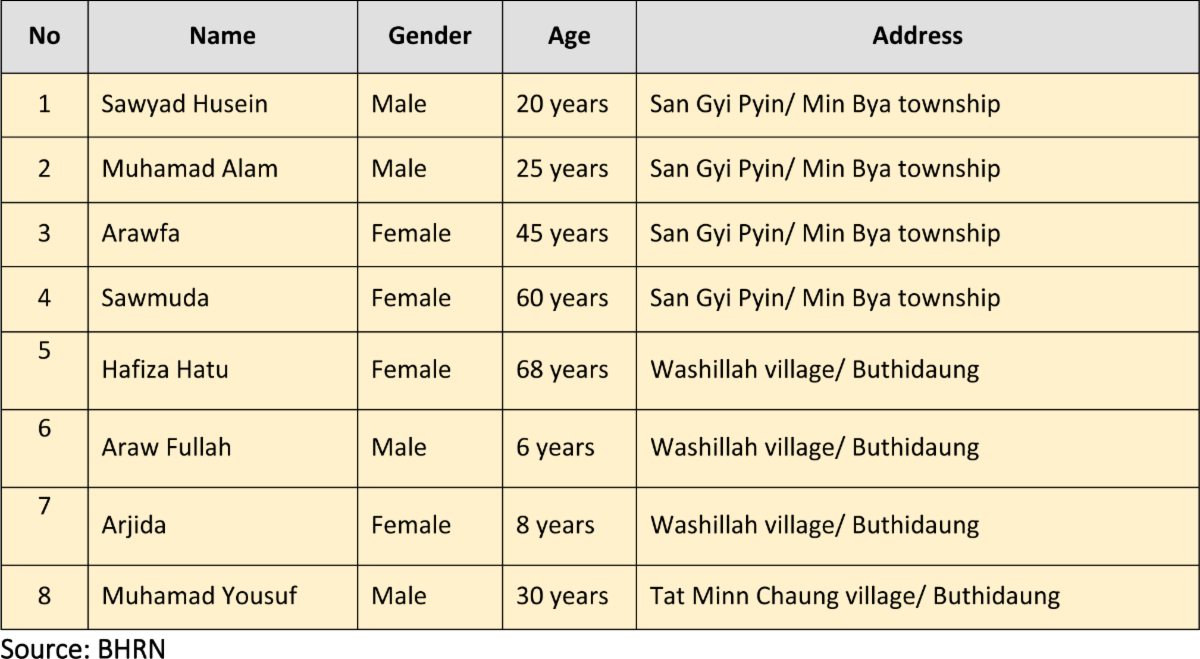
27 November - Military from Battalion 565 opened fire on a field in Buthidaung township where Rohingya workers and farmers were working. Three people, including two children, were killed. Seven people were injured, including three children. Source: BHRN


Rohingya Deaths Since the Resumption of Fighting

30 November - An estimated 8000 Rohingya have been displaced in November by the fighting between AA and the Burmese military.  Source: BHRN


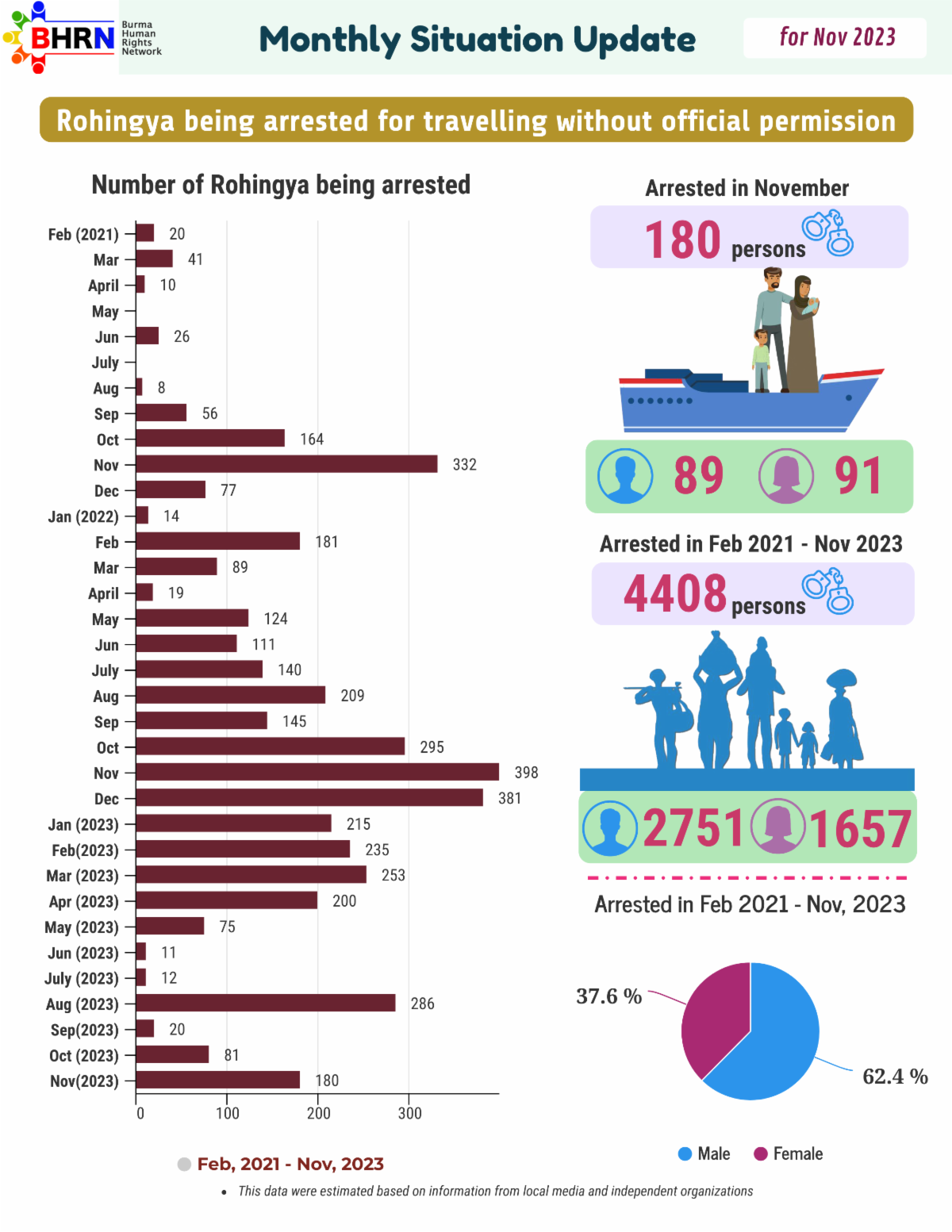
30 November- A statistic compiled by the Burma Human Rights Network (BHRN) found that at least 180 Rohingya Muslims including 3 minors were arrested by the regime authorities during November. They were arrested in the Rakhine State capital Sittwe as well as in Ann, Thandwe, Rathetaung, and Maungtaw townships in the state as well as in Ngaputaw Township in Ayeyarwaddy Region. Among them, six were charged with an immigration offence for illegal possession of the national registration cards and the same number among the arrested Rohingya Muslims were charged with illegal border crossing. Most of the remaining victims were arrested while they were trying to flee to Thailand and Malaysia- BHRN

3.2 Rohingya in Bangladesh Camp

20 November - Members of ARSA entered Camp 3 at midnight and assaulted bystanders who were ‘in the way.’ At a nearby football field, ARSA clashed with members of RSO, with one man, Syed Amin, killed. He was reportedly a member of the RSO. Another clash broke out shortly after on the border of camp-3 and camp-4 in the afternoon, where automatic rifle fire from the armed groups injured four children and one adult. Source: BHRN


25 November - Mohammad Ataullah, a Rohingya community leader, was killed in camp-19 by an unidentified group of men while walking home from a local shop. He was ‘hacked’ to death by assailants. Locals described Mohammad Ataullah as vocal in his opposition against ARSA.

Source: BHRN, Dhaka Tribune


28 November - Bangladesh police reportedly assaulted a group of Rohingya men on the roadside after Ashar prayer. The men were said to have been standing on the roadside listening to the radio when the police approached them. Source BHRN


Rohingya Trafficking


27 November - Several boats carrying Rohingya refugees from Bangladesh and Rakhine State arrived in Aceh, Indonesia. Authorities are scrambling to respond to the influx of refugees. The surge of refugees is now a yearly occurrence, with no significant changes in policy to thwart the exodus. The primary drivers are the lack of employment, the decrease in rations, dowry issues, and the increase of violence in the camps. Source: BHRN

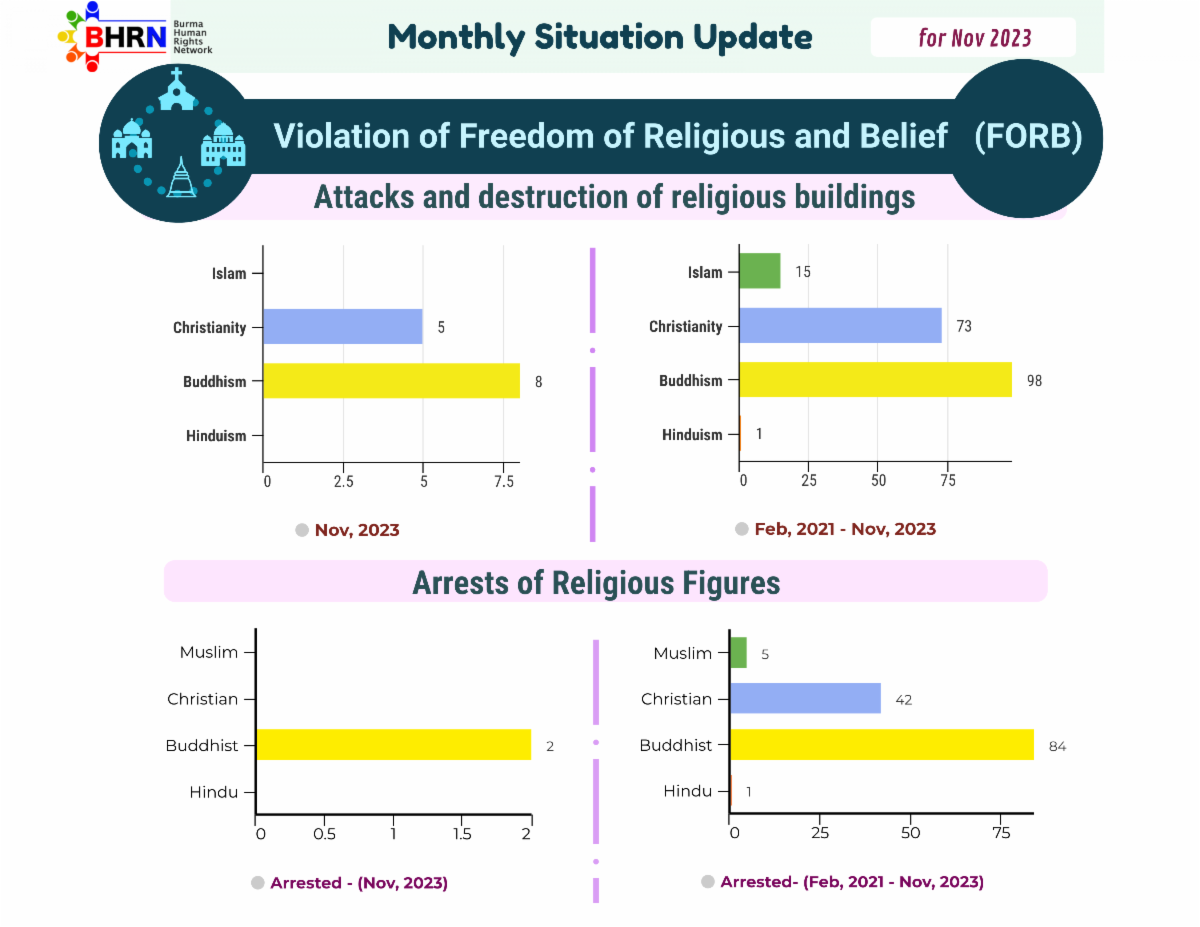
4. Violations of Freedom of Religion and Belief

6 November- Two civilians were killed in a shelling by junta troops on a church in Dau Phone Yan town in Kachin State on 5 November, a local source said. He said the unnamed duo were injured after one of the shells fired by soldiers from Light Infantry Division no 142 based in the town exploded in the town’s church. A local source told Radio Free Asia that the junta troops also shelled the town in the past, however, it was the first time there were casualties from the junta's attack had been reported. Ref: RFA


7 November- Several civilian homes and religious buildings were destroyed in a fierce fighting between the junta troops and an ethnic rebel group the Taung Plaung Liberation Army (TNLA) in Namkham Township in Shan State. A local source said a pagoda and a Buddhist congregation hall in the town were destroyed from street to street by fighting during the conflict. The source said the pagoda and the congregation hall were the places revered by the locals in the town. He said the incident was like an insult to the religious sentiment of the local communities. Namkham situated on the Myanmar Chin border, is a major trading post. The town, which was a center of activities by Christian missionaries including a famous American missionary, Dr Gordon Seagrave, has a sizable Christian population. Ref: DVB  


9 November- Three civilians including a monk were killed in an air raid by the junta troops in Htei Chaing Township in Sagaing Region on 8 November, a local source told Yangon Khit Thit media. The air raid comes as the junta is facing an attack by a local resistance group in the area. The local source told Yangon Khit Thit Media that civilian casualties were due to indiscriminate air raids on civilian targets in the town. Ref: Khit Thit Media


14 November- The junta troops abducted seven civilians including two monks in Maddya Township in Mandalay Region on 12 and 13 November, a local source told Radio Free Asia. He said a 69-year-old monk, U Wayama, from Htein Bin Kone monastery along with another monk U Khay Mar were among the civilians arrested, the source said. He said the two monks are the members of local monk supervision committee. Ref: RFA


17 November- 10 buildings including a church and schools were destroyed in an air raid by the junta troops on a village in Matupi Township in Chin State on 15 November, a local source said. The source told the Burma Human Rights Network (BHRN) that the BCM church and two government schools were destroyed in the raid on Wailu Township. The source said Wailu village is situated about 40 miles from Matupi and it has 90 households. He added that there was no incident of armed conflict in the village in the past. BHRN.  


19 November- Two novices were killed in a shelling by the junta troops on a monastery in the capital of Kayah State on 19 November, a member of a local aid group said. The source said the junta deliberately targeted Ottrayone Monastery in which two novices were killed on the site.  Ref: Khit Thit Media


21 November- A church in a village in Kalay Township in Sagaing Region was destroyed in a shelling by the junta troops, a local source told the Burma Human Rights Network (BHRN). The source said the junta troops targeted the Seventh Day Adventist Church in Latpan Chaung village during a fight with the local civilian defense forces in the region on 21 November. BHRN


26 November- The junta troops are accused of destroying religious and cultural sites of the Kokang ethnic groups during its occupation of the Kokant Region in Northern Shan State, near the border with China since 2009. A pro-Kokang ethnic army the Myanmar National Democratic Alliance Army (MNDAA) said in a statement issued on 26 November that the junta destroyed the religious and cultural sites of the Kokang people to build its military bases. The statement comes as MNDAA claims that it has reclaimed control of the capital of Kokang Region Laukkai, in a recent fighting with the junta troops. A claim disputed by the junta army. Ref: DVB


26 November- The junta arrested a senior monk along with his driver in a village in Singgu Township in Mandalay Region on 23 November, a spokesperson of a local resistance group The Singgu Revolutionary Forces said. He said the monk, who is known as Laythar Kyaung Sayardaw, was arrested in retaliation for an arrest of a pro-junta monk Pauk Sein (a.k.a) U Lakkhna on 1 November. Pauk Sein, a supporter of an ultra-nationalist group the Association for Protection of Race and Religion (Ma Ba Tha in Myanmar acronym) was arrested by the local resistance group at a complaint by the members of the local community.  Ref: DVB


27 November- A Buddhist monastery was destroyed in a shelling by the junta’s navy in a village in Ponnygyun Township in Rakhnie State on 27 November, a local source said. He said the monastery in Yoe Yar Pyin village was caused a fire after it was hit by a shell fired by a junta’s naval vessel, the source said, adding that the naval vessels of the junta are firing indiscriminately on the civilian targets in Ponnegyun Township in the wake of renewed fighting between the junta troops and a rebel group the Arakan Army (AA) in the region in recent days.  Ref: DVB


27 November- A group of displaced civilians and Christian clergy and nuns were forced to flee after the junta troops took over a church in Kayaah State capital Loikaw on 27 November, an online news site the Union of Catholic Asian News reported on 28 November. It said the Christ the King Church was providing shelter to 50 displaced civilians at the time the junta troops took over.  Ref: RFA


30 November- Two Buddhist monks were injured in an attack by the junta troops in a village in Kawkareik Township in Kayin State on 27 November, a rebel group the Kayin National Union (KNU) said. A news release from the KNU headquarters said the incident took place in An Fah Lay village and the two monks were injured as the shells fired by the soldiers from the junta’s Howitzer Batallion no 312 landed in the monastery where the two monks live. KNU said at least four shells believed to be fired from a 120-millimeter howitzer fell inside the monastery and the monks were hit by debris from the shells. It said the monastery building and a water tank were destroyed in the attack.  Ref: Khit Thit Media

5. Human Rights Violations

5.1 Extra Judicial Punishment

5.1.1 Arbitrary arrests and imprisonment

2 November- The junta arrested five civilians in Ngathoe Gyi Township in Mandalay Region for expressing their support for the ongoing attacks by the rebel groups against the junta, a local source told Mizzima News agency. He said the civilians were arrested on 2 November morning from their homes. He said their mobile phones were confiscated. They are not allowed to communicate with their families, the source said. The junta is facing a series of setbacks in conducted attacks carried out by three armed ethnic organisations with the code name 1027, marking the date the operation was launched on 27 October.  Ref: Mizzima


3 November- The junta said it has arrested 37 civilians including former minister U Ye Htut for posting anti-junta messages on social media, during October. U Ye Htut served as Information Minister under the government led by former president U Thein Sein who was in power from 2011 to 2016. The junta announcement said among those arrested were 15 from the Mandalay Region 7 each from Yangon Region and Mon State as well as 2 each from Ayeyarawaddy Region, Kachin and Shan states. Also one each from Bago and Tanintharyi regions, the announcement said. Ref: RFA 


4 November- A local youth was sentenced to one month in prison without committing any crime in Myeik Township in Tanintharyi Region on 4 November, a local source said. He said the unnamed youth was arrested by the junta's troops on his return home from work at late night. The source said he was sentenced the next day without a trial. The source told Burma Human Rights Network (BHRN) that such incidents of arbitrary arrests are on the rise in Myeik Township. BHRN


10 November- The junta said a former home minister Lieutenant General Soe Htut, a close confidante of the junta head Min Aung Hlaing, was sentenced to five years in prison after he was found guilty of corruption charges. An announcement in the junta’s mouthpiece the Myanma Allin newspaper on 10 November said a military tribunal has sentenced Soe Htut after he was found guilty of taking bribes from the passport applicants also for misappropriation of the staff welfare funds of the ministry while he was in the office during 2021 to earlier this year. Soe Htut earned notoriety for his heavy-handed approach to prosecuting the political opponents of the junta. He was instrumental in the hanging of two prominent political activists including Phyo Zeyar Thaw and Ko Jimmy in July 2021, the first death sentence carried out in Myanmar since the late 1980s. BHRN 


10 November- 12 civilians were arrested in Mandalay for writing on social media that the junta is arresting civilians to be used as military porters, a local source said. Among them, 4 are women adding that those who can afford to pay bribes to their cators were freed after they paid Kyat 6 million as bribe. The arrests come as the news went viral on social media on 8 November that the junta has reintroduced a night-time curfew in Mandalay and it is arresting youth and middle-aged people to use them against porters for the junta troops. Ref: DVB


12 November- At least 10 women were arrested in two townships in Mandalay earlier this month for their social media posts critical to the junta. A source close to the police said the women were arrested after they posted their pictures wearing Eugenia leaves, which symbolize victory. The photos were posted while the junta was facing heavy defeats at the hands of the ethnic armed organisations in different regions in the country, the source said. He said the junta is making arrests of civilians in public places. Ref: DVB


20 November- The junta troops arrested more than 100 civilians in Pauktaw Township in Rakhine State and they are being used as human shields in the fighting between the junta troops and a rebel group the Arakan Army (AA), a local source said. A local civil society group The Protection and Promotion of Human Rights in Rakhine State said the junta should allow the civilians who are trapped in the fighting to leave the areas to safer places. The group said it submitted its appeal to the junta on 20 November to allow the civilians to move out from the area where the fighting took place. BHRN


30 November- The Ahlone Township Court in Yangon has sentenced former Information Minister U Ye Htut to 10 years imprisonment on a sedition charge. He was also found guilty of obstruction of the junta in carrying out its administrative works. U Ye Htut was arrested on 28 October and since then he has been held in Yangon's notorious Insein Prison. He served as the Information Minister and a presidential spokesperson in a nominally civilian government led by President U Thein Sein from 2013 to 2016. U Ye Htut served as Lieutenant Colonel in the military and he is a graduate of the no 22 batch of the Defence Services Academy. BHRN

5.2 Extra Judicial Killings and Enforced Disappearances

2 November- Two voluntary teachers died due to interrogation by the junta troops in Mindat Township in Chin State, a local resistance group the Chin Defence Force said. It said another two civilians were also under the arrest of the junta. Ref: DVB


8 November- The junta killed at least 533 civilians in during more than two years since it took power in February 2021, an ethnic organisation the People’s Kayanni Protection Force (PKPF) said on 1 November. PKPF said it has compiled rights abuse committed by the junta troops since the coup and it found that among the deaths at the hands of the junta included 150 people who were tortured to death. It said an additional 147 displaced people were killed due to atrocities committed by the junta. BHRN


8 November- The junta troops killed five civilian youths in a village in Myingyan Township in Mandalay Region on 7 November, a local source told the Burma Human Rights Network (BHRN). He said the killing followed a fight between the junta troops and local resistance groups near Pyar Ywa in Myingyan Township. The source said among those killed included a three-year-old child and a 15-year-old boy. He said the junta troops ransacked the village and took position in the village. BHRN 


9 November- The junta slaughtered six civilians in Myaung Township in Sagaing Region on 8 November, a member of the local resistance group, Ko New Oo said. He said those civilians killed were among the 30 youths arrested by the junta troops in Myaung Township. The source said the victims were arrested while they were trying to flee their homes after the local resistance groups raided the police station and the administration office in Myaung Township which were under the control of the junta.    Ref: Myanmar Now


13 November- A monk was killed and another 12 civilians were abducted by the junta troops after fighting between the junta troops and local resistance groups in Yetarshay Township in Bago Region on 12 November, a local source said. He said the monk U Yewada was killed in a shelling by the junta troops and he added that the abducted civilians were to be used as human shields. Ref: Khit Thit Media


14 November- The junta troops killed a woman in a village in Moneywa Township in Sagaing Region, in early November a local source told Burma Human Rights Network (BHRN). He said the unnamed woman who ran a battle roll stall in Zalok village was killed after she was arrested for using her mobile phone while the junta troops approached her shop. The family was informed that she had died and asked to retrieve her body after paying kyat 1 million, the source said. BHRN 


16 November- The junta troops killed 13 civilians in the Mandalay Region on 16 November, a local source told the Burma Human Rights Network (BHRN). He said they were killed in an indiscriminate firing by the junta troops at a tea shop on Mandalay-Mogoke Highway, the source said. He said among the dead included the family of the owner of the tea shop. A group of junta soldiers who came to join other troops who were already in the area were responsible for the killings, the source said. He said among those killed were aged 18 and 50. BHRN


17 November- three civilians were shot dead by the junta troops in Bhamo Township in Kachin State on 16 November, a local source said. He said the three victims who were travelling on a motorbike when they were shot by the junta troops who were conducting a morning patrol near a school in Aung Thar Yar Ward in Bhamo. The source said they were shot as they refused to stop their motorbike for questioning, the source said, adding that at least six shots were fired at them. He said their bodies were not returned to their families.  Ref: RFA


20 November- The junta troops killed six civilians in two villages in Maddya Township in Mandalay Region on 17 November, a local source told Radio Free Asia. The source said the mutilated bodies of the six victims who were from Kin Ywa and Thayat Kine villages of Madayya Township were found the next day. The source said several wounds of knife attacks were found on their bodies. He said the junta had done several raids on Kin village in recent times, as it is believed the village has been providing shelter to the civilian resistance group the People Defence Forces (PDF). Ref: RFA


21 November- The junta troops and the members of its affiliate Pyu Saw Htee militant group killed three innocent civilians in Kyun Hla Township in Sagaing Region on 11 November, A local resistance group the Kyun Hla Activists the Burma Human Rights Network (BHRN). He said one woman was killed for wearing the Eugenia flower, which carries a symbol of victory in Myanmar culture. The killing comes as several towns under the junta’s control have fallen into the hands of ethnic armed organisations across the country. The source said the junta arrested 10 civilians including a six-year-old child. He said the incidents of killings and arrests have increased in recent weeks after the junta imposed a blockade in Kyun Hla Township. BHRN


21 November- a group of eight civilians were brutally killed in a village in Ngazun Township in Mandalay Region on 22 November, a local source said. He said the identities of the six people which include two women were unknown so as the motive for their killing. He said their bodies were buried with the help of a local charitable group on the same night as they were killed.  Ref: RFA


27 November- At least 76 civilians were killed in Kayah State in a series of attacks on civilian targets by the junta troops during recent fighting with civil defence forces in the state since 11 November, a local aid group Karenni Humanitarian Aid Initiative (KHAI), an NGO working to assist the refugees, said. The list of civilian casualties compiled by the group shows that most of the civilians were killed after being hit by shelling and airstrikes conducted by the junta troops. KHAI said 37 civilians lost their lives in shelling, 24 in air strikes as well and 15 were shot dead. It said among the dead include 12 children and 18 women as well as two novices. KHAI said the identities of 10 dead civilians were yet to be verified. The junta is facing renewed fighting by local resistance groups who launched a major offensive against the junta in the Kayah State on 11 November with the operation code name 11.11. BHRN


30 November- The junta killed six civilians in Kyaukse Township in Mandalay Region on 28 November, a local source said. They were killed shortly after they were arrested for involvement in an attack on the office of the pro-military union Solidarity and Development Party (USDP) in Kyaukse. They were arrested in connection with a grenade attack on the party’s office while there was a meeting going on inside the office, the source said. He said the attacks were carried out by two local civilian resistance groups Kyaukse District Defence Force (KDDF) and Kyaukse Revolution Army (KRA). The source said the six were arrested after the junta imposed a severe restriction on the movement of the people in the town after the attack on the USDP office. Ref: Mizzima

5.3 Violence attacks by pro-junta thugs

6 November- A militant group loyal to the junta has killed 3 civilians in Kanbalu Township in Sagaing Region, a local resistance group Kanbalu-Ktun Hla Resistance group said. It said the Pyu Saw Htee militant group also committed a similar attack in September this year in three villages in Kanbalu Township in which they shot dead three civilians and ransacked 7 homes in the village. BHRN 


12 November- A local youth was stabbed to death by a junta-appointed ward administrator and members of the pro-junta Pyu Saw Htee group in a suburban township in Yangon on 10 November, a local source said. He said Maung Saw Ko Ko Htet was killed by Khin Maung Zin, who is the administrator of no 94 Yu Zana ward in Dagon Seikkan Township, he said adding that the victim’s father who is an administrator of a street in the ward, has filed a lawsuit against Maung Saw Ko Ko Htet’s assailants. In an obituary for Maung Sw Ko Ko Htet, the family mentioned that he was killed by Pyu Saw Htee.  Ref: Khit Thit Media


21 November- The junta is reportedly forcibly conscripting civilians in several villages in Kyunsu Township in Tanintharyi Region, a report in local media said. The report in Yangon Khit Thit media quoting local sources said the junta is also conducting conscription in villages near the administrative capital Nay Pyi Taw. It said the local administrators are asked to provide six conscripts from each village.  Ref: Khit Thit Media

Background on the Burma Human Rights Network (BHRN)


Burma Human Rights Network (BHRN) is based in London, operates across Burma/Myanmar and works for human rights, minority rights and religious freedom in Burma. BHRN has played a crucial role in advocating for human rights and religious freedom with politicians and world leaders.


Media Enquiries


Please contact:

Kyaw Win, Executive Director

Burma Human Rights Network (BHRN)

E: kyawwin@bhrn.org.uk

T: +44(0) 740 345 2378


Learn More

[Burma Human Rights Network] | [Phone] | [E-mail] | [Website]

Facebook  X  Instagram