image002.png

October 12, 2023

Summary of Monthly Situation Update for September 2023

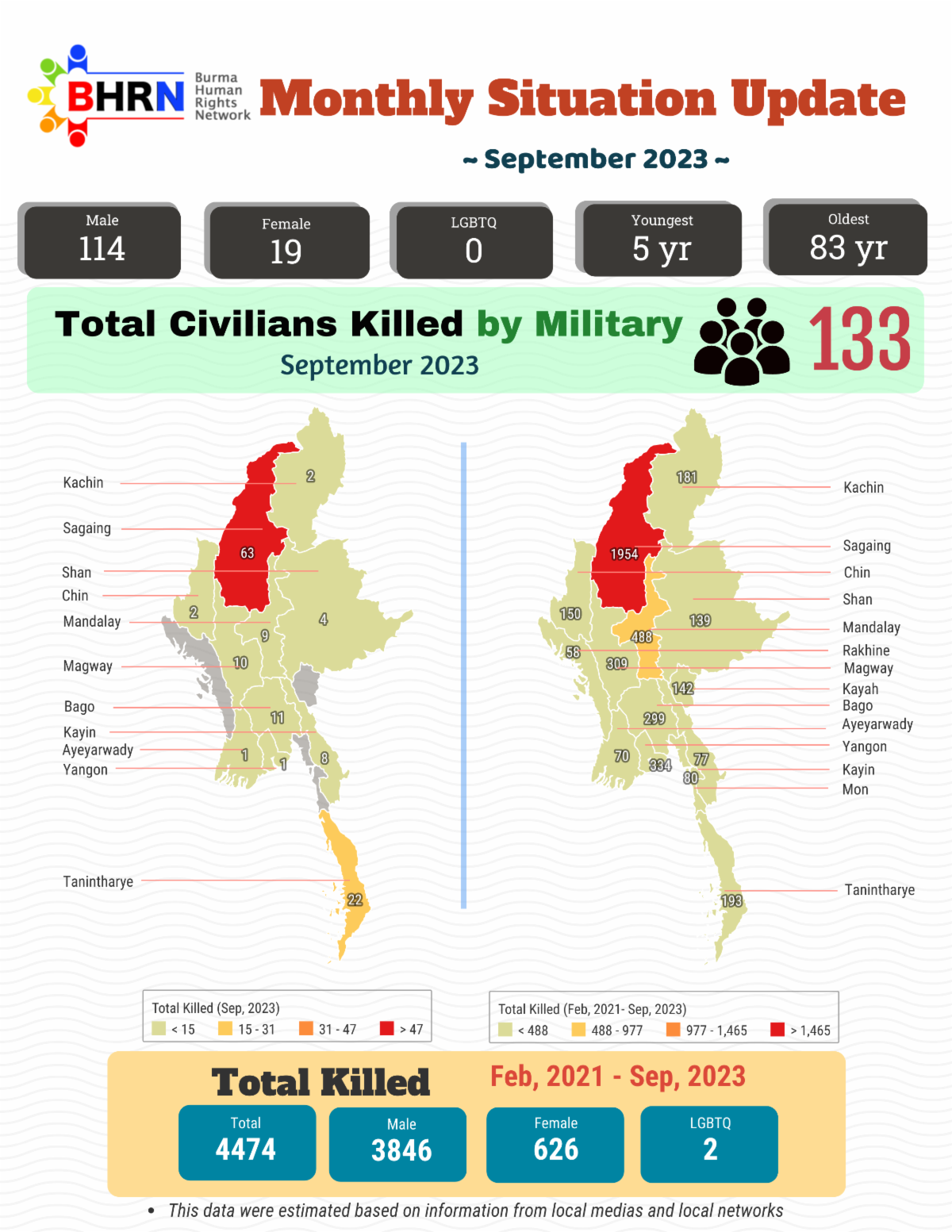
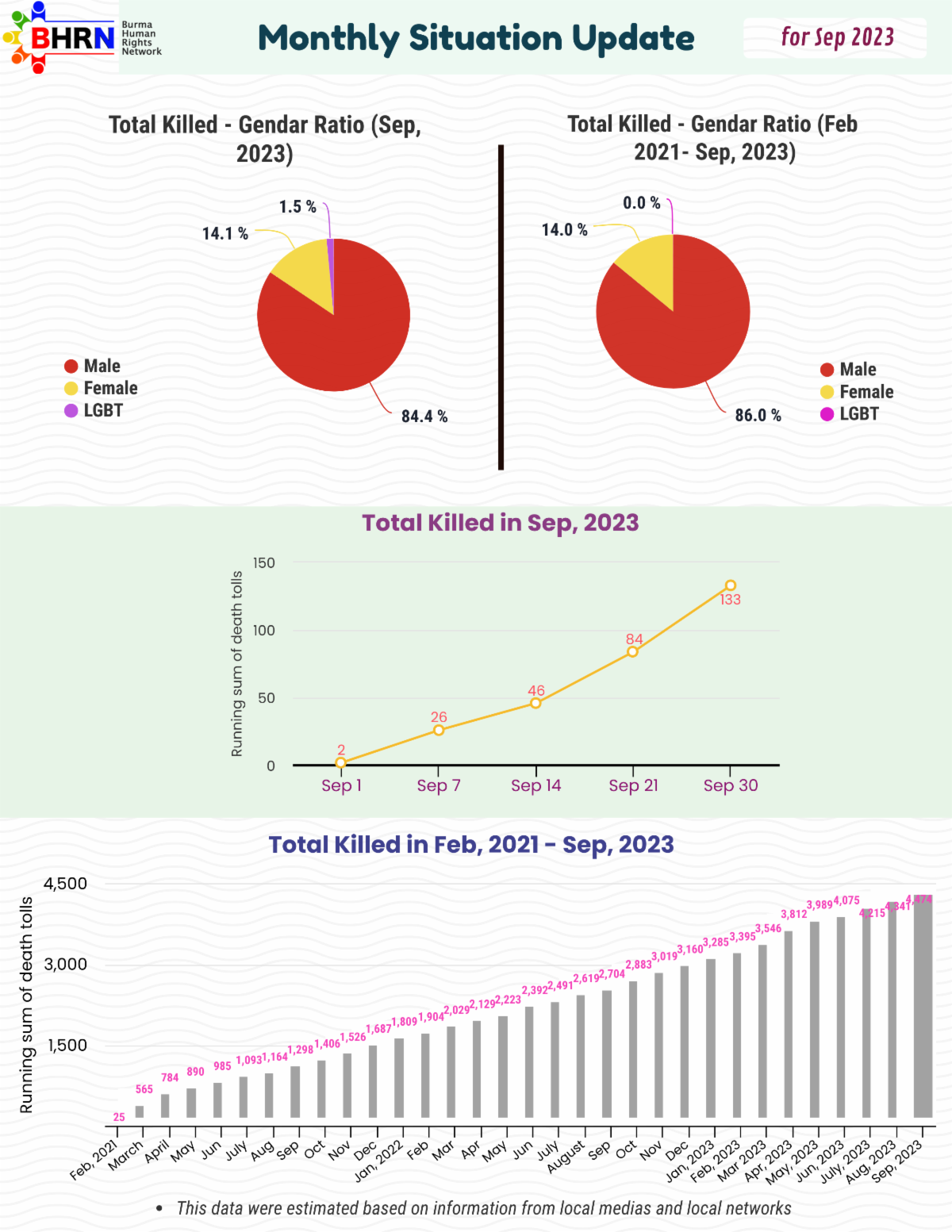
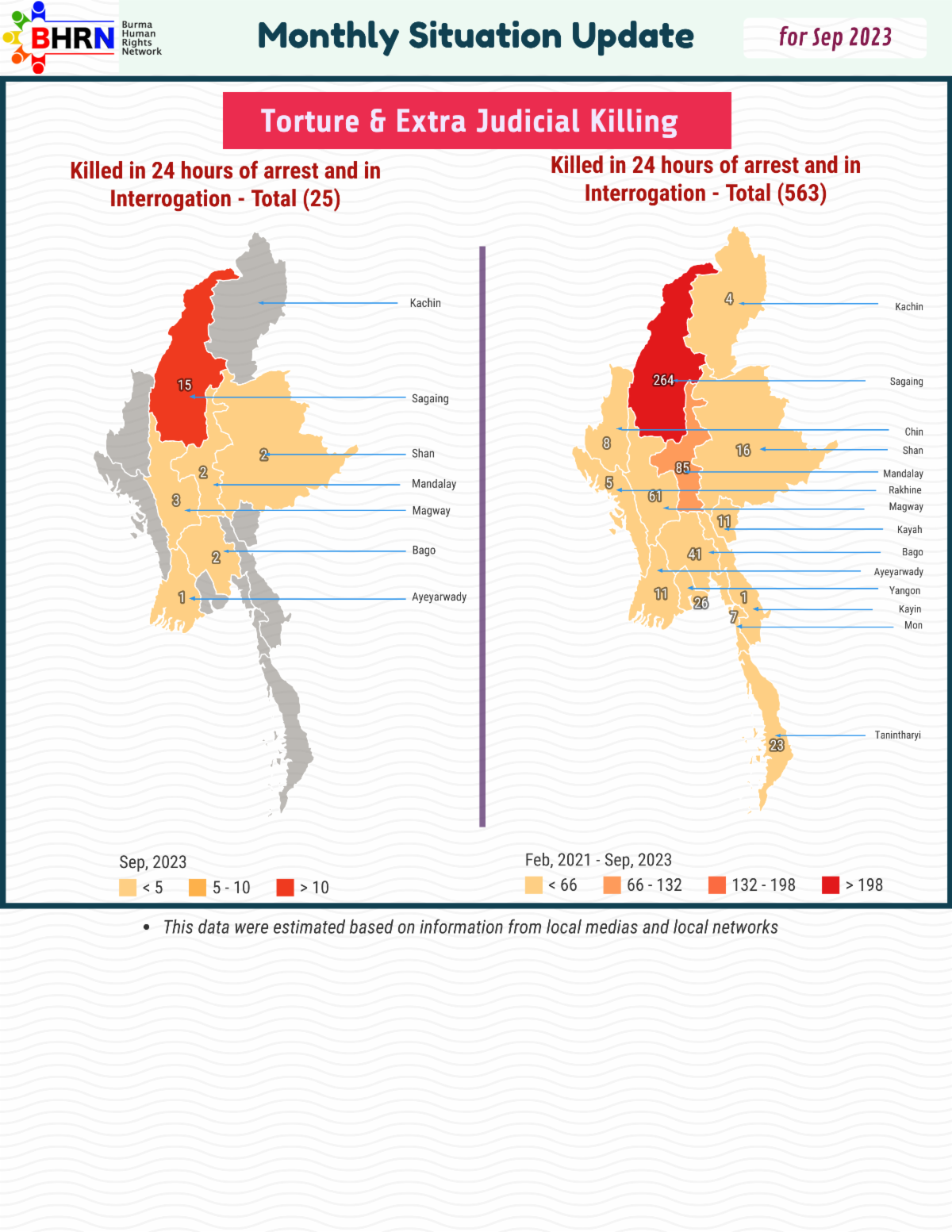
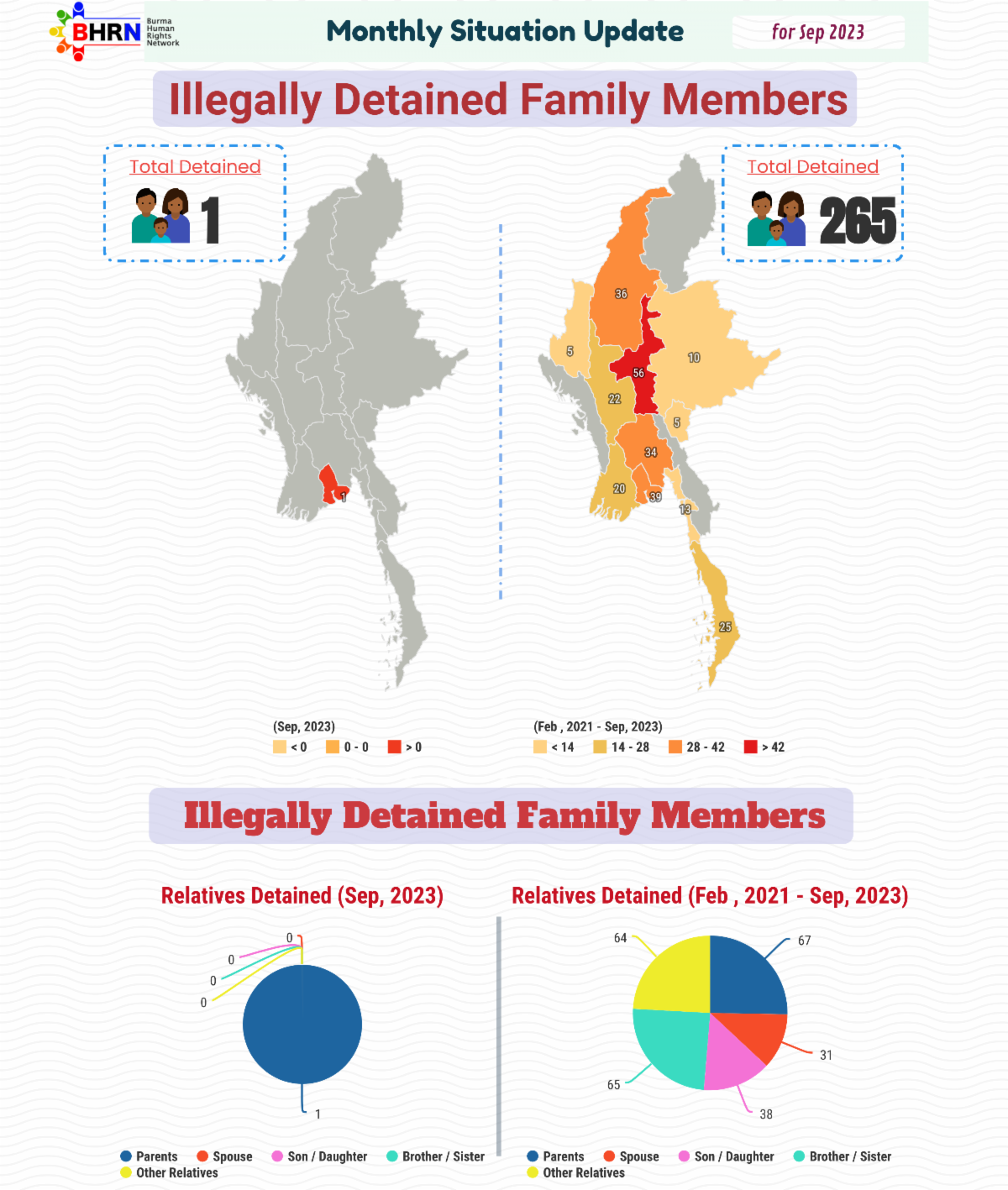
1. Info-graphs of BHRN's Report

2. Editor's Note

3. Rohingya Issue

3.1 Rohingya in Rakhine Updates

3.2 Rohingya Refugees in Bangladesh

4. Violations of Freedom of Religion and Belief

5. Human Rights Violations

5.1 Extra-Judicial Punishment and imprisonment

5.1.1 Arbitrary Arrests

5.2 Extra-Judicial-Killing and Enforced Disappearance

5.3 Violence attacks by pro-junta thugs

Every month BHRN provides a summary of situation update for the previous month’s important event in Burma. More detailed information for each paragraph contained in the update is available in more details upon request.


Methodology


Information in this document has been gathered by the BHRN team by primary and secondary research method. We employed local researchers and local informers across Burma including in Rakhine State, Thai-Burma border and the Bangladesh border monitoring, investigating and documenting incidents of human rights violations. Any information we receive is carefully checked for credibility and authenticity by experienced senior research officers in the organisation. Once the information is approved the editorial team prepares the final document.

HungerStrike.jpg

Short Video for Summary of Situation Update - September 2023

Short Video of Monthly Situation Update (BHRN) - August 2023

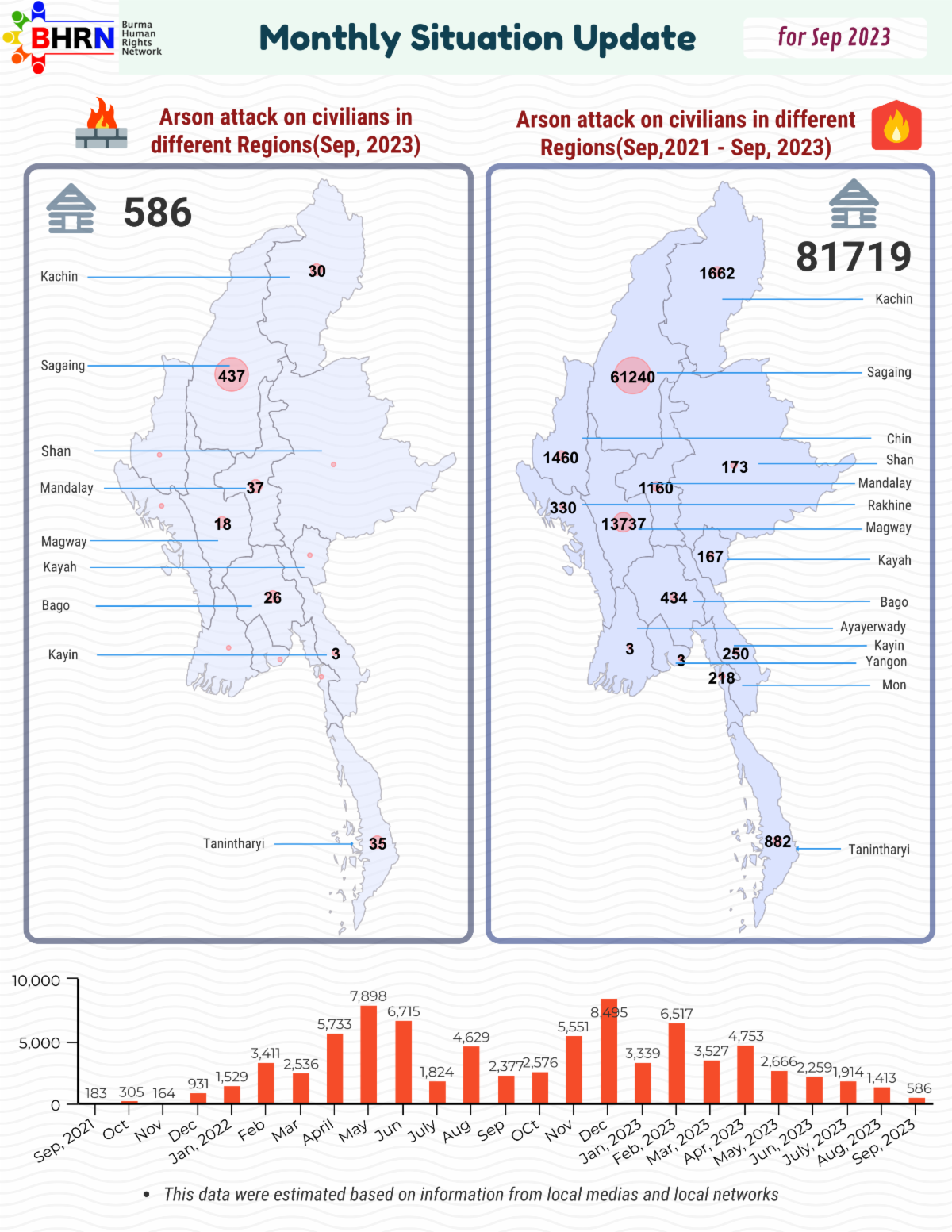
1.Info-graphs of BHRN’s Report

2.Editor's Note

  •         The junta in Myanmar faces a peril of internal divide, in the light of the recent sackings of senior military leaders. Among those who were sacked included a high-ranking military leader annotated to succeed Min Aung Hlaing. Such a situation could lead to an open war of competition for the leadership role. 
  •      Although, it would be very optimistic to think that the junta is crumbling, due to these internal dynamics, however, learning from past experiences, the latest leadership crisis could be forced the junta to make some political concessions, to divert attention from its internal rift.
  •         A political overture by the junta to the pro-democracy leader Daw Aung San Suu Kyi to help resolve the country’s political crisis could not be ruled out.   
  •       As the junta is marking the 8th anniversary of the signing of the Nationwide Ceasefire Agreement (NCA) the junta is reaching out to even to those who have not signed the accord to join the anniversary event to be held in Nay Pyi Taw on 15 October. 
  •      However, these possible moves by the junta are likely to be dismissed by the opposition groups as "too little too late", and Myanmar will likely remain in political logjam for the foreseeable future. 
  •      The election the junta promised to be held in early 2025, after a population census a year earlier, is unlikely to resolve the problem.
  •        Meanwhile, the most persecuted minority in the world the Rohingya Muslims are expected to remain in an appealing situation in the refugee camps in Bangladesh, with the latest attempt by China to help repatriate the refugees to Myanmar.  


Context 

It is beyond anyone’s doubt that almost all of Myanmar’s top generals are ruthless and corrupt tyrants. Those who are more ruthless and corrupt tend to be more powerful. This is a scenario that has existed in the Myanmar military since it was first introduced to political power in 1958, barely 17 years after its establishment. No top leaders in the Myanmar army ever lost their positions only for involvement in corruption, most of them lost due to their ambition for the leadership role.


When the news came about the sacking of two senior junta members Moe Myint Tun, a close confidante of Min Aung Hlaing who is relatively young and ambitious and Soe Htut, home affairs minister, who oversaw the hangings of four pro-democracy activists in July last year, it was received by most of the analysts that the junta is facing intense internal rivalry. 


It was widely reported that Moe Myint Tun, who chaired the Foreign Investment Commission and Foreign Currency Management committees was sacked for taking millions of dollars in bribes from foreign currency speculators. He was promoted to the rank of Lieutenant General rank only a little over three years ago at the age of 54 and at that time he was tipped to become the next chief of the Myanmar military. 


Both generals were removed from their respective positions on 25 September, and they are now known to be currently under house arrest while facing investigations. It is not ironic that the investigation is led by the deputy junta head Soe Win. Min Aung Hlaing reportedly used the two sacked officers to limit the powers of his deputy. The two positions are now filled with two Soe Win loyalists. A senior military officer Maung Maung Aye replaced Moe Myint Tun, and the new Home Affairs Minister is Yar Pyae, who is also a staunch Soe Win supporter.  


It is yet to be seen how these corruption investigations would further divide the junta leadership. However, it would be very naïve to think that such a split would bring down the junta. Such episodes are not new for the Myanmar military and every time such incidents took place it survived such shocks. A similar rift erupted in the junta nearly two decades ago when former military intelligence chief Khin Nyunt was sacked for corruption. The junta went on to rule for another 7 years until 2011 when it transferred power to a nominally civilian government led by former president Thein Sein. 


The junta may survive, but the question is can Min Aung Hlaing can keep his position. The junta head seems to be on the losing side of the latest power struggle. The latest incident also tends to indicate that 62-year-old Soe Win is becoming increasingly impatient to take up the leadership role. Min Aung Hlaing, who is five years older than his deputy may not have a lot of justification to continue in the position, as he is overseeing one of the biggest crises the Myanmar military ever faced during its more than 80 years of existence.  


The power struggle at the top also has ramifications at the regional level, where the two top military leaders tried their loyalists to take up key positions in the regional commands. In a recent reshuffle, Brigadier General Kyaw Swa Oo was appointed as the commander of Coastal Command based in the Tanintharyi Region, a prime position that is attractive for most of the corrupt military officers. Many who served in the region in the past are known to have earned billions of dollars from illegal foreign fishing vessels as well as from local smugglers. Even though it is not known exactly to whom Brigadier General Kyaw Swa Oo put his allegiances to, however, he will likely be linked to Soe Win, who is taking the upper hand in the current power struggle. 


The former commander of the Coastal Command Major General Saw Than Hlaing, a Min Aung Hlaing supporter is moved to Rakhine State where there is an active insurgency.


According to some confirmed sources Myanmar’s Navy Chief Moe Aung is also under investigation for his role in a corruption case. He is the son of a former senior junta leader Aung Thaung, whose family own a private bank, the Myanmar Amara Bank.


These incidents are seen as an attempt by Soe Win to consolidate his position and according to some reports, he is seeking backing from former junta heads including former military strongman Than Shwe, who still wielded a strong influence on the Myanmar military.  


In such an uncertain situation only way out for Min Aung Hlaing would be to gain a legal constitutional position, through an election. 


He reportedly sent a team of senior politicians to Japan recently to lobby for support from Tokyo to hold an early election in Myanmar, a report in Irrawaddy news agency said. 


It said a former National League for Democracy (NLD) member Daw Sandar Min, chairman of the Arakan Front Party Dr Aye Maung, and pro-junta Neo Politics News (NP News) founder Kyaw Myo Min went to Japan for about a week starting around 17 September. 


Daw San Dar Min was recently expelled from the NLD for her allegedly pro-junta position. 


The trio met with two Japanese opposition members of parliament in Tokyo on 19 September and discussed holding elections in Myanmar. They said it could be a way to end the country’s crisis.


The junta is also actively lobbying the ethnic armed organisations to allow the elections in the areas under their control. 


In recent weeks the junta reached out to several groups including the Kayin National Union (KNU) and the Shan State Army (South). A former head of the KNU, one of the largest rebel groups in the country, met the junta head Min Aung Hlaing in Nay Pyi Taw on 30 September to pledge his continued support to the Nationwide Ceasefire Agreement signed in 2015 between the Myanmar government at that time and eight rebel groups in the country. 


A team of Shan State Army rebel groups met the junta’s home minister during its recent trip to Nay Pyi Taw. However, the junta’s plan to woo the support of KNU backfired after the rebel group disassociated itself from the meeting between the junta head and its former leader Saw Mutu Sae Po.


These steps tend to indicate that the junta is trying to expedite the election process, in contrast to a recent announcement by Min Aung Hlaing that the elections are unlikely until 2025.


However, the junta is facing attacks in different parts of the country, and it only controls a third of the country, which could be the key obstacle to conducting the elections. Most of the country's territory is under the control of the people's defence forces, which are backed by the parallel government of Myanmar the National Union Government (NUG). 


The junta’s current plan is to hold the elections after the next rounds of population census to be conducted in late 2024 and it is expected that the polls will not be held before early 2025. 


In the meantime, the junta-appointed election commission is seeking support from authoritarian regimes in a bid to legitimize the elections when they are held in Myanmar. The head of the junta-appointed election commission visited Cambodia, and China in recent weeks and Russia this month, where he signed a memorandum of understanding to seek support from Russia on Myanmar elections. 


Otherwise, any election conducted by the junta is most likely to be declared as a sham by domestic opposition and the Western powers. 


Another bulk of problem waiting for the junta is the crisis in the western Rakhine State, where it is facing losing control of territory due to the increasing influence of a ethnic arms group, the Arakan Army (AA). Also, it faces a daunting task to repatriate nearly 1 million Rohingya refugees who fled to Bangladesh in 2016 and 2017. The junta which is facing an international tribunal on allegations of committing genocide of Rohingya Muslims is trying to repatriate the refugees with the help of China. 


A recent report by the International Crisis Group (ICG) highlighted the failure of the regime as well as the regional and international actors to help resolve the Rohingya refugee crisis.  


A report recently published by ICG Rohingya Refugees in Bangladesh: Limiting the Damage of a Protracted Crisis, said Bangladesh and Myanmar’s military regime have, since the beginning of 2023 sought to start repatriating Rohingya refugees to Rakhine State, and with Chinese support.


“Each country has its reasons for wanting Rohingya to return. Naypyitaw hopes it can strengthen its defence at the International Court of Justice, where it has been accused of violating the Genocide Convention, and relieve international pressure in the wake of the 2021 coup. 


Dhaka has its eye on the general election planned for January 2024, before which it hopes to have a foreign policy victory that dilutes the public’s impatience with hosting such a large refugee population. 


As for Beijing, it is seeking opportunities to portray itself as a constructive international player, amid heightened tensions with Washington, and also hoping to gain further support from Dhaka and Naypyitaw in Asia,” the ICG report said.


The Brussels-based think-tank called on the European Union to increase its role in supporting the Rohingya Muslims. 


ICG report called on the EU to 

  • Increase funding for the UN’s humanitarian appeal in Bangladesh to help meet the needs of Rohingya refugees, lest camp conditions deteriorate further. 
  • And to use the EU’s influential position in Bangladesh to encourage Dhaka to adopt a long-term strategy recognising that the vast majority of the refugees are likely to remain in the country for years to come.
  • To support the Rohingya community who remained inside Myanmar.
  • And to continue to support international efforts to hold Myanmar’s military accountable for its abuses against the Rohingya and other groups in Myanmar, both before and since the coup.

Observation and Analysis 


·        The latest situation inside the junta tends to indicate that the military leaders of the past including the former junta head Than Shwe and many of the current military leaders have lost their faith in Min Aung Hlaing in the face of his continuing inability of the junta head to quell armed rebellion led by youth. For them, it is enough to indicate Min Aung Hlaing's weak leadership.


·        It could lead to a change in the junta's leadership while the policies remained the same. 


·        The next transition of power is unlikely to be peaceful and systematic with Min Aung Hlaing’s deputy Soe Win likely to remove him by using his supporters in the military. 


·        Looking back at history Burma only had two [1]peaceful transitions of power since the country’s independence from British colonial rule 75 years ago, one was in 1953 after a democratic election and in 2016 when the pro-democracy party NLD came to power after a landslide election victory. 


·        Apart from U Thein Sein who oversees the last peaceful handover of power, the rest of the former leaders faced imprisonment after they left their positions. It is not a good sign for Min Aung Hlaing, who seems to be facing more criticism within the power establishment of Myanmar.  


·        As this dynamic unfolds in Myanmar, China which normally consulted on the political situation is unable to regain its influence, despite increased engagements between the two sides in recent weeks. 


·        The regime is moving fast to closer ties with Russia. China's lukewarm approach to the military coup soon after it took place in February 2021 has made the junta believe that Beijing is a less reliable partner. The junta tried to look for partners that could provide it with a stable flow of ammunition to continue its war machine inside the country.  


·        The role of Western powers in responding to the crisis in Myanmar including the Rohingya issue is very limited, it can best, at this stage, put pressure on the junta to allow unimpeded international assistance to everyone, including Rohingya Muslims, who are affected due to the ongoing civil war in Myanmar. 


·        The NUG and democratic opposition are so far unable to show their relevance in resolving the political crisis in Myanmar, all the eyes are still on the position of the pro-democracy leader Daw Aung San Suu Kyi. The local and international actors are still trying to understand her stand on the ongoing armed struggle, which has become part of Burma’s civil conflict while she has been locked away for more than 2 years. However, her influence among the youth has been significantly declined after she aligned with the military while in power. As for the ethnic groups, both the military and NLD party are seen as Bama ethno-religious mindset which cannot be reliable when it comes to the ethnic and religious minority issues.


[1] The 2011 handover of power from Than Shwe to Thein Sein was not counted as a transition of power as it was widely believed to be a leadership change carefully planned by Than Shwe. 


3.Rohingya Issue

3.1 Rohingya in Rakhine Updates

1 September - Around 80 members of the Lutheran World Foundation in Rakhine were suspended from work for organizing a silent strike where they sought higher pay. :BHRN


2 September- The junta organised a tour of Yangon-based diplomats to the camps for the displaced Rohingya Muslims in Sittwe in Rakhine State on 1 September. The group, which included the heads of the diplomatic missions, visited the Thatkaepyin IDP camp. An IDP who met the diplomat later told the Burma Human Rights Network (BHRN) that the IDPs were not allowed to discuss their situation with the diplomats. He said only those IDPs whom the junta selected to speak in its favour were allowed to speak. The IDP said several difficulties are being faced by IDPs. BHRN


5 September- A junta official said Myanmar will accept about 7000 Rohingya refugees from Bangladesh this year. Speaking to Myanmar state-owned newspapers, the Permanent Secretary of the Ministry of Social Welfare and Relief Dr Ko Ko Naing said Myanmar plans to repatriate the refugees under an agreement signed between Myanmar and Bangladeshi authorities in the Southern Chinese town of Kungming earlier this year. He said the refugees will be first accepted in the reception camps to be established along the Bangladesh-Myanmar border and they will be then transported to a main transit camp, Hla Poe Kaung in Maungtaw Township. He added that the refugees will be sent to their places of origin after spending a few weeks in the Hla Phoe Khaung camp. BHRN.  


7 September- The junta troops are harassing local communities in Buthotaung Township in Rakhine State. A local source said a group of soldiers from no 552 Light Infantry Division 552 has confiscated cattle in Buthitaung Township. He said they were forced to pay bribes to the junta troops. He said some civilians were arrested and they faced torture at the hands of soldiers. Ref: The Arakan Express


11 September - Seven Rohingya were arrested by police in for immigration charges when the vehicles they were in were stopped at a checkpoint. Checkpoints have increased in recent months and are conducted by both the junta and the Arakan Army. Source: BHRN


19 September - An estimated 600 Arakan Army soldiers entered Rohingya villages in southern Buthidaung, investigating ARSA activities in the area. Thirteen Rohingya were arrested and accused of being linked to ARSA. Some of those arrested were beaten and abused by AA.The detained were taken to an undisclosed location. After the raids, AA officials warned Rohingya not to support or collaborate with ARSA.  Source: BHRN


20 September- More than 80 internally displaced Rohingya Muslims have become the victims of human trafficking during the past year since August 2022. A statistic compiled by the officials in IDP camps said the victims were from 7 camps across the Rakhine State and they included women and children. U Kyaw Zaw, who is from the Kyein Ni Pyin IDP camp in Pauktaw Township, said most of the victims were from the Kyein Ni Pyin camp where at least 30 IDPs fell the victim of trafficking. And 6 IDPs from Thatkaepyin camp, 4 from Ohn Taw Gyi (north), 15 from Ohn Taw Gyi (South) and 11 from Bawdupha camp all situated in the Rakhine State capital Sittwe had also become the victims of human trafficking. He said the rest of the victims were from 10 in Nghat Chaung IDP camp in Pauktaw Township and 5 from an IDP camp in Myaypone Township. Tens of thousands of Rohingya Muslims have been displaced during a series of attacks on Rohingya Muslims by Buddhist mobs with the backing of the Myanmar army since 2012. Ref: Narinjara


22 September - ARSA claimed that they had killed 70 members of the Arakan Army after fighting in northern Buthidaung. Locals say the claims by ARSA are probably inflated, but they had inflicted significant casualties to AA. Source: BHRN


25 September- 6 Rohingya Muslims were abducted by a rebel group the Arakan Army (AA) during a series of raids by AA soldiers on the villages in Buthitaung Township in Rakhine State on 21 and 22 September, a local source said. He told on 25 September that a large number of AA soldiers were involved in the raids. He said the whereabouts of the abducted Rohingya Muslims are still unknown. He said the reason for their arrests was also unknown and their families were not contacted so far by AA, which is causing concerns for their communities. Ref: The Arakan Express


30 September - A two-year-old Rohingya boy reportedly died in hospital in Sittwe when he was unable to receive oxygen. Source: BHRN


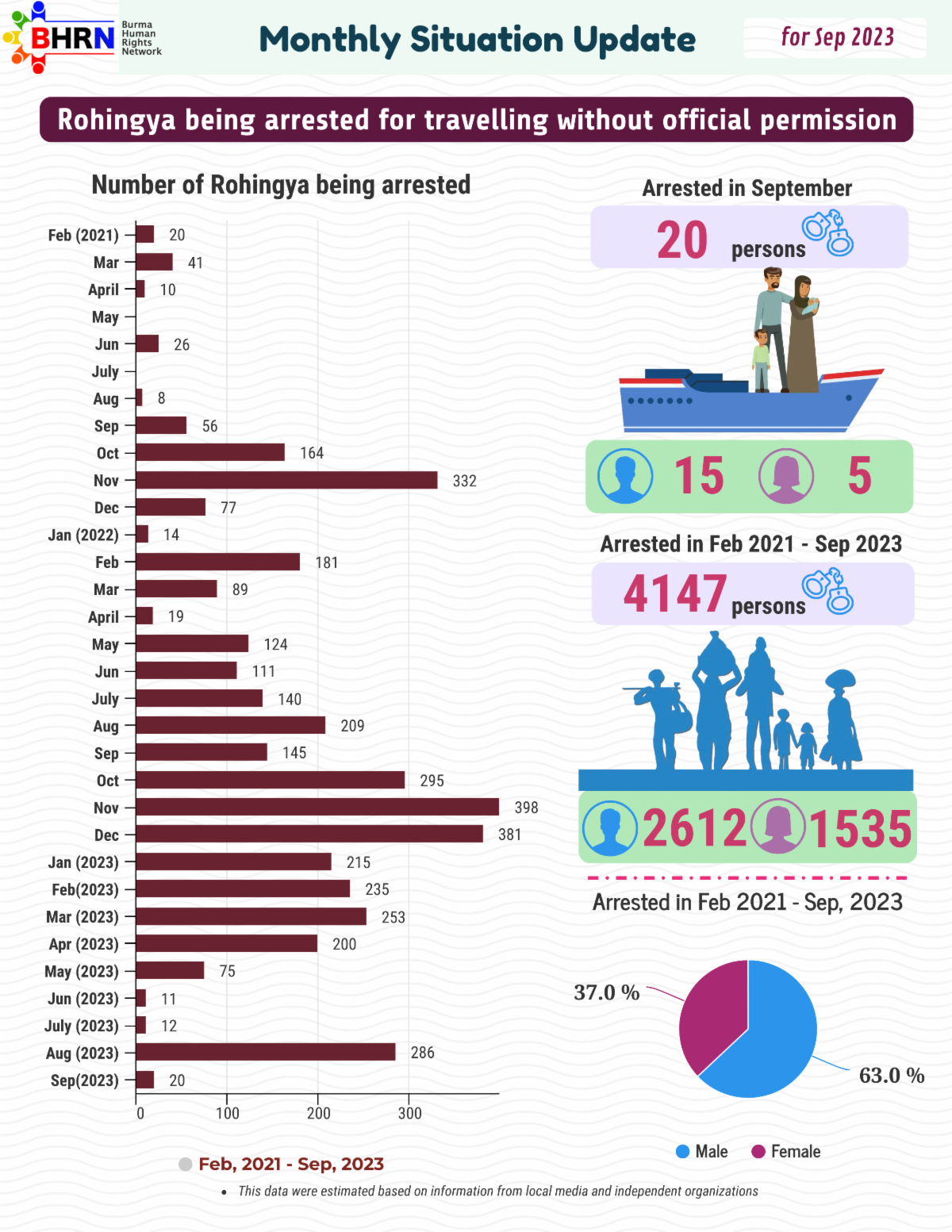
30 September- Statistics compiled by the Burma Human Rights Network (BHRN) said that the military junta has arrested at least 20 Rohingya Muslims in Rakhine State during September. They included five women, and the rest were adult males. BHRN said they were arrested from Ann, Sittwe, Thandwe and Maungtaw townships in separate incidents. BHRN

3.2 Rohingya in Bangladesh Camp

1 September - Cases of Dengue Fever increased throughout the camps in July and September. The World Health Organization noted the increase in cases in the camps on September 19. Dengue Fever is a virus usually transmitted to humans by mosquitoes in tropical areas. It can cause serious illness and severe cases can result in death. Source: Relief Web


2 September - Rohingya refugees found the body of a 24-year-old Rohingya man in a drain near Camp 8. The body was recovered by authorities. The victim was identified as Mohammed Mujib from camp 8. It was unclear who killed the man or why. Source: BHRN


11 September - A delegation from the UN led by Assistant Secretary-General Kanni Wignaraja visited the Rohingya camps to speak with refugees and survey their situation. Source: BHRN


19 September - A Rohingya man was hacked to death in Camp 18. The murdered man, Mohammed Ayub, was a community leader, and locals suspected he was killed for being a critic of the Arakan Rohingya Salvation Army (ARSA). The perpetrators have not been identified. Source: BHRN


20 September - Between 16 and 20 September 251 Rohingya refugees were arrested by authorities as they attempted to flee the camps. The Rohingya that were arrested were caught at checkpoints and returned to the camps. Source: BHRN


21 September - The United States announced they will provide 116 million dollars to support Rohingya in Bangladesh and Burma. The new aid was announced by US Secretary of State Tony Blinken. Source: US State Department


20 September- The Bangladeshi authorities have arrested more than 100 Rohingya refugees from refugee camps in Cox’s Bazar District in separate incidents, the Bangladeshi media reports said. It said the refugees were arrested during a special operation conducted by the Bangladeshi paramilitary force (APBn) and the police from the Ukhiya sub-district. The media reports said most of the arrests were made on 19 September in an area close to a Degree College in Ukhiya, the reports said quoting a police official in the Ukhia police force. The police said among the arrested Rohingya Muslims 40 were sent back to their camps and an investigation has been launched against 61 arrested refugees. Ref: The Arakan Express

4. Violations of Freedom of Religion and Belief

  • Targeting religious buildings 


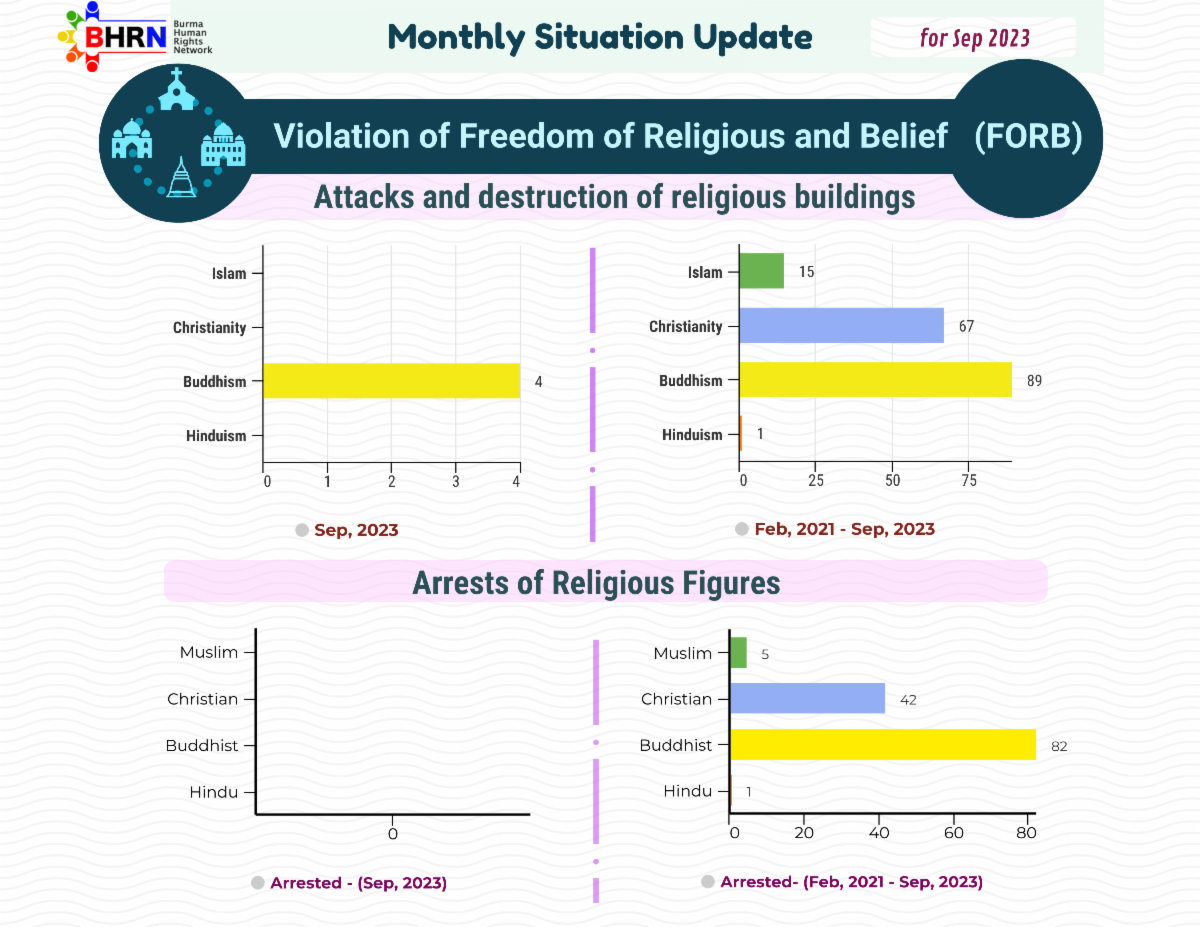
7 September- At least 200 religious buildings were destroyed in airstrikes by the junta troops across Myanmar since the military coup in 2021. Radio Free Asia (RFA) said it collected the numbers of religious buildings destroyed in the attacks from the personal accounts of the religious leaders as well as the reports released by the human rights organisations. RFA said that most of the religious buildings destroyed were in Chin State where a total of 85 buildings were hit by the airstrike by the junta troops followed by 50 in Saigaing, 39 each in Shan and Kayah states as well as 19 in Magwe and five each in Kayin, Mon and eastern Bago region. The religious buildings include Buddhist monasteries as well as churches and mosques. Ref: RFA


5 September- The junta launched airstrikes and shellings on civilian targets in Kyaukkyi Township in the Bago Region on 5 September, a rebel group, the Kayin National Union (KNU) said. A statement issued by the KNU said a monastery in Phayar Lay Kone village, was destroyed in the attacks by the junta troops. He said some schools in the nearby Law Mu Thaw village were closed due to the attacks. And several civilians were displaced due to the attack, the KNU statement said.  


18 September- A monk and his aide were killed after their monastery in Indaw Township in Sagaing Region was hit during an air raid by the junta troops on the township on 15 September, a local resistance group the Indaw Revolution said. It said 77-year-old Ashin Rizita along with his unknown aide were killed in the attack- BHRN 


19 September- Two monks were injured by indiscriminate shellings by the junta troops in Myeik Township in Tanintharyi Region on 19 September, a local source told the Burma Human Rights Network (BHRN). He said the incident took place in Nyaungpin Kwin village in Myeik and the junta shelled the village without any ongoing conflict in the area. Similar incidents were reported in several other parts of Myanmar where scores of people fell victim to indiscriminate fire by the junta troops. BHRN.


29 September- 18 children were injured due to indiscriminate shelling by junta troops on a monastery in a village at Wuntho Township in Sagaing Region on 27 September, a local source told the Burma Human Rights Network (BHRN). He said the junta’s no 102 Light Infantry Division was responsible for the attack on Gyo Htaung village. He said among the injured children the conditions of six children were very severe. BHRN.


5. Human Rights Violations

5.1 Extra Judicial Punishment

5.1.1 Arbitrary arrests and imprisonment

3 August- A woman rights group said the junta killed 21 women and arrested another 19 during 1 to 27 July this year. The Burmese Women’s Union said in a statement issued on 3 August that among those killed included 3 women who died in aristrikes, 11 after hit by heavy weapon fires, 1 was burned alive and 6 were shot dead. BHRN  


13 August- The junta arrested 6 civilains including two Maluvis in a village in Taninthayi Township in Tanintharyi Region on 13 August. They were arrested in a raid on Mawtone village in the area by the junta troops, a local source said. He said at least 200 junta troops were involved in the raid. The source said 4 were later released, however, the troops taken away two maluvis, Yahyah and Mushareef. BHRN


15 August- A Rakhine political activist Daw Nyo Aye was arrested in Rakhine State capital Sittwe on 15 August, a local source said. He said Daw Nyo Aye,, serve as the Chiarperson of Rakhnie Women’s Congress, was arrested for organizing an event to commemorate “Rice Crisis Day” on 13 August. The day mark killing by the Myanmar military of several civilian protestors on the day in 1967 calling for the end of rice crisis in the state. The source said Daw Nyo Aye faces criminal deformation charge. He said she was presented in a local court, which granted her remand to her captors.   BHRN


19 August- The junta said it has arrested 14 people including a Swiss national and four children in Mandalay in connection with a documentary on Buddhism. The documentary Don’t Expect Anything was posted on YouTube and TikTok channels on 24 July, which the junta said was blasphemous to the Buddhist religion. The arrested people are being held at Aung Myay Tharzan Police Station in Mandalay for interrogation. Ref: DVB


21 August- The junta has abducted 10 civilians from Ye U Township in the Sagaing Region to use them as human shields in fighting against the local militia groups the People Defence Forces (PDF). A spokesperson of PDF Htoo Khant Zaw (Ah Mae Thar) told the Yangon Khint Thit Media that 10 farmers were abducted while they were working on their farms. Ref: Khit Thit Media


22 August- A political activist U Myo Naing was arrested from his home in Yangon’s Tharkayta Township on 22 August. He was arrested after a picture of him taken in a liberated area holding a rifle was posted on his social media site. His family was not informed of his whereabouts and they are concerned about his safety, a source close to U Myo Naing’s family said. Ref: DVB


24 August- A military tribunal in Indaw Township in Sagaing Region has sentenced 4 civilians to death on suspicion of their involvement in attacks against the junta, a source in a local militia group Indaw Revolution- IR reported. The source said the four were charged under the Counter-Terrorism Law and the court passed the verdict on 18 August. According to IR, other 10 people are serving life imprisonment in Indaw prison. BHRN


25 August- A court in Launglone Township in Tanintharyi Region has sentenced the father of a pro-democracy activist to two years imprisonment on a criminal defamation charge. U Aung Phae, 65, the father of Ko Min Lwin Oo, who is a member of the Committee on Democratic Strike Committee was arrested in June from his home and he was allowed to meet his family only once since the arrest. BHRN


25 August- The military court of the Yangon Region Command has sentenced an officer to death on a treason charge. The 32-year-old captain, whose name is withheld for security reasons, was arrested in May after he posted posts critical of the military junta on social media. The officer is currently attending a master's course at the Military Medical Academy. He is from Mandalay, other details about the case are still sketchy.  Ref: Khit Thit Media


31 August- The Supreme Court has dismissed an appeal by incarcerated the pro-Democracy leader Daw Aung San Suu Kyi against the prison sentence imposed on her. Although the appeal has been rejected, the junta already commuted a total of six years sentence on the five cases submitted by Daw Aung San Suu Kyi to the Supreme Court on 18 July. The junta announced on August 1 that it has granted amnesty for the sentences Daw Aung San Suu Kyi is facing in these cases. The move was taken ahead of the verdict of the Supreme Court which comes only on 29 August. The 78-year-old pro-democracy leader is facing a total of 27 years imprisonment even after the junta reduced six years from the 33 years sentence from 19 cases in which she was found guilty by the junta-appointed court. Ref: RFA


5.2 Extra Judicial Killings and Enforced Disappearances

9 August- The junta troops killed 4 civilians during a raid on a village in Phyu Township in Bago Region on 8 August, a local source said. He told Yangon Khit Thit Media that the junta killed the civilians after accusing of the members of the people’s Defence Force (PDF). He said the troops has put the entire village of Auk Kyarin on fire after the raid and the killings. The incident took place amid fighting in the area between PDF and the junta forces.  Ref: Khit Thit Media


11 August- The junta troops killed four civilians including a mentally retard person in their recent raids on a number of villages in Watlet Township in Sagaing Region on 11 August. A spokesperson of a local group Wetlet Information Network said Maung Ko Zin, who is mentally rated and other three civilians were killed in the raids. The spokesperson said the junta troops have raided Taling, Kyaukphyu, Paethu Gyi, and Than Gyi villages in Wetlet Township since 11 August. BHRN


21 August- The junta troops shot dead 4 civilians in Yephyu Township in Taninthayi Region, a local source told the Burma Human Rights Network (BHRN). They were shot dead after being abducted to be used as human shields for the junta troops, the source said. The junta said the four victims were shot as they tried to flee. They were among a large group of civilians arrested by the junta. The source said other civilian victims, including a woman, were seriously injured in the incident. BHRN


22 August- The bodies of five civilians were found in a village in Kalay Township in Sagaing Region after the village was raided by the junta troops and its ally Pyu Saw Htee, a local source said. He said Tharzi village was raided by a combined force of 200 the junta and Pyu Saw Htee troops on 15 August. Many civilians fled the village after the raid and when they came back to the village on 22 August, they found the bodies of the victims and more than 800 homes, which accounted for up to two-thirds of the total homes in the village, were ransacked by the junta troops during the raid. BHRN


27 August- The junta troops shot dead a Muslim man in Pulaw Township in Tanintharyi Region on 23 August, a local source told the Burma Network for Human Rights (BHRN). The man whose identity was withheld was a merchant of metal scraps and he was shot after being asked to go into a checkpoint of junta troops. It said the man was shot after he refused to pay Kyat 500,000 he had with him at the time of his arrest. BHRN.


27 August- The junta has killed at least 89 doctors and other medical workers since the military coup in February 2021. A statistic released by a group the CDM Network said another 110 medical professionals were injured during the raids carried out by the junta troops on hospitals, clinics and other medical facilities, said the Network which was established with the doctors and other medical professionals who joined the Civil Disobedience Movement (CDM) to oppose the military coup. The CDM Network said a total of 853 medical professionals are still under arrest. BHRN


5.3 Violence attacks by pro-junta thugs

7 September- The members of a junta-affiliated group Pyu Saw Htee are extorting money from civilians in Myinchan Township in Mandalay Region, a local source said. He said the residents of no 1 Toeche ward were forced to pay Kyat 3000 for each household. He said the Pyu Saw Htee members told the residents to pay the money at the local administration office. The source said the residents of the no 1 Satellite ward were also forced to pay Kyat 50,000 for each household three months earlier.  Ref: Mizzima


10 September- A junta-affiliated militant group Pyu Saw Htee shot dead a 21-year-old man in Kalay Township in Sagaing Region on 9 September. The incident took place in the Minglar Oyin ward in Kalay Township. The victim was shot dead as he was riding on a bike together his male friend. The junta issued an order prohibiting the riding of two males on a motorbike. The incident took place a day after the order was issued, the source said, adding that the victim was the first to be targeted after the order was issued. BHRN


16 September- Members of a junta-affiliated group Pyu Saw Htee killed a Shepard, and his 140 sheep were looted, a media report said. The incident took place in Kangyi Kone village in Sagaing Region’s Chaung U Township on 15 September, Yangon Khit Thit Media report quoting a local people defence force. The report said Shepard Zaw Htay was attacked by more than 20 members of the armed Pyu Saw Htee group who came to the village to loot cattle, goats, and sheep for the rations for the Myanmar military. Zaw Htay was first arrested and later shot and killed, the source said.  Ref: Khit Thit News


18 September- The junta troops and its affiliate Pyu Saw Htee group killed four civilians in a brutal murder at a restaurant situated in a remote location on a highway in Mandalay Region on 17 September, a local source said. He said the victims were the workers at Ah Lin Restaurant situated on Mandalay Mogko highway. He said they were killed in a reprisal attack for a member of Pyu Saw Htee who was attacked earlier. However, it was not known how the victims were linked to the attack of a Phyu Saw Htee member. Pyu Saw Htee said one of its factions called “Lat Ma Yunnt” (Who do not fear to attack) was responsible for the killing of civilians. Ref: Khit Thit Media


25 September- The junta has established new factions of Pyu Saw Htee militant groups in Taungoo and Pyay townships in the Bago Region as the anti-junta People's Defence Forces (PDF) have increased their presence in the region, which is close to the junta’s capital city Nay Pyi Taw, a source said. He said the junta has provided arms, including automatic rifles, to the Pyu Saw Htee members. A photo showing the junta providing arms and ammunitions to Pyu Saw Htee toops was leaked to social media. The photo showed that the junta provided arms to about 200 Pyu Saw Htee soldiers, the source who saw the photo said. The Pyu Saw Htee was established by the junta in the aftermath of the military coup in 2021 to help quell the pro-democratic militia groups which are fighting the junta. The junta granted the Pyu Saw Htee member exemption from being taken as a porter for the military in the conflict areas, among the privileges granted by the junta to the members of the brutal militant group.   Ref: Myanmar Now


25 September- The junta is threatening the local communities in Kun Chan Kone Township in the Yangon Region to join a pro-junta militia group. The Yangon Khit Thit Media quoting a local source said that the junta-appointed local administrators have asked youths to participate in raffle draws to select recruits for the new militia group, the report said. It said the junta forced at least five civilians from each village to join the militia. The raffle draws to select the recruits were so far held in the three villages in Kun Chan Kone Township and the plans are underway to conduct a similar exercise in other villages in the township, the source said. Ref: Khit Thit Media


Background on the Burma Human Rights Network (BHRN)


Burma Human Rights Network (BHRN) is based in London, operates across Burma/Myanmar and works for human rights, minority rights and religious freedom in Burma. BHRN has played a crucial role in advocating for human rights and religious freedom with politicians and world leaders.


Media Enquiries


Please contact:

Kyaw Win, Executive Director

Burma Human Rights Network (BHRN)

E: kyawwin@bhrn.org.uk

T: +44(0) 740 345 2378


Learn More

[Burma Human Rights Network] | [Phone] | [E-mail] | [Website]

Facebook  Twitter  Instagram