|
Dear Friends committed to living and aging consciously:
Welcome to the Summer, 2025, edition of Conscious Eldering Inspiration and Resources; The Journal of the Center for Conscious Eldering. The Life Force is strong in our beautiful world in Summer. As we tend our vegetable and flower gardens, we are also called to use our strong, precious life energies to help grow life-supporting relationships, communities, and social structures for these times and for our descendants. And to intentionally nurture those personal qualities that enable us to shine our elder lights ever more brightly, and to weed out the fear, inertia, and disempowering stories that only serve to feed the darkness, in this time when our world seems to be teetering on a knife edge between collapse and transformation.
It is our hope that the featured articles, written for this journal, and the poetry and other resources you will find here, will serve to remind you of the gift you are to your community and to the larger human and earth community-- a gift that seeks this Summer to ripen and to nourish others through your commitment to living intentionally each day, with resilience, gratitude, trust, growth, service and joy. May this journal support your growth into the conscious elderhood that is your birth rite, but requires your willingness to accept it as both gift and responsibility.
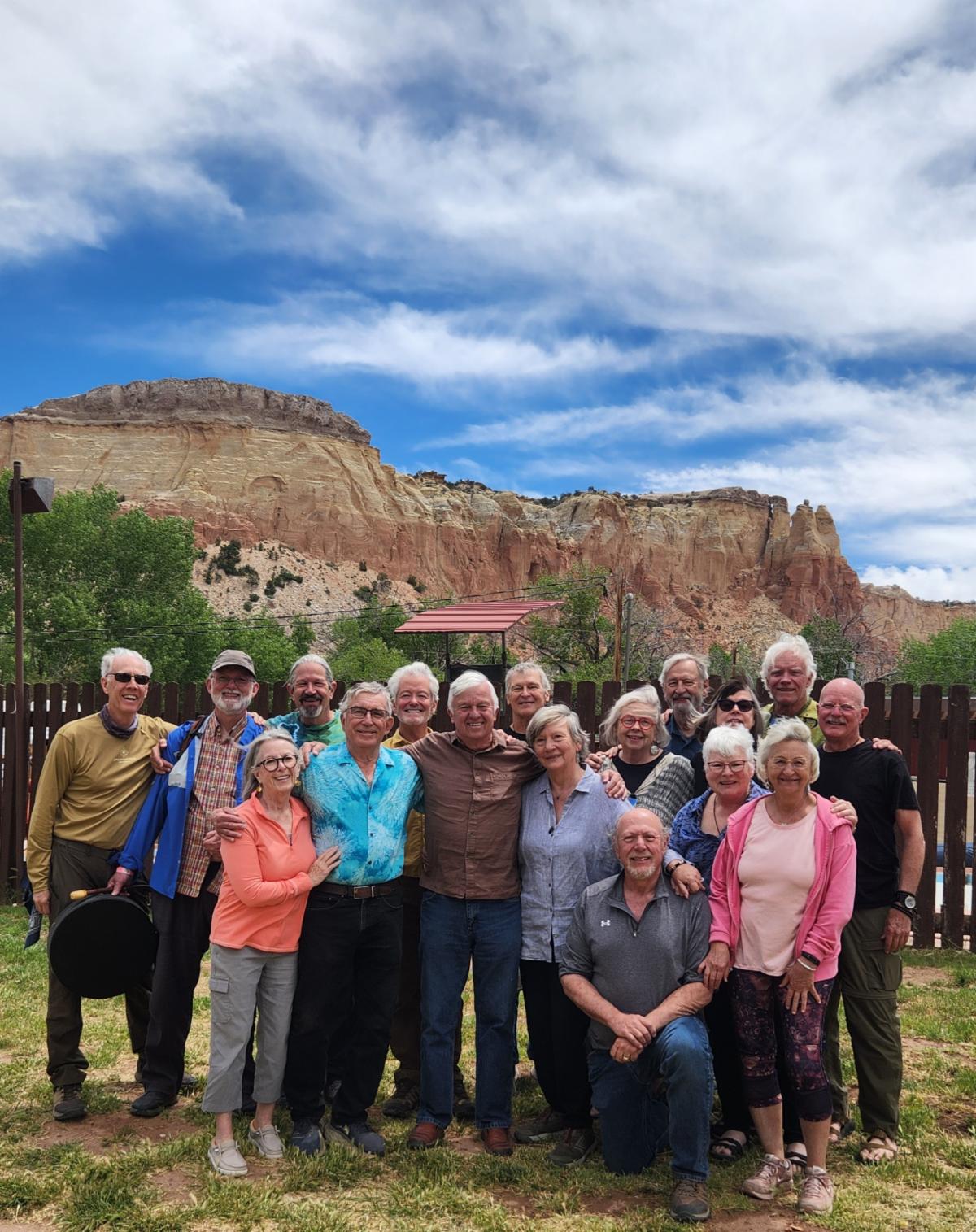
| | There are still a few spaces available in our Sept. 14-20 Choosing Conscious Elderhood retreat at Ghost Ranch, and the registration deadline is fast approaching. If you are interested and/or have questions, please contact retreat guide Dennis Stamper at stampers@charter.net or 828-443-1087. | | |
How You are Shining Your Elder Light
Your Responses to Our Invitation
by Ron Pevny
In the Spring edition of this journal and again in recent email to all of our list, I sent out an invitation to respond in writing (250 word maximum) to the question, “How do you see your journey of growth into a conscious elderhood being different now than it was one year ago.” This invitation was promoted by my having heard from so many people in recent months that they feel greatly challenged by the chaos and turbulence of these times and are realizing that the mounting cultural and environmental crises may not be temporary aberrations but rather existential in magnitude, calling for a somewhat different path to elderhood than they had previously imagined. The purpose of this invitation has been to try to gain a sense how of people like you, committed to being the elders our word so urgently needs, are navigating the challenges of eldering in a world that seems vastly different than the world of a year ago.
I have received about 20 heartfelt responses to the invitation, most centered on the challenges posed by these times but some speaking of the reality of significant personal life changes that have been the dominant realities for them in the past year. Below you will find seven of these responses. The others are deeply appreciated, and to all the writers I send my gratitude.
| | |
by Mary D.
My journey of growth has changed since last year . My need to create positivity in the world has intensified . While everything around me seems to mirror chaos, I cultivate my own calm center . We all have one . We just have to be still enough to feel and locate it within ourselves . What could drive me to despair , drives me to work harder to create peace within myself . When I am in touch with the peace within me , I can share that peace with others in my world .
I spend time early in the morning thinking about how I feel and my tasks for the day . I like to do good things every day . It helps others and increases my inner peace . Maybe it’s just a smile or a ride to the grocery store . Maybe I can just listen . This is now my focus and my legacy: to foster caring and positivity. My time is precious now and I will use it lovingly.
by Ruby G.
A year ago, my journey of growth into conscious elderhood was in a context of rather benign governmental and cultural environments. I know now that I had grown in a highly privileged era in which my values of diversity, equity, inclusion and progress in human rights for everyone, especially the most vulnerable who cannot speak for themselves, were generally mirrored in the culture at large and specifically in the government. While we were behind in what we needed to be doing about environmental degradation, I was optimistic that we would start taking steps to catch up. I believed we lived in a culture that fundamentally valued each member of the culture and was moving toward acknowledging fundamental human rights, including the right to housing, clean water and air, food, etc., for all.
Now my journey includes finding a way to accept the reality of a government and a culture worldwide that doesn’t care about most people, including me despite the various privileges that I hold. It has forced me to take a step back and view history more broadly, to see the broader waves of progression and regression and acknowledge that we may be in a period of regression. It has also moved me to open more to the work of people like Joanna Macy in The Work that Reconnects, who have been taking the broader view of an approaching “great turning” that could move humanity to greater heights or greater depths.
by Gary H.
We LGBTQ+ elders are having to learn to navigate new challenges on our elder journeys. I am a proud 86-year-old gay elder -- proud that my LGBTQ+ peers and I overcame so many of cultural biases and obstacles to realize our potential and proud to continue bringing conscious aging strategies to this, my community.
Until recently, my aging concerns were pretty typical – maintaining an affordable yet comfortable lifestyle, finding good healthcare, preparing for possible future aging challenges and doing what I can to maintain a decent quality of life as I complete my life journey. At the same time, I was savoring a slower pace and the opportunity to deepen my appreciation for the gifts of life.
We are all familiar with the recent threats to those typical aging concerns. As an aging gay man, those concerns and my ability to enjoy elderhood are being further exacerbated by the return and encouragement of anti-LGBTQ+ sentiment. Our stories and the history of our contributions and our struggles are being systematically erased while anti-LGBTQ+ violence is on the rise. Having spent most of my earlier life living with the threat of possible incarceration or institutionalization, I find myself again being hypervigilant. Speaking out against our government brings with it the possibility of unimaginable retaliation. At public gatherings with my peers, I am constantly alert to the potential for aggression. These are not concerns I expected to have at this late stage of my life!
by Mary Lu P.
The Gift of Kindness
In my elder years, being kind to others has been especially enjoyable. I volunteer with a local hospice program, providing companionship and music (I play the Irish harp and the banjo).to hospice patients and their families and friends. It's been personally gratifying to know they always felt better for receiving the gift of my music.
My most memorable patient, I'll call her Bertha, age 102, suffered from dementia. Unable to walk, she was confined to a wheelchair. On my first visit, I greeted her, then began to play the harp. "What the hell is that?" She said, obviously upset. She abruptly turned and wheeled herself out of the room. The next couple of visits we just talked. She told me a relative once played trombone in a band. On the next visit, I brought my banjo. I played and we sang her favorite song, "Show Me the Way to Go Home." A few months later I played the banjo for her as she lay quietly in her death bed coma.
The social and political chaos of today, the pain and suffering it is causing, forces me to struggle to maintain my own spiritual and emotional stability. Kindness is no longer a personal indulgence, it's an imperative. I see people everywhere who are frightened and hurting. My music, words of comfort, or even my quiet presence, may be the most important gift to them, and to myself.
by Jo Anne D.
Spirit of Osprey came in ceremony a few years ago to teach me about legacies. Osprey showed me that legacy is not only something left behind after death.
Osprey gave me a guiding question to carry into daily life: What legacy am I leaving right now, in this moment?
Osprey's medicine has become all the more essential in these Turning of the Times. Humanity has the potential to dismantle our out-of-balance ways, to re-member and awaken our genuine human hearts, to co-create a wildly diverse and flourishing planet, to reweave the web of life with balance, harmony, and love.
So what am I contributing to these extraordinary potentials and healing transformations? Am I sharing the offerings I really want to give to the generations now and to come? Osprey Medicine invites me to pause and reflect in everyday moments in everyday life. How am I touching the web of life with my choices and activities? With my words, thoughts, and emotions? With what I'm learning and unlearning? With how I'm giving and receiving? With the ways I bring myself into relationship with human beings and our many other companions on earth? What legacy am I living, and leaving, today? This question has become my sacred quest.
by Cheryl J.
I can’t talk about the last year without saying I am from Los Angeles. Apocalyptic fires, protests, and military force are the air I breathe. What is outside me has become a catalyst for changes within. A decade ago my life figuratively burned to the ground. A public figure who rewrites the truth becomes a pathway to understanding my childhood and my relationship with my mother. All loosening the ground of my history, allowing me to work with it differently, to acknowledge, to heal, to forgive.
A colleague of mine once said, “You are the instrument of your work.” I am working on the instrument of me. To strip away defenses, to soften in compassion with myself, to stand in the core of my being. It has not been easy. Despite all the work I have done on myself, those defenses are cellular. I am learning not to hope to eradicate them but to come into relationship. They served me once when I was younger and needed them. It is time to say thank you for taking care of me and I’ve got this going forward. To hear but not listen to the voice telling me I am not enough.
I am enough.
As I consider how I wish to show up as a conscious elder it is this.
“Here I am. Just as I am, arms open wide. Let’s see where that takes us.”
by Kelly H.P.
A year ago, as a widow after forty years of marriage, I faced the uncertainty of continuing life with purpose. Working full time while serving as my husband’s caretaker for a decade, I now leaned into grieving while focusing on my government job. Working with communities across the country experiencing tensions and conflict in an effort to bring about consensus and understanding has been a godsend!
However, the change in administration has shifted priorities. By January 2024 I was faced with the dismantling of our agency and the uncertainty of what comes next in this late phase of my career. Retirement is not an option or a desire. With the help of therapeutic professionals, spiritual leaders, friends, and colleagues, I recognized this as an opportune time to utilize wisdom that only comes with maturity to determine the next act.
Though the world appears to move at breakneck speed, some would call it chaotic and unprecedented, I am confident of certain truths. One, I possess everything I need spiritually, intellectually, and emotionally to navigate the rough waters of these times. Two, in all circumstances I have the desire and stamina to be a blessing to others. Three, while I may be fearful, I have learned fear is an emotion that doesn’t have to paralyze or prevent me from action. If I honor and respect it, fear will serve as the catalyst for change; change that allows me to blossom and realize my dreams in this third season!
| | |
Elder Reflections on Serious Illness
by Jan Flynn
The week before Christmas of 2024, I returned home from a once-in-a lifetime trip to Antarctica. Tired and exhilarated, I headed into the final throes of preparing for the holiday. And then the coughing started. Deep, non-productive coughing that wouldn’t stop. I couldn’t catch my breath. I couldn’t sleep. And I plowed through it for three days. At 2 am on the Monday before Christmas, I reluctantly agreed to go to the ER. Thus began a journey through a major health crisis that brought me face-to face with my own mortality.
I was originally diagnosed with both Flu A and Flu B, most likely picked up in my recent travels. In the ER, I went into stress related AFib with a racing heartbeat. Two days later, I was dismissed to spend Christmas at home. The heart racing subsided, but the coughing did not. It only got worse. Three days later, back in the ER, it was Flu A, Flu B, and some wicked respiratory challenge that they couldn’t identify. After several days, when I failed to respond to treatment at my local hospital, my very frustrated physician had me transferred by ambulance to a much larger medical facility… at 2 am.
For the next 14 days, I felt like I was in an episode of House, the medical mystery TV show. Three doctors…a hospitalist, a pulmonologist, and an infectious disease specialist… explored every respiratory avenue imaginable. Pneumonia, fungal infections, Legionnaire’s disease. They even went so far as to explore whether penguins can carry some rare type of bird flu.
I was poked and prodded and swabbed and scanned in every way possible, with no clear diagnosis and not much progress. I had so many IV’s started that my veins simply collapsed. This forced them to insert a med line into my upper arm, an “industrial strength” version of a normal IV line. As each new drug appeared, we would read about it and its side effects. The last antibiotic they hung said that this was “the drug of last resort.” Not “a drug” but “THE drug.” If this didn’t work, there was nothing else to throw at it! The next step was a respirator, most likely kidney failure, and death. I’ve not been that fearful since I received a cancer diagnosis 45 years ago.
Thankfully, the drug worked, and I was later released to recuperate at home. In the time since, I’ve reflected a lot on those 17 hospital days and on my recovery. Here is some of what I’ve come to believe:
True acceptance of my own mortality will always be a work in progress. I have been doing Conscious Eldering and Sage-ing work since 2017. I thought I had come to grips with my own mortality. I learned that I have not. Accepting it in theory is very different than facing death and accepting it in reality. Don’t get me wrong. The work is good work and is certainly helpful. However, during those times when I struggled to breathe and thought I had drawn my last breath, I realized that I am not ready to go. Every fiber of my being told me to fight for my life. I’m reminded of the lines by Dylan Thomas. “Do not go gentle into that good night; rage, rage against the dying of the light.” I have myself wondering what acceptance looks like and if full acceptance of my own mortality is possible. There’s more work to do here.
I’ve realized that serious illness is a lonely process. Much like ageing, it is work we must do alone. The night they transferred me to the larger medical center, I don’t think I have ever felt more alone. I couldn’t breathe. I couldn’t sleep. All I could do was cry. And each crying spell would bring on more violent coughing. It was not a good night. And what is it about 2 am? There’s something about the night to me that deepens the experience and somehow makes it more difficult. Tornado warnings in the night are much scarier than those in the daylight.
While serious illness is “one person” work, it does take a village to come through it successfully. I found myself profoundly grateful each day for the support of my partner and my family. There for me for whatever I needed. And the hospital “village.” The dear androgynous young nurse with the beautiful dreadlocks who provided care and comfort and tried so hard to make me laugh; the ancient cook who delivered my meals in our small rural hospital; the respiratory therapist who held my hand and reassured me when I was in a panic with no breath. And so many others in my circle who voiced reassurance and support. All of them providing the important promise of hope.
Giving in to the indignities of serious illness has brought home the need for patience, humility, and acceptance. All good lessons to prepare for life as an ageing elder. Patience has never been my strong suit. I learned to take each day as it comes and to let go of needing to know “when.” “When will I have an answer?” “When will I be released?” “When will the doctor be here?” Sometimes the answer is “there is no answer.” A hard lesson to learn. As to humility and acceptance, the first time I put on a Depends, I cried. It was, to me, the quintessential symbol being old, and of my loss of control. Over time, I accepted it as another tool that made my life a little easier. I also did a lot of reflection on what it means to be a “good patient.”
I tried hard to be compliant and to do my part. In the days since my release, I’ve come to accept that recovery is a long, difficult road with its own lessons along the way. I don’t bounce the way I used to, so recovery takes longer. I’ve struggled with giving myself the freedom to disengage and take the needed time to heal. The “shoulds” and “oughts” of feeling the need to do are difficult to control. Again, the lessons of acceptance, pace and patience. I have come to accept that my body will never be that of my younger self. I’m learning to treasure what I can do rather than lament what I no longer can do. And I’m trying hard each day to remember that even snails get where they are going.
I’m grateful to the Great Unknown Mystery for each new day…literally grateful that I am alive. This has reinforced focus on my sense of purpose. What is it I’ve been left here to do? And patience. Though things may move more slowly, I must recognize that just because I cannot see the movement doesn’t mean it is not happening. There’s an old proverb that says corn and children grow in the night. I’m working on balance, finding that sweet spot between being and doing. And I am doing my best to be more present, to live in the now.
Illness is an inevitable part of the ageing process. One more challenge in our ongoing journey. A serious illness tends to bring all of our inner and outer work of ageing into focus. It is “where the rubber meets the road.” I have learned that our task is to do our work, prepare ourselves as best we can, and in the end, trust the process.
Jan Flynn is a retreat guide for the Center for Conscious Eldering, retired business executive, a retired college professor, and a practicing organizational transition consultant. She has completed the Certified Sage-ing Leader program through Sage-ing International and continues to do work with that organization. Jan can be reached at jan.flynn@bellsouth.net
| | |
Elders and Youngers Learning From Each Other
About Our Fragile Democracy
by Jack Williamson
Imagine this: a classroom tucked within the architecture of a university, where something remarkable is taking place—quietly, without cameras, hashtags, or the urgency of breaking news. It’s not a protest, or a policy summit, or a symposium of experts. It is, rather, something older and in many ways more radical: an unfolding conversation.
A retired postal worker sitting beside a neuroscience undergraduate. A former civil rights marcher swapping stories with a young woman whose activism lives mostly on her phone. Together, researching and reflecting the Constitution’s Bill of Rights, “In Pursuit of Happiness”. Maybe they are reading Ralph Waldo Emerson. They are definitely reading each other.
This gathering, intergenerational and intentional, does not seek to solve democracy’s most urgent crises with clever soundbites. Its aim is both humbler and more ambitious: to talk, listen, reflect, and write. To bridge lives separated by decades and yet bound by the shared experiment of American democracy. To pursue happiness—together.
This is not the democracy of pundits or polarized panels. It is not the fever pitch of the evening news or the algorithmic certainties of social media. It is something older and more fragile, a civic quiet that echoes the preamble’s first, most daring phrase: We the People.
Not We the Young. Not We the Experts. Just We. It is a phrase that presumes collaboration across generations and geography, experience and aspiration. It presumes that the story of democracy is not written once and for all, but co-authored—sometimes in a single semester, often over a lifetime.
And yet, in our current moment, that presumption feels imperiled. The United States today is a nation often fractured along generational lines. We trade blame more readily than wisdom. Boomers are faulted for climate inaction. Millennials for economic fragility. Gen Z for cynicism or wokeness, depending on the channel. These narratives flatten people into caricature and feed the illusion that only one generation at a time gets to hold the pen of progress.
But what if we remembered that the American experiment was never a solo sprint, but a relay? The framers themselves understood this. Jefferson once proposed that each generation should rewrite the Constitution entirely. Madison disagreed—arguing instead for a structure that could adapt while retaining continuity. Their debate was itself an act of intergenerational trust: a conversation carried forward, not discarded.
It is in this spirit that programs like The Pursuit of Happiness class, which I initiated and help coordinate at the University of Colorado, emerge as a quiet model of democratic renewal. Not because they are flashy or widely known—most are not. But because they do something increasingly rare in higher education and public life: they bring strangers of different ages into shared civic space, and ask them to listen.
One might wonder what such classrooms achieve. After all, what can a 20-year-old teach a 75-year-old about democracy—or vice versa? But maybe that is the wrong question. The better one might be: What can they discover together that neither could find alone?
In these classrooms, stories become bridges. A student speaks about mental health through the lens of neuroscience. A grandfather recalls the loneliness of immigration. Emerson’s prose on self-reliance meets a discussion about digital dependence. The Bill of Rights is no longer an abstract document, but a living map of obligations and dreams. And somewhere in the overlap, something resembling civic memory is born.
It is tempting to dismiss such dialogues as idealistic or marginal. But I would argue they are deeply constitutional. The act of sitting down in trust, of disagreeing without dismissing, of revisiting founding texts not as artifacts but as living commitments—this is constitutional behavior. It may not show up in law reviews or court opinions, but it shapes the democratic habits that keep such institutions viable. Higher education, at its best, has always been more than credentialing. It is the rehearsal space of democracy. But too often, our classrooms are siloed—by age, by economics, by ideology. We have forgotten that the classroom can also be a civic commons: a place not just for the transfer of knowledge, but the co-creation of meaning and wellbeing. And in an era when our democratic institutions groan under the weight of mistrust, we need civic commons more than ever.
Of course, there are tensions. Generational memory is not always harmonious. A Vietnam veteran and a student activist may disagree about patriotism. A retired teacher and a first-generation college student may hold different ideas about what education should promise. But these tensions are not obstacles—they are the terrain. To navigate them is to engage in democracy as lived practice, not as abstraction.
In listening across age, we also learn to listen across time. We begin to see that happiness—a term both philosophically rich and politically fraught—is not a solitary endeavor, but a collective aspiration. Jefferson’s famous phrase, lifted into our founding documents takes on new resonance when discussed by people who have lived through different versions of the American dream and disillusionment. Happiness, like democracy, is a project that is never finished. It is not guaranteed by prosperity, or protected by law alone. It requires memory, humility, and a willingness to be surprised by someone who is not like you.
Which brings us back to the classroom. To the student who arrives thinking she has little to learn from someone living decades beyond her age. To the elder who comes curious and hopeful. And to the moment—often unexpected—when both realize they are learning how to live together. That moment is not newsworthy in the traditional sense. But in the deeper arc of civic life, it is revolutionary. We spend so much time lamenting what is broken in our democracy. But perhaps the question is not simply what has failed, but what we have forgotten. We have forgotten that democracy is not just a set of rules, but a set of relationships. That the Constitution is not just a limit on government, but a license for collaboration. That education is not just preparation for life, but also a place where civic life can be practiced—in real time, across real differences.
We need more such places. Not just in universities, but in libraries, community centers, congregations. Places where people of different generations can ask: What have we inherited? And what can we build together?
The answers may be imperfect. But the act of asking—deliberately, respectfully, and together—is itself a democratic act. And in that act, the age gap does not divide us. It becomes the bridge.
After 25 years as an Air Force Chaplain and over 15 years in non-profit leadership, Jack Williamson embraces this eldering stage of his life with curiosity and a commitment to service. In the past, he led intergenerational workshops for two Sage-ing International conferences. Ten years ago, at age 70, he launched an intergenerational course at Boulder’s University of Colorado, pairing adults 60 - 87 years of age with college students in an upper-division writing class, fostering meaningful connections and conversations across skipped generations. He is a team member and facilitator for Modern Elder Academy’s Third Act affinity group and is leading MEA’s new Boulder Colorado Alumni Chapter.
Jack can be reached at jackwco12@icloud.com, and 303-453-9143
| |
Aging and the Evolving Journey of Life
by Pat Williams
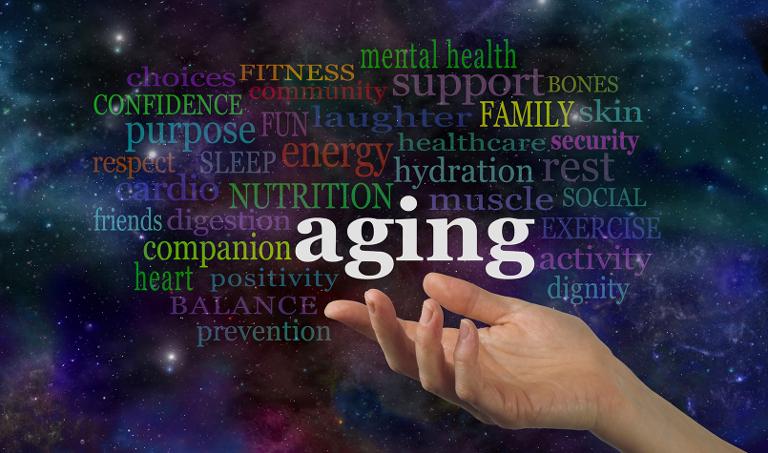
Aging is not merely the passage of time—it is the unfolding of life’s deeper layers. Each year we live adds texture, wisdom, and perspective to our journey. In many cultures, aging is revered as a sacred transformation: a passage from striving to savoring, from ambition to essence. Yet in modern society, aging is often misunderstood, framed as a slow decline rather than a rich evolution. In truth, aging is not the end of becoming; it is the beginning of becoming more deeply ourselves.
The Arc of Becoming
Human life can be seen as an arc—a curve that bends from innocence to experience, from expansion to introspection. In our early years, we are outward-focused: we build, we strive, we accumulate. We define ourselves through roles, achievements, and relationships. These chapters are essential—they help us develop a sense of self and agency in the world.
But eventually, we reach a point where the outer climb gives way to the inner journey. In midlife and beyond, questions shift from "What can I do?" to "Who am I, really?" and "What truly matters now?" This is not a crisis of aging; it is an invitation to authenticity.
Carl Jung called this the process of individuation—the journey of integrating all parts of the self, including the ones we’ve hidden or forgotten. It is during this later stage that we are asked not to do more, but to become more whole.
Every step of your life’s journey shapes who you become. The road may be winding and even challenging along the way, but growth also happens on this path, through consistency, challenge, and the courage to keep going. What path are you walking today?
The Gifts of Growing Older
While youth is often associated with speed, risk, and ambition, the later stages of life bring subtler, yet profound gifts:
- Perspective: With age comes the long view. We begin to understand that not all problems are permanent, not all victories are defining.
- Wisdom: Wisdom is not just knowledge accrued—it is knowledge refined by experience, compassion, and the ability to see the interconnectedness of things.
- Freedom: With fewer roles to play and fewer masks to wear, there can be a liberation in aging.
- Legacy: Aging offers us the time and space to consider what we will leave behind—not just in terms of achievements, but in values, wisdom, and impact.
A Culture Reimagined
Our culture generally idolizes youth and marginalizes the old, missing the chance to value what each life stage brings. Imagine a society where elders are not sidelined but sought out; where aging is not hidden but honored. Indigenous traditions often understand this well—elders are considered wisdom keepers, not has-beens.
In reimagining aging, we also reimagine our future. The rise of the "new elder" is not about going quietly into retirement—it is about rising into relevance, taking a stand for meaning, and mentoring the next generation with love and insight. Aging is not a slow surrender to time, but a powerful journey into the fullest expression of who we are meant to become. It is not the dimming of the light, but the deepening of its glow. With each passing year, we gain layers of insight, empathy, and resilience. The quickness of youth gives way to the richness of perspective. The pursuit of ambition softens into quiet confidence of knowing what truly matters. To grow older is not to fade, but to become rooted, more radiant, more whole. It is a privilege, a transformation, and a quiet triumph that many are not granted, and for that, it should be honored, not feared.
Conclusion: The Road Ahead
To age is to continue evolving. It is to become the author of the later chapters of one’s story—not a character written by time, but a conscious creator of legacy, wisdom, and presence. The journey of life does not flatten with age—it deepens. And if we are willing to walk with awareness, curiosity, and grace, then aging becomes not something to endure, but something to embrace.
Dr. Pat Williams is a long-time Leadership and Jungian Life Coach, author, speaker and mentor. His website is www.DrPatWilliams.com, and he can be reached at doccoach@me.com
| | |
Trough
by Judy Brown
(in The Sea Accepts All Rivers)
There is a trough in waves,
A low spot
Where horizon disappears
And only sky and water
Are our company.
And there we lose our way
Unless
We rest, knowing the wave will bring us
To its crest again.
There we may drown
If we let fear
Hold us within its grip
and shake us side to side,
And leave us flailing, torn, disoriented.
But if we rest there
In the trough,
Are silent, being with
The low part of the wave,
Keeping our energy and
Noticing the shape of things,
The flow,
Then time alone
Will bring us to another place
Where we can see
Horizon, see the land again,
Regain our sense
Of where we are,
And where we need to swim.
Summons
By Aurora Levins Morales
Last night I dreamed
ten thousand grandmothers
from the twelve hundred corners of the earth
walked out into the gap
one breath deep
between the bullet and the flesh
between the bomb and the family.
They told me we cannot wait for governments.
There are no peacekeepers boarding planes.
There are no leaders who dare to say
every life is precious, so it will have to be us.
They said we will cup our hands around each heart.
We will sing the earth’s song, the song of water,
a song so beautiful that vengeance will turn to weeping,
the mourners will embrace, and grief replace every impulse toward harm.
Ten thousand is not enough, they said,
so, we have sent this dream, like a flock of doves into the sleep of the world.
Wake up. Put on your shoes.
You who are reading this, I am bringing bandages and a bag of scented guavas from my trees.
I think I remember the tune.
Meet me at the corner.
Let’s go.
Beloved is Where You Begin
by Jan Richardson (in Circle of Grace)
If you would enter into the wilderness,
do not begin without a blessing.
Do not leave without hearing who you are:
Beloved,
named by the One
who has traveled this path before you.
Do not go
without letting it echo in your ears,
and if you find it is hard
to let it into your heart,
do not despair.
That is what this journey is for.
I cannot promise
this blessing will free you
from danger,
from fear,
from hunger
or thirst,
from the scorching of sun
or the fall of the night.
But I can tell you
that on this path there will be help.
I can tell you
that on this way there will be rest.
I can tell you
that you will know the strange graces
that come to our aid
only on a road such as this,
that fly to meet us
bearing comfort and strength,
that come alongside us
for no other cause
than to lean themselves toward our ear
and with their curious insistence
whisper our name:
Beloved!
Beloved!
Beloved!
| | |
From Uncertainty to Possibility
by Katia Petersen
In a world that trembles, shifting fast,
Where fear and doubt seem built to last, we search for light, a guiding way,
A space to breathe, to hope, to stay.
So come, dear soul, step through the door. Together we will dream once more. With open hearts, our voices rise, to weave new truths, to clear the skies.
In stories shared, in hands embraced,
We find the strength we thought misplaced.
From grief to grace, from dark to bright, we spark the flame, we birth new light.
The path ahead is ours to make,
Through love, through trust, through hearts awake.
So gather near, bring all you bear,
For in this space, we rise, we share.
A future waits, unwritten still,
A world shaped not by fear, but will.
Hope is calling step forward now, a sense of hope and change is near.
Letter to the Parts of Me I Have Tried to Exile
By Rosemerry Wahtola Trommer
I’m sorry. I thought banishing you
was the way to become better,
more perfect, more good, more free.
The irony: I thought if I cut you off
and cast you out, if I built the walls
high enough, then the parts left would be
more whole. As if the sweet orange
doesn’t need the toughened rind,
the bitter seed. As if the forest
doesn’t need the blue fury of fire.
It didn’t work, did it, the exile?
You were always here, jangling
the hinges, banging at the door,
whispering through the cracks.
Left to myself, I wouldn’t have known
to take down the walls,
nor would I have had the strength to do so.
That act was grace disguised as disaster.
But now that the walls are rubble,
it is also grace that teaches me to want
to embrace you, grace that guides me
to be gentle, even with the part of me
that would still try to exile any other part.
It is grace that invites me
to name all parts beloved.
How honest it all is. How human.
I promise to keep learning how
to know you as my own, to practice
opening to what at first feels unwanted,
meet it with understanding, trust all belongs, welcome you home.
Clearing
by Martha Postlethwaite
Do not try to save
the whole world
or do anything grandiose.
Instead, create
a clearing
in the dense forest
of your life
and wait there
patiently,
until the song
that is yours alone to sing
falls into your open cupped hands
and you recognize and greet it.
Only then will you know
how to give yourself
to this world
so worthy of rescue.
Threshold
by Mark Coleman
If you knew you were about
To step off the cliff of the known,
To slip from the safety of the familiar
into the womb of darkness
That has no names,
Would you still cross the threshold
With confident steps ,
Or hasten back to the old small house
That lies tight and cramped
Like an old snake skin around you ?
The call of the abyss
Looms like a reapers shadow
And looks annihilating
From the telescope of the mind ,
But there secret treasures
are sewn into the fabric of your skin .
To cross that line
Sometimes we have to trip and fall,
Lose ourselves like mist at dawn
Or take the hand of a friend
As we enter the unchartered realms .
What happens there is hard to say ,
Layers of silt are removed ,
Our palette gets washed away
And the house of familiarity
Feels hauntingly different .
Roles and routines no longer fit
as we are cast like spawn
into the ocean’s mouth
Or like light hurled in a starless sky ,
Where there is nothing to do but
Yield to the tug of the waves .
Trust the path that takes us to the edge ,
To the place where we can break open
and discover ourselves anew.
.
| | |
Upcoming Conscious Eldering Programs
Retreats
After offering two weeklong retreats and two shorter introductory workshops this Spring, we will be presenting our signature Choosing Conscious Elderhood retreat at magnificent Ghost Ranch this September 14-20. There are a few spaces still available, but we need to hear from you soon if you are interested.
Please consider joining us if you seek an empowering vision for your elder chapters, tools for helping make that vision reality, and the warmth of a supportive community of kindred spirits. Our programs provide a powerful opportunity to have your idealism acknowledged, your hope rekindled and your dreams for a vital, passionate elderhood supported? They offer you the wisdom of skilled guides and the heart-and-mind-opening energy of the natural world, to open you to the rich possibiities of your later-life chapters--for growth, purpose, spiritual deepening, and giving your elder gifts to support a healthy society and planet.
If you need financial assistance to participate in a Choosing Conscious Elderhood retreat, please contact us. We have a small scholarship fund. And if you are in a position to contribute to this fund, we would love to hear from you.
| | |
For Organizations, Faith Communities, etc:
We are available to present our highly impactful weekend workshops or custom designed programs for groups who would like to sponsor one in their area.
Contact us to explore possibilities.
for details on our programs and registration information, please visit
www.centerforconsciouseldering.com/events
| | |
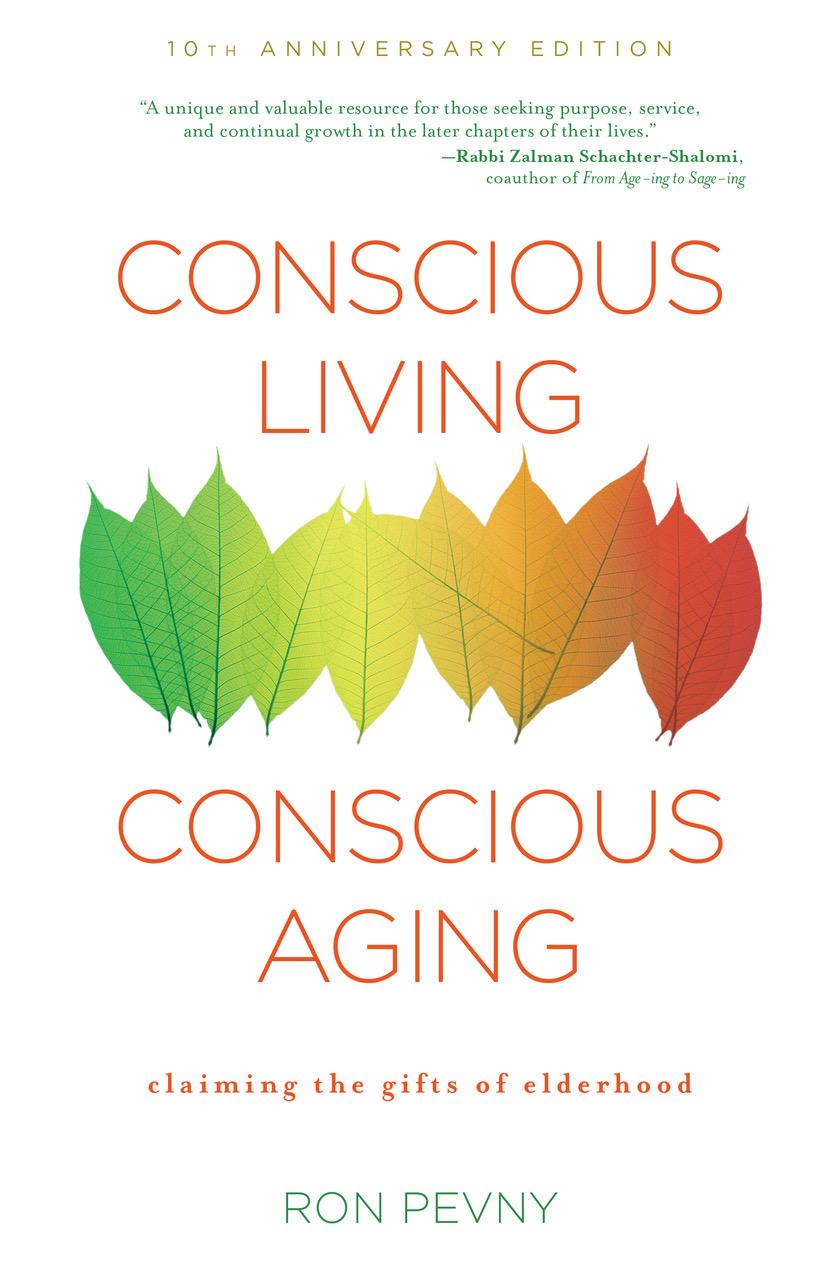
"Ron Pevny brings passion and clarity to the sacred passage into conscious eldering. Realistic about challenges along the way, filled with wisdom and inspiration, this brilliant new edition of his classic book is a gem. Ron is the real deal, a faithful companion on our journey into the unknown territory of aging, guiding us to a deep appreciation of the resilience, meaning, peace and wholeness conscious eldering brings to us and to our world."
Dr. Joan Borysenko, NY Times bestselling author of “Minding the Body, Mending the Mind”
The expanded, updated 10th Anniversary Edition of Ron's book is now available through all the customary sources. You can best support our work by buying it directly from the publisher, Beyond Words, using this link:
https://beyondword.com/products/conscious-living-conscious-aging-10th-anniversary-claiming-the-gifts-of-elderhood
| | | |
Last July Ron Pevny was asked to present a webinar for Sage-ing International's World Wisdom Traditions series. Ron's webinar was titled "Conscious Eldering: The Hero's Journey Into Elderhood."
You can watch his hour-long presentationt by using this link: https://youtu.be/BtTIpc8FIKw
| |
The Human Values in Aging Newsletter
The newsletter you are reading is not intended to provide a comprehensive listing of workshops and other resources available these days to help support people in aging consciously. That job is well done by Rick Moody in his monthly Human Values in Aging newsletter. To receive it on the first day of each month, send an email to hrmoody@yahoo.com
| | |
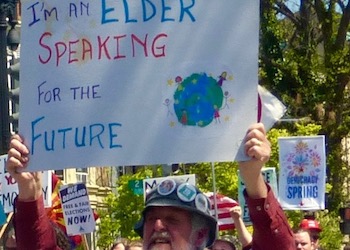
One of our partner organizations, the Elders Action Network is an educational non-profit organization fostering a budding movement of vital elders dedicated to growing in consciousness while actively addressing the demanding social and environmental challenges facing our country and planet. They work inter-generationally for social and economic justice,environmental stewardship, and sound governance. They offer their multiple talents and resources in service to the goal of preserving and protecting life for all generations to come. Anyone committed to living and serving as a conscious elder in invited to join them in this critically important endeavor. EAN offerings include, among others,
* Bi-weekly Elder Activists for Social Justice Community Conversations
*The growing and influential "Elders Climate Action" initiative
* The Empowered Elder--EAN's foundational program
* Intergenerational environmental and social action projects
*The Elders for Regenerative Living initiative
To learn about EAN and its initiatives and programs, visit www.eldersaction.org
| | |
Another of our partner organizations is Sage-ing International, the pioneering organization in promoting the principles of "Sage-ing/conscious aging, Their greatly expanded offerings of online workshops and seminars, Elder Wisdom Circles, and their training program for Certified Sage-ing Leaders is grounded in the work of the late Rabbi Zalman Schachter-Shalomi, who introduced conscious aging to the world with his workshops at Omega Institute with Ram Dass and others, and via his seminal book, From Age-ing to Sage-ing.
To view their website, visit www.sage-ing.org
Please note: This coming August 13-17, Sage-ing International is holding its first large in-person gathering since the pandemic. To be held at beautiful Sunrise Ranch in the foothills above Loveland, Colorado, there will be ceremony, sharing circles, and various engaging presentations, all within the context of the overarching theme of "conscious eldering; shining our elder light in these times of darkness". To learn more, visit sage-ing.org and look for information about The Gathering on the home page.
| | | |
The Pathways to Elderhood Alliance (PEAL) is a newly forming alliance of organizations, including the Center for Conscious Eldering, who offer programs that support the journey into elderhood. To learn about this promising collaboration, click here: Passageways to Elderhood Alliance
| |
Ron Pevny, Founder and Director
970-223-0857
3707 Coronado Ave, Fort Collins, Colorado 80526
ron@centerforconsciouseldering.com
| | |
Don't ask what the world needs. Ask what makes you come ALIVE and go do it. What the world needs is people who have come ALIVE.
Howard Turman
| | | | |