|
In this issue:
- Tennessee a retirement state? Rising pop. aged 25-44-years-old hints at changing landscape
- Census Bureau hits the pause button on the 2025 ACS data release, but for how long?
- Tennessee's higher education graduates featured in new product release
- Proposed 2030 Census rules mark big changes
| |
13,878 International Students Were Enrolled
at educational institutions in Tennessee in September 2026, according to Department of Homeland Security (DHS) figures. The vast majority were in bachelor's (34.4 percent), master's (42.2 percent) and doctorate (18.9 percent) programs. The state's total international enrollment bottomed out in late 2020 at a pandemic low of 7,200 students, then more than doubled to a peak of over 14,700 in September of last year. This year's 5.6 percent year-over-year decline was led by a 10 percent drop in students from Asia and a 6.7 percent decrease in African students.
| |  |
13.7 Percent of Workers Used GenAI Daily
over the workweek in May 2026. The GenAI Adoption Tracker reported workers spent 6.3 percent of their working hours using generative artificial intelligence tools, up more than 20 percent from a year ago. That saved 2.2 percent of their work hours. Workers in the information sector, which includes customer service and software development, saw a 4.9 percent productivity gain from using the tools, according to the survey. Data comes from the Real Time Population Survey, a smaller, high-frequency companion to the Current Population Survey.
| | Early-Career Age Population Increasing Across Tennessee | | Rural counties leading gains among 25- to 44-year-olds | | |
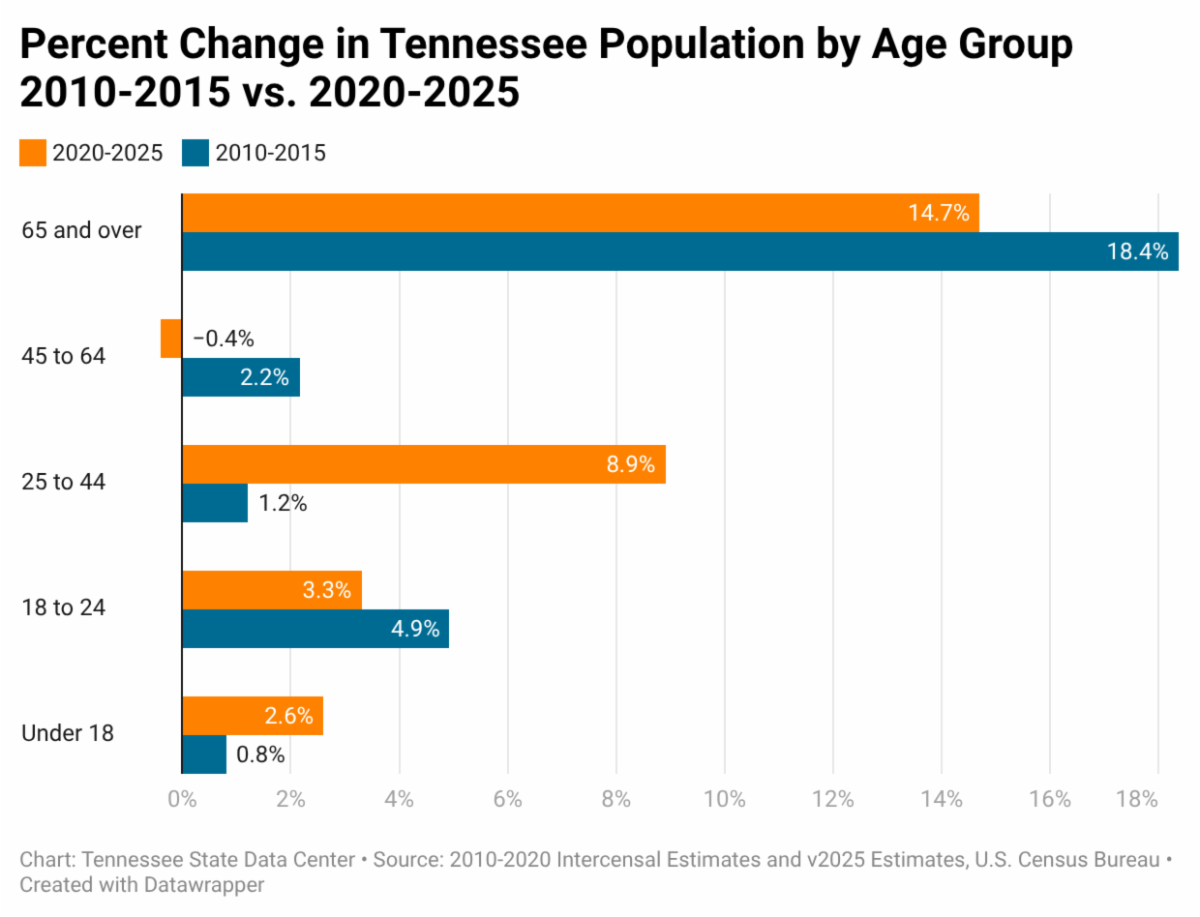
Tennessee's fastest-growing age group this decade remains its seniors – the state added 174,000 people over age 65 between 2020 and 2025. But the growth in the early-career population, ages 25 to 44, marks a sharp break from the 2010s, both in the size of the increase and in the number of counties where the gains are showing up.
Since July 1, 2020, Tennessee has added 159,000 people to the 25-to-44 age group. That 8.9 percent increase is more than seven times last decade's gain, which measured 1.2 percent over five years (Figure 1).
| | Figure 1: Gains in the 25-to-44 age group were seven times larger than a decade ago. | | |
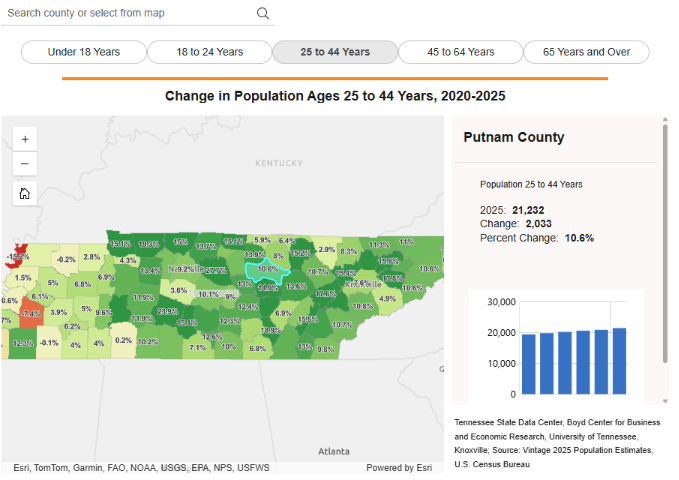
And they are showing up across the state. Ninety of Tennessee's 95 counties have seen their 25-to-44 population grow this decade – a dramatic swing from 2010 to 2015, when 81 counties recorded outright declines in this age group.
Early-career adults are up 11.3 percent in the state's rural counties, against a 7.7 percent gain in urban counties. Leading the way were Wilson (+28 percent) and Maury (+24 percent) counties, along with a group of counties encircling the Knoxville metro.
The growth in the state’s early-career population has been large enough that Tennessee is now one of only a handful of states — along with Maine, Kentucky, and Florida — showing no meaningful increase in median age so far this decade.
| | 2025 American Community Survey Releases Delayed – But for How Long? | | |
Last year's American Community Survey (ACS) releases were knocked off the standard, 5-month-long rolling release schedule due to an October federal government shutdown. This year, a new Department of Commerce rule has set off a more protracted delay in the 2025 ACS release. There are no firm release dates yet, and some significant reengineering may be in store.
A June 4 administrative rule by the Commerce Secretary prohibits the Census Bureau from using a range of techniques called "noise infusion" that help keep individual and business data confidential in published statistical products. Although the rule came without prior notice, it took immediate effect. Because it included techniques used in the ACS, the survey cannot be released until it is brought into compliance. In early August, the Bureau said the 1-Year ACS tables might be released "later this year.”
There has been no indication the policy change stems from current tools being ineffective; rather, the Bureau's stated goal is a more transparent framework for disclosure avoidance that prioritizes accuracy.
| | |
What else is delayed?
The rule covers every product built using the Bureau's confidential data. There’s no list of impacted products, but it likely includes the ACS, County Business Patterns, and Business Dynamics Statistics. Some products are unaffected because state agreements with the Bureau require the use of the specific protection methods that the rule prohibits, or because they are key economic indicators.
| | | |
Which techniques are prohibited?
"Noise infusion" – adding random values to entries so that no household or business can be reidentified. That includes differential privacy, the primary disclosure avoidance mechanism protecting the 2020 decennial census, and household swapping, which protected the 1990 through 2010 censuses as well as the ACS.
| | | |
What are data "coarsening" and "suppression"?
They're what the rule prefers instead. Coarsening means publishing less detail by rounding figures, reporting ranges rather than exact values, or merging small areas into larger ones. Suppression goes further and involves withholding numbers entirely. Coarsening and suppression protect confidentiality by removing detail rather than by adding noise.
| | | |
What's the longer-term tradeoff?
Less detail. Coarsening and suppression will almost certainly mean fewer published tables or coarser geography to keep confidentiality at the required level. The order will also require an entirely new framework for the 2030 Census. But the effects will likely show up in small communities well before then.
| | | We have more details on the new rule, product exceptions and other information on our website. | | Tennessee Economic Indicators | |
Higher Education Graduate Outcomes Loaded to Census Bureau’s PSEO Data
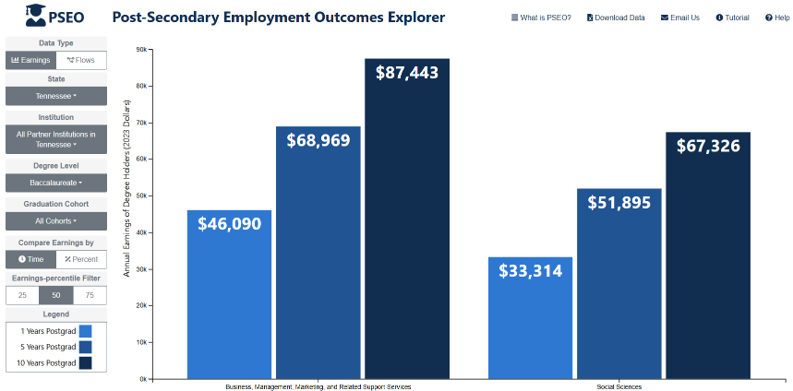
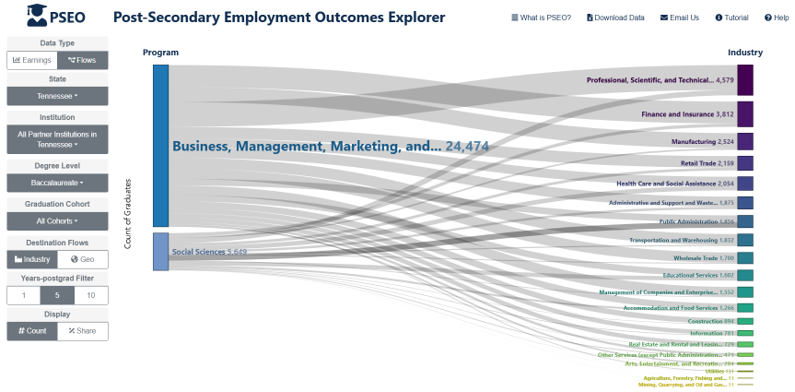
Data from public colleges and universities across Tennessee is now available in the U.S. Census Bureau's Post-Secondary Employment Outcomes (PSEO) data product. The PSEO framework provides statistics on graduate earnings and employment 1, 5, and 10 years after completing studies. Each metric below is available by major field of study, degree level, and individual institution:
| | | Earnings (25th, 50th and 75th percentile) | Industry of employment | Destination region within the U.S. | | | | | | |
2030 Census Rules Propose Shift on Race Questions, Residence, Apportionment Base
The Census Bureau answered some of the speculation about the direction of the 2030 Census on September 10, issuing a Federal Register notice titled "Proposed Residence Criteria and Proposed Regulations for Demographic Questions.” Three key changes headline the proposed regulation.
Removal of Questions About Race and Ethnicity
Change to Residence Rules
Exclusion of Certain Foreign Citizens from the Apportionment Base
The full notice contains additional details and historical background. This notice will likely draw a hefty set of comments related to the apportionment clauses and the potential impact on downstream products that draw on the decennial census for population and race/ethnicity controls. Those are due by October 13, 2026.
| |
TNSDC 2026 Housing Unit Review Program Opens
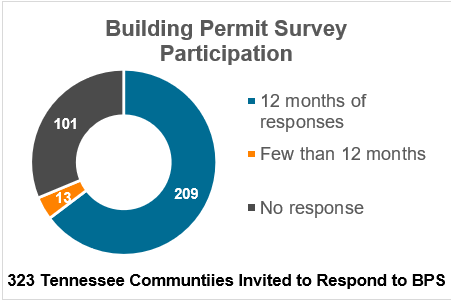
One-third of Tennessee cities and counties receiving invitations to participate in the U.S. Census Bureau’s Building Permit Survey (BPS) do not provide a full year’s data.
Missing or incomplete BPS responses can impact municipal population estimates and revenues distributed to communities.
What you should do:
-
Check if you live in a priority community where building permits are not fully reported
-
Learn about how the Housing Unit Review program can correct the missing data
-
Contact the Tennessee State Data Center with questions or to participate
| |
Update: 2024-2070 Boyd Center Population Projections
Be on the lookout for an updated set of population projections from the Boyd Center. Projections based on Vintage 2025 Population Estimates by Characteristics are in the final stages of development. The final product release will be announced soon.
2030 Address Count Listings, Viewer Updates
For communities looking to get an early start on Local Update of Census Addresses (LUCA) preparations for the 2030 Census, the Census Bureau has refreshed its count of housing units and group quarters in every census block. The data is current through July 2026.
If your community is weighing participation in LUCA, start by comparing the Bureau's block counts against the housing unit counts in your own address records. The LUCA payoff comes from identifying areas where your address counts run higher than the Bureau's and reporting missing addresses in those areas.
| | About the Tennessee State Data Center Network | | The State Data Center Program is a cooperative program of the State of Tennessee, The University of Tennessee and the U.S. Census Bureau. Data Centers in each state assist the Bureau by disseminating Census data, other federal data sets and information. | |
Data Center Affiliates
Each center has an internal statewide affiliate network to further assist in disseminating data to local users. These affiliates also have local information and expertise to offer. Visit tnsdc.utk.edu for a full listing of affiliates.
| | | | |