Greetings!
Good morning and great to be back in your in-box
It has been a month since we last posted, an unplanned summer break. Yes we contemplated a week for Rebecca to recover from a year in the classroom and her 18th annual reunion of women who gather in and around NYC from all over the world. Jerry’s prep for the most anticipated wedding on any coast and recent review of the calendar finds an excuse here and there for a missing issue, but no mention of a major health care event is illustrated.
June 13 we dropped. A few days later a complication from a prior month's procedure brought a most serious infection, which led to Jerry being hospitalized for the first time since he was 12; Jerry now transformed into a patient in a setting where he normally managed and monitored.
A Friday night in the ED (in this instance a first tier large ED) brought three nights in one of LA’s best hospitals, with its great nurses, doctors, and support staff all combining coordinated care and a willingness to laugh at Jerry’s jokes. Discharged with the infection under control, there was still a nagging cough.
A week later, Doctor Julia took Jerry to the clinic and the excellent team of family practice doctors determined that although the infection was gone, there was now the potential for cardiac complications and/or pneumonia. LA paramedics were called while a great nurse stood by. Paramedics determined that the best place to take Jerry was the ED at another of America’s leading hospitals. Swept into a room, a team of ED doctors, nurses, EMTs, and cardiologist did their job while Doctor Julia (who had practiced at this hospital many years ago) interrupted Jerry banter with a concise presentation of the case. Echos, labs, and great teamwork determined the likelihood of pericarditis and pneumonia, none of which related to prior infection, and most likely obtained in the week’s prior ED visit and/or hospital stay.
Back to home hospital and new hospitalists, new specialists, new nurses and support staff. All benefited from Julia’s clinical accuracy and my brilliant primary care doctor (and Med School prof recently back from paternity leave). To continue to lessen my tensions and lighten the burden of their long shifts, I continued my many questions about practitioners’ lives and struggles in the Covid era
With cautions as to building up strength and support at home from PT and nursing, a week later I have returned to doing just some work. I write today as an outside expert who interacted with a team of caregivers this time for me, not the Courts and community.
Our goal is to bring you an issue that offers articles and insights established first hand as the patient. What follows immediately is offered humbly to support your practice and allow you to reflect on your experience as patient or family of patient to better understand complex care.
I now also advance an understanding of the disparity in care. Far too many Americans do not have my access to top flight and affordable care, and virtually none have the team of resources and personal experiences that benefits one greatly when mistakes are made or bureaucracy fails.
To my caregivers, thank you for great care, humanity, and sense of humor. To those in charge and those engaged in change and improvement, please look at your institutions and perhaps my experiences as you make the system better for all.
As the expert now a patient, I had constant reminders of my caregivers' need to meet the demand to coordinate, do checklists, and have a primary care doctor in the middle. And equally important and often found on these pages is the role of nurses in care and the challenges faced during our pandemic.
Firstly, we link you to the New Yorker for Dr. Atul Guwande’s 2017 article “The Heroism of Incremental Care,” which teaches us that
“We devote vast resources to intensive, one-off procedures, while starving the kind of steady, intimate care that often helps people more.” (Also recommend his brilliant book "Checklist Manifesto").
We then give you StatNews'
recently published “For burned-out health workers, exhaustion from Covid-19 surges mixes with a sense of betrayal” that in words and a YouTube video offers a look at what nurses went through. This makes me thank again the dozens of nurses who I encountered in and out of hospitals who chose to stay post the great panic exhaustion.
-
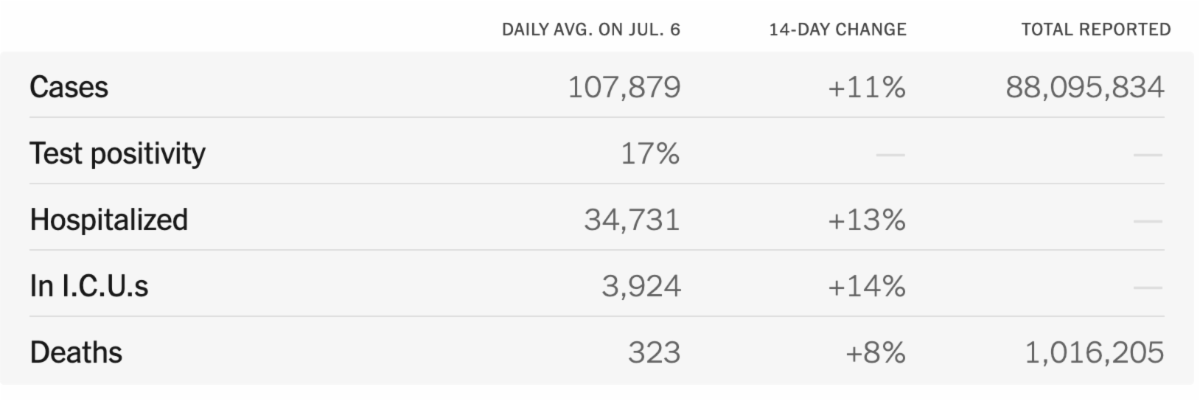
The number of known cases announced in the U.S. each day remains relatively stable, but rising test positivity rates and the emerging dominance of the BA.5 variant suggest that many places around the country are experiencing new outbreaks of infections.
-
The number of new cases reported each day has always been an undercount, and numbers are especially low this week due to reporting delays caused by the Fourth of July. Despite these depressed figures, more than half the states are seeing higher daily cases today than two weeks ago. Even New York and New Jersey, where conditions had been improving throughout June, are now in the midst of modest increases.
- Hospitalizations have increased steadily in recent weeks. On average, there are more than 33,000 people in American hospitals with coronavirus on a given day — the highest national average since early March.
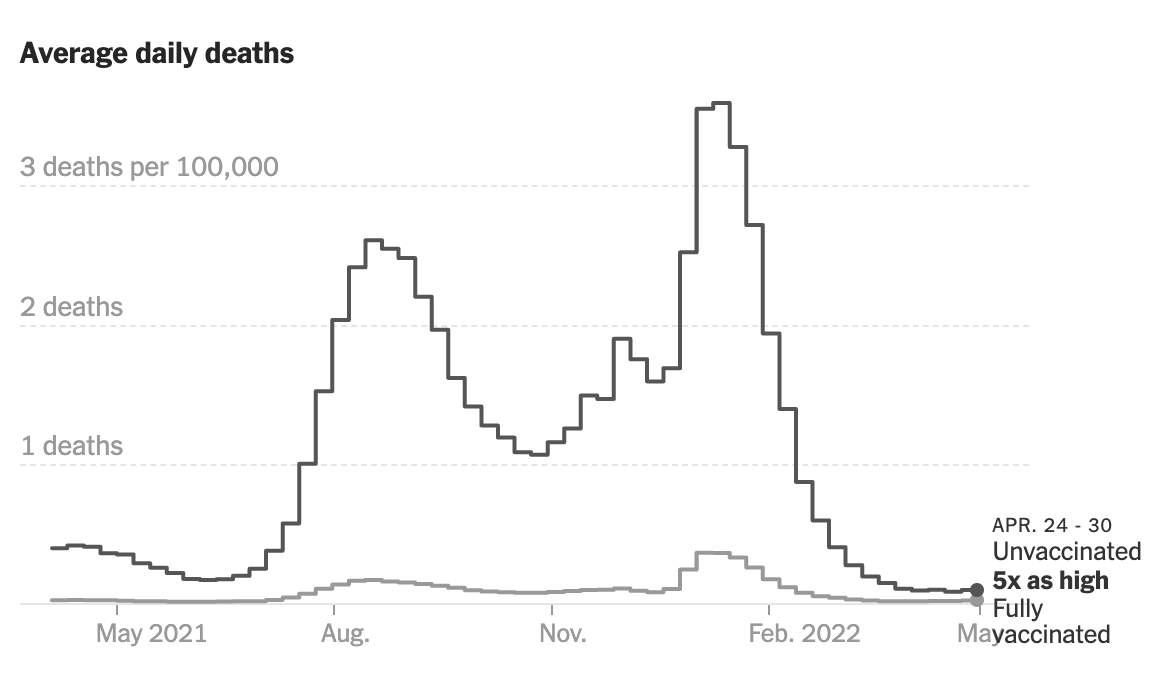
- Fatality data is also in flux after the holiday, but trends remain promising for now. Fewer than 400 deaths are currently reported each day, down from more than 2,600 a day at the height of the Omicron surge.