News from Mission Communications for Water and Wastewater Professionals |
|
Mission Joins
TASI Group
The goal of any company is to flourish and improve its offerings to customers. To help ensure that, Mission has joined the TASI Group. Mission will complement TASI Flow’s existing Asset Management and Wireless Connectivity Strategy, bringing a strong presence in the water and wastewater market. Forrest Robinson will continue to lead the company on its impressive growth track as President of Mission.
Both Mission and TASI aim to provide cost-effective, wireless connectivity to their customers. Mission will help TASI further expand into the water and wastewater industry, and TASI will allow additional growth for Mission.
“Mission’s extensive installed base in the water and wastewater market is complementary to TASI’s current asset management, flow meters, and instrumentation capabilities,” explained Forrest Robinson, President of Mission Communications. “And there will be ample opportunities to leverage each other’s technology and increase our value proposition to customers.”
Mission would like to take this opportunity to thank our valued customers for their continued support. As we join with TASI Flow we anticipate integration of sister division’s pump station controllers, as well as level and flow metering products, which will extend the “one stop shop” for your water and wastewater needs, and with their assistance begin to bring Mission products to international markets. Finally, we pledge that the new corporate structure will not change the customer-centric ethos we have adhered to over the past 20 years.
|
Since events are still in flux due to COVID restrictions, please make sure to confirm schedules with individual trade shows. We will update our website as new information is made available.
|
|
Cape Royale Realizes
Huge Unexpected Benefit
|
Cape Royale Utility District has been serving the residents of San Jacinto County, Texas since 1969. Located northeast of Houston, the district currently reaches approximately 2300 customers with two clean water wells, 11 lift stations and a wastewater facility that handles 150,000 gallons per day.
When Larry Clark joined as General Manager (GM) in 2019, the district was overextended on budget and chronically understaffed. Clark oversaw an extensive audit and was concerned with the results.
“We realized we had no monitoring capability of our lift stations. Ragged and air locked pumps had been burning up between checks. To compound the issue, the lift stations did not have drop flanges and rail systems for staff to pull pumps. Every time a pump needed to be pulled a contractor was called, increasing the cost significantly.” Clark moved quickly to find a solution. “I am proud to say that within my first 60 days at the Cape Royale Utility District we had an unbelievably capable remote monitoring system installed.”
|
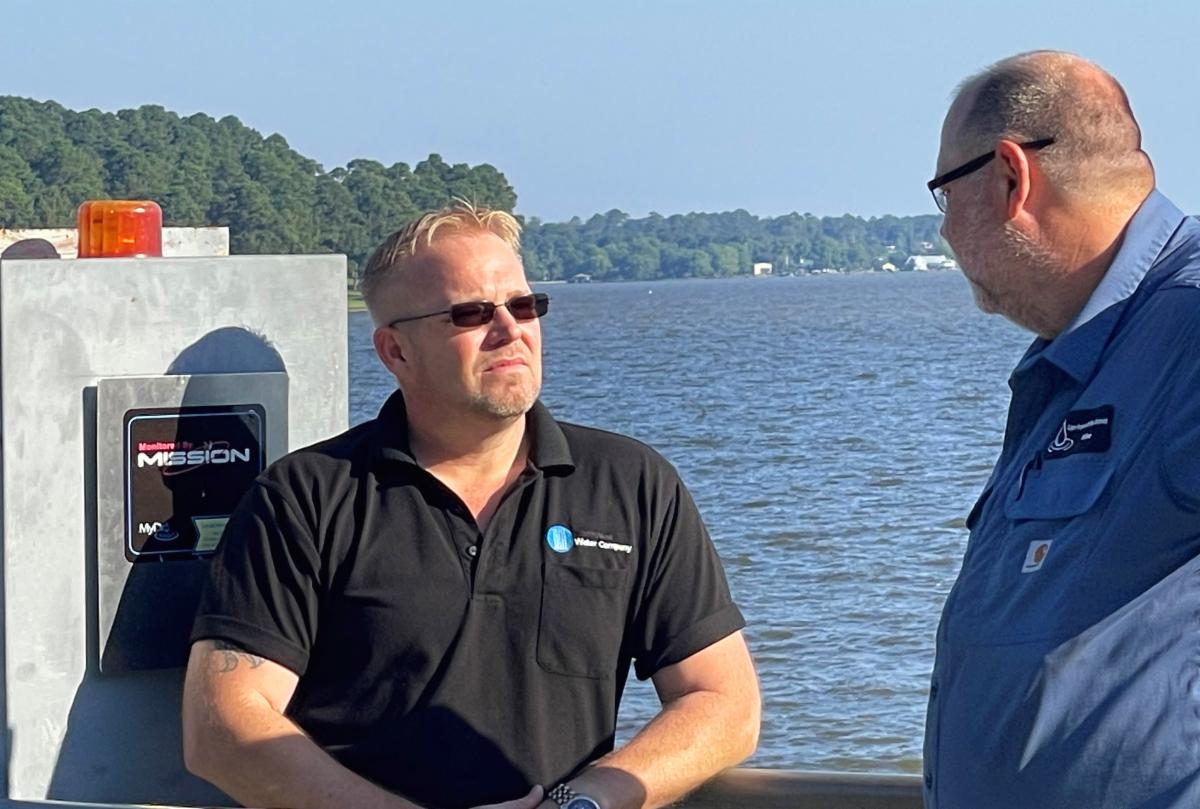
Larry Clark speaks with a coworker near a Mission RTU at the local marina. Photos courtesy of Larry Clark. |
When the Mission system was suggested to Clark, he immediately explored the details presented to him. “After research it seemed like an ideal solution. I gathered all the necessary information for a board presentation. We have an incredible Board of Directors at the Cape Royale Utility District that is very forward thinking and engaged in improvement. When presented with the problem, the solution, and specific equipment they gave immediate approval for purchase and installation.”
With the confirmation from the board, Clark moved forward with the project. With guidance from Matt Crousillac, Mission National Sales Manager, Clark ordered 13 MyDro remote terminal units (RTUs). The installation took only two days.
Clark was extremely pleased with the system capabilities. “We soon realized we had much more than a remote monitoring system. One huge benefit is our ability to almost pinpoint sources of I and I (Inflow and Infiltration) by monitoring during rain events or we can pull the historical data and see which lift stations received an increase in flow. Report generation has also had a huge impact with monthly reporting and during our recent TCEQ (Texas Commission on Environmental Quality) inspection it was noted that the TCEQ will accept Mission Communication generated reports for runtimes, etc., and you can generate a report of your chosen parameters with just a click.”
|
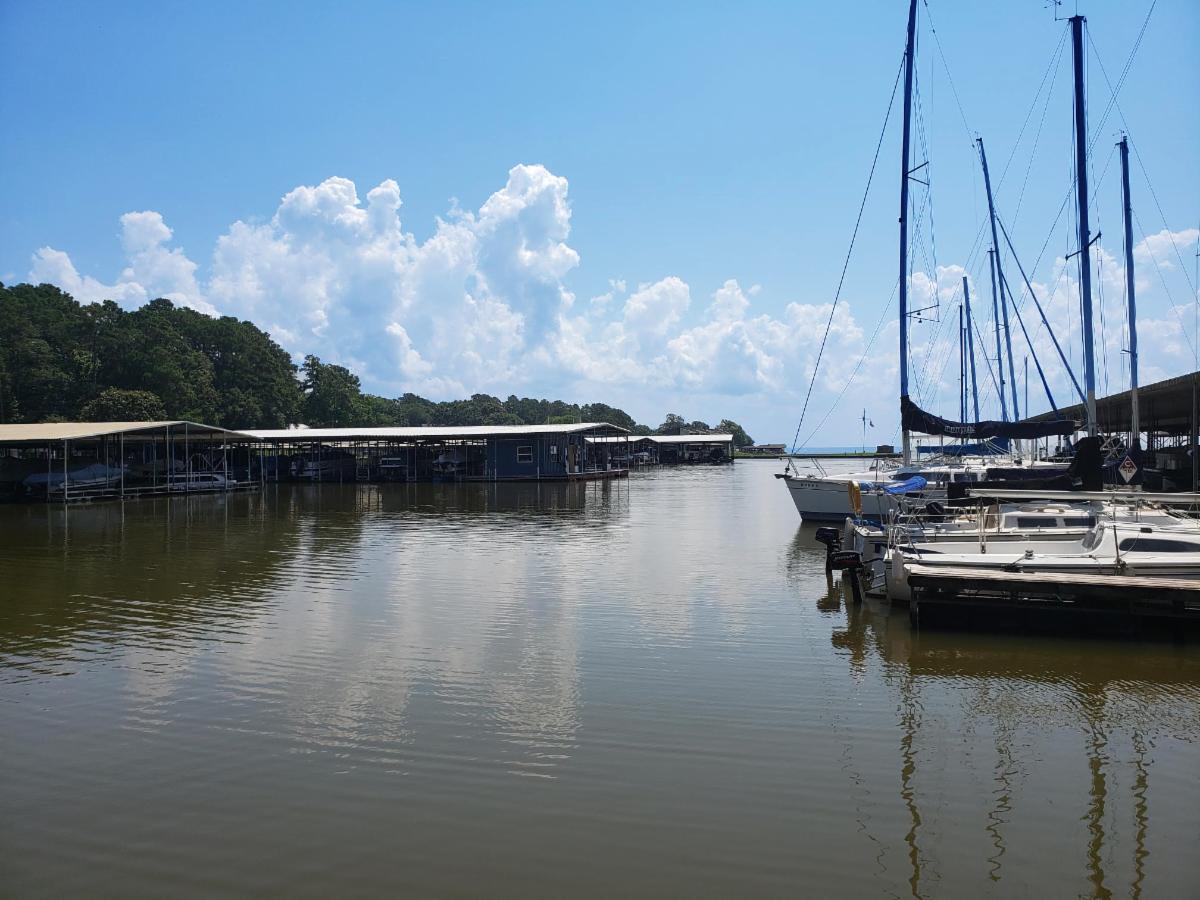
Cape Royale uses several RTUs located at a local marina in San Jacinto County, Texas. Photos courtesy of Larry Clark. |
Downtime is not an option when maintaining approximately 750 residential, multi-family, and commercial connections. Clark’s operators utilize reports to troubleshoot, plan, and order parts ahead of site visits, which have also decreased. On-site monitoring trips were reduced from seven per week to one; this saved Cape Royale more than 20 labor hours per week.
Along with decreasing field hours, data from Mission – especially reports and alarm notifications – dramatically reduced repair costs for Cape Royale.
“We have not lost a single pump since we installed Mission, seven months into this year’s budget zero dollars has been spent on an unexpected pump repair or replacement. With these savings I am able to rehabilitate the lift stations to be more manageable. The Mission Communications System has also more than paid for itself in less than a year.” Clark stated, “the on-call staff’s ability to monitor and troubleshoot from a smartphone before arriving is a huge overtime saver. I was also able to increase my hiring radius due to remote monitoring. This has dramatically increased my hiring pool of licensed operators. Huge unexpected benefit.”
As GM, Clark is responsible for ensuring everything at the district runs smoothly. Mission offers convenient data access along with necessary training to help customers learn the Mission system.
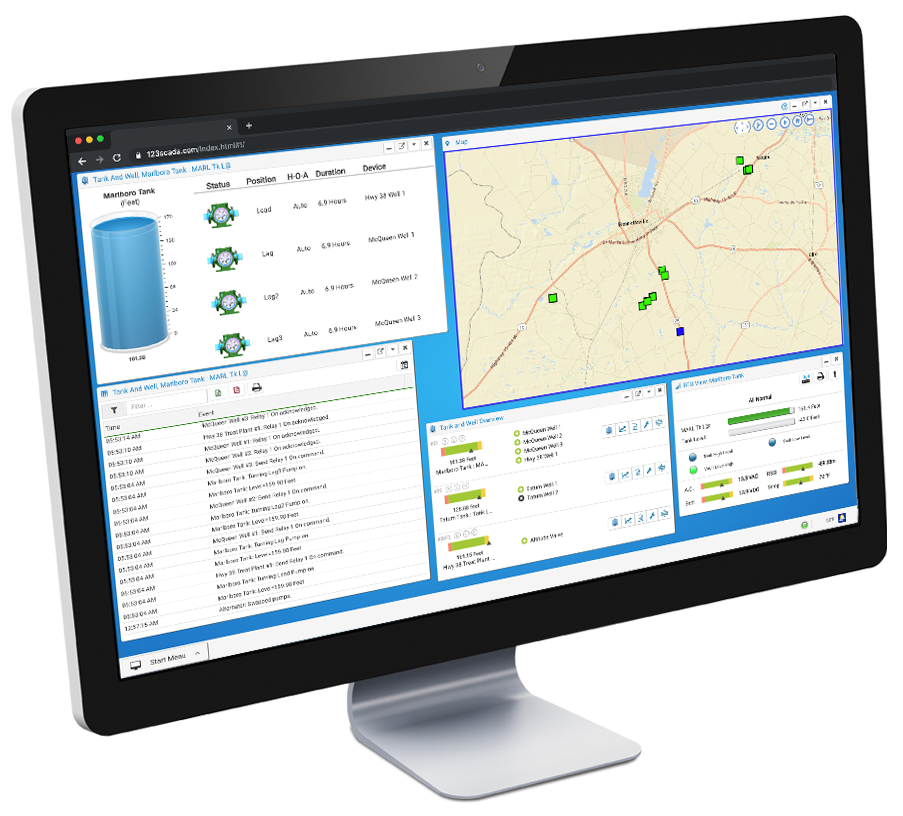
“Mission Communications has regular training webinars; however, the system is so easy to use I only participated in one. The ease of use was a huge plus, within an afternoon I was able to create multiple dashboards for use on desktops and the field staff’s phones. We could design a full dashboard overview or specific RTU views and get as detailed as needed quickly and simply by clicking, dragging, and resizing an abundance of information. The site and dashboards can be tailored for exactly what is needed for any system. Staff with little experience can use the system their first day,” Clark explained.
Mission provides real-time alarms notifications and purpose-built hardware to help utilities monitor and maintain their systems with less effort.
Clark lists peace of mind as a major benefit of the Mission system. “I am able to view, pull reports, schedule staff even if I am out of town, at a conference, or even while on vacation.”
|
|
March 3
Week 1: Survey of Features
June 23
Web Portal II—Advanced Features, Reporting, Supergraph, Volumetric Flow
June 30
Special Topics
July 14
Hardware and Instrumentation
July 21
Web Portal I—Unit Setup Options, Notification Setup Options, Alarm Groups, Website Tools
July 28
Web Portal II—Advanced Features, Reporting, Supergraph, Volumetric Flow
August 4
Survey of Features
August 11
Hardware and Instrumentation
August 18
Web Portal I—Unit Setup Options, Notification Setup Options, Alarm Groups, Website Tools
August 25
Web Portal II—Advanced Features, Reporting, Supergraph, Volumetric Flow
September 1
Survey of Features
September 15
Web Portal I—Unit Setup Options, Notification Setup Options, Alarm Groups, Website Tools
September 22
Web Portal II—Advanced Features, Reporting, Supergraph, Volumetric Flow
September 29
Special Topics
|
|
Mission Provides Reliable Backup for California American Water |
Reliability is key when nearly 43,000 people count on a company for clean water access. California American Water (CAW) in Monterey, California, utilizes a network of 70 pump stations, approximately 40 wells, and five satellite pump systems to serve its customers. A system of this size requires a dependable monitoring setup.
James Nichols, a foreman for the production department with CAW has been in the water industry for 45 years. When CAW needed additional monitoring and a backup system, they chose Mission. “When I moved to California, I did distribution for about 25 years. Now I’m in production. That means that we move the water a lot. We bring it out of the ground. We pump it to the tanks. We monitor the tanks, tank levels and everything. There was a time when Mission was only supposed to be the backup system. That turned out to be a really strong, powerful system. That backup system turned into our first position system for a long time. In other words, you could go with all the information that was provided by Mission while they were developing our internal SCADA system.”
Along with a proprietary SCADA system, CAW maintains nearly 100 Mission remote terminal units (RTUs) to ensure continuous service to their customers. Each RTU transmits data to the Mission servers, and that information is displayed on the web portal and regular reports. CAW utilizes these reports to streamline maintenance and supply orders.
“I have the reports emailed to me, but I’m not responsible for a lot of the admin duties. I mostly look at the website for current information. However, the folks in charge of admin will review the reports and set up maintenance accordingly. Like they’ll especially pay attention to pump runtimes and send someone out to check if a pump is running too long at one time. But, yeah, they get the reports and give us feedback so we can better plan our workday,” explained Nichols. “As an operator, if we need to fill a tank or move some water for testing purposes, I can look at the Mission system and say ‘You have four feet of room before an alarm goes off.’ I like knowing when the alarm is going to go off.”
|
Nichols reviews real-time data to prevent catastrophic events. This information provides peace of mind and allows CAW to reliably serve customers. “I could look at the Mission data, and if I had a low tank, I knew how long I had before I was in a critical situation. If I’ve got a main leak that’s leaking 200 gallons a minute, you could see that on the website as the levels drop. When I saw that decline, I could plan accordingly.”
Mission RTUs offer flexibility of receiving transducer readings and transmitting that data to customers via the web portal and mobile app. CAW utilizes this to follow government regulations.
According to Nichols, “Our goal is to stay in compliance. We use Mission for monitoring chlorine residual readings, PH levels, turbidity, and more. We like that Mission can read and report signal from anything that can be measured by a 4-20mA transducer.”
Mission offers consistent, reliable service that can be used independently or in conjunction with traditional SCADA systems. For more information, contact sales@123mc.com
|
How Water Shaped the States |
Water affects everything. Given enough time, the river can reduce a mountain to a sloping hill. Rivers have long been a means of travel for indigenous people as well as the colonial settlers who carved out borders for each state. The waterways often served as natural boundaries; all but four states have some water on their borders.
The Mississippi River marks the western Tennessee boundary, but a portion of the Tennessee River – Nickajack Lake – has caused tension between Tennessee and Georgia for 200 years. Congress originally set Tennessee’s border at the 35th parallel when the state was split from North Carolina. If the intended boundary is observed, Georgia would have access to Nickajack Lake, where the water already reaches as close as 200 feet to the state line. This would also reallocate 51 square miles of territory from Tennessee to Georgia.
For some the relatively small area may seem trivial, but access to water would be a boon for Georgia. “We need water in north Georgia as badly as anybody does. That’s what this is about,” Georgia State Representative, Harry Geisinger explained the importance to the History Channel during an episode of How the States Got Their Shape.
H.W. Brands of the University of Texas at Austin spoke to the History Channel. “Political borders can be established with not a whole lot of care or concern if there’s nobody there, and that’s usually when the border is established. … Then people show up, and they start to care where the border is, but once the border is written on a map, it’s very difficult to move it.”
It takes an act of Congress or the Supreme Court to change a state border.
As recently as 2019, Georgia initiated a resolution to create a committee to review changing the border or give Georgia access to the river without altering the state line. The people of Patrick’s Bar that sits in both Copper Hill, Tennessee and McKaysville, Georgia keep a close watch on the since back half of the bar sits in a dry county in Georgia, and if the border shifts, they’re business would change drastically.
Despite Georgia getting more rain, Maine has one of the wettest stories. Originally a part of Massachusetts, Glaciers helped form Maine’s jagged coast while a receding ice sheet left behind numerous lakes and rivers. This ice movement deposited layers of gravel, mud, and sand. Maine receives 24 trillion gallons of precipitation each year, and 2 to 5 trillion gallons soak into the ground to replenish groundwater. The sediment layers serve as natural filters, leaving Maine’s groundwater as some of the cleanest in the nation.
Hiram Ricker saw the advantage of such pure water and used the water from his wells to start the Poland Spring water company. Ricker believed the water had many health benefits, and he began selling the water in 1859. In 1893, this same water gained recognition at the World’s Columbian Exposition in Chicago and awarded a top prize at the St. Louis Fair. This exploded the company’s popularity and informed the world of the water quality in Maine.
The northern border of Maine was disputed – and still is if you ask some people – and was eventually pushed north, using the St. John River to divide the United States from Canada. To the east, the Saint Croix River marks the border between Maine and Canada.
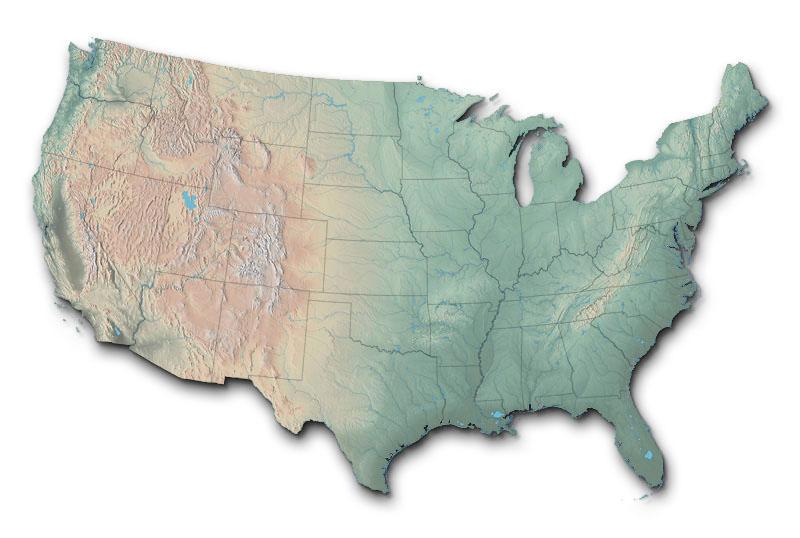
From glaciers to rivers, water has regularly played a role in creating state boundaries. The western United States is often in a state of drought given its lack of abundant fresh water sources. Seven states, part of the nation’s driest region, use water from the Colorado river to serve their inhabitants. Few have gone as far as Nevada.
The Nevada border was shifted both east (borrowing from the Utah Territory) and south (borrowing from the Arizona Territory) in 1866 and 1867 respectively to move closer to the Colorado River as well as mining opportunities.
To further accommodate population growth, the Hoover Dam was constructed in the 1930s. This project diverted water from the Colorado River into manmade Lake Mead. This lake is the primary water source for Las Vegas where water consumption is approximately 255 million gallons per day.
California settled its squiggly border to access the Colorado River as well. The state takes 1.5 trillion gallons from the river each year. Between its consumption and that of six nearby states, the Colorado River is draining faster than it can be replenished.
Across the map, many bodies of water denote the line between states, from the Delaware River to Lake Walter F. George to the Snake River. Water is a requirement for human survival, and it was often that need that drove colonial settlers to mark boundaries.
|
|
Where the waters do agree, it is quite wonderful the relief they give.
- Jane Austen
|
|
Newsletter Survey
Mission values your feedback! Please take a few moments to share your thoughts about this newsletter and tell us about your application. You could be featured in the next newsletter! Click here to complete the online survey.
|
|
3170 Reps Miller Rd NW,
Suite 190, Norcross, GA 30071
1-877-993-1911
|
|
|
|
|
|
|
|