|
On the Road with ASIRT ____________________Summer 2026
__
| |
 | | Dear Friends,
Anyone traveling about either in their own country or abroad cannot help but become aware of the electric scooters (e-scooters) that are increasingly zooming past. E-scooters have become part of everyday life in cities around the world. There are many good reasons for this.
E-scooters are fast, inexpensive, easy to rent, fun, and often promoted as a modern solution to traffic congestion and pollution. For many, especially young people, they represent freedom and convenience. For tourists, they are an added attraction while sightseeing. In developing countries, they are an excellent option where public transportation is limited or non-existent, and many people cannot afford to purchase a more expensive vehicle to get to and from work.
But behind this growing trend lies a troubling reality: e-scooters represent a rapidly increasing number of devastating injuries and preventable deaths. As a matter of fact, official agencies now collect injury and fatality data for e-scooters, recognizing them as among the traditional modes of transportation. If you visit the Facts page of ASIRT’s website you will note that e-scooter fatalities are now included in the UN Global Road Safety Status Report’s “Global Road Crash Deaths by User” demographic.
Emergency rooms across the globe are seeing more and more victims of e-scooter crashes. The statistics are alarming. In Great Britain, recent government figures estimated nearly 1,500 casualties involving e-scooters in a single year. In Germany, authorities reported almost 12,000 e-scooter injuries and 27 deaths in one year alone. Similar patterns are emerging across Europe, in the U.S., Asia, and Australia as scooter use continues to expand.
Doctors report that head injuries are among the most common consequences of e-scooter crashes. Yet many riders still travel without helmets, often weaving through traffic or riding at night with little visibility. Others underestimate how unstable scooters can be on potholes, wet pavement, or uneven roads. A small wheel hitting a crack in the street can instantly throw a rider onto concrete.
The rise in e-scooter injuries should concern all of us — not only riders, but parents, educators, city leaders, transportation planners, and drivers.
Simple precautions can save lives. Wearing a helmet, slowing down at intersections, avoiding distractions, staying off sidewalks, and never riding under the influence of alcohol or drugs can dramatically reduce the risk of serious injury. Cities must also do their part by improving bike lane infrastructure, enforcing safety regulations, and educating the public about responsible riding.
This summer, let us all look out for one another – whether on two wheels, on foot, or in any form of motorized vehicle – by staying alert and practicing shared road responsibility.
| | |
Rochelle Sobel
Founder and President
ASIRT
| |
| | |
Road Safety: Innovation and Action
Save the date for the ASIRT Annual Gala!
Thursday, November 12, 2026
Washington, DC
Details will follow.
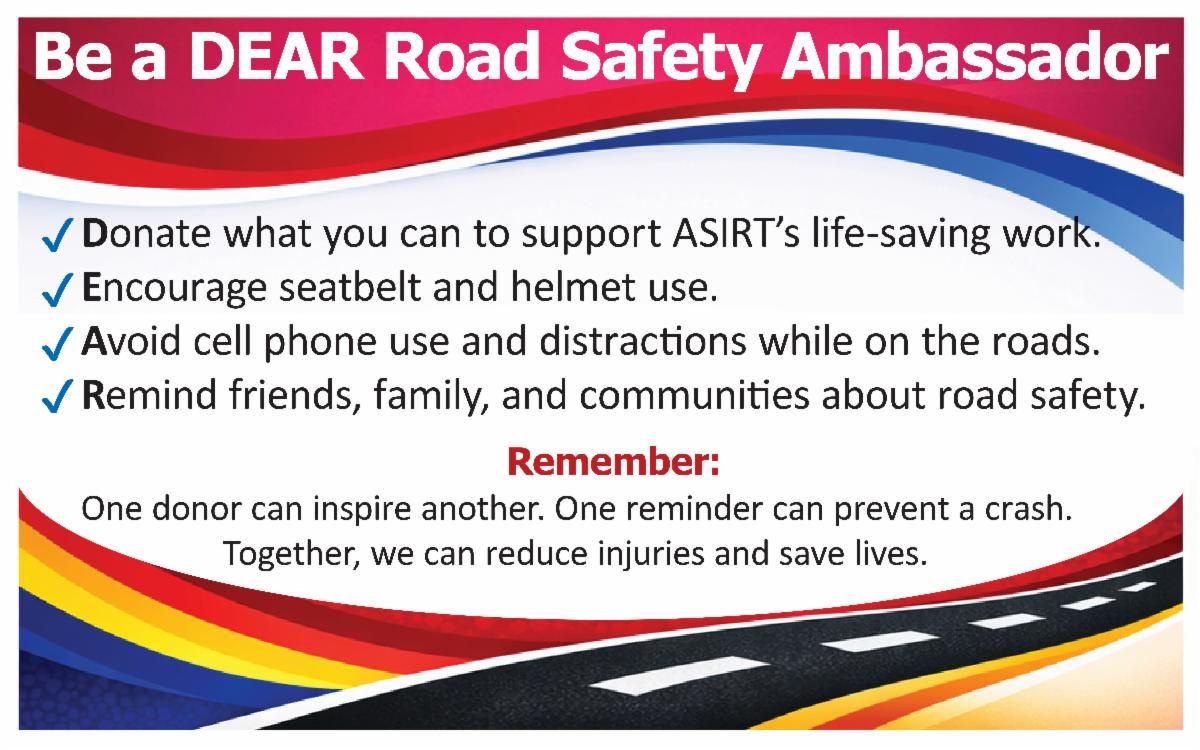
| | | | Please consider a donation to support ASIRT’s mission today. Become a Road Safety Ambassador by encouraging safe road travel choices and donating whatever you can at asirt.org/DonateToday.
Thank you for being part of a community that believes crashes are preventable and precious lives are worth protecting. | | | |
ASIRT Addresses Road Safety in the Middle East North African (MENA) Region
The OSAC Middle East and North Africa (MENA) Steering Committee hosted a webinar on Road Safety in the Middle East and North Africa region, featuring Rochelle Sobel of ASIRT and representatives of Jacobs, and Applied Driving. The hour-long session, facilitated by Paul Muniz, Safety & Security Director of ADRA (Adventist Development and Relief Agency), and Khushal Safi, Associate Vice President of GSNU (Global Safety Northeastern University), focused on road safety challenges and best practices across the Middle East and North Africa.
More than 140 webinar participants were engaged as ASIRT presented an overview of global and regional statistics and key risks and challenges faced by road users including drivers, passengers, and pedestrians. Countries’ highways, post-crash care capabilities, and the safety of local taxis were discussed. The conversation highlighted awareness of road conditions, local driving culture, and advance preparation as crucial to reducing crashes.
A case study revealed that driver assessments and training, along with specific organization protocols and the use of telematics, can lead to a substantial increase in mitigating road crashes. Even when drivers know their movements are being recorded, it isn’t until they are presented with data that behaviors begin to change.
As the session closed, panelists surmised that driver attention, speed management, and the flexibility of individuals and organizations to make steady improvement can lead to reducing crashes and saving the lives of loved ones.
ASIRT regularly presents on webinar and in-person panels for government and private sectors including education abroad and faith-based communities. Contact asirt@asirt.org for more information on scheduling a webinar or presentation.
| | |
JHU – Hanoi HEalS Program Students Meet with ASIRT to Expand Their Knowledge of Road Safety
Johns Hopkins University - Hanoi University — Hanoi HEaIS Program fellows visited ASIRT as part of their summer institute experience connecting classroom learning with real-world road safety advocacy and practice. ASIRT annually participates in this collaborative initiative addressing the urgent public health challenges related to trauma and injuries. Rochelle Sobel and Cathy Silberman presented an overview of global road safety and highlighted the challenges and successes of a small NGO in promoting safe travel worldwide.
ASIRT shared its history and experiences with the JHU-Haoi HEalS program fellows, led by Khushbu Balsara, postdoctoral research fellow, and Sagnik Ray, Research Program Coordinator, both of JHIRU, Johns Hopkins Bloomberg School of Public Health. Topics included road crash prevention, road safety education, and advocacy initiatives. The visit included a session during which the fellows reviewed ASIRT’s Road Safety Reviews (RSR) for Vietnam and provided additional insights for future Vietnam reports.
The Johns Hopkins University – Hanoi University of Public Health Research Program on Health, Economic, and Societal Consequences of Trauma and Injuries in Vietnam (JHU-Hanoi HEalS) is funded by the U.S. National Institutes of Health (NIH).
| |
Johns Hopkins University - Hanoi University fellows with ASIRT leadership. From left to right: Nguyen Phan Dan Truc, Phan Van Ha, Hoang Thuy Dung, Khushbu Balsara, ASIRT Executive Director Cathy Silberman, ASIRT President Rochelle Sobel, Vu Hoang Thuy Van | | | |
Education Abroad Perspective: Cairo
by Christopher Ingrassia
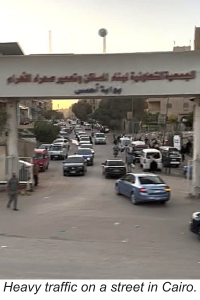
For most, imagining Cairo conjures images of Pyramids, the Nile, and vibrant culture. But for me there’s another image which comes to mind — traffic. The greater Cairo metropolitan area is home to 23 million people. This level of overpopulation has created one of the most spectacularly congested road networks on Earth. I was fortunate enough to visit the city for a day in December of 2025. Immediately upon arriving in Cairo, I was greeted by a concert of car horns from all directions. The noise was accompanied by the sight of endless traffic as far as the eye could see. Motorcycles and even donkey-drawn carts weave in between traffic. The cars themselves obey no speed limits or seemingly any other traffic laws. Upon further inspection, I noticed a distinct lack of traffic signals and road markings. Undoubtedly, this contributes to the chaos that is Cairo’s traffic. All of this creates a disorienting experience for even seasoned travelers. By the time I left, I found myself feeling a sense of awe. Cairo’s roads operate within their own system of rules, but at least I was leaving. The people of Cairo must face this reality every single day.
| | |
Christopher Ingrassia is a rising senior at Manhattan University where he studies International Relations. As part of his degree Christopher spent a semester abroad where his travels brought him to Egypt among other destinations. His international experiences have strengthened his passion and understanding of global and cultural affairs.
| | |
Road Safety Review (RSR) Update
Recently updated RSRs include Belgium, Hungary, Kuwait, Oman, Portugal, Switzerland, and Uganda. Free sample reports can be downloaded at asirt.org/resources. Subscriptions are available for 1, 8, 20, or all reports. Subscribe or renew to access more than 90 RSRs.
| | |
===RSR Fast Fact: Greece
When in beautiful Greece, it can be tempting to enjoy the sunshine by renting a motorbike, moped or scooter to zip around the narrow, scenic roads. What many visitors don’t know is that these vehicles are regularly involved in serious crashes, particularly on islands. Rentals are often poorly maintained and may lack working lights, brakes and other standard safety equipment. Visiting drivers may not have a full grasp of road patterns and traffic laws, adding to risks — as does local driving culture, which includes road rage, failure to wear seatbelts, unsafe overtaking and reckless driving.
Purchase the ASIRT Road Safety Review for Greece or learn more about road safety while traveling in unfamiliar territories.
| | |
Travel Snapshot: Panama City, Panama
By Stephanie Sporkin
Panama has become a popular travel destination, and I enjoyed my recent visit to this tropical city. Road safety is always a priority when I travel, and Panama City offered some interesting perspectives about safely navigating the city. With a population of approximately 1.15 million citizens, Panama City has experienced several decades of rapid growth and expansion. Traffic is often heavy, and the city’s infrastructure has not kept pace with the needs of its expanding population. Recently modernized roads offer safe options for pedestrians, cyclists, and scooter riders, but there are many areas still in need of updating and repair.
The Vehicular Traffic Regulations of the Republic of Panama Transit and Land Transport Authority list vehicle speed limits in city traffic to be between 40 to 60 kph (25 and 37 miles per hour). Pedestrians are instructed to use sidewalks, pedestrian paths, and overpasses and are advised to walk on the left side of the road facing oncoming vehicular traffic when other options are unavailable. While there are detailed traffic regulations, drivers can be aggressive and may not follow the rules of the road.
| | |
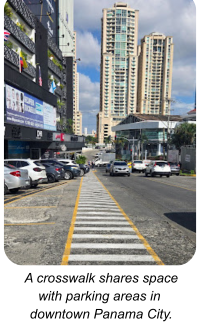
Crossing certain busy intersections or side streets could be challenging. Many streets in the business areas lack sidewalks, and available sidewalks are often narrow or uneven and in need of repair. The area in front of stores or office buildings is often used for parked vehicles, and pedestrians and cyclists are forced to navigate these limited spaces.
There are well-marked crosswalks on many streets, but the driving culture does not allow for pedestrians' right of way. Often, the only way I was able to cross a heavily trafficked side street was to make eye contact with the driver and proceed slowly until the driver came to a complete stop. On numerous occasions, I witnessed pedestrians unsafely navigating crowded intersections between vehicles.
Read more.
| | |
Celebration of Passage of Recent Road Safety Legislation
ASIRT’s Rochelle Sobel attended a gathering in June that marked the passage of Sarah’s Bill and other safety bills at the home of road safety champion and advocate Daniel Langenkamp. The Sarah Debbink Langenkamp Active Safety Transportation Act (H.R.2011) is named in memory of Sarah Debbink Langenkamp, a former diplomat and wife of Daniel Langenkamp, who was struck and killed by a truck while biking in Bethesda, Maryland. The bill was passed by the Transportation and Infrastructure Committee and will now advance to the full U.S. House of Representatives. Several other bills, among them Maryland’s Stop Super Speeders Bill, spearheaded by Families for Safe Streets, were also highlighted at the event. The celebration also recognized the formation of the Ride for Your Life organization headed by Daniel Langenkamp.
Former U.S. diplomat Daniel Langenkamp is an ASIRT Advisory Board member and road safety advocate.
| | |
At left: Rochelle Sobel, along with other road safety advocates, at the home of Daniel Langenkamp
| | |
In the News
The world's first roadside breathalyser is being tested by two police forces in the South of England for drivers high on nitrous oxide, often referred to as NOS or laughing gas. Read more.
BBC.com
Traffic deaths are declining nationwide, but transportation leaders say sustained progress will depend on combining street design, data, and automated enforcement to change driver behavior. Learn about the progress being made for safer roads.
Government Technology
See how Maryland lawmakers are attempting to crack down on chronic speeders with a new pilot program that would require some high-risk drivers to use technology designed to prevent them from exceeding posted speed limits.
Fox 45 News
The National Highway Traffic Safety Administration has rolled out a major new initiative aimed at reducing fatalities by targeting impairment, speeding, distraction, and seat belt violations. Read more.
EMS1
Learn how Uber plans to test an AI robotaxi program in Munich as the city’s dense streets and high-speed road networks provide the right environment to launch robotaxis at scale.
The Wall Street Journal
Speeding killed 11,288 Americans last year. Discover how speed-limiting technology installed in a vehicle can be used to prevent a driver from exceeding the posted speed limit.
The Hill
| | ASIRT Thanks Its Generous Sponsors | | View a complete list of sponsors. | | Support ASIRT's mission to improve road safety. Make a contribution today. | | | | |