Sunday News
July 26, 2026
| | |
CEO: Gayle Nash, MPH, RN
COO/CFO: Sam Sheth, PharmD, MBA
Contracts Manager: Kristin Miller, JD
| |
CEO Corner
Welcome to this week's Nash Sunday News!
We're at the end of July, which means many of you are sitting squarely inside your survey window — even if it doesn't feel that way yet. Summer is when census dips, when seasoned staff take their long-earned leave, and when the newer members of your team are covering shifts with less backup than usual. It's also not coincidental when surveyors walk in.
Readiness isn't a project you finish. It's the accumulated habit of a thousand small decisions: the competency signed off on properly, the tracer done when nobody asked for it, the finding closed instead of noted. The organizations that survey well are rarely the ones that prepared hardest in the final six weeks. They're the ones who never really stopped.
In this issue, Mark Duro, CRCST, FCS, and consultant, opens with a beginner's guide to steam sterilization: cycles, parameters, and safety. I'd encourage you to read it even if you're twenty years past "beginner." Some of the most consequential findings I've seen came down to a technician who'd been taught the button sequence but never the physics behind it. Understanding why a cycle needs dry time changes how carefully someone treats it at 6 a.m. on a short-staffed morning.
That theme carries forward - citations cluster where knowledge is thinnest, not where effort is lowest.
As always, we're including our weekly publications. This week we're looking at the workforce itself. AORN's publication on recruitment and retention, and Becker's data on median hospital salaries provide useful context for a hard conversation many of you are already having. As September approaches, we've included SAMHSA resources for Suicide Prevention Month because preparing now (rather than in September) is what makes the observance meaningful.
As always, my hope is that you find something here you can put to work on Monday morning.
Gayle Nash, MPH, RN
Please reach out if we can support you! As always, my email is Gnash@Nashhc.com, and my cell is 915-241-7830
| | | |
Understanding Steam Sterilization
A Beginner’s Guide to Cycles, Parameters, and Safety
| | |
Mark Duro, CRCST, FCS
Sterile Processing Consultant | Nash Healthcare Consulting
| | |
If you are new to the Sterile Processing Department (SPD) or surgical services, the autoclave can look like a giant metal black box. You push a button, wait a while, and pull out hot trays.
What happens inside that chamber, however, is a precise, scientific process. If even one setting or step is off, harmful bacteria, viruses, or bacterial spores can survive on surgical instruments — and it is this risk precisely that increases a patient's risk for serious surgical site infections.
| | In this guide: how steam sterilization works, the three main cycle types, the exposure parameters to use, and the special rules that apply if your facility runs weekly gravity cycles. | | 1. The Four Pillars of Steam Sterilization | | |
To sterilize an instrument, we aim for a Sterility Assurance Level (SAL) of 10−6. In plain English, that means there is less than a one-in-a-million chance that a single living germ survives on the device.
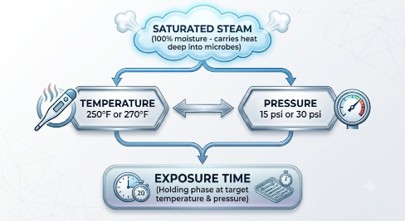
To get every instrument completely sterile, four key elements must work together:
| | Figure 1. The four interdependent elements of effective steam sterilization. | |
1. Saturated Steam (Moisture). Plain dry heat kills bacteria very slowly, much like roasting something in an oven. Steam carries moisture, which cooks and denatures the proteins inside germs almost instantly. The steam must be saturated — meaning it contains roughly 97% to 100% liquid water vapor, without extra dry air or dripping excess water.
2. Temperature. Steam at sea level only reaches 212°F. To kill tough bacterial spores such as Geobacillus stearothermophilus, the steam must be heated much higher — typically to 250°F or above.
3. Pressure. How do you get steam hotter than 212°F without it drying out? By trapping it under pressure inside a sealed chamber — think of a pressure cooker at home. Raising the pressure inside the autoclave allows water vapor to reach higher temperatures.
4. Time. Once the sterilizer reaches its target temperature and pressure, it must hold those conditions for a specified period. This is the exposure time, also called the kill time.
| | |
The Golden Rule: air is the enemy of steam.
Air acts like a protective blanket around instruments. If air is trapped inside a wrapper, tray, or hollow tube (lumen), steam cannot touch the instrument surface. No steam contact = no sterilization.
| 2. The Three Main Steam Cycles | | Not all sterilizers remove air the same way. There are three primary steam cycle types you will encounter in healthcare. | |
Gravity Displacement — the passive approach
• How it works. Think of how oil sits on top of water because it is lighter. Cool air is heavier and denser than hot steam. In a gravity cycle, steam enters the top or sides of the chamber and slowly fills the space, gently pushing the heavier air down and out through a drain valve at the bottom.
• Pros. Simple, reliable, and does not require complex mechanical vacuum pumps.
• Cons. Air takes a long time to drift out passively. Gravity cycles are poor at removing air from tight spaces, long hollow tubes (lumens), and tightly wrapped linen packs.
Prevacuum (Pre-Vac) — the active vacuum approach
• How it works. Instead of waiting for air to drift out on its own, a powerful mechanical vacuum pump runs before steam is introduced. It draws almost all the air out of the chamber and out of the interior of instrument sets. Once the air is removed, steam is injected, instantly filling every crack, crevice, and hollow tube.
• Pros. Fast, thorough, and excellent for complex, hard-to-reach surgical instruments.
• Cons. Requires a more complex machine and strict daily testing (the Bowie-Dick test).
Steam Flush Pressure Pulse (SFPP) — the rapid pulse approach
• How it works. SFPP is a hybrid method. It continuously flushes steam into the chamber while rapidly raising and lowering the pressure above atmospheric levels. These pressure pulses sweep air out through the drain line.
• Pros. Removes air very quickly without needing a deep mechanical vacuum pull.
• Cons. Requires specialized sterilizer controls and validated packaging.
| | 3. FDA-Cleared Exposure Parameters | | |
How long should a cycle run? The U.S. Food and Drug Administration (FDA) clears sterilizers based on strict testing to ensure they kill all microorganisms.
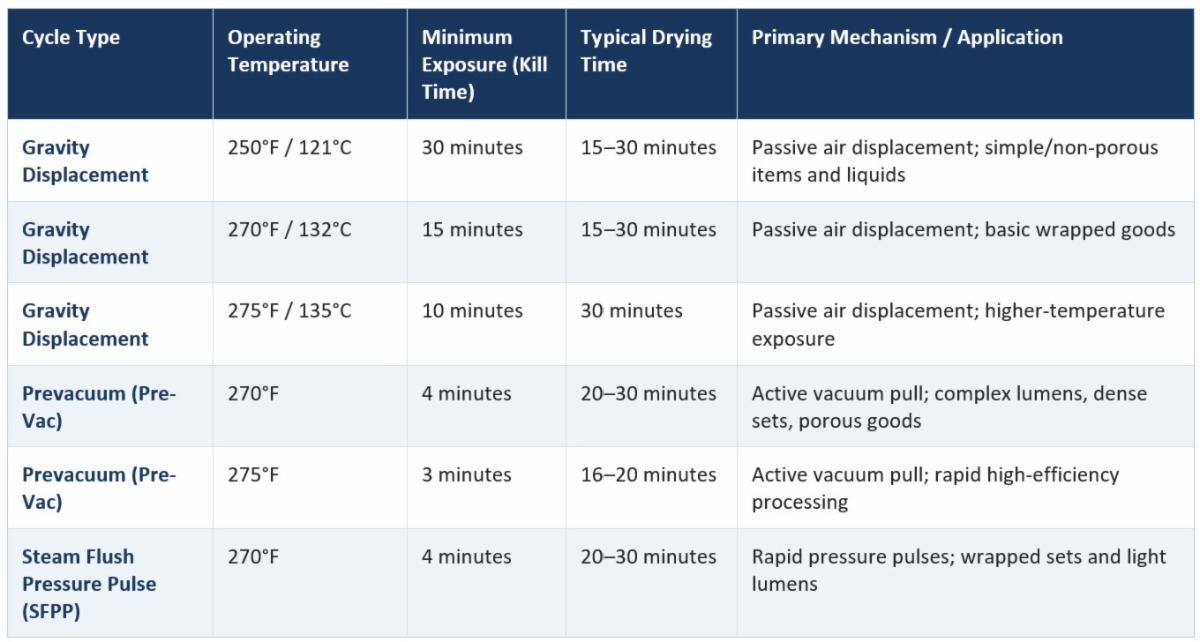
Always follow the specific medical device manufacturer’s Instructions for Use (IFU). The table below shows the standard FDA-cleared baseline exposure parameters for wrapped surgical instruments.
| | Key takeaway. A prevacuum cycle at 270°F requires only 4 minutes of exposure, while a gravity cycle at the same temperature requires 15 minutes. Because the vacuum pump removes air immediately, steam reaches the instruments almost instantly. | | 4. Requirements for Running Weekly Gravity Cycles | | In many modern SPD departments, prevacuum cycles handle daily instrument processing while gravity cycles are run weekly or occasionally for specific items such as liquids, non-porous items, or specialized tools. If your facility runs gravity cycles on a weekly schedule, ANSI/AAMI ST79 requires a strict quality control checklist. | |
4.1 Biological Indicator (BI) Testing
• What it is. A BI is a small vial containing living, highly resistant bacterial spores (Geobacillus stearothermophilus). If the sterilizer kills these extremely tough spores, you know it will kill everyday germs.
• The rule. A BI test must be run in your sterilizer at least weekly, though running it daily — and with every load containing implantable items — is best practice.
• Cycle-specific rule. Testing a prevacuum cycle with a BI does not count for your gravity cycle. If you run both cycle types, the gravity cycle must be tested separately with its own BI Process Challenge Device (PCD).
• Placement. Always place the BI PCD in the coldest, most difficult spot for steam to reach — on the bottom shelf, directly over the floor drain.
4.2 Chemical Indicators (CIs) — all cycles
• External CIs (Type 1). Exposure tape or printed indicators on the outside of wrappers change color to confirm that the package went through a heat cycle.
• Internal CIs (Type 4, 5, or 6). Placed inside every single package or rigid container. They prove that steam actually penetrated all the way to the center of the tray.
4.3 The Bowie-Dick Test Rule
| | |
Avoid this common beginner mistake: do NOT run a Bowie-Dick test in a gravity cycle.
A Bowie-Dick test is designed only to verify that a mechanical vacuum pump is working in a prevacuum sterilizer. Placed in a gravity cycle, it will fail every single time because there is no vacuum pull — producing an unnecessary false alarm.
| |
4.4 Smart Loading Habits
• Don’t crowd the chamber. Because gravity cycles rely on air sinking to the bottom, leave plenty of space between items.
• Stand peel pouches on edge. Position paper-plastic peel pouches on their side using a pouch rack so steam can enter and air can drain out easily.
• Solid items on the bottom. Place solid metal trays on lower shelves and fabric or linen items on upper shelves so condensation does not drip down and soak porous items.
|
4.5 Review the Printout
At the end of every cycle, you cannot simply open the door and push the cart to sterile storage. Check the physical cycle printout or digital log:
• Did the cycle reach the correct temperature (for example, 270°F)?
• Did it hold that temperature for the full required time (for example, 4 minutes)?
• Was the pressure steady?
Sign or initial the physical tape to verify that all parameters were met before releasing the load.
| | 5. Summary Checklist for Novice Technicians | | |
• Steam + Temperature + Pressure + Time = effective sterilization.
• Air blocks steam. If air cannot get out, steam cannot get in.
• Pre-Vac pulls air out fast — 4-minute kill time at 270°F.
• Gravity pushes air out slowly — 15-minute kill time at 270°F.
• Weekly gravity cycles: always run a separate Biological Indicator (BI) test for the gravity cycle.
• Never run a Bowie-Dick test in a gravity cycle. It may be used on a steam flush pressure pulse cycle.
• Always verify your cycle printout parameters before releasing any processed load.
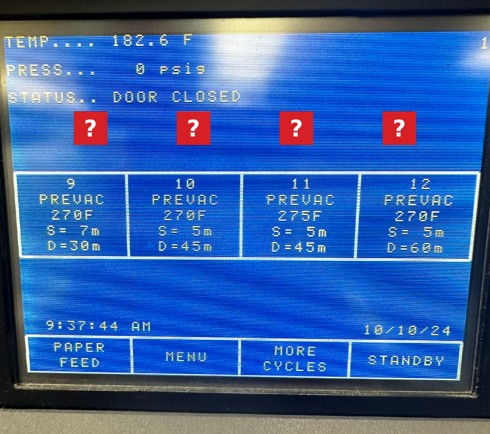
| Discussion: Read the Cycle Parameters | Figure 2. Sterilizer cycle menu showing four prevacuum cycles with differing exposure and dry times. |
Think about it: The four prevacuum cycles are set at 270°F and 275°F with exposure times of 7 and 5 minutes, and dry times ranging from 30 to 60 minutes. Do you believe every device processed in these cycles is validated by its manufacturer’s IFU for that exposure time?
Discuss with your team: how would you verify it, and what would you change if it were not?
| | Information, Articles, and Resources for You |
-
AORN - Recruit and Retain Book - Learn More
-
Beckers - Median Pay for 42 Hospital Jobs - Learn More
-
OR - Nurses Insulation Failure - Learn More
-
SAMHSA - CCBHC Response Disasters - Learn More
-
Scrub Colors and Safety Rethinking Role Identification in Critical Events - Learn More
-
Suicide ECRI Risk Assessment and Prevention in the Acute Care General Hospital Setting - Learn More
-
Suicide - SPM Ideas for Action 2026 - Learn More
-
Survey - Frequently Cited Findings 2026 - Learn More
-
Telemetry - Event Investigation - Learn More
-
IC - Why Visibly Clea Environments Can Still Create Infection Risks - Learn More
-
IC - Why is the Sterilization Equipment Market Growing? How IC, AI, and New Tech Are Driving Demand - Learn More
-
IC - Beyond the Alert - Why Sepsis Outcomes Comes Down to What Happens After Detection - Learn More
| | | | |