Sunday News
November 10, 2024
| |
|
CEO: Gayle Nash, MPH, RN
COO/CFO: Sam Sheth, PharmD, MBA
Contracts Manager: Kristin Miller, JD
| |
CEO Corner
Hi all, I hope you have had a good week. Thanks to all who provided feedback on last week's news. We had several positive comments on the updates for 2024.
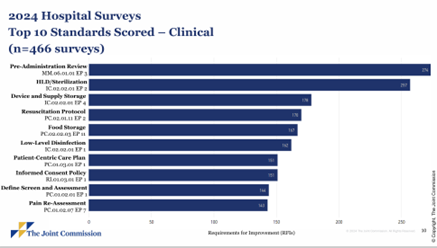
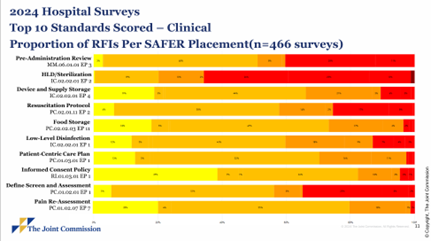
This week, we are sharing the top 10 clinical standards with working examples from each (see below).
If you recall, last week we reviewed the combined top 10 that included EOC, Life Safety, and 2 clinical standards. When our team prepares an organization for survey, we routinely include the top 10 clinical and top 10 EOC/LS elements of performance in our tracer activity as well as intersect the prior survey to prevent repeat findings.
| | |
We have also shared (below) helpful articles and publications on the following: IV fluid shortages, ATSDR social vulnerability index, current HAI progress report, NHSN guides, OR cleaning checklist, COOP CHA program, FDA food code, JC Hospital Org SAG, JC 11/24 EOC news, The Source, and more. | | |
The following are the top 10 clinical standards: | |
|
[1] Number 1 on the top 10 is at MM.06.01.01 EP 3:
“Before administration, the individual administering the medication does the following”: the medication is verified with the order, inspects for expirations or any discolorations and verifies contraindications, proper time, route, and prescribed dose.
Where this element of performance becomes difficult is the portion of the EP that requires “verification that the medication is being administered at the proper time, in the prescribed dose, and by the correct route,” EP abbreviated.
For example:
- A patient was prescribed Morphine 3 mg IVP for severe pain (7-10), but medication was administered for a pain of 5. This did not comply with the most recent order.
- After reviewing two medical records, it was noted that the medication administered did not consistently match the medication order. For example, pain medication ordered for a pain level of 4-6 was administered for an assessed pain of 8.
- One record noted that a patient was ordered PRN medication for breakthrough pain. Documentation indicated this was given at the same time as another PRN medication, and not for breakthrough pain as ordered. In addition, breakthrough pain was not defined for the time between doses and pain level.
- During an individual tracer, the nurse administering a pain medication gave one tab of Oxycodone 7.5, and Acetaminophen 325 for a pain score of 6. The dose ordered for a pain level of 6 was two tabs. The organization's policy does not allow the nurses to reduce the dose administered. (In this case, if the patient requested one tab instead of two, it must be defined in the policy and documented in the chart.)
|  | |
[2] Number 2 on the top ten clinical standards and the only one in the ITHS category is IC.02.02.01 EP 2 - now published as IC.06.01.01 EP 3.
During our tracers, we find frequent areas of opportunity at this standard and EP (the root cause having many contributing factors). For example, in the endoscopy area and sterile processing, we often find the following:
- general lack of attention to detail in these high-risk areas.
- opportunities for staff education
- problems with maintenance of sterilizers and HLD equipment
- unresolved water issues causing steam and instrument problems
- financial constraints preventing a needed purchase of new instrumentation or sterilizers
- financial constraints related to upgrading problematic endoscopes
- communication problems between departments such as the facilities team, biomedical engineering, administration and the clinical team,
Our last news blog (11/3/24), listed findings in this element of performance, and the following are a few more that resulted in an immediate threat to health and safety.
- The daily Bowie Dick testing indicated failures in the Immediate Use Steam Sterilizer (IUSS). It was documented in the paper log 20 out of 43 times. Even with the failures, the sterilizer was kept in use without notifying the vendor to repair the defect in the sterilizer.
- The IUSS was used to sterilize surgical instruments for 3 days despite having failed numerous Bowie Dick tests.
- The minimum weekly sterilizer leak test required by the MIFU for the IUSS was not being performed. When the leak test was performed during the survey, it failed due to insufficient vacuum pressure.
- The results for the daily biological indicator controls and tests were not consistently recorded as required by policy.
- Two sterilized trays were noted, with instrument paper count sheets sterilized inside the hard-sided tray.
- Instrument trays were opened for inspection. One tray had degraded plastic tape labels with an exposed adhesive, and a retractor handle was severely pitted and rusted.
| |
|
[3] Number 3 is IC.02.02.01 EP 4: This standard and EP are now combined in IC.06.01.01 EP 3: “The hospital implements activities for the surveillance, prevention, and control of health care-associated infections and other infectious diseases, including maintaining a clean and sanitary environment to avoid sources and transmission of infection, and addresses any infection control issues identified by public health authorities that could impact the hospital.” (See also NPSG.07.01.01, EP 1); CMS Medicare Standards: §482.51, §482.42, §482.42(a)(3)
Findings at this element of performance:
- Multiple instruments in steam pouches were sterilized, but the packaging had significant folds and wrinkles. The internal package was also not validated to be sterilized within another package.
- During tracer activities, in a procedural area, clean transvaginal probes that had been high-level disinfected were stored horizontally in a covered drawer.
- A blanket/fluid warmer had several bottles of solution stored at 123 degrees. The temperature log and policy indicated a maximum temperature of 104 degrees.
- Multiple sterilized instruments were stored in a sterile storage area with an air temperature of 80 degrees and humidity of 14%.
| |
|
[4] Number 4 is PC.02.01.11 EP 2: “Resuscitation equipment is available for use based on the needs of the population served.” For example, if the hospital has a pediatric population, then pediatric resuscitation equipment should be available.
The elements of performance in this standard often score in the high-risk category, particularly when issues are identified with pediatric resuscitation in an adult setting. Examples of findings at this element of performance include the following:
- During tracer activities on the Pediatric Unit, it was identified that there were multiple resuscitation references on the pediatric Broselow cart including a laminated neonatal reference card dated 2011, a Broselow Tape dated 2017, a Pediatric Guidebook dated 2013, and a Broselow laminated reference dated 2011. The staff was unclear which reference was the correct version to use for resuscitation or resuscitation training.
- During tracer activities in the PACU it was identified that two packages of EKG electrodes were open with no revised expiration date or sealed opening. The MIFU states"...fold over open end and use remaining electrodes within 30 days of opening."
- Observed in review of a crash cart log in the Emergency department the log was missing two shift check offs, (February 15 am shift and February 16 pm shift.)
- In the emergency department, the emergency pediatric airway box did not contain a Magill forceps. Per the inventory list, this item was to be part of the box.
- In the Imaging Suite, it was observed on the Pediatric Resuscitation Cart that a package of electrodes had expired.
- During the tracer visit to the dental clinic it was observed that two medications stored in the medication drawer of the emergency cart had an expiration date of July 2023. The date of this observation was July 2024.
[5] Number 5 is PC.02.02.03 EP 11: “The hospital stores food and nutrition products, including those brought in by patients or their families, using proper sanitation, temperature, light, moisture, ventilation, and security.” The findings in this standard are often what we refer to as “low-hanging fruit,” because they are often resolvable during environmental rounds having a clearly defined process for patient food storage. Food storage guidelines can be found in the FDA 2022 Food Code: Link HERE.
Observations at this element of performance:
- Multiple out of date food items were found in Food and Nutrition Services freezer.
- The walk-in refrigerators in the kitchen showed evidence of a black fungal-like substance on the ceilings. This was likely due to varying degrees in the different walk-ins.
- It was observed, on the Behavioral Health Unit, that there was no documentation that the freezer temperature was checked daily to assure that foods stored in the freezer were maintained at a proper temperature.
- There was no patient name label or expiration date on food being stored in nourishment refrigerator.
- In the emergency department, staff food was stored in a "patient food only" refrigerator.
- During tracer activities in the Emergency Department, out-of-date food that originated from the kitchen was found in the patient’s food refrigerator located in the medication room.
[6] Number 6 is IC.02.02.01 EP 1, and is now combined with IC.06.01.01 EP 3 - the low-level disinfection finding. This particular one is based on adhering to the following:
- Manufacturer’s instructions for use for the correct type of disinfection wipes.
- Disinfecting with knowledge of the correct dry time,
- Disinfecting glucose meters (three wipes horizontally and three wipes vertically), and,
- Low-level disinfecting equipment, such as, in the physical therapy department.
[7] Number 7 is PC.01.03.01 EP 1: “The hospital plans the patient’s care, treatment, and services based on needs identified by the patient’s assessment, reassessment, and results of diagnostic testing.”
This standard continues to be challenging year-after-year. It hasn't always been on the top ten list, but it's always on the problem list. Two causal factors are: 1) care plans do not address the reason the patient is in the hospital in the first place, and 2) the care plans are not tailored to each patient. Drop down menus do not solve or address unique human needs.
Observations at this element of performance:
- During the tracer activity and a review of the medical record, it was noted the plan of care did not include wound care as well as risk for falls following a below the knee amputation surgery. The hospital policy "Nursing Plan of Care" requires that all nursing care provide individualized care based on identified patient needs.
- During a record review, there was no evidence the patient's plan of care had been updated based the patient's assessed needs. This patient had issues with GERD and post-gastric bypass that were not included in the care plan.
- The nursing admission patient assessment indicated that an acceptable pain goal as voiced by the patient was 4/10. The patient's actual pain upon admission was documented at 5. There was no mention in the Nursing Care Plan of attention to the patient's pain goals and interventions to prevent pain.
- In record review, two of two inpatients admitted to the medical unit with diagnosis of end stage renal disease, GI bleed, pain and pneumonia, lacked evidence of individualized care plans based on their diagnosis. The plans of care referred to standard admitting processes such as falls, pain and skin, but neither chart addressed key diagnoses, such as GI bleed, pain or end stage renal disease.
[8] Number 8 is RI.01.03.01 EP 1. The hospital follows a written policy on informed consent that describes the following:
- The specific care, treatment, and services that require informed consent
- Circumstances that would allow for exceptions to obtaining informed consent
- The process used to obtain informed consent
- The physician or other licensed practitioner permitted to conduct the informed consent discussion in accordance with law and regulation
- How informed consent is documented in the patient record
Observations at the element of performance:
- In 1 of 3 patient records reviewed, there was no evidence of completed procedural sedation prior to the procedure as required by hospital policy.
- During tracer activity in the Pain Clinic, the record of a patient who had a Cervical Epidural Steroid Injection was reviewed. The record of care indicated that the patient's preferred language was Spanish; however, the record showed (and discussion with staff confirmed) the informed consent and discharge instructions were only provided in English.
- On the anesthesia consent form, the witness and the provider signing the consent omitted the date and time (date/time was required per policy). The Informed Consent policy states that providers are to sign, date, and provide a time.
- An OMFS consent for sedation did not have the patient or witness signature timed as required by the hospital memorandum Standard Operating Procedures, Perioperative Documentation, Appendix A.
- The consent form for a patient who underwent a vasectomy procedure in the primary care clinic was missing the witness signature, which is required by the organization’s "Informed Consent Process" dated February 2024.
[9] Number 9 is PC.01.02.01 EP 1: “The hospital defines, in writing, the scope and content of screening, assessment, and reassessment. Patient information is collected according to these requirements.”
Observations at this element of performance:
- In review of the medical record, there was no documentation evidence that the initial screening/assessment information was collected as per hospital requirements. For example, sections left blank in the required assessment /screening included preferred language, preferred method of learning, and health literacy (SILS).
- Observed in Record Review - on review of the closed record of a patient who had received Magnesium Sulfate, the hypertension disorder assessment was not completed with administration of the loading dose per the policy and procedure. The policy stated that baseline LOC, deep tendon reflexes and respiratory/breath sounds should be assessed and documented prior to the start of the medication. Documentation of the assessment was only found at completion of the loading dose.
- Regarding a patient who had received blood transfusions (on the inpatient unit), it was observed that temperature was not documented at the 15-minute reassessment period (after the initiation of the transfusion). Per the Blood Transfusion Policy, assessment of vital signs is required 15 minutes after initiation of the transfusion, and the patient should be closely monitored for a temperature increase.
- During tracer activity in PACU, a patient was discharged after 2 x 15-minute vital signs and 1 x 30-minute vital sign was recorded. The hospital policy "Post Operative Care" requires that vital signs be completed every fifteen minutes x2, thirty minutes x2 and at one-hour x1. The policy also states the patient can meet discharge criteria sooner than the completion of vitals. In this case, no additional vital signs were completed within 60 minutes of discharge.
- During a medical review for a patient on the mother baby unit, the patient had not been screened for post-partum depression using the Edinburgh tool as required by the organizational policy "Suicide Risk Assessment and Interventions.”
[10] Number 10 is PC.01.02.07 EP 7: The hospital has defined criteria to screen, assess, and reassess pain that is consistent with the patient’s age, condition, and ability to understand. Pain assessments and reassessments are classic, long-running findings that are easier for surveyors to find and score. When performing chart audits, it is important to include the nursing staff on review of the record. Each time the author of the record reviews their own record, there is an opportunity for learning.
Observations at this EP:
- During individual tracer of a patient in the labor and delivery unit there were 2 observations where the patient received a PRN pain medication; however, there was no documented pain reassessment after administration of medication as required by the organization's policy.
- The pain reassessment on a patient who received Tylenol for mild pain was performed 2 hours post administration instead of one hour as required by policy.
- The patient was medicated for moderate pain of 5 with no reassessment documented.
- During the patient record review tracer on the 2nd Floor I/P Unit at The Orthopedic Hospital, it was observed that a patient had an order for Hydrocodone 5mg-325 mg dose, po, every 4 hrs. PRN for moderate pain (4-6) score. Medication was administered on 9/22//22 at 1345 for pain, but no reassessment was documented in the record within the required time frame per the organization’s Pain Assessment and Management Policy.
- During the patient record review tracer on the 2nd Floor I/P Unit at The Orthopedic Hospital, it was observed that a patient had an order for Oxycodone 10mg dose, po, every 4 hrs. PRN for severe pain (7-10) score. Medication was administered on 9/23/22 at 1822 for pain; however, no reassessment was documented in the record within the required time frame per the organization’s Pain Assessment and Management Policy.
| |
|
Have a good rest of your week and thank you for all the feedback. We strive to provide valuable information on current, high-risk, and trending issues.
Gayle Nash
| |
|
We would love to hear from you!
We can help support your organization.
For consultations, education, and training, please contact us.
| | | | |